
 ЖИ көмекші

 Көп таңдалатын


 Ең тиімді
15 890₸ үнемдейсіз


жүктеу мүмкіндігіне ие боласыз
Бұл материал сайт қолданушысы жариялаған. Материалдың ішінде жазылған барлық ақпаратқа жауапкершілікті жариялаған қолданушы жауап береді. Ұстаз тілегі тек ақпаратты таратуға қолдау көрсетеді. Егер материал сіздің авторлық құқығыңызды бұзған болса немесе басқа да себептермен сайттан өшіру керек деп ойласаңыз осында жазыңыз
 22 Мамыр 2024
 264
264
КСП 6 сынып бойынша 4 тоқсан ағылшын тілі
Short term plan: term 4
|
Unit 8 Our neighbourhood |
Lesson 81 |
||
|
Teacher name: |
|
||
|
Date: |
|
||
|
Grade: 6 |
Number present: |
absent: |
|
|
Lesson title |
Places in a town |
||
|
Learning objectives |
6.2.5.1 understand most specific information and detail of short, supported talk on a wide range of familiar topics curricular topics. 6.1.8.1 develop intercultural awareness through reading and discussion 6.6.14.1 use prepositions to talk about time and location use prepositions like to describe things and about to denote topic use prepositions of direction to, into, out of, from, towards on a limited range of familiar general and curricular topics familiar general and curricular topics |
||
|
Lesson objectives |
Learners will be able to: • Learn vocabulary for places in a town. • Learn there is … , there are … with a, an, some and any to talk about a town. • Write sentences about a town. |
||
|
Value links |
Hospitality: Traditionally a nomadic culture, hospitality has always been an important part of Kazakh culture. |
||
|
Plan |
|||
|
Stages / Time |
Teachers’ actions |
Students’ actions |
Assessment criteria |
Resources |
|
Beginning of the lesson 5 min |
Organization moment 1.Greeting. Ask about the weather. The teacher sets the lesson objectives, letting students know what to anticipate from the lesson. Warm-up
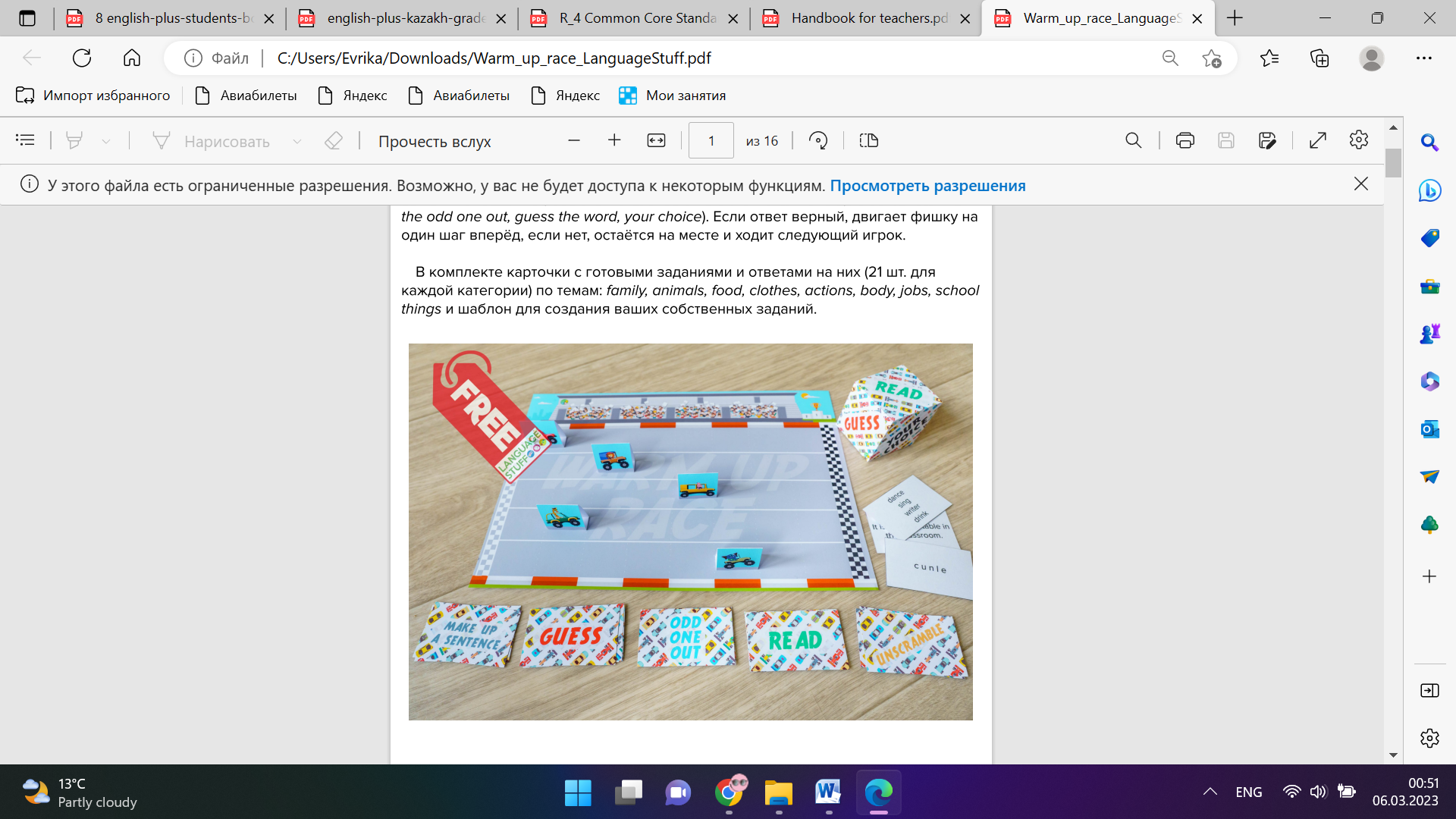
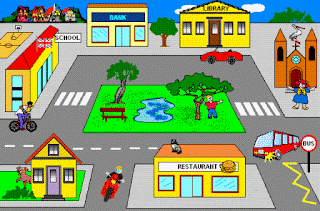
Fasten your seat belts and get ready for the all-round race Lead – In • With books closed, ask students: Do you live in a town or in the country? • Ask: What can you find in a town? Try to elicit some words for places in a town, e.g. shops, cinema |
Students' attention is drawn to the lesson. Students discuss the pictures in pairs. Determines the topic and aim of the lesson Students say different words from the picture |
Formative Assessment
Good job! Assessment criteria -Identify detailed information in extended conversation with support |
Pictures Student’s book |
|
Middle of the lesson Presentation part. 35 min |
Ex: 1 P:92 • Refer students to the picture on page 19. They match the words individually, then compare their answers in pairs. • Students listen and check their answers. • Drill the pronunciation of the words. • In a weaker class, check understanding of the words in the box and advise students to write translations of each word in their notebooks
Ex: 2 P:92 • Remind students to listen carefully for clues about where each speaker might be. • Ask students to check their answers in pairs. • If students disagree about their answers, play the CD again so that they can check. Ex: 3 P:92 • Point out the labels A–D on the map of the city. Refer students to the texts below the picture, and explain that each text describes the relevant area on the map. • Allow students time to read the texts and the options carefully, and choose option a or b Conclusion during the lesson some tasks differentiated by outcomes of the students and by their abilities. |
Students match twelve of the words in the box with places. Answers: 1 train station 2 factory 3 flats 4 park 5 shopping centre 6 offices 7 shops 8 school 9 sports centre 10 restaurant 11 river 12 car park Differentiation: «Verbal support» method is used to help Students use new words in the text. Students listen and answer the question. Where are the people in situations? Answers: 1 park 2 library 3 train station 4 restaurant 5 sports centre 6 factory 7 school 8 cinema Students work in pairs. Read the information. Answers: A a: This is a good place for the bus station. B a: This is a good place for the cinema. C a: This is a good place for the library. D b: This is a good place for the hospital. |
Descriptor: - match twelve of the words - work in pairs Total: 1 point Descriptor: -listen the task -answer the question Total: 1 point Descriptor: - gives information about himself/herself; Total: 1 point |
Cards Worksheets |
|
End of the lesson 5 min |
FEEDBACK Learners provide feedback on what they have learned at the lesson. |
|
Students evaluate each other and encourage classmate with phrases like: Well done! Brilliant! Good job! I like it! . |
Poster
|




Short term plan: term 4
|
Unit 8 Our neighbourhood |
Lesson 82 |
||
|
Teacher name: |
|
||
|
Date: |
|
||
|
Grade: 6 |
Number present: |
absent: |
|
|
Lesson title |
Reading: A description of a modern city |
||
|
Learning objectives |
6.1.1.1 use speaking and listening skills to solve problems creatively and cooperatively in groups 6.2.5.1 understand most specific information and detail of short, supported talk on a wide range of familiar topics 6.3.7.1 use appropriate subject-specific vocabulary and syntax to talk about a limited range of general topics |
||
|
Lesson objectives |
Learners will be able to: • Read about some interesting buildings. • Find spelling rules for plural nouns. • Talk about your town. |
||
|
Value links |
Tradition: Kazakh traditions and culture have been passed on from one generation to another through oral histories told by traditional Kazakh tribal leaders and elders. |
||
|
Plan |
|||
|
Stages / Time |
Teachers’ actions |
Students’ actions |
Assessment criteria |
Resources |
|
Beginning of the lesson 5 min |
Organization moment 1.Greeting. Ask about the weather. The teacher sets the lesson objectives, letting students know what to anticipate from the lesson. Warm-up
Fasten your seat belts and get ready for the all-round race < |









 Бұл курс Қазақстан Республикасы Оқу-ағарту министрлігімен келісілген










