
 ЖИ көмекші


 Қауіпсіз төлем

жүктеу мүмкіндігіне ие боласыз
Бұл материал сайт қолданушысы жариялаған. Материалдың ішінде жазылған барлық ақпаратқа жауапкершілікті жариялаған қолданушы жауап береді. Ұстаз тілегі тек ақпаратты таратуға қолдау көрсетеді. Егер материал сіздің авторлық құқығыңызды бұзған болса немесе басқа да себептермен сайттан өшіру керек деп ойласаңыз осында жазыңыз
 26 Қаңтар 2024
 258
258
1 жыл бойы шексіз жүктеңіз
Reported speech
|
Unit 4 Charities and conflict |
|
||
|
Teacher name: |
Yergesh Sandugash |
||
|
Date: |
04.12.2023 |
||
|
Grade: 9 |
Number present: |
absent: |
|
|
Lesson title |
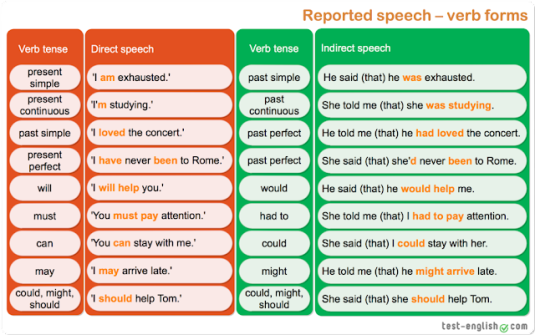
Reported speech: tense changes |
||
|
Learning objectives |
9.3.6.1 link comments with growing flexibility to what others say at sentence and discourse level in pair, group and whole class exchanges; 9.5.3.1 write with moderate grammatical accuracy on a wide range of familiar general and curricular topics 9.6.11.1 use an increased variety of reported speech forms for statements, questions and commands: including indirect and embedded questions with know, wonder on a range of familiar general and curricular topics |
||
|
Lesson objectives |
Learners will be able to: • Learn about tense changes in reported speech. • Practise transforming direct speech to reported speech. |
||
|
Value links |
Self-Discipline – If you value self-discipline, you might be a person who wakes up early, exercises daily, and doesn’t get distracted by vices. |
||
|
Plan |
|||
|
Stages / Time |
Pedagogues’ actions |
Learner’ actions |
Assessment criteria |
Resources |
|
Beginning of the lesson Warming-up 5 min |
1.Greeting. Ask about Ask about the weather. Warm-up • With books closed, ask students to think again about the text about a charity. Ask students how some of the injured soldier mentioned in the text felt about the games Lead – In
|
The wish flower” method helps to start the lesson with good wishes to each other. The aim: To develop learners speaking skills and create friendly atmosphere Efficiency: By telling the wishes they show their appreciations . Students express their ideas
Good job! |
At the organization moment pedagogue tries to award active learners. «The praise» method is used to evaluate learners with phrases like: “excellent” “well done”
|
Poster
PPT |
|
Middle of the lesson Presentation part. 35 min |
Exercise 1. Sarah says: “I love Maths very much.” Sarah says that she loves Maths very much. 2. Timur says to Sarah: “Do you like Maths?” Timur asks Sarah if she likes Maths. 3. He asks: “What is the capital of the USA?” He asks what the capital of the USA is. Exercise 1 P:47 • Write on the board: Many soldiers said they couldn’t find the motivation to take part in everyday activities. Refer students to paragraph 1 of the text on page 46 Exercise 2 P:47 Focus on the example and remind students that pronouns also often change in reported speech. • In a weaker class, get volunteers to stand up and be the characters (Jane, Pete, Pete’s friend and Liz) and the reporter. Have the reporter stand to one side of the group. Elicit how they would describe each other, e.g. Pete says Exercise 3 P:47 • In a weaker class, ask students to underline the words that will change, and talk them through if necessary. In a stronger class, refer students back to the rules, and encourage them to rewrite the sentences
|
Students find the difference between the given sentences ANSWERS: 1. Direct –Indirect 2. Direct- Indirect 3. Direct- Indirect When the reported clause/statement of a direct speech is a universal truth speech or any historical event or a habitual action (a part of the daily routine), then the tense in the indirect speech doesn’t change, no matter in whatever tense the reporting verb (say/said) is. Learners study sentences. Find these sentences in reported speech in the text. How do the verbs change? Choose the correct words in the rules. ANSWERS: Rules: 1 past simple 2 past perfect 3 past perfect 4 had to Learners read the dialogue and complete the summary with the correct pronouns. ANSWERS: 1 his 2 he 3 him 4 her 5 she 6 him 7 they 8 him Learners rewrite the sentences using reported speech. ANSWERS: 1 The man said that he didn’t feel guilty. 2 My brother said that I was making a big mistake. 3 Phil’s father said that Phil had to stay at home. 4 John said that he would keep quiet about the crime. 5 The children said that their teacher could be quite strict. 6 The teacher said that some students hadn’t done much revision. 7 His friends said that they had already seen that film. |
Assessment criteria - Learn about tense changes in reported speech. Descriptor: - Find difference between the sentence Assessment criteria - Learn about tense changes in reported speech. Descriptor: - Find reported speech in the text. Assessment criteria - Learn about tense changes in reported speech. Descriptor: - read the dialogue and complete the summary with the correct pronouns Assessment criteria: - Practise transforming direct speech to reported speech. Descriptor: - read and rewrite the sentences |
Presentation Worksheets Kazakhstan edition. Copyright Oxford University Press. English Plus. Grade 9 Student’s book By Ben Wetz and Diana Pye |
|
End of the lesson 5 min |
Giving the hometask. Ex.4 p. 47 Self-reflection |
Peer-assessment. Two stars and a wish.
Maybe you could ... |
Learners use their stickers to show their knowledge according to the lesson. |
Kazakhstan edition. Copyright Oxford University Press. English Plus. Grade 9 Student’s book By Ben Wetz and Diana Pye |



`









 Бұл курс Қазақстан Республикасы Оқу-ағарту министрлігімен келісілген










