
 ЖИ көмекші


 Қауіпсіз төлем




1 жыл бойы шексіз жүктеңіз
Баяндама:The use of “critical thinking” strategies at the English lessons

#1 слайд
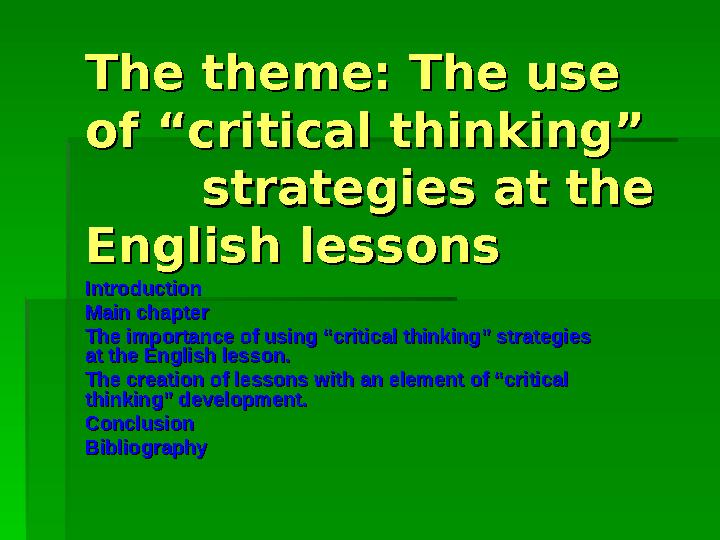
The theme: The use The theme: The use
of “critical thinking” of “critical thinking”
strategies at the strategies at the
English lessonsEnglish lessons
IntroductionIntroduction
Main chapterMain chapter
The importance of using “critical thinking” strategies The importance of using “critical thinking” strategies
at the English lesson.at the English lesson.
The creation of lessons with an element of “critical The creation of lessons with an element of “critical
thinking” development.thinking” development.
ConclusionConclusion
BibliographyBibliography
1 слайд
The theme: The use The theme: The use of “critical thinking” of “critical thinking” strategies at the strategies at the English lessonsEnglish lessons IntroductionIntroduction Main chapterMain chapter The importance of using “critical thinking” strategies The importance of using “critical thinking” strategies at the English lesson.at the English lesson. The creation of lessons with an element of “critical The creation of lessons with an element of “critical thinking” development.thinking” development. ConclusionConclusion BibliographyBibliography
#2 слайд
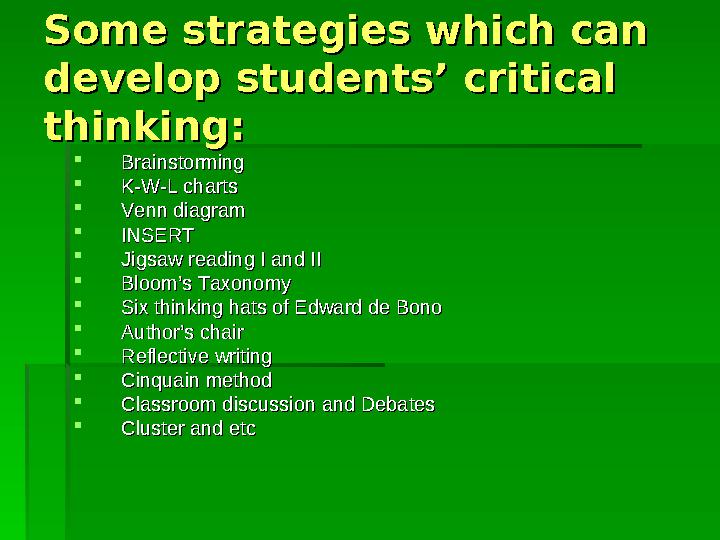
Some strategies which can Some strategies which can
develop students’ critical develop students’ critical
thinking:thinking:
BrainstormingBrainstorming
K-W-L chartsK-W-L charts
Venn diagramVenn diagram
INSERTINSERT
Jigsaw reading I and IIJigsaw reading I and II
Bloom’s TaxonomyBloom’s Taxonomy
Six thinking hats of Edward de BonoSix thinking hats of Edward de Bono
Author’s chairAuthor’s chair
Reflective writingReflective writing
Cinquain methodCinquain method
Classroom discussion and DebatesClassroom discussion and Debates
Cluster and etcCluster and etc
2 слайд
Some strategies which can Some strategies which can develop students’ critical develop students’ critical thinking:thinking: BrainstormingBrainstorming K-W-L chartsK-W-L charts Venn diagramVenn diagram INSERTINSERT Jigsaw reading I and IIJigsaw reading I and II Bloom’s TaxonomyBloom’s Taxonomy Six thinking hats of Edward de BonoSix thinking hats of Edward de Bono Author’s chairAuthor’s chair Reflective writingReflective writing Cinquain methodCinquain method Classroom discussion and DebatesClassroom discussion and Debates Cluster and etcCluster and etc
#3 слайд
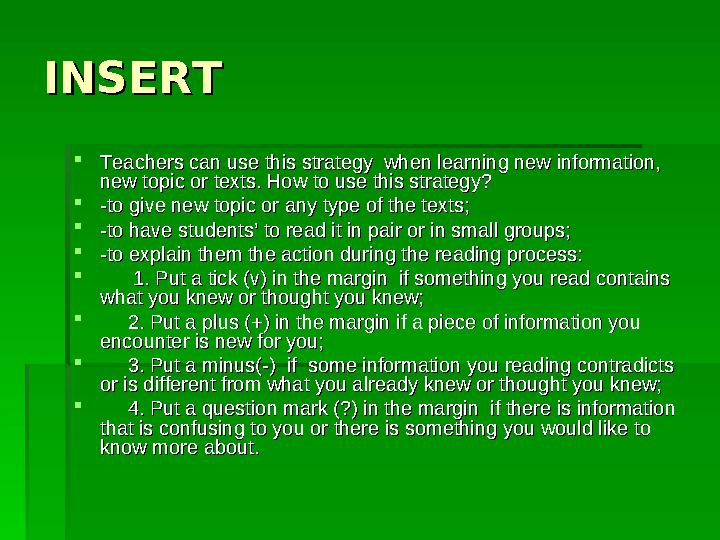
INSERTINSERT
Teachers can use this strategy when learning new information, Teachers can use this strategy when learning new information,
new topic or texts. How to use this strategy?new topic or texts. How to use this strategy?
-to give new topic or any type of the texts;-to give new topic or any type of the texts;
-to have students’ to read it in pair or in small groups;-to have students’ to read it in pair or in small groups;
-to explain them the action during the reading process:-to explain them the action during the reading process:
1. Put a tick (v) in the margin if something you read contains 1. Put a tick (v) in the margin if something you read contains
what you knew or thought you knew;what you knew or thought you knew;
2. Put a plus (+) in the margin if a piece of information you 2. Put a plus (+) in the margin if a piece of information you
encounter is new for you;encounter is new for you;
3. Put a minus(-) if some information you reading contradicts 3. Put a minus(-) if some information you reading contradicts
or is different from what you already knew or thought you knew;or is different from what you already knew or thought you knew;
4. Put a question mark (?) in the margin if there is information 4. Put a question mark (?) in the margin if there is information
that is confusing to you or there is something you would like to that is confusing to you or there is something you would like to
know more about.know more about.
3 слайд
INSERTINSERT Teachers can use this strategy when learning new information, Teachers can use this strategy when learning new information, new topic or texts. How to use this strategy?new topic or texts. How to use this strategy? -to give new topic or any type of the texts;-to give new topic or any type of the texts; -to have students’ to read it in pair or in small groups;-to have students’ to read it in pair or in small groups; -to explain them the action during the reading process:-to explain them the action during the reading process: 1. Put a tick (v) in the margin if something you read contains 1. Put a tick (v) in the margin if something you read contains what you knew or thought you knew;what you knew or thought you knew; 2. Put a plus (+) in the margin if a piece of information you 2. Put a plus (+) in the margin if a piece of information you encounter is new for you;encounter is new for you; 3. Put a minus(-) if some information you reading contradicts 3. Put a minus(-) if some information you reading contradicts or is different from what you already knew or thought you knew;or is different from what you already knew or thought you knew; 4. Put a question mark (?) in the margin if there is information 4. Put a question mark (?) in the margin if there is information that is confusing to you or there is something you would like to that is confusing to you or there is something you would like to know more about.know more about.
#4 слайд
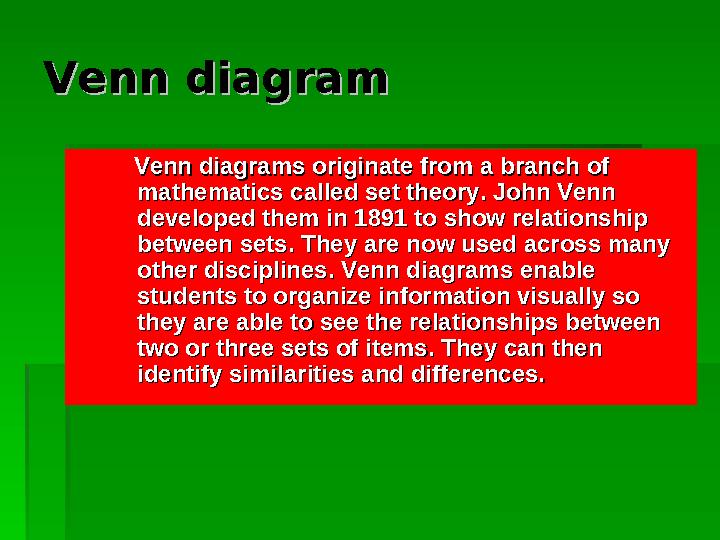
Venn diagram Venn diagram
Venn diagrams originate from a branch of Venn diagrams originate from a branch of
mathematics called set theory. John Venn mathematics called set theory. John Venn
developed them in 1891 to show relationship developed them in 1891 to show relationship
between sets. They are now used across many between sets. They are now used across many
other disciplines. Venn diagrams enable other disciplines. Venn diagrams enable
students to organize information visually so students to organize information visually so
they are able to see the relationships between they are able to see the relationships between
two or three sets of items. They can then two or three sets of items. They can then
identify similarities and differences.identify similarities and differences.
4 слайд
Venn diagram Venn diagram Venn diagrams originate from a branch of Venn diagrams originate from a branch of mathematics called set theory. John Venn mathematics called set theory. John Venn developed them in 1891 to show relationship developed them in 1891 to show relationship between sets. They are now used across many between sets. They are now used across many other disciplines. Venn diagrams enable other disciplines. Venn diagrams enable students to organize information visually so students to organize information visually so they are able to see the relationships between they are able to see the relationships between two or three sets of items. They can then two or three sets of items. They can then identify similarities and differences.identify similarities and differences.
#5 слайд
Author’s chairAuthor’s chair
This strategy provides a way for readers to share with This strategy provides a way for readers to share with
each other the excitement of a particular moment in each other the excitement of a particular moment in
relation to a book or to their own writing. Author's Chair relation to a book or to their own writing. Author's Chair
is the final step in the writing process. A special time is the final step in the writing process. A special time
and place is allotted to writers who wish to share their and place is allotted to writers who wish to share their
final products with an audience. Because the writing final products with an audience. Because the writing
has already gone through revising and editing based has already gone through revising and editing based
on constructive criticism, Author's Chair is an on constructive criticism, Author's Chair is an
opportunity for the writer to receive positive feedback opportunity for the writer to receive positive feedback
from their classmates. The student in the author's chair from their classmates. The student in the author's chair
reads aloud a selected piece of text or a piece of their reads aloud a selected piece of text or a piece of their
own writing. Peers then have an opportunity to respond own writing. Peers then have an opportunity to respond
to what is read aloud.to what is read aloud.
5 слайд
Author’s chairAuthor’s chair This strategy provides a way for readers to share with This strategy provides a way for readers to share with each other the excitement of a particular moment in each other the excitement of a particular moment in relation to a book or to their own writing. Author's Chair relation to a book or to their own writing. Author's Chair is the final step in the writing process. A special time is the final step in the writing process. A special time and place is allotted to writers who wish to share their and place is allotted to writers who wish to share their final products with an audience. Because the writing final products with an audience. Because the writing has already gone through revising and editing based has already gone through revising and editing based on constructive criticism, Author's Chair is an on constructive criticism, Author's Chair is an opportunity for the writer to receive positive feedback opportunity for the writer to receive positive feedback from their classmates. The student in the author's chair from their classmates. The student in the author's chair reads aloud a selected piece of text or a piece of their reads aloud a selected piece of text or a piece of their own writing. Peers then have an opportunity to respond own writing. Peers then have an opportunity to respond to what is read aloud.to what is read aloud.









 Бұл курс Қазақстан Республикасы Оқу-ағарту министрлігімен келісілген










