
 ЖИ көмекші


 Қауіпсіз төлем




1 жыл бойы шексіз жүктеңіз
Intonation in questions

#1 слайд
Basic intonation
patterns of English
1 слайд
Basic intonation patterns of English
#2 слайд
Tones are used in particular sequences (patterns) to express a
wide range of meanings. There are several clearly discernable
intonation patterns that are used on a regular basis in English.
They are called basic because
1 they can be contrasted to one another both in form and
meaning, i.e. the replacement of one pattern by another causes a
change in the meaning of an utterance;
2 they are typical, i.e. they are pronounced and used in much
the same way by all the educated English-speaking people;
3 they refer to an independent utterance, i.e. correspond to one
intonation group.
2 слайд
Tones are used in particular sequences (patterns) to express a wide range of meanings. There are several clearly discernable intonation patterns that are used on a regular basis in English. They are called basic because 1 they can be contrasted to one another both in form and meaning, i.e. the replacement of one pattern by another causes a change in the meaning of an utterance; 2 they are typical, i.e. they are pronounced and used in much the same way by all the educated English-speaking people; 3 they refer to an independent utterance, i.e. correspond to one intonation group.
#3 слайд
Basic intonation patterns (BIP) of English are traditionally
presented as pitch patterns, pitch being regarded as a decisive
component in the description of intonation. According to the
directional type of nuclear pitch change BIPs are divided into 4
main groups, the Falling tone pattern , the Rising tone pattern ,
the Falling-Rising tone pattern , and the Rising-Falling tone
pattern. Each patterns in its turn includes several contours. For
example, the Falling pattern is further subdivided into
1 the High (Stepping) head + Mid Wide Fall contour;
2 the High (Stepping) head + High Wide Fall contour;
3 the Low Head + Low Narrow Fall;
4 the Sliding head + Mid Wide Fall contour, etc.
3 слайд
Basic intonation patterns (BIP) of English are traditionally presented as pitch patterns, pitch being regarded as a decisive component in the description of intonation. According to the directional type of nuclear pitch change BIPs are divided into 4 main groups, the Falling tone pattern , the Rising tone pattern , the Falling-Rising tone pattern , and the Rising-Falling tone pattern. Each patterns in its turn includes several contours. For example, the Falling pattern is further subdivided into 1 the High (Stepping) head + Mid Wide Fall contour; 2 the High (Stepping) head + High Wide Fall contour; 3 the Low Head + Low Narrow Fall; 4 the Sliding head + Mid Wide Fall contour, etc.
#4 слайд
The Rising Tone Pattern
4 слайд
The Rising Tone Pattern
#5 слайд
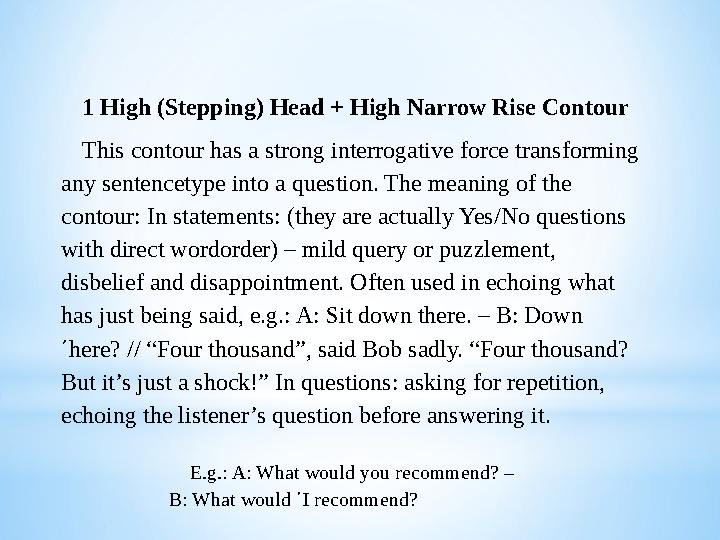
1 High (Stepping) Head + High Narrow Rise Contour
This contour has a strong interrogative force transforming
any sentencetype into a question. The meaning of the
contour: In statements: (they are actually Yes/No questions
with direct wordorder) – mild query or puzzlement,
disbelief and disappointment. Often used in echoing what
has just being said, e.g.: A: Sit down there. – B: Down
΄ here? // “Four thousand”, said Bob sadly. “Four thousand?
But it’s just a shock!” In questions: asking for repetition,
echoing the listener’s question before answering it.
E.g.: A: What would you recommend? –
B: What would ΄ I recommend?
5 слайд
1 High (Stepping) Head + High Narrow Rise Contour This contour has a strong interrogative force transforming any sentencetype into a question. The meaning of the contour: In statements: (they are actually Yes/No questions with direct wordorder) – mild query or puzzlement, disbelief and disappointment. Often used in echoing what has just being said, e.g.: A: Sit down there. – B: Down ΄ here? // “Four thousand”, said Bob sadly. “Four thousand? But it’s just a shock!” In questions: asking for repetition, echoing the listener’s question before answering it. E.g.: A: What would you recommend? – B: What would ΄ I recommend?
#6 слайд
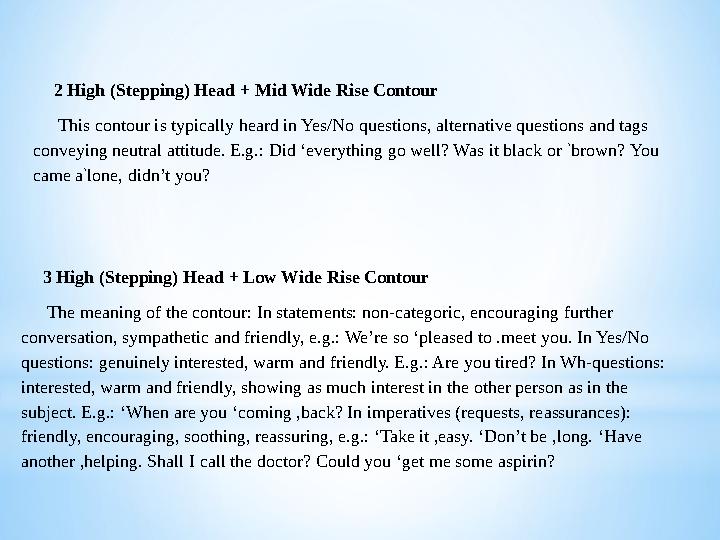
2 High (Stepping) Head + Mid Wide Rise Contour
This contour is typically heard in Yes/No questions, alternative questions and tags
conveying neutral attitude. E.g.: Did ‘everything go well? Was it black or ‵ brown? You
came a ‵ lone, didn’t you?
3 High (Stepping) Head + Low Wide Rise Contour
The meaning of the contour: In statements: non-categoric, encouraging further
conversation, sympathetic and friendly, e.g.: We’re so ‘pleased to .meet you. In Yes/No
questions: genuinely interested, warm and friendly. E.g.: Are you tired? In Wh-questions:
interested, warm and friendly, showing as much interest in the other person as in the
subject. E.g.: ‘When are you ‘coming ,back? In imperatives (requests, reassurances):
friendly, encouraging, soothing, reassuring, e.g.: ‘Take it ,easy. ‘Don’t be ,long. ‘Have
another ,helping. Shall I call the doctor? Could you ‘get me some aspirin?
6 слайд
2 High (Stepping) Head + Mid Wide Rise Contour This contour is typically heard in Yes/No questions, alternative questions and tags conveying neutral attitude. E.g.: Did ‘everything go well? Was it black or ‵ brown? You came a ‵ lone, didn’t you? 3 High (Stepping) Head + Low Wide Rise Contour The meaning of the contour: In statements: non-categoric, encouraging further conversation, sympathetic and friendly, e.g.: We’re so ‘pleased to .meet you. In Yes/No questions: genuinely interested, warm and friendly. E.g.: Are you tired? In Wh-questions: interested, warm and friendly, showing as much interest in the other person as in the subject. E.g.: ‘When are you ‘coming ,back? In imperatives (requests, reassurances): friendly, encouraging, soothing, reassuring, e.g.: ‘Take it ,easy. ‘Don’t be ,long. ‘Have another ,helping. Shall I call the doctor? Could you ‘get me some aspirin?
#7 слайд
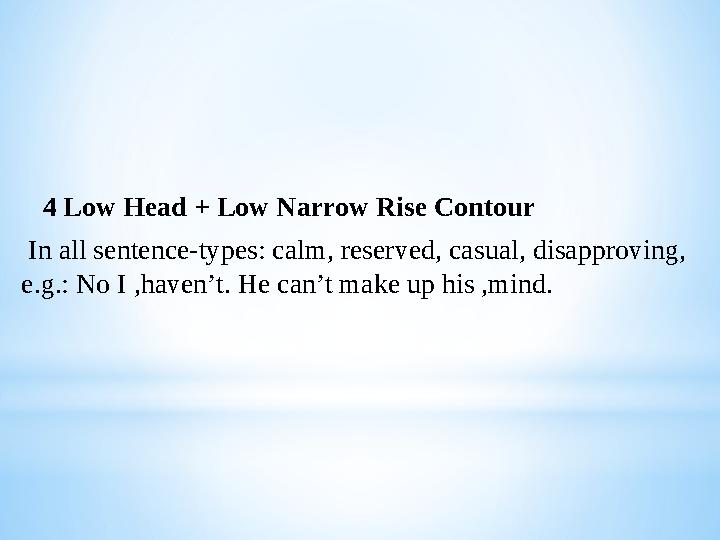
4 Low Head + Low Narrow Rise Contour
In all sentence-types: calm, reserved, casual, disapproving,
e.g.: No I ,haven’t. He can’t make up his ,mind.
7 слайд
4 Low Head + Low Narrow Rise Contour In all sentence-types: calm, reserved, casual, disapproving, e.g.: No I ,haven’t. He can’t make up his ,mind.
#8 слайд
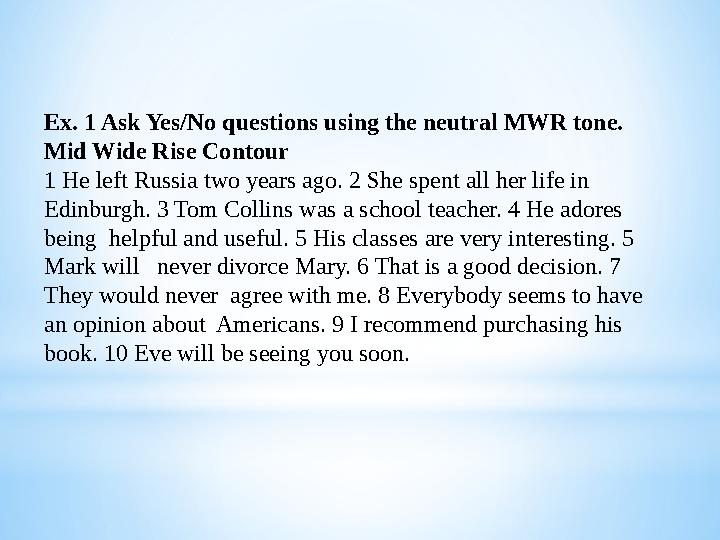
Ex. 1 Ask Yes/No questions using the neutral MWR tone.
Mid Wide Rise Contour
1 He left Russia two years ago. 2 She spent all her life in
Edinburgh. 3 Tom Collins was a school teacher. 4 He adores
being helpful and useful. 5 His classes are very interesting. 5
Mark will never divorce Mary. 6 That is a good decision. 7
They would never agree with me. 8 Everybody seems to have
an opinion about Americans. 9 I recommend purchasing his
book. 10 Eve will be seeing you soon.
8 слайд
Ex. 1 Ask Yes/No questions using the neutral MWR tone. Mid Wide Rise Contour 1 He left Russia two years ago. 2 She spent all her life in Edinburgh. 3 Tom Collins was a school teacher. 4 He adores being helpful and useful. 5 His classes are very interesting. 5 Mark will never divorce Mary. 6 That is a good decision. 7 They would never agree with me. 8 Everybody seems to have an opinion about Americans. 9 I recommend purchasing his book. 10 Eve will be seeing you soon.
#9 слайд
Ex. 2 Ask a Yes/No question, follow the model.
Sound warm,
interested (LWR):Low Wide Rise Contour
Model: A: I went home early yesterday. (feel sick) – B:
Did you
feel sick?
1 A: Mary bought a new house. (big) – B: … . 2 A: We’re
leaving on Monday. (holiday) – B: … . 3 A: Joe’s finished
reading “Gone with the Wind”. (like) – B: … . 4 A: Sue
and Mike are a beautiful couple. (marry) – B: … . 5 A:
My cat is three years old. (catch mice) – B: … . 6 А: My
mother has never left Belarus. (travel) – B: … . 7 A: We
study a lot. – (have a rest) – B: … . 8 A: He’s going to
see his parents in Vladivostok. (fly) – B: … . 9 A: Neil’s
planning to go to the university. (pass his exam) – B: ... .
10 A: We went to the circus yesterday. (enjoy) – B: … .
9 слайд
Ex. 2 Ask a Yes/No question, follow the model. Sound warm, interested (LWR):Low Wide Rise Contour Model: A: I went home early yesterday. (feel sick) – B: Did you feel sick? 1 A: Mary bought a new house. (big) – B: … . 2 A: We’re leaving on Monday. (holiday) – B: … . 3 A: Joe’s finished reading “Gone with the Wind”. (like) – B: … . 4 A: Sue and Mike are a beautiful couple. (marry) – B: … . 5 A: My cat is three years old. (catch mice) – B: … . 6 А: My mother has never left Belarus. (travel) – B: … . 7 A: We study a lot. – (have a rest) – B: … . 8 A: He’s going to see his parents in Vladivostok. (fly) – B: … . 9 A: Neil’s planning to go to the university. (pass his exam) – B: ... . 10 A: We went to the circus yesterday. (enjoy) – B: … .
#10 слайд
Ex. 3 Read Wh-questions with LWR.
Make sure you sound interested,
friendly. 1 A: Let’s meet next week. – B:
When exactly do you suggest we meet? 2
A: I have to write a course paper. – B:
What are you going to work at? 3 A: My
sister has three children. – B: How old are
they? 4 A: I need a new skirt. – B: What’s
your size? 5 A: Let’s go to the cinema. – B:
Nice idea. What film would you prefer? 6
A: Here’s my wife Joan. – B: Oh, when did
you get married? 7 A: I had to borrow
money from Mike. – B: Why didn’t you say
that earlier? 8 A: I feel unwell. – B: Why
aren’t you in bed? 9 A: I’d like something
typically English. – B: What about
roastbeef and Yorkshire pudding?
10 слайд
Ex. 3 Read Wh-questions with LWR. Make sure you sound interested, friendly. 1 A: Let’s meet next week. – B: When exactly do you suggest we meet? 2 A: I have to write a course paper. – B: What are you going to work at? 3 A: My sister has three children. – B: How old are they? 4 A: I need a new skirt. – B: What’s your size? 5 A: Let’s go to the cinema. – B: Nice idea. What film would you prefer? 6 A: Here’s my wife Joan. – B: Oh, when did you get married? 7 A: I had to borrow money from Mike. – B: Why didn’t you say that earlier? 8 A: I feel unwell. – B: Why aren’t you in bed? 9 A: I’d like something typically English. – B: What about roastbeef and Yorkshire pudding?
#11 слайд
Ex. 4 Read the dialogues below and respond with surprise using
the question words below as prompts. Who? How many? How far?
How? What? What? What? Who? Example: A: Nick Updike lives in
a caravan on a river bank. – B: ΄Where … (does he live)?
1 A: He lives there with his elderly aunt. – B: Who …. 2 A: He’s
also got four dogs there with him. – B: How many … . 3 A: He lives
ten miles away from the nearest village. – B: How far away … . 4
A: He travels everywhere in a vintage Rolls Royce. – B: … . 5 A:
He always wears shorts and sandals, and a hat. – B: … . 6 A: In his
spare time he plays the trumpet. – B: … . 7 A: And as a hobby, he
collects animals’ teeth. B: … . 8 A: He will never agree to move to a
different place. – B: … .
11 слайд
Ex. 4 Read the dialogues below and respond with surprise using the question words below as prompts. Who? How many? How far? How? What? What? What? Who? Example: A: Nick Updike lives in a caravan on a river bank. – B: ΄Where … (does he live)? 1 A: He lives there with his elderly aunt. – B: Who …. 2 A: He’s also got four dogs there with him. – B: How many … . 3 A: He lives ten miles away from the nearest village. – B: How far away … . 4 A: He travels everywhere in a vintage Rolls Royce. – B: … . 5 A: He always wears shorts and sandals, and a hat. – B: … . 6 A: In his spare time he plays the trumpet. – B: … . 7 A: And as a hobby, he collects animals’ teeth. B: … . 8 A: He will never agree to move to a different place. – B: … .

#12 слайд
Home task:
Read the all new informations which you write on your copybook
12 слайд
Home task: Read the all new informations which you write on your copybook









 Бұл курс Қазақстан Республикасы Оқу-ағарту министрлігімен келісілген










