
 ЖИ көмекші


 Қауіпсіз төлем




1 жыл бойы шексіз жүктеңіз
Презентация "Abai (Ibrahim) Qunanbaiuly "

#1 слайд
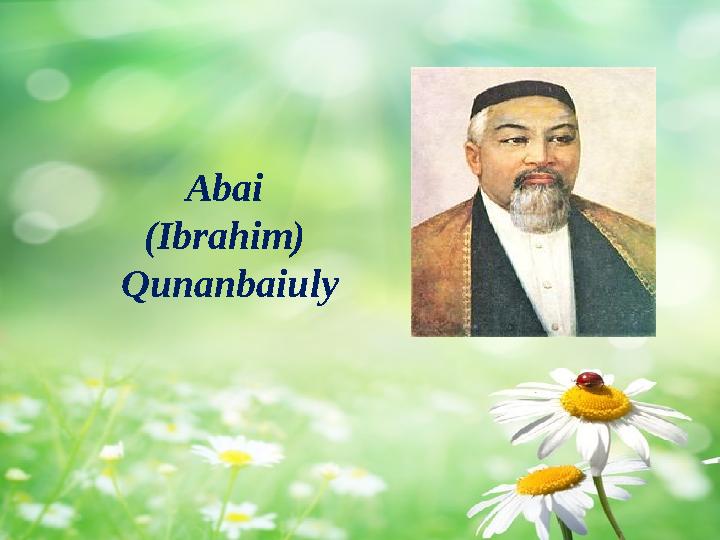
Abai
(Ibrahim)
Qunanbaiuly
1 слайд
Abai (Ibrahim) Qunanbaiuly
#2 слайд
Abay was born in what is today the selo of Karauyl, in
Abay District, East Kazakhstan Region; the son of Qunanbay
and Uljan, Qunanbay's second wife, they named him Ibrahim,
but because of his brightness, he soon was given the nickname
"Abay" (meaning "careful"), a name that stuck for the rest of
his life. His father's economic status enabled the boy to attend
a Russian school in his youth, but only after he had already
spent some years studying at a madrasah under Mullah Ahmet
Ryza.
[citation needed]
At his school in Semipalatinsk, Abay
encountered the writings of Mikhail Lermontov and
Alexander Pushkin.
2 слайд
Abay was born in what is today the selo of Karauyl, in Abay District, East Kazakhstan Region; the son of Qunanbay and Uljan, Qunanbay's second wife, they named him Ibrahim, but because of his brightness, he soon was given the nickname "Abay" (meaning "careful"), a name that stuck for the rest of his life. His father's economic status enabled the boy to attend a Russian school in his youth, but only after he had already spent some years studying at a madrasah under Mullah Ahmet Ryza. [citation needed] At his school in Semipalatinsk, Abay encountered the writings of Mikhail Lermontov and Alexander Pushkin.
#3 слайд
Abay's main contribution to Kazakh culture and folklore lies
in his poetry, which expresses great nationalism and grew out
of Kazakh folk culture. Before him, most Kazakh poetry was
oral, echoing the nomadic habits of the people of the Kazakh
steppes. During Abay's lifetime, however, a number of
important socio-political and socio-economic changes
occurred. Russian influence continued to grow in Kazakhstan
, resulting in greater educational possibilities as well as
exposure to a number of different philosophies, whether
Russian, Western or Asian. Abay Qunanbayuli steeped
himself in the cultural and philosophical history of these
newly opened geographies. In this sense, Abay's creative
poetry affected the philosophical thinking of educated
Kazakhs.
3 слайд
Abay's main contribution to Kazakh culture and folklore lies in his poetry, which expresses great nationalism and grew out of Kazakh folk culture. Before him, most Kazakh poetry was oral, echoing the nomadic habits of the people of the Kazakh steppes. During Abay's lifetime, however, a number of important socio-political and socio-economic changes occurred. Russian influence continued to grow in Kazakhstan , resulting in greater educational possibilities as well as exposure to a number of different philosophies, whether Russian, Western or Asian. Abay Qunanbayuli steeped himself in the cultural and philosophical history of these newly opened geographies. In this sense, Abay's creative poetry affected the philosophical thinking of educated Kazakhs.
#4 слайд
The leaders of the Alash Orda movement saw him as their inspiration
and spiritual predecessor.
Contemporary Kazakh images of Abay generally depict him in full
traditional dress holding a dombra (the Kazakh national instrument).
Today, Kazakhs revere Abay as one of the first folk heroes to enter into
the national consciousness of his people. Almaty State University is
named after Abay, so is one of the main avenues in the city of Almaty.
There are also public schools with his name.
The Kazakh city of Abay is named after him.
Among Abay's students was his nephew, a historian, philosopher, and
poet Shakarim Qudayberdiuli (1858–1931).
Statues of him have been erected in many cities of Kazakhstan, as well
as in Moscow.
A film on the life of Abay was made by Kazakhfilm in 1995, titled Abai.
He is also the subject of two novels and an opera by Mukhtar Auezov,
another Kazakhstani writer.
Another film describing his father's life was made in December 2015,
titled "Qunanbai".
4 слайд
The leaders of the Alash Orda movement saw him as their inspiration and spiritual predecessor. Contemporary Kazakh images of Abay generally depict him in full traditional dress holding a dombra (the Kazakh national instrument). Today, Kazakhs revere Abay as one of the first folk heroes to enter into the national consciousness of his people. Almaty State University is named after Abay, so is one of the main avenues in the city of Almaty. There are also public schools with his name. The Kazakh city of Abay is named after him. Among Abay's students was his nephew, a historian, philosopher, and poet Shakarim Qudayberdiuli (1858–1931). Statues of him have been erected in many cities of Kazakhstan, as well as in Moscow. A film on the life of Abay was made by Kazakhfilm in 1995, titled Abai. He is also the subject of two novels and an opera by Mukhtar Auezov, another Kazakhstani writer. Another film describing his father's life was made in December 2015, titled "Qunanbai".
#5 слайд
Abay also translated into Kazakh the works of Russian and
European authors, mostly for the first time. Translations
made by him include poems by Mikhail Lermontov,
Johann Wolfgang von Goethe, Lord Byron, Ivan Krylov
's Fables and Alexander Pushkin's Eugene Onegin.
Abay's major work is The Book of Words («қара
сөздері», Qara sózderi), a philosophic treatise and collection
of poems where he encourages his fellow Kazakhs to
embrace education, literacy, and good moral character in
order to escape poverty, enslavement and corruption. In
Word Twenty Five, he discusses the importance of Russian
culture, as a way for Kazakhs to be exposed to the world's
cultural treasures.
5 слайд
Abay also translated into Kazakh the works of Russian and European authors, mostly for the first time. Translations made by him include poems by Mikhail Lermontov, Johann Wolfgang von Goethe, Lord Byron, Ivan Krylov 's Fables and Alexander Pushkin's Eugene Onegin. Abay's major work is The Book of Words («қара сөздері», Qara sózderi), a philosophic treatise and collection of poems where he encourages his fellow Kazakhs to embrace education, literacy, and good moral character in order to escape poverty, enslavement and corruption. In Word Twenty Five, he discusses the importance of Russian culture, as a way for Kazakhs to be exposed to the world's cultural treasures.
#6 слайд
On May 9, 2012, following two days of protests in Moscow
following Vladimir Putin's inauguration as President of the
Russian Federation for the third term, protesters set up camp
near the monument to Abai Qunanbaiuli on the
Chistoprudny Boulevard in central Moscow, close to the
embassy of Kazakhstan. The statue quickly became a
reference point for the protest's participants.
[1]
OccupyAbai
was among the top ranking hash-tags in Twitter for several
days thanks to Russian opposition leader Alexey Navalny
who set up a meeting with his followers next to Abai
Qunanbaiuly's monument in Moscow that he called "a
monument to some unknown Kazakh". This spurred a wave
of indignation among ethnic Kazakhs who highly esteem
Abai. This also brought Abai's poetry into the top 10
AppStore downloads.
[2]
6 слайд
On May 9, 2012, following two days of protests in Moscow following Vladimir Putin's inauguration as President of the Russian Federation for the third term, protesters set up camp near the monument to Abai Qunanbaiuli on the Chistoprudny Boulevard in central Moscow, close to the embassy of Kazakhstan. The statue quickly became a reference point for the protest's participants. [1] OccupyAbai was among the top ranking hash-tags in Twitter for several days thanks to Russian opposition leader Alexey Navalny who set up a meeting with his followers next to Abai Qunanbaiuly's monument in Moscow that he called "a monument to some unknown Kazakh". This spurred a wave of indignation among ethnic Kazakhs who highly esteem Abai. This also brought Abai's poetry into the top 10 AppStore downloads. [2]









 Бұл курс Қазақстан Республикасы Оқу-ағарту министрлігімен келісілген










