
 ЖИ көмекші





Сабақ презентациясы Булану

 Жүктеу
#1 слайд
A topic "Evaporation"
•The purpose of the lesson: is to define the
phenomenon of evaporation. To study the
reasons for which the rate of evaporation
depends.
1 слайд
A topic "Evaporation" •The purpose of the lesson: is to define the phenomenon of evaporation. To study the reasons for which the rate of evaporation depends.
#2 слайд
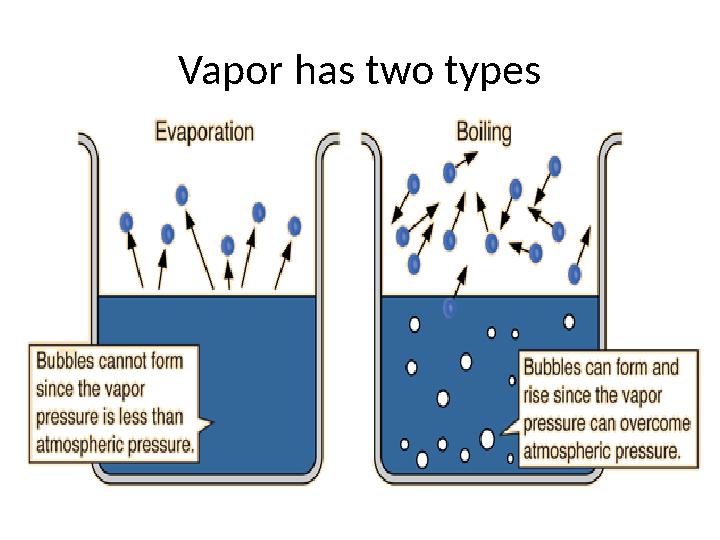
Vapor has two types
2 слайд
Vapor has two types
#3 слайд
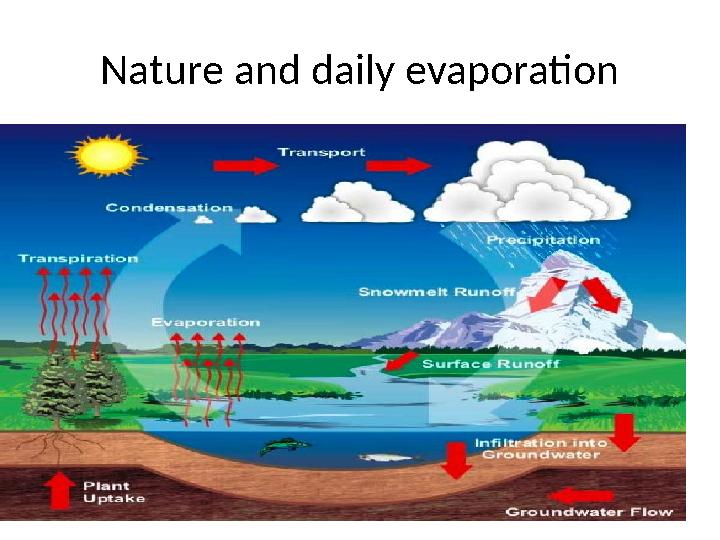
Nature and daily evaporation
3 слайд
Nature and daily evaporation
#4 слайд
4 слайд
#5 слайд
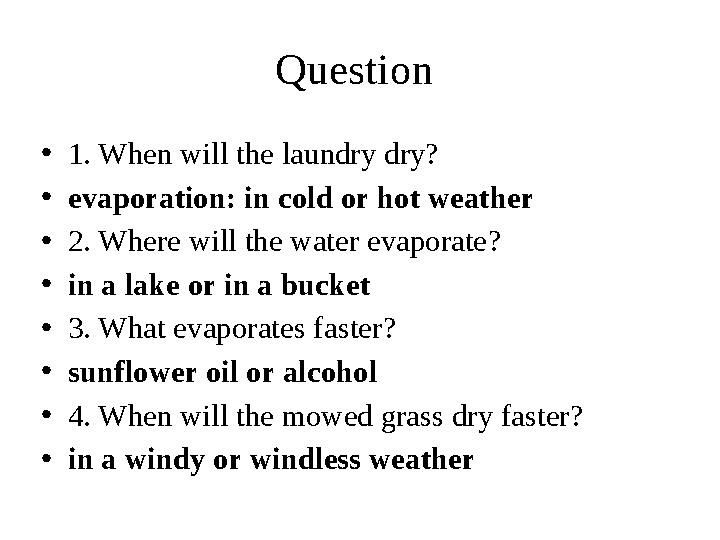
Question
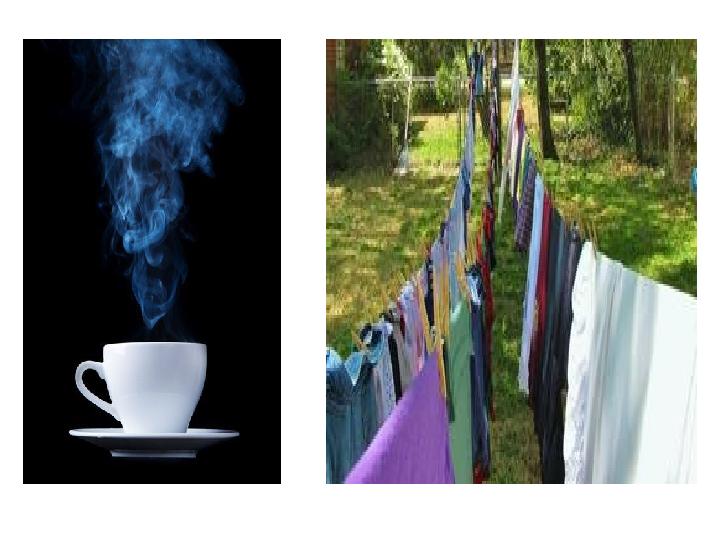
•1. When will the laundry dry?
•evaporation: in cold or hot weather
•2. Where will the water evaporate?
•in a lake or in a bucket
•3. What evaporates faster?
•sunflower oil or alcohol
•4. When will the mowed grass dry faster?
•in a windy or windless weather
5 слайд
Question •1. When will the laundry dry? •evaporation: in cold or hot weather •2. Where will the water evaporate? •in a lake or in a bucket •3. What evaporates faster? •sunflower oil or alcohol •4. When will the mowed grass dry faster? •in a windy or windless weather
#6 слайд
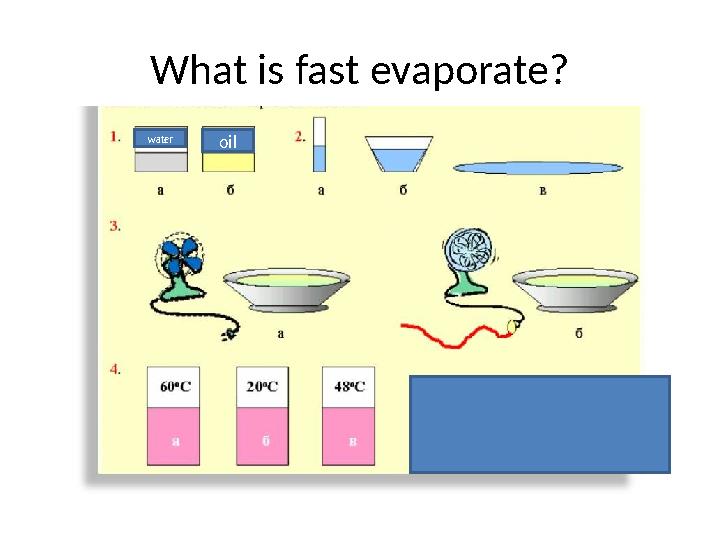
What is fast evaporate?
water
oil
6 слайд
What is fast evaporate? water oil
#7 слайд
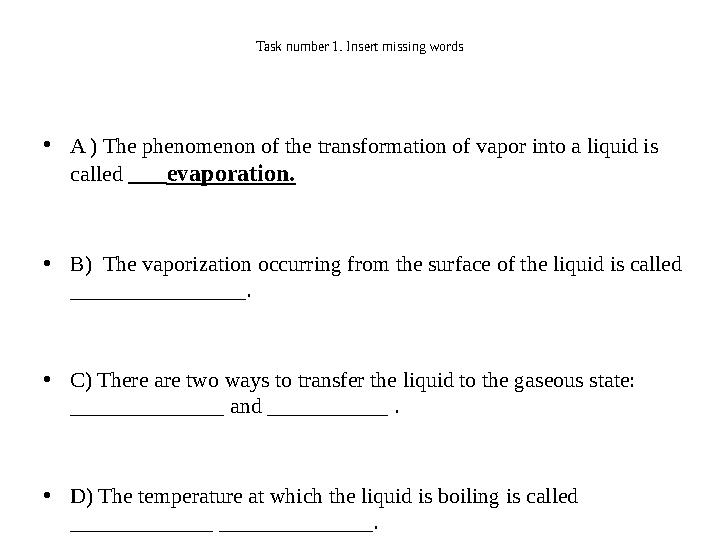
Task number 1. Insert missing words
•A ) The phenomenon of the transformation of vapor into a liquid is
called evaporation.
•B) The vaporization occurring from the surface of the liquid is called
________________.
•C) There are two ways to transfer the liquid to the gaseous state:
______________ and ___________ .
•D) The temperature at which the liquid is boiling is called
_____________ ______________.
7 слайд
Task number 1. Insert missing words •A ) The phenomenon of the transformation of vapor into a liquid is called evaporation. •B) The vaporization occurring from the surface of the liquid is called ________________. •C) There are two ways to transfer the liquid to the gaseous state: ______________ and ___________ . •D) The temperature at which the liquid is boiling is called _____________ ______________.
#8 слайд
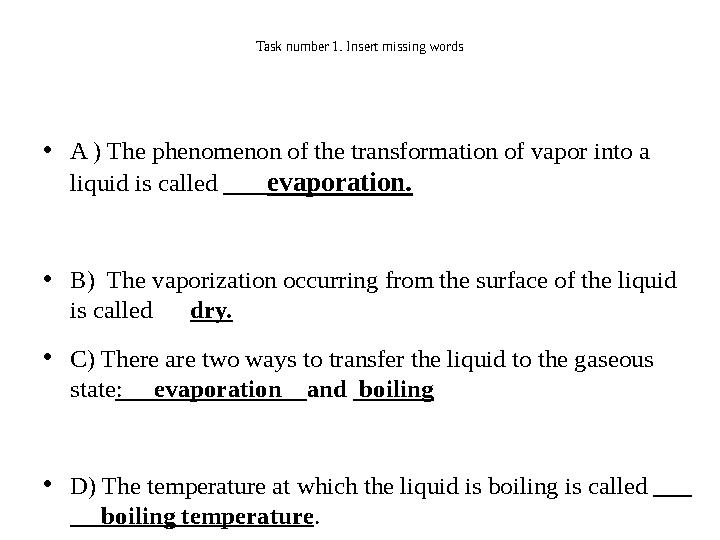
Task number 1. Insert missing words
•A ) The phenomenon of the transformation of vapor into a
liquid is called evaporation.
•B) The vaporization occurring from the surface of the liquid
is called dry.
•C) There are two ways to transfer the liquid to the gaseous
state: evaporation and boiling
•D) The temperature at which the liquid is boiling is called
boiling temperature.
8 слайд
Task number 1. Insert missing words •A ) The phenomenon of the transformation of vapor into a liquid is called evaporation. •B) The vaporization occurring from the surface of the liquid is called dry. •C) There are two ways to transfer the liquid to the gaseous state: evaporation and boiling •D) The temperature at which the liquid is boiling is called boiling temperature.
![Task number 2. Using the book, fill out the table Specific heat of ice, with answer 1 The melting point of ice, t [o C]0 degree](https://api.ust.kz/storage/files/materials/pptx/image/2018/november/d10/1541847098-9.jpeg "Task number 2. Using the book, fill out the table Specific heat of ice, with answer 1 The melting point of ice, t [o C]0 degree")
#9 слайд
Task number 2. Using the book, fill out the
table
Specific heat of ice, with answer
1
The melting point of ice, t [o C]0 degrees Celsius
2
Specific heat of water, with
3
Specific heat of melting of ice, λ
4
Specific heat of evaporation of
water, L
5
The boiling point of water, t [o C]
9 слайд
Task number 2. Using the book, fill out the table Specific heat of ice, with answer 1 The melting point of ice, t [o C]0 degrees Celsius 2 Specific heat of water, with 3 Specific heat of melting of ice, λ 4 Specific heat of evaporation of water, L 5 The boiling point of water, t [o C]
![Task number 2. Using the book, fill out the table Specific heat of ice, with answer 1 The melting point of ice, t [o C]0 degree](https://api.ust.kz/storage/files/materials/pptx/image/2018/november/d10/1541847098-10.jpeg "Task number 2. Using the book, fill out the table Specific heat of ice, with answer 1 The melting point of ice, t [o C]0 degree")
#10 слайд
Task number 2. Using the book, fill
out the table
Specific heat of ice, with answer
1
The melting point of ice, t [o C]0 degrees Celsius
2
Specific heat of water, with 18 degrees Celsius
3
Specific heat of melting of ice, λ 3.4*10^5 J/kg
4
Specific heat of evaporation of
water, L
2.3*10^6 J/kg
5
The boiling point of water, t [o C]100 degrees Celsius
10 слайд
Task number 2. Using the book, fill out the table Specific heat of ice, with answer 1 The melting point of ice, t [o C]0 degrees Celsius 2 Specific heat of water, with 18 degrees Celsius 3 Specific heat of melting of ice, λ 3.4*10^5 J/kg 4 Specific heat of evaporation of water, L 2.3*10^6 J/kg 5 The boiling point of water, t [o C]100 degrees Celsius
#11 слайд
Task number 3 .The rate of evaporation depends on:
Kind of fluid
11 слайд
Task number 3 .The rate of evaporation depends on: Kind of fluid
#12 слайд
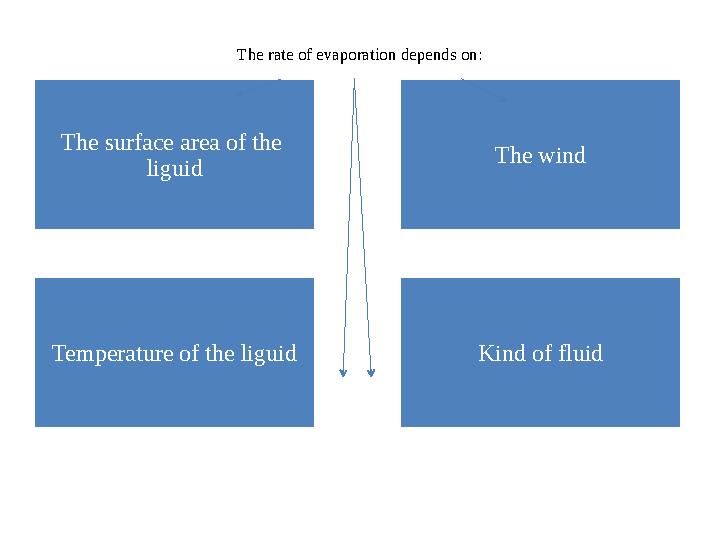
The rate of evaporation depends on:
The surface area of the
liguid
The wind
Temperature of the liguid Kind of fluid
12 слайд
The rate of evaporation depends on: The surface area of the liguid The wind Temperature of the liguid Kind of fluid
#13 слайд
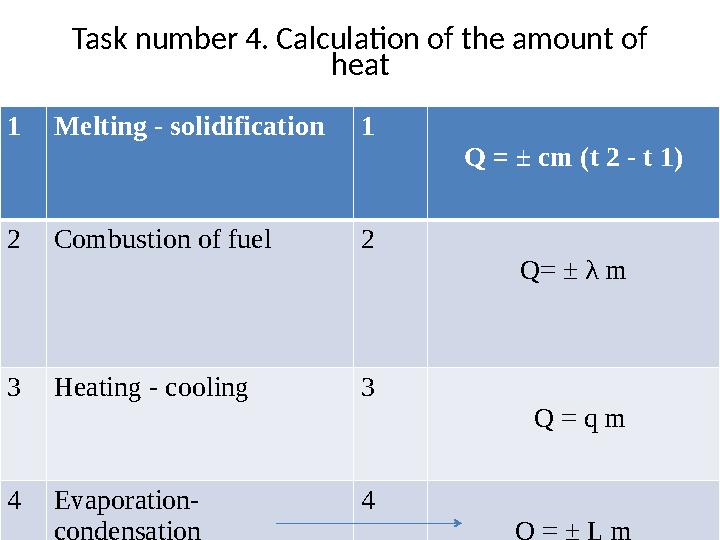
Task number 4. Calculation of the amount of
heat
1Melting - solidification1
Q = ± cm (t 2 - t 1)
2Combustion of fuel 2
Q= ± λ m
3Heating - cooling 3
Q = q m
4Evaporation-
condensation
4
Q = ± L m
13 слайд
Task number 4. Calculation of the amount of heat 1Melting - solidification1 Q = ± cm (t 2 - t 1) 2Combustion of fuel 2 Q= ± λ m 3Heating - cooling 3 Q = q m 4Evaporation- condensation 4 Q = ± L m
#14 слайд
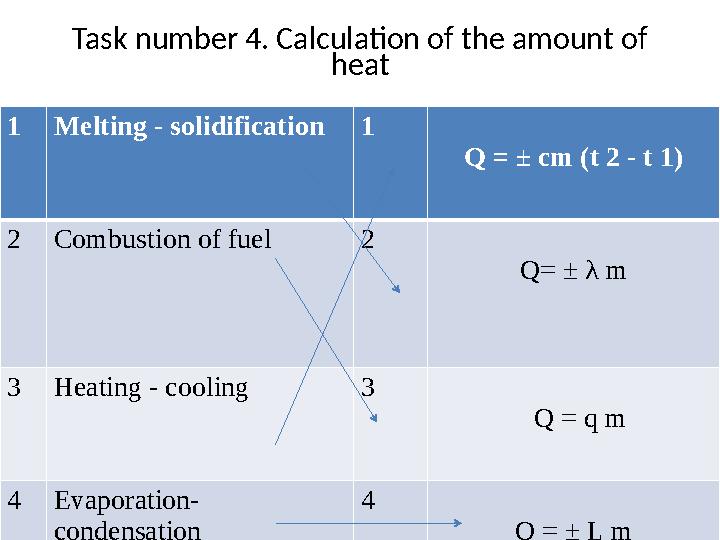
Task number 4. Calculation of the amount of
heat
1Melting - solidification1
Q = ± cm (t 2 - t 1)
2Combustion of fuel 2
Q= ± λ m
3Heating - cooling 3
Q = q m
4Evaporation-
condensation
4
Q = ± L m
14 слайд
Task number 4. Calculation of the amount of heat 1Melting - solidification1 Q = ± cm (t 2 - t 1) 2Combustion of fuel 2 Q= ± λ m 3Heating - cooling 3 Q = q m 4Evaporation- condensation 4 Q = ± L m
#15 слайд
Experiment №1
•1 Drip on two glass plates on a drop of
alcohol, place one of them over the included
electric plate. Observe their evaporation.
Which plate quickly evaporated a drop of
alcohol? Conclude the dependence of the rate
of evaporation on temperature and explain it
with the help of molecular-kinetic theory.
15 слайд
Experiment №1 •1 Drip on two glass plates on a drop of alcohol, place one of them over the included electric plate. Observe their evaporation. Which plate quickly evaporated a drop of alcohol? Conclude the dependence of the rate of evaporation on temperature and explain it with the help of molecular-kinetic theory.
#16 слайд
Feedback
16 слайд
Feedback
#17 слайд
Experiment №2
•Drop a drop of alcohol on the glass plate and,
tilting the plate in different directions, make
sure that the drop spreads over the glass as
much as possible. Next, apply one more drop
of alcohol. Observe their evaporation. Which
drop evaporated faster? Make a conclusion
about the dependence of the rate of
evaporation of the liquid on the dimensions of
its surface. What explains this dependence?
17 слайд
Experiment №2 •Drop a drop of alcohol on the glass plate and, tilting the plate in different directions, make sure that the drop spreads over the glass as much as possible. Next, apply one more drop of alcohol. Observe their evaporation. Which drop evaporated faster? Make a conclusion about the dependence of the rate of evaporation of the liquid on the dimensions of its surface. What explains this dependence?
#18 слайд
Experiment №3
•Take a glass plate and drip into its different
places one drop of sunflower oil, water and
alcohol. Track, which of the drops evaporates
first, which is the second and which will
remain on the glass for a long time. How can
the results of the experiment be explained on
the basis of knowledge of the forces of
molecular interaction?
18 слайд
Experiment №3 •Take a glass plate and drip into its different places one drop of sunflower oil, water and alcohol. Track, which of the drops evaporates first, which is the second and which will remain on the glass for a long time. How can the results of the experiment be explained on the basis of knowledge of the forces of molecular interaction?
#19 слайд
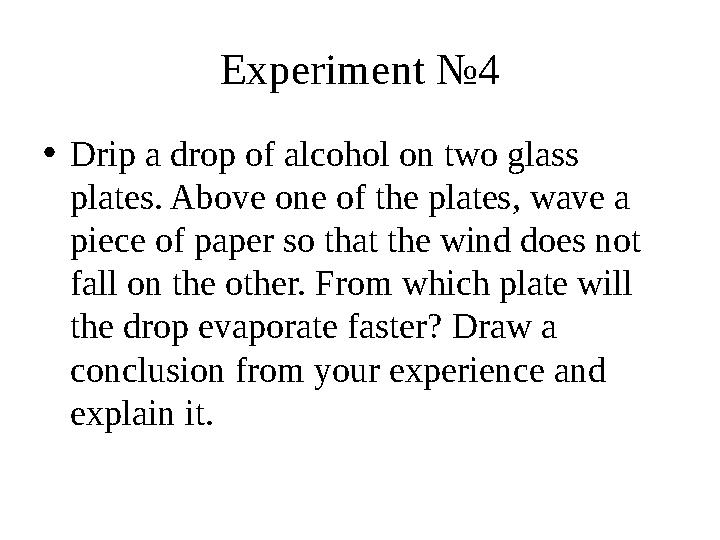
Experiment №4
•Drip a drop of alcohol on two glass
plates. Above one of the plates, wave a
piece of paper so that the wind does not
fall on the other. From which plate will
the drop evaporate faster? Draw a
conclusion from your experience and
explain it.
19 слайд
Experiment №4 •Drip a drop of alcohol on two glass plates. Above one of the plates, wave a piece of paper so that the wind does not fall on the other. From which plate will the drop evaporate faster? Draw a conclusion from your experience and explain it.
#20 слайд
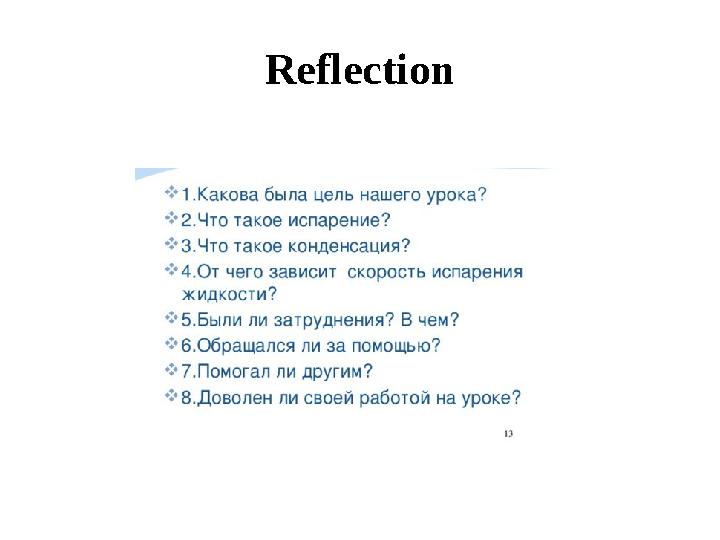
Reflection
20 слайд
Reflection


 Жүктеу
шағым қалдыра аласыз

 Бұл курс Қазақстан Республикасы Оқу-ағарту министрлігімен келісілген










