ЖИ көмекші


 Қауіпсіз төлем




1 жыл бойы шексіз жүктеңіз
Sharing best practices: ICQs and CCQs


#1 слайд
Sharing best
practices
Fulbright TEA Alumna,
Georgia State University 2023
CELTA certified English Teacher
Tussibekova Mira Malikovna
1 слайд
Sharing best practices Fulbright TEA Alumna, Georgia State University 2023 CELTA certified English Teacher Tussibekova Mira Malikovna
#2 слайд
The Role of Lead-In and
Effective Questioning in
Teaching Vocabulary
Tussibekova Mira Malikovna
2 слайд
The Role of Lead-In and Effective Questioning in Teaching Vocabulary Tussibekova Mira Malikovna
#3 слайд
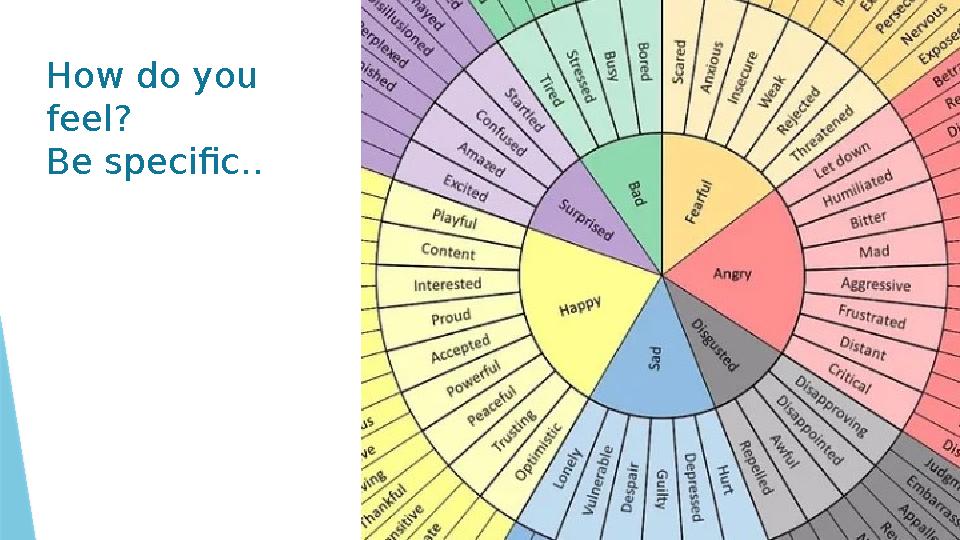
How do you
feel?
Be specific..
3 слайд
How do you feel? Be specific..
#4 слайд
Greet each other as if…
Walk around, grab a partner and act
… you haven’t seen for ages;
… you’re at the airport saying goodbye;
… you’re robots;
… you’re a queen;
Say “hello” and speak to each other in a language that doesn’t exist;
Act as a person who just won the lottery together.
4 слайд
Greet each other as if… Walk around, grab a partner and act … you haven’t seen for ages; … you’re at the airport saying goodbye; … you’re robots; … you’re a queen; Say “hello” and speak to each other in a language that doesn’t exist; Act as a person who just won the lottery together.
#5 слайд
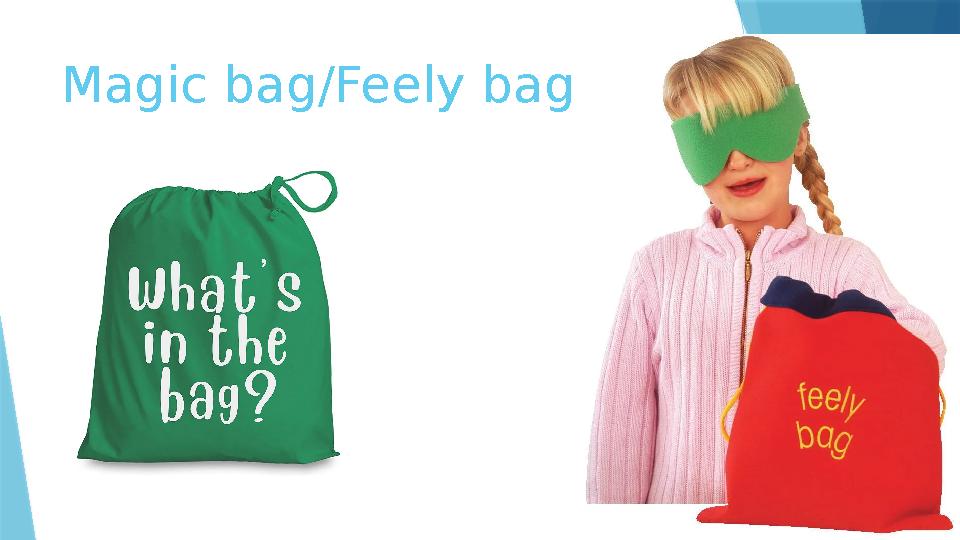
Magic bag/Feely bag
5 слайд
Magic bag/Feely bag
#6 слайд
Warm-up or Lead-in? What’s
the difference?
1. Warm-up
Purpose: To get students mentally
engaged, energized, and ready
to learn.
Focus: Often reviews previous
knowledge or gets students
thinking in English.
Type of Activities: Light, general,
not directly connected to the
lesson topic.
2. Lead-in
Purpose: To introduce the lesson
topic in an engaging way.
Focus: Activating background
knowledge and generating
curiosity about the main lesson.
Type of Activities: More
specific to the lesson theme
than a warm-up.
6 слайд
Warm-up or Lead-in? What’s the difference? 1. Warm-up Purpose: To get students mentally engaged, energized, and ready to learn. Focus: Often reviews previous knowledge or gets students thinking in English. Type of Activities: Light, general, not directly connected to the lesson topic. 2. Lead-in Purpose: To introduce the lesson topic in an engaging way. Focus: Activating background knowledge and generating curiosity about the main lesson. Type of Activities: More specific to the lesson theme than a warm-up.
#7 слайд
How do you start your lessons?
Discuss with a partner
Do you smile when you enter the classroom?
Do you ask any questions?
Do you ask them to share their emotions, feelings, news,
thoughts?
Do you begin with their homework?
Do you use rhymes? Give examples..
Do you make an eye contact?
7 слайд
How do you start your lessons? Discuss with a partner Do you smile when you enter the classroom? Do you ask any questions? Do you ask them to share their emotions, feelings, news, thoughts? Do you begin with their homework? Do you use rhymes? Give examples.. Do you make an eye contact?
#8 слайд
Rhymes
Class, Class! – Yes, Yes!
Class, Class! – Yes, Yes!
Are you ready for the class? – Yes, I am. Yes, we are!
Are you ready for the class? – Yes, I am. Yes, we are!
Let’s be quiet! – Shshsh!
Macaroni cheese – everybody freeze!
Hands on top – now we stop!
Hocus pocus – now we focus!
8 слайд
Rhymes Class, Class! – Yes, Yes! Class, Class! – Yes, Yes! Are you ready for the class? – Yes, I am. Yes, we are! Are you ready for the class? – Yes, I am. Yes, we are! Let’s be quiet! – Shshsh! Macaroni cheese – everybody freeze! Hands on top – now we stop! Hocus pocus – now we focus!
#9 слайд
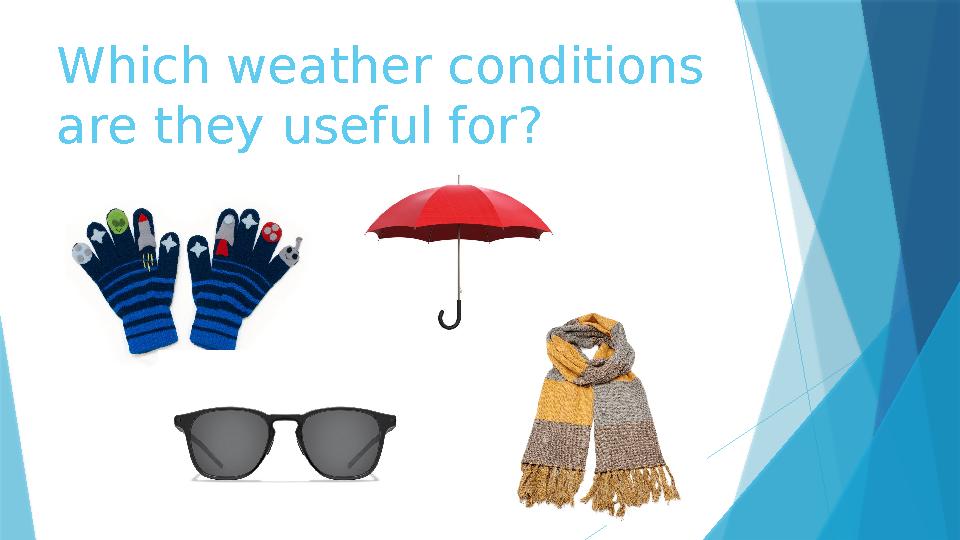
Which weather conditions
are they useful for?
9 слайд
Which weather conditions are they useful for?
#10 слайд
Match the words with the
pictures. Check the
answers.1 hail C
2 boiling D
3 freezing B
4 heavy rain E
5 heatwave A
6 thunder and lightning H
7 snowstorm G
8 high winds F
10 слайд
Match the words with the pictures. Check the answers.1 hail C 2 boiling D 3 freezing B 4 heavy rain E 5 heatwave A 6 thunder and lightning H 7 snowstorm G 8 high winds F
#11 слайд
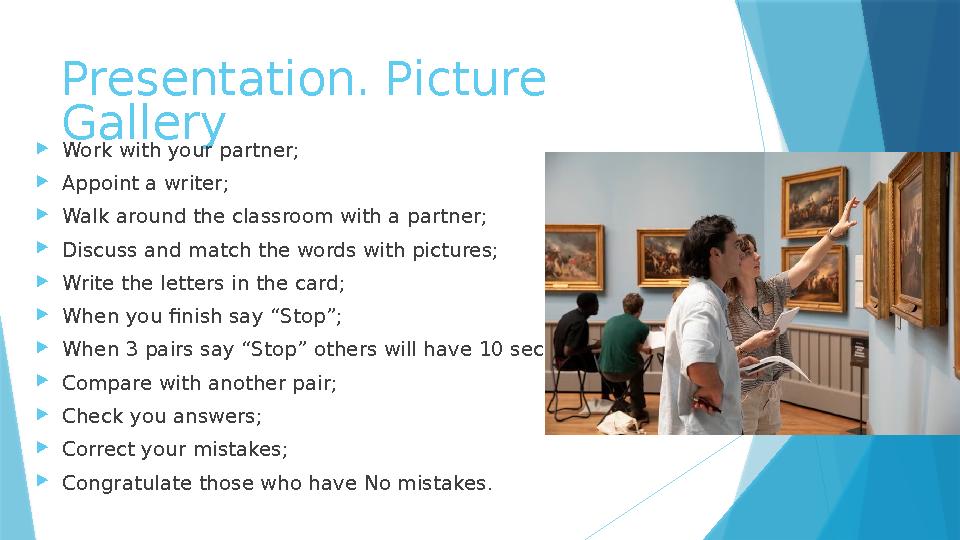
Presentation. Picture
Gallery
Work with your partner;
Appoint a writer;
Walk around the classroom with a partner;
Discuss and match the words with pictures;
Write the letters in the card;
When you finish say “Stop”;
When 3 pairs say “Stop” others will have 10 seconds;
Compare with another pair;
Check you answers;
Correct your mistakes;
Congratulate those who have No mistakes.
11 слайд
Presentation. Picture Gallery Work with your partner; Appoint a writer; Walk around the classroom with a partner; Discuss and match the words with pictures; Write the letters in the card; When you finish say “Stop”; When 3 pairs say “Stop” others will have 10 seconds; Compare with another pair; Check you answers; Correct your mistakes; Congratulate those who have No mistakes.
#12 слайд
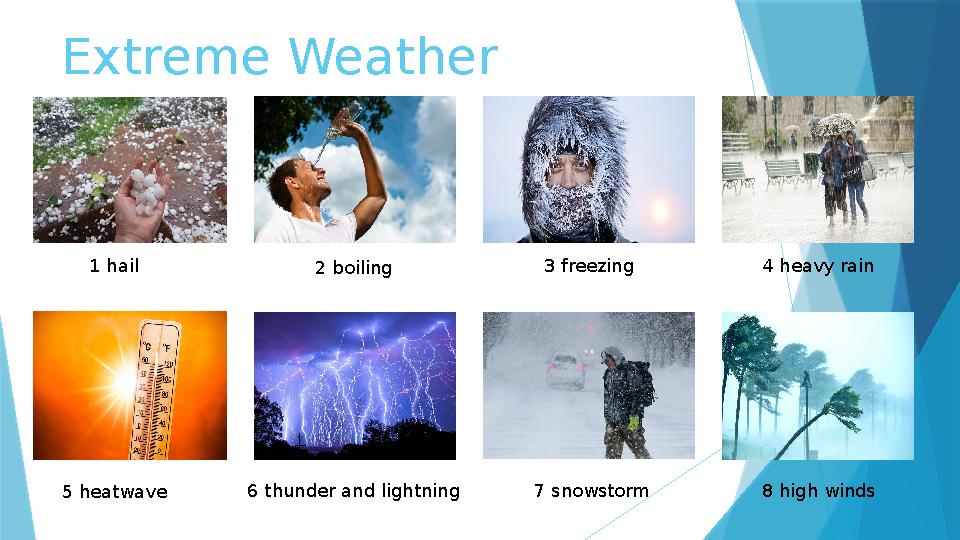
Extreme Weather
1 hail 2 boiling 3 freezing 4 heavy rain
5 heatwave 6 thunder and lightning 7 snowstorm 8 high winds
12 слайд
Extreme Weather 1 hail 2 boiling 3 freezing 4 heavy rain 5 heatwave 6 thunder and lightning 7 snowstorm 8 high winds
#13 слайд
Analysing the meaning using
CCQs1. Hail (small balls of ice falling from the sky)
"Is hail made of ice or water?" (Ice.)
"Does hail fall in winter or summer?" (It can fall in both, but usually in
storms.)
"Is hail soft like rain or hard like ice?" (Hard like ice)
2. Heatwave (a long period of very hot weather)
"Is a heatwave cold or very hot?" (Very hot.)
"Does a heatwave last for one hour or many days?" (Many days.)
3. Thunder and Lightning (loud sounds and flashes in a storm)
"Do you see or hear thunder?" (Hear.)
“Do you see or hear lightning?” (See.)
"Does lightning come before or after thunder?" (Before.)
13 слайд
Analysing the meaning using CCQs1. Hail (small balls of ice falling from the sky) "Is hail made of ice or water?" (Ice.) "Does hail fall in winter or summer?" (It can fall in both, but usually in storms.) "Is hail soft like rain or hard like ice?" (Hard like ice) 2. Heatwave (a long period of very hot weather) "Is a heatwave cold or very hot?" (Very hot.) "Does a heatwave last for one hour or many days?" (Many days.) 3. Thunder and Lightning (loud sounds and flashes in a storm) "Do you see or hear thunder?" (Hear.) “Do you see or hear lightning?” (See.) "Does lightning come before or after thunder?" (Before.)
#14 слайд
Now it’s your turn. Make up 2-3
concept checking questions (CCQs)
for each extreme weather word with
your neighbour.
Heavy rain
Snowstorm
14 слайд
Now it’s your turn. Make up 2-3 concept checking questions (CCQs) for each extreme weather word with your neighbour. Heavy rain Snowstorm
#15 слайд
Why Are Concept Checking
Questions (CCQs) Important?
Ensure Understanding – Instead of asking “Do you
understand?”, CCQs confirm if students truly catch the
meaning.
Encourage Participation – They make learning interactive,
keeping students engaged.
Identify Confusion – Wrong answers show where
clarification is needed.
Work for All Levels – Simple for beginners ("Is thunder
quiet or loud?"), more detailed for advanced learners.
Reduce Translation – They help students think in English
instead of relying on their native language.
15 слайд
Why Are Concept Checking Questions (CCQs) Important? Ensure Understanding – Instead of asking “Do you understand?”, CCQs confirm if students truly catch the meaning. Encourage Participation – They make learning interactive, keeping students engaged. Identify Confusion – Wrong answers show where clarification is needed. Work for All Levels – Simple for beginners ("Is thunder quiet or loud?"), more detailed for advanced learners. Reduce Translation – They help students think in English instead of relying on their native language.
#16 слайд
Do you know any other
types of questions teachers
use during the lesson?
What’s the difference between CCQs and ICQs?
When do we use CCQs and ICQs?
Can you give any examples of ICQs?
What is a bad and a good ICQ?
16 слайд
Do you know any other types of questions teachers use during the lesson? What’s the difference between CCQs and ICQs? When do we use CCQs and ICQs? Can you give any examples of ICQs? What is a bad and a good ICQ?
#17 слайд
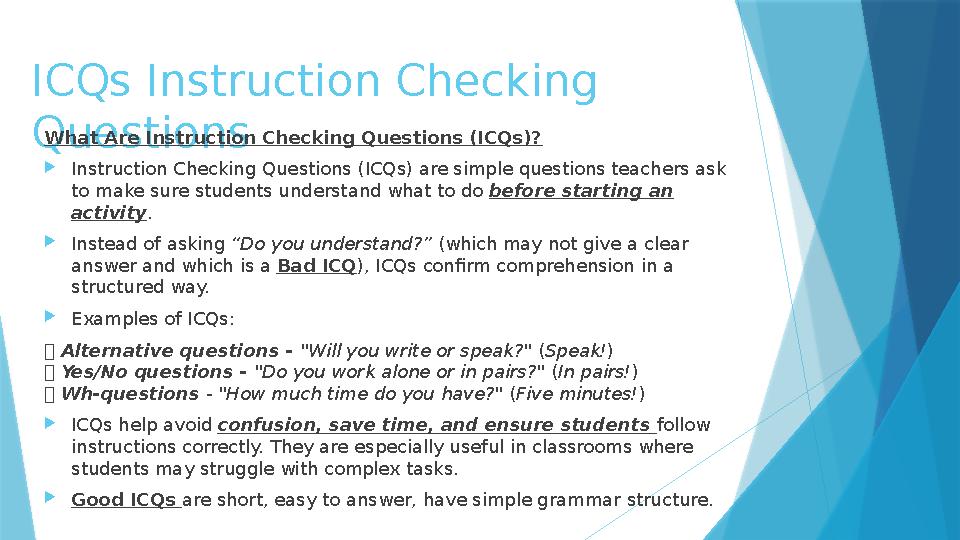
ICQs Instruction Checking
Questions
What Are Instruction Checking Questions (ICQs)?
Instruction Checking Questions (ICQs) are simple questions teachers ask
to make sure students understand what to do before starting an
activity.
Instead of asking “Do you understand?” (which may not give a clear
answer and which is a Bad ICQ), ICQs confirm comprehension in a
structured way.
Examples of ICQs:
✅ Alternative questions - "Will you write or speak?" (Speak!)
✅ Yes/No questions - "Do you work alone or in pairs?" (In pairs!)
✅ Wh-questions - "How much time do you have?" (Five minutes!)
ICQs help avoid confusion, save time, and ensure students follow
instructions correctly. They are especially useful in classrooms where
students may struggle with complex tasks.
Good ICQs are short, easy to answer, have simple grammar structure.
17 слайд
ICQs Instruction Checking Questions What Are Instruction Checking Questions (ICQs)? Instruction Checking Questions (ICQs) are simple questions teachers ask to make sure students understand what to do before starting an activity. Instead of asking “Do you understand?” (which may not give a clear answer and which is a Bad ICQ), ICQs confirm comprehension in a structured way. Examples of ICQs: ✅ Alternative questions - "Will you write or speak?" (Speak!) ✅ Yes/No questions - "Do you work alone or in pairs?" (In pairs!) ✅ Wh-questions - "How much time do you have?" (Five minutes!) ICQs help avoid confusion, save time, and ensure students follow instructions correctly. They are especially useful in classrooms where students may struggle with complex tasks. Good ICQs are short, easy to answer, have simple grammar structure.
#18 слайд
Let’s continue the
presentation
Picture Gallery;
Analysis using CCQs;
Drilling;
Recording;
Practice Test each other in 2 lines
18 слайд
Let’s continue the presentation Picture Gallery; Analysis using CCQs; Drilling; Recording; Practice Test each other in 2 lines
#19 слайд
Stages of the lesson
Rhyme
Lead-in Feely bag
Presentation Picture gallery
Matching activity
Analysis CCQs
ICQs
19 слайд
Stages of the lesson Rhyme Lead-in Feely bag Presentation Picture gallery Matching activity Analysis CCQs ICQs
#20 слайд
Feedback
What was useful for you?
What was new for you?
What will you implement to your lesson?
20 слайд
Feedback What was useful for you? What was new for you? What will you implement to your lesson?

#21 слайд
21 слайд









 Бұл курс Қазақстан Республикасы Оқу-ағарту министрлігімен келісілген