
 ЖИ көмекші


 Қауіпсіз төлем




1 жыл бойы шексіз жүктеңіз
The pronoun

#1 слайд
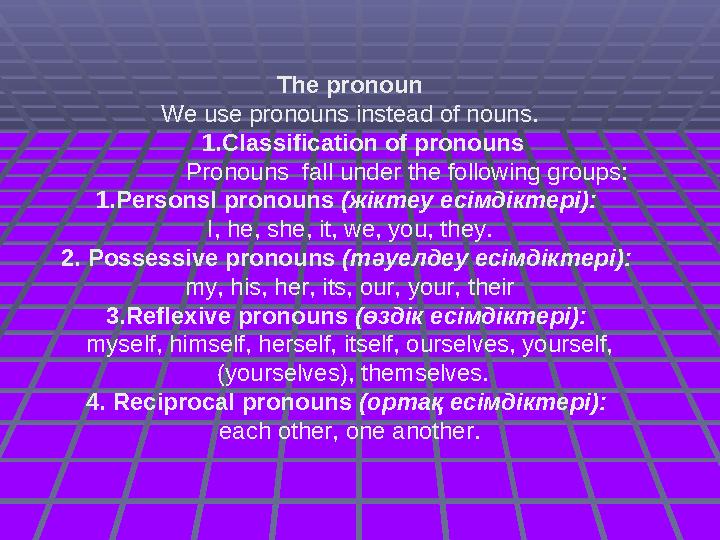
The pronoun
We use pronouns instead of nouns.
1.Classification of pronouns
Pronouns fall under the following groups:
1.Personsl pronouns (жіктеу есімдіктері):
I, he, she, it, we, you, they.
2. Possessive pronouns (тәуелдеу есімдіктері):
my, his, her, its, our, your, their
3.Reflexive pronouns (өздік есімдіктері):
myself, himself, herself, itself, ourselves, yourself,
(yourselves), themselves.
4. Reciprocal pronouns (ортақ есімдіктері):
each other, one another.
1 слайд
The pronoun We use pronouns instead of nouns. 1.Classification of pronouns Pronouns fall under the following groups: 1.Personsl pronouns (жіктеу есімдіктері): I, he, she, it, we, you, they. 2. Possessive pronouns (тәуелдеу есімдіктері): my, his, her, its, our, your, their 3.Reflexive pronouns (өздік есімдіктері): myself, himself, herself, itself, ourselves, yourself, (yourselves), themselves. 4. Reciprocal pronouns (ортақ есімдіктері): each other, one another.
#2 слайд
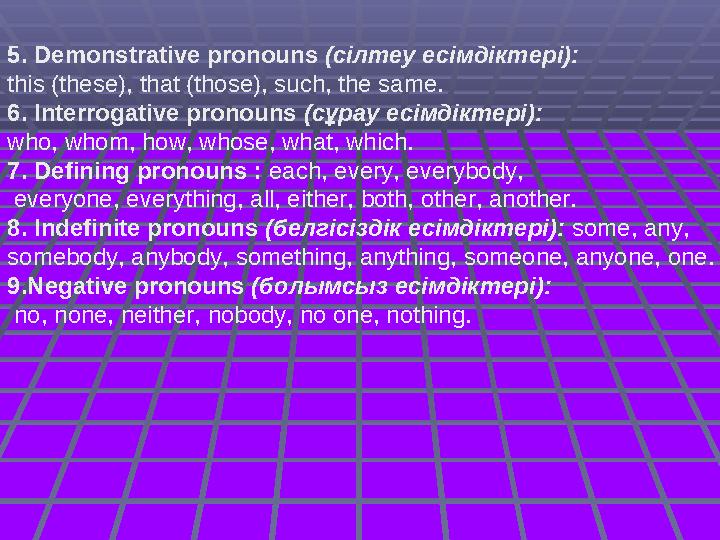
5. Demonstrative pronouns (сілтеу есімдіктері):
this (these), that (those), such, the same.
6. Interrogative pronouns (сұрау есімдіктері):
who, whom, how, whose, what, which.
7. Defining pronouns : each, every, everybody,
everyone, everything, all, either, both, other, another.
8. Indefinite pronouns (белгісіздік есімдіктері): some, any,
somebody, anybody, something, anything, someone, anyone, one.
9.Negative pronouns (болымсыз есімдіктері):
no, none, neither, nobody, no one, nothing.
2 слайд
5. Demonstrative pronouns (сілтеу есімдіктері): this (these), that (those), such, the same. 6. Interrogative pronouns (сұрау есімдіктері): who, whom, how, whose, what, which. 7. Defining pronouns : each, every, everybody, everyone, everything, all, either, both, other, another. 8. Indefinite pronouns (белгісіздік есімдіктері): some, any, somebody, anybody, something, anything, someone, anyone, one. 9.Negative pronouns (болымсыз есімдіктері): no, none, neither, nobody, no one, nothing.
#3 слайд
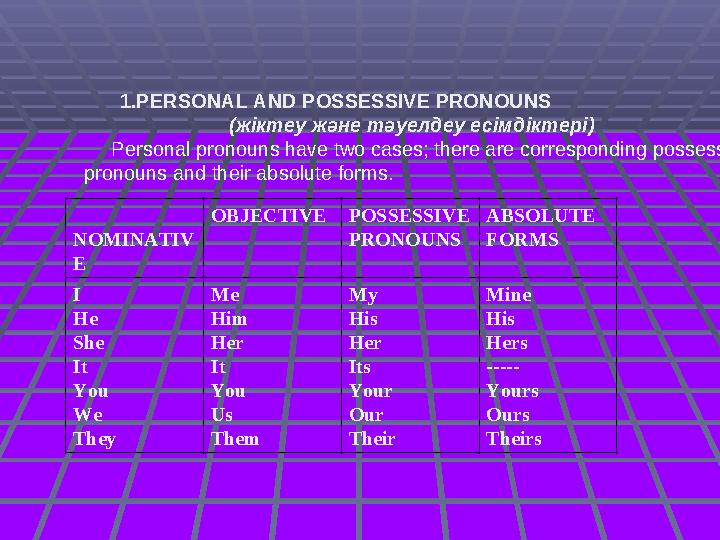
1.PERSONAL AND POSSESSIVE PRONOUNS
(жіктеу және тәуелдеу есімдіктері)
Personal pronouns have two cases; there are corresponding possessive
pronouns and their absolute forms.
NOMINATIV
E
OBJECTIVE POSSESSIVE
PRONOUNS
ABSOLUTE
FORMS
I
He
She
It
You
We
They
Me
Him
Her
It
You
Us
Them
My
His
Her
Its
Your
Our
Their
Mine
His
Hers
-----
Yours
Ours
Theirs
3 слайд
1.PERSONAL AND POSSESSIVE PRONOUNS (жіктеу және тәуелдеу есімдіктері) Personal pronouns have two cases; there are corresponding possessive pronouns and their absolute forms. NOMINATIV E OBJECTIVE POSSESSIVE PRONOUNS ABSOLUTE FORMS I He She It You We They Me Him Her It You Us Them My His Her Its Your Our Their Mine His Hers ----- Yours Ours Theirs
#4 слайд
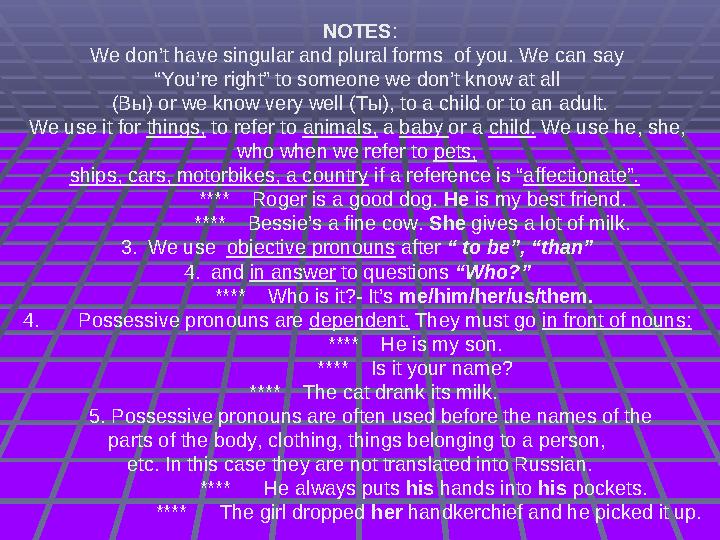
NOTES:
We don’t have singular and plural forms of you. We can say
“You’re right” to someone we don’t know at all
(Вы) or we know very well (Ты), to a child or to an adult.
We use it for things, to refer to animals, a baby or a child. We use he, she,
who when we refer to pets,
ships, cars, motorbikes, a country if a reference is “affectionate”.
**** Roger is a good dog. He is my best friend.
**** Bessie’s a fine cow. She gives a lot of milk.
3.We use objective pronouns after “ to be”, “than”
4.and in answer to questions “Who?”
**** Who is it?- It’s me/him/her/us/them.
4. Possessive pronouns are dependent. They must go in front of nouns:
**** He is my son.
**** Is it your name?
**** The cat drank its milk.
5. Possessive pronouns are often used before the names of the
parts of the body, clothing, things belonging to a person,
etc. In this case they are not translated into Russian.
**** He always puts his hands into his pockets.
**** The girl dropped her handkerchief and he picked it up.
4 слайд
NOTES: We don’t have singular and plural forms of you. We can say “You’re right” to someone we don’t know at all (Вы) or we know very well (Ты), to a child or to an adult. We use it for things, to refer to animals, a baby or a child. We use he, she, who when we refer to pets, ships, cars, motorbikes, a country if a reference is “affectionate”. **** Roger is a good dog. He is my best friend. **** Bessie’s a fine cow. She gives a lot of milk. 3.We use objective pronouns after “ to be”, “than” 4.and in answer to questions “Who?” **** Who is it?- It’s me/him/her/us/them. 4. Possessive pronouns are dependent. They must go in front of nouns: **** He is my son. **** Is it your name? **** The cat drank its milk. 5. Possessive pronouns are often used before the names of the parts of the body, clothing, things belonging to a person, etc. In this case they are not translated into Russian. **** He always puts his hands into his pockets. **** The girl dropped her handkerchief and he picked it up.
#5 слайд
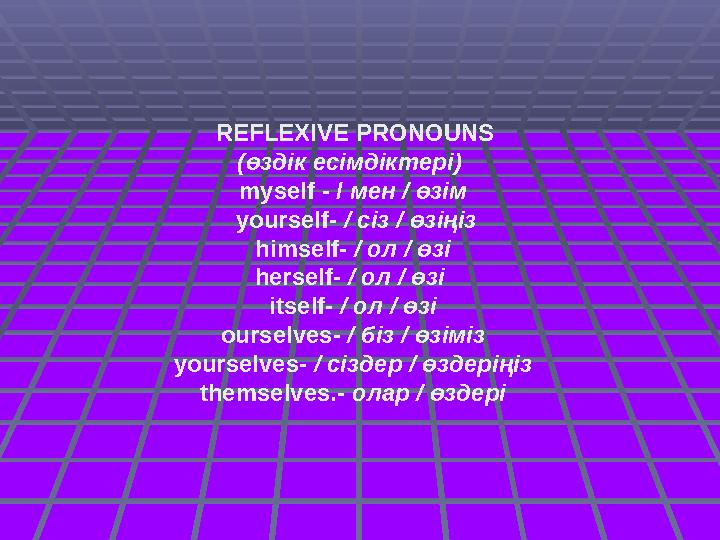
REFLEXIVE PRONOUNS
(өздік есімдіктері)
myself - / мен / өзім
yourself- / сіз / өзіңіз
himself- / ол / өзі
herself- / ол / өзі
itself- / ол / өзі
ourselves- / біз / өзіміз
yourselves- / сіздер / өздеріңіз
themselves.- олар / өздері
5 слайд
REFLEXIVE PRONOUNS (өздік есімдіктері) myself - / мен / өзім yourself- / сіз / өзіңіз himself- / ол / өзі herself- / ол / өзі itself- / ол / өзі ourselves- / біз / өзіміз yourselves- / сіздер / өздеріңіз themselves.- олар / өздері
#6 слайд
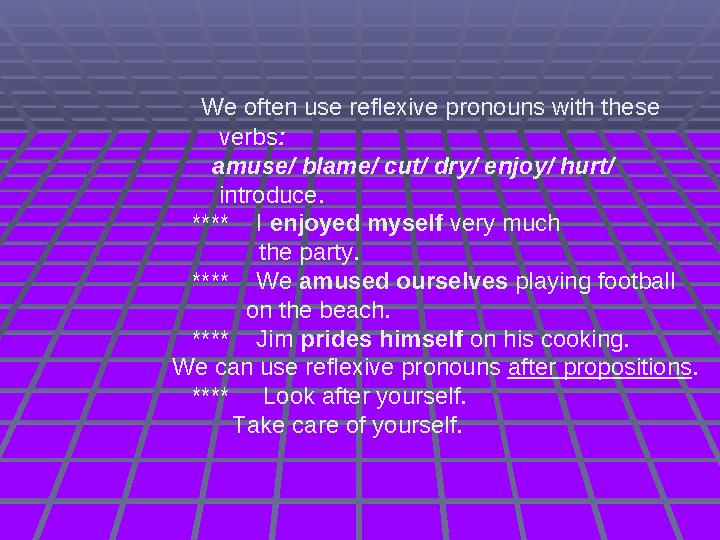
We often use reflexive pronouns with these
verbs:
amuse/ blame/ cut/ dry/ enjoy/ hurt/
introduce.
**** I enjoyed myself very much
the party.
**** We amused ourselves playing football
on the beach.
**** Jim prides himself on his cooking.
We can use reflexive pronouns after propositions.
**** Look after yourself.
Take care of yourself.
6 слайд
We often use reflexive pronouns with these verbs: amuse/ blame/ cut/ dry/ enjoy/ hurt/ introduce. **** I enjoyed myself very much the party. **** We amused ourselves playing football on the beach. **** Jim prides himself on his cooking. We can use reflexive pronouns after propositions. **** Look after yourself. Take care of yourself.
#7 слайд
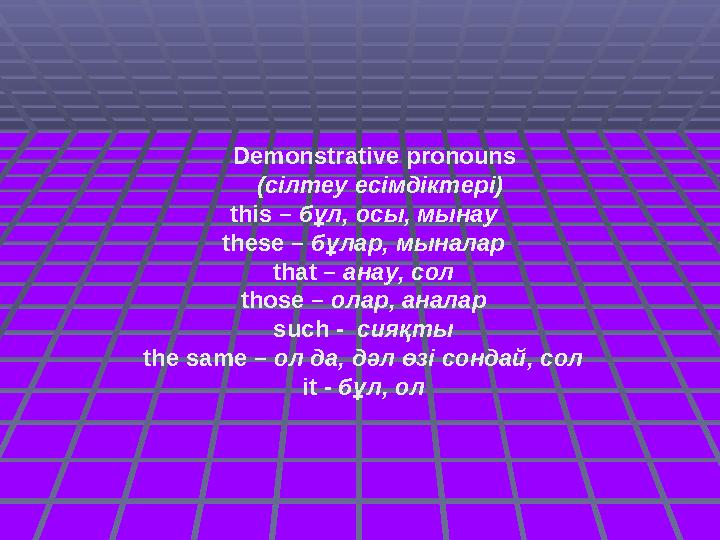
Demonstrative pronouns
(сілтеу есімдіктері)
this – бұл, осы, мынау
these – бұлар, мыналар
that – анау, сол
those – олар, аналар
such - сияқты
the same – ол да, дәл өзі сондай, сол
it - бұл, ол
7 слайд
Demonstrative pronouns (сілтеу есімдіктері) this – бұл, осы, мынау these – бұлар, мыналар that – анау, сол those – олар, аналар such - сияқты the same – ол да, дәл өзі сондай, сол it - бұл, ол
#8 слайд
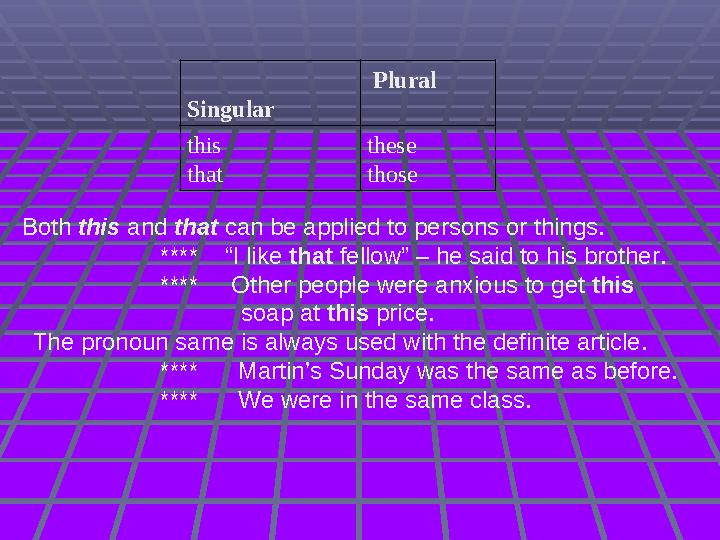
Singular
Plural
this
that
these
those
Both this and that can be applied to persons or things.
**** “I like that fellow” – he said to his brother.
**** Other people were anxious to get this
soap at this price.
The pronoun same is always used with the definite article.
**** Martin’s Sunday was the same as before.
**** We were in the same class.
8 слайд
Singular Plural this that these those Both this and that can be applied to persons or things. **** “I like that fellow” – he said to his brother. **** Other people were anxious to get this soap at this price. The pronoun same is always used with the definite article. **** Martin’s Sunday was the same as before. **** We were in the same class.
#9 слайд
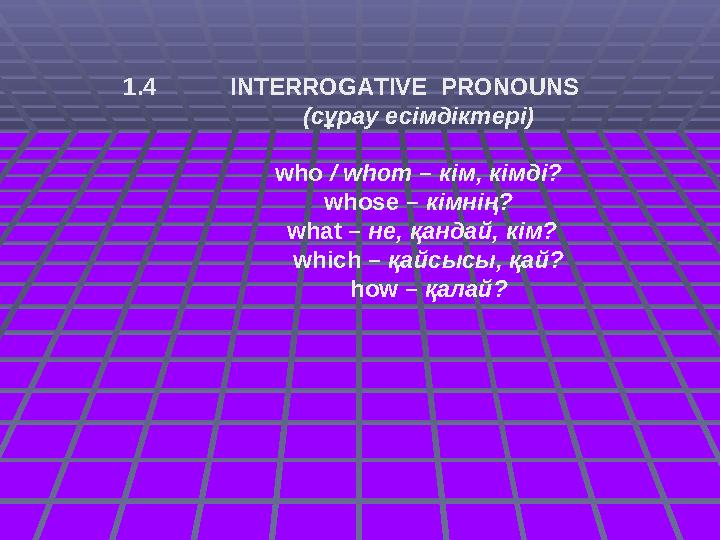
1.4 INTERROGATIVE PRONOUNS
(сұрау есімдіктері)
who / whom – кім, кімді?
whose – кімнің?
what – не, қандай, кім?
which – қайсысы, қай?
how – қалай?
9 слайд
1.4 INTERROGATIVE PRONOUNS (сұрау есімдіктері) who / whom – кім, кімді? whose – кімнің? what – не, қандай, кім? which – қайсысы, қай? how – қалай?
#10 слайд
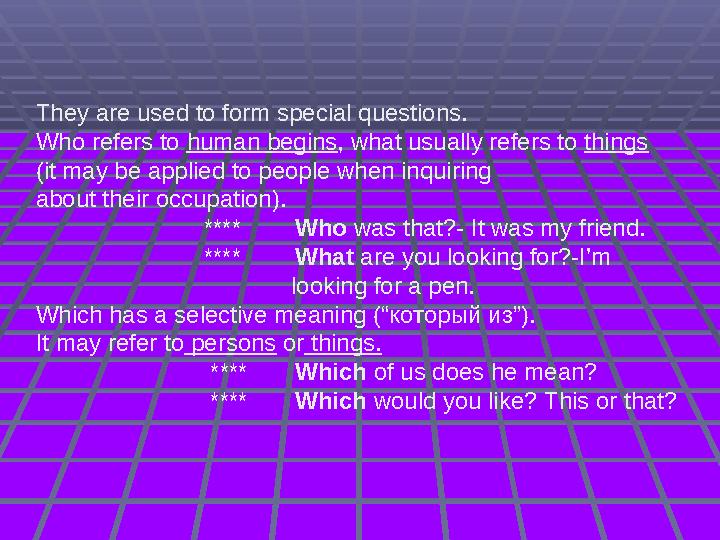
They are used to form special questions.
Who refers to human begins, what usually refers to things
(it may be applied to people when inquiring
about their occupation).
**** Who was that?- It was my friend.
**** What are you looking for?-I’m
looking for a pen.
Which has a selective meaning (“кoторый из”).
It may refer to persons or things.
**** Which of us does he mean?
**** Which would you like? This or that?
10 слайд
They are used to form special questions. Who refers to human begins, what usually refers to things (it may be applied to people when inquiring about their occupation). **** Who was that?- It was my friend. **** What are you looking for?-I’m looking for a pen. Which has a selective meaning (“кoторый из”). It may refer to persons or things. **** Which of us does he mean? **** Which would you like? This or that?
#11 слайд
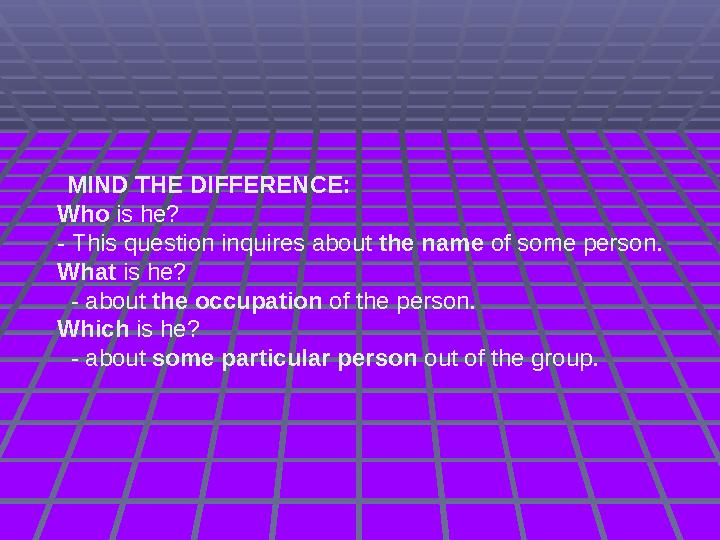
MIND THE DIFFERENCE:
Who is he?
- This question inquires about the name of some person.
What is he?
- about the occupation of the person.
Which is he?
- about some particular person out of the group.
11 слайд
MIND THE DIFFERENCE: Who is he? - This question inquires about the name of some person. What is he? - about the occupation of the person. Which is he? - about some particular person out of the group.
#12 слайд
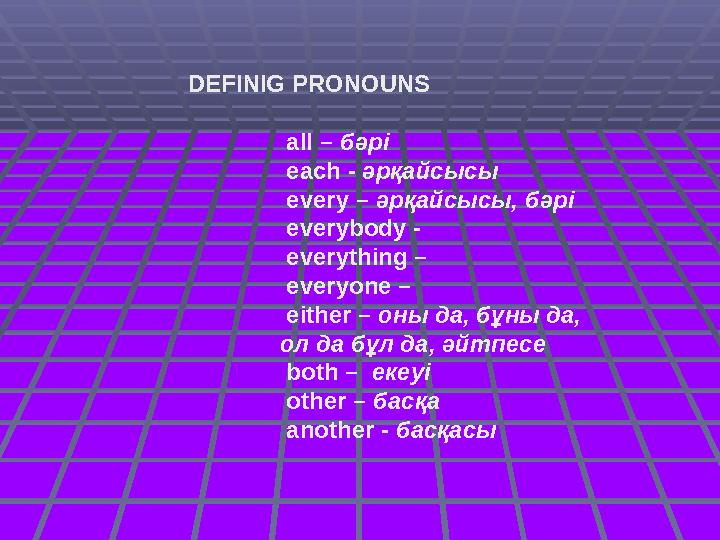
DEFINIG PRONOUNS
all – бәрі
each - әрқайсысы
every – әрқайсысы, бәрі
everybody -
everything –
everyone –
either – оны да, бұны да,
ол да бұл да, әйтпесе
both – екеуі
other – басқа
another - басқасы
12 слайд
DEFINIG PRONOUNS all – бәрі each - әрқайсысы every – әрқайсысы, бәрі everybody - everything – everyone – either – оны да, бұны да, ол да бұл да, әйтпесе both – екеуі other – басқа another - басқасы
#13 слайд
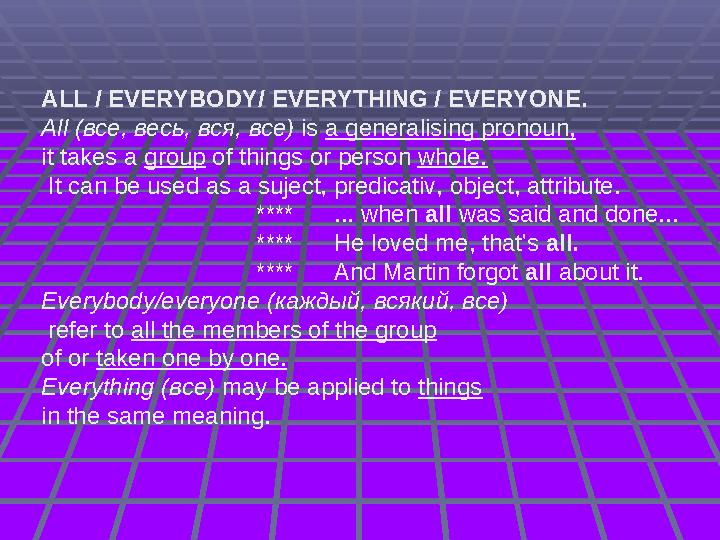
ALL / EVERYBODY/ EVERYTHING / EVERYONE.
All (все, весь, вся, все) is a generalising pronoun,
it takes a group of things or person whole.
It can be used as a suject, predicativ, object, attribute.
**** ... when all was said and done...
**** He loved me, that's all.
**** And Martin forgot all about it.
Everybody/everyone (каждый, всякий, все)
refer to all the members of the group
of or taken one by one.
Everything (все) may be applied to things
in the same meaning.
13 слайд
ALL / EVERYBODY/ EVERYTHING / EVERYONE. All (все, весь, вся, все) is a generalising pronoun, it takes a group of things or person whole. It can be used as a suject, predicativ, object, attribute. **** ... when all was said and done... **** He loved me, that's all. **** And Martin forgot all about it. Everybody/everyone (каждый, всякий, все) refer to all the members of the group of or taken one by one. Everything (все) may be applied to things in the same meaning.
#14 слайд
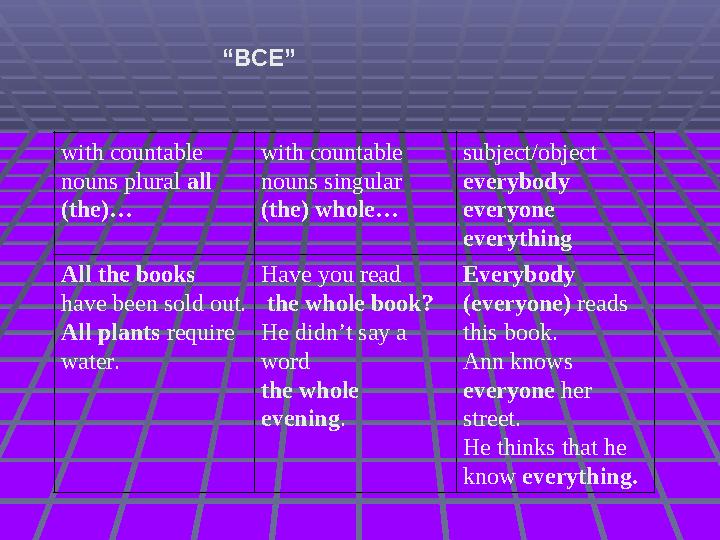
“ВСЕ”
with countable
nouns plural all
(the)…
with countable
nouns singular
(the) whole…
subject/object
everybody
everyone
everything
All the books
have been sold out.
All plants require
water.
Have you read
the whole book?
He didn’t say a
word
the whole
evening.
Everybody
(everyone) reads
this book.
Ann knows
everyone her
street.
He thinks that he
know everything.
14 слайд
“ВСЕ” with countable nouns plural all (the)… with countable nouns singular (the) whole… subject/object everybody everyone everything All the books have been sold out. All plants require water. Have you read the whole book? He didn’t say a word the whole evening. Everybody (everyone) reads this book. Ann knows everyone her street. He thinks that he know everything.
#15 слайд
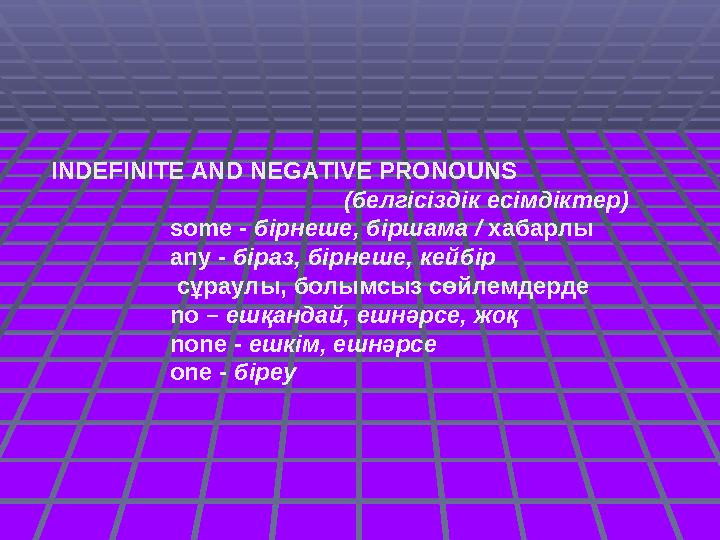
INDEFINITE AND NEGATIVE PRONOUNS
(белгісіздік есімдіктер)
some - бірнеше, біршама / хабарлы
any - біраз, бірнеше, кейбір
сұраулы, болымсыз сөйлемдерде
no – ешқандай, ешнәрсе, жоқ
none - ешкім, ешнәрсе
one - біреу
15 слайд
INDEFINITE AND NEGATIVE PRONOUNS (белгісіздік есімдіктер) some - бірнеше, біршама / хабарлы any - біраз, бірнеше, кейбір сұраулы, болымсыз сөйлемдерде no – ешқандай, ешнәрсе, жоқ none - ешкім, ешнәрсе one - біреу
#16 слайд
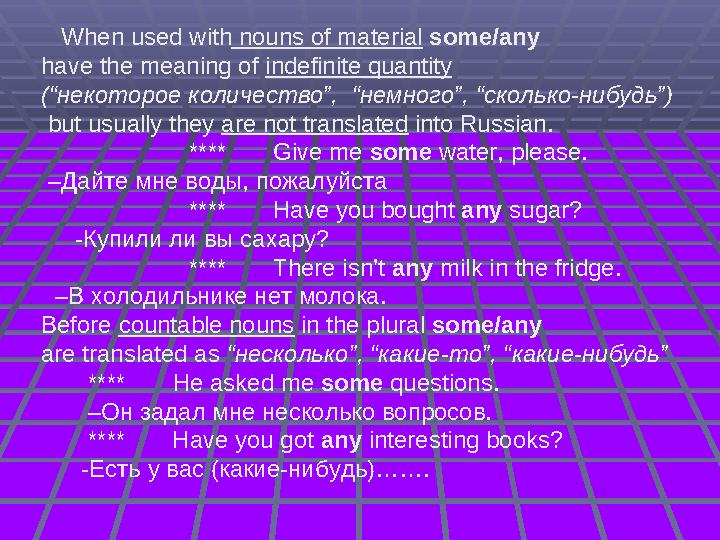
When used with nouns of material some/any
have the meaning of indefinite quantity
(“некоторое количество”, “немного”, “сколько-нибудь”)
but usually they are not translated into Russian.
**** Give me some water, please.
–Дайте мне воды, пожалуйста
**** Have you bought any sugar?
-Купили ли вы сахару?
**** There isn’t any milk in the fridge.
–В холодильнике нет молока.
Before countable nouns in the plural some/any
are translated as “несколько”, “какие-то”, “какие-нибудь”
**** He asked me some questions.
–Он задал мне несколько вопросов.
**** Have you got any interesting books?
-Есть у вас (какие-нибудь)…….
16 слайд
When used with nouns of material some/any have the meaning of indefinite quantity (“некоторое количество”, “немного”, “сколько-нибудь”) but usually they are not translated into Russian. **** Give me some water, please. –Дайте мне воды, пожалуйста **** Have you bought any sugar? -Купили ли вы сахару? **** There isn’t any milk in the fridge. –В холодильнике нет молока. Before countable nouns in the plural some/any are translated as “несколько”, “какие-то”, “какие-нибудь” **** He asked me some questions. –Он задал мне несколько вопросов. **** Have you got any interesting books? -Есть у вас (какие-нибудь)…….
#17 слайд
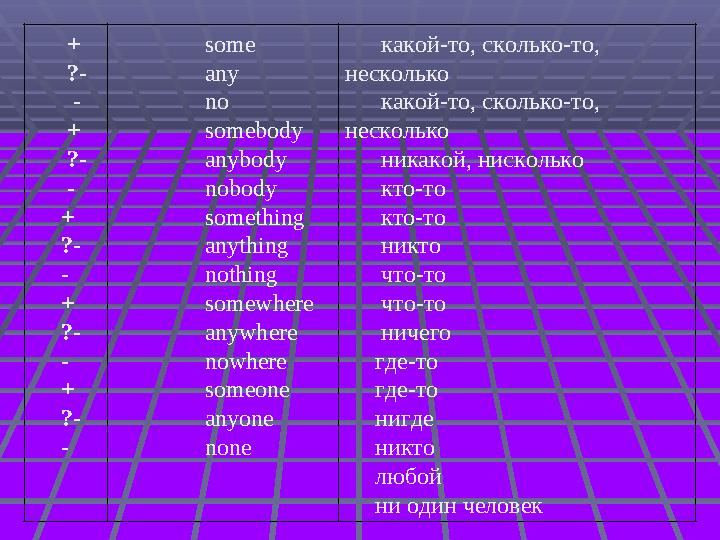
+
?-
-
+
?-
-
+
?-
-
+
?-
-
+
?-
-
some
any
no
somebody
anybody
nobody
something
anything
nothing
somewhere
anywhere
nowhere
someone
anyone
none
какой-то, сколько-то,
несколько
какой-то, сколько-то,
несколько
никакой, нисколько
кто-то
кто-то
никто
что-то
что-то
ничего
где-то
где-то
нигде
никто
любой
ни один человек
17 слайд
+ ?- - + ?- - + ?- - + ?- - + ?- - some any no somebody anybody nobody something anything nothing somewhere anywhere nowhere someone anyone none какой-то, сколько-то, несколько какой-то, сколько-то, несколько никакой, нисколько кто-то кто-то никто что-то что-то ничего где-то где-то нигде никто любой ни один человек
#18 слайд
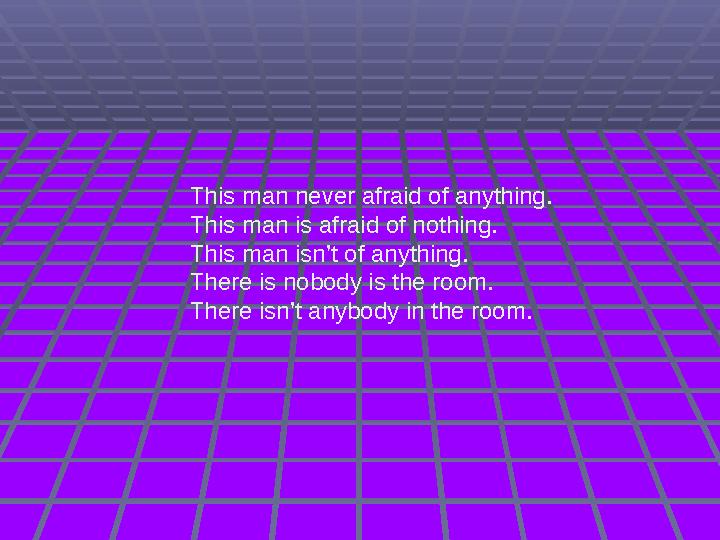
This man never afraid of anything.
This man is afraid of nothing.
This man isn’t of anything.
There is nobody is the room.
There isn’t anybody in the room.
18 слайд
This man never afraid of anything. This man is afraid of nothing. This man isn’t of anything. There is nobody is the room. There isn’t anybody in the room.
#19 слайд
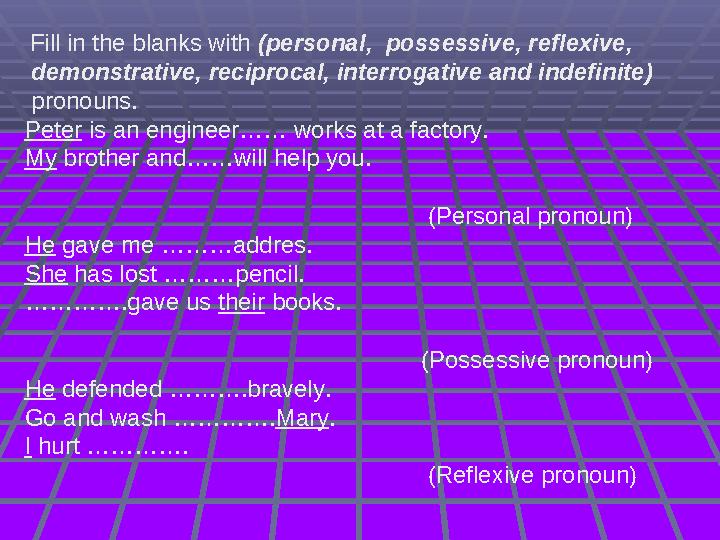
Fill in the blanks with (personal, possessive, reflexive,
demonstrative, reciprocal, interrogative and indefinite)
pronouns.
Peter is an engineer…… works at a factory.
My brother and……will help you.
(Personal pronoun)
He gave me ………addres.
She has lost ………pencil.
………….gave us their books.
(Possessive pronoun)
He defended ……….bravely.
Go and wash ………….Mary.
I hurt ………….
(Reflexive pronoun)
19 слайд
Fill in the blanks with (personal, possessive, reflexive, demonstrative, reciprocal, interrogative and indefinite) pronouns. Peter is an engineer…… works at a factory. My brother and……will help you. (Personal pronoun) He gave me ………addres. She has lost ………pencil. ………….gave us their books. (Possessive pronoun) He defended ……….bravely. Go and wash ………….Mary. I hurt …………. (Reflexive pronoun)
#20 слайд
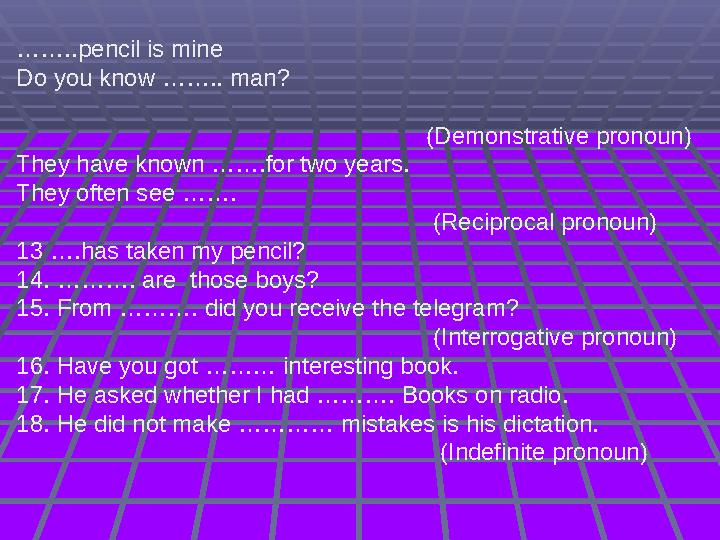
……..pencil is mine
Do you know …….. man?
(Demonstrative pronoun)
They have known …….for two years.
They often see …….
(Reciprocal pronoun)
13 ….has taken my pencil?
14. ………. are those boys?
15. From ………. did you receive the telegram?
(Interrogative pronoun)
16. Have you got ……… interesting book.
17. He asked whether I had ………. Books on radio.
18. He did not make ………… mistakes is his dictation.
(Indefinite pronoun)
20 слайд
……..pencil is mine Do you know …….. man? (Demonstrative pronoun) They have known …….for two years. They often see ……. (Reciprocal pronoun) 13 ….has taken my pencil? 14. ………. are those boys? 15. From ………. did you receive the telegram? (Interrogative pronoun) 16. Have you got ……… interesting book. 17. He asked whether I had ………. Books on radio. 18. He did not make ………… mistakes is his dictation. (Indefinite pronoun)

#21 слайд
1.She is younger than…… .
A) Her D) Him
B) Where E) Its
C) Who
2. Can you lend me……… spoons, please?
A) No D) Some
B) Anyone E) Its
C) All
3. Be careful! He is looking at……..
A) You D) I
B) Ours E) Our
C) We
21 слайд
1.She is younger than…… . A) Her D) Him B) Where E) Its C) Who 2. Can you lend me……… spoons, please? A) No D) Some B) Anyone E) Its C) All 3. Be careful! He is looking at…….. A) You D) I B) Ours E) Our C) We
#22 слайд
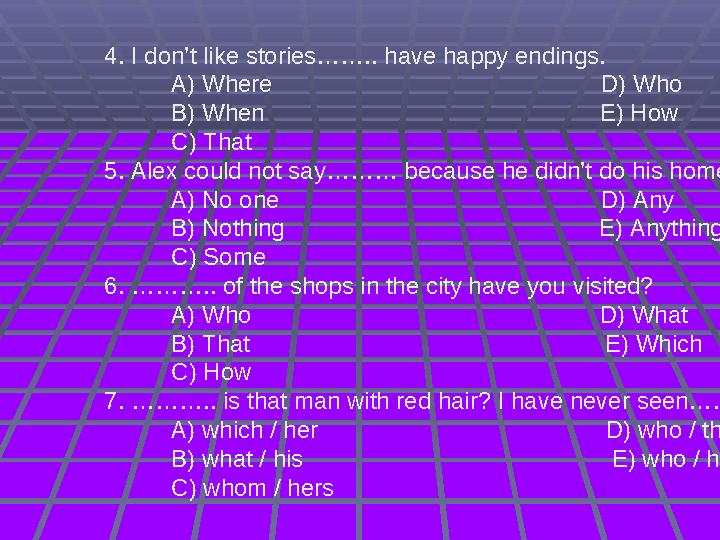
4. I don’t like stories…….. have happy endings.
A) Where D) Who
B) When E) How
C) That
5. Alex could not say……… because he didn’t do his homework.
A) No one D) Any
B) Nothing E) Anything
C) Some
6. ……….. of the shops in the city have you visited?
A) Who D) What
B) That E) Which
C) How
7. ……….. is that man with red hair? I have never seen………
A) which / her D) who / that
B) what / his E) who / him
C) whom / hers
22 слайд
4. I don’t like stories…….. have happy endings. A) Where D) Who B) When E) How C) That 5. Alex could not say……… because he didn’t do his homework. A) No one D) Any B) Nothing E) Anything C) Some 6. ……….. of the shops in the city have you visited? A) Who D) What B) That E) Which C) How 7. ……….. is that man with red hair? I have never seen……… A) which / her D) who / that B) what / his E) who / him C) whom / hers
#23 слайд
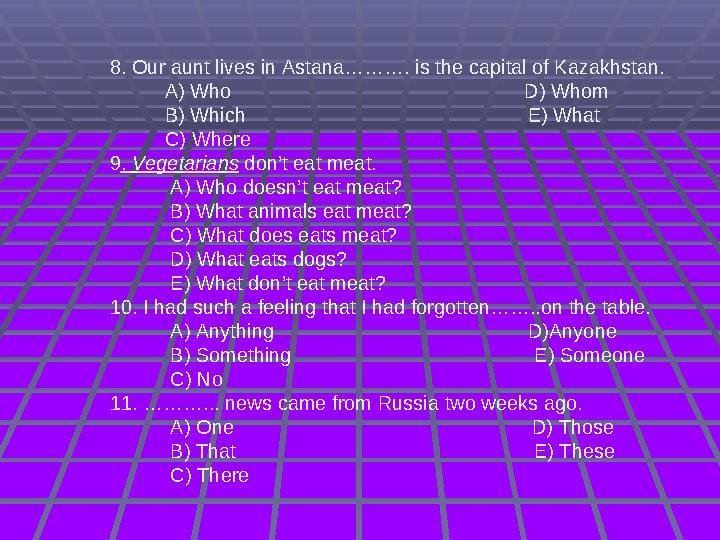
8. Our aunt lives in Astana………. is the capital of Kazakhstan.
A) Who D) Whom
B) Which E) What
C) Where
9. Vegetarians don’t eat meat.
A) Who doesn’t eat meat?
B) What animals eat meat?
C) What does eats meat?
D) What eats dogs?
E) What don’t eat meat?
10. I had such a feeling that I had forgotten……..on the table.
A) Anything D)Anyone
B) Something E) Someone
C) No
11. ………... news came from Russia two weeks ago.
A) One D) Those
B) That E) These
C) There
23 слайд
8. Our aunt lives in Astana………. is the capital of Kazakhstan. A) Who D) Whom B) Which E) What C) Where 9. Vegetarians don’t eat meat. A) Who doesn’t eat meat? B) What animals eat meat? C) What does eats meat? D) What eats dogs? E) What don’t eat meat? 10. I had such a feeling that I had forgotten……..on the table. A) Anything D)Anyone B) Something E) Someone C) No 11. ………... news came from Russia two weeks ago. A) One D) Those B) That E) These C) There
#24 слайд
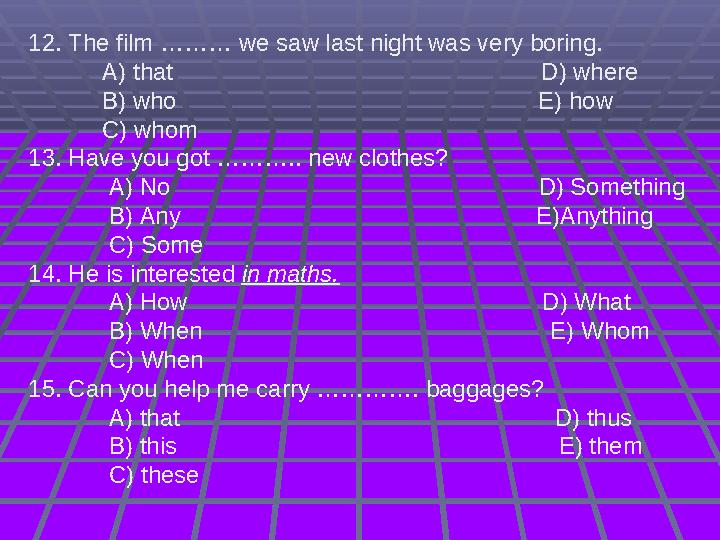
12. The film ……… we saw last night was very boring.
A) that D) where
B) who E) how
C) whom
13. Have you got ……….. new clothes?
A) No D) Something
B) Any E)Anything
C) Some
14. He is interested in maths.
A) How D) What
B) When E) Whom
C) When
15. Can you help me carry …………. baggages?
A) that D) thus
B) this E) them
C) these
24 слайд
12. The film ……… we saw last night was very boring. A) that D) where B) who E) how C) whom 13. Have you got ……….. new clothes? A) No D) Something B) Any E)Anything C) Some 14. He is interested in maths. A) How D) What B) When E) Whom C) When 15. Can you help me carry …………. baggages? A) that D) thus B) this E) them C) these

#25 слайд
25 слайд

#26 слайд
26 слайд









 Бұл курс Қазақстан Республикасы Оқу-ағарту министрлігімен келісілген










