
 ЖИ көмекші


 Қауіпсіз төлем

жүктеу мүмкіндігіне ие боласыз
Бұл материал сайт қолданушысы жариялаған. Материалдың ішінде жазылған барлық ақпаратқа жауапкершілікті жариялаған қолданушы жауап береді. Ұстаз тілегі тек ақпаратты таратуға қолдау көрсетеді. Егер материал сіздің авторлық құқығыңызды бұзған болса немесе басқа да себептермен сайттан өшіру керек деп ойласаңыз осында жазыңыз
 06 Қаңтар 2025
 242
242
1 жыл бойы шексіз жүктеңіз
10 сынып КМЖ
|
Unit 5: Reading for pleasure |
School: |
||||||
|
Date: 9 January |
Teacher name:Unit revision |
||||||
|
Grade: 10 |
Number present: |
Number absent: |
|||||
|
Theme of the lesson: |
Learners read a non-fiction text |
||||||
|
Learning objectives |
10.1.2 - use speaking and listening skills to provide sensitive feedback to peers 10.2.7 - understand speaker viewpoints and extent of explicit agreement between speakers on a range of general and curricular topics; 10.4.4 - read a wide range of extended fiction and non-fiction texts on familiar and unfamiliar general and curricular topics; |
||||||
|
Lesson objectives |
All learners will be able to: use some target language correctly in response to speaking and writing task prompts and in exchanges Most learners will be able to: use a range of target language correctly in response to speaking and writing task prompts and in exchanges Some learners will be able to: use a range of target language correctly in response to a wider range of speaking and writing task prompts and in exchanges |
||||||
|
Previous lesson |
Unit revision |
||||||
|
Plan |
|||||||
|
Planned timings |
Planned activities |
Learners’ activities |
Evaluation |
Resources |
|||
|
Begining 5 min |
GREETINGS The teacher sets the lesson objectives, letting students know what to anticipate from the lesson. Read the title of the module Reading for pleasure and ask Ss to suggest what they think the module will be about (the module is about types of literature). Go through the objectives list to stimulate Ss' interest in the module. |
|
|
|
|||
|
Middle 35 min |
To present vocabulary for types of literature; to introduce the topic • Direct Ss to the pictures. Explain that they show book covers for different types of literature. • Elicit which ones are fiction and which ones are non-fiction from Ss around the class. To talk about types of books; to present adjectives • Read out the adjectives in the list and explain/ elicit their meanings. • Then ask Ss to read the example and elicit similar sentences from Ss around the class about which books they like to read and why. Suggested Answer Key I enjoy science-fiction books as I find them thrilling and imaginative. I don't like travel books. I find them a waste of time. To read for specific information Give Ss time to read the text and answer the question. Elicit an answer from the class. To consolidate information in a text Have Ss ask and answer questions in pairs about H.G. Wells following the example. Monitor the activity around the class. Suggested Answer Key B: He worked as a shop assistant, a chemist's assistant, a teaching assistant and a teacher. What did he study at college? A: He studied biology. Who did he marry? B: He married Amy Catherine Robbins. What was his first novel? A: 'The Time Machine'. What other novels did he write? B: 'The Invisible Man' and 'The War of the Worlds'. When did he die? A: In 1946. |
Students study new vocabulary Students talk about types of books and present adjectives Learners read the text and answer the question Learners consolidate information in a text |
Mutual avaluation Individual avaluation Verbal evaluation |
|
|||
|
End 5 min |
REFLECTION At the end of the lesson, learners reflect on their learning: - What has been learned - What remained unclear - What is necessary to work on Hometask: to learn the new vocabulary Saying goodbye |
|
Self-assessment |
|
|||
|
Unit 5: Reading for pleasure |
School: |
|||||||
|
Date: |
Teacher name: |
|||||||
|
Grade: 10 |
Number present: |
Number absent: |
||||||
|
Theme of the lesson: |
Learners read a non-fiction text |
|||||||
|
Learning objectives |
10.1.4 - evaluate and respond constructively to feedback from others; 10.2.8 - recognise inconsistencies in argument in extended talk on a range of general and curricular subjects; 10.3.1 - use formal and informal language registers in talk on a wide range of general and curricular topics; 10.6.16 - use a wide variety of conjunctions on a wide range of familiar general and curricular topics |
|||||||
|
Lesson objectives |
All learners will be able to: identify some specific information and key ideas in texts and use some target language to express views and comment on some views of others with support Most learners will be able to: identify most specific information and key ideas in texts and use a range of target language to express views and comment on some views of others with support Some learners will be able to: identify all specific information and most key ideas in texts and use a range of target language to express views and comment on views of others with little support |
|||||||
|
Previous lesson |
Learners read a non-fiction text |
|||||||
|
Plan |
||||||||
|
Planned timings |
Planned activities |
Learners’ activities |
Evaluation |
Resources |
||||
|
Begining 5 min |
GREETINGS The teacher sets the lesson objectives, letting students know what to anticipate from the lesson. |
|
|
|
||||
|
Middle 35 min |
To read for specific information Explain the task and ask Ss to read the statements and then read the text and mark them according to what they read. To identify and discuss text types Ask Ss to read the theory box. Explain/Elicit the meanings of any unknown words. Then ask Ss to identify the text types in Exs 3 & 5 and justify their answers by giving reasons using the information in the theory box. To identify character development through emotions in a literary extract Give Ss time to read the extract and elicit how the characters express their fears. Suggested Answer Key The narrator expresses his fears physically by walking around and shouting (lines 4-5). Then he expresses his fear by doing something careless and dangerous (lines 42-43). He also expresses his fears by letting his imagination run wild (lines 3-4). He also expresses his fears in his description of others (lines 31-32). The curate expresses his fears physically in the way he acts like a helpless child (lines 23-24) and the way he followed the narrator (lines 25-26). He also expresses his fears verbally by trying to reassure himself (line 20). They both express their fears in their actions when they are hiding in fear, when they are too scared to move, and when they are running away (lines 36-37, 51-52). То read for specific information Ask Ss to read the questions and answer choices and give them time to read the extract again and choose their answers according to what they read. To describe a fictional object from an extract Give Ss time to read the extract again and list all the words used to describe tripods. Then ask Ss to use the words to describe a tripod to their partner. Monitor the activity around the class and then ask some Ss to tell the class. Answer Key taller than the trees and metallic, towering, long legs, Heat-Ray, metal container hanging like a workman's basket behind him |
Students read the statements and mark them according to what they read Students discuss text types Students identify character development through emotions in a literary extract Students read the questions and answer choices Students use the words to describe a tripod to their partner |
Verbal evaluation Mutual avaluation Individual avaluation Mutual avaluation
|
|
||||
|
End 5 min |
REFLECTION What was the most interesting thing that you have learnt today? Hometask: to write the description of tripods Saying goodbye |
|
Self-assessment
|
|
||||
|
|
|
|
|
|
||||
|
Unit 5: Reading for pleasure |
School: |
|||||||
|
Date:16 December |
Teacher name: |
|||||||
|
Grade: 10а,ә |
Number present: |
Number absent: |
||||||
|
Theme of the lesson: |
Learners read a non-fiction text |
|||||||
|
Learning objectives |
10.1.6 - organise and present information clearly to others; 10.3.4 - evaluate and comment on the views of others in a growing variety of talk contexts on a growing range of general and curricular topics; 10.5.2 - use a growing range of vocabulary, which is appropriate to topic and genre, and which is spelt accurately; |
|||||||
|
Lesson objectives |
All learners will be able to: identify some specific information in the listening text and use some functional language correctly in speaking and email writing task with support Most learners will be able to: identify most specific information in the listening text and use a range of functional language correctly in speaking and email writing task with support Some learners will be able to: identify all specific information in the listening text and use a range of functional language correctly in speaking and email writing task with little support |
|||||||
|
Previous lesson |
Learners read a non-fiction text |
|||||||
|
Plan |
||||||||
|
Planned timings |
Planned activities |
Learners’ activities |
Evaluation |
Resources |
||||
|
Begining 15 min |
GREETINGS The teacher sets the lesson objectives, letting students know what to anticipate from the lesson. To complete a graphic organizer Explain the task and give Ss time to complete the graphic organiser referring to the extract in Ex. 7. Then ask Ss to use their notes and suitable conjunctions to write a summary of the extract. Suggested Answer Key Characters: the narrator, the curate (the narrator's brother and cousin) Setting: an empty house in Halliford, England Main events: black smoke around house, men prisoners, Monday morning, tripod washed it away, narrator decided to leave, curate came with him, roads full of scared people, saw Martians at Kew, hid in shed, narrator sets off before dark, curate follows, saw a tripod chasing men, Martian picked them up and threw them into a metal container, froze in fear, ran for lives. The narrator and the curate are in an empty house in Halliford, England. There is black smoke around the house which makes the men prisoners. On Monday morning, a tripod washed it away and the narrator decided to leave. The curate came with him. The roads were full of scared people. They saw some Martians at Kew and they hid in a shed. Then the narrator set off again before dark. The curate followed him. They saw a tripod chasing some men. A Martian picked them up and threw them into a metal container. The narrator and the curate froze in fear and then they ran for their lives. |
Students complete the graphic organizer referring to the extract in Ex. 7. Students use their notes and suitable conjunctions to write a summary of the extract |
Verbal evaluation Individual avaluation |
|
||||
|
Middle 20 min |
To compare fiction and non-fiction Elicit comparisons from Ss around the class. Tell them to refer to the table in Ex. 6 if necessary. Suggested Answer Key The extract is about an imaginary series of events featuring fictional characters, but the biography and the review are factual about a real person and a real book. The purpose of the extract is to entertain, but the purpose of the biography and the review is to inform. The extract is in the first-person point of view, but the biography is in the third-person and the review has no person. The extract has a plot that is being advanced, but the biography and the review both contain an introduction, a main body and a conclusion. The language in the extract is very stylistic and descriptive, but the language in the biography and the review is less descriptive and plainer. |
Students do the task |
Mutual avaluation |
|
||||
|
End 10 min |
REFLECTION Students reflect on the lesson completing the sentences: Today at the lesson I … The most useful and interesting thing was … I was good / bad / active at … Hometask: to complete the Venn diagram in their notebooks Saying goodbye |
Students reflect on the lesson |
Self-assessment |
|
||||
|
Unit 5: Reading for pleasure |
School: |
||||||
|
Date: |
Teacher name: |
||||||
|
Grade: 10 |
Number present: |
Number absent: |
|||||
|
Theme of the lesson: |
Learners read a non-fiction text |
||||||
|
Learning objectives |
10.4.9 - recognise inconsistencies in argument in extended texts on a wide range of general and curricular topics; 10.5.4 - use style and register to achieve appropriate degree of formality in a growing variety of written genres on a range of general and curricular topics; 10.6.5 - use a wide variety of question types on a wide range of familiar general and curricular topics; |
||||||
|
Lesson objectives |
All learners will be able to: use some target structures accurately in more controlled and freer production tasks with some support Most learners will be able to: use most target structures accurately in more controlled and freer production tasks with some support Some learners will be able to: use most target structures accurately in more controlled and freer production tasks with little support |
||||||
|
Previous lesson |
Learners read a non-fiction text |
||||||
|
Plan |
|||||||
|
Planned timings |
Planned activities |
Learners’ activities |
Evaluation |
Resources |
|||
|
Begining 5 min |
GREETINGS The teacher sets the lesson objectives, letting students know what to anticipate from the lesson. To compare a novel with a film Ask Ss to watch the film adaptation of The War of the Worlds or rent the DVD and play it in class. If this is not feasible, ask Ss to read a plot summary for the film at and compare it to the plot of the book. Elicit answers from Ss around the class. Suggested Answer Key The film is completely different to the book in a number of ways. The characters are different. In the film, the main characters are Ray Ferrier and his children, Rachel and Robbie. In the book, the main characters are the narrator and his wife, the curate and the artilleryman. The setting is different. The film is set in the USA and the book is set in the UK. On the whole the plots are very different, but the main idea is the same that Martians come to Earth, cause lots of death and destruction and are then killed by simple bacteria. |
Students read a plot summary for the film at and compare it to the plot of the book |
Individual avaluation |
or www.imdb.com |
|||
|
Middle 35 min |
To present and practise conjunctions Ask Ss to read the theory box and then give them time to read the sentences 1-7 and choose the correct conjunction. Check Ss' answers around the class. To present, identify and practice find examples in the extract in Ex. 7. • Elicit answers from around the class and then elicit each type of figurative language used in the sentences 1-6. Answer Key Simile: like frightened animals, like a workman's basket Metaphor: he was a child, frozen with fear Personification: the Black Smoke had crept around the house 1 simile (fought like lions) 2 metaphor (bomb site) 3 personification (flowers danced) 4 personification (wind howled) 5 simile (sly as a fox) 6 metaphor (heart of stone) To read and consolidate information Ask Ss to read the novel The War of the Worlds at home. In a future lesson after Ss have read the book, ask Ss to answer the questions to test their knowledge. |
Students read the sentences 1-7 and choose the correct conjunction. Students do the task Students read the book and correct their guesses at a future time. |
Verbal evaluation Mutual avaluation |
|
|||
|
End 5 min |
REFLECTION Students reflect on the lesson answering the questions: What have you remembered on the lesson today? What was new for you? What information was interesting for you? Home task: to read the novel The War of the Worlds Saying goodbye |
|
Self-assessment |
|
|||
|
Unit 5: Reading for pleasure |
School: |
||||||
|
Date: |
Teacher name: |
||||||
|
Grade: 10 |
Number present: |
Number absent: |
|||||
|
Theme of the lesson: |
Learners read a non-fiction text |
||||||
|
Learning objectives |
10.2.8 - recognise inconsistencies in argument in extended talk on a range of general and curricular subjects; 10.4.4 - read a wide range of extended fiction and non-fiction texts on familiar and unfamiliar general and curricular topics; 10.6.16 - use a wide variety of conjunctions on a wide range of familiar general and curricular topics |
||||||
|
Lesson objectives |
All learners will be able to: use some target structures accurately in more controlled and freer production tasks with some support Most learners will be able to: use most target structures accurately in more controlled and freer production tasks with some support Some learners will be able to: use most target structures accurately in more controlled and freer production tasks with little support |
||||||
|
Previous lesson |
Learners read a non-fiction text |
||||||
|
Plan |
|||||||
|
Planned timings |
Planned activities |
Learners’ activities |
Evaluation |
Resources |
|||
|
Begining 5 min |
GREETINGS The teacher sets the lesson objectives. To practise pronunciation of situational language Pla the recording. Ss listen and repeat chorally and/or individual Pay attention to Ss’ pronunciation and intonation and correct as necessary. |
Students listen and repeat chorally and/or individual |
|
|
|||
|
Middle 35 min |
To read for gist/specific information Ask Ss to read the newspaper headlines and the extracts and say how they are related to The War of the Worlds. Suggested Answer Key The first extract is about how people believed Earth was being attacked by Martians when The War of the Worlds was first broadcast over the radio in 1938. They didn't understand it was a fictional drama. The second extract explains that the first story over exaggerates what really happened and although some people were frightened, there was no mass hysteria. To compare and contrast two news articles Ask Ss to read the news articles again and compare and contrast the presentation of the reaction to Orson Welles' version of The War of the Worlds. Elicit comparison from Ss around the class and which one Ss believe and why. Suggested Answer Key The first article presents the public reaction as hysteria with many injuries and calls to the police. The second article presents the public reaction as mild and claims that the initial reports were exaggerated. It says that some people were frightened, but not in a complete panic. It claims that the newspapers at the time misrepresented the story to make it more news worthy. I believe the report from 2011 because I think it is very possible that it made the story more exciting. I don't think people were so easily fooled by a radio programme. |
Students read the newspaper headlines and the extracts and say how they are related to The War of the Worlds Students compare and contrast two news articles |
Verbal evaluation Individual avaluation |
|
|||
|
End 5 min |
REFLECTION Reflection: “3-3-1” 3 sentences to reflect on the lesson 3 adjectives to describe the lesson 1 word about the lesson Hometask: To create a poster about how activate intelligence. Saying goodbye |
|
Self-assessment |
|
|||
|
Unit 5: Reading for pleasure |
School: |
||||||
|
Date: |
Teacher name: |
||||||
|
Grade: 10 |
Number present: |
Number absent: |
|||||
|
Theme of the lesson: |
Learners read a non-fiction text |
||||||
|
Learning objectives |
10.2.7 - understand speaker viewpoints and extent of explicit agreement between speakers on a range of general and curricular topics; 10.4.9 - recognise inconsistencies in argument in extended texts on a wide range of general and curricular topics; 10.5.2 - use a growing range of vocabulary, which is appropriate to topic and genre, and which is spelt accurately; |
||||||
|
Lesson objectives |
All learners will be able to: use some target structures accurately in more controlled and freer production tasks with some support Most learners will be able to: use most target structures accurately in more controlled and freer production tasks with some support Some learners will be able to: use most target structures accurately in more controlled and freer production tasks with little support |
||||||
|
Previous lesson |
Learners read a non-fiction text |
||||||
|
Plan |
|||||||
|
Planned timings |
Planned activities |
Learners’ activities |
Evaluation |
Resources |
|||
|
Begining 5 min |
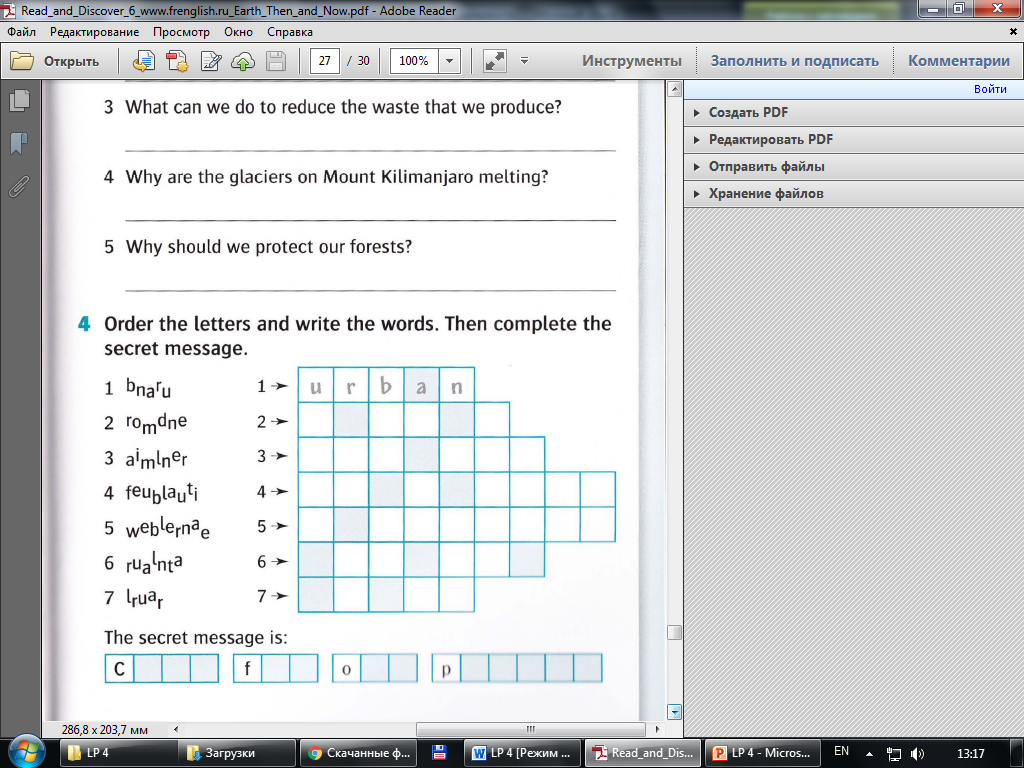
GREETINGS The teacher sets the lesson objectives, letting students know what to anticipate from the lesson. Warm up: Riddle Ss are shown the crossword, they have to complete the crossword with a word, and make a sentence out of the highlighted words. Ask sts to guess the topic of the lesson.
The secret message is “Care for our planet” |
Students are shown the crossword, they have to complete the crossword with a word, and make a sentence out of the highlighted words |
Verbal evaluation |
|
|||
|
Middle 35 min |
To compare the personalities of two characters from a literary extract Explain the task and give Ss time to formulate their answers referring to the extract in Ex. 7 and the ideas in Ex. 11 to help them. Suggested Answer Key The narrator is worried because he doesn't know where his wife is (lines 2-3 and line 11). He is also courageous (lines 42-43) because he wants to try and find her even though the Martians' deadly machines are close by. The curate, on the other hand, is selfish (line 12) because he is complaining about the situation, but he isn't helping change it. He is also childish (lines 23-24) and unable to keep calm as well as foolish because he is saying that the house is safe, when it clearly isn't (line 20). Both the narrator and the curate are scared (lines 36-37). Express an opinion Ask various Ss around the class to tell the rest of the class how they would represent the story if they were to film the story today in their country. Suggested Answer Key I would keep it very closely to the original story. The main characters would be the narrator, another man like the curate, but perhaps he would be a farmer or a villager instead of a type of priest. The place would be a country village and a large city as in the book and I would include a lot of special effects for the aliens. The plot would be the same as the book with only a few changes to make it more relevant to the present day. The Martians would be aliens from another planet because we know a lot more about Mars these days and we know there are no Martians. They would still have weapons like the Heat-Ray and the Black Smoke because these are still very scary. However, the ending would be the same as it is logical that bacteria could kill aliens. |
Students compare the personalities of two characters from a literary extract Students do the task |
Mutual avaluation Individual avaluation |
|
|||
|
End 5 min |
REFLECTION Describe a mistake you made and what learned from it? Explain how you challenged yourself today? Tell about something you noticed today? Hometask: to finish your story Saying goodbye |
|
Self-assessment |
|
|||
|
Unit 6: Capabilities of Human Brain |
School: |
|||||||||||
|
Date: |
Teacher name: |
|||||||||||
|
Grade: 10 |
Number present: |
Number absent: |
||||||||||
|
Theme of the lesson: |
Capabilities of Human Brain |
|||||||||||
|
Learning objectives |
10.S2 ask and respond to complex questions to get information about a wide range of general and curricular topics 10.R4 read a wide range of extended fiction and non-fiction texts on familiar and unfamiliar general and curricular topics 10.C6 organise and present information clearly to others |
|||||||||||
|
Lesson objectives |
use subject-specific vocabulary in the context of discussion interact with peers and get information about particular topic using active vocabulary read for gist an detail |
|||||||||||
|
Criteria |
practice usage of active vocabulary in discussions practice reading skills develop critical thinking through reading and discussions |
|||||||||||
|
Previous lesson |
Learners read a non-fiction text |
|||||||||||
|
Plan |
||||||||||||
|
Planned timings |
Planned activities . |
Learners’ activities |
Evaluation |
Resources |
||||||||
|
Begining 5 min |
GREETINGS Module Objectives Read the title of the module The human brain and ask Ss to suggest what they think the module will be about (the module is about capabilities of the human brain and stress and advice). Go through the objectives list to-stimulate Ss' interest in the module. Ss write dictation on the following sentence: It’s the most complex object in the known universe. |
Students answer |
|
|
||||||||
|
Middle 35 min |
Ss are asked to tell the t everything they know about the brain. All ideas and thoughts are written up on the board. These prompts are used to get the ideas flowing: size, weight, colour, human brain versus animal brains Ss are given “Use your brain worksheet”. Ss do the quiz individually first. Then, they compare answers in small groups. The groups should try and agree on one answer for each question. Ss check the answers with the class. Which group got the most correct answers? Do the answers to the quiz help to determine whether the information on the board is correct or not? Which information in the quiz did ss find the most surprising? Ss are told that the brain has a left side and a right side, and that experiments suggest they control different thigs. Ss look at the board and explain what those words mean and guess which things are controlled by which side of the brain Ss are told that, in most people, one side of the brain is dominant. Ss read the 12 statements and guess if the statements are true or false Ss are pointed towards the Phrasebook. Ss have discussion on their results in small groups, using the language. Pre-reading Students look at the title “The creative path” and say what the text is going to be about. Introduce unknown vocabulary from the text by explaining the definitions. Reading Divide the class into 3 groups. Each group gets its own piece of passage of the text. Organize jigsaw reading. All Students read the text. Post-reading Students answer multiple choice and open-ended questions. Students work individually then compare their answers in pairs. Open class feedback and discussion. |
Students decide if the information on the board is definitely true, probably true or possibly true Students follow the instructions |
Verbal evaluation Mutual avaluatioт Individual avaluation |
|
||||||||
|
End 5 min |
REFLECTION At the end of the lesson, learners reflect on their learning: - What has been learned - What remained unclear - What is necessary to work on Home task: to answer the questions by the text Saying goodbye |
|
Self-assessment |
|
||||||||
|
Unit 6: Capabilities of Human Brain |
School: |
|||||||||||
|
Date: |
Teacher name: |
|||||||||||
|
Grade: 10 |
Number present: |
Number absent: |
||||||||||
|
Theme of the lesson: |
Investigate and report on the functions of the brain |
|||||||||||
|
Learning objectives |
10.S2 ask and respond to complex questions to get information about a wide range of general and curricular topics 10.R4 read a wide range of extended fiction and non-fiction texts on familiar and unfamiliar general and curricular topics 10.W5 develop with support coherent arguments supported when necessary by examples and reasons for a wide range of written genres in familiar general and curricular topics |
|||||||||||
|
Lesson objectives |
read the text for gist and specific details watch the video for specific details discuss the different ideas |
|||||||||||
|
Criteria |
Identify the main idea and specific details of the text correctly Identify specific details of the video correctly Provide your argument on the topic and give reasons |
|||||||||||
|
Previous lesson |
Capabilities of Human Brain |
|||||||||||
|
Plan |
||||||||||||
|
Planned timings |
Planned activities |
Learners’ activities |
Evaluation |
Resources |
||||||||
|
Begining 5 min |
GREETINGS Lead-in: T asks students the following questions: what is CREATIVITY? Students discuss what is CREATIVITY, give their own definition, examples and non-examples, and characteristics in pairs or small groups, followed by open class discussion. What is being creative? Get feedback from your students, ask them if they agree with what the film says about creativity. |
Students watch a short film titled and discussion |
|
|
||||||||
|
Middle 35 min |
Speaking Show learners a poster of a famous cartoon Wallace and Gromit and elicit what they know about them. Tell learners that they are going to watch an episode of this cartoon. Tell that in the episode they will see an invention called “SNOOZATRON”, Students should watch the video and discuss in groups what is that invention (description, functions, advantages and disadvantages) Students brainstorm a list of possible new inventions with their group. List all ideas and make notes about what they do. As a group, students choose one of the inventions from their list then draw a picture of the invention. Learners have to fill out the first column (what I know) of KWL chart. They write what they already know about the brain. Cut the text into 4 parts. Label the first paragraph A, the second paragraph B, the third paragraph C, the fourth paragraph D. Put the students into groups and distribute the reading strips. Group learners with the same letter text together so they can preview and read the text together. After reading learners in each group fill in the 3-rd column of (what I learnt) chart. Regroup the class into three new groups so that each new group has a student who has read each paragraph. So, group1 should have an A, B, and a C, and D. Learners elicit information from each other and share ideas from each of the paragraphs. While discussing each learner fills out the 3-d column (what I learnt) of KWL chart. Check answers with the class Pre-project work “Create Your Own Invention” Students individually think of simple products, machines, or devices in their life and make a list of everyday inventions that make life more convenient or better than it was in the past. |
Students discuss the question in small groups. Students follow the instructions Students design a new invention and complete the handout 3. |
Mutual avaluatioт Verbal evaluation Individual avaluation |
|
||||||||
|
End 5 min |
REFLECTION At the end of the lesson, learners reflect on their learning: - What has been learned - What remained unclear - What is necessary to work on Hometask: Students present the idea of their project to the class Open class feedback Saying goodbye |
|
Self-assessment |
|
||||||||
|
Unit 6: Capabilities of Human Brain |
School: |
||||||
|
Date: |
Teacher name: |
||||||
|
Grade: 10 |
Number present: |
Number absent: |
|||||
|
Theme of the lesson: |
Investigate and report on the functions of the brain |
||||||
|
Learning objectives |
10.C10 use talk or writing as a means of reflecting on and exploring a range of perspectives on the world topics 10.R2 understand specific information and detail in extended texts on a range of familiar general and curricular topics, and some unfamiliar topics |
||||||
|
Lesson objectives |
All learners will be able to: Use adjectives to describe films Define types of films to the pictures Most learners will be able to: Add more adjectives to pictures Write film reviews inventing details Some learners will be able to: write film reviews of imaginary films with few grammar mistakes |
||||||
|
Criteria |
Learners: use specific vocabulary on the theme speak and write coherently on the theme |
||||||
|
Previous lesson |
Investigate and report on the functions of the brain |
||||||
|
Plan |
|||||||
|
Planned timings |
Planned activities |
Learners’ activities |
Evaluation |
Resources |
|||
|
Begining 5 min |
GREETINGS The teacher sets the lesson objectives, letting students know what to anticipate from the lesson. Warm-up: Draw a noughts and crosses grid on the board. Divide the class into two teams. One team is X and the other O. The first team decides which square they want to nominate. Teacher asks a question. If the team get it right their symbol is written in that square. The first team to get a line of three symbols in any direction across the grid is the winner. |
Students do the task |
Verbal evaluation |
|
|||
|
Middle 35 min |
Brainstorming Divide learners in pairs. Ask them to revise information on multiple intelligences from the previous lessons. Have a whole class discussion. Teacher puts all ideas on the whiteboard. Show learners a task. Give them time to brainstorm Learners read the text “Your body: the brain” and decide if the statements are True or False. Learners are given worksheets where they color lobes of the brain and write their functions. Learners are divided into groups of four. Each group is given a copy of the Why Do Zombies Love Brains worksheet. Learners read the interesting facts about the brain and ponder upon the areas responsible for different things by looking and reflecting at the picture with their group. Learners write the ideas that they found most interesting about the brain from the worksheet and explain why. Go around the class and ask them to share what they wrote. Planning Ask them to plan Introduction. Give them 7 minutes to write the Introduction part of the essay. |
Students create a poster. Students read the text and choose True or False statements. Students should align their information with paragraphs of the essay. |
Mutual avaluation Individual avaluation |
|
|||
|
End 5 min |
REFLECTION Students reflect on the lesson answering the questions:
Hometask: to complete writing a short essay according the plan Saying goodbye |
|
Self-assessment |
|
|||
|
Unit 6: Capabilities of Human Brain |
School: |
||||||
|
Date: |
Teacher name: |
||||||
|
Grade: 10 |
Number present: |
Number absent: |
|||||
|
Theme of the lesson: |
Investigate and report on the functions of the brain |
||||||
|
Learning objectives |
1. read a wide range of extended fiction and non-fiction texts on familiar and unfamiliar general and curricular topics 2. recognise patterns of development in lengthy texts [inter-paragraph level] on a range of general and curricular topics |
||||||
|
Lesson objectives |
All learners will be able to: Summarize information of each paragraph Most learners will be able to: Make up questions for a text Some learners will be able to: |
||||||
|
Criteria |
Learners: Identify the main idea Underline key words Write 2-3 sentence summary of each paragraph Construct questions |
||||||
|
Previous lesson |
Investigate and report on the functions of the brain |
||||||
|
Plan |
|||||||
|
Planned timings |
Planned activities . |
Learners’ activities |
Evaluation |
Resources |
|||
|
Begining 5 min |
GREETINGS The teacher sets the lesson objectives, letting students know what to anticipate from the lesson. Ss try to guess the theme of the lesson. They read the sentences on the board and guess that they will work with the Physical structure of the human brain |
|
|
|
|||
|
Middle 35 min |
1 a) To present vocabulary related to the physical structure of the human brain Ask Ss to talk in pairs about the meanings of the words /phrases in the list.Tell Ss to check the meanings of any they are unsure of in their dictionaries. 1 b) To predict the content of the text; to listen and read for gist Explain that our brain is divided into two hemispheres (left, right) each one controlling different tasks/skills. 2 To read for specific information • Ask Ss to read the statements 1-8 and then give Ss time to read the text and mark the statements according to what they read. • Ss compare their answers with their partner. • Refer Ss to the Check these words box and ask Ss to look them up in the Word List. • Play the video for Ss and elicit their comments. 3. To consolidate information in a text Give Ss time to answer the questions referring to the text as necessary and then elicit Ss’ answers. 4. To consolidate new vocabulary Go through the list of words in the rubric and give Ss time to match them to the highlighted words in the text. Tell Ss they may use their dictionaries if necessary. Check Ss' answers. Answer Key regulates = controls complex = complicated senses = the five physical abilities (touch, taste, sight, smell & hearing) dominant = more powerful function = purpose handle = deal with/manage |
Students present vocabulary related to the physical structure of the human brain Students guesses in answer to the questions in the rubric. Students read the text and mark the statements according to what they read. Students answer the questions referring to the text Students match them to the highlighted words in the text. |
Verbal evaluation Mutual avaluation Individual avaluation Verbal evaluation |
|
|||
|
End 5 min |
REFLECTION The teacher throws a ball and asks learners to share what was useful, what was difficult, what is worth remembering. Hometask: to learn new vocabulary Saying goodbye |
|
Self-assessment |
|
|||
|
Unit 6: Capabilities of Human Brain |
School: |
||||||
|
Date: |
Teacher name: |
||||||
|
Grade: 10 |
Number present: |
Number absent: |
|||||
|
Theme of the lesson: |
Multiple intelligences (self-study project) |
||||||
|
Learning objectives |
10.3.7 - use appropriate subject-specific vocabulary and syntax to talk about a range of general and curricular topics; 10.6.17 - use if / if only in third conditional structures use a variety of relative clauses including with which [whole previous clause reference] on a wide range of familiar general and curricular topics 10.5.2 - use a growing range of vocabulary, which is appropriate to topic and genre, and which is spelt accurately; 10.5.3 - write with grammatical accuracy on a range of familiar general and curricular topics; |
||||||
|
Lesson objectives |
All learners will be able to: use some target structures accurately in more controlled and freer production tasks with some support Most learners will be able to: use most target structures accurately in more controlled and freer production tasks with some support Some learners will be able to: use most target structures accurately in more controlled and freer production tasks with little support |
||||||
|
Previous lesson |
Multiple intelligences (self-study project) |
||||||
|
Plan |
|||||||
|
Planned timings |
Planned activities . |
Learners’ activities |
Evaluation |
Resources |
|||
|
Begining 5 min |
GREETINGS The teacher sets the lesson objectives, letting students know what to anticipate from the lesson. To practise pronunciation of situational language Play the recording. Ss listen and repeat chorally and/or individual Pay attention to Ss’ pronunciation and intonation and correct as necessary. |
|
|
|
|||
|
Middle 35 min |
Grammar To present relative clauses Explain that a defining relative clause gives necessary information and is essential to the meaning of the main sentence. We do not put the clause in commas, e.g. The man who fixed my car was very tall. Which man is tall? The one who fixed my car.) Explain that a non-defining relative clause gives extra information and is not essential to the meaning of the main sentence. The clause is put in commas. We cannot use that instead of who. E.g. Ben, who is my ractice, is noisy. (Ben is noisy – the meaning of the sentence is clear; who is my ractice – gives extra information.) Ask Ss to Refer Ss to the Grammar Reference section for more details. To practice defining/non-defining relative clauses Explain the task and give Ss time to complete it. Speaking & Writing To conduct a survey, interview classmates and prepare a poster • Explain the task and give Ss time to conduct a survey by interviewing their classmates about their type of intelligence with reasons. • Give Ss time to compile their information and create a poster. Tell Ss they may include a chart or a diagram to display the information. • Then display the posters around the classroom. |
Students read the theory box and then elicit examples from the text. Students complete the task Students conduct a survey by interviewing their classmates about their type of intelligence with reasons. |
Verbal evaluation Mutual avaluatio Individual avaluation |
|
|||
|
End 5 min |
REFLECTION Students reflect on the lesson completing the sentences: Today at the lesson I … The most useful and interesting thing was … I was good / bad / active at … Hometask: To write a biography Explain the task and ask Ss to go online arc research information about Howard Gardner For the next lesson will check Ss' answers Saying goodbye |
|
Self-assessment |
|
|||
|
Unit 6: Capabilities of Human Brain |
School: |
||||||
|
Date: |
Teacher name: |
||||||
|
Grade: 10 |
Number present: |
Number absent: |
|||||
|
Theme of the lesson: |
Describing the symptoms of stress and giving advice on how to reduce stress |
||||||
|
Learning objectives |
10.2.2 - understand specific information in unsupported extended talk on a wide range of general and curricular topics, including talk on a limited range of unfamiliar topics; 10.5.2 - use a growing range of vocabulary, which is appropriate to topic and genre, and which is spelt accurately; 10.6.1 - use a variety of abstract compound nouns and complex noun phrases on a range of familiar general and curricular topics, and some unfamiliar general and curricular topics; 10.4.2 - understand specific information and detail in extended texts on a range of familiar general and curricular topics, and some unfamiliar topics; |
||||||
|
Lesson objectives |
All learners will be able to: identify some specific information and key ideas in texts and use some target language to express views and comment on some views of others with support Most learners will be able to: identify most specific information and key ideas in texts and use a range of target language to express views and comment on some views of others with support Some learners will be able to: identify all specific information and most key ideas in texts and use a range of target language to express views and comment on views of others with little support |
||||||
|
Previous lesson |
Multiple intelligences (self-study project) |
||||||
|
Plan |
|||||||
|
Planned timings |
Planned activities . |
Learners’ activities |
Evaluation |
Resources |
|||
|
Begining 5 min |
GREETINGS The teacher sets the lesson objectives, letting students know what to anticipate from the lesson. To practise subject-specific vocabulary Give Ss time to complete the sentences using the words. Check Ss' answers around the class. |
Students complete the sentences using the words. |
Individual avaluation |
|
|||
|
Middle 35 min |
To listen and read for specific information Have Ss read the sentences again. Play the recording. Ss listen and follow the text in their books and find out which of the sentences in Ex.1 are true. • Check Ss' answers. Background information Alzheimer's disease is a progressive brain damaging illness that slowly destroys memory and thinking skills. In most people suffering from this disease, symptoms appear after the age of 60. 3. To read for specific information Ask Ss to read questions 1-3 and the possible answers and give them time to read the text again and choose the correct answers. Check Ss' answers around the class. Ss should justify their answers. To answer comprehension questions based on a text Give Ss time to answer the questions without copying the information straight from the text. Check Ss’ answers around the class. To identify abstract and compound nouns Explain that an abstract noun is the name of something that is not concrete or tangible (e.g. emotion, intelligence) and that a compound noun is the name of something that is made up of two words that have been put together (e.g. blackboard, swimming pool). To research and write a paragraph about stress. Explain the task and ask Ss to work in small groups and collect information from the Internet. Then ask Ss to use their notes to write a paragraph about it. Ask various Ss to read their text to the class. |
Students listen and follow the text in their books and find out which of the sentences in Ex.1 are true Students read the text again and choose the correct answers Students answer the questions Students identify abstract and compound nouns Students research and write a paragraph about stress |
Mutual avaluation Verbal evaluation Individual avaluation Verbal evaluation Individual avaluation |
|
|||
|
End 5 min |
REFLECTION What was the most interesting thing that you have learnt today? Hometask: to finish your writing Saying goodbye |
|
Self-assessment |
|
|||
|
Unit 6: Capabilities of Human Brain |
School: |
||||||
|
Date: |
Teacher name: |
||||||
|
Grade: 10 |
Number present: |
Number absent: |
|||||
|
Theme of the lesson: |
Describing the symptoms of stress and giving advice on how to reduce stress |
||||||
|
Learning objectives |
10.6.9 - use appropriately a wide variety of active and passive simple present and past forms and past perfect simple forms in narrative and reported speech on a wide range of familiar general and curricular topics; 10.3.7 - use appropriate subject-specific vocabulary and syntax to talk about a range of general and curricular topics; 10.5.5 - develop with support coherent arguments supported when necessary by examples and reasons for a wide range of written genres in familiar general and curricular topics; |
||||||
|
Lesson objectives |
All learners will be able to: identify some key ideas from listening and plan and write an email recounting some experiences with support Most learners will be able to: identify most key ideas from listening and plan and write an email recounting a range of experiences with support Some learners will be able to: identify all key ideas from listening and plan and write an email recounting a range of experiences with little support |
||||||
|
Previous lesson |
Describing the symptoms of stress and giving advice on how to reduce stress |
||||||
|
Plan |
|||||||
|
Planned timings |
Planned activities . |
Learners’ activities |
Evaluation |
Resources |
|||
|
Begining 5 min |
GREETINGS The teacher sets the lesson objectives, letting students know what to anticipate from the lesson. To identify and revise the passive Explain that to form the passive we use the verb to be and the past participle of the main verb. Elicit that the subject of the active sentence becomes the agent (the person doing the action) and is introduced with by. Explain that the passive sentence gives emphasis to the action rather than the person who does it. Then elicit the passive forms in the text. Check Ss' answers and refer them to the Grammar Reference section for more information. |
Students revise the passive |
|
|
|||
|
Middle 35 min |
GRAMMAR To practise the passive Explain the task and give Ss time to complete it. Check Ss' answers. To present type 3 Conditional Ask Ss to read the examples. Explain/Elicit that we form type 3 conditional with if/when + past perfect + would have + past participle and that we use it to talk about an unreal situation in the past. Refer Ss to the Grammar Reference section for more information. To practise the type 3 Conditional Explain the task and give Ss time to complete it. Check Ss' answers. Listening To listen for specific information Explain the task and ask Ss to read the statements (A-E) and then play the recording. Play the recording. Ss listen and complete the task. Check Ss' answers. Speaking & Writing To talk about reducing stress Read the rubric aloud and elicit answers from Ss around the class. |
Students complete the task Students Study and make the sentences Students do the task Students listen and complete the task. Students talk about reducing stress |
Individual avaluation Verbal evaluation Mutual avaluation Individual avaluation Mutual avaluation |
|
|||
|
End 5 min |
REFLECTION Students reflect on the lesson completing the sentences: Today at the lesson I … The most useful and interesting thing was … I was good / bad / active at … Hometask: To write a paragraph about reducing stress Explain the task and give Ss time to research online for other ways to reduce stress and write a short paragraph about it. Saying goodbye |
|
Self-assessment |
|
|||
|
Unit 6: Capabilities of Human Brain |
School: |
||||||
|
Date: |
Teacher name: |
||||||
|
Grade: 10 |
Number present: |
Number absent: |
|||||
|
Theme of the lesson: |
Describing the symptoms of stress and giving advice on how to reduce stress |
||||||
|
Learning objectives |
10.2.7 Understand speaker viewpoints and extent of explicit agreement between speakers on a range of general and curricular topics 10.3.2 Ask and respond to complex questions to get information about a wide range of general and curricular topics 10.6.16 Use a wide variety of conjunctions on a wide range of familiar general and curricular topics |
||||||
|
Lesson objectives |
All learners will be able to: Identify speaker’s opinion in an extended talk between speakers on a range of general and curricular topics Ask and answer complex questions Apply a range of conjunctions on a wide range of familiar general and curricular topics |
||||||
|
Previous lesson |
Describing the symptoms of stress and giving advice on how to reduce stress |
||||||
|
Plan |
|||||||
|
Planned timings |
Planned activities . |
Learners’ activities |
Evaluation |
Resources |
|||
|
Begining 5 min |
GREETINGS The teacher sets the lesson objectives, letting students know what to anticipate from the lesson. Warm up: Sts are sitting in 3 groups. Each group is given a set of cards; they have to find what all these words have in common, and all together guess the topic of the lesson Set 1: symptoms of stress Set 2: causes of stress Set 3: therapy of stress |
Students follow the instructions |
|
|
|||
|
Middle 30 min |
Jigsaw Reading: Get stressed, Stay young Divide sts into 3 groups of 4, each student is given a paragraph of one text. Sts read their part of the text and then retell it to other members of their team. Explain sts that they should retell their part of the text paying attention to the details, as later they will do a short quiz on checking the main idea. Having retold the text sts do a quiz as a team. They have to answer 4 questions that are presented on the board. They read the question write the letter of the right option on the sticker and show it to the class. Correct answers are presented in PPT. Vocabulary Sts are asked to remember all expressions with “take”. The first team tells one expression with “take” and gives the definition of it, if it’s correct definition- the team receives the points. Then the second and third teams continue in the same way until all the words are revised. Writing Bizarre and interesting ways of relieving stress. Sts are supposed to write an advice column for a magazine. Example is shown on the board in PPT. Try to convince your readers that your advice really works. No more than 2-3 methods. To read for gist Read the quotation aloud and elicit what Ss can infer about his personality from it. Play the recording. Suggested Answer Key I think that he must have been clever and he must have believed that by working really hard you can achieve your goals. To read for comprehension Ask Ss to read the headings (A-H) and give them time to read the text again and match them to the paragraphs (1-7). Check Ss' answers and ask them to give reasons for their choices. Refer Ss to the Check these words box and ask Ss to look them up in the l/Word List. |
Students do the task Students remember all expressions with “take”. Students do the task Students listen, follow the text in their books and find out. Students read the text again and match them to the paragraphs |
Individual avaluation Verbal evaluation Mutual avaluatio |
|
|||
|
End 5 min |
Plenary: Have you succeeded in…? Hometask: Learners should present information with visual support on the following topics: Brain parts/Brain function/The neural structure of the brain Saying goodbye |
|
Self-assessment |
|
|||
|
Unit 7: Breakthrough technologies |
School: |
||||||||||||
|
Date: |
Teacher name: |
||||||||||||
|
Grade: 10 |
Number present: |
Number absent: |
|||||||||||
|
Theme of the lesson: |
Breakthrough technologies |
||||||||||||
|
Learning objectives |
10.5.2 - use a growing range of vocabulary, which is appropriate to topic and genre, and which is spelt accurately; 10.3.2 - ask and respond to complex questions to get information about a wide range of general and curricular topics; 10.1.8 - develop intercultural awareness through reading and discussion; 10.3.7 - use appropriate subject-specific vocabulary and syntax to talk about a range of general and curricular topics; |
||||||||||||
|
Lesson objectives |
All learners will be able to: Listen and read for gist, read for specific information, Most learners will be able to: Listen and read for gist, read for specific information, get an overview of a module Some learners will be able to: Listen and read for gist, read for specific information, talk about forms of module |
||||||||||||
|
Assessment criteria |
Learners have met the learning objective if they can: talk about entertainment |
||||||||||||
|
Previous lesson |
Unit revision |
||||||||||||
|
Plan |
|||||||||||||
|
Planned timings |
Planned activities . |
Learners’ activities |
Evaluation |
Resources |
|||||||||
|
Begining 5 min |
GREETINGS The teacher sets the lesson objectives, letting students know what to anticipate from the lesson. Lead-in: Students have to define the meaning of the word: “nano”. Students elicit the meaning of the word: “nano”. What is “nano”? What are “nano” participles? What do you know about nanotechnology? Students are introduced with the lesson objectives and assessment criteria. Vocabulary To introduce new vocabulary Direct Ss' attention to the pictures and ask them to read the texts next to each one. Go through the words in the list and explain/elicit the meanings of any unknown words. |
Students try to answer the following questions Students introduce new vocabulary |
Verbal evaluation |
|
|||||||||
|
Middle 35 min |
OVER TO YOU! To talk about a major breath express a personal opinion Elicit answers to the questions in from various Ss around the class. Give Ss time to complete the texts. Check Ss' answers. Background information Alexander Fleming (1881-1955) was a Sc biologist and pharmacologist. Nikola Tesla (1856-1943) was a Serbian-Am inventor, physicist, mechanical engineer electrical engineer. His work helped form the for the invention of radio communication. Yuri Gagarin (1934-1968) was a Soviet cosmonaut. He was the first human to journey into outer Discussion: What is nanotechnology? What is the importance of nanotechnology nowadays? What industries and worlds do nano-technology applications open up for human? What is the importance of nanoparticles in drug delivery? What changes have been done in the fabrics? |
Students do the task Students discuss the questions and answer Students create their own questions for other students. |
Mutual avaluatio Individual avaluation |
|
|||||||||
|
End 5 min |
REFLECTION At the end of the lesson, learners reflect on their learning: - What has been learned - What remained unclear - What is necessary to work on Hometask: read the text at page 84 and choose the correct answer Saying goodbye |
|
Self-assessment |
|
|||||||||
|
Unit 7: Breakthrough technologies |
School: |
||||||||||||
|
Date: |
Teacher name: |
||||||||||||
|
Grade: 10 |
Number present: |
Number absent: |
|||||||||||
|
Theme of the lesson: |
Nanotechnology |
||||||||||||
|
Learning objectives |
10.1.3 - respect differing points of view; 10.2.3 - understand the detail of an argument in unsupported extended talk on a wide range of general and curricular topics, including talk on a limited range of unfamiliar topics; 10.3.2 - ask and respond to complex questions to get information about a wide range of general and curricular topics; |
||||||||||||
|
Lesson objectives |
All learners will be able to: Listen and read for gist, read for specific information, Most learners will be able to: Listen and read for gist, read for specific information, get an overview of a module Some learners will be able to: Listen and read for gist, read for specific information, talk about forms of module |
||||||||||||
|
Assessment criteria |
Learners have met the learning objective if they can: talk about water attractions and write a blog entry |
||||||||||||
|
Previous lesson |
Breakthrough technologies |
||||||||||||
|
Plan |
|||||||||||||
|
Planned timings |
Planned activities . |
Learners’ activities |
Evaluation |
Resources |
|||||||||
|
Begining 5 min |
GREETINGS Warming-up Divide learner into 3 groups. Have them discuss 3 quotations about the use of nanotechnologies. Give each group 5 minutes to discuss and come up with ideas. After small group discussion, one representative from each group can share the ideas of their own groups. |
Students follow the instruction |
|
|
|||||||||
|
Middle 35 min |
Vocabulary & Reading To introduce key vocabulary and predict the content of the text Go through the words/phrases in the list and explain/elicit their meanings. Elicit Ss' guesses as to what the text may be about. Play the recording. Ss listen, read and check. Listen and read for specific information Ask Ss to read questions 1-6 and possible answers. Check Ss' answers and ask them to justify them. Answer Key 1D (microscopic robot... device) 2A (understand its surrounding environment, make decisions and move automatically) 3В (a possible walking distance of around 100 nanometres) 4A (One day, people could live ... with miniature robot surgeons ... protecting the insides of their bodies.) 5C (most of these concerns are over safety regulations ... would like further tests to be carried out on products before they are allowed to enter the market) 6C (these microscopic robots ... will allow treatments to be given that are currently impossible) Refer Ss to the Check these words box and ask Ss to look them up in the Word List. Play the video for Ss and elicit their comments. To express an opinion Ask Ss to discuss the question in pairs and justify their opinions with reasons. Then ask various Ss around the class to tell the rest of the class. To consolidate new vocabulary Explain the task. Give Ss time to fill in the gaps to complete the phrases. Then, ask Ss to write sentences using the phrases. Check Ss' answers around the class. |
Students introduce key vocabulary and predict the content of the text Students listen and read the text again and choose the correct answers. Students discuss the question in pairs and justify their opinions with reasons Students write sentences using the phrases. |
Verbal evaluation Individual avaluation Mutual avaluatio |
|
|||||||||
|
End 5 min |
REFLECTION At the end of the lesson, learners reflect on their learning: - What has been learned - What remained unclear - What is necessary to work on Hometask: to write about unusual ways to travel to see the capital city and present your work to the class to the next lesson. Saying goodbye |
|
Self-assessment
|
|
|||||||||
|
Unit 7: Breakthrough technologies |
School: |
||||||||||||
|
Date: |
Teacher name: |
||||||||||||
|
Grade: 10 |
Number present: |
Number absent: |
|||||||||||
|
Theme of the lesson: |
Nanotechnology |
||||||||||||
|
Learning objectives |
10.6.11 - use a variety of reported statements and question forms on a wide range of familiar general and curricular topics; 10.1.3 - respect differing points of view; 10.5.9 - punctuate written work at text level on a wide range of general and curricular topics with a good degree of accuracy; 10.3.2 - ask and respond to complex questions to get information about a wide range of general and curricular topics; |
||||||||||||
|
Lesson objectives |
All learners will be able to: Listen and read for gist, read for specific information, Most learners will be able to: Listen and read for gist, read for specific information, get an overview of a module Some learners will be able to: Listen and read for gist, read for specific information, talk about forms of module |
||||||||||||
|
Assessment criteria |
Learners have met the learning objective if they can: talk about types of media, past events |
||||||||||||
|
Previous lesson |
Nanotechnology |
||||||||||||
|
Plan |
|||||||||||||
|
Planned timings |
Planned activities . |
Learners’ activities |
Evaluation |
Resources |
|||||||||
|
Begining 5 min |
GREETINGS The teacher sets the lesson objectives, letting students know what to anticipate from the lesson. |
|
|
|
|||||||||
|
Middle 35 min |
Grammar To revise/practise reported speech Explain the task and read out the example. Explain how tenses and pronouns change from direct to reported speech. Refer Ss to the Grammar Reference section for more details. Answer Key 2 Ulan told me that he had just found a job working in a science lab. 3 He said that they would soon have enough money to buy a more powerful computer. 4 He asked her if/whether she was going to visit the Science Museum the following weekend. 5 Damir asked me how long Dana had been working for a company that designed robots. 6 She told me that she had read an article al artificial intelligence the day before. To express an opinion Read the rubric aloud and ask various Ss aro the class to share their opinions with the res the class. Suggested Answer Key I think that a positive impact will come from robots who help people with household chores, especially the elderly and the disabled. I think that industrial robots and robots that do tasks that hum currently earn their living from will have a negative impact because these people will lose their jobs and their income. Speaking & Writing To identify the main idea; To summarise a text Give Ss time to look through the text ag; and find the main idea in each paragraph. / Ss to make notes and then give Ss time to i their notes to summarise the text. Remind that they should use their own words wh writing the summary as much as possible. Ask various Ss around the class to read the summary to the rest of the class. |
Students complete the task and then check answers around the class. Students do the task Students summarise a text |
Mutual avaluation Verbal evaluation Individual avaluation |
|
|||||||||
|
End 5 min |
REFLECTION Students reflect on the lesson answering the questions:
Hometask: Workbook: 7b & Use of English 7 Saying goodbye |
|
Self-assessment
|
|
|||||||||
|
Unit 7: Breakthrough technologies |
School: |
||||||
|
Date: |
Teacher name: |
||||||
|
Grade: 10 |
Number present: |
Number absent: |
|||||
|
Theme of the lesson: |
Nanotechnology |
||||||
|
Learning objectives |
10.2.3 - understand the detail of an argument in unsupported extended talk on a wide range of general and curricular topics, including talk on a limited range of unfamiliar topics; 10.1.8 - develop intercultural awareness through reading and discussion; 10.5.7 - use independently appropriate layout at text level on a range of general and curricular topics; |
||||||
|
Lesson objectives |
All learners will be able to: Listen and read for gist, read for specific information, Most learners will be able to: Listen and read for gist, read for specific information, get an overview of a module Some learners will be able to: Listen and read for gist, read for specific information, talk about forms of module |
||||||
|
Assessment criteria |
Learners have met the learning objective if they can: talk about types of media, past events |
||||||
|
Previous lesson |
Nanotechnology |
||||||
|
Plan |
|||||||
|
Planned timings |
Planned activities . |
Learners’ activities |
Evaluation |
Resources |
|||
|
Begining 5 min |
GREETINGS The teacher sets the lesson objectives, letting students know what to anticipate from the lesson. |
|
|
|
|||
|
Middle 35 min |
To introduce the topic Direct Ss' attention to the definition. Ask them to read it and then ask some Ss to tell the class. Listening To listen and read for specific information Read the actions aloud and ask Ss to discuss in pairs which ones they think the robot in the picture can do. Ss listen, read and check. To read for specific information Explain the task and ask Ss to read the questions and answer choices and then read the text again and choose their answers. Refer Ss to the Check these words box and ask Ss to look them up in the Word List. Play the video for Ss and elicit their comments. То consolidate information in a text Give Ss time to answer the questions, referring to the text as necessary. Check Ss' answers. Answer Key 1 A humanoid robot is a robot that looks a bit like a person. 2 It's got two wheels to move around on. 3 Pepper robots work there as receptionists. Some upgraded models can also do hospital jobs like greeting new patients and showing them where to go, and can work with sick children to cheer them up and help them do exercise. To express an opinion Give Ss time to consider their answers and then ask various Ss around the class to share their answers with the rest of the class. To complete a summary of the text Explain the task and give Ss time to complete it. Check Ss' answers. Listening To listen for specific information Ask Ss to read the gapped text and think about what the missing words might be. Play the recording. Ss listen and complete the gaps. Check Ss' answers. Speaking & Writing To express an opinion Give Ss time to consider their answers and then various Ss around the class to share their ansv with the rest of the class. |
Students introduce the topic Students discuss in pairs which ones they think the robot in the picture can do Students answer the questions Students share their answers with the rest of the class. Students do the task Students complete the task Students listen and complete the gaps. |
Verbal evaluation Mutual avaluation Individual avaluation Mutual avaluation
|
|
|||
|
End 5 min |
REFLECTION At the end of the lesson, learners reflect on their learning: - What has been learned - What remained unclear - What is necessary to work on Hometask: To design and present a robot Saying goodbye |
|
Self-assessment |
|
|||
|
Unit 7: Breakthrough technologies |
School: |
||||||
|
Date: |
Teacher name: |
||||||
|
Grade: 10 |
Number present: |
Number absent: |
|||||
|
Theme of the lesson: |
Nanotechnology SA |
||||||
|
Learning objectives |
10.1.3 - respect differing points of view; 10.4.6 - recognise the attitude or opinion of the writer in extended texts on a wide range of familiar general and curricular topics; 10.4.7 - recognise patterns of development in lengthy texts [inter-paragraph level] on a range of general and curricular topics |
||||||
|
Lesson objectives |
All learners will be able to: Listen and read for gist, read for specific information, Most learners will be able to: Listen and read for gist, read for specific information, get an overview of a module Some learners will be able to: Listen and read for gist, read for specific information, talk about forms of module |
||||||
|
Assessment criteria |
Learners have met the learning objective if they can: create and present a TV guide |
||||||
|
Previous lesson |
Nanotechnology |
||||||
|
Plan |
|||||||
|
Planned timings |
Planned activities . |
Learners’ activities |
Evaluation |
Resources |
|||
|
Begining 5 min |
GREETINGS The teacher sets the lesson objectives, letting students know what to anticipate from the lesson. |
|
|
|
|||
|
Middle 20 min |
To introduce the topic of the text Elicit what, if anything, Ss know about Thomas Edison. Suggested Answer Key Thomas Edison was an American inventor who was born in the 19th century. He is best known for inventing a long-lasting light bulb. |
Students introduce the topic of the text |
Verbal evaluation |
|
|||
|
SA 20 min |
LISTENING Task 1. Listen and circle True or False for the statements. 1.Embryonic stem cells in the adult brain produce new neurons. 2.Striatum is not an area where new neurons are generated. 3. healthy human stem cells can stimulate the neurognic process. 4.Astrocytes can be coaxed into generating neurons. 5.Hippocampus doesn’t play a role in learning the memory. SPEAKING Task 2. Work in pairs or group of three. Create a poster about a celebrity with at least 3-4 important facts. Present your findings to class. The rest of the class complete peer-assessment sheets while the pairs/groups are presenting. After presentation ask complex questions about the presentation. Possible questions to ask: 1. What facts about your celebrity impressed you? Why? Give reasons. 2. How can you apply the knowledge/idea you gained from the biography in real life situations? Learners may be arranged either in pairs or in small groups. Learners get familiar with assessment criteria. While the speaking process is on, the teacher makes notes on learners’ answers identifying good points and areas for improvement. When all learners finish their presentations the teacher summarises learners’ answers and gives feedback in accordance with the criteria. |
Students listen and circle True or False for the statements. Students create a poster about a celebrity with at least 3-4 important facts. Students choose a person to write about. |
Individual avaluation |
|
|||
|
End 5 min |
REFLECTION Students reflect on the lesson completing the sentences: Today at the lesson I … The most useful and interesting thing was … I was good / bad / active at … Hometask: To identify the author's purpose Read the rubric aloud and elicit answers with reasons from Ss around the class. Saying goodbye |
|
Self-assessment |
|
|||
|
Unit 7: Breakthrough technologies |
School: |
||||||
|
Date: |
Teacher name: |
||||||
|
Grade: 10 |
Number present: |
Number absent: |
|||||
|
Theme of the lesson: |
Robotics |
||||||
|
Learning objectives |
10.C8 develop intercultural awareness through reading and discussion 10.S2 ask and respond to complex questions to get information about a wide range of general and curricular topics 10.S5 interact with peers to make hypotheses about a wide range of general and curricular topics 10.S6 navigate talk and modify language through paraphrase and correction in talk on a range of familiar general and curricular topics |
||||||
|
Lesson objectives |
All learners will be able to: brainstorm about robots answering questions discuss questions after reading with some success Most learners will be able to: brainstorm about robots answering questions without support discuss questions after reading without support Some learners will be able to: brainstorm about robots answering questions effectively discuss questions after reading effectively |
||||||
|
Assessment criteria |
Students create own robots using the information from the text |
||||||
|
Previous lesson |
Nanotechnology |
||||||
|
Plan |
|||||||
|
Planned timings |
Planned activities . |
Learners’ activities |
Evaluation |
Resources |
|||
|
Begining 5 min |
GREETINGS The teacher sets the lesson objectives, letting students know what to anticipate from the lesson. Warming up: students should answer questions themselves, the discuss with their partners. Teacher monitors their talk What films have you seen with robots in? Do you like films with robots? Why / not? What were the abilities of the film robots? Do you think that robots with these abilities will ever exist? DO you think that in the future robots will become a normal part of our lives? |
Students answer questions themselves, the discuss with their partners. |
Verbal evaluation |
|
|||
|
Middle 35 min |
Pre-reading: Students should decide if the statements are true or false for them before they read the article. Pre-reading: Students should match the words with their definitions. They can use dictionaries. Teacher monitors. Having finished, students should compare their answers with partners, only then check their answers. Additional task for early finishers: make them find the word from text. Reading Students read the text and teacher asks following questions after reading. What is the main idea of the text? What details have you remembered? EXTRA TIME Students should be divided into groups or pairs and create own types of robots using the information from the text and other data they will find. Then they should present their results to the class. Criteria for robot creation: What will your robot be able to do? What will your robot look like? How much will your robot cost to buy? What type of people will want to buy your robot? What brand name will you give your robot? |
Students choose true or false statements Students match the words with their definitions Students read the text and answer the questions Students create own types of robots using the information from the text |
Mutual avaluation Individual avaluation |
|
|||
|
End 5 min |
Plenary What information was useful in the lesson? When and where can you use that information? How can you use that information? Hometask: to finish your work by Criteria for robot creation Saying goodbye |
|
Self-assessment
|
|
|||
|
Unit 7: Breakthrough technologies |
School: |
||||||
|
Date: |
Teacher name: |
||||||
|
Grade: 10 |
Number present: |
Number absent: |
|||||
|
Theme of the lesson: |
Robotics |
||||||
|
Learning objectives |
10.4.2 Understand specific information and detail in extended texts on a range of familiar general and curricular topics, and some unfamiliar topics 10.5.5 Develop with support coherent arguments supported when necessary by examples and reasons for a wide range of written genres in familiar general and curricular topics 10.6.8 Use a variety of future active and passive and future continuous forms on a wide range of familiar general and curricular topics |
||||||
|
Lesson objectives |
Identify specific information and details in a text Connect ideas into a coherent paragraph using linking words justifying responses with examples and reasons Apply future active and passive and future continuous forms |
||||||
|
Previous lesson |
Robotics |
||||||
|
Plan |
|||||||
|
Planned timings |
Planned activities . |
Learners’ activities |
Evaluation |
Resources |
|||
|
Begining 5 min |
GREETINGS The teacher sets the lesson objectives, letting students know what to anticipate from the lesson. Warming up: Divide students in pairs and give them out following words for each (pair)- one word, they should find out the meaning of that word Laboratories, exhibition, mimic, creepy, cutting-edge, science fiction, robotics, domestic chores, artificial intelligence, replica |
|
|
|
|||
|
Middle 35 min |
Listening Give out handouts of listening to students. You may give them read(3 min) the text and check their understanding of main idea of the text. Then they should listen to the audio 2 times and check their answers. After first time listening they should compare their answers with their partners. Post-listening: Speaking Suggested topics for role play: Visiting the exhibition of robots; Robots are our future friends; Robots will never be as realistic as human is; Robots should (not) be controlled by people Speaking criteria: Make a hook: grab audience’s attention Use at least 3 words from the listening vocabyulary Speak not less than 2 min |
Students do the task Students should create a short role play using learned vocabulary from listening and present it to the class. |
Verbal evaluation Mutual avaluation |
|
|||
|
|
READING Read the text and complete the sentences using information from the text 1. If Alexander Fleming hadn`t been so messy, he wouldn`t have____ 2. Arthur Fry wouldn`t have invented sticky notes if he ____ 3. If Edouard Benedictus hadn`t knocked over glass bar_____ 4. Percy Le Baron Spencer wouldn`t have_______________ if a chocolate bar_____ 5. If Jacques E Brandenburger_______ WRITING Follow the steps for writing: use topic-related vocabulary; write advantages or disadvantages of robots (includes reasons and/or examples); support opinion with arguments; use connectors to link paragraphs logically; pay attention to grammar. |
Students read the text and complete the sentences using information from the text Students write an essay discussing the advantages and disadvantages of robots |
Individual avaluation Individual avaluation |
|
|||
|
End 5 min |
Plenary What information was useful in the lesson? When and where can you use that information? How can you use that information? Hometask: to learn new vcabulary Saying goodbye |
|
Self-assessment
|
|
|||
|
Unit 7: Breakthrough technologies |
School: |
||||||
|
Date: |
Teacher name: |
||||||
|
Grade: 10 |
Number present: |
Number absent: |
|||||
|
Theme of the lesson: |
Robotics |
||||||
|
Learning objectives |
10.3.2 - ask and respond to complex questions to get information about a wide range of general and curricular topics; 10.1.10 - use talk or writing as a means of reflecting on and exploring a range of perspectives on the world; 10.5.1 - plan, write, edit and proofread work at text level independently on a range of general and curricular topics; |
||||||
|
Lesson objectives |
All learners will be able to: Listen and read for gist, read for specific information, Most learners will be able to: Listen and read for gist, read for specific information, get an overview of a module Some learners will be able to: Listen and read for gist, read for specific information, talk about forms of module |
||||||
|
Previous lesson |
Robotics SA 2 |
||||||
|
Plan |
|||||||
|
Planned timings |
Planned activities . |
Learners’ activities |
Evaluation |
Resources |
|||
|
Begining 10 min |
GREETINGS The teacher sets the lesson objectives, letting students know what to anticipate from the lesson. To revise quantifiers and countable/ uncountable nouns • Give Ss time to complete the task. Refer Ss to the Grammar Reference section for details. 1 elicit examples in the text. • Elicit which of the words in bold we use v countable/uncountable nouns or both. Examples in the text: Most people, many me things, many of his inventions, we all, a few ti; Many of life's failures, All our mistakes, under little pressure, you'll be amazed by how much, wi several small metal balls, many new ideas countable nouns: every, a few, few, many, several uncountable nouns: a little, much, little, a grei deal of both: none, a small amount of, hardly any, a lot о all, either, both, or, any |
Students complete the task |
Verbal evaluation |
|
|||
|
Middle 30 min |
To distinguish between commonly confused words Give Ss time to complete the task using thei dictionaries if necessary. To consolidate new vocabulary Explain the task and go through the list of words in the rubric. Give Ss time to match them to the words in bold in the text. Tell Ss they may use their dictionaries if necessary. Check Ss' answers. To analyse quotations Ask Ss to read Edison's quotations in the text again and explain them. Then ask various Ss around the class to say which ones are the most inspirational and why. To develop critical thinking skills Read the rubric aloud and give Ss time to think of their answers. Then write a few sentences. Ask various Ss to read out their sentences to the rest of the class. To develop research skills; To a presentation on Thomas Edison Explain the task and give Ss time to rest online for more information about Edison. Ask various Ss to report back to the class. |
Students do the task Students match them to the words in bold in the text. Students read Edison's quotations and explain them. Students write a few sentences. Students information about Edison |
Mutual avaluation Individual avaluation Individual avaluation |
|
|||
|
End 5 min |
REFLECTION At the end of the lesson, learners reflect on their learning: Learners list 3 things they found out/learnt on the lesson. Hometask: to finish your writing Saying goodbye |
|
Self-assessment |
|
|||
|
Unit 7: Breakthrough technologies |
School: |
||||||
|
Date: |
Teacher name: |
||||||
|
Grade: 10 |
Number present: |
Number absent: |
|||||
|
Theme of the lesson: |
Robotics |
||||||
|
Learning objectives |
10.5.4 - use style and register to achieve appropriate degree of formality in a growing variety of written genres on a range of general and curricular topics; 10.5.5 - develop with support coherent arguments supported when necessary by examples and reasons for a wide range of written genres in familiar general and curricular topics; 10.6.16 - use a wide variety of conjunctions on a wide range of familiar general and curricular topics |
||||||
|
Lesson objectives |
All learners will be able to: Listen and read for gist, read for specific information, Most learners will be able to: Listen and read for gist, read for specific information, get an overview of a module Some learners will be able to: Listen and read for gist, read for specific information, talk about forms of module |
||||||
|
Previous lesson |
Robotics |
||||||
|
Plan |
|||||||
|
Planned timings |
Planned activities . |
Learners’ activities |
Evaluation |
Resources |
|||
|
Begining 5 min |
GREETINGS The teacher sets the lesson objectives, letting students know what to anticipate from the lesson. To analyse a rubric Ask Ss to read through the rubric, identify the key words and answer the questions. Check Ss' answers around the class |
|
|
|
|||
|
Middle 35 min |
To analyze a model for content and Structure Give Ss time to read the model and match the paragraphs to their content. Check Ss' answers. To understand the writer's viewpoint Ask Ss to read the model again and elicit the writer's opinion on the topic. Answer Key The writer is in favour of robots because they can work efficiently and can produce goods quickly. Also, using robots in factories helps make it a safe environment so people won't have to do dangerous tasks. To substitute topic sentences Elicit the topic sentences and then ask Ss around the class to suggest suitable alternatives. Suggested Answer Key There are a number of benefits to using robots. = There are many advantages to using robots. On the other hand, the use of robots has its drawbacks. = Nevertheless, using robots also has some disadvantages. To substitute linkers Elicit substitutions for the linkers in bold in the model for suitable alternatives from the list from Ss around the class. Suggested Answer Key To begin with = First This means that = Therefore Moreover = Additionally As a result = Consequently On the other hand = Flowever In addition to this = Also All things considered = To conclude To practise linkers Explain the task and give Ss time to complete it and then check Ss' answers. Answer Key 1 however 4 In spite of 2 besides 5 Despite 3 although 6 however |
Students the model and match the paragraphs to their content , then elicit the writer's opinion on the topic Students substitute topic sentences Students do the task Students complete the task |
Individual avaluation Verbal evaluation Mutual avaluation |
|
|||
|
End 5 min |
REFLECTION Students reflect on the lesson completing the sentences: Today at the lesson I … The most useful and interesting thing was … I was good / bad / active at … Hometask: To create a character of the Future’s robot Saying goodbye |
|
Self-assessment |
|
|||
|
Unit 7: Breakthrough technologies |
School: |
||||||
|
Date: |
Teacher name: |
||||||
|
Grade: 10 |
Number present: |
Number absent: |
|||||
|
Theme of the lesson: |
Robotics |
||||||
|
Learning objectives |
10.5.5 - develop with support coherent arguments supported when necessary by examples and reasons for a wide range of written genres in familiar general and curricular topics; 10.6.16 - use a wide variety of conjunctions on a wide range of familiar general and curricular topics 10.5.3 - write with grammatical accuracy on a range of familiar general and curricular topics; |
||||||
|
Lesson objectives |
All learners will be able to: Listen and read for gist, read for specific information, Most learners will be able to: Listen and read for gist, read for specific information, get an overview of a module Some learners will be able to: Listen and read for gist, read for specific information, talk about forms of module |
||||||
|
Previous lesson |
Robotics |
||||||
|
Plan |
|||||||
|
Planned timings |
Planned activities . |
Learners’ activities |
Evaluation |
Resources |
|||
|
Begining 5 min |
GREETINGS The teacher sets the lesson objectives, letting students know what to anticipate from the lesson. To practise linkers Explain the task and give Ss time to complete it. Check Ss' answers by asking Ss around the class to read out their sentences. Answer Key 1 Despite the fact that robots make a teacher's job easier, they cannot teach students social skills. 2 In spite of the fact that robots can be used in distance learning, they are not able to replace a human teacher. 3 Although robots are very useful in the classroom, they are expensive. 4 Even though robots can be exciting for students, they can't display any human emotions. |
Students complete the task |
Verbal evaluation |
|
|||
|
Middle 35 min |
To practise writing paragraphs and topic sentences Explain the task and give Ss time to complete it. Check Ss' answers by asking Ss around the class to read out their completed paragraphs. To analyse a rubric Ask Ss to read through the rubric and underline the key words. Explain to Ss that it is very important to read the rubric carefully so that they include all the points mentioned. Check Ss' answers around the class. To match arguments to justifications Give Ss time to match the arguments and the justifications and then check Ss' answers. To categorise arguments as for or against a topic Elicit which arguments from Ex. 7b are in favour of robots in education and which are against from Ss around the class. To write a for – and – against essay Explain the task and give Ss time to wtite an essay using the plan and their answer: Then ask various Ss to read their essay. Remind Ss to use full verb for appropriate linkers. Alternatively, assign the task as HW a Ss' answers in the next lesson. |
Students practise writing paragraphs and topic sentences Students analyse a rubric Students match arguments to justifications Students do the task Students follow the instruction to write an assay |
Mutual avaluation Individual avaluation Individual avaluation |
|
|||
|
End 5 min |
REFLECTION Teacher and the whole class come back to lesson objectives Revision of vocabulary, grammar and writing. Hometask: to prepare for the Summative Assesment Saying goodbye |
|
Self-assessment |
|
|||
|
Unit 7: Breakthrough technologies |
School: |
||||||
|
Date: |
Teacher name: |
||||||
|
Grade: 10 |
Number present: |
Number absent: |
|||||
|
Theme of the lesson: |
Summative control work for the 3d term |
||||||
|
Learning objectives |
10.2.3 Understand the detail of an argument in unsupported extended talk on a wide range of general and curricular topics, including talk on a limited range of unfamiliar topics 10.4.2 Understand specific information and detail in extended texts on a range of familiar general and curricular topics, and some unfamiliar topics 10.5.3 Write with grammatical accuracy on a range of familiar general and curricular topics 10.6.16 Use a wide variety of conjunctions on a wide range of familiar general and curricular topics 10.3.2 Ask and respond to complex questions to get information about a wide range of general and curricular topics 10.3.7 Use appropriate subject-specific vocabulary and syntax to talk about a range of general and curricular topics |
||||||
|
Lesson objectives |
Listen to the recording twice and choose the correct letter, A, B or C. Complete the notes below write ONE WORD ONLY for each answer. Read the text carefully and answer the questions. Mark these sentences Yes / No / Not Given. Write an article about the capabilities of the human brain presenting your own ideas if it is a good or bad idea to change something in human brains. |
||||||
|
Previous lesson |
Robotics |
||||||
|
Plan |
|||||||
|
Planned timings |
Planned activities . |
Learners’ activities |
Evaluation |
Resources |
|||
|
Begining 2 min |
GREETINGS The teacher sets the lesson objectives, letting students know what to anticipate from the lesson. |
|
|
|
|||
|
SA 40 min |
LISTENING Task 1. Listen to the recording twice and choose the correct letter, A, B or C. 1. The speaker says that one problem with nanotechnology is that. 2. According to the speaker, some scientists believe that nano-particles 3. In the speaker's opinion, research into nanotechnology Complete the notes below write ONE WORD ONLY for each answer. Technology Computers will be even smaller, faster, and will have a greater (4)_______ Solar energy will become more affordable. The Environment Nano-robots could rebuild the ozone layer. There will be no (5)_______ from manufacturing. Health and Medicine New methods of food production could eradicate famine. Analysis of medical (6)_____ will be speeded up. Life expectancy could be increased. READING Task 2. Read the text carefully and answer the questions. 1. What happened with some people when faced with simple math problems? 2. What measure a brain-scanning device? Mark these sentences Yes / No / Not Given. 3. When the math is more challenging the brains of those with math anxiety might get maxed out. 4. People with math anxiety struggle less with complex problems. 5. The brain scans turned up some differences. 6. People with mathematical abilities are very beautiful WRITING Task 3. Write an article about the capabilities of the human brain presenting your own ideas if it is a good or bad idea to change something in human brains. SPEAKING Task 4. Take a card with a topic and questions to speak about for 2-3 minutes. Before you speak you have one minute to think about what you are going to say. |
Students listen to the recording twice and choose the correct letter, A, B or C. Students сomplete the notes below write ONE WORD ONLY for each answer Students read the text carefully and answer the questions. Students mark these sentences Yes / No / Not Given. Students write an article about the capabilities of the human brain |
Individual avaluation |
|
|||
|
End 3 min |
Self-reflection. Most ……. thing Hometask: revise the words from the units Saying goodbye |
|
Self-assessment
|
|
|||
|
Unit 7: Breakthrough technologies |
School: |
||||||
|
Date: |
Teacher name: |
||||||
|
Grade: 10 |
Number present: |
Number absent: |
|||||
|
Theme of the lesson: |
Unit revision |
||||||
|
Learning objectives |
10.5.2 - use a growing range of vocabulary, which is appropriate to topic and genre, and which is spelt accurately; 10.6.15 - use infinitive forms after an increased number of verbs and adjectives use gerund forms after a variety of verbs and prepositions use a variety of prepositional and phrasal verb on a wide range of familiar general and curricular topics; |
||||||
|
Lesson objectives |
All learners will be able to: Listen and read for gist, read for specific information, Most learners will be able to: Listen and read for gist, read for specific information, get an overview of a module Some learners will be able to: Listen and read for gist, read for specific information, talk about forms of module |
||||||
|
Previous lesson |
Summative control work for the 3d term |
||||||
|
Plan |
|||||||
|
Planned timings |
Planned activities . |
Learners’ activities |
Evaluation |
Resources |
|||
|
Begining 5 min |
GREETINGS The teacher sets the lesson objectives, letting students know what to anticipate from the lesson. To present and practise phrasal verbs with the particle down Ask Ss to study the diagram and then give them time to complete the task using their dictionaries to help them if necessary. Check Ss' answers. |
Students study the diagram and complete the task |
Verbal evaluation |
|
|||
|
Middle 35 min |
To practise prepositional phrases Explain the task and give Ss time to complete it. Check Ss' answers. Ask Ss to add the words to the Prepositions section in their notebooks. Ask Ss to revise this section regularly as this will help them use the English language in a natural way. To practise collocations Explain the task and give Ss time to complete it. Check Ss' answers. To practise word formation Explain the task and give Ss time to complete it. Check Ss' answers. Further Practice - Quiz To consolidate information in the module Make photocopies of the quiz. Give Ss time to complete the quiz, looking through the module if necessary. Quiz Mark the sentences T (true) or F (false). Correct the false sentences. 1 Nikola Tesla discovered antibiotics. 2 The Rosetta Stone was found in Egypt. 3 The nano-spider has eight legs. 4 Pepper first went on sale in France. 5 Pepper can understand 20 languages. 6 Edison held 193 patents. 7 Thomas Edison wrote poems. 8 The Science Museum is open six days a week. 9 The ISS is 400 km from Earth. 10 Machines are programmed using algorithms. EXTRA ACTIVITY To create a quiz Ask Ss to read through Module 7 and write a qui; of their own. Ss can prepare their quizzes alone or in groups (in class or at home). Ask Ss to go through the module and compile their quizzes. Ask Ss to exchange their quizzes, do them, and then check their answers. |
Students complete the task Students do the task Students complete the quiz, looking through the module if necessary. Students follow the insrtruction |
Mutual avaluation Individual avaluation Mutual avaluation Verbal evaluation |
|
|||
|
End 5 min |
Peer-assessment. Two stars and a wish. You did a really good job on ... I really like how you ... Maybe you could ... Hometask: revise grammar themes from the units Saying goodbye |
|
Self-assessment
|
|
|||









 Бұл курс Қазақстан Республикасы Оқу-ағарту министрлігімен келісілген










