ЖИ көмекші


 Қауіпсіз төлем

жүктеу мүмкіндігіне ие боласыз
Бұл материал сайт қолданушысы жариялаған. Материалдың ішінде жазылған барлық ақпаратқа жауапкершілікті жариялаған қолданушы жауап береді. Ұстаз тілегі тек ақпаратты таратуға қолдау көрсетеді. Егер материал сіздің авторлық құқығыңызды бұзған болса немесе басқа да себептермен сайттан өшіру керек деп ойласаңыз осында жазыңыз
 10 Қаңтар 2024
 309
309
1 жыл бойы шексіз жүктеңіз
4 сынып 3 токсан КМЖ
Құрметті әріптес!
Қазақстан Республикасының «Авторлық құқық және сабақтас құқықтар туралы» заңына сәйкес авторлық құқық заңмен қорғаланатынын ескертеміз. Сатып алған ҚМЖ – ны тарату туралы факт анықталған жағдайда әкімшілік айыппұл салынады.
«USTAZ tilegi» ғылыми әдістемелік орталығының әкімшілігі
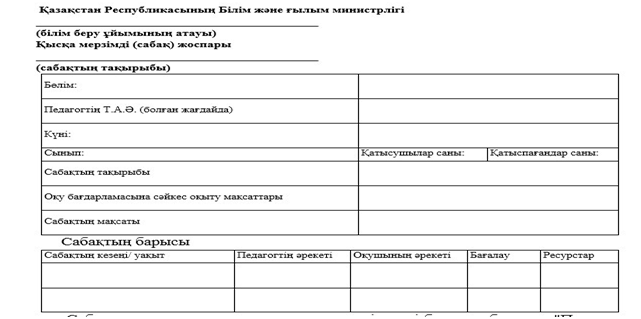
№472 бұйрығы бойынша жасалған ҚМЖ келесі бетте
Бұл ҚМЖ ust.kz сайтында жасалынған. «USTAZ tilegi» ғылыми-әдістемелік орталығының сайтынының ҚМЖ бөлімінде кез-келген пән, кез-келген сынып бойынша ҚМЖ және презентацияны жүктеп ала аласыз. Ол үшін сілтеме арқылы өтіңіз.
Theme of the lesson:.
|
Unit:5 |
Hot and cold |
|
Teacher’s name: |
|
|
Date: |
|
|
Grade: 4 |
Number present: absent: |
|
Theme of the lesson: |
Weather 1 |
|
Learning objectives(s) that this lesson is contributing to: |
4.L9 recognize words that are spelt out from a limited rung of general and curricular topics 4.S1 make basic statements which provide information on an increasing range of general and some curricular topics 4.R5 understand the main points of short simple texts on a limited range of familiar general and some curricular topics by using contextual clues |
|
Lesson objectives: |
All learners will be able to: recognize and use some target language correctly and show comprehension of some written and spoken familiar words in simple sentences Most learners will be able to: talk about summer and winter activities Some learners will be able to: recognize and use target language correctly with clear pronunciation and talk about the weather. |
|
Assessment criteria |
-pronounce the topical words correctly -describe the weather in a short talk |
|
Value links |
Ls will work together as a group showing respect and being polite with each other. |
|
Cross curricular links |
Natural science |
|
ICT skills |
Using videos & pictures, working with URLs |
|
Previous learning |
Learners will need to be familiar with/Structures: comparisons; the verb 'have got'; there is/are. Target vocabulary |
Plan:
|
Part of the lesson/Time |
Teacher’s activity |
Student’s activity |
Assessment |
Resources |
||
|
Beginning of the lesson Warming-up 5 мин. |
Organization moment : 1.Greeting. 2. Organization moment. Look at the picture Refer the pupils to the pictures and have a picture discussion. Elicit what season it is, what's the weather like, what the children are doing and what they're wearing (e.g. Is it winter or summer? Is it cold or hot? etc). Explain the activity. Go through the questions and elicit/explain any unknown vocabulary. Allow the pupil's some time to answer the questions. Check their answers. |
Ss answer the questions as possible and write down the unknown vocabulary to the copybook. Answers: It’s winter. It’s cold They’re wearing jackets, helmets and gloves. New Year. The aim: learn to express the opinions intelligibly. Efficiency: develop speaking skills and pronounce the new vocabulary correctly. |
At the organization moment T supports Ss to express their speech clearly using .«The praise» method to evaluate Ss. like: “Good job! Well done!” |
PPP-2 Pupil’s book Smiles 4. Page 69 Ex ½ PPP-2 |
||
|
Pre-learning Individual work 5 min. |
Listen, point and repeat. Answer the questions. It’s snowing. It’s cloudy. It’s sunny. It’s foggy. It’s cold. It’s hot. It’s windy. It’s raining. Aim: pronounce the topic vocabulary words correctly. Efficiency:Ss learn new words before starting new theme. And practice during the exercise. This method helps Ss to reflect the spelling of new words. |
Pupils' books closed. Put the flashcards up on the board. Point to the flashcards, one at a time, and say the corresponding phrases. The pupils repeat, chorally and/or individually. Point to them in random order. Ask individual pupils to name them. Ask the rest of the class for verification. Pupils' books open. Play the CD.The pupils listen, point to the words and repeat. If you wish, play the CD again pausing after each phrase. The pupils repeat, chorally and/or individually. |
Feedback: “Hamburger” You are excellent! You can pronounce the words correctly. Please, be more attentively when you work on pronunciation! You name all words correctly! |
Pupil’s book Smiles 4. Page 69 Ex 2. (Track 1 CD2) FLASHCARDS (29-36) PPP-3 |
||
|
Middle of the lesson Individual work. 8 min. |
Read and match. Then say. Pupils' books closed. Write on the board a summer activity and a winter activity. Ask the pupils What do you do in summer? Elicit answers (e.g. I go swimming.). Give verification to the pupils by saying (Swimming) is a summer activity. Repeat the same in order to elicit winter activities. Pupils' books open. Explain the activity. Go through the prompts and elicit/explain any unknown words. Allow the pupils some time to complete the activity. Check their answers. |
Ss follow teacher’s instruction and classify the characteristics of weather. Answer key: A summer activity: surfing, skating, camping A winter activity: skiing, snowboarding Aim: define each season’s characteristics correctly. Efficiency: develop vocabulary and speaking skills by describing the weather. Differentiation: Less able Ss classify the weather characteristics by teacher’s support drilling the new words translation. |
T supports Ss to express their speech clearly using «The praise» method to evaluate Ss. like: “Good job! Well done!” Descriptor: -read the words -match the words -say the activities |
Pupil’s book Smiles 4. Page 69 Ex 3. PPP-4 |
||
|
Individual work. “Game” 15 min. |
Let's Play Ask the pupils to draw a picture of them doing a winter or summer activity. Ask one pupil from each team to come to the front of the classroom. One pupil shows his/her drawing and asks: What am I doing? The other pupil answers: You're (swimming). It's summer/winter. Each correct answer wins a point. The pupils with the most points wins the game. |
Ss draw a picture of activities and say to the class. Aim: develop speaking and critical thinking skills. Efficiency: Ss practice the describing tasks to improve speaking skills and expressing clear ideas. Differentiation:«Game» method is helps to the teacher to see the general comprehension of Ss. Less able Ss name the characteristics of weather by supports of the classmates. |
Descriptor: -draw a picture -describe the picture -define the activities «The praise» method to evaluate Ss. like: “Good job! Well done!” |
Poster Pencils PPP-5 |
||
|
Individual work 4 min |
(An activity to consolidate the language of the lesson.) Put the flashcards on the board. Point to a picture and say a type of weather condition, sometimes saying the correct one and sometimes not. Ask the pupils to say yes or no. e.g. |
Teacher: (pointing to It's cold.') It's cold. Class: Yes. Teacher: (pointing to 'It's sunny.') It's raining. Class: No. etc Aim: develop speaking and critical thinking skills. Efficiency: Ss practice the describing tasks to improve speaking skills and expressing clear ideas. |
Descriptor: -listen to the teacher -define correct condition «The praise» method to evaluate Ss. like: “Good job! Well done!” |
PPP-6 |
||
|
End of the lesson. Reflection Individual work: 3 min. |
“Comments” method is used to find out was the lesson clear or not. Use the stickers. |
Ss use their stickers to write about today’s lesson. Commentaries, wishes. Aim: know how many Ss got the theme. Efficiency:learn to comment somebody using simple sentence. |
Ss hung the stickers on the board. |
Whiteboard Stickers PPP-7 |
||
|
Additional information |
||||||
|
DIFFERENTIATION – how do you plan to give more support? How do you plan to challenge the more able learners? |
ASSESSMENT – how are you planning to check learners’ learning? |
Health and safety
rules |
||||
|
During the lesson some tasks differentiated by outcomes of the students and by their abilities. All learners recognise and use some target language correctly and show comprehension of some written and spoken familiar words in simple sentences Most learners talk about summer and winter activities Some learners recognise and use target language correctly with clear pronunciation and talk about the weather. |
Reflection at the end of the lesson and teacher summary provides support for progress and achievement, and challenge to thinking and setting future objectives. Teacher evaluates with “The praise”. “Hamburger” You are excellent! You can pronounce the words correctly. Please, be more attentively when you work on pronunciation! You name all words correctly! |
Provide some physical exercises for learners |
||||
|
Reflection Were the lesson objectives/learning objectives realistic? Did all learners achieve the LO? If not, why? Did my planned differentiation work well? Did I stick to timings? What changes did I make from my plan and why? |
|
|||||
|
Summary evaluation What two things went really well (consider both teaching and learning)? 1: 2: What two things would have improved the lesson (consider both teaching and learning)? 1: 2: What have I learned from this lesson about the class orachievements/difficulties of individuals that will inform my next lesson? |
||||||
Lesson Plan 2
Theme of the lesson:.
|
Unit:5 |
Hot and cold |
|
Teacher’s name: |
|
|
Date: |
|
|
Grade: 4 |
Number present: absent: |
|
Theme of the lesson: |
Weather 1 |
|
Learning objectives(s) that this lesson is contributing to: |
4.S7 contribute a growing range of suitable words, phrases, and sentences including giving opinions during short pair, group and whole class exchanges 4.R6 understand with some support, some specific information and detail in short, simple texts on a growing range of general and some curricular topics 4.W4 write with support short basic sentences with appropriate spaces between words |
|
Lesson objectives: |
All learners will be able to practise talking about camping; to learn how to distinguish between Most learners will be able to: develop listening and reading comprehension skills through a story Some learners will be able to: recognise and use target language correctly with clear pronunciation and good comprehension of written and spoken familiar words in simple sentences. |
|
Assessment criteria |
|









 Бұл курс Қазақстан Республикасы Оқу-ағарту министрлігімен келісілген