
 ЖИ көмекші


 Қауіпсіз төлем

жүктеу мүмкіндігіне ие боласыз
Бұл материал сайт қолданушысы жариялаған. Материалдың ішінде жазылған барлық ақпаратқа жауапкершілікті жариялаған қолданушы жауап береді. Ұстаз тілегі тек ақпаратты таратуға қолдау көрсетеді. Егер материал сіздің авторлық құқығыңызды бұзған болса немесе басқа да себептермен сайттан өшіру керек деп ойласаңыз осында жазыңыз
 12 Қазан 2026
 59

1 жыл бойы шексіз жүктеңіз
9 сынып
 Құрметті
әріптес!
НАЗАР АУДАРЫҢЫЗ!
Ұсынылып отырған ҚМЖ материалдары авторлық еңбек болып табылады. Материалдарды сатып алу оларды үшінші тұлғаларға таратуға, қайта сатуға, ашық немесе жабық платформаларда жариялауға құқық бермейді. Авторлық материалдарды рұқсатсыз көшіруге және таратуға жол берілмейді.
2026–2027 ОҚУ ЖЫЛЫНА АРНАЛҒАН ҚМЖ ТУРАЛЫ
Сабақтың қысқа мерзімді жоспары 2026–2027 оқу жылында Қазақстан Республикасының жалпы білім беретін мектептерінде білім беру процесін ұйымдастырудың ерекшеліктері туралы Әдістемелік нұсқау хаттың негізгі бағыттары ескеріле отырып әзірленді.
ҚМЖ құрылымын әзірлеуде педагогтер жүргізуге міндетті құжаттардың нысандарын айқындайтын ҚР БҒМ-нің 2020 жылғы 6 сәуірдегі №130 бұйрығы басшылыққа алынды. Аталған құжат 2026–2027 оқу жылына арналған Әдістемелік нұсқау хаттың нормативтік-құқықтық актілер тізбесіне де енгізілген.
Сонымен қатар, жоспарлар МЖМБС, Үлгілік оқу жоспарлары және Үлгілік оқу бағдарламаларының қолданыстағы талаптарына сәйкес әзірленіп, оқушылардың жас ерекшелігіне, білім деңгейіне және оқу қажеттіліктеріне қарай бейімделді. 2026–2027 оқу жылында осы құжаттарға енгізілген өзгерістер мен толықтырулар да ескерілді.
Ulpan Education ғылыми-әдістемелік орталығы 2026–2027 оқу жылына арналған ҚМЖ-ларды мұғалімнің күнделікті жұмысына ыңғайлы, мазмұны кеңейтілген және заманауи білім беру талаптарына бейімделген форматта ұсынады.
2026–2027 ҚМЖ ерекшеліктері:
• МЖМБС, ҮОЖ, ҮОБ және Әдістемелік нұсқау хаттың талаптары ескерілген;
• оқу мақсаттары мен сабақ мақсаттарына бағытталған тапсырмалар жүйеленген;
• функционалдық сауаттылықты, дербестік пен жауапкершілікті дамытуға бағытталған;
• «Адал азамат» бағдарламасының құндылықтарын сабақ мазмұнына кіріктіру қарастырылған;
• бағалау нақты критерийлерге, объективтілік пен академиялық адалдық қағидаттарына негізделген;
• цифрлық сауаттылықты дамыту, жасанды интеллект құралдарын саналы, қауіпсіз және тиімді пайдалану элементтері ескерілген;
• оқушылардың жеке білім алу қажеттіліктерін ескеруге және оқытуды даралауға мүмкіндік беретін заманауи әдіс-тәсілдер енгізілген.
© Ulpan Education | 2026–2027 оқу жылы
Материал тек жеке пайдалануға арналған. Көшіруге, қайта сатуға және үшінші тұлғаларға таратуға тыйым салынады.
Lesson Plan 1
Unit 1: Hobbies and qualities |
lesson 1 |
||
Name of school |
|
||
Teacher name: |
|
||
Date: |
|
||
Grade: 9 |
Number present: |
absent: |
|
Lesson title |
Attributes and personality |
||
Learning objectives |
9. 5. 2. 1 independently write about past experiences or real events and actions on familiar general and academic topics; 9. 6. 15. 1 Use infinitive forms after a limited number of verbs and adjectives on a wide range of familiar general and academic topics, using gerunds, auxiliary verbs, and phrasal verbs after a limited number of verbs and auxiliaries; |
||
Lesson objectives
|
Students will be able to: -Learn nouns and adjectives of attributes and personality. -Do a questionnaire about hobbies. - Learn about forming adverbs from adjectives |
||
Stages/ Time |
Teachers actions |
Students actions |
Assessment |
Resources |
Beginning 5 min |
Greeting. T tells the class to make groups of 2. Warm up:
AI-integrated
warm-up
– “Personality from Actions, Not Appearance”
|
AI
task: Students observe/read the AI scenes, name the hobbies,
suggest 1–2 possible qualities, and justify each idea from an
action. They avoid judging personality from physical
appearance.
2026–2027
priority: AI safety: Teacher checks AI-generated materials before the lesson. Students do not enter full names, addresses, phone numbers, passwords, account details, private photos or other unnecessary personal data. |
Teacher evaluate Students with Formative Assessment phrases like: “Good job! Well done!”
Descriptor:
|
Resources: Adobe Firefly — teacher-generated fictional hobby scenes; ChatGPT — teacher-controlled visual prompt. |
Middle 12 min |
Ex: 1 P:8 In a weaker class, ask for translations. In a stronger class, encourage students to put the words into sentences to show understanding. Differentiation: - show understanding by translating the words into their first language with teacher support.
AI
Error Detective
(after students complete Ex.1 independently)
Value
integration – Justice and Responsibility:
2026–2027
priority: |
Students complete the table. Which adjectives are negative? ANSWERS 1 generous 2 passion 3 moody 4 anxious 5 pessimistic 6 optimism 7 responsibility 8 respect 9 enthusiasm 10 confidence 11 frustrated Negative adjectives: moody, anxious, pessimistic, frustrated
AI task: Students compare the AI classification with Exercise 1, find two errors, correct them and explain their corrections. |
Descriptor:
Point 3 |
Resources: Oxford ELT — Student’s Book reference; Cambridge Dictionary — word class and meaning verification; ChatGPT — teacher-generated error list. |
10 min |
Ex: 2 P:8 In a weaker class, you could help students to prepare for the task by deciding together whether the missing words are adjectives or nouns. In a stronger class, ask students to give reasons and justify their opinion. Ask some students to compare their answers and report back to the class on how similar or different they and their partner are Differentiation: - Students are supported by translating the new vocabulary into their first language to confirm understanding.
AI
Sentence Coach
– “Improve, Don’t Copy”
Value
integration – Diligence and Professional Competence:
2026–2027
priority: |
Students complete the sentences with your own ideas using words in exercise 1. ANSWERS Student’s own answer
AI
task: Students read AI feedback, decide “accept” or “reject”,
explain why, and revise their own sentence if necessary. |
Descriptor:
Point 3 |
Resources: Oxford ELT — Student’s Book exercise; ChatGPT — teacher-controlled sentence feedback; Cambridge Dictionary — language verification. |
13 min |
Ex: 3 P:8 Students do the Hobbies questionnaire, then compare their answers in pairs. Do they have similar views on hobbies? Ask them to discuss what hobbies they do and what attributes help with that hobby. Differentiation: - Provide sentence starters or a word bank to support discussion (e.g., “I enjoy ___ because...”, “You need to be ___ to do this hobby”).
AI
Hobby & Quality Challenge
Value
integration – Unity and Cooperation: |
Students complete the Hobbies questionnaire. Then compare your answers with a partner. Do you have the same attitude to hobbies? How are you the same and different? ANSWERS Student’s own answer
AI
task: Students compare one AI hobby profile with their
questionnaire answers, agree/disagree with one suggested quality,
and justify: “I agree/disagree because …”. |
Descriptor:
Point 4
9-10 points – “5” 7-8 points – “4” 5-6 points – “3”
|
Resources: Oxford ELT — Student’s Book questionnaire; Canva — teacher-prepared hobby profile cards. |
End |
PERSONALITY EVIDENCE EXIT — 5 min. Students choose one hobby, write two suitable personality qualities and justify one with an action: ‘A person may need to be ___ because ___.’ Then they label one target word noun/adjective.
Value
integration – Justice and Responsibility: |
Descriptor: connects a hobby with two relevant qualities; gives one evidence-based reason; identifies one word class correctly. |
Resources: Microsoft Forms — 3–2–1 exit ticket; Canva — printable reflection card. |
|
Lesson Plan
Unit 1: Hobbies and qualities |
lesson 2 |
||
Name of school |
|
||
Teacher name:
|
|
||
Date: |
Teacher name:
|
||
Grade: 9 |
Number present: |
absent: |
|
Lesson title |
Comparing adjectives and adverbs |
||
Learning objectives |
9. 5. 2. 1 independently write about past experiences or real events and actions on familiar general and academic topics; 9. 6. 12. 1 Use a variety of comparative forms of regular and irregular adverbs on a wide range of familiar general and academic topics, using a wide range of adverbs that come before, after, and at the end of verbs; |
||
Lesson objectives (assessment criteria)
|
Students will be able to: - Learn about comparative and superlative adjectives and adverbs. - Practise using comparative and superlative adjectives and adverbs |
||
Stages/ Time |
Teachers actions |
Students actions |
Assessment |
Resources |
Beginning 5 min |
Greeting. T tells the class to make groups of 2. Warm up: AI INTEGRATION – AI Hobby Comparison Starter Teacher displays 3 short AI-generated descriptions of fictional teenagers doing hobbies. Ask Students to identify the hobby and compare how the actions are performed.
Prompt:
“Create 3 short Grade 9 classroom-safe descriptions of
fictional teenagers doing different hobbies. Include adverbs such
as carefully, confidently and enthusiastically. Do not label
personality directly.”
|
Students identify the hobbies, underline the adverbs and make one comparison, e.g. “Aida works more carefully than Ben.” Value inte
gration
– Creativity and Innovation:
2026–2027
priority: AI safety: Teacher checks AI-generated materials before the lesson. Students do not enter full names, addresses, phone numbers, passwords, account details, private photos or other unnecessary personal data. |
Teacher evaluate Students with Formative Assessment phrases like: “Good job! Well done!”
AI Descriptor: identifies an adverb and produces one meaningful comparative sentence. |
Resources: Adobe Firefly — teacher-generated hobby comparison visual; ChatGPT — teacher-controlled descriptions. |
Middle 10 min |
Ex: 4 P: 9 Write on the board: In life, it’s best not to act too … Elicit possible endings for the sentence (quickly, carefully, etc.). Write the adverbs successfully, generously, anxiously, and confidently on the board and underline them. Elicit that they are adverbs, they end in -ly, and they are formed from the adjectives in exercise 1. Check that students understand the difference between adjectives and adverbs. Write on the board: Petra is a good singer. Petra sings well. Underline good and well. Explain or elicit that adjectives modify nouns and adverbs modify verbs. Point out that well is irregular Differentiation - Provide a list of common adjectives and their adverb forms for reference.
AI Error Detective – Adjective or Adverb? After Students complete the rules, show an AI-generated list containing exactly two deliberate mistakes. Prompt: “Generate 8 Grade 9 adjective–adverb pairs connected with hobbies and qualities. Include exactly two deliberate formation mistakes. Do not reveal the mistakes.” Students must verify the AI output using the rule/table before correcting it.
Value
integration – Justice and Responsibility:
2026–2027
priority: |
Students complete the examples and the rules in the table ANSWERS 1 -ly 2 firmly 3 -ily 4 angrily 5 -ally 6 optimistic 7 fast 8 hard Adverbs from adjectives in exercise 1: successfully, generously, passionately, moodily, anxiously, pessimistically, optimistically, responsibly, enthusiastically, confidently, frustratingly
Students compare the AI forms with the grammar rule, find two errors, correct them and explain the rule. |
Descriptor: finds both deliberate errors; gives correct adverb forms; explains at least one formation rule.
Point 3 |
Resources: Oxford ELT — Student’s Book grammar rule; Cambridge Dictionary — adverb-form verification; ChatGPT — teacher-generated error set. |
8 min |
Ex: 5 P: 9 In a weaker class, allow students to work in pairs to write their sentences. Ask some students to write some of their sentences on the board. Discuss if they are logical and correctly formed. Differentiation: -Provide guided support by reviewing one sentence at a time and prompting with correction questions (e.g., “Is this the right word order?”, “Does the adverb match the verb?”). AI Sentence Coach – Check, Don’t Copy Students first write their own six sentences. Teacher then enters anonymous sample sentences into AI for feedback. Prompt: “Check these Grade 9 sentences for adjective/adverb choice and word order. Give a short hint for each error, but do not rewrite the whole sentence.”
Value
integration – Diligence and Professional Competence: |
Students write six sentences describing how you do different things. Use the verbs in the first box and adverbs formed from the adjectives in the second box. ANSWERS Student’s own answer
Students read AI hints, decide whether the feedback is correct, and revise only the sentences that need correction. |
Descriptor: evaluates AI feedback critically and improves adjective/adverb use without copying a full AI answer.
Point 2 |
Resources: Oxford ELT — Student’s Book exercise; ChatGPT — teacher-controlled feedback; Cambridge Dictionary — language check. |
10 min |
Ex: 6 P: 9 Focus on the example and elicit one or two more examples from the class. Check answers. Make sure students understand we use less, the least, more, the most to form comparative and superlative forms of adverbs. Differentiation: - Provide sentence frames (e.g., "She runs ___ than me." / "He speaks ___ of all.") and visual aids to support understanding.
AI Comparison Challenge Teacher asks AI to generate six short hobby situations. Prompt: “Create 6 Grade 9 mini-situations comparing how two or three fictional teenagers do hobbies. Leave one blank in each sentence for more/less/the most/the least + adverb. Mix comparative and superlative forms.”
Value
integration – Diligence and Professional Competence: |
Students study sentences 1–5. How do we form the comparative and superlative forms of adverbs? Complete the table with the words in blue ANSWERS We use less and more to form comparative adjectives. We use the least and the most to form superlatives. Comparative adjectives: meaner, more comfortable, less stressful Comparative adverbs: less seriously, more positively, more happily Superlative adjectives: the most selfish, the least successful, the most optimistic, the richest Superlative adverbs: the least generously, the most rudely In pairs, Students complete the AI sentences, justify the form, then compare with the textbook rule and examples. |
Descriptor: chooses comparative/superlative forms accurately and justifies the choice using the number of people/actions compared.
Point 3 |
Resources: Oxford ELT — Student’s Book rule and examples; Wordwall — controlled comparison practice. |
7 min |
Ex: 7 P: 9 Focus on the first sentence and elicit that the missing word is an adverb and a superlative. Elicit the answer (the most successfully). In a weaker class, allow students to work in pairs. In a stronger class, ask students to complete the sentences individually, but allow them to check their answers in pairs before you check with the class
Differentiation: - Allow students to work in pairs to complete the sentences, encouraging peer support and discussion.
AI Grammar Critic – Is AI Correct? After Exercise 7, show 5 AI answers with one deliberate mistake. Prompt: “Generate 5 Grade 9 sentences using comparative or superlative adjectives/adverbs with more, less, the most and the least. Include exactly one deliberate grammar mistake. Do not identify it.”
Value
integration – Justice and Responsibility:
2026–2027
priority: |
Students complete the sentences with the comparative or superlative form of an adjective or adverb. Use more / less and the most / the least ANSWERS 1 the most successfully 2 less pessimistically 3 more carefully 4 less noisy 5 more slowly 6 the least sensitive
Students check each AI sentence, locate the mistake, correct it and explain why it is wrong. |
Descriptor: checks AI output against the grammar rule; identifies and corrects the deliberate mistake.
Point 2
9-10 points – “5” 7-8 points – “4” 5-6 points – “3”
|
Resources: ChatGPT — teacher-generated grammar critic; Oxford ELT — Student’s Book verification. |
End |
COMPARISON EXIT — 5 min. Students write one comparative adverb sentence and one superlative adverb sentence about fictional hobby performance, then underline the comparison form.
Value
integration – Justice and Responsibility: |
Descriptor: forms one comparative adverb accurately; forms one superlative adverb accurately; uses logical word order. |
Resources: Microsoft Forms — lesson-specific 3–2–1 exit ticket; Canva — printable exit card. |
|
Lesson Plan
Unit 1: Hobbies and qualities lesson 3 |
|
||
Name of school |
|
||
Teacher name: |
|
||
Date: |
|
||
Grade: 9 |
Number present: |
absent: |
|
Lesson title |
Comparing generations |
||
Learning objectives |
9. 4. 2. 1 understand specific information in texts on familiar general and academic topics, including some longer texts; 9. 5. 2. 1 independently write about past experiences or real events and actions on familiar general and academic topics; |
||
Lesson objectives (assessment criteria)
|
Students will be able to: - Synthesize information from the reading passage about life in the 1950s. - Demonstrate the correct use of adjectives + prepositions. - Interpret a text comparing past and present generations. - Express their opinions about different generations building extended sentences. |
||
Stages/ Time |
Teachers actions |
Students actions |
Assessment |
Resources |
Beginning 5 min |
Greeting. T tells the class to make groups of 2.
Warm
up:
Value
integration – Creativity and Innovation:
2026–2027
priority: AI safety: Teacher checks AI-generated materials before the lesson. Students do not enter full names, addresses, phone numbers, passwords, account details, private photos or other unnecessary personal data. |
AI
Students’ action
|
Teacher evaluate Students with phrases like: “Good job! Well done!” Formative Assessment
|
Resources: Adobe Firefly — teacher-generated 1950s/modern comparison visuals; ChatGPT — teacher-controlled visual prompts. |
Middle 10 min |
Ex: 1 P: 10 Read through the items in the list with the class and check that students understand them. In a weaker class, allow students to use dictionaries or pre-teach ballroom (a place where people used to go to dance) and big band (a style of jazz music played by a group of twelve to fifteen musicians). In a stronger class, elicit suggestions and guesses for unfamiliar vocabulary, and then discuss again after the first reading, encouraging students to use context to work out the meaning Differentiation: - Allow use of dictionaries or pre-teach key terms such as ballroom (a place where people used to go to dance) and big band (a jazz music style played by a large group of musicians).
Value
integration – Justice and Responsibility:
2026–2027
priority: |
Students which of these things do you think were common in the 1950s? Which are common now? Read, listen and compare your answers with the text. ANSWERS More common in the 1950s ballrooms, big bands, black-and-white TV More common now mobile phones, computers, jobs for women, discos, bad language
|
Descriptor: compares two sources; finds textual evidence; corrects at least one unsupported or inaccurate AI claim.
Point 3
|
Resources: Oxford ELT — core reading text; ChatGPT — teacher-generated prediction list; Cambridge Dictionary — key vocabulary support. |
8 min |
Ex: 2 P: 10 In a weaker class, encourage students to underline the parts of the text where they found the answers. In a stronger class, encourage students to identify the false sentences and correct them from memory. Then they should read again and confirm. Differentiation: - Encourage students to underline or highlight the parts of the text where they found their answers to help them locate evidence and stay focused.
AI
Evidence Detective – True, False or Unsupported?
Value
integration – Justice and Responsibility:
2026–2027
priority: |
Students read the text again. Write true or false. Correct the false sentences. ANSWERS 1 False. The cinema was popular in the fifties. 2 False. A family in her street bought a TV. 3 True. 4 False. She really likes the fashions. 5 True. 6 True. 7 False. People wait longer these days. 8 True
|
Descriptor: distinguishes fact from unsupported AI output; locates relevant evidence; corrects inaccurate information.
Point 2
|
Resources: Oxford ELT — reading text and Ex. 2; Nearpod — teacher-led evidence check. |
7 min |
Ex: 3 P: 10 In a weaker class, explain that prepositions are words like in, from, to, in front of, at and on, which are usually used before a noun or pronoun to show place (He lives in Paris.), position (The book is on the table.), time (The film starts at nine o’clock.) or method (Shall we walk or go by bus?). In a stronger class, ask students what prepositions are and elicit examples Differentiation: - Clearly explain what prepositions are, using simple definitions and familiar examples (e.g., in, on, at, from, to), and show how they function in sentences.
Value
integration – Diligence and Professional Competence: |
Students complete the sentences with prepositions. Then check your answers in the text ANSWERS 1 on 2 by 3 about 4 in 5 to 6 for 7 about
|
Descriptor: recognizes target combinations; corrects preposition errors accurately; explains a correction using the grammar pattern.
Point 2 |
Resources: Oxford ELT — Student’s Book grammar evidence; ChatGPT — teacher-generated error sentences; Cambridge Dictionary — usage verification. |
10 min |
Ex: 4 P: 10 In a weaker class, ask students to choose the correct prepositions first. Check the answers with the class, then tell students to complete the sentences with their own ideas. In a stronger class, ask students to look at the sentences in exercise 3 again and tell you what part of speech usually follows the preposition (noun). Write on the board: She’s keen on playing tennis. Are you interested in joining the drama club? Ask students what part of speech are the words after on and in (verb). Point out that when students use verbs after prepositions, they should use -ing forms, not infinitives Differentiation: - Have students first choose the correct prepositions.
Value
integration – Creativity and Innovation:
2026–2027
priority: |
Students complete the sentences with the prepositions in the box and your own ideas ANSWERS 1 of + students’ own answers 2 with + students’ own answers 3 about + students’ own answers 4 at + students’ own answers 5 for + students’ own answers 6 from + students’ own answers
|
Descriptor: evaluates AI feedback; revises grammar independently; keeps the Student’s original meaning.
Point 3
9-10 points – “5” 7-8 points – “4” 5-6 points – “3”
|
Resources: ChatGPT — teacher-controlled sentence feedback; Oxford ELT — Student’s Book pattern reference. |
End |
GENERATIONS: EVIDENCE + RESPONSE — 5 min. Students write one accurate difference between the 1950s and today, cite one detail from the reading, and add one adjective + preposition sentence expressing their view.
Value
integration – Justice and Responsibility:
2026–2027
priority: |
Descriptor: states an accurate comparison; supports it with text evidence; uses one adjective + preposition pattern correctly. |
Resources: Microsoft Forms — generations evidence exit ticket; Canva — printable reflection card. |
|
Lesson Plan 4
Unit 1: Hobbies and qualities |
lesson 4 |
||
Name of school |
|
||
Teacher name:
|
|
||
Date: |
|
||
Grade: 9 |
Number present: |
absent: |
|
Lesson title |
Language focus. Past perfect and Past simple |
||
Learning objectives |
9. 5. 1. 1 plan, write, edit and check text-level work on general and academic topics without the support of a teacher; 9. 6. 9. 1 correctly use the active and passive simple forms of the present and past tenses in the present and past tenses in the present and past tenses on many familiar general and study topics; |
||
Learning objectives
|
Students will be able to: - Learn the past perfect, and the difference between the past perfect and past simple. - Practise using the past perfect and past simple together. |
||
Stages/ Time |
Teachers actions |
Students actions |
Assessment |
Resources |
Beginning 5 min |
Greeting. T tells the class to make groups of 2. Warm up:
AI-INTEGRATED
WARM-UP – AI Timeline Challenge Teacher tells values of this month. The value of diligence and professional competence. - completing the task on time; - participating actively in the lesson;
|
AI
task: In pairs, Students read the AI-generated event pairs,
identify the earlier/later event and explain their choice using
first / then / before / after.
Value
integration – Diligence and Professional Competence:
2026–2027
priority: AI safety: Teacher checks AI-generated materials before the lesson. Students do not enter full names, addresses, phone numbers, passwords, account details, private photos or other unnecessary personal data. |
Teacher evaluate Students with phrases like: “Good job! Well done!” Formative Assessment
|
Resources: ChatGPT — teacher-generated timeline challenge; Canva — timeline cards. |
Middle 10 min |
Ex: 1 P: 11 Ask students to open their books and look at the timeline. Tell them to read the sentence again and match the events to the diagram. Ask students to translate the examples into their own language. Discuss how the equivalent tense is formed in the students’ own language, and whether this is similar to English.
Value
integration – Justice and Responsibility:
2026–2027
priority: |
Students study the timeline and the sentence. Write the events in the correct place on the timeline. Then choose the correct words in the rules ANSWERS Recent past: I visited my gran Earlier past: she’d found some of her old photos Rules: a before b past simple c had
|
Descriptor: distinguishes Past Perfect from Past Simple and corrects AI errors with a reason.
Point 3 |
Resources: Oxford ELT — Student’s Book timeline and rule; ChatGPT — teacher-generated grammar detective. |
12 min |
Ex: 2 P: 11 Read the example with the class and ask: Which action happened first? (I saw the film). Focus on the next sentence and ask Which action happened first? (Alice didn’t have many hobbies when she was a child). Elicit which verb should be in the past perfect (have) and which in the past simple (tell). Remind students that some irregular verbs have the same form for the past tense and past participle, but others have different forms. Tell students to use the irregular verbs list on page 126 of the Student’s Book Differentiation: -Provide partially completed sentences and guided practice. Encourage use of the irregular verb list as a support tool.
Value
integration – Diligence and Professional Competence: |
Students complete the sentences. Use the past perfect and the past simple in each sentence. ANSWERS 1 told, hadn’t had 4 was, had left, had found 2 got, went, hadn’t seen 5 hadn’t started, arrived 3 hadn’t invented, was 6 wanted, had had
|
Descriptor: verifies irregular verb forms and uses had + past participle accurately.
Point 3
|
Resources: Oxford ELT — Student’s Book irregular verb list; Cambridge Dictionary — irregular verb verification; ChatGPT — teacher-generated check list. |
13 min |
Ex: 3 P: 11 Make sure students understand the logical order of events. In the example, one fact is a consequence of the other. Remind them to use context and to look out for time markers, e.g. when, by the time, after in the prompts
Value
integration – Creativity and Innovation: |
Students complete the sentences using the past perfect and your own ideas ANSWERS Students’ own answers
|
Descriptor: uses context and time markers to explain event sequence; creates an original sentence rather than copying AI.
Point 4
9-10 points – “5” 7-8 points – “4” 5-6 points – “3”
|
Resources: ChatGPT — teacher-generated mini-story; Oxford ELT — Student’s Book time-marker examples. |
End |
TIMELINE EXIT — 5 min. Students receive two past events, place them in order and combine them in one sentence using Past Perfect for the earlier event and Past Simple for the later event.
Value
integration – Justice and Responsibility: |
Descriptor: identifies earlier/later events; uses Past Perfect accurately; uses Past Simple accurately. |
Resources: Microsoft Forms — Past Perfect/Past Simple exit check; Canva — timeline exit card. |
|
Lesson Plan 5
Unit 1: Hobbies and qualities |
lesson 5 |
||
Name of school |
|
||
Teacher name: |
|
||
Date: |
|
||
Grade: 9 |
Number present: |
absent: |
|
Lesson title |
Uses of get Diagnostic test |
||
Learning objectives |
9. 2. 2. 1 understand some specific information on general and educational topics independently in extended conversations without support 9. 3. 1. 1 use formal and informal registers when speaking within general and academic topics; |
||
Lesson objectives
|
Students will be able to: - Learn collocations with make, do, collect and write. - Ask and answer questions using make, do, collect and write. - Listen to four people talking about their memories. - Listen for general meaning and specific details. |
||
Stages/ Time |
Teachers actions |
Students actions |
Assessment |
Resources |
Beginning 5 min |
Greeting. T tells the class to make groups of 2. Warm up:
AI-integrated
Warm-up – Memory Word Cloud
|
AI
task: Students choose one fictional prompt, identify 2–3 useful
words and briefly explain which past tense may be useful.
2026–2027
priority: AI safety: Teacher checks AI-generated materials before the lesson. Students do not enter full names, addresses, phone numbers, passwords, account details, private photos or other unnecessary personal data. |
Teacher evaluate Students with phrases like: “Good job! Well done!” Formative Assessment
Descriptor: identifies relevant vocabulary and links it to a suitable past-time context. |
Resources: ChatGPT — teacher-controlled fictional memory prompts; Canva — safe memory word-cloud visual. |
Middle 10 min |
Ex: 1 P: 12 In a weaker class, elicit translations of the collocations and make example sentences as a class. In a stronger class, encourage students to record the new phrases in their own example sentences. Point out that students can use diagrams like these to record other collocations. They could also turn the diagrams into spidergrams if they prefer Differentiation: - Focus on oral translation and sentence-building as a class. Provide sentence starters and model diagrams.
AI
Collocation Error Detective
Value
integration – Justice and Responsibility:
2026–2027
priority: |
Students complete the diagram with the words in the box ANSWERS 1 model planes 2 clothes 3 music 4 puzzles 5 woodwork 6 sports 7 badges 8 stamps 9 football cards 10 blogs 11 poetry 12 short stories
Students
compare the AI list with the book, identify two incorrect
collocations, correct them and justify their choices. |
Descriptor: identifies and corrects AI collocation errors using a reliable source.
Point 3 |
Resources: Oxford ELT — Student’s Book collocation diagram; Cambridge Dictionary — collocation verification; ChatGPT — teacher-generated error list. |
8 min |
Ex: 2 P: 12 Students complete the questions individually. Check answers, then put students into pairs to ask and answer the questions. Ask some students to report back on what they learnt about their partner.
AI
Question Coach – Check, Don’t Copy
Value
integration – Unity and Cooperation: |
Students choose the correct words to complete the questions. Then ask and answer in pairs. ANSWERS 1collect 2 write 3 make 4 make 5 written 6 do 7 do, make Students’ own answers.
Students detect the incorrect AI question, explain the correction, then improve one of their own questions without copying the AI model. |
Descriptor: forms accurate questions and evaluates AI language critically.
Point 2 |
Resources: Oxford ELT — Student’s Book questions; ChatGPT — teacher-controlled question coach. |
10 min |
Ex: 3 P: 12 Focus on the photos and elicit what they show. Elicit whether they are modern or old photos (old). Tell students they are going to hear people talking about the past. Allow students time to read through the words in the box. Students listen and match the words with the people. Differentiation: - Pre-teach key words, pause the recording after each speaker, and allow repeated listening.
AI
Pre-listening Prediction
Value
integration – Diligence and Professional Competence: |
Students listen to the dialogues. Match two words with each of the people in the photos 1–4 ANSWERS 1 Michael: money, test 2 Maxine: uniform, upset 3 Clare: party, married 4 Joey: uncle, Tickets
Students
make predictions, listen, then mark each prediction as heard/not
heard. They use the audio—not AI—as evidence for matching
words to speakers. |
Descriptor: distinguishes prediction from evidence and matches details from listening accurately.
Point 2 |
Resources: Oxford ELT — Student’s Book listening task; ChatGPT — teacher-generated pre-listening vocabulary; Nearpod — listening response grid. |
7 min |
Ex: 4 P: 12 Allow students time to read the questions. Encourage them to make notes from the first listening, which they can confirm when listening again. Differentiation: -Provide visual examples and sentence contexts for each phrase.
AI
vs Audio – Evidence Detective
Value
integration – Justice and Responsibility:
2026–2027
priority: |
Students listen again and choose the correct answers. ANSWERS 1 c 2 a 3 b 4 c 5 a
Students
listen again, classify statements as supported/not supported and
explain answers with details from the recording. |
Descriptor: checks AI claims against primary listening evidence and corrects unsupported information.
Point 3
9-10 points – “5” 7-8 points – “4” 5-6 points – “3”
|
Resources: Oxford ELT — Student’s Book audio task; ChatGPT — teacher-generated evidence statements. |
End |
COLLOCATION + LISTENING EXIT — 5 min. Students write two correct make/do/collect/write collocations and one fact they verified from the listening. They mark the fact ‘audio evidence’.
Value
integration – Justice and Responsibility: |
Descriptor: gives two accurate collocations; records one accurate listening detail; distinguishes evidence from prediction. |
Resources: Microsoft Forms — collocation/listening exit ticket; Canva — printable reflection card. |
|
Lesson Plan 6
Unit 1: Hobbies and qualities |
lesson 6 |
||
Name of school |
|
||
Teacher name: |
|
||
Date: |
|
||
Grade: 9 |
Number present: |
absent: |
|
Lesson title |
Language focus. Past simple and continuous |
||
Learning objectives |
9. 5. 2. 1 independently write about past experiences or real events and actions on familiar general and academic topics; 9. 6. 10. 1 use the present tense and future tense forms, as well as some continuous forms of the intransitive verb |
||
Lesson objectives
|
Students will be able to: - Learn the use of the past simple and past continuous. - Learn how to highlight examples of tenses. - Learn key phrases for talking about memories. - Practise talking about memories |
||
Stages/ Time |
Teachers actions |
Students actions |
Assessment |
Resources |
Beginning 5 min |
Greeting. T tells the class to make groups of 2. Warm up:
AI
Warm-up – Photo Story Predictor
|
Students’
action (AI):
Value
integration – Creativity and Innovation:
2026–2027
priority: AI safety: Teacher checks AI-generated materials before the lesson. Students do not enter full names, addresses, phone numbers, passwords, account details, private photos or other unnecessary personal data. |
Teacher evaluate Students with Formative Assessment phrases like: “Good job! Well done!”
|
Resources: Adobe Firefly — teacher-generated fictional hobby scene; ChatGPT — teacher-controlled image prompt. |
Middle 8 min |
Ex: 1 P: 13 Students work in pairs to study the sentences and match them to the descriptions. Check answers with the class. Elicit which tenses are used. Differentiation: -Provide a list of possible tenses to choose from and model one example together. Use visual timelines to support understanding.
AI
Grammar Detective – “Which tense and why?”
Value
integration – Justice and Responsibility:
2026–2027
priority: |
Students look at the photos and about their hobbies. ANSWERS 1 b (past continuous) 2 c (past continuous and past simple) 3 a (past simple)
Students’
action (AI): |
Descriptor
(AI): -finds and corrects the deliberate AI error; - justifies the correction.
Point 3 |
Resources: Oxford ELT — Student’s Book tense rule; ChatGPT — teacher-generated grammar detective. |
10 min |
Ex: 2 P: 13 Students copy the sentences from exercise 4 and highlight or underline the tenses. Tell students to use different colours to indicate different tenses. Discuss as a class how this technique might be helpful, for example by giving students memorable examples of tenses that they can remember easily. In a stronger class, write on the board: When I arrived, she had made a cake. When I arrived, she was making a cake. and When I arrived, she made a cake. Ask students to underline or highlight the verbs in the sentences, then identify the tenses and explain the difference in meaning
Differentiation: - Provide a list of possible tenses to choose from and model one example together.
AI
Tense Highlighter – Check, Don’t Copy
Value
integration – Diligence and Professional Competence: |
Students read and listen to the text. Check your answers. ANSWERS Student’s own answer
Students’
action (AI): |
Descriptor
(AI): - checks AI output critically.
Point 2 |
Resources: Oxford ELT — Student’s Book examples; ChatGPT — teacher-controlled tense highlighter; Cambridge Dictionary — verb-form verification. |
10 min |
Ex: 3 P: 13 Focus on the example and ask: Which action was in progress? (he was competing) Which action is finished? (he won). In a weaker class, do another together. Focus on the first question and elicit which action was in progress (using) and which finished (said). Elicit the correct verb forms from the class. In a stronger class, one example should be enough. Students continue writing their questions individually. Check answers as a class. Put students into pairs to answer the questions. Listen and check answers to the quiz questions. Ask students how many they got right. Differentiation: - Provide additional scaffolding and sentence starters if needed.
AI
Event-Pair Challenge
Value
integration – Unity and Cooperation: |
Students read the text again and choose the correct answers. ANSWERS 1 What new invention was Alexander Bell using when he said, ‘Mr Watson, come here. I want to see you’? (the telephone) 2 When Titanic hit an iceberg in 1912, where was it travelling to? (New York) 3 When Neil Armstrong said, ‘That’s one small step for man; one giant leap for mankind’, where was he standing? (on the moon) 4 Where was Isaac Newton sitting when he discovered gravity? (under a tree) 5 Where was Mark Zuckerberg studying when he invented Facebook? (Harvard University) 6 Where were people celebrating the new millennium when they took this picture? (Sydney, Australia)
Students’
action (AI): |
Descriptor
(AI): - forms both tenses correctly; - uses when/while appropriately.
Point 3 |
Resources: Oxford ELT — Student’s Book event questions; Canva — event-pair practice cards. |
7 min |
Ex: 4 P: 13 Students complete the questions individually or in pairs
AI
Key-Phrase Sentence Coach
Value
integration – Diligence and Professional Competence: |
Students find these sentences in the text. Then complete the sentences with the words in blue. ANSWERS 1 not mad about 2 prefer 3 especially 4 a … fan 5 good at 6 can’t stand
Students’
action (AI): |
Descriptor
(AI): - creates a meaningful sentence; - explains vocabulary choice.
Point 2
9-10 points – “5” 7-8 points – “4” 5-6 points – “3”
|
Resources: Oxford ELT — Student’s Book key phrases; Quizlet — controlled vocabulary retrieval. |
End |
PAST TENSE SNAPSHOT — 5 min. Students write two linked sentences about a fictional situation: one action in progress and one completed/interruption action. They label Past Continuous / Past Simple and add when or while.
Value
integration – Justice and Responsibility: |
Descriptor: uses Past Continuous for an action in progress; Past Simple for a completed/interruption action; uses when/while appropriately. |
Resources: Microsoft Forms — Past Simple/Past Continuous exit ticket; Canva — printable tense-check card. |
|
Lesson Plan 7
Unit 1: Hobbies and qualities |
lesson 7 |
|||
Name of school |
|
|||
Teacher name: |
|
|||
Date: |
|
|||
Grade: 9 |
Number present: |
absent: |
||
Lesson title |
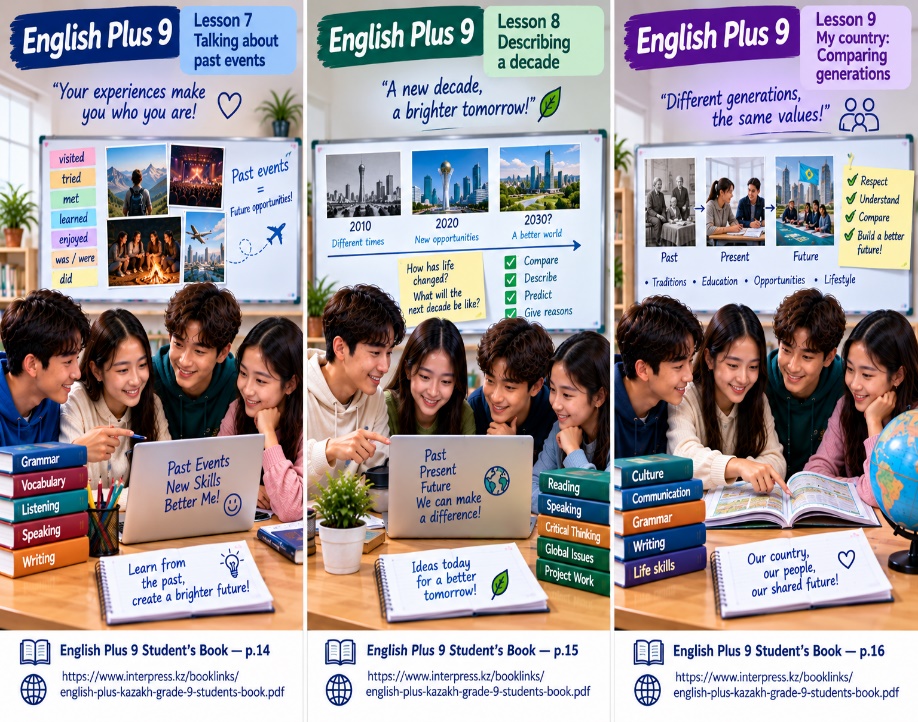
Talking about past events |
|||
Learning objectives |
9. 2. 1. 1 understand the main ideas of general and educational topics in extended conversations without support; 9. 3. 3. 1 explain and justify one's point of view within general and academic topics; |
|||
Lesson objectives
|
Students will be able to:
|
|||
Stages/ Time |
Teachers actions |
Students actions |
Assessment |
Resources |
Beginning 5 min |
Greeting. T tells the class to make groups of 2. Warm up: AI integration – Predict and verify (ChatGPT/projector):
AI prompt: “Create 3 Grade 9 pairs of fictional everyday past events. Each pair must contain one earlier action and one later action. Use classroom-safe content, do not use real personal data, and do not give the answers.” The teacher displays three AI-generated pairs. Students decide which action happened first, explain their choice, and check that the verbs are suitable for past events. The teacher reminds Students that AI output may contain mistakes and must be checked. |
Students’ AI action: Work in pairs; order the events; justify answers using past-time expressions; identify and correct any doubtful AI suggestion.
Descriptor (2 points): 1 point – sequences at least 2 of 3 event pairs logically; 1 point – justifies or corrects an AI-generated example using a grammar rule. |
Teacher evaluate pupils with Formative Assessment phrases like: “Good job! Well done!”
|
ChatGPT or another school-approved AI tool; projector; teacher-prepared AI output AI tool: ChatGPT Purpose: generate safe fictional past-event pairs for prediction and sequencing English Plus 9: Student’s Book p.14 |
Middle 10 min |
Ex: 1 P: 14 Draw students’ attention to the photo and elicit a description. In a weaker class, encourage students to participate by accepting factual descriptions. In a stronger class, ask students to speculate about the answers to the questions and explain their answers.
Differentiation:
AI integration – Description enhancer: AI prompt: “Write 2 short Grade 9 descriptions of this classroom photo: one factual and one speculative. Use past-event vocabulary. Label them A and B. Do not identify real people.” After Students describe the photo independently, the teacher asks AI for two possible fictional descriptions. Students compare them with visible evidence and underline one supported detail and one unsupported assumption. Value Discussing hometowns, landmarks of Kazakhstan, national traditions, and local culture during speaking or reading tasks. |
Students complete the sentences from the text. Then complete rules.
Descriptor (2 points): 1 point – distinguishes a visible fact from an AI assumption; 1 point – improves one sentence with accurate past-event vocabulary
|
Formative assessment: Photo-evidence comparison and sentence improvement. Success criteria: - distinguishes a visible fact from an unsupported AI assumption
|
Student’s Book; ChatGPT or other teacher-approved AI AI tool: Microsoft Copilot Purpose: support photo-based prediction while separating visible facts from assumptions English Plus 9: Student’s Book p.14 |
10 min |
Ex: 2 P: 14 Tell students they are going to listen to a conversation between the man and the boy. They should listen for general understanding and to find the answer to the question. (Colin is Dean’s grandfather.) After listening once, ask which part of the festival Colin enjoyed most. Differentiation: - Provide the guiding question (Which part of the festival did Colin enjoy most?) before listening and write it on the board. AI integration – Listening evidence check: AI prompt: “Create 3 short claims for a Grade 9 listening-evidence activity about a fictional grandfather remembering a festival. Make two plausible and one clearly unsupported for the teacher. Do not use real personal data.” Before the second listening, the teacher shows three AI-generated claims about Colin’s memory. Students predict which may be true, then verify every claim against the audio. AI is used for prediction only; the recording is the evidence source. Value Discussing ethical choices in reading texts, sharing responsibilities in team tasks, and honest self-assessment. |
Students listen to the dialogue. Which part of the festival did Colin enjoy most? ANSWERS The end of the last day.
descriptor (2 points): 1 point – correctly verifies at least 2 of 3 claims; 1 point – gives relevant listening evidence.
|
Formative assessment: Listening-claim verification and evidence note. Success criteria: - verifies at least two of three AI claims accurately
|
You tube https://youtu.be/yClmcr4HkA4?si=VU2hl0PPXsK0JC4l
Audio; speakers; AI-generated claim cards AI tool: Diffit Purpose: create listening gist/evidence prompts without replacing the textbook audio task English Plus 9: Student’s Book p.14 |
8 min |
Ex: 3 P: 14 Students work in pairs to complete the key phrases. In a stronger class, tell them to cover the dialogue and try to do it from memory. Students listen again to check their answers. Tell them to listen to the intonation of the phrases, as well as the words. Students practise the dialogue in pairs.
Differentiation: -Allow them to keep the dialogue visible while completing the key phrases.
Value Classroom rules, school routines, road safety units, and discussing digital citizenship/cyber safety. |
Students complete the key phrases. Then listen and check your answers. Practise the dialogue with a partner ANSWERS 1 ever 2 was 3 ago 4 have 5 bit 6 happened
AI descriptor (2 points): 1 point – finds and corrects the AI error; 1 point – uses key phrases and appropriate intonation in the pair dialogue. |
Formative assessment: Key-phrase check and pair-dialogue observation. Success criteria: - uses key phrases with appropriate intonation in dialogue |
You tube https://youtu.be/61hBPA7DNFI?si=fJlhDOPtqAdVxoh1
Student’s Book; teacher-prepared AI dialogue; projector AI tool: MagicSchool AI Purpose: generate controlled key-phrase and intonation practice for pair dialogue English Plus 9: Student’s Book p.14 |
7 min |
Ex: 4 P: 14 Tell students they are going to hear parts of a dialogue, and they must choose the most appropriate responses. Students listen and answer individually. Play the CD again and elicit the answers. Differentiation: - Allow students to read the response choices before the first listening. |
Students listen and choose the correct answers
Descriptor: - listen to segments of a dialogue and choose the most appropriate responses
ANSWERS 1 b 2 b 3 a 4 b |
Formative assessment: Individual four-item listening check and answer confirmation. Success criteria: - selects at least three of four appropriate responses
9-10 points – “5” 7-8 points – “4” 5-6 points – “3” |
You tube https://youtu.be/9fS7F0eeSnw?si=CyWRdaElzv2QAXWn
AI tool: Quizizz AI Purpose: provide a quick formative check on appropriate conversational responses English Plus 9: Student’s Book p.14 |
End 5 min |
Reflection Name 3 things: AI-supported exit ticket: AI prompt: “Create one Grade 9 sentence about a fictional past event using a key phrase from the lesson. It may be correct or contain one subtle mistake. Do not provide the answer.” The teacher displays one AI-generated past-event sentence. Students use the Check–Correct–Explain routine: check accuracy, correct if necessary, and explain the rule. No Student names, photos, voices, or other personal data are entered into AI. |
Students’ reflection: Complete Check–Correct–Explain, then name one benefit and one limitation of using AI in language learning. Exit descriptor (2 points): 1 point – checks/corrects the sentence accurately; 1 point – explains the decision or states a sensible AI limitation. |
Exit-ticket slide; stickers AI tool: Mentimeter Purpose: collect a concise exit reflection on past-event language and AI checking English Plus 9: Student’s Book p.14 |
|
Lesson Plan 8
Unit 1: Hobbies and qualities |
lesson 8 |
||
Name of school |
|
||
Teacher name: |
|
||
Date: |
|
||
Grade: 9 |
Number present: |
absent: |
|
Lesson title |
Describing a decade |
||
Learning objectives |
9. 4. 6. 1 identify the author's opinion or point of view in long texts on unfamiliar general and academic topics 9. 5. 2. 1 independently write about past experiences or real events and actions on familiar general and academic topics; |
||
Lesson objectives
|
Students will be able to: - Study a model account of a decade. - Learn key phrases for writing about a decade. - Learn about giving examples. |
||
Stages/ Time |
Teachers actions |
Students actions |
Assessment |
Resources |
Beginning 5 min |
Greeting. T tells the class to make groups of 2. Warm up: AI integration - Decade detective:
AI prompt: “Create 5 short Grade 9 clues about the 2000s: fashion, technology, music and daily life. Include exactly one deliberate factual mistake. Do not reveal it and do not use real Students' data.” The teacher shows a teacher-prepared AI snapshot. Pairs identify the decade, sort details into likely / doubtful, and explain how doubtful claims could be verified. The teacher stresses that AI can invent facts.
|
Students' AI action: Identify the decade; discuss each clue; flag the doubtful claim and justify the decision.
descriptor (2 points): 1 point - identifies the decade from relevant clues; 1 point - flags and explains one unreliable AI claim. |
Teacher evaluate pupils with Formative Assessmenphrases like: “Good job! Well done!”
|
ChatGPT or other teacher-approved AI AI tool: ChatGPT Purpose: generate decade clues with one deliberate claim for Students to verify English Plus 9: Student’s Book p.15 |
Middle 12 min |
Ex: 1 P: 15 Read through the questions and make sure everyone understands. In a weaker class, students can compare answers in pairs before checking as a class. In a stronger class, set a short time limit and tell students to skim read the text for the information in the questions. Differentiation: -Allow students to work in pairs to find answers and discuss them before class feedback. AI integration - Point-of-view checker: AI prompt: “Write two 35-word summaries of a model account of a decade for Grade 9. Summary A should reflect a positive author's viewpoint; Summary B should be neutral. Do not add facts not present in the supplied text.” Value Exploring Kazakhstan’s geography, heritage, famous historical figures, and traditions through reading and listening texts. |
Students read the model text and answer the questions.
Descriptor: - read a set of comprehension questions - find the answers in a text Total: 3 point
ANSWERS 1 a 2 Paragraph 2 3 Paragraph 4
|
Formative assessment: Model-text question check and viewpoint evidence annotation. Success criteria: - identifies the summary matching the author's viewpoint
|
Student’s book ChatGPT or other teacher-approved AI AI tool: Diffit Purpose: support reading of the model decade text with gist and evidence prompts English Plus 9: Student’s Book p.15 |
13 min |
Ex: 2 P: 15 Read through the key phrases with the class. Ask students to find the key phrases in the model text and translate them into their own language. AI integration - Key-phrase editor: AI prompt: “Write a 70-word Grade 9 paragraph describing the 1990s. Use these frames: The ... was a decade which ...; In the world of ...; One of the most memorable ...; By the end of the decade ... . Include exactly one phrase-structure error and do not reveal it.”
Value Discussing honesty, moral choices, and character traits in storytelling and fictional dialogues. |
Students study the key phrases. Which phrases introduce the paragraphs in the text?
descriptor (2 points): 1 point - finds and corrects the AI language error; 1 point - uses or translates a key phrase accurately
ANSWERS Paragraph 1: The … was a decade which … Paragraph 2: In the world of fashion … Paragraph 3: One of the most memorable … Paragraph 5: By the end of the decade. |
Formative assessment: Key-phrase error correction and translation check. Success criteria: - finds and corrects the deliberate AI language error
|
ChatGPT or other teacher-approved AI AI tool: MagicSchool AI Purpose: provide sentence starters for key phrases used to describe a decade English Plus 9: Student’s Book p.15 |
10 min |
Ex: 3 P: 15 Look at the words in blue in the model text. Elicit what their role is (to introduce examples). Point out the use of commas with for instance and for example. Students complete sentences 1–4 individually with their own ideas. Ask some students to read their sentences to the class Differentiation: - Allow students to work in pairs to generate ideas before writing individually. AI integration - Example builder and human revision: AI prompt: “Suggest 4 Grade 9 sentences about changes during a fictional decade. Use for example twice and for instance twice. Include one punctuation mistake for Students to find. Do not give corrections.”
Value Encouraging persistence in mastering complex grammar, vocabulary acquisition, and project-based learning. |
Students study the words in blue in the model text. Then complete sentences with these words and your own ideas
descriptor (3 points): 1 point - corrects the punctuation error; 1 point - uses example linkers appropriately; 1 point - writes a coherent original paragraph.
|
Formative assessment: Writing checklist, peer review and human revision of AI suggestions. Success criteria: - corrects the deliberate punctuation error
9-10 points – “5” 7-8 points – “4” 5-6 points – “3”
|
Notebook; teacher-approved AI tool; checklist AI tool: ChatGPT Purpose: generate examples using for example/for instance so Students can check punctuation and usage English Plus 9: Student’s Book p.15 |
End 5 min |
Reflection AI-supported exit ticket - Check, Correct, Explain: AI prompt: “Create one Grade 9 sentence about a fictional decade using for example. It may contain one subtle factual or punctuation error. Do not provide the answer.” The teacher shows one AI sentence about a decade. Students check the fact and language, correct it if needed, and explain the evidence or rule. No names, photos, voices, locations or other personal data are entered into AI. |
Students' reflection: Complete Check-Correct-Explain; state one benefit and one limitation of AI for writing. Exit descriptor (2 points): 1 point - checks/corrects the sentence accurately; 1 point - explains the decision or gives a sensible AI limitation. |
Exit-ticket slide; stickers AI tool: Padlet Purpose: collect a short Check-Correct-Explain reflection on writing and responsible AI use English Plus 9: Student’s Book p.15 |
|
 Lesson
Plan 9
Unit 1: Hobbies and qualities |
lesson 9 |
||
Name of school |
|
||
Teacher name: |
|
||
Date: |
|
||
Grade: 9 |
Number present: |
absent: |
|
Lesson title |
My country: Comparing generations |
||
Learning objectives |
9. 4. 2. 1 understand specific information in texts on familiar general and academic topics, including some longer texts; 9. 5. 2. 1 independently write about past experiences or real events and actions on familiar general and academic topics; |
||
Lesson objectives
|
Students will be able to: - Study a text written by a grandfather and his granddaughter about their different experiences and hobbies as teenagers. - Learn compound adjectives connected with people’s attributes - Review talking about the past using used to. - Talk about hobbies and interests students used to have |
||
Stages/ Time |
Teachers actions |
Students actions |
Assessment |
Resources |
Beginning 5 min |
Greeting. T tells the class to make groups of 2. Warm up: AI integration - Generation clues: AI prompt: “Create 4 short classroom-safe profiles of fictional people in Kazakhstan: two teenagers from the 1980s and two teenagers today. Mention hobbies, transport and communication. Avoid stereotypes, real names and personal data. Include one claim that Students should question.” The teacher displays four fictional AI-generated profiles from two generations. Pairs identify likely differences in hobbies and lifestyle, then label each idea fact, inference or stereotype. AI uses fictional people only; Students do not enter information about real relatives. |
Students' AI action: Compare profiles; classify statements as fact, inference or stereotype; explain which AI claim needs checking.
descriptor (2 points): 1 point - identifies at least two relevant generational differences; 1 point - questions an unsupported or stereotypical AI claim. |
Teacher evaluate pupils with Formative Assessment phrases like: “Good job! Well done!”
|
Teacher-prepared AI profiles; projector; comparison chart AI tool: ChatGPT Purpose: generate fictional generation profiles for comparison while avoiding stereotypes and personal data English Plus 9: Student’s Book p.16 |
Middle 10 min |
Ex: 1 P: 16 Draw students’ attention to the photos and ask them what they know about the people’s hobbies from the photos. Encourage students to describe the photos using the present continuous. Differentiation: - Allow use of L1 for brainstorming vocabulary, then support translation into English. AI integration - Evidence before assumption:
AI prompt: “Write two Grade 9 captions for the supplied photos: one factual description in the present continuous and one clearly labelled possible interpretation of the people's hobbies. Do not identify real people.”
Value Vocabulary units on jobs, career ambitions, teamwork, and taking responsibility for assigned group tasks. |
Students look at the photos. What are the people doing? What do you think their hobbies are?
descriptor (2 points): 1 point - distinguishes a visible detail from an AI assumption; 1 point - produces an accurate present continuous sentence. ANSWERS Grandpa Sansizbay is playing a dobra and his granddaughter is drawing in the mountains
|
Formative assessment: Photo-evidence annotation and present-continuous check. Success criteria: - distinguishes a visible detail from an AI assumption
|
ChatGPT or other teacher-approved AI AI tool: Microsoft Copilot Purpose: support photo observation and distinguish evidence from assumptions English Plus 9: Student’s Book p.16 |
8 min |
Ex: 2 P: 16 Before reading and listening students look at the true / false questions and guess the answers. Ask them to discuss the reason for their decisions in pairs. Students listen and answer individually. Give students a few minutes after the audio ends for them to complete the exercise.
Value Establishing classroom rules, discussing digital citizenship, online safety, and school routines. |
Students read and listen to the text. Are the sentences true or false? descriptor (2 points): 1 point - verifies at least 2 of 3 AI claims correctly; 1 point - gives relevant listening evidence.
ANSWERS 1 True. 2 False. There were no buses then. 3 False. He thinks most teenagers are like his granddaughter: hardworking and open-minded. 4 False. She’s not really into sport. 5 True. 6 True |
Formative assessment: True/false listening check and evidence citation. Success criteria: - verifies at least two of three AI claims correctly
|
You tube https://youtu.be/bKlmzlKZXQM?si=xyE-c-m800JhnWLJ
AI tool: Diffit Purpose: create true/false evidence prompts to support reading/listening comprehension English Plus 9: Student’s Book p.16 |
7 min |
Ex: 3 P: 16 Students look through the text and complete the exercise. Encourage them to use their dictionaries to find the meaning of any adjectives they don’t understand. Check the meanings in translation. As a follow-up, ask students in a stronger class to write sentences using the adjectives. In a weaker class, put the translations on the board for students to copy AI integration - Compound-adjective error hunt: AI prompt: “Create 6 Grade 9 sentences about fictional teenagers using compound adjectives, including hardworking and open-minded. Include exactly two deliberate formation or meaning errors. Do not reveal them.”
Value Creative writing prompts, designing fictional projects, and integrating visual prompts or digital tools. |
Students match the words to make compound adjectives. descriptor (2 points): 1 point - finds and corrects the two AI errors; 1 point - explains or uses a compound adjective accurately. ANSWERS 1 b 2 d 3 f 4 a 5 c 6 e
|
Formative assessment: Compound-adjective matching and AI error correction. Success criteria: - finds and corrects both deliberate AI errors
|
ChatGPT or other teacher-approved AI Dictionary; textbook; teacher-generated AI sentence set AI tool: Quizlet Purpose: practise compound adjectives connected with people’s attributes English Plus 9: Student’s Book p.16 |
10 min |
Ex: 4 P: 16 Allow students time to think about the adjectives in relation to the people listed. Encourage them to write two sentences, then in pairs to describe the people. In a stronger class, encourage them to give examples demonstrating the attribute described by the adjective. Differentiation: - Allow the use of dictionaries or word banks for support.
AI integration - Compare, revise, own the writing: AI prompt: “Write an 80-word Grade 9 comparison between fictional teenagers in the 1980s and today. Use used to twice and two compound adjectives. Include one subtle grammar error and one stereotypical overgeneralisation for Students to improve. Do not reveal them.”
Value Comparing Kazakh traditions and landmarks with international cultures during reading and speaking tasks. |
Students choose two of the adjectives in exercise 3 to describe each of these people
descriptor (3 points): 1 point - corrects used to accurately; 1 point - removes the stereotype; 1 point - writes a coherent comparison using compound adjectives.
|
Formative assessment: Writing checklist, stereotype audit and human revision. Success criteria: - corrects used to and removes the overgeneralisation
9-10 points – “5” 7-8 points – “4” 5-6 points – “3”
|
ChatGPT or other teacher-approved AI AI tool: MagicSchool AI Purpose: provide structured prompts for comparing people and generations using target adjectives and used to English Plus 9: Student’s Book p.16 |
End 5 min |
Reflection AI-supported exit ticket - Check, Correct, Explain: AI prompt: “Create one Grade 9 sentence comparing two fictional generations using used to and a compound adjective. It may contain one subtle error. Do not provide the answer.” Students check one AI sentence about generations, correct it if necessary, and explain the grammar rule or evidence. No real family names, photos, voices, ages, workplaces or other personal information are entered into AI. |
Students' reflection: Complete Check-Correct-Explain; name one useful AI feature and one limitation. Exit descriptor (2 points): 1 point - checks/corrects the AI sentence accurately; 1 point - explains the choice or states a sensible AI limitation. |
Exit-ticket slide; stickers AI tool: Padlet Purpose: collect a brief exit reflection and one corrected AI-generated comparison English Plus 9 |
|
Lesson Plan 10
Unit 1 Hobbies and Qualities |
Lesson 10 |
||
Name of school |
|
||
Teacher name |
|
||
Date |
|
||
Grade 9 |
Number present |
Absent |
|
Lesson title |
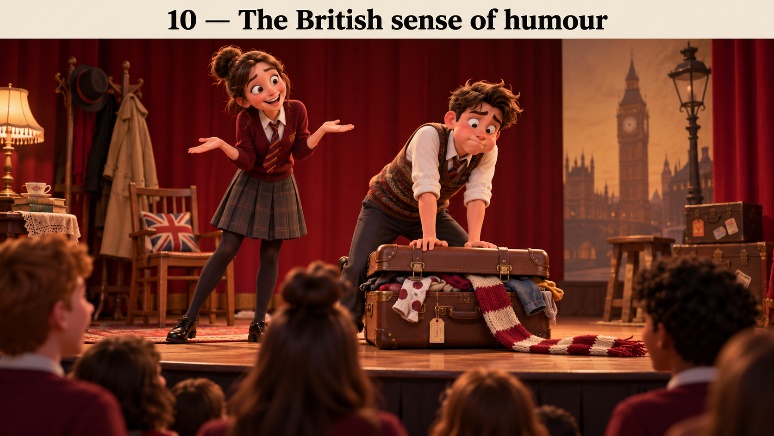
CLIL The British sense of humour |
||
Learning objectives |
9.4.2.1 understand specific information in texts on familiar general and academic topics, including some longer texts; 9.5.2.1 independently write about past experiences or real events and actions on familiar general and academic topics; |
||
Lesson objectives |
Students will be able to: • Locate specific details and explanations in a cultural text. • Write a clear account of a funny past experience. |
||
Stages
/ |
Teacher’s actions |
Students’ actions |
Assessment |
Resources |
Beginning 5 min |
Task 1. Share the lesson aims. Ask: What makes a situation funny? Teacher prepares and checks all AI materials before class. AI prompt: Create three discussion prompts about What makes a situation funny? for Grade 9. No personal data; no answers.
|
Share ideas in pairs, then give one example. Descriptor: Gives a relevant example and listens to a partner. Possible answer: An unexpected mistake can be funny when nobody is hurt. |
Formative Assessment Individual check against descriptors. Oral check; no points. Feedback: Check the evidence or verb form; revise one response. |
English Plus 9 — p. 17 ChatGPT — task card |
Middle 8 min |
Task 2. p. 17, Ex. 1–2. Read the complete article and fill six gaps using the word box. Check by rereading the surrounding sentences. AI prompt: Format the supplied task as a printable card; keep answers separate. |
Read and select words from context. Descriptor: Completes six gaps — one third of a point each. Correct answers: 1 good sense of humour; 2 comedians; 3 laughter; 4 sarcasm; 5 make fun of; 6 bizarre. |
Formative Assessment Individual check against descriptors. Maximum 2 points. Feedback: Check the evidence or verb form; revise one response. |
English Plus 9 — p. 17 ChatGPT — task card |
Middle 10 min |
Task 3. p. 17, Ex. 3. Answer questions 1, 3, 4, 5, 6 and 7. Attribute generalisations to the article rather than to every British person. AI prompt: Format the supplied task as a printable card; keep answers separate. |
Locate details and explain references. Descriptor: Answers six selected questions — 0.5 point each. Correct answers: 1 Sense of humour, good looks and money. 3 The author suggests laughter may compensate for bad weather. 4 Musicians are more internationally popular than British comedians, according to the article. |
Formative Assessment Individual check against descriptors. Maximum 3 points. Feedback: Check the evidence or verb form; revise one response. |
English Plus 9 — p. 17 ChatGPT — task card |
|
|
5 No; characters can be rude or unkind. 6 Yes; the article mentions over 200 countries. 7 He does ordinary things in bizarre ways and people appreciate his eccentricity. |
|
|
Middle 8 min |
Task 4. Recall a real or clearly fictional amusing event. Make notes: when, where, people, unexpected event, reaction. Differentiation: Support: five headings. Challenge: distinguish the earlier background from the main event. AI prompt: Format the supplied task as a printable card; keep answers separate. |
Plan a past account and share the sequence. Descriptor: Includes a clear setting — 1; sequences the unexpected event and reaction — 1. Model answer: Last Saturday; kitchen; my brother and me; he put salt in his tea by mistake; we laughed and made fresh tea. |
Formative Assessment Individual check against descriptors. Maximum 2 points. Feedback: Check the evidence or verb form; revise one response. |
English Plus 9 — p. 17 ChatGPT — task card |
Middle 9 min |
Task 5. Write 70–90 words about the planned event. Use past forms, two sequence links and an ending explaining why it was funny. Edit independently. AI prompt: Format the supplied task as a printable card; keep answers separate. |
Write, reread and correct a short account. Descriptor: Uses appropriate past forms — 1; sequences events clearly — 1; explains the reaction — 1. Model answer: Last Saturday my brother and I made tea in the kitchen. He was telling me |
Formative Assessment Individual check against descriptors. Maximum 3 points. Feedback: Check the evidence or verb form; revise one response. |
English Plus 9 — p. 17 ChatGPT — task card |
|
|
a story while he reached for the sugar bowl. Suddenly he noticed that he had used salt instead. He looked surprised, and then we both laughed. We made fresh tea and checked the labels carefully. The situation was funny because he usually reminds me to pay attention. Nobody was upset, and we enjoyed our tea together. |
|
|
End 5 min |
Task 6. Exit check: Write one past-tense sentence about an amusing event. Homework: Revise your account and underline two time links. AI prompt: Format a monochrome exit slip with one response line and one reflection line. Use the supplied question. |
Complete an individual exit response and note the next learning step. Descriptor: Applies the target skill in one independent response. Possible answer: Yesterday I waved at someone who looked like my friend. |
Formative Assessment Individual check against descriptors. Oral check; no points. Feedback: Check the evidence or verb form; revise one response. |
English Plus 9 — p. 17 ChatGPT — task card |
Lesson Plan 11
Unit 1 Hobbies and Qualities |
Lesson 11 |
||
Name of school |
|
||
Teacher name |
|
||
Date |
|
||
Grade 9 |
Number present |
Absent |
|
Lesson title |
Review Unit 1 and Progress assessment Hobbies and Qualities |
||
Learning objectives |
9.5.1.1 plan, write, edit and check text-level work on general and academic topics without the support of a teacher; 9. 6. 12. 1 Use a variety of comparative forms of regular and irregular adverbs on a wide range of familiar general and academic topics, using a wide range of adverbs that come before, after, and at the end of verbs; |
||
Lesson objectives |
Students will be able to: • Plan, draft, edit and check an independent account. • Use regular and irregular comparative adverbs accurately. |
||
Stages
/ |
Teacher’s actions |
Students’ actions |
Assessment |
Resources |
Beginning 5 min |
Task 1. Share the lesson aims. Ask: How has your performance in a hobby changed? Teacher prepares and checks all AI materials before class.
AI prompt: Create three discussion prompts about How has your performance in a hobby changed? for Grade 9. No personal data; no answers. |
Share ideas in pairs, then give one example. Descriptor: Gives a relevant example and listens to a partner. Possible answer: I play more confidently than before. |
Formative Assessment Individual check against descriptors. Oral check; no points. Feedback: Check the evidence or verb form; revise one response. |
English Plus 9 — p. 18 ChatGPT — task card |
Middle 7 min |
Task 2. p. 18, Ex. 1. Form adverbs from angry, good, careful, polite, optimistic and firm. Discuss adjective versus adverb use. AI prompt: Format the supplied task as a printable card; keep answers separate. |
Recall adverb forms and explain one example. Descriptor: Forms six adverbs and recognises their function. Correct answers: angrily; well; carefully; politely; optimistically; firmly. |
Formative Assessment Individual check against descriptors. Oral check; no points. Feedback: Check the evidence or verb form; revise one response. |
English Plus 9 — p. 18 ChatGPT — task card |
Middle 8 min |
Task 3. p. 18, Ex. 2. Choose the correct words in sentences 1–5. Explain why sang and played need adverbs. Review planning and editing steps before assessment. AI prompt: Format the supplied task as a printable card; keep answers separate. |
Complete revision and review the writing process. Descriptor: Chooses forms and explains one choice. Correct answers: 1 more beautifully; 2 the hardest, the most successful; 3 noisily, happily; 4 optimistic; 5 well, best. |
Formative Assessment Individual check against descriptors. Oral check; no points. Feedback: Check the evidence or verb form; revise one response. |
English Plus 9 — p. 18 ChatGPT — task card |
Middle 6 min |
Task 4. Progress Assessment Task A. Distribute the student sheet. Complete four comparative-adverb sentences independently. No answer key or AI feedback is shown during assessment. AI prompt: Format the supplied task as a printable card; keep answers separate. |
Complete four sentences independently. Descriptor: Uses four comparative adverbs — 1 point each. Correct answers: 1 more regularly; 2 better; 3 more quickly; 4 harder. |
Progress Assessment Teacher uses the stated rubric independently. Maximum 4 points. Feedback: After assessment, review one strength and one next step. |
English Plus 9 — p. 18 ChatGPT — task card |
Middle 14 min |
Task 5. Progress Assessment Task B. Use the student-sheet prompt: an 80–100 word account of learning a hobby. Allow 2 minutes to plan, 9 to write and 3 to edit. Collect the plan, draft and corrections. AI prompt: Format the supplied task as a printable card; keep answers separate. |
Plan, write, edit and check the account independently. Descriptor: Content — 1; links — 1; past forms — 1; two comparative adverbs — 1; plan — 1; checking/editing — 1. Model answer: Last month I joined a drawing club. At first, I worked slowly because I worried about every line. I planned a picture of my street and practised each afternoon. After a week, I drew more confidently than before. My teacher showed me how to notice shapes, so I began to work faster. One day I finished a complete picture without help. It was not perfect, but I felt proud of my progress. I learnt that regular practice was more useful than waiting for a perfect idea. Accept other coherent accounts. |
Progress Assessment Teacher uses the stated rubric independently. Maximum 6 points. Feedback: After assessment, review one strength and one next step. |
English Plus 9 — p. 18 ChatGPT — task card |
End 5 min |
Task 6. Exit check: Which stage helped you most: planning, writing or editing? Homework: After receiving feedback, revise one paragraph and explain your correction. AI prompt: Format a monochrome exit slip with one response line and one reflection line. Use the supplied question. |
Complete an individual exit response and note the next learning step. Descriptor: Applies the target skill in one independent response. Possible answer: Personal reflection; no fixed answer. |
Formative Assessment Individual check against descriptors. Oral check; no points. Feedback: Check the evidence or verb form; revise one response. |
English Plus 9 — p. 18 ChatGPT — task card |
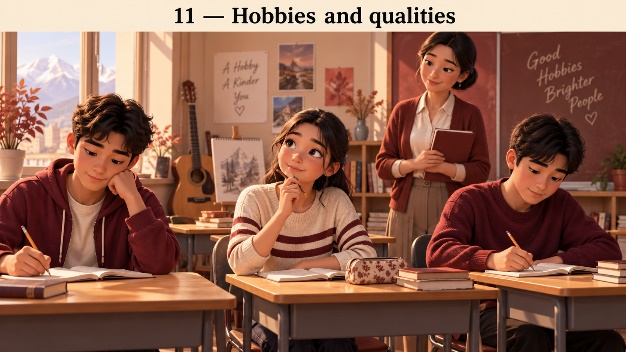
Lesson Plan 12
Unit 1 Hobbies and Qualities |
Lesson 12 |
||
Name of school |
|
||
Teacher name |
|
||
Date |
|
||
Grade 9 |
Number present |
Absent |
|
Lesson title |
Project An interview summary Teenage years |
||
Learning objectives |
9.4.6.1 identify the author's opinion or point of view in long texts on unfamiliar general and academic topics 9.5.6.1 write texts on familiar general and academic topics using various connecting conjunctions |
||
Lesson objectives |
Students will be able to: • Identify the writer’s viewpoint and supporting language. • Write a connected interview summary organised into sections. |
||
Stages
/ |
Teacher’s actions |
Students’ actions |
Assessment |
Resources |
Beginning 5 min |
Task 1. Share the lesson aims. Ask: What would you ask an older person about their teenage years? Teacher prepares and checks all AI materials before class.
AI prompt: Create three discussion prompts about What would you ask an older person about their teenage years? for Grade 9. No personal data; no answers. |
Share ideas in pairs, then give one example. Descriptor: Gives a relevant example and listens to a partner. Possible answer: What did you do in your free time? |
Formative Assessment Individual check against descriptors. Oral check; no points. Feedback: Check the evidence or verb form; revise one response. |
English Plus 9 — p. 19 ChatGPT — task card |
Middle 8 min |
Task 2. p. 19, Ex. 1. Match paragraphs A–E to questions 1–5. AI prompt: Format the supplied task as a printable card; keep answers separate. |
Read the complete interview summary and identify topics. Descriptor: Matches five paragraphs — 0.4 point each. Correct answers: 1 E; 2 A; 3 D; 4 B; 5 C. |
Formative Assessment Individual check against descriptors. Maximum 2 points. Feedback: Check the evidence or verb form; revise one response. |
English Plus 9 — p. 19 ChatGPT — task card |
Middle 10 min |
Task 3. Read the summary again. Ask: 1 Which words show a positive view of fashion? 2 What description makes the summer memories sound relaxed? 3 Does the text clearly claim that all life was better then? Explain. AI prompt: Format the supplied task as a printable card; keep answers separate. |
Distinguish details from viewpoint and quote short evidence. Descriptor: Identifies positive fashion language — 1; identifies relaxed description — 1; recognises the unsupported generalisation — 1. Correct answers: 1 “fun” and “very colourful”. 2 “lazy evenings outdoors” with friends. 3 No. It describes memories and differences without claiming everything was better. |
Formative Assessment Individual check against descriptors. Maximum 3 points. Feedback: Check the evidence or verb form; revise one response. |
English Plus 9 — p. 19 ChatGPT — task card |
Middle 8 min |
Task 4. Pairs role-play an interview using these fictional notes: Aida, teenager in the 1990s; borrowed books from a library; listened to the radio; played volleyball; enjoyed a school concert. Write four questions and record answers. Differentiation: Support: topic headings. Challenge: add a follow-up question. AI prompt: Format the supplied task as a printable card; keep answers separate. |
Ask questions and organise the supplied information. Descriptor: Uses relevant questions — 1; records accurate notes under headings — 1. Model answer: What did you read? Library books. What music source did you use? The radio. What sport did you play? Volleyball. What is a special memory? A school concert. |
Formative Assessment Individual check against descriptors. Maximum 2 points. Feedback: Check the evidence or verb form; revise one response. |
English Plus 9 — p. 19 ChatGPT — task card |
Middle 9 min |
Task 5. Write an 80–100 word summary based on the fictional interview or verified personal notes. Use at least three different connectors and clear topic sections. Do not invent quotes from a real interview. AI prompt: Format the supplied task as a printable card; keep answers separate. |
Draft and edit a connected summary. Descriptor: Accurate content — 1; three appropriate connectors — 1; clear organisation — 1. Model answer: Aida was a teenager in the 1990s. She borrowed books from the library because she enjoyed reading |
Formative Assessment Individual check against descriptors. Maximum 3 points. Feedback: Check the evidence or verb form; revise one response. |
English Plus 9 — p. 19 ChatGPT — task card |
|
|
She also listened to music on the radio. In her free time, she played volleyball with friends, and this was an important part of her week. Although she remembers several school events, her favourite memory is a concert. These details show what she enjoyed as a teenager. They describe one person’s life rather than the lives of all teenagers in the 1990s. |
|
|
End 5 min |
Task 6. Exit check: Join: She liked reading. She visited the library. Homework: With consent, interview an adult or use the fictional profile; improve the summary using the checklist on p. 19. AI prompt: Format a monochrome exit slip with one response line and one reflection line. Use the supplied question. |
Complete an individual exit response and note the next learning step. Descriptor: Applies the target skill in one independent response. Correct answers: She visited the library because she liked reading. |
Formative Assessment Individual check against descriptors. Oral check; no points. Feedback: Check the evidence or verb form; revise one response. |
English Plus 9 — p. 19 ChatGPT — task card |
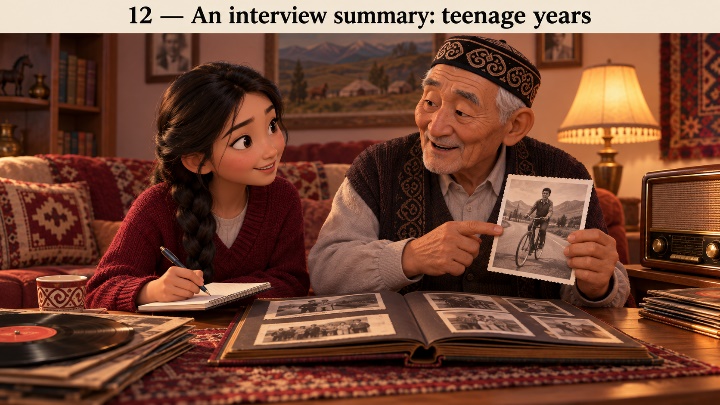
Lesson Plan 13
Unit 2 Physical education and sports |
Lesson 13 |
||
Name of school |
|
||
Teacher name |
|
||
Date |
|
||
Grade 9 |
Number present |
Absent |
|
Lesson title |
Medical science Health and exercise vocabulary |
||
Learning objectives |
9.4.2.1 understand specific information in texts on familiar general and academic topics, including some longer texts; 9.5.2.1 independently write about past experiences or real events and actions on familiar general and academic topics; |
||
Lesson objectives |
Students will be able to: • Locate specific information and word combinations in a text. • Write about a past sports or learning experience. |
||
Stages
/ |
Teacher’s actions |
Students’ actions |
Assessment |
Resources |
Beginning 5 min |
Task 1. Share the lesson aims. Ask: Which qualities help you keep practising a sport? Teacher prepares and checks all AI materials before class.
AI prompt: Create three discussion prompts about Which qualities help you keep practising a sport? for Grade 9. No personal data; no answers. |
Share ideas in pairs, then give one example. Descriptor: Gives a relevant example and listens to a partner. Possible answer: Determination and discipline help me practise. |
Formative Assessment Individual check against descriptors. Oral check; no points. Feedback: Check the evidence or verb form; revise one response. |
English Plus 9 — p. 20 ChatGPT — task card |
Middle 8 min |
Task 2. p. 20, Ex. 1. Sort the twelve nouns into mental attitude and physical health. Discuss reasonable overlap. This task checks word meanings, not the truth of the health quiz claims. AI prompt: Format the supplied task as a printable card; keep answers separate. |
Classify vocabulary and explain choices. Descriptor: Correctly classifies at least eight terms — 2 points; four to seven — 1. Correct answers: Mental attitude: commitment, self-esteem, determination, self-reliance, discipline, team work, concentration, mood. Physical health: stamina, endorphins, energy, blood pressure. Accept justified overlap. |
Formative Assessment Individual check against descriptors. Maximum 2 points. Feedback: Check the evidence or verb form; revise one response. |
English Plus 9 — p. 20 ChatGPT — task card |
Middle 10 min |
Task 3. p. 20, Ex. 2. Locate verbs used with these six nouns: stamina, concentration, self-esteem, self-reliance, mood, blood pressure. Read the sentences to find language; do not use the quiz as personal health advice. AI prompt: Format the supplied task as a printable card; keep answers separate. |
Scan the text for six verb–noun combinations. Descriptor: Locates six combinations — 0.5 point each. Correct answers: improve stamina; improve concentration; build self-esteem; develop self-reliance; boost mood; raise blood pressure (wording of a quiz statement, not a verified claim). |
Formative Assessment Individual check against descriptors. Maximum 3 points. Feedback: Check the evidence or verb form; revise one response. |
English Plus 9 — p. 20 ChatGPT — task card |
Middle 8 min |
Task 4. Read the teacher account: “Last term I joined a basketball team. I missed several passes at first. My friend practised with me on Fridays. After three weeks, I completed more passes during a match. I thanked my friend and decided to continue.” Ask: What sport? What difficulty? When did they practise? What changed? AI prompt: Format the supplied task as a printable card; keep answers separate. |
Read for four specific details. Descriptor: Answers four questions — 0.5 point each. Correct answers: Basketball; missed passes; on Fridays; completed more passes after three weeks. |
Formative Assessment Individual check against descriptors. Maximum 2 points. Feedback: Check the evidence or verb form; revise one response. |
English Plus 9 — p. 20 ChatGPT — task card |
Middle 9 min |
Task 5. Write 70–90 words about a past sports, club or learning experience. Include a difficulty, practice and a result; use three new nouns. Differentiation: Support: time–problem–action–result headings. Challenge: distinguish personal experience from general claims. AI prompt: Format the supplied task as a printable card; keep answers separate. |
Write a clear past account and check vocabulary. Descriptor: Sequences past events — 1; uses three topic nouns — 1; explains a result — 1. Model answer: Last term I joined a basketball club. At first, I missed many passes and felt nervous during matches. I needed determination to continue. My friend practised with me every Friday, and our team work improved. |
Formative Assessment Individual check against descriptors. Maximum 3 points. Feedback: Check the evidence or verb form; revise one response. |
English Plus 9 — p. 20 ChatGPT — task card |
|
|
I paid more attention to the ball, so my concentration also improved. After three weeks, I completed more passes in a game. I was pleased with my progress and thanked my friend. That experience helped me understand why regular practice matters. |
|
|
End 5 min |
Task 6. Exit check: Complete a natural combination: develop ___. Homework: Write six sentences using the new nouns, including two about a past experience. AI prompt: Format a monochrome exit slip with one response line and one reflection line. Use the supplied question. |
Complete an individual exit response and note the next learning step. Descriptor: Applies the target skill in one independent response. Possible answer: self-reliance. |
Formative Assessment Individual check against descriptors. Oral check; no points. Feedback: Check the evidence or verb form; revise one response. |
English Plus 9 — p. 20 ChatGPT — task card |
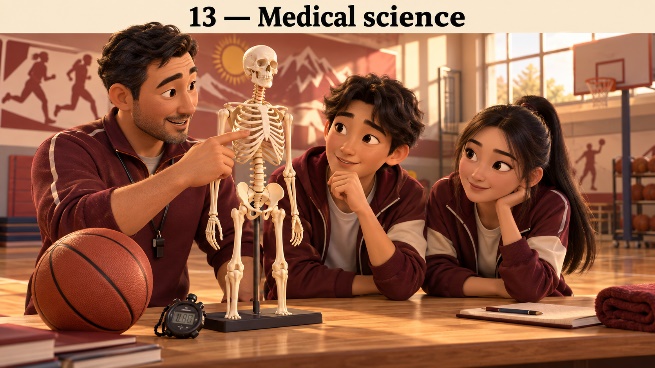
Lesson Plan 14
Unit 2 Physical education and sports |
Lesson 14 |
||
Name of school |
|
||
Teacher name |
|
||
Date |
|
||
Grade 9 |
Number present |
Absent |
|
Lesson title |
Language focus could can and will be able to |
||
Learning objectives |
9.5.2.1 independently write about past experiences or real events and actions on familiar general and academic topics; 9. 6. 13. 1 use modal forms for various purposes, and the past tense modal forms should/shouldn't have to to express regret and criticism on many familiar general and academic topics |
||
Lesson objectives |
Students will be able to: • Distinguish past, present and future ability. • Write about past experience and use a past modal to express regret. |
||
Stages
/ |
Teacher’s actions |
Students’ actions |
Assessment |
Resources |
Beginning 5 min |
Task 1. Share the lesson aims. Ask: What can you do now that you could not do when younger? Teacher prepares and checks all AI materials before class.
AI prompt: Create three discussion prompts about What can you do now that you could not do when younger? for Grade 9. No personal data; no answers. |
Share ideas in pairs, then give one example. Descriptor: Gives a relevant example and listens to a partner. Possible answer: I can swim now, but I could not swim when I was five. |
Formative Assessment Individual check against descriptors. Oral check; no points. Feedback: Check the evidence or verb form; revise one response. |
English Plus 9 — p. 21 ChatGPT — task card |
Middle 8 min |
Task 2. p. 21, Ex. 6. Read Jed’s account and complete gaps 1–7 with affirmative or negative ability forms. AI prompt: Format the supplied task as a printable card; keep answers separate. |
Use time references to select forms. Descriptor: Correctly fills seven gaps: 6–7 correct — 2; 3–5 — 1. Correct answers: 1 can’t; 2 couldn’t; 3 could; 4 can; 5 will be able to; 6 will be able to; 7 won’t be able to. |
Formative Assessment Individual check against descriptors. Maximum 2 points. Feedback: Check the evidence or verb form; revise one response. |
English Plus 9 — p. 21 ChatGPT — task card |
Middle 10 min |
Task 3. Complete teacher sentences: 1 At five, I ___ read long novels, but now I can. 2 Now she ___ play three songs. 3 After more practice, we ___ perform next year. 4 Yesterday I forgot my notes. I ___ have packed them earlier. Explain ability versus regret. AI prompt: Format the supplied task as a printable card; keep answers separate. |
Complete time-based forms and explain meaning. Descriptor: Three ability forms — 0.5 each; should for regret — 0.5; explains the distinction — 1. Correct answers: 1 couldn’t; 2 can; 3 will be able to; 4 should. Ability says what is possible; should have evaluates a past action. |
Formative Assessment Individual check against descriptors. Maximum 3 points. Feedback: Check the evidence or verb form; revise one response. |
English Plus 9 — p. 21 ChatGPT — task card |
Middle 8 min |
Task 4. Pairs ask about past and current abilities and a future goal. Use a follow-up question about practice. Differentiation: Support: time expressions. Challenge: describe one successful occasion using was able to. AI prompt: Format the supplied task as a printable card; keep answers separate. |
Interview and take brief notes. Descriptor: Asks a suitable question — 1; answers using an appropriate ability form — 1. Model answer: Could you ride a bike at six? |
Formative Assessment Individual check against descriptors. Maximum 2 points. Feedback: Check the evidence or verb form; revise one response. |
English Plus 9 — p. 21 ChatGPT — task card |
|
|
No, I couldn’t. Can you ride now? Yes. How did you learn? I practised with my sister. |
|
|
Middle 9 min |
Task 5. Write five or six connected sentences about learning a skill. Include could/couldn’t, can, will be able to and one should have sentence about preparation. AI prompt: Format the supplied task as a printable card; keep answers separate. |
Write and edit a learning account. Descriptor: Uses three ability time forms — 1; expresses a relevant regret — 1; creates a coherent past account — 1. Model answer: Last year I couldn’t play the guitar. I joined a club and practised every week. I can play three songs now. I forgot my music at my first performance. I should have packed it earlier. With more practice, I will be able to play a longer piece. |
Formative Assessment Individual check against descriptors. Maximum 3 points. Feedback: Check the evidence or verb form; revise one response. |
English Plus 9 — p. 21 ChatGPT — task card |
End 5 min |
Task 6. Exit check: Choose: Next year I can / will be able to speak more confidently. Homework: Write six sentences about ability across three time periods. AI prompt: Format a monochrome exit slip with one response line and one reflection line. Use the supplied question. |
Complete an individual exit response and note the next learning step. Descriptor: Applies the target skill in one independent response. Correct answers: will be able to. |
Formative Assessment Individual check against descriptors. Oral check; no points. Feedback: Check the evidence or verb form; revise one response. |
English Plus 9 — p. 21 ChatGPT — task card |
Lesson Plan 15
Unit 2 Physical education and sports |
Lesson 15 |
||
Name of school |
|
||
Teacher name |
|
||
Date |
|
||
Grade 9 |
Number present |
Absent |
|
Lesson title |
Reading Alternative therapy |
||
Learning objectives |
9.4.2.1 understand specific information in texts on familiar general and academic topics, including some longer texts; 9.5.3.1 write on familiar general and academic topics with uniform grammatical competence; |
||
Lesson objectives |
Students will be able to: • Find details and reference links in a text. • Write a grammatically accurate summary that preserves uncertainty. |
||
Stages
/ |
Teacher’s actions |
Students’ actions |
Assessment |
Resources |
Beginning 5 min |
Task 1. Share the lesson aims. Ask: What is the difference between “may help” and “will help”? Teacher prepares and checks all AI materials before class.
AI prompt: Create three discussion prompts about What is the difference between “may help” and “will help”? for Grade 9. No personal data; no answers. |
Share ideas in pairs, then give one example. Descriptor: Gives a relevant example and listens to a partner. Possible answer: May expresses possibility; will expresses a stronger prediction. |
Formative Assessment Individual check against descriptors. Oral check; no points. Feedback: Check the evidence or verb form; revise one response. |
English Plus 9 — pp. 22–23 ChatGPT — task card |
Middle 8 min |
Task 2. p. 22, Ex. 2. Read the article, including its continuation on p. 23. Insert sentences a–e by following reference words. Treat this as analysis of the textbook’s claims, not treatment advice. AI prompt: Format the supplied task as a printable card; keep answers separate. |
Read the complete article and connect ideas. Descriptor: Matches five gaps — 0.4 point each. Correct answers: 1 b; 2 d; 3 a; 4 e; 5 c. |
Formative Assessment Individual check against descriptors. Maximum 2 points. Feedback: Check the evidence or verb form; revise one response. |
English Plus 9 — pp. 22–23 ChatGPT — task card |
Middle 10 min |
Task 3. p. 22, Ex. 3. Form nouns from medicate, treat, infect, ill, reduce, depress, lonely. Then identify one expression in the article that shows uncertainty. AI prompt: Format the supplied task as a printable card; keep answers separate. |
Find noun forms and recognise cautious language. Descriptor: Seven nouns — 0.25 each; suitable uncertainty marker — 1.25. Correct answers: medication; treatment; infection; illness; reduction; depression; loneliness. Markers include could, might, may, some scientists think. |
Formative Assessment Individual check against descriptors. Maximum 3 points. Feedback: Check the evidence or verb form; revise one response. |
English Plus 9 — pp. 22–23 ChatGPT — task card |
Middle 8 min |
Task 4. Text questions: 1 What ancient thinker is mentioned? 2 What social problem appears in the final paragraph? 3 What group activity is suggested there? 4 Does “may” mean a result is guaranteed? AI prompt: Format the supplied task as a printable card; keep answers separate. |
Locate specific details and interpret modality. Descriptor: Answers four questions — 0.5 point each. Correct answers: 1 Hippocrates. |
Formative Assessment Individual check against descriptors. Maximum 2 points. Feedback: Check the evidence or verb form; revise one response. |
English Plus 9 — pp. 22–23 ChatGPT — task card |
|
|
2 Loneliness / separation from friends and family. 3 Joining a sports club. 4 No. |
|
|
Middle 9 min |
Task 5. Write a four-sentence summary of what the article argues. Attribute claims to the author and keep may/might where needed. Do not recommend changing treatment. Differentiation: Support: The article suggests…. Challenge: identify a claim requiring further evidence. AI prompt: Format the supplied task as a printable card; keep answers separate. |
Summarise without turning possibilities into certainties. Descriptor: Accurately reports the text’s topic — 1; preserves uncertainty — 1; uses clear grammatical sentences — 1. Model answer: The article discusses exercise and health. It suggests that activity may help in certain situations. It also discusses loneliness and group activities. These are claims in the article, and further evidence is needed before using them to make treatment decisions. |
Formative Assessment Individual check against descriptors. Maximum 3 points. Feedback: Check the evidence or verb form; revise one response. |
English Plus 9 — pp. 22–23 ChatGPT — task card |
End 5 min |
Task 6. Exit check: Rewrite as a cautious report: Exercise cures every illness. Homework: Write five noun-family sentences and underline suffixes. AI prompt: Format a monochrome exit slip with one response line and one reflection line. Use the supplied question. |
Complete an individual exit response and note the next learning step. Descriptor: Applies the target skill in one independent response. Correct answers: The article suggests exercise may help with some conditions; it does not establish a cure for every illness. |
Formative Assessment Individual check against descriptors. Oral check; no points. Feedback: Check the evidence or verb form; revise one response. |
English Plus 9 — pp. 22–23 ChatGPT — task card |
Lesson Plan 16
Unit 2 Physical education and sports |
Lesson 16 |
||
Name of school |
|
||
Teacher name |
|
||
Date |
|
||
Grade 9 |
Number present |
Absent |
|
Lesson title |
Language focus may might could must and can’t |
||
Learning objectives |
9.5.3.1 write on familiar general and academic topics with uniform grammatical competence; 9. 6. 13. 1 use modal forms for various purposes, and the past tense modal forms should/shouldn't have to to express regret and criticism on many familiar general and academic topics |
||
Lesson objectives |
Students will be able to: • Express possibility and strong deductions with modal verbs. • Write accurate sentences and distinguish deduction from regret. |
||
Stages
/ |
Teacher’s actions |
Students’ actions |
Assessment |
Resources |
Beginning 5 min |
Task 1. Share the lesson aims. Ask: You see a closed classroom door. What can you conclude? Teacher prepares and checks all AI materials before class.
AI prompt: Create three discussion prompts about You see a closed classroom door. What can you conclude? for Grade 9. No personal data; no answers. |
Share ideas in pairs, then give one example. Descriptor: Gives a relevant example and listens to a partner. Possible answer: The room might be empty, but the closed door does not prove it. |
Formative Assessment Individual check against descriptors. Oral check; no points. Feedback: Check the evidence or verb form; revise one response. |
English Plus 9 — p. 23 ChatGPT — task card |
Middle 8 min |
Task 2. p. 23, Ex. 1. Read the grammar rules, then use neutral classroom examples. Which forms express possibility? Which express a strong positive or negative deduction? Is to used after a modal? AI prompt: Format the supplied task as a printable card; keep answers separate. |
Identify functions and form. Descriptor: Identifies possibility group — 1; identifies deduction forms and no to — 1. Correct answers: Possibility: may, might, could. Strong deduction: must; negative deduction: can’t. Use the base verb without to. |
Formative Assessment Individual check against descriptors. Maximum 2 points. Feedback: Check the evidence or verb form; revise one response. |
English Plus 9 — p. 23 ChatGPT — task card |
Middle 10 min |
Task 3. Choose and explain: 1 Perhaps Ali is in the library: he might/must be there. 2 The only key is in my hand: it can’t/may be in my bag. 3 I can see Sara through the window: she must/might be in the room. 4 We are unsure: the club could/can’t meet tomorrow. AI prompt: Format the supplied task as a printable card; keep answers separate. |
Match evidence strength to four choices. Descriptor: Four appropriate choices — 0.5 each; one clear evidence-based explanation — 1. Correct answers: 1 might; 2 can’t; 3 must; 4 could. Seeing Sara gives strong direct evidence for 3. |
Formative Assessment Individual check against descriptors. Maximum 3 points. Feedback: Check the evidence or verb form; revise one response. |
English Plus 9 — p. 23 ChatGPT — task card |
Middle 8 min |
Task 4. Correct: 1 She might to arrive late. 2 He must is in class. 3 They could plays outside. 4 I forgot my homework yesterday; I should packed it. AI prompt: Format the supplied task as a printable card; keep answers separate. |
Edit modal structures. Descriptor: Corrects four forms — 0.5 point each. Correct answers: 1 might arrive; 2 must be; 3 could play; 4 should have packed. |
Formative Assessment Individual check against descriptors. Maximum 2 points. Feedback: Check the evidence or verb form; revise one response. |
English Plus 9 — p. 23 ChatGPT — task card |
Middle 9 min |
Task 5. Write a short paragraph about an uncertain school situation, with three different modal forms and a reason. Add one past regret about preparation. Differentiation: Support: evidence/guess headings. Challenge: explain why a stronger modal would be unjustified. AI prompt: Format the supplied task as a printable card; keep answers separate. |
Write and check the strength of each conclusion. Descriptor: Uses accurate modal forms — 1; connects deduction to evidence — 1; forms should have plus participle — 1. Model answer: The hall lights are on, so somebody might be inside. It could be the drama club. My friend cannot be at the rehearsal because she is beside me. I should have checked the timetable before coming. |
Formative Assessment Individual check against descriptors. Maximum 3 points. Feedback: Check the evidence or verb form; revise one response. |
English Plus 9 — p. 23 ChatGPT — task card |
End 5 min |
Task 6. Exit check: Is “She speaks Spanish, so she must be Mexican” justified? Homework: Write four possibilities and two deductions using clear evidence. AI prompt: Format a monochrome exit slip with one response line and one reflection line. Use the supplied question. |
Complete an individual exit response and note the next learning step. Descriptor: Applies the target skill in one independent response. Correct answers: No. Speaking a language does not establish nationality. |
Formative Assessment Individual check against descriptors. Oral check; no points. Feedback: Check the evidence or verb form; revise one response. |
English Plus 9 — p. 23 ChatGPT — task card |
Lesson Plan 17
Unit 2 Physical education and sports |
Lesson 17 |
||
Name of school |
|
||
Teacher name |
|
||
Date |
|
||
Grade 9 |
Number present |
Absent |
|
Lesson title |
Vocabulary and listening Phrasal verbs |
||
Learning objectives |
9.2.2.1 understand some specific information on general and educational topics independently in extended conversations without support 9.3.2.1 ask complex questions to obtain information within general and educational topics; |
||
Lesson objectives |
Students will be able to: • Identify six details in a conversation without written support. • Ask complex questions to obtain information about routines. |
||
Stages
/ |
Teacher’s actions |
Students’ actions |
Assessment |
Resources |
Beginning 5 min |
Task 1. Share the lesson aims. Ask: What new hobby would you like to start? Teacher prepares and checks all AI materials before class.
AI prompt: Create three discussion prompts about What new hobby would you like to start? for Grade 9. No personal data; no answers. |
Share ideas in pairs, then give one example. Descriptor: Gives a relevant example and listens to a partner. Possible answer: I would like to take up badminton. |
Formative Assessment Individual check against descriptors. Oral check; no points. Feedback: Check the evidence or verb form; revise one response. |
English Plus 9 — p. 24 ChatGPT — task card |
Middle 8 min |
Task 2. p. 24, Ex. 1. Match eight phrasal verbs to meanings a–h. Use them as vocabulary examples rather than a personal health prescription. AI prompt: Format the supplied task as a printable card; keep answers separate. |
Match phrases to meanings. Descriptor: Eight accurate matches — 0.25 point each. Correct answers: a take up; b call on; c cut down on; d work out; e get over; f turn off; g go without; h give up. |
Formative Assessment Individual check against descriptors. Maximum 2 points. Feedback: Check the evidence or verb form; revise one response. |
English Plus 9 — p. 24 ChatGPT — task card |
Middle 10 min |
Task 3. Use this original listening alternative, not the unavailable recording 1.17. Read twice with no displayed transcript. Ask: 1 What did Dana take up? 2 Why did she want to stop? 3 When does she practise? 4 What did she reduce? 5 What does Amir turn off? 6 Whom does he visit? Listening script: Host: Today we are talking about hobbies and daily routines. Dana, what did you change this term? Dana: I took up badminton with a friend. At first I wanted to give up because I missed the shuttle so often. My friend helped me practise. Host: When do you practise? Dana: On Tuesday after school. I also cut down on time watching videos, so I can finish my homework first. |
Listen independently and record six details. Descriptor: Six accurate details — 0.5 point each. Correct answers: 1 Badminton. 2 She often missed the shuttle. 3 Tuesday after school. 4 Time watching videos. 5 The television. 6 His grandfather. |
Formative Assessment Individual check against descriptors. Maximum 3 points. Feedback: Check the evidence or verb form; revise one response. |
English Plus 9 — p. 24 ElevenLabs — audio script |
|
Host: Amir, what about you? Amir: I used to leave the television on while I worked. Now I turn it off before studying. On Saturdays, I call on my grandfather and we play chess. Host: Do you work out in a gym? Amir: No. I prefer our school club. Dana: I like having a clear plan, but sometimes I change it when I have extra homework. Host: So you both chose routines that fit your week. AI prompt: Read the supplied Host, Dana and Amir dialogue exactly with three distinct voices. Use a clear moderate pace. |
|
|
|
Middle 8 min |
Task 4. Build two complex questions using Could you explain why…? and How did you decide which…? Ask a partner about hobbies or study routines. Differentiation: Support: question stems. Challenge: ask a follow-up referring to an answer. AI prompt: Format the supplied task as a printable card; keep answers separate. |
Ask two complex questions and listen to answers. Descriptor: Forms two relevant complex questions — 1 each. Model answer: Could you explain why you took up badminton? How did you decide which activity to give up? |
Formative Assessment Individual check against descriptors. Maximum 2 points. Feedback: Check the evidence or verb form; revise one response. |
English Plus 9 — p. 24 ChatGPT — task card |
Middle 9 min |
Task 5. Pairs interview each other about a weekly routine. Ask a reason, a choice and a challenge; use three phrasal verbs in the exchange. AI prompt: Format the supplied task as a printable card; keep answers separate. |
Conduct a connected interview with follow-up. Descriptor: Uses three phrasal verbs accurately — 1; asks a relevant follow-up — 1; gives a clear answer — 1.
|
Formative Assessment Individual check against descriptors. Maximum 3 points. Feedback: Check the evidence or verb form; revise one response. |
English Plus 9 — p. 24 ChatGPT — task card |
|
|
Model answer: Why did you take up chess? I wanted a quiet hobby. Could you explain what you cut down on to make time? I watch fewer videos. Was it hard to give up that time? At first, but I enjoy the club. |
|
|
End 5 min |
Task 6. Exit check: Give a synonym for cut down on and use it in a sentence. Homework: Write five interview questions, including two complex questions. AI prompt: Format a monochrome exit slip with one response line and one reflection line. Use the supplied question. |
Complete an individual exit response and note the next learning step. Descriptor: Applies the target skill in one independent response. Correct answers: Reduce. I cut down on video time during exams. |
Formative Assessment Individual check against descriptors. Oral check; no points. Feedback: Check the evidence or verb form; revise one response. |
English Plus 9 — p. 24 ChatGPT — task card |
Lesson Plan 18
Unit 2 Physical education and sports |
Lesson 18 |
||
Name of school |
|
||
Teacher name |
|
||
Date |
|
||
Grade 9 |
Number present |
Absent |
|
Lesson title |
Language focus Past modals |
||
Learning objectives |
9.5.2.1 independently write about past experiences or real events and actions on familiar general and academic topics; 9. 6. 13. 1 use modal forms for various purposes, and the past tense modal forms should/shouldn't have to to express regret and criticism on many familiar general and academic topics |
||
Lesson objectives |
Students will be able to: • Use modal plus have plus past participle for past deductions. • Write about past events using regret and criticism appropriately. |
||
Stages
/ |
Teacher’s actions |
Students’ actions |
Assessment |
Resources |
Beginning 5 min |
Task 1. Share the lesson aims. Ask: Your notebook is missing. Give one possible explanation about the past. Teacher prepares and checks all AI materials before class.
AI prompt: Create three discussion prompts about Your notebook is missing. Give one possible explanation about the past. for Grade 9. No personal data; no answers. |
Share ideas in pairs, then give one example. Descriptor: Gives a relevant example and listens to a partner. Possible answer: I might have left it at home. |
Formative Assessment Individual check against descriptors. Oral check; no points. Feedback: Check the evidence or verb form; revise one response. |
English Plus 9 — p. 25 ChatGPT — task card |
Middle 8 min |
Task 2. p. 25, Ex. 1. Identify strong positive deduction, strong negative deduction and possibility. Complete the form rule. Then distinguish should have for regret. AI prompt: Format the supplied task as a printable card; keep answers separate. |
Compare meanings and structures. Descriptor: Identifies deduction groups — 1; supplies have plus participle and distinguishes regret — 1. Correct answers: must have: strong positive deduction; can’t have: strong negative deduction; could/might have: possibility. Form: modal + have + past participle. Should have expresses a past action judged desirable. |
Formative Assessment Individual check against descriptors. Maximum 2 points. Feedback: Check the evidence or verb form; revise one response. |
English Plus 9 — p. 25 ChatGPT — task card |
Middle 10 min |
Task 3. Transform teacher sentences: 1 She must leave early. 2 They might forget the time. 3 He can’t lose both keys. 4 We could miss the bus. 5 I should check the date. 6 They shouldn’t shout. Put every sentence in the past. AI prompt: Format the supplied task as a printable card; keep answers separate. |
Form six past-modal structures. Descriptor: Six correct forms — 0.5 point each. Correct answers: 1 must have left; 2 might have forgotten; 3 can’t have lost; 4 could have missed; 5 should have checked; 6 shouldn’t have shouted. |
Formative Assessment Individual check against descriptors. Maximum 3 points. Feedback: Check the evidence or verb form; revise one response. |
English Plus 9 — p. 25 ChatGPT — task card |
Middle 8 min |
Task 4. Read: “Yesterday I arrived late for rehearsal. I had read the wrong time. My friends waited outside because I had the key. I apologised and we started.” Write one regret and one constructive criticism. AI prompt: Format the supplied task as a printable card; keep answers separate. |
Read the account and evaluate past actions. Descriptor: Appropriate should have sentence — 1; appropriate shouldn’t have sentence — 1. Model answer: I should have checked the time. I shouldn’t have kept my friends waiting. |
Formative Assessment Individual check against descriptors. Maximum 2 points. Feedback: Check the evidence or verb form; revise one response. |
English Plus 9 — p. 25 ChatGPT — task card |
Middle 9 min |
Task 5. Write 70–90 words about a real or fictional missed event. Include a past possibility, a regret, a consequence and a better future plan. Differentiation: Support: event–reason–result–reflection. Challenge: clearly separate known events from guesses. AI prompt: Format the supplied task as a printable card; keep answers separate. |
Write and independently edit a reflective account. Descriptor: Uses past speculation accurately — 1; expresses regret or criticism accurately — 1; sequences events and reflection clearly — 1. Model answer: Yesterday I missed the start of our club meeting. |
Formative Assessment Individual check against descriptors. Maximum 3 points. Feedback: Check the evidence or verb form; revise one response. |
English Plus 9 — p. 25 ChatGPT — task card |
|
|
I thought it began at four, but everyone arrived at three. I might have copied the time incorrectly. My friends waited for my part of the presentation, so we finished late. I should have checked the message before leaving home. I apologised and helped tidy the room afterwards. Next time I will write the time in my diary and read it again before I set off. |
|
|
Lesson 19
Unit 2 Exercise and sport |
Lesson 19 |
||
Name of school |
|
||
Teacher name |
|
||
Date: |
|
||
Grade
9 |
Number present |
Absent |
|
Lesson title |
Exchanging opinions |
||
Learning objectives |
9.2.7.1
identify the characteristic features of most oral genres at the
word, sentence and text levels |
||
Lesson objectives |
Students will recognise features of oral discussion and exchange supported opinions on familiar topics. |
||
Stages / Time |
Teacher’s actions |
Students’ actions |
Assessment |
Resources |
Beginning
of the lesson |
Organisation
1 min; Warm-up 2 min; Lead-in 2 min
AI integration Teacher prompt: “Create a Grade 9 B1 visual for Exchanging opinions. No text. Teacher checks details.” Before class: OBSERVE → COMPARE with the book → VERIFY. Values Link to Unity and Solidarity: Students listen respectfully and take equal turns. |
Respond
to the greeting, try the warm-up and explain the
topic. |
Formative assessment: Observation and oral questioning. “You noticed the key clue!” |
Interactive board; teacher-prepared cards; paper; pencils. Gemini — picture clues. English Plus 9 textbook — p. 26. |
Middle
of the lesson |
Ex
1 p 26 Poster messages AI integration Teacher prompt: “Prepare Grade 9 teacher-prepared listening model for Ex 1 p 26 Poster messages. Give a separate checked key.” Before class: OBSERVE → COMPARE with the book → VERIFY. Values Link to Honesty and Responsibility: Students give their own answers and correct mistakes. |
Describe
the posters and justify a preference. |
Formative assessment: Observation and evidence questioning. “Your reason explains your preference!” |
Interactive board; teacher-prepared cards; paper; pencils. ElevenLabs — teacher-prepared listening model. English Plus 9 textbook — Ex. 1 p. 26. |
Middle
of the lesson |
Ex
2 p 26 Listening and oral genre AI integration Teacher prompt: “Prepare Grade 9 reading and evidence prompts for Ex 2 p 26 Listening and oral genre. Give a separate checked key.” Before class: OBSERVE → COMPARE with the book → VERIFY. Values Link to Fairness and Respect: Students discuss people and abilities respectfully. |
Identify
opinions, reasons and oral-genre features. |
Formative assessment: Listening and genre checklist. “You used language and structure to identify the genre!” |
Interactive board; teacher-prepared cards; paper; pencils. Claude — reading and evidence prompts. English Plus 9 textbook — Ex. 2 p. 26; separate listening practice. |
Middle
of the lesson |
Ex
3 p 26 Key phrases and intonation AI integration Teacher prompt: “Prepare Grade 9 practice cards for Ex 3 p 26 Key phrases and intonation. Give a separate checked key.” Before class: OBSERVE → COMPARE with the book → VERIFY. Values Link to Digital Literacy: Students OBSERVE, COMPARE and VERIFY the prepared examples. |
Identify
strong opinion and polite disagreement; compare oral genres;
practise turns. |
Formative assessment: Intonation observation and comparison. “Your disagreement is clear and polite!” |
Interactive board; teacher-prepared cards; paper; pencils. Microsoft Copilot — practice cards. English Plus 9 textbook — Ex. 3 p. 26. |
Middle
of the lesson |
Ex
4 p 26 Modals and original opinion exchange AI integration Teacher prompt: “Prepare Grade 9 rubric and checking support for Ex 4 p 26 Modals and original opinion exchange. Give a separate checked key.” Before class: OBSERVE → COMPARE with the book → VERIFY. Values Link to Unity and Solidarity: Students share responsibilities and reach an agreement respectfully. |
Complete
modals, correct two errors and exchange reasoned
opinions. |
Formative assessment: Grammar self-check and role-play rubric. “Your suggestion responds to your partner’s idea!” |
Interactive board; teacher-prepared cards; paper; pencils. ChatGPT — rubric and checking support. English Plus 9 textbook — Ex. 4 p. 26; added modal practice and role-play. |
End
of the lesson |
Reflection
and homework
|
Write
an original example, check it and reflect honestly. |
Formative assessment: Exit-ticket review and self-assessment. “Your correction shows progress!” |
Interactive board; teacher-prepared cards; paper; pencils. Canva Magic Studio — reflection icons. English Plus 9 textbook — p. 26 reflection. |

Lesson 20
Unit 2 Exercise and sport |
Lesson 20 |
||
Name of school |
|
||
Teacher name |
|
||
Date: |
|
||
Grade
9 |
Number present |
Absent |
|
Lesson title |
A discussion essay and Unit 2 Progress assessment |
||
Learning objectives |
9.4.6.1
identify the author's opinion or point of view in long texts on
unfamiliar general and academic topics |
||
Lesson objectives |
Students will identify a qualified viewpoint in a longer text and write supported arguments with examples. |
||
Stages / Time |
Teacher’s actions |
Students’ actions |
Assessment |
Resources |
Beginning
of the lesson |
Organisation
1 min; Warm-up 2 min; Lead-in 2 min
AI integration Teacher prompt: “Create a Grade 9 B1 visual for A discussion essay and Unit 2 Progress assessment. No text. Teacher checks details.” Before class: OBSERVE → COMPARE with the book → VERIFY. Values Link to Unity and Solidarity: Students listen respectfully and take equal turns. |
Respond
to the greeting, try the warm-up and explain the
topic. |
Formative assessment: Observation and oral questioning. “You noticed the key clue!” |
Interactive board; teacher-prepared cards; paper; pencils. Gemini — picture clues. English Plus 9 textbook — p. 27. |
Middle
of the lesson |
Ex
1 p 27 Writer viewpoint AI integration Teacher prompt: “Prepare Grade 9 teacher-prepared listening model for Ex 1 p 27 Writer viewpoint. Give a separate checked key.” Before class: OBSERVE → COMPARE with the book → VERIFY. Values Link to Honesty and Responsibility: Students give their own answers and correct mistakes. |
Identify
viewpoint and cite supporting lines. |
Formative assessment: Viewpoint and evidence check. “You kept the qualification in the writer’s opinion!” |
Interactive board; teacher-prepared cards; paper; pencils. ElevenLabs — teacher-prepared listening model. English Plus 9 textbook — Ex. 1 p. 27. |
Middle
of the lesson |
Ex
2–4 p 27 Discourse markers AI integration Teacher prompt: “Prepare Grade 9 reading and evidence prompts for Ex 2–4 p 27 Discourse markers. Give a separate checked key.” Before class: OBSERVE → COMPARE with the book → VERIFY. Values Link to Honesty and Responsibility: Students cite the text and correct unsupported answers. |
Complete
phrases, classify functions and correct two errors. |
Formative assessment: Classification and sentence check. “Your marker matches the function!” |
Interactive board; teacher-prepared cards; paper; pencils. Claude — reading and evidence prompts. English Plus 9 textbook — Ex. 2–4 p. 27. |
Middle
of the lesson |
Added
essay planning AI integration Teacher prompt: “Prepare Grade 9 practice cards for Added essay planning. Give a separate checked key.” Before class: OBSERVE → COMPARE with the book → VERIFY. Values Link to Digital Literacy: Students OBSERVE, COMPARE and VERIFY the prepared examples. |
Make
concise notes and distinguish argument from example. |
Formative assessment: Planner conference. “Your example supports the reason rather than repeating it!” |
Interactive board; teacher-prepared cards; paper; pencils. Microsoft Copilot — practice cards. English Plus 9 textbook — p. 27; added essay plan. |
Middle
of the lesson |
Unit
2 Teacher-created assessment draft 10 points AI integration Teacher prompt: “Prepare Grade 9 teacher model proofreading for Unit 2 Teacher-created assessment draft 10 points. Give a separate checked key. Teacher preparation only; check the school specification and hide keys until collection.” Before class: OBSERVE → COMPARE with the book → VERIFY. Values Link to Honesty and Responsibility: Students complete assessed responses independently; feedback follows collection. |
Read
for viewpoint and write a supported discussion
independently. |
Progress draft: reading 4 + writing 6 = 10. School assessment specification takes precedence. |
Interactive board; teacher-prepared cards; paper; pencils. Grammarly — teacher model proofreading. English Plus 9 textbook — Unit 2 teacher-created assessment draft. |
End
of the lesson |
Reflection
and homework
|
Write
an original example, check it and reflect honestly. |
Formative assessment: Exit-ticket review and self-assessment. “Your correction shows progress!” |
Interactive board; teacher-prepared cards; paper; pencils. Canva Magic Studio — reflection icons. English Plus 9 textbook — p. 27 reflection. |

Lesson 21
Unit 2 Exercise and sport |
Lesson 21 |
||
Name of school |
|
||
Teacher name |
|
||
Date: |
|
||
Grade
9 |
Number present |
Absent |
|
Lesson title |
My country Exercise and sport |
||
Learning objectives |
9.4.9.1
identify inconsistencies in the evidence presented in longer
texts on a variety of general and academic topics |
||
Lesson objectives |
Students will identify inconsistencies in evidence and write a profile using an appropriate genre. |
||
Stages / Time |
Teacher’s actions |
Students’ actions |
Assessment |
Resources |
Beginning
of the lesson |
Organisation
1 min; Warm-up 2 min; Lead-in 2 min
AI integration Teacher prompt: “Create a Grade 9 B1 visual for My country Exercise and sport. No text. Teacher checks details.” Before class: OBSERVE → COMPARE with the book → VERIFY. Values Link to Unity and Solidarity: Students listen respectfully and take equal turns. |
Respond
to the greeting, try the warm-up and explain the
topic. |
Formative assessment: Observation and oral questioning. “You noticed the key clue!” |
Interactive board; teacher-prepared cards; paper; pencils. Gemini — picture clues. English Plus 9 textbook — p. 28. |
Middle
of the lesson |
Ex
1–2 p 28 Sportspeople and evidence AI integration Teacher prompt: “Prepare Grade 9 teacher-prepared listening model for Ex 1–2 p 28 Sportspeople and evidence. Give a separate checked key.” Before class: OBSERVE → COMPARE with the book → VERIFY. Values Link to Honesty and Responsibility: Students give their own answers and correct mistakes. |
Identify
people from source captions/text and complete six
details. |
Formative assessment: Text-evidence checklist. “You checked the claim in the source!” |
Interactive board; teacher-prepared cards; paper; pencils. ElevenLabs — teacher-prepared listening model. English Plus 9 textbook — Ex. 1–2 p. 28. |
Middle
of the lesson |
Ex
3–4 p 28 Nouns and past ability AI integration Teacher prompt: “Prepare Grade 9 reading and evidence prompts for Ex 3–4 p 28 Nouns and past ability. Give a separate checked key.” Before class: OBSERVE → COMPARE with the book → VERIFY. Values Link to Fairness and Respect: Students discuss people and abilities respectfully. |
Form
nouns, correct spelling and apply past-ability
forms. |
Formative assessment: Word-formation and contextual grammar check. “Your form matches the type of achievement!” |
Interactive board; teacher-prepared cards; paper; pencils. Claude — reading and evidence prompts. English Plus 9 textbook — Ex. 3–4 p. 28. |
Middle
of the lesson |
Added
longer evidence audit AI integration Teacher prompt: “Prepare Grade 9 practice cards for Added longer evidence audit. Give a separate checked key.” Before class: OBSERVE → COMPARE with the book → VERIFY. Values Link to Digital Literacy: Students OBSERVE, COMPARE and VERIFY the prepared examples. |
Audit
evidence, classify problems and propose revisions. |
Formative assessment: Evidence audit and reasoning rubric. “You separated contradictory evidence from missing evidence!” |
Interactive board; teacher-prepared cards; paper; pencils. Microsoft Copilot — practice cards. English Plus 9 textbook — p. 28 theme; added evidence audit. |
Middle
of the lesson |
Added
school-magazine profile AI integration Teacher prompt: “Prepare Grade 9 rubric and checking support for Added school-magazine profile. Give a separate checked key.” Before class: OBSERVE → COMPARE with the book → VERIFY. Values Link to Responsibility: Students work independently and use classroom materials carefully. |
Plan
and write a profile with accurate supplied details. |
Formative assessment: Genre and evidence writing checklist. “Your profile is clear and stays within the supplied facts!” |
Interactive board; teacher-prepared cards; paper; pencils. ChatGPT — rubric and checking support. English Plus 9 textbook — p. 28 theme; added profile. |
End
of the lesson |
Reflection
and homework
|
Write
an original example, check it and reflect honestly. |
Formative assessment: Exit-ticket review and self-assessment. “Your correction shows progress!” |
Interactive board; teacher-prepared cards; paper; pencils. Canva Magic Studio — reflection icons. English Plus 9 textbook — p. 28 reflection. |

Lesson 22
Unit 2 Exercise and sport |
Lesson 22 |
||
Name of school |
|
||
Teacher name |
|
||
Date: |
|
||
Grade
9 |
Number present |
Absent |
|
Lesson title |
CLIL Healthy eating |
||
Learning objectives |
9.4.9.1
identify inconsistencies in the evidence presented in longer
texts on a variety |
||
Lesson objectives |
Students will identify inconsistencies in evidence and support a proposal with arguments and examples. Check the complete wording of objective 9.4.9.1 in the school curriculum plan. |
||
Stages / Time |
Teacher’s actions |
Students’ actions |
Assessment |
Resources |
Beginning
of the lesson |
Organisation
1 min; Warm-up 2 min; Lead-in 2 min
AI integration Teacher prompt: “Create a Grade 9 B1 visual for CLIL Healthy eating. No text. Teacher checks details.” Before class: OBSERVE → COMPARE with the book → VERIFY. Values Link to Unity and Solidarity: Students listen respectfully and take equal turns. |
Respond
to the greeting, try the warm-up and explain the
topic. |
Formative assessment: Observation and oral questioning. “You noticed the key clue!” |
Interactive board; teacher-prepared cards; paper; pencils. Gemini — picture clues. English Plus 9 textbook — p. 29. |
Middle
of the lesson |
Ex
1 p 29 Vocabulary AI integration Teacher prompt: “Prepare Grade 9 teacher-prepared listening model for Ex 1 p 29 Vocabulary. Give a separate checked key.” Before class: OBSERVE → COMPARE with the book → VERIFY. Values Link to Honesty and Responsibility: Students give their own answers and correct mistakes. |
Match
five definitions and correct word use. |
Formative assessment: Vocabulary and context check. “Your definition explains the word accurately!” |
Interactive board; teacher-prepared cards; paper; pencils. ElevenLabs — teacher-prepared listening model. English Plus 9 textbook — Ex. 1 p. 29. |
Middle
of the lesson |
Ex
2–3 p 29 Reading with evidence AI integration Teacher prompt: “Prepare Grade 9 reading and evidence prompts for Ex 2–3 p 29 Reading with evidence. Give a separate checked key.” Before class: OBSERVE → COMPARE with the book → VERIFY. Values Link to Fairness and Respect: Students discuss people and abilities respectfully. |
Summarise
the text and justify choices with evidence. |
Formative assessment: Reading-evidence check. “You kept the text’s cautious wording!” |
Interactive board; teacher-prepared cards; paper; pencils. Claude — reading and evidence prompts. English Plus 9 textbook — Ex. 2–3 p. 29. |
Middle
of the lesson |
Added
longer report with inconsistent evidence AI integration Teacher prompt: “Prepare Grade 9 practice cards for Added longer report with inconsistent evidence. Give a separate checked key.” Before class: OBSERVE → COMPARE with the book → VERIFY. Values Link to Digital Literacy: Students OBSERVE, COMPARE and VERIFY the prepared examples. |
Compare
evidence across text and table; classify problems. |
Formative assessment: Evidence audit checklist. “Your conclusion matches what was measured!” |
Interactive board; teacher-prepared cards; paper; pencils. Microsoft Copilot — practice cards. English Plus 9 textbook — p. 29 theme; added report. |
Middle
of the lesson |
Ex
4 p 29 Adapted fictional menu argument AI integration Teacher prompt: “Prepare Grade 9 rubric and checking support for Ex 4 p 29 Adapted fictional menu argument. Give a separate checked key.” Before class: OBSERVE → COMPARE with the book → VERIFY. Values Link to Responsibility: Students work independently and use classroom materials carefully. |
Write
a supported proposal with examples and cautious
claims. |
Formative assessment: Argument-and-example writing rubric. “Your examples justify the proposed changes!” |
Interactive board; teacher-prepared cards; paper; pencils. ChatGPT — rubric and checking support. English Plus 9 textbook — Ex. 4 p. 29; adapted fictional proposal. |
End
of the lesson |
Reflection
and homework
|
Write
an original example, check it and reflect honestly. |
Formative assessment: Exit-ticket review and self-assessment. “Your correction shows progress!” |
Interactive board; teacher-prepared cards; paper; pencils. Canva Magic Studio — reflection icons. English Plus 9 textbook — p. 29 reflection. |

Lesson 23
Unit 2 Exercise and sport |
Lesson 23 |
||
Name of school |
|
||
Teacher name |
|
||
Date: |
|
||
Grade
9 |
Number present |
Absent |
|
Lesson title |
Progress control work for Term 1 |
||
Learning objectives |
9.2.1.1
understand the main ideas of general and educational topics in
extended conversations without support; |
||
Lesson objectives |
Students will understand main ideas in listening and reading, write an account of a past event, and use formal and informal registers appropriately. |
||
Stages / Time |
Teacher’s actions |
Students’ actions |
Assessment |
Resources |
Beginning
of the lesson |
Organisation
1 min; Warm-up 2 min; Lead-in 2 min
AI integration Teacher prompt: “Create a Grade 9 B1 visual for Progress control work for Term 1. No text. Teacher checks details. Teacher preparation only; check the school specification and hide keys until collection.” Before class: OBSERVE → COMPARE with the book → VERIFY. Values Link to Honesty and Responsibility: Students complete assessed responses independently; feedback follows collection. |
Respond
to the greeting, try the warm-up and explain the
topic. |
Observation and oral questioning. “You noticed the key clue!” |
Interactive board; teacher-prepared cards; paper; pencils. Gemini — picture clues. English Plus 9 textbook — Term 1 teacher-created assessment draft. |
Middle
of the lesson |
Listening
Teacher-created draft 5 points AI integration Teacher prompt: “Prepare Grade 9 teacher-prepared listening model for Listening Teacher-created draft 5 points. Give a separate checked key. Teacher preparation only; check the school specification and hide keys until collection.” Before class: OBSERVE → COMPARE with the book → VERIFY. Values Link to Honesty and Responsibility: Students complete assessed responses independently; feedback follows collection. |
Listen
independently for main ideas. |
Progress draft listening 5 points; hide keys until collection. |
Interactive board; teacher-prepared cards; paper; pencils. ElevenLabs — teacher-prepared listening model. English Plus 9 textbook — Term 1 teacher-created assessment draft. |
Middle
of the lesson |
Reading
Teacher-created draft 5 points AI integration Teacher prompt: “Prepare Grade 9 reading and evidence prompts for Reading Teacher-created draft 5 points. Give a separate checked key. Teacher preparation only; check the school specification and hide keys until collection.” Before class: OBSERVE → COMPARE with the book → VERIFY. Values Link to Honesty and Responsibility: Students complete assessed responses independently; feedback follows collection. |
Read
a longer text and summarise main ideas. |
Progress draft reading 5 points. |
Interactive board; teacher-prepared cards; paper; pencils. Claude — reading and evidence prompts. English Plus 9 textbook — Term 1 teacher-created assessment draft. |
Middle
of the lesson |
Writing
Teacher-created draft 6 points AI integration Teacher prompt: “Prepare Grade 9 practice cards for Writing Teacher-created draft 6 points. Give a separate checked key. Teacher preparation only; check the school specification and hide keys until collection.” Before class: OBSERVE → COMPARE with the book → VERIFY. Values Link to Honesty and Responsibility: Students complete assessed responses independently; feedback follows collection. |
Write
an original organised account and proofread
independently. |
Progress draft writing 6 points. |
Interactive board; teacher-prepared cards; paper; pencils. Microsoft Copilot — practice cards. English Plus 9 textbook — Term 1 teacher-created assessment draft. |
Middle
of the lesson |
Speaking
Teacher-created draft 4 points AI integration Teacher prompt: “Prepare Grade 9 rubric and checking support for Speaking Teacher-created draft 4 points. Give a separate checked key. Teacher preparation only; check the school specification and hide keys until collection.” Before class: OBSERVE → COMPARE with the book → VERIFY. Values Link to Honesty and Responsibility: Students complete assessed responses independently; feedback follows collection. |
Perform
both register tasks and respond to follow-up
questions. |
Progress draft speaking 4 points; total 20. School specification takes precedence. |
Interactive board; teacher-prepared cards; paper; pencils. ChatGPT — rubric and checking support. English Plus 9 textbook — Term 1 teacher-created assessment draft. |
End
of the lesson |
Reflection
and homework
|
Write
an original example, check it and reflect honestly. |
Exit-ticket review and self-assessment. “Your correction shows progress!” |
Interactive board; teacher-prepared cards; paper; pencils. Canva Magic Studio — reflection icons. English Plus 9 textbook — Term 1 teacher-created assessment draft. |

Lesson 24
Unit 2 Exercise and sport |
Lesson 24 |
||
Name of school |
|
||
Teacher name |
|
||
Date: |
|
||
Grade
9 |
Number present |
Absent |
|
Lesson title |
Review Unit 2 |
||
Learning objectives |
9.4.2.1
understand specific information in texts on familiar general and
academic topics, including some longer texts; |
||
Lesson objectives |
Students will identify specific details in a longer text and independently write a coherent account of a past experience. |
||
Stages / Time |
Teacher’s actions |
Students’ actions |
Assessment |
Resources |
Beginning
of the lesson |
Organisation
1 min; Warm-up 2 min; Lead-in 2 min
AI integration Teacher prompt: “Create a Grade 9 B1 visual for Review Unit 2. No text. Teacher checks details.” Before class: OBSERVE → COMPARE with the book → VERIFY. Values Link to Unity and Solidarity: Students listen respectfully and take equal turns. |
Respond
to the greeting, try the warm-up and explain the
topic. |
Formative assessment: Observation and oral questioning. “You noticed the key clue!” |
Interactive board; teacher-prepared cards; paper; pencils. Gemini — picture clues. English Plus 9 textbook — p. 30. |
Middle
of the lesson |
Ex
1–2 p 30 Vocabulary and noun formation AI integration Teacher prompt: “Prepare Grade 9 teacher-prepared listening model for Ex 1–2 p 30 Vocabulary and noun formation. Give a separate checked key.” Before class: OBSERVE → COMPARE with the book → VERIFY. Values Link to Honesty and Responsibility: Students give their own answers and correct mistakes. |
Complete
seven verbs and eight nouns; explain a form. |
Formative assessment: Collocation and spelling checklist. “Your word form fits the sentence!” |
Interactive board; teacher-prepared cards; paper; pencils. ElevenLabs — teacher-prepared listening model. English Plus 9 textbook — Ex. 1–2 p. 30. |
Middle
of the lesson |
Ex
3 p 30 Phrasal verbs AI integration Teacher prompt: “Prepare Grade 9 reading and evidence prompts for Ex 3 p 30 Phrasal verbs. Give a separate checked key.” Before class: OBSERVE → COMPARE with the book → VERIFY. Values Link to Fairness and Respect: Students discuss people and abilities respectfully. |
Complete
particles and explain meanings in the printed
context. |
Formative assessment: Meaning and self-correction check. “You explained the whole expression!” |
Interactive board; teacher-prepared cards; paper; pencils. Claude — reading and evidence prompts. English Plus 9 textbook — Ex. 3 p. 30. |
Middle
of the lesson |
Ex
4 p 30 Ability across time AI integration Teacher prompt: “Prepare Grade 9 practice cards for Ex 4 p 30 Ability across time. Give a separate checked key.” Before class: OBSERVE → COMPARE with the book → VERIFY. Values Link to Digital Literacy: Students OBSERVE, COMPARE and VERIFY the prepared examples. |
Complete
forms and justify time reference. |
Formative assessment: Contextual grammar check. “Your form matches the time clue!” |
Interactive board; teacher-prepared cards; paper; pencils. Microsoft Copilot — practice cards. English Plus 9 textbook — Ex. 4 p. 30. |
Middle
of the lesson |
Added
longer reading and independent past account AI integration Teacher prompt: “Prepare Grade 9 rubric and checking support for Added longer reading and independent past account. Give a separate checked key.” Before class: OBSERVE → COMPARE with the book → VERIFY. Values Link to Responsibility: Students work independently and use classroom materials carefully. |
Find
specific details and write a coherent past account. |
Formative assessment: Specific-information and writing rubric. “Your details make the past experience clear!” |
Interactive board; teacher-prepared cards; paper; pencils. ChatGPT — rubric and checking support. English Plus 9 textbook — p. 30; added reading and writing. |
End
of the lesson |
Reflection
and homework
|
Write
an original example, check it and reflect honestly. |
Formative assessment: Exit-ticket review and self-assessment. “Your correction shows progress!” |
Interactive board; teacher-prepared cards; paper; pencils. Canva Magic Studio — reflection icons. English Plus 9 textbook — p. 30 reflection. |










 Бұл курс Қазақстан Республикасы Оқу-ағарту министрлігімен келісілген










