
 ЖИ көмекші


 Қауіпсіз төлем

жүктеу мүмкіндігіне ие боласыз
Бұл материал сайт қолданушысы жариялаған. Материалдың ішінде жазылған барлық ақпаратқа жауапкершілікті жариялаған қолданушы жауап береді. Ұстаз тілегі тек ақпаратты таратуға қолдау көрсетеді. Егер материал сіздің авторлық құқығыңызды бұзған болса немесе басқа да себептермен сайттан өшіру керек деп ойласаңыз осында жазыңыз
 23 Қаңтар 2020
 11154

1 жыл бойы шексіз жүктеңіз
9 сынып ағылшын тілінен 3 тоқсанға арналған тжб
SUMMATIVE ASSESSMENT TASKS FOR TERM 3
Summative assessment for the units «Reading for Pleasure» and «Traditions and Language»
Learning objectives 9.4.5.1 Deduce meaning from context in extended texts on a
range of familiar general and curricular topics
9.3.4.1 Respond with growing flexibility at both sentence
and discourse level to unexpected comments on a range of
general and curricular topics
9.3.7.1 Use appropriate subject-specific vocabulary and
syntax to talk about an increased range of general and
curricular topics;
9.3.8.1 Recount extended stories and events on a range of
general and curricular topics
Assessment criteria Identify the meaning from context
Deliver effective reply speeches or comment on the partner’s speech without preparation
Use topic related vocabulary and syntax to express the opinion
Retell extended stories and events
Level of thinking skills Knowledge and comprehension
Application
Higher order thinking skills
Duration 20 minutes
Reading
Task 1. Read the text and circle True (T) or False (F) for the statements 1-6.
The festival of Hallowe'en has its (0) roots in Celtic and Roman traditions. Over 2,000 years ago the Celts in Britain, Ireland and parts of France celebrated Samhain to (1) mark the beginning of winter. When the Romans invaded, they merged this with Feralia, their celebration of the passing of the dead. As Christianity spread, the Church tried to replace these pagan feasts with official Church holy days. One of these was November 1. It was called All Saints Day, or "All Hallows", and October 31 was known as "All Hallows' Eve", and then Hallowe'en.
Hallowe'en is a popular festival in many countries all over the world, and every year it seems to get bigger. Find out some more about the traditional festival of Hallowe'en.
In the past there was a tradition called "souling". Poor people went around houses asking for food. In exchange, they promised to say prayers for the dead. People no longer go souling, but the habit has been transformed into a modern Hallowe'en game for children in America, who dress up as ghosts, witches and monsters and go around people's houses, asking for sweets. This game is called ‘Trick or Treat’.
The pumpkin is a symbol of Hallowe'en. People empty a pumpkin, cut a face into the side, and put a candle inside. It's known as a Jack O' Lantern, from an Irish legend about a man called Jack, who made a deal with the devil.
Hallowe'en wouldn't be fun without witches. Witches have always been part of popular folklore. Shakespeare's (2) play "Macbeth" opens with three witches. A witch was someone - usually a woman - who had special powers and had dealings with the devil. The American town, Salem, in the state of Massachusetts, is famous for the "witchcraft trials", which took place there in 1692.
1. The Christian Church took over the older pagan festivals. T F
2. Witches are modern characters. T F
3. Lots of people like Hallowe'en. T F
4. Only poor people play 'Trick or Treat'. T F
5. The Celts celebrated Samhain at the end of autumn. T F
6. Jack O'Lantern was another name for the devil. T F
6p
Speaking
Task 2. In pairs, learners take a card and develop a conversation answering the given questions. They have 1 minute to generate the ideas and they have to speak for 2-3 minutes.
Card 1. Answer the following questions in the form of conversation. You have 1 minute for preparation and you have to speak for 2-3 minutes. 1. Describe one of the main characters of the book that you`ve read. 2. What changes does a main character go through? 3. Describe one significant part of the book. 4. How did reading it change you, or your views?
Card 2. Answer the following questions in the form of conversation. You have 1 minute for preparation and you have to speak for 2-3 minutes. 1. Something you disliked about the book you`ve read. 2. Describe the setting. 3. Which character did you like most? Why? 4. Which character did you like least? Why?
Card 3. Answer the following questions in the form of conversation. You have 1 minute for preparation and you have to speak for 2-3 minutes. 1. Explain the title of the book you`ve read. 2. What category or genre do you think it fits into? 3. What do you think the author’s purpose is? 4. Something you liked about it. Why?
Card 4. Answer the following questions in the form of conversation. You have 1 minute for preparation and you have to speak for 2-3 minutes. 1. What was the lesson that you`ve learnt from the book? 2. What do you think of the ending? 3. What happens, or should happen, after the ending? 4. How did reading it change you, or your views
Card 5. Answer the following questions in the form of conversation. You have 1 minute for preparation and you have to speak for 2-3 minutes. 1. What would you say to persuade a friend to read the book that you`ve read or not to read it? 2. Summarise it in one sentence. 3. What feedback would you give the author? 4. What would you change in the book if you had a chance?
4p
Summative assessment for the unit «Music and Film»
Learning objectives 9.2.4.1 Understand most of the implied meaning in unsupported extended talks on a wide range of general and curricular topics
9.5.3.1 Write with moderate grammatical accuracy on a wide range of familiar general and curricular topics
9.5.5.1 Develop with support coherent arguments supported when necessary by examples and reasons for a range of written genres in familiar general and curricular topics
9.5.6.1 Write coherently at text level using a variety of connectors on a growing range of familiar general and curricular topics
Assessment criteria Identify most of the implied meaning in unsupported extended talks
Develop coherent paragraphs with moderate grammatical accuracy
Develop coherent arguments supported by examples and reasons
Use a variety of connectors to develop coherent paragraphs
Level of thinking skills Knowledge and comprehension
Application
Duration 20 minutes
Listening
Task 1. Listen and circle True or False for statements 1-6. CD2. Tapescript 3.
1. The girl says she will call him the next day.. T F
2. He doesn’t like singing. T F
3. He can’t remember the song on the guitar T F
4. The boy wants to be in the band. T F
5. The boy is good at drums T F
5p
Writing
Task 2. Write a film review of your favourite movie. In your review you should include the following information:
Film`s title.
The type of the film. When it was made.
Explain the film`s story but don`t explain the ending.
Your opinion about the film.
Should people go and watch the film?
5p
SPECIFICATION OF SUMMATIVE ASSESSMENT FOR TERM 3
Review of summative assessment for term 3
Duration of the summative assessment – 40 minutes
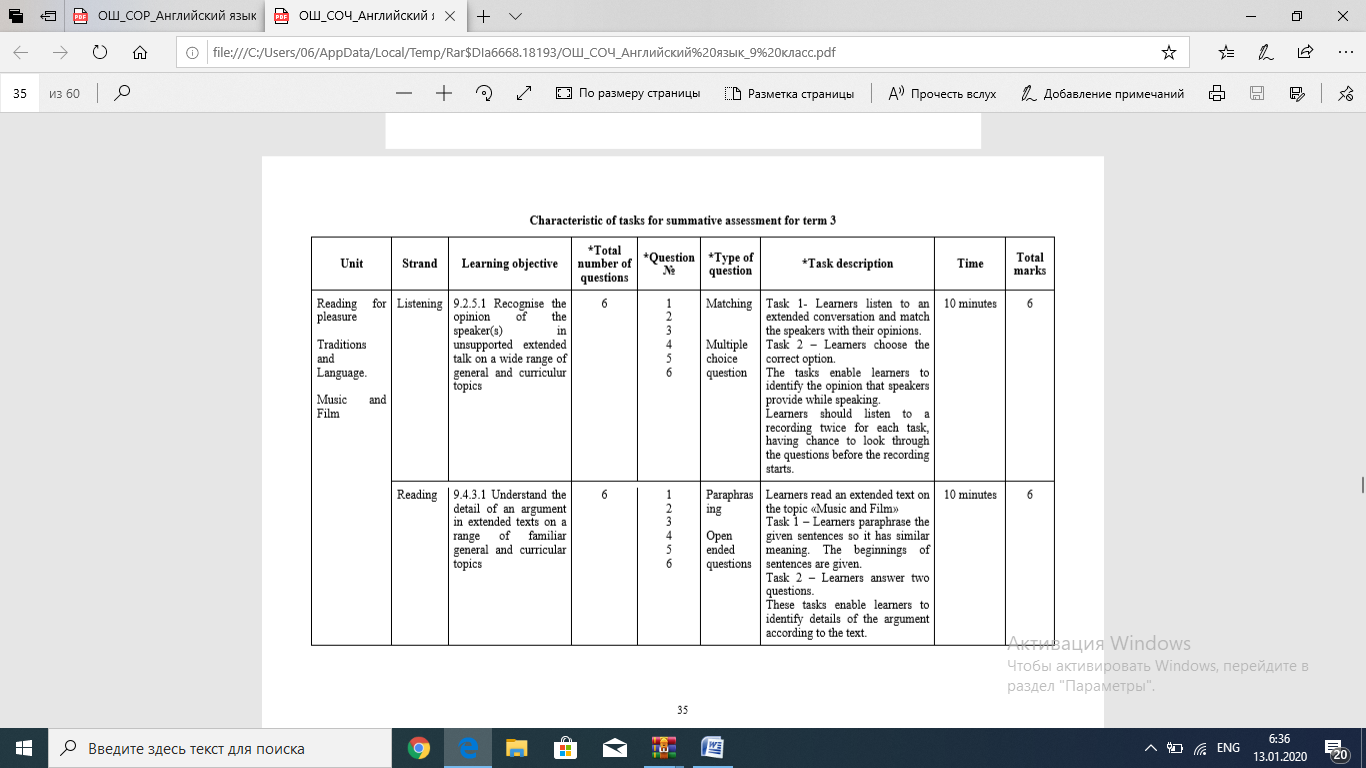
Listening – 10 minutes
Reading – 10 minuets
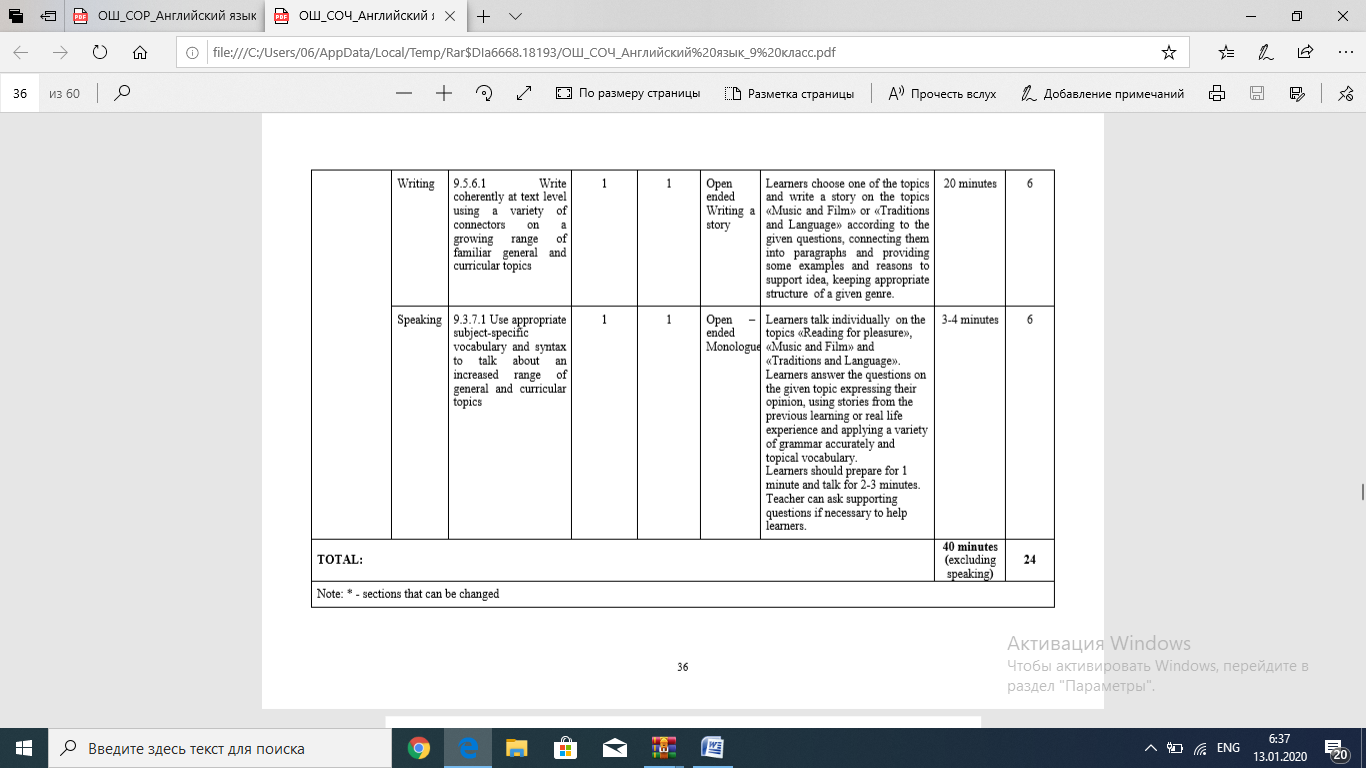
Writing – 20 minutes
Speaking task is conducted separately.
Total marks - 24
The structure of the summative assessment
This Summative Assessment consists of 14 questions: listening, reading, writing and speaking. Different types of tasks are used in the Summative Assessment for term. Listening – matching and multiple choice question on the topic «Traditions and Language». Reading – paraphrasing and open ended questions on the topic «Music and Film». Writing – writing a story on the topics «Traditions and Language» and «Music and Film». Speaking – producing a speech (monologue) on the topics «Reading for pleasure», «Music and Film» and «Traditions and Language». Tapescript for listening task can be found in CD3. Transcript can be found after the mark scheme.
Tasks for the Summative Assessment for term 3
Variant 1
LISTENING
Task 1. Listen to five speaker talking about different celebrations. Match the halves of the sentences
with the opinions (A-F) to make true sentences. ONE argument is extra. CD3 Tapescript3
1. According to Speaker 1 their band is the best as _____ [1]
2. According to Speaker 2 you have to be careful because _____ [1]
3. According to Speaker 3 the picnic is going to be organised because _____ [1]
4. According to Speaker 4 the birthday will be thematic as ____ [1]
5. According to Speaker 5 Royal wedding is the reason of _____ [1]
A. there are the thieves around.
B. remembering people.
C. it’s going to be a family celebration.
D. having a celebration.
E. they have been playing for a long time together.
F. it will fall at the end of autumn.
Task.2 Choose and circle the correct answer A, B or C.
6. According to the speakers [1]
A. people celebrate festivals with families
B. celebrations make people get tired
C. celebrations unite people together
Total [6]
READING
WHAT’S A FILM WITHOUT POPCORN
Popcorn has been associated with cinemas and films for as long as we can remember. But where did this connection begin and will it carry on into the future? Popcorn became a popular snack food in North America in the 19th century and was sold at circuses and fairs. No kitchen was needed to prepare it and once the mobile steam owered popcorn maker was invented, it became possible to mass produce the snack. Popcorn had an appealing smell when popped and this attracted many people to buy it. In the 1930s, people began flocking to the cinema but at first, popcorn was not sold inside the cinemas. Cinema owners wanted to protect the costly carpets that they had put in their cinemas. They were also concerned that the sound of people eating snacks would disturb the other people watching the film. So, enterprising salesmen set up popcorn machines outside the buildings. As lots of people began buying popcorn on their way into the cinema, cinema owners understood that they could make money from the popular snack. Thus, they decided to allow the salesmen to sell popcorn in the cinema lobby for a daily fee. Eventually, cinemas began selling snacks themselves. This decision helped save many of the cinema owners from going out of business. Today, popcorn is still economically important to cinemas. Because popcorn is so cheap to make, cinemas make a lot of profits on every box they sell. Yet, there are those that suggest that popcorn in cinemas may be on its way out. In recent years, luxury cinemas have become increasingly popular. These cinemas try to give people a more “exclusive” experience by serving gourmet food in addition to traditional popcorn. Yet despite this development, it is unlikely that popcorn will vanish completely from cinemas. For many of us, eating popcorn is an integral part of the experience of watching a film. Even when we watch a film on TV at home, we often make ourselves some microwave popcorn. Old habits, it seems, are hard to break!
Task.3 Paraphrase the given sentences so it has similar meaning. Use the given beginnings of sentences. Example, No kitchen was needed to prepare popcorn.
Preparation _________________________. Answer, Preparation of popcorn did not need any kitchen.
1. When we watch a film on TV at home, we often make ourselves some microwave popcorn. Home made _________________________________________________________________. [1]
2. In recent years, luxury cinemas have become increasingly popular. Popularity ______________________________________________. 1]
3. Selling snacks themselves helped save many of the cinema owners from going out of business. Many cinema __________________________________________________________________.[ [1]
4. Enterprising salesmen set up popcorn machines outside the building. Popcorn machines __________________________________________. [1]
Task 4. Answer the questions.
5. Why cannot popcorn be dissapperead from cinemas? [1]
6. Why have cinemas sold popcorn since the 19th century? [1]
Total [6]
WRITING
Choose ONE of the topics and write.
Topic 1. You are a foreign journalist, recently visiting Kazakhstan. You would like to write a story about this country in your professional blog. Include the following information in your story:
• People in Kazakhstan;
• Kazakh traditions (kyrkynan shygaru, shildekhana, tusau kesu, etc.);
• Traditional clothes (shapan, kamzol, saukele, takiya, etc.);
• Traditional food;
• Personal recommendation
Topic 2. You are a blogger who shares with own experience. Write a story about a concert you have been to. Include the following information in your review:
• The concert; when? / where?
• The band: people in the band/ kind of music/ songs played
• The audience: how many people / their reaction
• Problems: the music/ the sound quality/ the time
• Suggestions: different place / different time / different kind of music Write a story using linking words appropriately and paragraphing your story accurately.
Total [6]
SPEAKING
Task 5.
You are given questions to speak about for 2-3 minutes. Before you
speak you have one minute to think about what you are going to say.
Card 1 1. What music do you enjoy listening to? 2. Where do people usually enjoy listening to music? 3. Is foreign music or music from your country more popular with people of your age? (Why do you think that is?) 4. What do you think the effect of more music in schools would be?
Card 2 1. What national traditions do you know? Tell about one of them. 2. What kind of tradition around the world do you know? 3. Why are traditions important? 4. Are there any changes in modern and traditional lifestyles
Card 3 1. How often do you watch films? 2. What genre do you prefer? 3. What’s your favourite film? 4. How have films changed over the years?
Card 4 1. How many languages do you speak? 2. Should people learn foreign languages? Why? Why not? 3. Do you think that all children should learn foreign languages at school? 4. Why do some people have more difficulties than others while learning a language?
Card 5 ? 1. Do you like listening to music on a regular basis? 2. What kind of songs or music do you like listening to? 3. Where do you think people enjoy listening to music the most? 4. Do you think music is getting better as time goes on?
Card 6 1. What language would you like to learn? Why? 2. What difficulties you think you might have when learning the language? 3. Why, in your opinion, do some people not progress in their language studies? 4. Do you think there is a danger that English could slowly replace your native language?
Card 7.1. How is modern Kazakh music different from traditional Kazakh music? 2. What influence do you think music has on life? 3. How does music change your mood? 4. What part does music play in your culture?
Card 8 1. What is the most famous tradition in your country? 2. What are Kazakh people famous for? 3. Should we keep our traditions in modern life? 4. What tradition would you like to pass on to the next generation?
Total [6
] Total marks ____/24
Tasks for the Summative Assessment for term 3
Variant 2
LISTENING
Task 1. Listen to five speaker talking about different celebrations. Match the halves of the sentences
with the opinions (A-F) to make true sentences. ONE argument is extra. CD3 Tapescript3
1. According to Speaker 1 their band is the best as _____ [1]
2. According to Speaker 2 you have to be careful because _____ [1]
3. According to Speaker 3 the picnic is going to be organised because _____ [1]
4. According to Speaker 4 the birthday will be thematic as ____ [1]
5. According to Speaker 5 Royal wedding is the reason of _____ [1]
A. it will fall at the end of autumn.
B. they have been playing for a long time together.
C. having a celebration.
D. there are the thieves around.
E. remembering people.
F. it’s going to be a family celebration.
Task.2 Choose and circle the correct answer A, B or C.
6. According to the speakers [1]
A. people celebrate festivals with families
B. celebrations unite people together
C. celebrations make people get tired
Total [6]
READING
WHAT’S A FILM WITHOUT POPCORN
Popcorn has been associated with cinemas and films for as long as we can remember. But where did this connection begin and will it carry on into the future? Popcorn became a popular snack food in North America in the 19th century and was sold at circuses and fairs. No kitchen was needed to prepare it and once the mobile steam owered popcorn maker was invented, it became possible to mass produce the snack. Popcorn had an appealing smell when popped and this attracted many people to buy it. In the 1930s, people began flocking to the cinema but at first, popcorn was not sold inside the cinemas. Cinema owners wanted to protect the costly carpets that they had put in their cinemas. They were also concerned that the sound of people eating snacks would disturb the other people watching the film. So, enterprising salesmen set up popcorn machines outside the buildings. As lots of people began buying popcorn on their way into the cinema, cinema owners understood that they could make money from the popular snack. Thus, they decided to allow the salesmen to sell popcorn in the cinema lobby for a daily fee. Eventually, cinemas began selling snacks themselves. This decision helped save many of the cinema owners from going out of business. Today, popcorn is still economically important to cinemas. Because popcorn is so cheap to make, cinemas make a lot of profits on every box they sell. Yet, there are those that suggest that popcorn in cinemas may be on its way out. In recent years, luxury cinemas have become increasingly popular. These cinemas try to give people a more “exclusive” experience by serving gourmet food in addition to traditional popcorn. Yet despite this development, it is unlikely that popcorn will vanish completely from cinemas. For many of us, eating popcorn is an integral part of the experience of watching a film. Even when we watch a film on TV at home, we often make ourselves some microwave popcorn. Old habits, it seems, are hard to break!
Task.3 Paraphrase the given sentences so it has similar meaning. Use the given beginnings of sentences. Example, No kitchen was needed to prepare popcorn.
Preparation _________________________. Answer, Preparation of popcorn did not need any kitchen.
1. When we watch a film on TV at home, we often make ourselves some microwave popcorn. Home made _________________________________________________________________. [1]
2. In recent years, luxury cinemas have become increasingly popular. Popularity ______________________________________________. 1]
3. Selling snacks themselves helped save many of the cinema owners from going out of business. Many cinema __________________________________________________________________.[ [1]
4. Enterprising salesmen set up popcorn machines outside the building. Popcorn machines __________________________________________. [1]
Task 4. Answer the questions.
5. Why popcorn is important to cinemas? [1]
6. Where is first popcorn was made? [1]
Total [6]
WRITING
Choose ONE of the topics and write.
Topic 1. You are a blogger who shares with own experience. Write a story about a festival you have been to. Include the following information in your review:
• when? / where?
• what was the main goal?
• The audience: how many people / their reaction
• Problems: with organization or prepation
• Suggestions: different place / different time
Topic 2. You are a foreign blogger, recently visiting Kazakhstan. You would like to write a story about this country in your professional blog. Include the following information in your story:
• Nature of Kazakhstan
• Kazakh traditions
• Traditional clothes
• Traditional food;
• Personal recommendation
Total [6]
SPEAKING
Task 5.
You are given questions to speak about for 2-3 minutes. Before you
speak you have one minute to think about what you are going to say.
Card 1 1 What national traditions do you know? Tell about one of them. 2. What kind of tradition around the world do you know? 3. Why are traditions important? 4. Are there any changes in modern and traditional lifestyles
Card 2 1. . What music do you enjoy listening to? 2. Where do people usually enjoy listening to music? 3. Is foreign music or music from your country more popular with people of your age? (Why do you think that is?) 4. What do you think the effect of more music in schools would be?
Card 3 1. How often do you watch films? 2. What genre do you prefer? 3. What’s your favourite film? 4. How have films changed over the years?
Card 4 1. Do you like listening to music on a regular basis? 2. What kind of songs or music do you like listening to? 3. Where do you think people enjoy listening to music the most? 4. Do you think music is getting better as time goes on?
Card 5 1. How many languages do you speak? 2. Should people learn foreign languages? Why? Why not? 3. Do you think that all children should learn foreign languages at school? 4. Why do some people have more difficulties than others while learning a language?
Card 6 1. What language would you like to learn? Why? 2. What difficulties you think you might have when learning the language? 3. Why, in your opinion, do some people not progress in their language studies? 4. Do you think there is a danger that English could slowly replace your native language?
Card 7. 1. What is the most famous tradition in your country? 2. What are Kazakh people famous for? 3. Should we keep our traditions in modern life? 4. What tradition would you like to pass on to the next generation?
Card 8 1. How is modern Kazakh music different from traditional Kazakh music? 2. What influence do you think music has on life? 3. How does music change your mood? 4. What part does music play in your culture?
Total [6
] Total marks ____/24









 Бұл курс Қазақстан Республикасы Оқу-ағарту министрлігімен келісілген










