
 ЖИ көмекші


 Қауіпсіз төлем

жүктеу мүмкіндігіне ие боласыз
Бұл материал сайт қолданушысы жариялаған. Материалдың ішінде жазылған барлық ақпаратқа жауапкершілікті жариялаған қолданушы жауап береді. Ұстаз тілегі тек ақпаратты таратуға қолдау көрсетеді. Егер материал сіздің авторлық құқығыңызды бұзған болса немесе басқа да себептермен сайттан өшіру керек деп ойласаңыз осында жазыңыз
 17 Қаңтар 2019
 422

1 жыл бойы шексіз жүктеңіз
Ағылшын тілі пәнін оқытуда кинотренинг әдісін пайдалану
CONTENT
Introduction……………………..………………………………………3
I.THE MEANING AND CONTENT OF THE LESSON OF A FOREIGN LANGUAGE BY THE VIDEO TRAINING PROCESS …………………….6
I.1.Periods of working with film and video cameras…………………………14
II.2. Fundamentals of application for foreign language lessons movies and
audio……………………………………………………………………….....19
II.USING VIDEO TRAINING AT ENGLISH LESSONS………………....28
II.1.The peculiarities of Using Video………………………………………..42
II.2.The Pecularities of Psyhological development of school children while
using video…………………………………………………………………...58
Conclusion………………………………………………………………70
REFERENCES…………………………………….…………………………72
INTRODUCTION
The modern system of learning a foreign language is characterized by the fact that the practical knowledge of a foreign language is need every educated person in connection with the requirements for the it requirements of the company. Foreign language beneficial effect on the general level of culture of the people, promotes the development of communications.
The formation of communicative competence is the main and leading the purpose of teaching a foreign language. Today it is especially topical. Oral communication, the role of which has become especially significant is impossible without well-developed skills of speaking. For competent foreign language communication it is need to know the rules of grammar, constantly enrich their vocabulary, to have knowledge of phonetic peculiarities of the language, the understanding of the traditions and culture of the target language and, of course, to develop the skills of speaking. According to the state standard of foreign language teaching for basic level, for successful communication, the student should learn to conduct the dialogue, using evaluative judgments in situations of formal and informal communication, talk about themselves, their plans; participate in the discussion of the problems in connection with the read/ listened foreign-language text, observing the rules of speech etiquette; to talk about their environment, to think in terms of the studied subjects and issues; to be able to represent the socio-cultural portrait of his country and the country/countries of the studied language. [31]
The RF law «On Education» says that the
content of education should ensure adequate to the world level of
general and professional culture of a society, formation of
students with adequate to modern level of knowledge and level of
education program (step study) picture of the world and the
integration of the personality in the national and world culture.
[34, p.14-15]
The achievement of this goal is impossible
without use of in the process of learning modern technologies,
including technical means of training, such as video. Despite the
ample equipment of schools of different appliances, teachers often
do not use it on the lessons - in first turn, because modern
educational-methodological kits rarely contain video tutorials, and
a selection of additional material not enough time. Some believe
that the use of video in the classroom too, «loose» children,
spending time in class. However, we see the video as one of the
means that increase students ' activity at the lesson and producing
in them a desire to speak out, express their opinion about what he
saw. Thus, the students will develop skills of speaking and
communication skills in a foreign language, and it is the main
objective of teaching a foreign language. The lack of readiness of
the methodology of video materials on the lessons of the English
language determines the relevance of this
work.
The aim of this work is identifying the
impact of video on the lessons of the English language on the
development of students ' skills of
speaking.
To achieve this goal we need to solve the
following tasks:
1. Analyse the concept of «speaking», consider speaking as a type of speech activity;
2. To analyze the age peculiarities of pupils at secondary schools and their consideration in the teaching of speaking;
3. A definition of «video», an analysis of their role in the development of speech skills of the pupils;
4. Develop a set of exercises with the use of video materials on the lessons of the English language;
5. In the course of practical studies to examine the efficiency of using video in secondary school at the English language lessons;
6. To develop methodological recommendations on the use of video.
This final qualifying work is divided into theoretical and practical parts. The theoretical part of the final qualification work is based on the works of the following psychologists, teachers and methodologists: Horn G.V., Kadjaspirova G. M., Sokolova E., Kirillova E.P., Lazareva B.T., Petrushina S.I., Krajewski V.V., Khutorskoy A.V., Tomalin B. Willis J.
The basis of the practical part is the expected practical survey carried out during the pre-diploma practice in secondary school in classes. In the course of this study we carried out the verification of the provisions of the studied by us in the theoretical part of the final qualification work, namely, the impact of the use of video materials on the development of the pupils of 6-7 classes of secondary school skills of speaking in English.
Increasing the interest of the student to master a new language material students can use the method of film training during the busy-knowable. However, the device offers film training as visibility and enables the material to absorb higher level during the training exercise can be entered in the multiple connection gives awakening process then enables communication with pleasant pictures.
Film training method promotes the use of the scientific method for improving the education system and allows to the students to see the personal abilities and skills in the use of their education systems, makes it possible to learn the linguistic and communicative form.
In the literature developed scientific education in the sphere of education, such as the use of film training, of foreign and stateland scientists, provides few easy directions.For example: how to use the film training can be applied in the process of psychological principles examined in the works. B.B Davydov.In general pedagogical principles and the use of methods and apparatus film training and information S.I.Arhangelsky, B.P.Bespalno, N.D. B.M.Monahov, G.V.Gabay, V.V.Rubtsavyh developed on the writings of scientists.
Terms of
the work:
The
aim of
the work:using the method
of film theoretical training, English
language proficiency and
personal way
to prove the effectiveness
of education and training films to
argue the
opposite;
-make common
early or
repeat examination
in English
learning.
-using a method of
using film training ,
English
classes, organize the
meaning and
content.
I.THE MEANING AND CONTENT OF THE LESSON OF A FOREIGN LANGUAGE BY THE VIDEO TRAINING PROCESS.
Language is the most important means of
communication, without it is impossible to existence and
development of human society. In the modern world knowledge only
the native language is not enough, therefore, more attention is
given to study foreign languages at school. A foreign language is a
compulsory subject of the curriculum, it is studied for many years,
requires special techniques and skills of teaching from the
teacher, but mastering them outside of the language is the great
difficulty. A lot of effort is required from the student but for
the most part is given the role of the teacher. In order to create
lasting positive motivation of students in respect of a foreign
language, in order to achieve the most optimal level of mastering
of educational material the teacher should use non-standard forms
of the work and to include in the process of training new
techniques and methods of teaching foreign languages, refer to the
new technical means of
training.
Knowledge of a foreign language increases the
level of humanitarian education of students, contributes to the
formation of personality and their social adaptation to the
conditions of the constantly changing multicultural semi language
of the world. In the modern world knowledge of foreign languages is
a necessity, the increasing popularity of the English language
because it has the status of an international language. Proceeding
from the requirements of the modern education and the need for the
implementation of a social order of education of competent
personality, each teacher has to solve many problems on the search
for modern ways of learning, making it according to exciting and
relevant standards.
Despite some progress (use of the Internet,
different programs and etc.), one of the difficulties of learning a
foreign language is a very limited opportunity to interact with
native language and use the skills of spoken language outside of
school. Therefore, an important task of a teacher is to create real
and imaginary situations of communication in the classroom of
foreign language with the use of different methods of work. No less
important is also considered initiation of pupils in the cultural
values of the people-native speakers of the language. In these
purposes the great importance has the authentic materials - movies
and various video materials. Their use contributes to the
implementation of the essential requirement of communicative
methodology is to present the process of mastering the language as
the comprehension of a living foreign language culture; the
individualization of training and development and motivation of
speech activity of students [2, p.
21]
Modern teacher is given the opportunity to
use the extensive nomenclature of the technical means of education
among which the most accessible and widespread, and also universal
is a visual equipment, which allows to use simultaneously listening
and video support of the educational material. It may be noted that
the introduction of video in the process of learning changes the
nature of the traditional lesson makes it more alive and
interesting. Also the use of video in the classroom contributes to
the expansion of the General Outlook of pupils, enrichment of their
language stock and local
knowledge.
It should be noted that a movie is not just
another source of information using movie contributes to the
development of the different sides of mental activity of students,
and first of all, attention and memory. Watching the video, class
spirit the joint cognitive activity. In these circumstances, even
the unwary student becomes careful because the understanding of the
content of the film the students should make certain efforts. So
involuntary attention goes into arbitrary and the intensity of
attention has an impact on the process of memorizing. The use of
different channels of receipt of the information (auditory and
visual channels, motor perception), a positive effect on the
strength of imprinting the country study linguistic
material.
Thus, the psychological characteristics of the impact of the training videos on students (ability to manage the attention of each student's and group of the audience, to influence the volume of long-term memory and increase the strength of remembering, have an emotional impact on students and increase the motivation of training) contribute to the intensification of the educational process and create favorable conditions for the formation of the communicative (linguistic and socio-cultural) competence of schoolchildren [2, p. 22-23].
The movie has a strong emotional impact on students, affects the formation of personal attitude to what he saw. Another advantage of the movie is the immediacy of the picture of reality, the special manner of communication leading to the audience (if this is the TV program or TV show), the use of a large plan, unobtrusive presentation of the information, the number of colors, the presence of background music. In case of contact with what is happening on the screen, the conditions of the most approximate to the natural (natural language environment - a total of verbal and non-spoken conditions that reflect everyday life, history, culture and traditions of the native language in the facts of the language) [17, с.220-221].
In contrast to the audio or printed text, which can be highly informative, educational and developing value, videotext has the advantage combines different aspects of the instrument of speech interaction. In addition to the content of communication, videotext provides visual information about the place of the event, the appearance and non-verbal behaviour of the parties to the communication in a particular situation often caused by the specifics of the age, gender and psychological characteristics of the person speaking [6, p. 13].
The use of video in the classroom helps to solve the following tasks:
•Increased motivation of training,
•Intensification of training,
•Activation of students,
•Independent work of students,
•Improvement of the quality of knowledge of students.
There are a huge number of videos which you
can use on the lessons of the English language. This can be
promotional videos or interviews with famous people, cartoons or
the story of the world blockbusters, snippets of news and TV
programs. The scientific-methodical literature of severe
classification video does not exist. Based on the technical side,
you can make a distinction between the video image, i.e. the
materials recorded on the media and those which are directly
broadcasted on the air. Thanks to modern technology and the
Internet, almost any information can be found in the global network
and burn to media.
The basis method of presentation all
audio-visual materials can be divided into slide shows and
videos.
Filmstrip (from Greek δια - prefix, here means «the transition from the beginning till the end, and English film - photo or film) - positive (slides) film (rarely - a few films), the frames of which thematically linked with each other and provide a consistent picture. Filmstrips are divided into training, employees of the instructive educational tool in schools, lectures and advocacy and art with a set of illustrations and a brief text of artistic works (most often the children's fairy-tales). To dia-films in the modern interpretation can be attributed slide-shows which are widely used in the learning process and as an illustrative material presented by the teacher, and in project-based learning, as an independently created disciple of the slide show.
Recent times the most widely began to be used video in the teaching of foreign languages.
Movie or film is a separate work of art. In
technological terms, usually, the film is a collection of
photographic images (frames), linked by a single plot. Films are
produced by recording images of the surrounding world with the help
of the camera, or produced from individual images using animation
or special effects.
There is a huge number of video-materials,
which in the style of the transmitted information can be divided
into the following:
a) Art (cartoons, various films, fragments of performances)
b) Scientific-popular, publicistic (interview, documental and educational films)
c) Information (advertising, tapes of news, TV programs, movies)
d) Country study (video excursions)
The most important in a methodical plan is the following classification of the video [11, p. 62-63]:
1. Specially designed for the teaching a foreign language (video tutorials and other educational films);
2. Designed for native speakers or authentic, including films and direct television broadcasting of programmes in the air;
3. Developed by teachers and students;
Video materials, related to the first two
categories are widely used in the teaching process because of the
accessibility and less complicated to use. Videos, developed
independently can solve a greater number of tasks set by the
teacher, because the teacher chooses fragments for shooting and may
have an impact on the process itself, to guide him in the right
direction. For the creation of such material requires a lot of
time, careful planning and the availability of technical equipment.
As stories specially designed for the teaching a foreign language,
independently developed by fragments of different artificially
created voice
situation.
Available on all the stages of the English
language training are training videos. They consist of small
episodes and have additional didactic material. According to
B.Tomalin it can be divided into 2 types of training
videos:
a) direct training language (direct teaching video)
b) acting as an additional source for the teaching of the language (resource video)
For the teaching material of the first type is typical training right from the screen where the leader shows samples of structures. The teacher's role is reduced that with the help of books for teachers and support tools improve the skills and abilities of learners.
Video footage of the second type contains more educational information which shows how the language is used at various levels. This is usually unrelated to the content of the episodes which takes into account the degree of complexity and language functions [11, p. 63].
From the point of view the methodology, training film (video) - it is a specially prepared in the methodological and the Director's plan of audio-visual teaching tool designed to create a natural situations of speech communication and with a great power of the emotional influence on students by the synthesis of the main types of visibility (visual, auditory, motor, shaped, extralinguistic, etc.) [17, p. 222].
Authentic video footage offer a great variety of language samples and speech, including a variety of regional accents, widely used special vocabulary, idioms, etc., and in a real context as their use speakers of the language. They provide ample opportunities for the acquisition of the foreign language culture. At the same time these videos are oriented mainly at students with a good language preparation, as well as for beginners to learn the language they are main difficulties associated with the speed of speech, its individually-typological characteristics, the dialects of the features, background noise, etc.
Authentic video materials have different methodological features. According to the genre and thematic they can be divide into 3 groups [11, p. 64]:
a) entertainment (dramatic works of all kinds, show, «music» video, sports and entertainment programs, etc.)
b) programmes based on factual information (video documentary, TV discussions, etc.)
b) the «short» program (shorties), lasting from 10 seconds up to 10-15 minutes (news, weather forecast, the results of sports competitons, advertisements, etc.)
Demonstration of videos related to any above categories has a great importance in the process of teaching foreign languages. While viewing the video is auditory-visual synthesis, simultaneous broadcasting of sound and image which promotes the development of skills and speech perception on hearing and stimulates the oral speech communication of students which takes the form of expression of one's opinion, relationship, searching for arguments and evidence. Practice shows, that the disciple remembers what he hears and sees five times better than what he just heard.
In order to make the process of teaching foreign languages to help the video footage to be effective must be systematic and rational use of video in the classroom. Also you should determine the place of video tutorials in the education system and the frequency of the presentation. In the foreign methodical literature it is recommended to use video once a week or, at least, once in two weeks. The duration of the classes using the video is from 45 minutes to 1 hour. Preference is given to short-duration video materials: from 30 seconds up to 5-10 minutes, when it is considered that 4-5 minutes is demonstration video can ensure that the hard work of the group during the whole hour. This is due to the specific feature of the video, as the density and richness of information. In virtue of this particular advisable to use a short clip for intensive study, rather than a longer video for extensive [11, p. 62].
The successful use of video is guaranteed in almost all stages of the process of teaching a foreign language [11, p 63.]:
a) for a presentation of the language material in the context of real
b) to consolidate and training language material in different situations of communication
c) for the development of skills of oral speech communication
d) for teaching foreign language culture and the identification of cross-cultural differences
Video can be used in the training of all kinds of speech activity, especially in the training of the perception of speech in listening and speaking, as well as exercises for the training aspects of the language.
The film is one of the most obvious devices in learning a foreign language. It familiarizes students with many necessary materials.In the creation of the teaching film takes time and money. And for as long as it is necessary for special equipment. For demonstrations showing movies 7-8 minutes to display movies 20-25 minutes,10-15 minutes away to the discussion. Teacher during the lesson should remember last topic, check homework, then moves on to a new topic explanation the last 15 minutes left to play the movie. When the show films without sound teacher tells with sense.After watching the film, the teacher asks questions on the subject and asks map objects of movies. Teacher to choose the right film should know the meaning of the movie. Until the showing film students teacher should view itself is not the right places has cut-outs that are required to collect the material, especially now in TV show very much on foreign language transmission. In ancient time, you can see the transfer of the lesson. The transfer is between 12-15 minutes.
After the lesson the teacher asks questions of transfer students. Tell the student realized, after which his work as a TV teacher gives students a report abstracts. The most useful is the transmission of "cinema clubs travelers." They make a lot of gear out of school.
Foreign language contributes to the modern times of scientific - technical economically, it is the source of culture and development of the society. Now learning a foreign language is very high. In an interactive way of learning the language, games, debates use such Computer Internet. In learning a foreign-language communication emerged technical aids, multimedia hypertext, etc.
Application of
the movie training enables the use
of text
documents,
graphics, images, sound and
image documents.
All
this, in
turn, makes it
possible to
motivate learning
and to increase
the speed of
development of
language tools. Experience shows that
the use of the
method of
training helps
the movie to
learn a foreign
language. Building on
the use
of educational
research methods film training helps to
achieve such
values in the
study of a foreign
language as:
multiple
aspects of
information-learning
environment and
building students who have the
ability to
see and listen to
talk at the same
time.
- the possibility of formation of communicative skills by giving different tasks
-availability of information that is for short term to be able to move from one to the other information, it is impossible that the disciples remembered the material covered and assignments in the course of work with programs;
infinity of
time and content
of on
the
job
-students
can choose
the pace of the
job, that
is, during the
execution, they
can
use the
attributive information, for
example to
get the opportunity to
correct the direction
of the
desired language
or audio.
to the basic
rules of
communicative teaching a foreign
language film with the
training method
include;
-the use of
visual tools for
teaching grammar
Note the use
of students of their
creative projects,
not finished
projects
-eliminate
the traditional system
of evaluating the
possibility of
multivariate response
-frequent
use of foreign
language learning
interaction,
student-film,
slide and movie, student-student
Increased activity of thinking student in the learning processes that use the method to upgrade forms of training, the formation of activities and skills are the main problems that need to pay attention to the application of the film the training method.
The use of film training methods to learn a foreign language applicant affect the development and creativity of students and teachers of language education in the skills of listening, on the development and formation of conversational skills to improve spelling, to improve the individual in terms of creativity.
It may be noted that multimedia images, graphics, music samples, animated illustrations are important in learning a foreign language.
At this time, the proposed form, demonstration right tools, design, visual and imaginative solutions and other complementary it contained the process of learning a foreign language.
Multimedia helps students in the perception of information to blend the images of vision and hearing.
A study of information technology is a special methods, educational technology, software, and technical network) for information.
Information technology training is an opportunity to give the new knowledge you need to understand that this is an additional information technology for the formation of the student's personality in the process of education and training.
XIX century calls for the development of computer technology economic policy of social processes, changes in the educational system. Virtual space is the introduction of the Internet are beneficial tools in the development of this competence. As information technology training are carried out in systems this information teaching tools that are used in the information technology knowledge can not be limited only to the computer and the software embedded in the computer. In fact, the opposite is true information technology, software tools and technologies, software tools and technological knowledge themselves are adjacent to the information educational environment in the form of small systems that are separate from the educational system.[10]
We must give great importance to the use of modern technology, audio materials, multimedia tools in the study of a foreign language
During the lesson, the use of technical tools VCR, TV, projector, computer allows students to listening and seeing native speakers to learn the language. it helps students seize the level of conversation in that language. Through the audition they can correct their mistakes. The term listening means listening to understand a foreign language. While listening to audio and video cassettes to fulfill communication exercises. Drawing attention to the simplicity or complexity of the task, using the new word or phrase you need is the dialogues and monologues.
Looking through video films, you have to stay on the new words phrases, repeat them and ask questions after each section. As a result of the lesson, you need to give the job to check the test results and evaluate.
The effectiveness of the use of information and communication technologies. 1 Support for multimedia music or announcer training, animated videos, slide shows. 2 Structure of the management system, the teacher was able to offer only one mixing different audiences.
3 Evaluate and get the results of knowledge through observation. We can reach the following achievements in the classroom using a foreign language information technology.
1 Handle grammatical and lexical learning materials using a personal computer to create crosswords and tables. 2 Learning to write correctly and beautifully decorate the English words. 3 Expand the knowledge and performance students personal
using a computer. Free to express their opinions and exchange e-mails using the internet.
English language training through new technologies, this question is very important for the Republic of Kazakhstan in which the Search result is interstate. These technologies allow unauthorized learn language, develop intelligence, creativity and communication skills of the student.[11]
I.1.Periods of working with film and video cameras.
If the main purpose of learning a foreign language is to speak fluently and write correctly in a foreign language, using video and film material can further develop the ability to speak a foreign-language. Use any video to a foreign-language class can be divided into several periods,
U.A.
Komarova said video and
film material support to
use in the learning
process,
and
considers this
support the
forming tool in
the development of
the abilities
of students. It
distinguishes the work
with video and
film and
footage on
the following
periods: first
period:-movie-substantial support
(Video
fragment VF-1)
Second
period: movie -
the
semantic support
(movie -
VF-2),
Third
period: stimulus
(VF-3)
U.A.
Komarova, taking into account
any movie,
says that in each
period, the teacher
should combine and apply
video monologues.
The
lessons that
utilize video and
film divides into the following
periods:
First
period: the
period in which the
teacher expresses his opinions
to help support VF-1
in
the form of a
monologue.
Second
period: Based on the
support VF-2, the
teacher develops
and reveals
his strategy, using
the monologue.
Third
period: To
bring his
point, using the
WF-3
support and
a monologue. In each
period, after showing
the video and
film information you
need to
fix their
respective exercises and
activities.
For
example, after
a silent video in the
classroom,
the
student is
given the following
tasks:
-
To
tell what he
saw the
video for those
who have not seen
it.
-
See and
explain what they
saw.
-
After
watching describe what
happened.
J.
Vehage distinguishes
several periods
of training. In this
period, the
events that will be
featured in the
film are preliminary exercises,
ask
questions,
and we
will prepare the
student for the
film.
Second
Period:
Pre-interactive
demonstration before the screening
of the
film:
- Brainstorming. - To discuss
the title of the
film with the
students.
- To
discuss the
screenplay with pupils
describe the events
that they
see.
Third
period: to show the
film without
sound.
-
To
describe the
individual film
frames (still
image)
The fourth
period:
to show the
film with
sound.
-
Find and
highlight words in
a sentence a
sentence that the
student had seen and
heard (in the
movie)
- To
organize the
discussion,
the
debate on the content
of the
movie.
-
Discuss with
students the
video information from the
individual passages in a foreign
language,
or
write an
essay.
The fifth
period:
after watching the
film and
cinema to perform the
task,
the
tangents of this
film.
-
Answer
questions orally or in
writing.
- To
work with the
text,
finding the remaining
words.
-
Make a
video of
your opinion.
I am in
the course
of writing the
thesis proposed to
distinguish
between periods
of use
of film
and video on
the language
class as
follows:
-
Preparatory and pre ostentatious period (
pre-viewing)
- During the development and demonstration of the film. ( while viewing)
- Check interval learning or understanding of the content of the film, or after the trial period. ( (post) after viewing))
- Language
enrichment, increasing
the skills of the
oral conversation
or creative
period.[12]
The video helps to shape and improve
auditory-pronouncing skills, as at the time of the educational
film, which uses a phonetic exercises, so in the course of viewing
any other video. While viewing the authentic video is stored
phonetic rules on a subconscious level, the concentration of
attention on the differences in sound standards of English and
American language options, regional accents and
dialects.
As considers the Leontief phonetic exercises with the use of videos include:
• demonstration of samples of articulation with their subsequent playback;
• repetition of certain words, sentences, replica dialogue after the speaker, using the button «pause»;
• viewing movies with simultaneous allocation in the text (underlining, making circle) words with a given sound, a repetition of these words in the pauses for the bearer;
• phonetic mini-lesson in the form of a game;
• write to the medium of speech of students, the analysis of the teacher to show as the articulation affect the pronunciation;
the comparison of the recordings made at the beginning and the end of the study [11, p.67-68];
According to Leontyeva lexical exercises with the use of video focused on the perception of lexical units in adequate audio-visual context, which promotes the use of such techniques as:
a) forecasting (prediction) words, phrases, which will be spoken by the characters of the video after a pause, their further actions, behavior, as well as the character's appearance, which students should describe on the basis of the sound of a number of not seeing it on the screen;
b) detection, finding (identification) on video certain objects, phenomena, action, colours, whose names are written on the Board, including the “distraction”;
c) correlation (matching adjectives, recorded on a Board or on the card, with one or another character of the video; list of synonyms with key words from the movie;
In the teaching of grammar video gives the opportunity to show how dependent on each other grammar and speech as grammatical structures used native language.
Presentation of the speech and the means of their expression are carried out in an adequate context, in a variety of situations of communication and shall be accompanied by the following exercises:
• repetition different speech samples to implement this function in the pauses for a speaker;
• selection of the list of the linguistic means of expression functions, which are found in the video;
•
responding adequately to the
situation provided in the case with the use of “stop-frame”: “What
will/can say this character in this
situation”;
The intensification of the grammatical
material will take place in speaking after watching the track. This
can be commenting on the content of the film, the addition of
situations (for example: the restoration of a telephone
conversation), audio dubbing replicas, formulating questions of
various types to the content of the movie, or for an interview with
the hero of the film or the Director of the
film.
With the help of the movie you can also
develop the ability to read, mainly, in the process of working on a
short or full script of the movie. For this purpose students are
offered the following list of
tasks:
• read before watching the movie, summary of its contents with the subsequent filling of the gaps of missing words and phrases;
• read a short summary of the content of the fragment and find while browsing the extent that it is wrong, does not correspond to reality;
• prior to the demonstration of the feature film sequential reading of parts of the script to extract the essential information and training to the film with the development of the skills of reading the work with the video comes down to work on the full and brief scenario:
• read before watching a summary of the content of the video with the subsequent filling of the gaps of missing words, phrases;
• read a short summary of the content track and find while browsing the extent that it is wrong, does not correspond to reality;
• previous demonstration of the art of the film sequential reading of parts of the script to extract the essential information and training to the film.
Video can be a good incentive, as for interpretation, as well as for the written statements. With the account of the genre and thematic characteristics of the video students may be offered the following types of tasks:
• writing an imaginary biography of one of the characters of the video;
• the video in the form of a letter;
• formulation of a sports reporter on the basis of the preview release of news and filling in the table;
• writing a brief advertisement of the movie, a review of a film;
• write a small story on the basis of 10 phrases/words proposed by the teacher with the aim of predicting the plot of the video;
The teaching foreign languages in the modern world has a communicative orientation, so the video is a unique means for learning and speaking foreign language communication.
Video allows you to teach the students of the school to foreign language communication taking into account the different sociolinguistic factors submitted with the help of visual information and in many respects the character of speech utterances communicates namely: their social status, the nature of the relationship, the spatio-temporal conditions of communication, etc. For teaching speaking you can use the following exercises:
• view the video without audio and answer the questions about the whereabouts of the interlocutors, what are the relationships between them, the differences in status;
• preview the movie trainees without sound and definition, which of the two proposed on the card dialogues (formal or informal) corresponds to him.
The video also plays a great role in development of students creative skills unprepared dialogue or monologue speech. The impetus for this is achieved by active viewing of video, oriented, first of all, on the development of skills of perception and understanding speech at the hearing. In the training of dialogical speech are used exercises aimed at:
- the restoration of the dialogue presented on video on the basis of individual replicas of obtained by each student;
- restoration of the missing replica of one of the characters;
- the correlation of each 8-10 replica received by the trainees before viewing, with a certain character;
The exercises are intended for the training of monologic speech include:
- drawing up of the story about what had happened to the moment on the video which interrupted «stop-frame»; an assumption about what would happen next;
- restoration of the missed part of the plot of the movie (beginning, end or climax event in the middle of the episode);
- preparation of the retelling of the story of the name of one of the characters [11, с.68-70];
The conclusion may be noted that the introduction of video in the process of learning a foreign language helps to solve many problems. The video is a strong incentive to study foreign languages. Students get the opportunity to apply and expand their knowledge in an authentic material. When students realize that they are able to understand the foreign language authentic speech, they have higher self-esteem and motivation to study.
The use of video on the lessons of the English language allows students to develop language guess and broaden my horizons. They will have the opportunity to learn about the history, traditions, customs of the people of the country of the studied language. Working with the video involved all four types of communicative activities: listening, speaking, reading and writing. The emphasis is on listening, the most difficult aspect in teaching a foreign language. Video support makes the process of learning auding more effective.
Also the use of video in the classroom increases the activity of the students. In the work with the video the students receive a huge amount of diverse information which is very helpful in follow-up work on post-watching stage; therefore, video support creates the conditions for independent work of students.
It is important to note that the use of the video is a very important technique to improve the quality of knowledge of students and encourages them to apply their knowledge in practice.
I.2. Fundamentals of
application for foreign language
lessons movies
and audio.
"Whatever
the teaching
tool, however,
he had properties in the
information-themed environment,
didactic questions,
especially secretly
were defined learning
objectives are always in
the first
place," - so
says ES
Polat.
That
is, film
and movies, with all
its possibilities
and reserves are
tools implementing these objectives and
responsibilities.
Consideration should be
given utmost
importance in
the use
of foreign language
teaching modern
technology, film, movie, audio,
multimedia.[13]
Just
as in the use
of film
and film can introduce them
in the learning
process,
giving didactic explanations
can solve didactic questions.
-
Using
sophisticated materials
can build
skills and
knowledge.
- It is
possible to improve
the knowledge
of monologues and
dialogues, discussing
the materials
collected in the
network.
-
Can
improve thinking
skills and writing
skills,
responding in
writing to his
companions,
doing reports and
essays.
-complementary active and
passive vocabulary
of modern political
and social and
cultural words of a
foreign language.
Acquainted with
the traditions,
culture,
language of the
country the language is
spoken,
Using the lessons
of film and
video materials, we
can achieve the
following features:
- The ability
to choose any authentic
material for
a practical lesson
-
The possibility to
record the audio
information
- The
ability to
discussing issues taken in the
network, - The ability
to analyze linguistic
data, idioms,
proverbs, neologisms native
speakers
-
The ability to
use lexical and
grammatical materials, dictionaries, reference
books for the introduction
of a
practical lesson
XIX age of
advanced technology, therefore the
effective use
of films and filmstrips in
teaching a
foreign-language is very
important.[14]
Creating a new
system of education
and the introduction
of Pedagogical of new
information technologies to
build an
information environment is an important
strategic tasks.
With the help of movies and technology can
achieve unprecedented opportunities to learn the language
and gain
knowledge.
The use
of new technological tools
facilitates complex work teachers, there are new ways of
learning,
Mastering the vocabulary of a foreign
language are carried out on these lessons through the cinema and
movies student can work with grammatical, lexical and phonetic
exercises.You
can gain
knowledge through multimedia,
e-books, interactive video
conferencing,
The student
of language people can learn the
language through films,
join in contact with
them, can
work key
movies in the education
system:
- Secure
the open
system of
educated and
leave the
man the right to
choose an
effective way of
learning,
-
Change
the technique of
training,
-
Use e-learning effectiveness movies and
films
1.To
support multimedia opportunities (announcer and
musical training animation) 2.Management
Structure system-teacher had the opportunity
to offer
their thoughts,
views offer
only one mixing different
audiences,
Since listening is
receptive action as
training we try
to understand what is
happening as well
as it is
read,
For example if we can use this material as just as we hear them.When we hear on the radio about the weather, we select only the information we need, tangent our area, if we are on TV or hear on the radio good advice, try to remember word for word, listening is the kind of conversation in which there is a specificity of training. Integration of the listening process can arrange a convenient education in which there is extra-linguistic and linguistic individual with the property, these factors determine the difficulty in understanding and mastering of hearing , today in studying process the meaning and use of technical tools in the listening test is very large, Audio and Video. The main purpose of the educational programs of today is the development of foreign language skills and the development of students
- To
understand the speaker's
words in different
situations by direct
contact with unfamiliar language tools.
-
Finding of facts
and understanding of the
basic contents in different degrees
of understanding audio
texts (the degree of
inclusion in
this
text types audio
texts and determines the
position of
understanding)
Back
in the
target area defined training and
other conversational acts in
different ways new moldable learning
objectives listening, pragmatic
aspect that determines
the orientation
of the
reception of
hearing.
In the
new program,
the need is based on
the degree of understanding
of the
content, to
the qualitative properties
of types of
foreign texts.[15]
For example, at the end of this stage due to the level of training of students, their wants and needs, we must understand the basic content of authentic texts: short stories, short stories, a description of the animals, interesting history, cartoons
for
kids language news that
we need to fully
understand.
The programs
of basic
courses are short duty. Children should be taught
to understand the
basic content of
authentic short
and simple texts. (weather
forecasts, advertising, radio
and television
programs)
and select the information they
want.
The development
of three types
of listening, that
is, audio
cassettes (TV and
radio programs, genres,
TV video movies and other
reports)
many thematic
and with the
property information.
The
necessary information they
want.
The development
of three types
of listening, that
is, audio
cassettes (TV and
radio programs, genres,
TV video movies and other
reports)
many thematic
and with the
property information.
If you take all kinds of audio texts, they can get together in one group of students by age and degree of Compliance them look. You can use the relevant tests for primary schools: children's songs, poems, tales, short stories, letters, cartoons, and in secondary schools, commercial broadcasters in airports and train stations, weather and youth television programs.This is the main base of the form of listening ability. They are well in learning a foreign language, but they are limited in comparison with their receptive nomenclature. In addition students meet with academic and adaptive complex.
In practice we made extensive use of video materials on the theme «Historical facts, inventions». Selected videos by us consist of video clips about the wonders of the Ancient world and New world, human inventions; include video excursions in Ancient Rome and Egypt.
When studying the facts of the history of mankind video served as a visual aid and addition to the basic textbook «Magic Tour» for sixth grade edited by a group of authors Ukhnel N. V., Bushueva E. C. and others.
Videos have been used as at the stage of introduction of new lexical units and on the reinforcement of vocabulary on the topic and grammatical structures of the Past Simple Passive.
Studying the theme “The Time Machine” the video “Ancient Egypt” helped to create the conditions of immersion during the reign of Tutankhamun and the world of the pharaohs. The movie logically associated with the theme of the lesson was a sort of “time machine” which helped to create the proper atmosphere. Before viewing, the movie was given to the following setting: “Watch a video and tell me, would you like to visit Egypt? (Watch the film and say would you like to visit Egypt?)”. The video “Ancient Egypt” - this is a short video (7mn), containing facts from the history of the appearance of the pyramids, the description of the ancient monument “the Sphinx”, cognitive information about Tutankhamen and the Egyptians. Fragment in the English language with a simple familiar disciples vocabulary.
The video “Ancient Rome” was applied in the
course of familiarization with the history of Ancient Rome. The
video includes information on the legend of the creation the city
of Rome and an overview of the main attractions of the
city.
On pre-watching stage was asked to recall the
history of ancient Rome, and during browsing to find the answer to
the question: “Whom and when it was founded Rome? (Who was Rome
founded by and when?)”. On post-watching point, it was suggested
the following task:
-
relate the proposals with pictures and put them in the correct order, using the information from the video “Ancient Rome” (exercise 1, p. 34-35 from the textbook “Magic Tour”).
The video “Ancient Rome” lasts 8 minutes,
contains the legend of Romula and Rome, overview of the city and
its major attractions, excursion in English with the use of
grammatical structures of the Past Simple
Passive.
Synthesis lesson on the theme “Historical
facts and inventions” was presented in the form of a video-game
using the movie “7 wonders of Ancient World” and “7 wonders of the
New World”.
The plan of the lesson "Child labour"
The objectives of the lesson:
1. To develop skills of listening / understanding unadapted video material.
2. To develop the skills of communicative competence in the dialogical speech and reading.
3. To intensify the use of vocabulary on the topic, expand vocabulary.
4. The development of the skills of a personal letter in the format of the unified state examination.
Equipment: a projector, personal print,
textbook Spotlight7
(unit3)
1. Organizational
conversation.
T: «Good morning, pupils. Sit down, please. I hope you are fine today and ready to work hard at the lesson. Today are going to have an unusual lesson. We are going to discuss the problems which we fortunately don't have in our country and you hardly know that many other countries, especially the developing ones, face this problem even nowadays. Now try to guess what we are going to speak about.»
2. An introduction to the topic of the lesson.
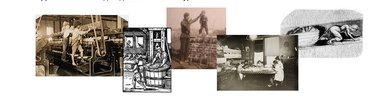
The projector displays the image. The teacher organizes the conversation with the help of leading questions:
Who can you see in the pictures? Are they adults or children? Say, where they are and which jobs they are doing.
Do the pictures show us the life at present or in the past? Why aren't these young children at school? So what is our today's topic?
Work with text / audio material
3. New vocabulary:
Chimney sweep; orphan; cotton factory; cotton thread; to fix; truck; coal; tunnel; cruel; adult
Introduction with a vocabulary is carried out with the help of synonyms, definitions.
A person who cleans chimneys (chimney sweep)
A child who doesn’t have parents (orphan)
A place where cotton is used (cotton factory)
A long thin string of cotton (cotton thread)
To repair (to fix)
A hard black material used as fuel (coal)
Meanandhurtful(cruel)
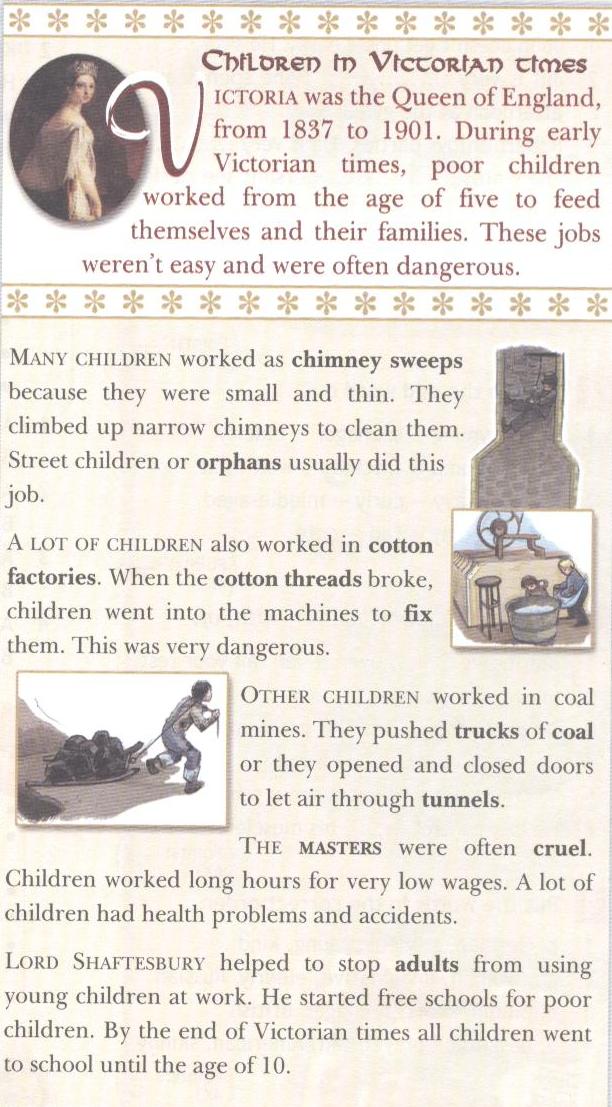
4. Listening in the selective understanding (audio recording of the text which in the following assignment will be offered to read).
Now we are going to listen to the text about child labourers of the past.
Listen and complete the table:
|
Century: |
|
|
Age: |
|
|
Jobs the children did: |
1) 2) 3) |
5. Read (search and studying)
а) We are going to read the text which you have just heard and now your aim is to find information about:
◦ The reason they had to work
◦ The reason why the chimney sweeps were children, not adults
◦ The work they did in cotton factories / in mines
◦ The changes which took place by the end of Victorian times
b) Read again and complete the sentences:
● Children’s work in cotton factories was _________________________and they____________________ usually became chimney sweeps.
● Children in mines pushed ___________________________________
● Masters made children work___________________________and they often were______________________________
● Lord Shaftsbury started______________________________
5. The implementation of communicative post-reading jobs. The development of the skills of dialogical speech with the support of the plan.
Now you are going to work in pairs. Imagine that one of you is a poor child who has to work, and the other one is a journalist who asks questions about your life. Act out a dialogue according to the plan:
• Age
• Job
• Working conditions
• Master’s attitude
• Wages
Working with video material
6. Introductory conversation. Working with
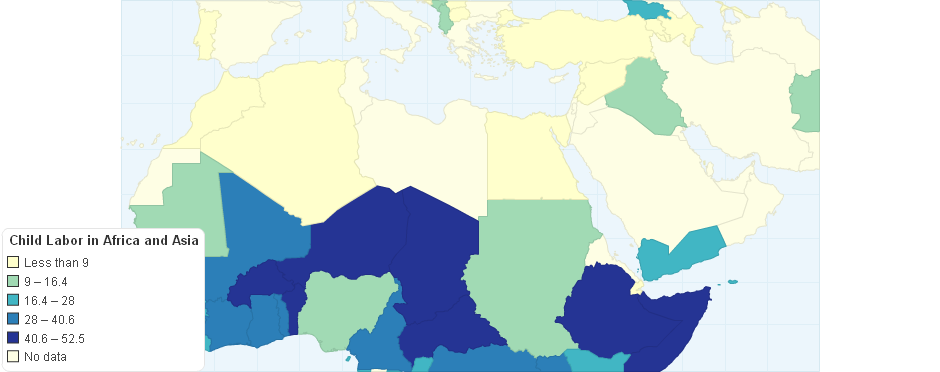
the map
We have just read and discussed the text about child labour in the past. And what about children nowadays? Do all of them have a chance to go to school?
Look at the map and find:
the countries where child labour is widely used.
the countries where is isn’t used at all.
7. Viewing a report ВВСо child labour in Africa.
Watch the TV programme dedicated to the problem of child labour and answer the questions: (Clip 1 http://youtu.be/fP_raW23QzU )
Which country is the report about? ; Where do they work? ; Why don’t they go to school?
2. Watch the first part and fill in the numbers: (Clip 2 http://youtu.be/rI_Li9sVcPo )
|
Number of child labourers around the world: |
|
|
Child labourers under 14: |
|
|
Child labourers in Africa: |
|
|
Number of children who work in copper mine shown in the report: |
|
|
Their age: |
|
|
Money they earn a day: |
|
3) Watch and mark the sentences as true, false or doesn’t say. If the sentence is false, correct it. (Clip 3 http://youtu.be/9kXEJ1A5GGI )
Their day starts at 9 am.
Child labour is unofficial and badly organized in Congo.
The boys’ fist job is sifting away the dirt from pieces of copper.
He has been to school once and he doesn’t want to go there.
He regrets that he earns little money.
He wants to be like grown-ups and earn a lot of money.
People in Congo have to pay for education.
4) Listen and fill in the gaps with missing words: (Clip 4 http://youtu.be/bMFfgyjkO40 )
In the cold light of ………………….. with few comforts and empty ………………….. it’s time for the young to …………………. another day. “I’d like to be like children in ………………. ”, he says. “They go to school, I saw them on TV. But my father can’t pay my school …………………. That’s why my life is so ……………………..” The older ones get …………………….. more, so many of the organizers here prefer to ………………….. a child.
5) Watch and answer the questions: (Clip 5 http://youtu.be/j3D_N2rIMQM )
How do children work? Which protective equipment do they use?
Where does the money earned by children go to?
What are the boys searching for in the dirt?
What do they get after the day of work?
How many hours do they work a day?
8. The final part of the lesson. Letter
Imagine that you are one of these boys who works hard in the mine. Write a letter to your friend and tell him about your life.
Don’t forget to mention:
type of work
difficulties
working hours
wages
master’s attitude
Dear _________________________.,
Thanks for your last letter, I was very glad to receive it. I'm sorry I couldn't reply straightaway because we ran out of candles and had no money to buy them.
You are askin about my life. Well, let me tell you how I live.
I work_____________________________________________________________________________________________________________________________________________________________________________________________________________________________________________________________________________________________________________________________________________________________________________________________________
Well, I'm happy to hear you've finally fulfilled your dream – you bought a new pair of shoes! ____________________________________________?
_______________________________________?
______________________________________________?
Oh, I have to go now. Mum wants me to feed the chickens.
Hope to hear from you soon, ______________________
T: O’k thank you very much for the lesson children.
The lesson is over. See you tomorrow!
II. USING VIDEO TRAINING AT ENGLISH LESSONS
The term "video" in teaching a foreign language can mean either play TV to the VCR for training purposes, watching movies, and the use of video cameras in the classroom for recording and playback in the learning activities of students in the class.
Videos are divided into the following types:
- video films and programs specifically for educational purposes;
- video recording of TV programs and films;
- video recording programs in various disciplines; video, created by the students.
Video stimulates interest, give an example to follow speech, and behavior in the specific situation of communication broaden the knowledge of students about the country of the target language as well as a highly motivated statements about themselves, their life circumstances and interests are an excellent material for discussion.
Video clip as a fragment can be used to
illustrate the language and speech material as the message of the
source of information for the situation of communication as well as
information about the country of the target language, different
realities as a fragment of the story or
script.
Sound information, sounding from the screen
accompanied by a video sequence, significantly improves the
conditions of the perception of language by hearing. So the video
is widely used precisely for the training of listening, one of the
most difficult types of speech activity. Control the perception of
the video basically is to check the understanding of language,
sounding from the screen. The video can be viewed in this aspect as
one of the best ways of teaching listening, more effective, than
magnetic recording or film due to the presence of the button pause
and rewind that allows you to stop or turn back the desired in the
process of learning the frame without the need for the movie
blackout make recordings and to intensify the activities of the
students in the course of
view.
Recession movie is an excellent basis for teaching speaking. The information obtained situative, colourful, emotional, causes interest of the student and thereby stimulates speech utterances as reproductive, and creative nature. Video allows you to use a wide range of communicative exercises to develop skills of foreign language speaking.
At the same time the majority of the oral tasks, aimed at teaching the speaking can serve and formation of skills of written speech, in all its manifestations: description, narrationе the composition of the evaluation of critical reviews and scene sketches. At the Junior level students undertake in writing various tests that examine the completeness of perception and also just to make entries on the video to use them as a support for the implementation of communicative tasks.
For learning to read is currently using the so-called TV or video with subtitles captioned television as the additional training reception. Reading from the screen, which initially was intended only to help deaf people with impaired hearing watch TV programs is now seen as a new method of teaching reading turned the screen in interesting narrator. Audio and video context contributes to the realization of the value of the graphic image of the word giving at the same time and a sample of the sound which significantly expands the possibilities of video in teaching reading in a foreign language.
Thus, viewing video stimulates the development of all four kinds of speech activities.
Using audio-visual equipment, video
including, gives the opportunity
to:
1) present situation of communication in all
its fullness;
2) see and hear the parties to the
communication (see their facial expressions and gestures that
enhances the perception of the communicative
situation)
3) expand the scope of communication due to
the fact that the student sees the situation (place, time, day, and
year), can determine the age, sex, clothes, social position from
the action at the moment moods and
feelings
4) make the conclusion of a formal or
informal nature of the
communication.
Video is in no way a substitute for the teacher, but only expands its capabilities in the creation of optimal conditions for better mastering of a foreign language. How much time should be given to the viewing the video in classе Echo depends on the purposes of using the video. We should not forget that the viewing of the video is not the end in itself but only one of effective means of communication practical language proficiency stimulating listening, speaking, reading and writing in a foreign language. If we speak about General trends, currently the methods of teaching foreign languages there is a tendency of reduction of the time watching a video from half an hour to five - and less-minute passages which provide sufficient material for a proper understanding of subsequent use in speech stimulating the statement of the students based on the proposed in the video situation.
How many times should watch the video? - At the initial stage of the operation can be carried out after 2-3 views. But each of views should be focused. Such an approach requires the teacher as the specific skills of working with video films and the availability of methodological didactic material in a word the training programme works with the video so that the entire view is not reduced to the inclusion and design of video recording only on the grounds that it was made on the basis of foreign language.
Watching the video at the lesson unlike home
watching television is an active process. The organizer and the
initiator of its acts is a
teacher.
Work with the video includes three stages:
pre-demonstration, demonstration and
post-demonstration.
Before viewing the video, the students put a communicative task which directs their attention in the right direction. To do this the development issues and working handout material which allows the teacher to organize active viewing of the lesson. In an extreme case the material to view can be rewritten from the Board. Looking forward to viewing children will make it quickly. In any case, the success of the operation depends on the preliminary preparation - viewing technology which involves the division of the film into logical pieces development into individual tasks aimed at removal of language difficulties and explanation of the unknown realities.
When working with didactic handouts should take into consideration the following technology
1) Pre-familiarize yourself with worksheets or tasks
2) Handout material should be simple, for the disciple to gain confidence in its successful progress
3) Handout does not test, as it stimulates students;
4) Work sheets allow you to turn in the work of the whole class, as well as undertake individual work.
On predemonstration stage removed language difficulties are re-acceptance of the text of the movie fragment an explanation of linguistic realities.
Facilitating students’ further perception,
the teacher gives the job to anticipate content guidelines, basic
words and phrases.
The possible difficulties of understanding
can also be removed through selective audit of separate fragments
of sound co-spending. In particularly complex cases, it is possible
the preliminary reading of the script. This method is justified
when viewing authentic feature films in
English.
As pre-watching guidelines there are also
questions on the content, illustrations from the movie and the
portraits of the
characters.
Directly before the students are offered
communications operational tasks, which make viewing active and
purposeful. Data mining tasks is great potential for creativity of
a teacher. As the recommendations can be
offered
- questions, which, as a point of reference, at the same time direct the attention of the students at specific points;
- task for worksheets: a note on the sheet is the correct option the direction of the content and etc.
- set the type: locate the images from the film at your workplace in order of their appearance in the video;
- you can also offer job training to individual aspects of the language phonetics grammar and vocabulary highlight the phrases that Express irritation anger, joy, confusion, etc
- individual tasks involve self-study of the
student. Modern technology allows you to do this with the help of
computer programs.
During the demonstration phase, in the case
repeated viewing after the first demonstration of the teacher
conducts the first control understanding of individual words,
phrases. One of the most under-attractions features video recording
is possible to use the button pause as well as rewind the video in
the opposite direction in order to achieve an adequate
understanding and implementation of set of communicative tasks. In
the course of the dialogue between the teacher and the students are
being established complexity of perception given additional support
and tips.
During the secondary browsing the teacher achieves a detailed pony-mania content, and move to post-demonstration stage, which aims to control the understanding and skill development of foreign language speaking on the basis of a movie.
The simplest form of control is a task to specify the correct and incorrect allegations, choose the correct option from several proposed. This form of control for the most quick way test understanding of the development of the skills of listening however he does not develop the ability to speak. Responses to proposed to view the questions you can create a conversation on the content of visited fragment and at a more advanced stage, discussion especially in the case when the questions have a problem.
The location of frames in the order of their appearance in the film can not only check the attention of students but give support to oral statements. Images illustrate the development of the plot and serve as a good basis for the narrative. More complicated task can be given to the justification of choice where one frame is not preceded by another. More complex version is a method of introduction of interference. When the frames of this movie gets a shot from a foreign film students are encouraged to explain why this frame could not be a part of the visited their video.
The movie is a good dynamic visibility to the practice of foreign language communication and creating situations of such communication at the training session. Students dramatize heard from the screen dialogue playing his role. Here it is possible not only accurate reproduction of what he had heard and seen but creative rethinking of the text new interpretation. Such a task may be more affordable than dubbing or dubbing of the movie in their native language. If the same level of knowledge of students makes it quite correctly and accurately reproduce the scenario of the text speaking on behalf of the heroes of the video while previewing with the sound turned down, such an exercise can cause as much interest on the part of students and have a large impact on the increase of their level of linguistic competence-competence. When performing this job there are various interpretations of the individual heroes you can compare more or less successful variants. The same great benefit has and duplication in their native language, because it teaches students not literally translate the heroes of the phrase but to adequately interpret the meaning of the utterance given the differences in intonation and full text design. Particular attention is required to the interpretation of idioms interjections appeals. Truly stumbling block is the transition of the treatment with "you" to "you", because the English language is not done the difference between singular and plural pronouns of the second person which in many languages mean officially-friendly or familiar-friendly attitude. Therefore in order to adequately convey the phrase in the Russian language students must correctly determine the level of statements in a foreign language. Adequate translation of idioms and interjections you specifically want to teach.
Recession scene video and can become a
starting point-point for independent creative expressions of the
students. Review-the roar of the part of the video students can
predict the development of the plot expressing their assumptions
amend the end of the film when she was disappointed by your
students.
Video can also serve as a basis for the
development of written speech. The teacher allows students to do
recording in the course of the film, for which stops the pictures
while browsing and students record the re-hick an opinion or
questions. After watching the students write a written retelling
using its record as a foothold predict the end of the film provide
written characteristic of heroes describe the place of action
review the film.
A video film students involves the preparation of a script. It is better, if the script is written themselves students, distribute roles rehearse. One of the conditions of the video is a fellowship of students in a foreign language. Before the beginning of work on the movie this condition is discussed with students. They have been acquainted with the necessary vocabulary. In the course of work sometimes there are unforeseen situations and their resolution requires the use of unfamiliar vocabulary. In this case, students can arrange a help desk or find other ways to appeal to the teacher for help.
In any case, the success of the teaching of a foreign language with the help of the video depends on the training of students to the perception of the movie. Expansion of the international relations and release on the market of British and American educational-methodical complexes, which include movies, video, significantly expanded our capabilities in the use of audiovisual technology. In that case, if the video is a Supplement to the British or the American teacher can use the technology of its application developed by foreign methods described in the book for a teacher. In this case, the video is an effective means of teaching a foreign language. Together with British teachers us market has received a lot of them feature films. Viewing them on the senior stage of training, in classes with profound studying of foreign language in additional lessons similar in importance to the reading of original fiction, and is of no less importance for studying a foreign language because you can develop skills of listening, speaking and writing on authentic material that contributes to the improvement of communicative competence of students. An example of such development may serve as a lesson by lesson planning a series of lessons on the American feature film by Forrest Gump which received an Academy award in 1995.
The film was not chosen by chance. He not only received the prize for best picture best actor and best Director, he became an event in the life of American society. The film provides the historical panorama of the events of the last 40 years important for life of America and change of three presidents, the Vietnam war, the movement of the Black Panthers and hippies segregation in the education and its main idea consists in the fact that the destiny of man is inseparable from the history of the country.
The heroes of the film are
living in the South America, and for them is characterized by a
special southern dialect, which is a certain degree of difficulty
of perception for the students. Therefore the author of the
methodical development solved in the first instance issues a
hardship withdrawal lingual character and peculiarities of
pronunciation and vocabulary of the South American.
Pre-demonstration stage covers the 5 lessons, another five lessons
devoted to demonstration of the film and two lessons are devoted to
the control of the detailed understanding of the film and summing
up the results of the creative work of the students (the last stage
may require more training time, the lesson).
The author of methodical recommendations recommends that the
students use the computer for the preparation of the reports from
the field of history culture and public life sending them to the
computer encyclopedia Compton's Interactive Encyclopedia and
computer dictionary American Heritage Talking Dictionary and is the
first lesson in the computer
class.
Worksheets first lesson guide
the students of the Academy of Sciences of the film's content. For
this purpose the disciples distribute the advertising brochure of
the film, which depicts the heroes of the film addresses the major
events shown in the film. Students study the advertising brochure
and prescribe for characteristics of the characters, their
description of the occupation.
Messages from the history of America students are prepared on the
basis of information received from the computer. The form of notice
depends on the choice of the students themselves interview dialogue
TV shows news reporting.
The second lesson of the cycle devoted to the peculiarities of the
language of film and South Rican dialect in particular. With this
purpose the playing of magnetic recording made by a teacher of
English from the southern state which he commented on some of the
details of his speech. In the course of listening to students will
complete its work sheet information, gleaned from their teacher's
speech and also note the difficulty of that they have to
experience. American colloquial vocabulary which abounds in the
film is introduced and explained by the teacher in the context
of е wannana ,gonnana ,kindada
,dressy dresseses coed schools,
etc.
The third lesson is devoted to a fuller acquaintance with the hero of the film che-cut reading of fragments from the book, which brought the movie. In the future this information can be the basis for comparison and adaptation of the book. Filling in the worksheet, students pay attention name of the hero, his actions and opinions, which was about him from others. The teacher continues to acquaint students with the vocabulary of the film, including the proposal from the movie script for translation.
The fourth lesson the teacher expands the knowledge about the country and its history. Students study the map of the country and listen to the prepared classmates posts study the geographical names and the concerns of Americans racial problems by the social differences. At the same lesson, the teacher tells about the education system in the United States.
The last pre-demonstration lesson devoted to the theme of war, the political conditions that impact on society to the army dictionary. In this lesson the students who prepared the message about the war in Vietnam. Worksheet is the mainly purpose of the interpretation of the army slang abbreviations, the study of military ranks.
From the sixth to the tenth lesson students
are looking movie. The movie goes 142 minutes and is divided into
six logical parts. At each viewing the students receive questions
and tasks, which help to better understand the content of the film.
The main task of the teacher is to make the browsing active to view
the distributed worksheets with questions and tasks. After the
review there are discusses the answers to the questions and more
clarity in weird
places.
Only the author has developed 13 worksheets
to help students in their perceptions of the
film.
Tests offered by the students after the
viewing, expandт clarify complement the information contained
in the movie as well as to help it retain in memory. Tests have job
type who owns the data replicas of whom referred to in these
remarks. Who said in this
speechе? In connection with what
said?
As usual, complex forms of work and themes
shall be completed compositions of the students on a given topic.
As a support students use their completed
worksheets.
In the form of additional tasks students may prepare a speech about the music and musicians who accompany the film; or duplicate part of the movie in their native language; or write a review for the film or write a letter to a friend with a recommendation to see this movie. The preparation of such methodical development is an obligatory condition of active video, the efficiency of the means of teaching a foreign language.
The main points are:
1. Video is the effective means of development of all kinds of speech activities are envisaged.
2. On the lesson better to use a small video fragments.
3. The main task of the teacher to make the browsing active.
4. Viewing is divided into three stages pre-demonstration, demonstration and post-demonstration.
5. At the initial stage of the possible one-two repeat viewing of video.
6. on pre-demonstration stage is carried out occurs containing removed the difficulty of the language and lingua nature is determined by the communicative purpose of viewing.
7. During the demonstration of students can fill out worksheets make notes in connection with the communication task. The teacher uses the button pause for an explanation of difficult places during the first viewing.
8. Post-demonstration stage is the control of understanding and the development of skills of oral and written language on the basis of the content of the video.
9. A video film involves students a preliminary writing the script, the distribution of roles and rehearsal as well as the availability of specific skills of working with video equipment. Special attention should be paid to communication in a foreign language in the course of work on the video.
10. View artistic video films in a foreign language require the teacher big preparatory work with a view to making it the most active. Each of these stages requires detailed study and preparation of didactic materials distributed.
Electronic media, such as a computer, VCR, at
the present time are becoming increasingly important in the
education and upbringing of students. The use of video is very
effective in the formation of communicative culture of
schoolchildren, as the videos will not only are the students of a
live speech of native speakers, but immersed them in a situation in
which they become familiar with the language, facial expressions
and gestures, the way of relationships and realities of the country
of the studied language. The video also allows print jobs to the
understanding, to give the students an assignment to treatment of
the facial expressions and gestures («body language»), to recognize
the style of relations and the like, so that in a real situation
the students are not made serious mistakes in communication with
representatives of the country of the studied language. Video for
the lesson is the language in a live context. It connects a lesson
from the real world and shows the language in action. This teaching
aid enriches the already available in the Arsenal of the teacher's
materials. Video, among other things, can help to overcome the
cultural barrier in learning a
language.
There are a number of situations in class,
when the video can be especially
helpful.
For
example:
• if we want to provide a complete language context;
• show communicative side of the language through the study of facial expressions and gestures;
• practice listening skills in a natural way;
• to present the situation for playing in the class (for example, a role-playing game);
• practice the skills of description and narrative;
• enrich vocabulary;
• encourage communication or discussion.
In carrying out of video-lessons there is needed to respect the basic approaches and principles of their realization, in particular, the criteria for the selection of materials for the video lesson.
1.The requirement for the
shooting:
a) the image and sound should be clear and of
good quality;
b) you must have big plans with the display
of the speaker and combining them with the General plans with the
demonstration of
situations;
b) of the facial expressions of the
characters must be seen
clearly.
d) Requires the scenes using gestures, the
reactions of the audience in different
situations.
2. The requirement to the
story:
a) must be a clear link between the subject
and the content of the dialogues in the
scenes.
3. Requirements to the speech of the characters:
a) at the initial stage of the work with the video, it should be clear enough, without extraneous and background noise;
b) it should be clear enough and not too fast;
c) it is desirable that the accent or dialect speaker was understandable to students.
4. The requirement to the
language:
a) the language should be modern,
corresponding to requirements and norms of the literary language of
the areas, which often have to face the students (however, in many
cases, this choice is determined by the task
lesson);
b) it is necessary to the existence of
natural pauses between
sentences;
c) jargon and exclamations should be fairly
short and not too difficult to
understand;
d) the text should not be overloaded with new
words, expressions and odd
gestures.
5. Requirements to the length of the plots:
-
subjects should take no more than 10-15 minutes, or share the meaning of the segments that can be repeated several times during the period of the lesson;
-
all segments should have the complete story.
6. Content requirements:
a) situation should be typical, such that you may encounter students in practice;
b) well, if the story can be subsequently retold by the students in the form of a complete story, with which it is possible to work in other forms;
c) for the lesson can be selected educational, cultural, promotional films, news and other stories.
Planning video-lesson includes the following phases:
1. Preparation
a) is held preliminary discussion, in the course of which repeats the language closest to the subject matter of the film, but also stimulates the interest of students to the subject;
b) creative work, in the course of which you can give the students the opportunity to propose the names of the movies, the use of problem situations related to the discussed topic. You can ask students to make predictions about what will be video-plot;
C) working with the new vocabulary, in the course of which the students are given a new word on the subject.
2. View
When viewing you can use the following types of works:
a) verification of the predictions made by the students to view;
b) searching of information. After the first viewing of the students there are exercises for information search, and the plot is seen again, by segment or entirely, depending on the level of class and objectives of the lesson;
C) working with the separate segment. This stage of the work provides the greatest opportunity for the formation of the elements of the communicative culture. In addition, at this stage, there will be training of basic skills decoding of the text that is the most important aspect of listening. Students view a separate segment of the video-scene and perform one (or more) of the following types of exercises.
Sometimes you can remove the image to only remained sound. The plot is played by parts and the disciples are asking questions, who said, the place of action, what did the heroes, where they went, what was talked about, etc. When they gathered all the information possible, they look again, already with the image and check your interpretation.
Prediction
Video-plot playing with the sound and the
image, but from time to time the picture stops, and during pause,
the students is trying to foresee that the characters will say or
will do in the next
frame.
Jigsaw listening and
viewing
Divide the class into two groups. Ask one group to walk out of class, while the second group of watching the episode with the sound turned down. The first group is returned, the second to leave the room. Episode playing again, this time there is a sound but no picture. Then the groups are merged, divided into pairs and discuss the on-screen happened, and who said what.
What are they thinking?
This exercise is based on the idea that people don't always say what they think. Stop the tape at key moments and ask the students to assume, what are the real thoughts of the speaker.
Character role-play
Give each student a character to learn. Tell, that at the time of viewing they watched, as played this role. Then ask the students to play by the memory of their roles. They need not reproduce the text verbatim, you only need to play accordingly character. If the selected segment is very short, you can learn the role of the heart. Then the sound is turned off, and students voiced their characters during playback.
Character study
Working in groups, students write the words that they associate with each of the characters in the story and explain why, in their opinion, these are the words fit the character.
Deducing dialogue from
pictures,
select the plot consisting of a dialogue
between the 2-dimensional people, write down on paper only one
role, instead of the other misses, the so-called gapped dialogue.
Prepare a sufficient number of permits issued for each pair of
students.
Show the students the video-plot without
sound.
Then play only the audio track without an
image.
Divide the students into pairs and give each
pair of the gapped dialogue. In this you can give them the
opportunity to see the story several times, but without
sound.
Finally, the plot is played back entirely with the sound and the image and compared the work of the students with the original. Moreover, the work is evaluated not according to accurate reproduction of the original, and on how their version is suitable to the optic video images.
Video translation
You will need to art movie with subtitles in Russian. Choose a 2-minute plot, containing the dialog (or the conversation of a few people), where there is no complicated vocabulary.
Tell the students that they need to translate the subtitles into English. Typically, they respond to this job with amazement. Tell me, what their task is not to recreate the original, and translate the subtitles, as they will be able to.
Show the beginning of a scene without sound. When the first subtitle, stop the video and ask the students to write down their translations. Warn that it is better to avoid literary translation, interesting formulate natural equivalents, using their knowledge of the English language.
At the end of this work, ask the students to compare their translations in groups of 2-3 people, then voice adjusted translation. You can offer students identify speaking in their translations.
Then the whole class discusses the translations. At this stage avoid criticize students for grammatical errors, or because their translations differ from the original. To consider the options should, in the light of how they are available in the context.
3. Work after the viewing.
Offer the following kinds of work:
a) repetition and refinement of the voice of blocks received after viewing;
b) comments on and reinforcement of communication techniques, which have been seen in the film;
c) discussion. The students correlate seen in real situations in their life, in their country and analyze the similarities and differences in culture;
d) role-playing game. You can ask pupils to lose reviewed the plot or to develop it;
e) reading on the topic. You can offer the students the problem or informational texts on the topic of the video of the plot for the viewing of reading and discussion. Especially this is useful when viewing stories from news programs;
f) creative work. Students are encouraged to write a short abstract, a reflection on the theme visited the scene, and add to the biography of a well-known person, referred to in the story, draw up a dialogue or a role-play or other similar tasks.
In the senior classes when viewing movies or
excerpts from them, we often use the methodological principle of
«the role of a witness. Students perform the role of witnesses who
observed the situation and simply report that they have seen on the
screen. The episode or film demonstrates once from beginning to end
without a break. Class are asked a few questions about what they
saw: the place of the action, how many there were people, they were
wearing, what happened first, then what, etc. Issues, as a rule, a
little bit, but they should be targeted at key moments, which
students need to take into account in the reconstruction of the
episode. The children receive a printed with names, geographical
names and the key words or read them on the Board. The house is
offered on the memory write what he saw in the form of a
presentation.
Part of the exercises, recommended for
domestic and foreign specialists to work on the video material can
be classified as sensitive communication, for
example:
What did they
say?
Students view a short story without sound, it can be a scene in a restaurant, a shop, a meeting of friends, coming for a visit or any other material depending on the level of the students and guess what they say about the characters. Then make up a dialogue and lose it as editing video. Then review the plot with sound and compare the speech of the characters with his variant. The teacher gives the necessary comments.
What will you see?
Students listen to the sound of the video of the plot without an image. The teacher draws their attention to the intonation of the characters and sound effects. Students respond to the questions like: «Where does the scene take place? How many characters will you see? What are they doing? How are they dressed?» etc.
Who said it?
Students are given leaflets with the lines of dialogue and the names of the characters. Viewing is carried out without a sound. After watching the students have to say, what words would likely belong to the characters. Then there is viewing with audio and learners to check their guesses.
Body Language
Students are asked to observe the gestures and facial expressions of any character. They scan video without sound. Next, students imitate facial expressions and gestures of the character and try to give their interpretation. You can then view a video with sound and give the students themselves check your guesses. After that the teacher makes a comment and give the necessary explanations.
Biographies
Students view a video-plot with sound and then write biographies of characters, evaluating their nature, social status, level of education on the characteristics of speech, conduct and communicative culture.
Inner monologues
Students are encouraged to watch one of the characters from the video of the plot. Then they scan the complete passage of the dialogue of the characters, after which compose the internal monologue of this character, on the basis of his reactions, facial expressions, gestures.
What if?
Students view a video-plot, after which are
to be discussed, how could this movie, if the action took place in
our country.
What happens
next?
When viewing with audio teacher stops the
film in some places, and students to predict what will the
character, or what will happen
next.
Effective when the working with video is
exercises in search of
information.
What's the product?
When viewing a video of the story about any product and well-known subject teacher stops the film directly after the characters will discuss or characterize the subject. Students have to say about what was discussed.
Five W's and H
Students are prompted to preview video-the story and write the main data in the 6 columns under the titles of Who? What? Where? When? Why? How? Especially it is recommended to conduct this exercise when working with documentaries and news programs.
Info – Matching
Before viewing of a documentary or news teacher is a list of facts, names and titles. Students can work in pairs and groups. Their objective is to view the video-plot and burn the maximum amount of information. After they had a record of all the information that they remembered (including names), they are issued with a list compiled by the teacher. They compare the data. Each match can be assessed, for example in 10 points, and data, which are not in the list of master - 20 points, if they are true. After the counting of points is determined a couple or a group had the most won.
What do you want to know about?
Before viewing of thematic video-story or documentary film students make a list of possible questions on the topic of the film. Then they look at the video and find the answers to those questions, on what is possible.
What happened when?
Students view a video-plot and then make suggestions or questions, describing all the events or information in chronological order.
Matching
Students should compare the names and the names given to them in advance, so that made the character, or what is said about this character, or with what happened at the named place.
Where did it happen?
Before viewing, students are encouraged to
pay attention to any kind
of
information, for example, geographical names,
personal names, record numbers,
etc.
Work with questions
When viewing documentaries and news programs in groups, do not have experience of work with video, it is recommended that the first few lessons offer students a list of questions in search of information. These issues may have a specific thematic focus.
There are a number of exercises to work with separate segment. One of the main aspects of the work of the segment is the decoding of the text. Ideally, as a result of this work, students should be able to record a section of text from the soundtrack of the video of the plot, as well as to be able to correctly interpret reactions, facial expressions and gestures of characters.
II.1.The peculiarities using video
Language is the most important means of communication, without which it is impossible to existence and development of human society. In the modern world knowledge only of the native language is not enough, therefore, more attention is given to studying foreign languages at school. A foreign language is a compulsory subject of the curriculum, he studied for many years, requires special techniques and skills of teaching from the teacher, but mastering them outside of the language is the great difficulty. A lot of effort is required from the student, but for the most part is given the role of the teacher. In order to create lasting positive motivation of students in respect of a foreign language, in order to achieve the most optimal level of mastering of educational material the teacher should use non-standard forms of work, and to include in the process of training new techniques and methods of teaching foreign languages, refer to the new technical means of training.
Despite some progress (use of the Internet,
different programs and etc.), one of the difficulties of learning a
foreign language is a very limited opportunity to interact with
native language and use the skills of spoken language outside of
school. Therefore, an important task of a teacher is to create real
and imaginary situations of communication in the classroom foreign
language with the use of different methods of work. No less
important is also considered initiation of pupils in the cultural
values of the people-native speakers of the language. In these
purposes are of great importance authentic materials - movies and
various video materials. Their use contributes to the
implementation of the essential requirement of communicative
methodology is to present the process of mastering the language as
the comprehension of a living foreign language culture; the
individualization of training and development and motivation of
speech activity of
students.
Modern teacher is given the opportunity to
use the extensive nomenclature of the technical means of education,
among which the most accessible and widespread, and also universal
is a visual equipment, which allows to use simultaneously listening
and video support educational material. It may be noted that the
introduction of video in the process of learning changes the nature
of the traditional lesson, makes it more alive and
interesting.
Also the use of video in the classroom contributes to the expansion of the General Outlook of pupils, enrichment of their language stock, and local knowledge.
It should be noted that a movie is not just another source of information. Using movie contributes to the development of the different sides of mental activity of students, and first of all, attention and memory. While watching the class spirits the joint cognitive activity. In these circumstances, even the unwary student becomes a careful, because for the understanding of the content of the film the students should make certain efforts. So involuntary attention goes into arbitrary, and the intensity of attention has an impact on the process of memorizing.
The use of different channels of receipt of the information (auditory and visual channels, motor perception), a positive effect on the strength is imprinting the countryside and linguistic material.
The movie has a strong emotional impact on students, affects the formation of personal attitude to what he saw. Another advantage of the movie is the immediacy of the picture of reality, the special manner of communication leading to the audience (if this is the TV program or TV show), the use of a large plan, unobtrusive presentation of the information, the number of colors, the presence of background music. In case of contact with what is happening on the screen, the conditions of the most approximate to the natural (natural language environment - a total of verbal and non-spoken conditions that reflect everyday life, history, culture and traditions of the native language in the facts of the language) [17, с.220-221].
In contrast to the audio or printed text, which can be highly informative, educational, educational and developing value, videotext has the advantage that combines different aspects of the instrument of speech interaction. In addition to the content of communication, videotext provides visual information about the place of the event, the appearance and non-verbal behaviour of the parties to the communication in a particular situation, often caused by the specifics of the age, gender and psychological characteristics of the person speaking [6, p. 13].
The use of video in the classroom helps to solve the following tasks:
Increased motivation of training,
Intensification of training,
Activation of the trainees,
Independent work of students,
Improvement of the quality of knowledge of students.
There are a huge number of videos, which you can use on the lessons of the English language. This can be a promotional videos or interviews with famous people, cartoons or the story of the world blockbusters, snippets of news and TV programs. The scientific-methodical literature of severe classification video does not exist. Based on the technical side, you can make a distinction between the video image, i.e. the materials recorded on the media, and those, which are directly broadcasted on the air. Thanks to modern technology and the Internet, almost any information can be found in the global network and burn to media. Movie (English film - film), film is a separate work of art. In technological terms, usually, the film is a collection of photographic images (frames), linked by a single plot. Films are produced by recording images of the surrounding world with the help of the camera, or produced from individual images using animation or special effects.
The most important in a methodical plan is the following classification of video
1. Specially designed for the teaching of a foreign language (video tutorials and other educational films);
2. Designed for native speakers or authentic, including films and direct television broadcasting of programmes in the air;
3. Developed by teachers and students.
Video materials, related to the first two categories, are widely used in the teaching process because of the accessibility and less complicated to use. Videos, developed independently, can solve a greater number of tasks set by the teacher, because the teacher chooses fragments for shooting and may have an impact on the process itself, to guide him in the right direction. For the creation of such material requires a lot of time, careful planning and the availability of technical equipment. As stories, specially designed for the teaching of a foreign language, independently developed by fragments of different artificially created by the voice of the situation.
Available at all stages of learning English are training videos. For the teaching material of the first type is typical training right from the screen, where the leader shows samples of structures. The teacher's role is reduced to that with the help of books for teachers and support tools to improve the skills and abilities of learners.
Video footage of the second type contain more educational information, which shows how the language is used at various levels. This is usually unrelated to the content of the episodes, which takes into account the degree of complexity and language functions [11, p. 63].
Authentic video footage offers a greater
variety of samples of language and speech, including a variety of
regional accents, useful and special vocabulary, idioms, etc., and
in a real context, as their use speakers of the language. They
provide ample opportunities for the acquisition of the foreign
language culture. At the same time, these videos are oriented
mainly at students with a good language preparation, as well as for
beginners to learn a language they represent significant
difficulties connected with the speed of speech, its
individually-typical characteristics, the dialects of the features,
background noise,
etc.
Authentic video materials have different
methodological features. According to the genre and thematic they
can share on 3 groups
:
a) entertainment (dramatic works of all kinds, show, «music» video, sports and entertainment programs, etc.)
b) programmes, based on factual information (video documentary, TV discussions, etc.)
b) the «short» program (shorties), lasting from 10 seconds up to 10-15 minutes (news, weather forecast, the results of sports competitions, advertisements, etc.)
Demonstration of videos related to any of the above categories, is of great importance in the process of teaching foreign languages. While viewing the video is auditory-visual synthesis, simultaneous broadcasting of sound and image, which promotes the development of skills and speech perception on hearing and stimulates the oral speech communication of students, which takes the form of expression of one's opinion, relationship, search for arguments and evidence.
Practice shows, that the disciple remembers what he hears and sees five times better than what he just heard.
In order to make the process of teaching of foreign languages with the help of video footage to be effective must be systematic and rational use of video in the classroom. Also you should determine the place of video tutorials in the education system and the frequency of the presentation. In the foreign methodical literature it is recommended to use video once a week or, at least, once in two weeks. The duration of the classes with the use of video is from 45 minutes to 1 hour. Preference is given to short-duration video materials: from 30 seconds up to 5-10 minutes, when it is considered, that 4-5 minutes, demonstration video can ensure that the hard work of the group during the whole hour. This is due to the specific feature of the video, as the density and richness of information. In virtue of this particular advisable to use a short clip for intensive study, rather than a longer video - for extensive [11, p. 62].
Interest and motivation to the language depends on the technologies and methods used by teacher on the lesson. Highly efficient creative implementing various forms of development of education and training, in our opinion, is the use of video on the lessons of foreign language. This method of organization of educational activity allows you to fascinating in a creative form effectively solve all the objectives of the lesson to carry out training, communicative, cognitive activity.
For teachers, the use of video opens boundless field of activity for the organization of work on a variety of subjects at different levels of education, with children of different ages
Stages of work with video and their tasks.
One of the main tasks of teaching the English language is the development of the skills of speaking, therefore, the main goal in teaching English language with the use of video is the training of oral and written speech demonstrated of any video Methodists broken into stages. So, Yu. Komarova regards the functioning of the movies in the educational process as the functioning of bearings, designed to contribute to the formation of specific skills. It defines their functions in accordance with the stages of the work on them on the lesson:
1 stage: the movie - content support (video VF-1)
2stage: the movie - semantic support (VF -
2)
stage
3stage: the movie - stimulus (VF - 3)
Taking into account the functions movies at each stage Yu. Komarova allocates the ability to build monologue statements as follows [18, p. 11-12]:
1stage: the ability to express their thoughts in a monologue form based on the VF - 1.
2 stage: the ability to deploy strategy statements-monologue based on the VF - 2.
3 stage: the ability to Express themselves in the form of a monologue with a support on the VF - 3.
At each stage of Yu.Komarova proposed a set of consistently growing exercises, providing for the variant based on the audio track, the video track, the sound and video track at the same time. To use only the audio track were offered the following tasks [18, c.13]: "listen, imagine what happens on the screen; "listen to me, tell me, what you can tell about this character, as you can imagine, look, compare.
For the submission of silent video, there are the following tasks:
- take a look and tell those who haven't seen;
- take a look and lay out the;
- take a look and role-play the situation;
On the basis of the traditional division of work process with the video on the steps and out of the proposed Yu.Komarova, Th.Вехаге, in our opinion, it is possible to allocate four basic stages:
1. Preparatory or pre-demonstration stage (pre-viewing);
2. The perception of the film or demonstration phase (while viewing);
3. Control of understanding of the substantive content or post-demonstration stage ((post) after-viewing);
4. The development of the language skills of
oral speech or creative
stage;
At each stage there are a number of tasks,
implementation of which is determined by the efficiency of all the
audio-visual process [15, p.
289-290]:
I. Pre-demonstration stage
Objectives of phase:
1. motivate students, set them on the job, making active participants in the learning process;
2. remove the possible difficulty of the text and to prepare for the successful implementation of the tasks.
At this stage there is the language difficulties and difficulties understanding of the content of the movie. The possible introduction of proper names, which may cause difficulties when playing a movie, an explanation of events or conditions in which the action takes place.
The teacher can briefly convey the main plot
of the movie, a focus on matters which would be disclosed to
post-demonstrate
stage.
Viewing the video, you can complete the cycle
of lessons on any topic or problem. Students in advance are given
the task to study a particular material, which is logical prepares
them to view the video. Preliminary reading of texts and discuss
issues on the same subject (in native and foreign languages), also
contribute to the increase of motivation in the course of browsing
the form provided that the movie opens new prospects vision of the
topic, contains an element of novelty and
unpredictability.
II. The demonstration stage
The purpose: to Ensure further development of the language, speech, or socio-cultural competence of the students with regard to their real possibilities of foreign language communication.
Demonstration of the film must be accompanied by an active educational activity of the audience-students.
At this stage, are used tasks, aimed at finding, identifying, capturing, the transformation of the linguistic material: vocabulary, grammar, phonetics. In this case not so much the formulation of the task, how much of the content of the exercise provides some degree of efficiency and validity of the job. Students can also make entries to the text of the film, which will be necessary when performing tasks on post-demonstration stage.
III. Post-demonstration stage
The goal of this stage: the use of the
original material as a basis and support for the development of the
productive skills in oral or written
speech.
At this stage the efficiency of use is
checked in the process of viewing the movie benchmarks proposed by
the pre-demonstration stage of perception of the film, and used in
the film language and speech
means.
Consistency of presentation of video and correct formulation of the tasks contribute to the efficiency of use of video in the process of learning English.
Therefore, especially at the
initial stage, the Student before viewing should get a clear task,
the implementation of which they should be focused.
Of course, the use of video on the lesson of English language and
in extracurricular activities-from-opens a number of unique
opportunities for teachers and students in terms of mastering a
foreign language culture, especially in terms of formation of
socio-cultural competence as one of the components of communicative
competence as a whole.
In contrast to the audio or printed text which can be highly informative, educational, educational and developing value, videotext has the advantage that combines different aspects of the instrument of speech interaction. In addition to the content of communication, videotext provides visual information about the place of the event, the appearance and non-verbal behaviour of the parties to the communication in a particular situation.
Videos provide almost unlimited opportunities for the analysis based on the comparison and mapping of cultural realities and specifics of behavior of people in different situations of intercultural communication (provided that the selected videotexts provide the necessary basis for such a comparison).
It is also obvious that the video may have a strong understates the emotional impact on the students, slough-live stimulus and increased to create additional motivation for further educational-research and creative activity.
Simple viewing of the film, even in a foreign
language is too passive activity for the educational process. This
is why we offer a number of tasks for working with video on the
lesson:
1. What
movie?
Even before viewing, inform the students of
the name of the movie, with which you will work. You can also tell
them about the fact, in what year the film, in any country, who is
the Director, etc., you can ask the question: «How do you think
what is the film about?». This task will prepare them to
work.
2.
«Endgame»
This technique can be applied as in the beginning of the movie, and at the time of any of its parts. You must first select the appropriate episode, the level of training of your students or previous topic. Turn off the sound and give students a task vocalize what is happening.
It is possible to allocate the role of re-Pro-watch fragment, but after the training, the group is required to film dubbing.
-
Prediction
This task can be performed several times
throughout the movie: stop viewing on «the most interesting place
and ask the students: «What will happen
next?».
If you use a full-length artistic production
of the film, most likely, work will be over-planned to a few
sessions, so that you can give this job to the house. You can add
the-establishment of their conditions: for example, restrict
students using only ahead of time (or on the contrary, the
past).
4. Without pictures
This method, return «dubbing». Select a fragment of the film, which you can only listen to, for example, intense dialogue. STU-dent themselves are the actors: they come up and portray the film, based on what you have listened. We must ensure that, when discussing a job, they communicate in Russian language only.
-
Back in the past
After watching the whole movie or part of it, ask students how they conceive of the past the main heroes of which is not covered in the film: their childhood, family, how they studied and etc.
6. Description of the characters of the
Ask each of the students choose one character and describe it with all the details: appearance, character, habits, the schedule of the day... This work will be more useful if you set it at home, because the written assignment requires a more careful selection of vocabulary and more attention to the grammar.
-
Feelings!
Say whether the characters what they think, or cheat? What emotions they are managed? They feel at one time or another movie? All of these questions will help draw the students ' attention to the facial expressions, gestures, differences in intonation of the characters. In addition, you can repeat the words and expressions with the help of which describes a sensation, surprise, fear, anger, etc.
-
Freeze frame
Freeze frame - the work with one frame from the movie. If you use photos on the lessons, you will easily come up with questions and for this job. You can divide students into pairs and show the frame of only one of the two. His task will be to describe the second picture, and that should help, asking leading questions, and select the image from proposed.
-
For reasons...
After viewing the film the group must play between one of his scenes or invent and stage a continuation of the film. Here it is important to distribute the roles so that everyone can express themselves. Of course, you can set the scene and without watching the movie, but in this case students will be limited to a specific characters, the characters which are known to them. Imitating the heroes of the film, they should use the characteristic of character words and expressions, gestures, and accents.
-
Morality
Each film is based on different situations of life: social conflicts, the problems of human relations or simply interesting events. Select the most bright topics for discussion and ask the students questions for debate. For example:
1) is there friendship between a man and a woman?
2) is it possible to buy happiness for money?
Such questions often cause resonance in the group, and students try to convince each other that they are right, it is in the emotional state they overcome the spoken language barrier, and it is in dispute are trying to use all his eloquence, even in non-native languages.
The 10 technician - it's not all that you can think of in the work with the video. Ask other questions, just stopping the movie:
1) What is the weather outside the window of the room of the hero? 2) And that he had in his pockets (or she has in her purse)? 3) What is the smell feels hero, walking on the street?
Possibility of use for beginners video a few are limited due to the small volume of their vocabulary and knowledge of grammar. However, the use of video from time to time will pleasantly surprise occupation, it makes element of this life, even on the screen, and teaches them to work with video, and not just look at the screen.
Practice shows that especially effective advocacy at the initial stage of studying foreign languages are cartoons. Their use allows increasing the voice activity of students in the learning process. Animation allows you to easily penetrate into the essence of real things and phenomena in a simple visual form convey information to behold-lei. Methodologically, it is important that the interest to the cartoons is not weakened by repeated viewings. It helps to maintain consideration to repeatedly claim brought by the teaching material and ensures the efficiency of perception.
Obvious advantages of cartoons are these:
1) authenticity;
2) informative saturation;
3) the concentration of linguistic means;
4) the emotional impact on the students, etc.
The efficiency of the use of the video depends on the rational organization of the occupation.
-
Learning objectives
One of the training tasks, which can be solved with the help of video, is a repetition of the vocabulary and vocabulary development.
To do this, do any snippet from 30 seconds to 1 minute, which presents objects, actions, or the characteristics of the corresponding lexical topic. It is desirable that the passage was accompanied by music or text.
For example, students look passage, where there are different animals (profession, color, people who commit various actions). Then discussing in groups (pairs) seen. If necessary they may use a dictionary or ask for help from the teacher.
For example:
- the name of the first beast that you saw-do;
"tell me, what makes a giraffe; who by profession man was, which you saw on the street;
- how green objects you see on the screen, etc.
Then students respond to the questions. The
teacher warns that they-look at the passage again and will need to
check how well the group performed their
task.
Then you see a passage for the second time
and check the correctness of the
answers.
Video can also be used for the introduction
of new lexical units or new lexical topics. Instead of using the
introduction of animal names translation or picture, you can just
show them in a zoo or in the wild that will produce much more vivid
impression and will contribute to a better
memorization.
As in this case, and to set the "OPI-the
picture" you can use the "pause" to the students had the
opportunity to consider all the details on the
screen.
Another task, which can be solved with the power of video at this stage, is a task of learning to understand speech at the hearing. It should be noted, that the use of the video for the training of listening has its own positive and negative sides.
On the one hand, video recording, compared with the tape recording is more than life character - you not only hear, but also see the speakers, their facial expressions and gestures, as well as receive information about the broader context of what is happening - the place of the action of the age of the participants, etc.
On the other - all these factors distract listen to a future of proper speech, and it can be carried away by looking at the picture, instead of focus on listening. Therefore, especially at the initial stage, the students before viewing should get a clear task, the implementation of which they should be the focus.
-
Videodialogues (5-15 minutes)
These exercises in addition to listening
incorporate receive in themselves
skills-reading.
A. The teacher selects an excerpt from the
film for 1-2 minutes, which consists of clearly spoken replicas,
simple in form and
content.
Writes every line on a separate card, marking
what the character she belongs
to.
The group provides a full set of cards,
with-holding
dialogue.
The group should have a look at the passage, without looking at the cards, and then put the replica in the order in which they are encountered in the recording.
After that, you should see a fragment twice, checking the correctness of the order of the speeches. If necessary do a pause.
Students in the group are trained in the reading of the dialogue.
Teacher includes recording without sound, and students voiced dialogue on the screen (on the wishes of). As an alternative, you can offer the following:
• Students lay out the cards in the order that they think it's right, before watching, and then check the fidelity of his conjectures.
• The dialogue is given not on the cards, but on one sheet of paper, and they should be numbered replica in order of appearance.
B. The teacher selects a fragment from the feature film for 1-3 minutes in which the conversation is taken from three up to five participants. It is desirable that the disciples were familiar with the characters.
The teacher prepares two lists of names of the characters and their replicas in random order. Each student should have his own copy.
If it is impossible to make a copy of the
lists of selected is described on the
Board.
The teacher explains to the students that the
passage seems without a sound and their task is to arrange the
replica of the order, and also to understand what anyone
says.
The teacher shows a clip without sound. Teaching-the students work in pairs, reconstructing the sequence of replicas and their authorship.
The teacher shows an excerpt from the sound. Students check the correctness of their work.
The dialogue is to be read and discussed with the group.
-
Predictions (30 minutes)
The teacher prepares a passage from the TV shows, a performance or a film, from which rather quickly you can understand how the situation will develop.
Then prepare signs:
THEME
VIDEO
WORDS
SOUNDS
SMELLS
Gives students plates or draw a table on the blackboard, the teacher said, that will show the beginning of the passage and we should think, how will the events unfold, and then need to fill out a sign.
The teacher shows quite a large piece of text, to be able to understand the plot and its further development.
In pairs, the students discuss what they saw and fill out the sign the theme of the passage
-
what they expect to see
-
what words they are waiting to hear
-
what sounds they are waiting to hear
-
what smells they could feel
The teacher discusses with students their guesses. Then he indicates the remaining fragment of the movie. Students discuss in pairs, what they saw, heard and compare with what they expected to see. The teacher with the group discusses were their expectations. If necessary, excerpts look again.
Options:
• While viewing the teacher makes a pause, so that the students guessed that would happen.
• Tells the group what they see. Then to Pro-review of the students respond to the following questions to:
What do you see?
Where is it? (what this place is?)
What kind of dialogue?
If it is necessary, before answering the questions, the teacher shows the beginning of the passage.
So that students can predict the next line,
the teacher should stop in front of each
replica.
You can use the following exercise, the
teacher says, what will be the passage, and on the Board writes the
names of the six objects or the names of people, of which four will
appear in the passage, and two no. Students will be expected to
predict what the four will appear. This is a good way of entering
the active
vocabulary.
4. Exercise on the repetition of the special
issues (10 - 15
minutes)
From television news program teacher chooses
a snippet that reads the announcer and which contains enough
material to ask all kinds of special
issues.
The teacher explains to the group that they now see the real news, containing information to answer the questions
About whom the story?
What this story?
When this happens?
Where is it going?
Why is this happening?
How is this happening?
On the blackboard, the teacher writes these
six questions, warns students about how much of the news is in this
passage. The task before the first preview is to listen and try to
understand the topic. The task before the second viewing to listen
and make notes on the contrary each
question.
After the second viewing students respond
these six questions.
Then you can offer to watch the news for the
third time, after which you should write a small article,
containing news, heard on TV. You can give it as a home task. You
can turn it into a contest: ask students to state what they hear on
separate sheets (go to print on your computer), and then without
the signature of post for the evaluation and "vote" color circles.
Who received the greatest number of red circles becomes a
"journalist" in the next
week.
-
News in brief (15-45 minutes)
-
The teacher chooses a fragment program with different news.
For each student prepares a copy of such
signs (see table.
1).
Students are distributed to the plate. Then,
looking at news program, you need to think of news the most
appropriate title and fill in the
plate.
Students watch the news, and then fill in the
sign (individual
work).
The teacher shows the news again, pausing
after each of the topics to interested persons could give its
header. The team discusses the appropriateness of this
choice.
Table 1
Number Name
Content
| |
|
| |
|
| |
|
The teacher gives the plate students and checks whether all is clear, what kind of information is required to fill the plate.
In the other variant - the teacher warned the
group, which now will be shown
infomercial.
The task is to fill in the sign of the data,
which they will receive from the movie. The students see the movie
several times if necessary, fill the plate. After their finish
there invited everyone to compare their answers with the answers
neighbor.
The movie demonstrates once again to clarify the obscure moments.
-
The real questions (15-20 minutes)
The teacher chooses a passage from the documentation total film or news which is of interest for students. News should inform the announcer on the screen (not behind the scenes).
Asking students what they know about the Mets, which is covered in the news. Answers for-require state on the Board.
Offer to ask a few (2-3) questions on this topic. Students account for a minimum of three questions on the same topic.
Before viewing the teacher warns that in some of the questions in the proposed text, possibly, will be the answers. They can be expressed directly, indirectly, or they will not do. The task of students is to determine which questions to the passage will be given answers.
Students are browsing the passage, read the questions on which they received the answers.
On the remaining questions the teacher asks find answers in the form of homework or group of the "project".
Option - the teacher shows the beginning of the passage and checks as all students understand the topic for discussion or not.
-
Biography (20-30 minutes)
The teacher selects a passage for 5-10 minutes, in which the characters communicate between themselves. The passage should give answers or encourage speculation about who the characters are, where they come from, etc. In that case, if the students already understand oral speech, you can show them a long passage, or a movie.
On the Board are recorded questions:
Name the full names of the heroes?
Where was he/she born?
What's his/her family?
The teacher explains, what will be the passage, and students choose one of the characters. After watching his disciples to write his brief biography starting with the answers to the questions that are written on the board students look passage.
Give the time to write a biography. Afterwards, the students in groups to discuss in turn "their" story.
Students look passage again, that confirms or refutes their assumptions.
-
Overview of the opinions of consumers (30 minutes)
The teacher chooses the advertising of goods or services, which may be of interest to students. Distributing the questionnaire, answering the questions of which you can find out how much time (in a day, week, month) on average they watch TV.
Teacher warns that show infomercial, writes the questions that need to be answered on the Board:
What a text message?
Who this movie is?
Whether you're the group, which designed this video?
Do you think this video is compelling?
The students see the advertising.
In pairs, the students discuss their
responses to the
questions.
The disciples are browsing the video again,
so that you can verify the accuracy of the
answers.
-
Fill the video gaps (10-15 minutes)
The teacher chooses the passage, which is well seen storyline. Burning write their beginning and the end (approximately a minute).
The task of students is to write the story,
to which would connect these
passages.
Students watching the first passage, and then
discuss the situation and characters in groups or pairs (and a
representative of the group expresses the
I-tion).
Students are looking the second passage. The order of discussion is the same.
Compare two text-place, the events, the
relations of the characters,
etc.
Each group writes a story that connects these
two events.
The representative of each group read (or
talk) his version.
Students compare the credibility and dignity of others of the story, then watching the whole passage entirely and compare their IP of the original.
-
Create a video clip (40-50 minutes)
The teacher chooses the music of the video, preferably one that is not seen by the group. The teacher writes the words of the song, makes a questionnaire in two parts: in the first one the questions on the text of the song and its execution, and in the second - on accompanying her video sequences.
Give the words of the disciples. Discuss the mood and the contents of the songs.
Handing out the questionnaire the teacher warned the students that at first they will only listen to the song, so the answer to the first part of the questionnaire.
Now playing song on tape or the video, the
image is closed.
The students in groups to discuss what image
they escorted to those or other part of the song (the second part
of the questionnaire). Students tell us, what kind of video clip
they would have made for this
song.
The teacher shows the video.
The group answers the questions: did you see
the video, which had expected? Were you surprised that something?
Whether visuals with the text of the song? Lee adds visuals
something to the content of the text? What they liked most of all:
watch the clip or just listen to the
song?
The video demonstrates once again to clarify
the points of
contention.
-
People in the news (15-20 minutes).
The teacher chooses a fragment of the news on the well-known people. Given signs will show ways of naming the person and issues according to the information of the movie, and explains that will be shown an excerpt from the news of several well-known people. The task of students is to determine, as they were called in on-dash.
On the blackboard, the teacher writes example:
The Name
The pronoun it,
Position
The profession of the Chairman of the
government,
an experienced
politician
Other information
Age
Place of birth
Place of residence
The purpose of stay
The disciples looked one passage or several
times. Then fill in the
table.
All compare results (you can call willing to
write on the Board). Students are looking passage again for the
final approval of the
results.
For the more advanced students or groups are invited to write a short biography of the leader (as domestic work or project).
-
Reconstruction (15-20 minutes)
You need to choose a passage with a clear storyline. There well placed for this purpose silent films.
The teacher explains to the group that will be until the passage, in which a particular event occurs (for example, robbery). The task of students is to remember as much detail as possible and then put them in chronological order.
Students are browsing the passage, and then work in pairs, discussing seen and writing in the correct order. The representative of each pair read your list. The group decides, a list of what is the most correct and full.
Students are browsing the passage again, the teacher makes a pause to clarify the details. You can also stop the image and ask learners to say what will happen after that.
-
Review
This exercise makes sense to offer only in the case if the group is well aware of speech. The teacher chooses a film that should be like the disciples. Is questions that draw attention to the fact that it is necessary to write the review. Teacher stipulates, what length should be review (for example, shows an example of a newspaper).
Give questions. Explain to the students what
kind of information is usually contained in the review. Discusses
with the students, so that all understand exactly what is required
of them.
The students see the entire movie or the
cha-focused, if necessary. Then in pairs, the students discuss
questions and answers on
them.
As homework, the students write a review on the movie.
-
Debate
This exercise is also designed for groups,
well speak the
language.
The teacher chooses the passage containing
some idea, which may cause differences for example - "Every old or
a terminally ill person has the right to a fast care of life
(euthanasia)".
The approval of the teacher writes on the
blackboard.
Warns the disciples, that will show the
sequence in which is contained the idea. Students look
passage.
The teacher explains that in the discussion of all have to speak, using the arguments "for" and "against".
To choose two commands (for 2-4 persons), which will represent one or the other point of view. Each team shall be the captain. The captain in the early expresses the point of view of the team and at the end of sums it up.
If you have time you need to students
provision for the passage
again.
Home students prepare their arguments. Each
of you is a crime limited in time. The rest should prepare a 3-5
questions to speak-as. It is desirable that questions based on what
they have seen and heard in the
video.
In the next lesson:
The speakers are sitting face to the group. Each team stands with his statement after the speeches and the summing up of the questions are asked. In the end you can vote, whose position was expressed more strongly.
In that case, if the task is show the feature film entirely, it is necessary to give a group tasks, which made to listen to the dialogue, as well as to compare the behaviour and actions of the characters and to draw conclusions from this.
In that case, if the movie is a Comedy, the disciples were given the task to write jokes, which were in.
If this is detective, film is shown to the place where the offender изобличается, you can ask to make a reasoned answer, who is to blame and why they think so. It can be rather difficult, therefore, detective stories it is expedient to watch in parts, discussing every part and making preliminary conclusions about the identity and motives of the crime.
This does not apply to the stories of the offender, which begin with a display of crimes (as in the TV series "Colombo").
In that case, if the film tells about the life of people, we need to ask questions about their relationships. Here it is also desirable to stop from time to time and make forecasts about the further development of events and relationships of the characters.
From the point of view of listening and viewing other documentary films are more easy to understand, since most of the text is read by an announcer with a well-placed pronunciation and a clear articulation. In addition to about Verka understanding can be given the task of Nadi-write a short article on the same or a similar topic, such as "the Most terrible catastrophe of the XX century" or "the Problems of ecology".
II.2.The peculiarities of psychological development of school children while using video
Stages of the work with video-texts and their tasks.
Types of tasks for each of the stages.
When working with any text in methods of teaching foreign languages to provide three the fundamental stages: pre-reading stage, the text of the stage of post-reading stage.
І.Pre-reading stage
Objectives of phase:
1. motivate students, set them on the job, making active participants in the learning process;
2. remove the possible difficulty of the text and to prepare for the successful implementation of the tasks.
Types of tasks:
1. Different variants of anticipating the meaning of the text, based on:
-
a generalization of previously acquired knowledge on the topic;
-
the peculiarities of the title;
-
cursory view part of the movie without sound;
-
the list of new words with translation or define conventions, submitted to the text;
-
the content of questions or correct/false statements.
The table below shows the approximate formulations of the tasks used at this stage. The job can be done either orally, in pairs, groups or in the front of discussion in the group.
|
The exercise |
Students’ action |
The content of the exercise |
1-motivation 2-difficulties |
|
1. Read the name of the text? What about is the video? 2. Read the questions to the text and find out the main meaning of the text, its theme. 3. Read the following statements. Before watching the video try to find out which is right and wrong. 4. Introduce with the title of the video, questions, statements and write them down а) what you know about the title б) what you want to know 5. Try to think about the content of the film according to its title and questions. Remain the main vocabulary associated with the theme or the problem. 6. Look at new words which could meet in the film. Find out the theme of the video by its basic and remember the words and combinations you know. |
In pairs, in group and individual *read the title *make associations with the reading materials before * determine the range of possible situations * formulate anticipated event or set of problems for discussion |
1) The title has to be connected with the previous themes 2) the theme has to be clear and to have associations 3)it’s better when the title has the meaning. It makes the text more interesting |
1) pupils tell their own opinion then wait for the right or wrong statements. It means they will read the text very attentively. 2) associations are based on the topics and issues, and so at a certain semantic field. Use of specific vocabulary in the course of preliminary discussion activates it and provides you with the hearing in the future. |
-
A summary of the teacher basically the content of the text - the teacher may briefly convey the main plot of the movie, explaining thus, what remains to be seen. If the item is interesting for students this introduction is intended to be interesting to students and therefore, the first objective of phase can be reached. In his speech, the teacher can convey the main idea of the text, simple and clear words, and can keep a number of difficult-to-understand the language. The main thing in this case is the anticipation of possible difficulties of linguistic, speech and socio-structural nature and their withdrawal with the help of different methods, including an explanation, interpretation, translation, and reference to previously studied material, etc. It is obvious, that for the use of this type of assignment the teacher should have a certain level of professional-methodical and professional communicative competence.
When using this type of task should be mindful of the fact that the text of the entry is not installed on the primary view, therefore, should be clear and understandable to formulate the task at the time of viewing the text by selecting one of the tasks of the second phase, which will be discussed below.
Preliminary research or project work
Viewing the video, you can complete the cycle of lessons on any topic or problem. Students in advance are given the task to study a particular material, which is logical prepares them to view the video. Preliminary reading of texts and discuss issues on the same subject, also contribute to the increase of motivation in the course of viewing of video provided that the movie opens new prospects vision of the topic, contains an element of novelty and unpredictability.
II Reading stage
The purpose: to Ensure further development of the language, speech, or socio-cultural way of students with regard to their real possibilities of the English-speaking communication.
Types of the tasks:
-
The job of the search language information.
This type of exercises and tasks aimed at finding, identifying, capturing, the transformation of the linguistic material: vocabulary, grammar, phonetics. In this case not so much the formulation of the task, how much of the content of the exercise provides some degree of efficiency and validity of the case of job. The wording of the job might sound something like this:
View the video and...
1. pick up English/ German/ French and Russian/ Spanish etc equivalents to the following Kazakh words and expressions;
2. pick up the Kazakh equivalent to the English/ German etc words and combinations;
3. fill out the gaps in the sentences of the right words and expressions;
4. make a note of all adjectives that used in the case with the noun «the road» (all the verbs, which used with the noun «products», etc.);
5. write down the verbs from the following list in the grammatical form in which they were used in the text;
6. the intonation was
pronounced the word «day-valid» in the text, from the following
list synonymous expressions select the check,
which is (not) used in the text of the
video.
2. Job, on the development of the receptive mind of the (at the level of conceptual and semantic information).
At this stage the work can be used traditional exercises aimed at:
1) search for the right answers to the questions (questions are offered to the view);
2) the definition of the faithful/ incorrect statements;
3) correlation of isolated sentences with semantic parts of the text (the plan of the text and bar-label each part of the property);
4) examine the parts of the text in a logical after-coherence;
5) establishment of the causal relations and etc.
3. Tasks aimed at the development of speaking skills
The following methods of work with the video directed to the development of monologic speech:
-
the Lack of an image while maintaining sound. Most often, in this case, the settings are used in the description:
-
the alleged appearance of the characters and their clothes;
-
subjects that could be next;
-
place of event;
-
the nature of the relationships between the characters, etc.
All these tasks are a specific type of monologue - the description of the preservation of the distinct features of the descriptions of people, objects, etc.
-
Tasks using the « PAUSE».
In this task students offer suggestions about the further course of events which is inseparably connected with the development of such discursive abilities as the definition and establishment of the logical-semantic relations of the text and their development.
-
The tasks aimed at the reproduction of what he saw in the form of a story, messages, etc.
A number of tasks can be effectively used van for the development of the skills of dialogical speech, for example: turn off the sound when saving images with subsequent playback proposed text. This exercise could hardly be used for reproduction of texts monologue, because the contents of monologue in this case, it is practically impossible to anticipate, if the person does not know how to read lips. As for the dialogue, that at presence of such elements of speech situation as the place and time of events, the communication partner, their non-verbal behaviour can make certain assumptions about the content of the dialogue, especially if the situation is quite standard (in the shop, in the theater, the doctor, etc.)
4) Tasks aimed at the
development of socio-cultural skills
quite often faced with the understanding of socio-cultural
competence in a very narrow sense, almost identical in meaning of
the country study knowledge. Of course, in order to achieve the
necessary and sufficient level of socio-cultural competence, it is
necessary to have a certain set of knowledge about the country of
the studied language. However more important to learn how to
compare different cultures of the world and see them in the
cultural-specific features, and to find a common cultural patterns.
The most difficult challenge for a teacher in the formation of
socio-cultural competence is the ability to teach students to
interpret the different situations of verbal and nonverbal nature
from the point of view of cultural specifics of a particular
country, avoiding the formation of false stereotypes and not
falling under the influence of opinions and ideas.
The use of video provides an excellent basis, however, it would be
naive to believe that without the guidance of a teacher and a
proper system of specially designed exercises the ability to
establish themselves. So, when working with video, proposed the use
of this type of job as the establishment of cross-cultural
comparisons and differences. Here it is important to remember that
until such time as the ability to compare and contrast of cultural
display information will not be formed, it is necessary to think
through the support system, directing the attention of students to
identifying, capturing and interpreting the necessary
information.
III. Post-reading stage
The purpose: use the source
text in the basis and support for the development of the productive
skills in oral or written speech.
Both of the previous stages are binding as to the terms of
use-videotext as a means of development of the complex
communication skills, as a means of control receptive skills
(listening). This stage may be omitted if videotext is used only
for the development and control of receptive
skills.
The exercises, which can be directed on the development of the productive skills in oral speech, had already been partially mentioned in the previous section. At this stage, in addition to the above exercises you can use the project work related to preparation of similar movies independently (holding video exhibitions in the city/ school, etc., visiting student concert, races is a story about his family, etc.), role-playing game, based on a story or situation of the movie while they may be partially modified.
Practical application of video materials for English lessons in the secondary school
The use of video is a unique means of teaching the English language at all stages of the study a language in a secondary school. The efficiency of the use of video with all age groups of pupils at the lessons of the English language has been proven in practice. To work supplied its own development lesson-view the training of the cartoon «Mickey Mouse - the Gift of the Magic»
Subject: training the cartoon “The gift of the Magi”
Objective: to Develop skills of listening, to raise the interest to study the independence and initiative.
Tasks:
1. Perfection of spelling skills, skills of
speaking and
listening.
2. To develop and train the attention,
memory, thinking.
Z. To encourage respect for the culture of
his country and of the countries of studied
language.
Equipment: DVD-ROM cartoons “Mickey and Minnie”, the computer, a projector, a screen, a handout with a job, Board, greeting cards.
The procedure of the lesson:
1.Organizational moment
2.Warm-up
3. Working with words
4.Watching cartoon
5.Doing exercises.
6.Conclusion.
Course of the event.
Organizational moment. (1 min)
T: Good morning, boys and girls! I am glad to see you. How are you today?
ІІ.Речевая charge.(2 min)
T:Ok, please tell me do you like to watch cartoons? What is your favorite cartoon? What the most famous Walt Disney's cartoons do you know? (“Beauty &the Beast”, “Cinderella”, “Mickey& Minnie”).
Today we will watch the cartoon produced by
Walt Disney. It is a “Gift of the Magi” with the most favorite
Disney’ actors Mickey& Minnie Mouse and you will see how these two
little mice keep their
Christmas.
III. Work with words. (5
min)
T: But at first I'll give you some words from
the cartoon. Read them and try to
remember.
Active words and word
combinations.
1. Tip-tip money
2. Heirloom-the value of
3. Giddy-up-rush arrow(forward!)
4. Folk-people
5. Down payment-the initial payment
6. Gosh!-wow!
7. Harmonica-harmonica
8. Gift-wrapping department-the Department of gift packaging
9. Then put out a fire-fight fire
10. Toy drive-a charity collection of toys
11. Holy cow! Oh my God! Well, well!
12. Sleigh-Sani
13. Shake a leg! - Hurry up! Move!"
T: Now let's do ex.1
1. Fill in the blanks using the active vocabulary.
1. Just then.... music came from the living room.
2. At .... Minnie was working extra hard gifts.
3. Minnie told that her watch was the only her.... .
4. Minnie was late for work and Mickey has suggested to bring her on his... .
5. ...! the customers will not wait for you!
6. Pay in the ...and you may take away this New Year's eve with you!
2. Give the synonyms to the following words using the active vocabulary.
An accordion, a treasure, a people, a block-head, Oh my God!; to gnaw round.
IV. Show the cartoon. (15 min)
T: And now watch the cartoon very attentive. Then you will have to make some exercises.
V. Exercises. (20 min)
1. Which of the statements are true and which
are false?
1. Mickey had a job at Mortimer's Department
Store.
2. Minnie planned to buy a fancy case for
Mickey's.
3. Mickey wanted the customers to buy the
expensive ten - foot
trees.
4. Mickey played
piano.
5. Minnie had received a thousand dollars as
a Christmas bonus.
6. Mickey
helpеd to the Toy drive to gather all sorts of
toys for the poor children of the
town.
7. Mickey began to scold Minnie for her
useless Christmas
gift.
8. At Christmas Mickey and Minnie ate a
fruit-cake.
2.Overlook and arrange under the order of the
scattered sentences.
• Mickey decided to trade his harmonica to
get a chain for
Minnie.
• Minnie was counting on a big Christmas
bonus to buy a present for Mickey but received only a
cake.
• Mickey and Minnie realized that they had given up smth they treasured to get special gifts for one another.
• Early in the morning Mickey looked wistfully into a show window, where he saw a gold watch.
• For Mickey's help a rich lady gave him a lot of tips.
• Mickey helped to gather all sorts of toys for the poor children.
• At her house Minnie carried about all the bills she had to pay.
3. T: Now make up your version of dialogues between Mickey& Minnie at the kitchen (for example they may discuss their plans for the evening or how they will keep Christmas )
4. T: Now tell me please do you like to get
presents? (5 min)
T: Imagine that you have to present the gift
to friend or relative, but you don't have enough money. What will
you do?
T: Is it very important for you the price of
the gift you have
received?
T: Do you know how appeared the tradition to
present the gift to each
other?
(There are a lot of versions but I will tell
you about one of them^ When Jesus was born the star appeared in the
east in the sky. And the three Magi visited Jesus and brought him
gifts.)
T: Read the poem and try to translate.
Our last present may seem small
Not fancy Flashy or special at all
But this gift can be given by the rich or the poor
It is a gift of the heart
And it means so much more.
VI. The final stage. Summary (1 min)
T: Very good. I am satisfied with your work.
Thank you for the
lesson.
In secondary
schools, foreign language
lessons using video is an effective
tool in
all stages of
education.
we have determined
that foreign language
lessons (Search result)
application video movie information efficiency
in practical works.
Teaching
practice was
held in South
Kazakhstan,
Mahtaral area in the
village Karakai in high
school number 19 named
by M.
Mametova in
7
"a"
form
Stage 1
lesson. At
this
stage through the
Audio Plays
There were preparatory exercises. The experiment had the opportunity to spend with each student work, the development of language skills, for each student provided a computer technology. as to the level of thinking, individual student's mastery of the material. At each RBS were used all four types of speech processes: reading, speaking, listening, writing. During the lesson were used : snapshot, conversation , grammar focus, listening , role play, pronunciation , word power, writing reading. During the exercise the students' attention was directed at the picture on the screen. The figure emerged color they were to say that the meaning of these colors in the U.S. Blue – truthful , green- jealous, yellow- happy , orange –fun, red- exciting , pink loving , white – pure, gray –boring, black-sad brown- friendly, purple – mysterious. after that, they responded to questions:
Which words have a positive meaning?
Which words have a negative meaning?
What does your favorite color make meaning `
In this exercise students listened to the conversation Steve and Mary then trained themselves
3. Grammar Focus. Complete these conversations. Then practice with a partner.
1. A: Excuse me. How much are those jeans?
B: Which …………? Do you mean …………?
A: No, the light blue ………… .
B: Oh, ………… are $59.95.
A: Almost $60! Are you kidding?
2.A: I like ………… backpack over there.
How much ………… it?
B: Which …………?
A: The red ………… .
B: It’s $27.49. But ………… green ………… is only $22.25
A: OK. Let me see it, please.
Pupils listened to the above tasks, complemented empty seats, then they themselves played a role. Answers:
1. A: Excuse me. How much are those jeans?
B: Which ones? Do you mean these?
A: No, the light blue ones.
B: Oh, those are $59.95.
A: Almost $60! Are you kidding?
2.A: I like that backpack over there.
How much is it?
B: Which one?
A: The red one.
B: It’s $27.49. But this green one is only $22.25
A: OK. Let me see it, please.
4. Listening. In this exercise, the students listened to conversations Tim and Sandra in the store, and perform the following tasks:
Listen to Tim and Sandra shopping. Complete the chart.
|
Item |
Price |
Do they buy it? |
Reason
|
|
|
Yes |
No |
|||
|
1.In-line skates |
|
|
|
|
|
2.Cap |
|
|
|
|
|
3.Sunglasses |
|
|
|
|
|
4.Watch |
|
|
|
|
Pronunciation. Sentence stress
In this activity students understand the meaning of each word in the correct accent listening to the dialogue. for example
Listen and practice. Notice that the important words in a sentence have more stress.


Excuse me. They’re perfect. I like the blue one. They’re not very attractive
Practice the conversations. Pay attention to the sentence stress.
Word power. On a computer screen are pictures of things. Pupils to say what they are made use of the following words
a plastic bracelet 5) a leather jacket
a gold ring 6) a cotton shirt
a silk tie 7) silver earrings
a wool socks 8) rubber boots
Writing. In this exercise, students filled the table
How much do these things cost in your country. Complete the chart. Then compare the prices in your country with the prices in the U.S.
-
Price in my country
Price in the U.S.
a newspaper
$ 0.75
a cup of coffee
$ 1.00
a CD
$ 17.99
a paperback book
$ 7.95
Reading. In this exercise, students read the text.
Theme “The world’s online marketplace – eBay!”.
Read the article. Answer these questions. Then write the number of the paragraph where you find each answer.
…… a. How many people use eBay?
…… b. What do people think about eBay?
…… c. How do you sell items on eBay?
…… d. What is eBay?
…… e. Where is eBay?
…… f. What can you buy and sell on eBay?
Find these statements in the article. Which are facts? Which are opinions? Check
(√) Fact or Opinion. In this exercise, students have to say that the fact that just a thought
|
Fact |
Opinion |
||
|
1 |
It’s a place to buy and sell almost anything |
|
|
|
2 |
eBay is more popular than any other shopping site |
|
|
|
3 |
The person who bids the most money gets to buy the items |
|
|
|
4 |
Selling on eBay is easy |
|
|
|
5 |
The traditional way to shop is better |
|
|
Pair work. Have you ever shopped online? If so, how was your experience?
Questions were asked about the text. Students said that did not participate in the online bidding. But in the future would like to try this kind of bargaining.
We used the video at English lessons, which are held in this class "Inventors. Historical facts"
According to this text held video tour of the ancient wonders of the ancient and the new world, for the world wonders, wonders executed by human hands held video information as a video tour of Ancient Rome and Ancient Egypt.
CONCLUSION
Summing up the above, we can affirm that educational video tutorials and animation reveal ample opportunities for active work in the process of formation of speech skills and abilities of students and to make the educational process of language acquisition attractive to students at all stages of training.
The efficiency of use the video in teaching
speech depends not only on the precise definition of its place in
the system of education, but also
from
how rationally organized structure of the
video course, as agreed training opportunities of the movie with
the training objectives. In the structure of video course for the
training an oral speech there are four
phases:
1) the preparatory phase prior removal of the language and country study difficulties;
2) the perception of the movie - development of skills of information perception;
3) the control of understanding the core content;
4) development of language skills and speech.
The fourth stage can be repeated viewing of
the fragment.
To solve each of the problems students should
know not only the total content of the movie, but remember the
details, as well as to be able to assess the events, to give the
characteristic of the actors, using the words and expressions from
the narrated movie.
The very prospect of watching the video on a
lesson can become a good stimulus for the increase of the level of
effectiveness of the work of students
and
used by the teacher as an «incentive award»
for the good work.
For a really effective use of video in class it is necessary to ensure the fact that:
-
the content of the used video with-compliant real level of the General and language of students ' development and in line with the content of the series of lessons on the subject;
-
the duration of the used video does not exceed the real possibilities of the lesson/ stage of a lesson;
-
the situation provided movie, the interesting opportunities for the development of language, speech, socio-cultural competence of the students;
-
the context is a certain degree of novelty or of surprise;
-
text of the video is accompanied by a clear instructions directed on the decision of the specific and implement educational objectives, clear the disciples, and justified the logic of the lesson.
Equipment should be configured and tested in advance, accustomed to use for the master: the movie must be known to the teacher in advance and placed at the beginning of view.
In addition to the educational video, you can
successfully use these videos
as:
-
feature films and documentaries;
cartoons; -
video television news and other TV programs;
-
music videos;
-
advertising;
-
video courses for different cities and museums of the world.
It is necessary to remember that difficult in
language respect to the text of the video can be offset by a fairly
easy task, for example: to determine the main idea of the text, by
selecting from a number of suggested variants of the most
acceptable, or to relate the videotext with proposals that express
the main idea of its individual parts, and build them in the
correct sequence, and so on.
It gives a real opportunity to use complex
texts in groups with low levels of language training. Easy in this
regard, the text can become the basis for a much more complex
linguistically job, if the source material is only the starting
point for the subsequent reasoning, establish associative relations
with account of the real capabilities as cultural, and purely
linguistic development of
students.
It is much more important way to formulate a
step that, aside from the specific language used the trainees could
consciously summarize the existing knowledge and experience and
demonstrate real for them the level of communicative skills in the
course of performance of the task. So, for example, an advertising
roller /video /excursion can be used to detect complex patterns of
inter-cultural issues. Simple story of the cartoon (for example,
«Cheburashka», «just you Wait!») can become the basis for such a
task, as the psychological characteristics of the hero, writing
reviews etc.
REFERENCES
-
D. Vale Teaching Children English стр. 111, стр. 213
-
Julie Tice The Mixed Ability Class . стр. 61
-
Tomalin B. Video, TV and radio in the English class. - London, 1986
-
Willis J. 101 ways to use video. - Oxford, 1983
-
Аргунова, Е. Р. Активные методы обучения [Текст]: учеб.-метод. пособие / Е. Р. Аргунова, Р. Ф. Жуков, И. Г. Маричев. -- М.: Исследовательский центр проблем качества подготовки специалистов, 2005. -- 104 с.
-
Бархаев, Б. П. Педагогическая психология: учеб. пособие для вузов / Б. П. Бархаев. - Гриф УМО. - СПб.: Питер, 2009. - 444 с.
-
Барышников Н.В. Методика обучения второму иностранному языку в школе. – М.: Просвещение, 2003. – 159 с.
-
Бгашев В., Эрнарестьен Н. Универсальный курс по интенсивному обучению английскому разговорному языку (по методике Н. Эрнарестьен): Американский вариант: Учебное пособие, 3-е изд., перераб. и доп. – М.: АСТ Издательство, 2006. – 158 с.
-
Беркалиев, Т. Н. Развитие образования: опыт реформ и оценки прогресса школы Текст. / Т. Н. Беркалиев, Е. С. Заир-Бек, А. П. Тряпицына. -СПб.: КАРО, 2007. -144 с.
-
Бордовская, Н. В. Педагогика [Электронный ресурс]: учеб. для вузов / Н. В. Бордовская, А. А. Реан. - СПб.: Питер, 2000.
-
Бордовская, Н. В. Педагогика: учеб. пособие для вузов / Н. В. Бордовская, А. А. Реан. - Гриф МО. - СПб.: Питер, 2008. - 299 с.
-
Гальскова Н.Д., Гез Н.И. Теория обучения иностранным языкам. Лингводидактика и методика: Учебное пособие. 5-е стер. изд. – М.: Академия ИЦ, 2008. – 334 с.
-
Е. Ильченко Использование видеозаписи на уроках английского языка// Первое сентября, Английский язык №9 2003 г. стр. 7
-
Е.Н. Соловова Использование видео на уроках иностранного языка // ELT NEWS & VIEWS № 1 март 2003 г. стр. 2
-
Ефремов, О. Ю. Педагогика: [учеб. пособие для вузов] / О. Ю. Ефремов. - СПб.: Питер, 2010. - 351 с
-
Загвязинский, В. И. Педагогика [Электронный ресурс]: учеб. для студ. учреждений высш. проф. образования / В. И. Загвязинский, И. Н. Емельянова; под ред. В. И. Загвязинского. - М.: Академия, 2011.
-
Зайцева, И. И. Технологическая карта урока. Методические рекомендации / И Зайцева // Педагогическая мастерская. Всё для учителя! 2011. - Пилотный выпуск. - С. 4-6
-
Закон РФ «Об образовании». – СПб; АО "Гиппократ", 1996.
-
Каджаспирова Г.М. Педагогика: учебник. – М.: Гардарики, 2007. – 528 с.
-
Каджаспирова Г.М., Петров К.В. Технические средства обучения и методика их использования. – М.: Академия ИЦ, 2008. – 351 с.
-
Каменецкая Н.П., Ефременко В.А. Антропова А.И. Педагогические технологии в медиаобразовании при обучении английскому языку// Иностранные языки в школе, 2006. №7. – с. 62.
-
Каменецкая Н.П., Ефременко В.А. Применение информационных технологий на уроках иностранного языка// Иностранные языки в школе, 2007. №8. – с. 18.
-
Каменецкая Н.П., Леонович Е.О. Об использовании некоторых традиционных норм обращения в английском языке.// Иностранные языки в школе, 2006. №5. – с. 87.
-
Каменецкая Н.П., Мятова М.И. Использование видеофильмов при обучении инстранному языку в средней общеобразовательной школе.//Иностранные языки в школе, 2006. №4 - с. 31.
-
Каменецкая Н.П., Смирнов И.Б. Развитие устной речи учащихся на основе аутентичного художественного фильма.// Иностранные языки в школе, 2006. №6. – с. 11.
-
Ким Н.А., Королева Г.В., Ливенец М.А., Малышева С.В., Перкова В.Г., Рожкина Е.В., Сапрыкин Э.Э., Черкасский В.С., Щеглов Ю.А. Дидактические материалы к базовому курсу обучения компьютерным технологиям. – Новосибирск: Ферт-М, 2001 – 168 с.
-
Кириллова Е.П., Лазарева Б.Т., Петрушин С.И. Хрестоматия по методике преподавания иностранных языков. - М.: Просвещение, 1981. – 207 с.
-
Китайгородская Г.А. Методические основы интенсивного обучения иностранным языкам. - М.: Изд-во Московского университета, 1986. – 176 с.
-
Климанова, Л. Ф. Инновационные технологии в обучении грамоте / Л. Ф. Климанова // Начальная школа. – 2010. - № 9. – С. 10.
-
Климов, Е. А. Педагогический труд: психологические составляющие / Е. А. Климов. - Гриф УМО. - М.: Изд-во МГУ: Академия, 2004. - 240 с.
-
Колкер Я.М., Устинова Е.С., Еналиева Т.М. Практическая методика обучения иностранному языку: Учебное пособие для студентов филологических специальностей высших педагогических учебных заведений, 2-е стер. изд. – М.: Академия ИЦ, 2004. – 259 с.
-
Колкова М.К. (отв.ред.). Методика обучения иностранным языкам в средней школе: Пособие для учителей, аспирантов и студентов. - М.: Каро, 2001. – 240 с.
-
Коротаева, Е. В. Психологические основы педагогического взаимодействия / Е. В. Коротаева. - М.: Профит Стайл, 2007. – 362 с.
-
Краевский В.В., Хуторской А.В. Основы обучения. Дидактика и методика: Учебное пособие для студентов ВУЗов. – М.: Академия ИЦ, 2008. – 348 с.
-
М.Л. Вайсбурд, Л. Н. Пустосмехова Телепередача как опора для организации речевой игры на уроке иностранного языка //Иностранные языки в школе № 6 2002 г. стр. 6
-
Маслыко Е.А., Бабинская П.К., Будько А.Ф., Петрова С.И. (под ред.). Настольная книга преподавателя иностранного языка. - Минск: Вышэйная школа, 2001. – 528 с.
-
Матюшкин, А. М. Проблемные ситуации в мышлении и обучении / А. М. Матюшкин. - М.: Директ-Медиа, 2008. – 321 с.
-
Настольная книга преподавателя иностранного языка под. ред. Е.А. Мыслыко, П.К. Бабинская, А.Ф. Будько, С.И. Петрова, Минск, 1996 г. стр. 298
-
О.И. Барменкова Видеозанятия в системе обучения иностранной речи //Иностранные языки в школе № 3 1999 г. стр. 20
-
Образовательный стандарт основного общего образования по иностранному языку. - http://www.school.edu.ru
-
Педагогика / под ред. Л. П. Крившенко. - Гриф МО. - М.: Проспект: Кнорус, 2010.
-
Педагогика. Учебник для студентов педагогический учебных заведений. / Под ред. П.И.Пидкасистого.- М.: Педагогическое общество России, 2002.- 608 с.
-
Педагогика: теории, системы, технологии: учеб. для студ. высш. и сред. учеб. заведений / И. Б. Котова [и др.]; под ред. С. А. Смирнова. - 8-е изд., стер. - М.: Академия, 2008. - 510 с.
-
Педагогика: учеб. пособие / Б. З. Вульфов [и др.]; под ред. П. И. Пидкасистого. - Гриф УМО. - М.: Юрайт, 2009. - 430 с.
-
Педагогика: учебник для вузов / Л. П. Крившенко [и др.]; под ред. Л. П. Крившенко. - Гриф МО. - М.: Проспект, 2010. - 428 с.
-
Педагогические технологии [Текст]: учеб. пособие / авт.-сост. Т. П. Сальникова. М.: ТЦ Сфера, 2007. - 128 с.
-
Психологическая теория деятельности: вчера, сегодня, завтра. / под ред. А. А. Леонтьева. - М.: Смысл, 2006. – 328 с.
-
Рогова Г.В. Английский язык за два года. – М.: Просвещение, 1982. – 174 с.
-
Рогова Г.В. Методика обучения английскому языку (на анг.языке). –М.: Просвещение, 1983. – 351с.
-
Рогова Г.В., Верещагина И.Н. Методика обучения английскому языку на начальном этапе в средней школе. – М.: English Publication, 1986. – 224 с.
-
Скакун В.А. Организация и методика профессионального обучения: Учебное пособие. – М.: Форум, 2007. – 335 с.
-
Сластенин, В. А. Педагогика: учеб. для вузов / В. А. Сластенин, И. Ф. Исаев, Е. Н. Шиянов; под ред. В. А. Сластенина. - 8-е изд., стер.; Гриф МО. - М.: Академия, 2008. - 567 с.
-
Словарь-справочник по педагогике / авт.-сост. В. А. Мижериков, под ред. П.И. Пидкасистого. - М.: Высш. шк., 2004. – 197 с.
-
Соколова Е.Н. Методика обучения иностранным языкам: Продвинутый курс: Пособие для студентов педагогических вузов и учителей. – М.: АСТ Издательство, 2008. - 271 с.
-
Соловьева Е.Н. Методика обучения иностранным языкам: базовый курс лекций: пособие для студентов пед. вузов и учителей. – М.: Просвещение, 2006. – 239 с.
-
Филатов В.М., Белогрудова В.П., Исаева Т.Е. Методика обучения иностранным языкам в начальной и основной общеобразовательной школе: учебное пособие для студентов педагогических колледжей (Под ред. В.М.Филатова). – Ростов н/Д: Феникс, 2004. – 416 с.
-
Шанский Н.М., Резниченко И.Л., Кудрявцева Т.С. и др. Что значит знать язык и владеть им (Под ред. Н.М.Шанского). – Л.: Ленинградское Отделение,1989. – 192 с.
-
Шубин Э.П. Языковая коммуникация и обучение иностранным языкам. М.: Просвещение, 1972. – 350 с.
-
Щерба Л.В. Преподавание иностранных языков в школе. Общие вопросы теории: Учебное пособие для студентов филологических факультетов. 3-е изд., испр. и доп. М.: Академия ИЦ, 2003. – 151 с.
-
Щукин А.Н. Методика использования аудиовизуальных средств. – М.: Русский язык,1981. – 128 с.
-
Щукин А.Н. Современные интенсивные методы и технологии обучения иностранным языкам. – М.: Филоматис, 2008. – 188 с.
-
Эффективные приемы обучения английскому языку: Пособие для учителя /О.И. Барменкова - г. Пенза, 1997.
-
Ю. И. Верисокин Видеофильм как средство мотивации школьников при обучении иностранному языку // Иностранные языки в школе № 5 2003 г. стр.31
49









 Бұл курс Қазақстан Республикасы Оқу-ағарту министрлігімен келісілген










