|
Unit 3. Our countryside
|
School: Tasaryk
|
|
Date: 06.11.2018
|
Teacher name: Dilmuratova
Arailym
|
|
Them
|
Animals in countryside
|
|
CLASS: 6
|
Number present:
|
absent:
|
|
Learning objectives(s) that this lesson is
contributing to
|
6.3.3.1 give an opinion at sentence level on a limited
range of general and curricular topics
|
|
Lesson objectives
|
All learners will be able
to:
Most learners will be able
to:
• Use most topical vocabulary
when speaking on farm animals
• Discuss on most functions and
uses of farm animals
Some learners will be able
to:
•
Use less-frequent topical vocabulary when
speaking on farm animals
• Discuss on functions and uses of farm animals
without support
|
|
Assessment criteria
|
Learners have met 6.3.3.1 learning objective if
they can tell bout farm animals to express their opinion and use
their background knowledge
|
|
Value links
|
Respect to Nature and living
things
|
|
Cross curricular links
li
|
Nature, Biology
|
|
ICT skills
|
Projector or Smart board for power
point
|
|
Previous learning
|
Vocabulary on animals
|
|
Plan
|
|
Planned timings
|
Planned activities
|
Resources
|
|
Beginning
5
minutes
5 minutes
|
(W) Org moment: Greeting
students.
Setting the aim of the
lesson:
The aims of the lesson are
given in PPT:
(W)Lead-in
Teacher continues the topic on
countryside (nature). Teacher asks what learners did in the
previous lesson.
After learners answer, teacher
puts up several pictures of farm animals. Teacher asks learners to
guess the topic of today’s lesson using phrases written by a
teacher on the board.
Useful
language
I believe the topic of the
lesson is…
I think the topic of the
lesson relates to…
My guess is that, the topic is
about…
Teacher may ask the
following questions:
What do you see on the
board?
Why did I choose these
animals?
What do they have in
common?
Where do they
live?
Which are useful
animals?
|
PPP slides 1-2
PPP slides 3-4
|
|
Middle
10
minutes
15 minutes.
|
Vocabulary work
Learners get a hand-out to match animals with
their pictures.
Next teacher names 3 animals (dog, cow and sheep)
and asks why people keep these animals. Teacher elicits learners’
answers who share it with the class.
Differentiation.
Teacher may support with less able learners
useful language : Dog gives protection and loyalty\Cows give milk
and meat\Sheep give meat and wool.
Optional: Teacher may list down these animals and
randomly put related words for learners to match.
Teacher distributes hand-outs with animals and
their use.
Learners match the use that comes from these
animals.
FA:
teacher observes learners’ work and checks answers as a
group.
(P)Speaking
Learners
in pair
do a concept map on a farm animal. Teacher shows
one example of it. Learners must make a concept map on A4 paper
with a certain animal.
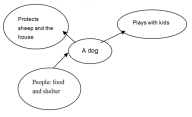
Pairs sit facing each other
and take turns describing their mind map.
Differentiation: less able learners may read
some information from their mind
map.
Optional: pairs may rotate one
or two times.
FA: Teacher oversees the process providing support
where necessary.
FA: teacher discusses criteria for assessing with
learners and they evaluate their peers work according to these
criteria.
|
Appendix 1
http://learnenglishteens.britishcouncil.org/vocabulary/beginner-vocabulary/animals
PPP
slide 5
PPP slide 6
|
|
End
5 minutes
|
(W)Feedback
Learners provide feedback on
what they have learned at the lesson.
Teacher writes incomplete
sentences on the board;
In this lesson I have learnt
about……….
Now I know that sheep
……..
Dogs
……..
Cats
catch…….
Further students may
come up with other animals.
|
PPP
slide 7
|
|
Additional information
|
|
Differentiation – how do you plan to give
more support? How do you plan to challenge the more able
learners?
|
Assessment – how are you planning to check
learners’ learning?
|
Cross-curricular links
Health and safety check
ICT links
Values links
|
|
Teacher oversees the process providing
support where necessary..
|
Teacher may see how well the vocabulary is
learnt and lesson understood by checking students feedback
sheets.
|
Nature
Students show respect to each other and the
teacher.
Students and teacher stick to safety rules
in the classroom.
|
|
Reflection
Teacher writes incomplete
sentences on the board;
In this lesson I have learnt
about……….
Now I know that sheep
……..
Dogs
……..
Cats
catch…….
Further students may come up
with other animals….
Did I stick to timings? What changes did I
make from my plan and why?
|
Use the space below to reflect on your
lesson. Answer the most relevant questions from the box on the left
about your lesson.
|
|
Summary evaluation
What two things went really well (consider both
teaching and learning)?
1:
What two things would have improved the lesson
(consider both teaching and learning)?
1:
What have I learned from this lesson about the
class or individuals that will inform my next
lesson?
|

 ЖИ көмекші


 Қауіпсіз төлем













 Бұл курс Қазақстан Республикасы Оқу-ағарту министрлігімен келісілген










