
 ЖИ көмекші


 Қауіпсіз төлем

жүктеу мүмкіндігіне ие боласыз
Бұл материал сайт қолданушысы жариялаған. Материалдың ішінде жазылған барлық ақпаратқа жауапкершілікті жариялаған қолданушы жауап береді. Ұстаз тілегі тек ақпаратты таратуға қолдау көрсетеді. Егер материал сіздің авторлық құқығыңызды бұзған болса немесе басқа да себептермен сайттан өшіру керек деп ойласаңыз осында жазыңыз
 17 Желтоқсан 2020
 716

1 жыл бойы шексіз жүктеңіз
Ашық сабақ: " Magnetic field"
|
«М.О.Әуезов атындағы педагогикалық колледжі» КМҚК Шығыс Қазақстан облыстық білім басқармасы КГКП «Педагогический колледж имени М.О.Ауэзова» Управление образования Восточно-Казахстанской области |
Методическая инструкция СМК МИ-7.5-24-03 Оқу-әдістемелік кешенді құрастыру туралы әдістемелік нұсқаулық/ Методическая инструкция по оформлению учебно-методического комплекса |
Издание /басылым 1/2017 Стр/бет.
|

Technological сard №
І BLOCK «Aims and objectives»
Subject: Рhysics |
Specialty: « Basic secondary education» |
Group: 14 |
Date : |
||
Lesson theme: |
Magnetic field. Magnetic induction, Ampere's and Lorentz's force. |
||||
Type of lesson: |
combined lesson |
||||
Form of lesson: |
learning new knowledge |
||||
The aim of the lesson: |
The problem of magnetic field properties, phenomenon of electromagnetic induction and analysis of Lents rule on the direction of induction current and Faraday's experiments, using the formulas. |
||||
Lesson objectives:
|
Educational: |
The problem of magnetic field properties, phenomenon of electromagnetic induction and analysis of Lents rule on the direction of induction current and Faraday's experiments, using the formulas.. |
|||
Developing: |
Developing students 'logical thinking and thinking skills by drawing up reports according to the theme, developing students' ability to express their thoughts accurately, to set specific questions and answer them clearly. |
||||
Bring up: |
Educate the aspirations of students to gain knowledge by increasing their curiosity. |
||||
Professionalism: |
Teaching to demonstrate pedagogical-psychological and integrative attributes of the teacher's competence, as well as the ability of the young teacher to be able to; development of creative search; development of intellectual and pedagogical competence skills. |
||||
Results of the lesson: |
Basic: |
|
|||
Professional: |
|
||||
Inter-subject communication: |
English, mathematics, geometry, geography |
||||
ІІ BLOCK «Lesson equipment» |
|||||
Recourses |
Schemes, pictures, cards |
||||
Technical equipment |
Computer, active board, magnets, magnetic field lines |
||||
Information resource Basic literature
|
|
||||
Additional literature
|
|
||||
Basic terms and concepts |
magnetic induction, magnetic field, induction current, magnetic flux, speed, number, magnetic field energy, magnetic flux velocity, length, inductor |
||||
Techniques and methods of lesson: |
Advanced training, critical thinking technology, question and answer method, reporting method, information collected from media, interactive methods: explanation, thinking, comparisons, analysis, information transfer, vocabulary; |
||||
Educational and methodical complex |
Teaching-methodological complex for Physics. |
||||
ІІІ BLOCK «Lesson plan»
Stages |
Methods of teaching |
Outline of Lesson Plan |
||||
І. Organizational stage |
Positive atmosphere |
Greetings. Inventory of students. Psychological training in the classroom |
||||
ІІ. Check your homework |
LearningApps |
Find the correspondence |
||||
Oral frontal |
1) What is the magnetic field? 2) Magnetic induction. 3) Magnetic field strength. Magnetic flux. 4) Earth's magnetic field and its effect on the Sun. 5) Paramagnetic, diamagnetic, ferromagnetic substances. |
|||||
ІІІ. Brain Attack |
Method of using the ICT
|
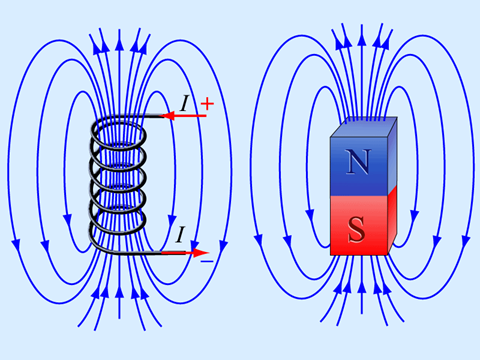
Look at the picture. What can you see?
|
||||
ІV. Learning new knowledge |
Terminology |
Presenting new lexical theme and new words Магнит-магнит-magnet магнит өрісі-магнитное поле-magnetic field магнит индукциясы-магнитная индукция-magnetic induction магнит ағыны-магнитный поток-magnetic flux полюс-полюс-pole солтүстік полюс-северный полюс-north pole оңтүстік полюс-южный полюс-south pole диамагнитті-диамагнетик-diamagnetic парамагнитті-парамагнетик-paramagnetic ферромагнитті-ферромагнетик-ferromagnetic Ампер күші-Сила Ампера-Ampere's force Лоренц күші-Сила Лоренца-Lorentz's force |
||||
Ask a question |
Why do magnets push or pull other magnets and iron objects? Why can not push or pull plastic or wooden objects? |
|||||
Bilimland.kz |
Magnetic field. Ampere force. The magnetic flux |
|||||
Poster compilation iTest.kz |
|
|||||
V. Approve Lesson |
LearningApps |
Find the correspondence |
||||
Oral frontal |
1) What is the magnetic field? 2) Magnetic induction. 3) Magnetic field strength. Magnetic flux. 4) Earth's magnetic field and its effect on the Sun. 5) Paramagnetic, diamagnetic, ferromagnetic substances |
|||||
Issue of reports Bilimland.kz |
|
|||||
|
Reflection
|
Reflection
|
||||
VІ. Assessment of the knowledge skills |
«HAND» evaluation method |
After mastering the material, students defense the posters. E content of the materials
exact information |
||||
VІI. Homework, indication of student's independent work |
|
|


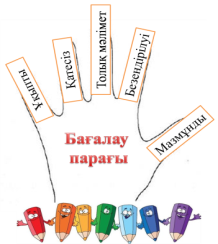 valuated
by HAND:
Theme: Magnetic field. Magnetic induction, Ampere's and Lorentz's force.
Plan:
Magnetic field.
Magnetic induction,
Ampere's and Lorentz's force.
A magnetic field is a force field that affects electric charges and bodies with a magnetic moment in motion (independent of their motion state). The magnetic field is characterized by the magnetic induction vector (B). The value of B determines the electric charge moving on a magnetic moment and the force acting on the body at a given point in the field. Magnetic fields are used to visualize magnetic fields, and the term "magnetic field" was introduced by the English physicist M. Faraday in 1845. He suggested that both magnetic interaction and magnetic interaction are transmitted through a single material field. Made by Maxwell (1873) and quantum theory in the 20's of the 20th Century (Macro) The sources of the magnetic field are magnetized bodies, current-carrying conductors and charged bodies in motion. Principle 1: A magnetic field arises as a result of a charged particle (electron, proton, ion) as well as its own (spin) magnetic moment (Magnetism). Electric and magnetic fields, their interactions with each other are described in detail by Maxwell's equation Magnetic field voltage (H) and magnetic induction (B) - force characteristic of a field. If the voltage vector is a magnitude independent of the environment properties of the field, the induction vector describes the general field in the body. The induction vector also detects the effect of a magnetic field on a body with a magnetic moment and a strong effect on the charge excited by a magnetic field, as well as other effects observed by a field. Lines in the magnetic field along the axes of the small magnetic plates are called magnetic field lines or magnetic field strength lines.
There are many types of magnetic fields in nature. The Earth's magnetic field, which generates the magnetosphere, stretches for 70 to 80 thousand kilometers to the Sun and millions of kilometers in the opposite direction. On Earth, the magnetic field is on average 0.5 E, and at the boundary of the magnetosphere is 10-3 E. The interplanetary magnetic field is basically the field of the solar wind. Magnetic fields play a significant role in such phenomena as solar ignition, spotting of protuberances, and the appearance of cosmic rays from the Sun. The magnetic field has a significant influence on the optical properties of the substance (environment) and the process of interaction of the electromagnetic radiation phenomenon with the substance, galvanomagnet on conductors and semiconductors.
Used literature:
Physics Literature, A Reference ManualRobert H. Whitford and Robert L. Weber Citation: American Journal of Physics 23, 180 (2010);
Published by the American Association of Physics Teachers Articles you may be interested in Physics in Literature Phys. Teach. 52, 22 (2014)









 Бұл курс Қазақстан Республикасы Оқу-ағарту министрлігімен келісілген










