Save the
nature!
The aims of the lesson:
Educational: to consolidate
lexical stock, to encourage students dialogue and
to
express their opinions, to
enrich students vocabulary.
Developing: to develop pupils speaking habits and
self working skills
Bringing-up: to educate pupils
save the nature of the world and care for their
riches.
Inter-subject connection:
Kazakh, Russian, geography
The type of the lesson: computer-based,
integrative
Methods of teaching:
explanation, demonstration, presentation
The equipment of the lesson:
A) Visual aids: diagrams on the tasks, pictures
posters
B) Technical means: computers,
note- books, interactive
board, E- book by
programme “Baiterek”
Epigraph: The Earth and ocean
seem to sleep in one another's arms, and dream of
waves,
flowers, clouds, rocks, and
all that we read in their smiles , and call
reality.
Percy
Shelley
The plan of the
lesson:
-
Organization moment
-
The golden rules
-
Brainstorming
ІҮ. Checking the home
task
Ү. Presentation. New
theme ”Save the nature !”
ҮІ. Vocabulary:
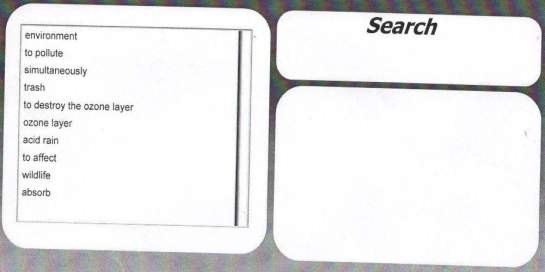
environment, to pollute, simultaneously, trash, to destroy the
ozone layer,
ozone layer, acid rain, to
affect, wildlife, absorb
ҮІІ. Listening
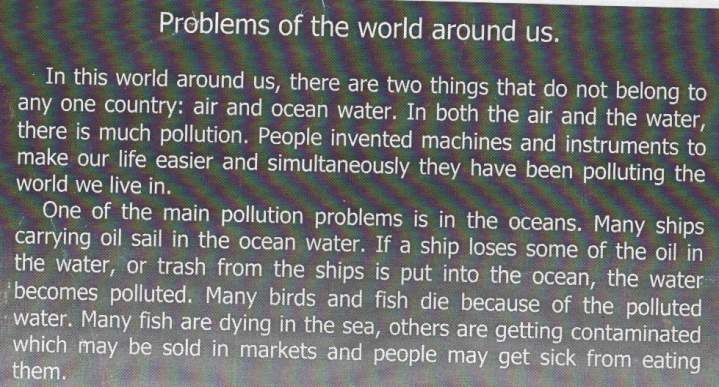
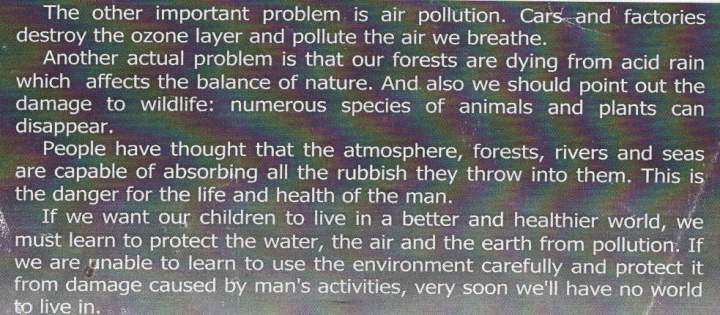
comprehension. Text ”Problems of the world around us”(from
the
electronic
text-book)
ҮІІІ.
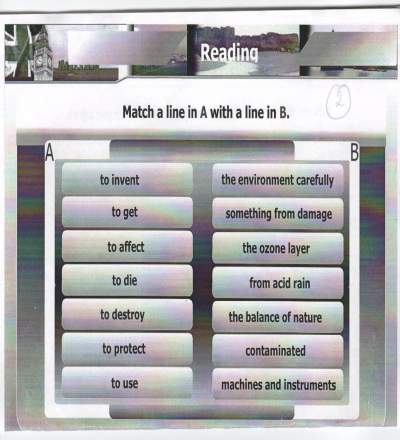
Activities
ІХ. Work with
book. Creative
works
Х. Conclusion. Check
yourself
ХІ. Evaluation
ХІІ. Home-
work
The procedure of the lesson.
-
Organization
moment.
T: Good morning, boys and girls!
P: Good morning , teacher!
T: How are you?
P: We are fine, thank you! And you?
T: I am OK. Thank you! Sit down,
please!
Checking up absentees.
II. Teacher: At the beginning of the lesson I
want to ask your attention to these rules, you should follow
them.
The golden rules:
- First think then
speak
Pupils, today you are estimate
your works by yourself (cards)
-
Checking home-task.
-
Task 1,2
-
Test
-
Creative tasks to the new
theme: essay in Russian, English languages;
poems
ІІІ. Brainstorming: Do this task: Yes or No.
Circle the letters.
|
№
|
Sentences
|
Yes
|
No
|
|
1
|
There are two types of
schools in the USA: private and public schools
|
S
|
H
|
|
2
|
In English children go to school between the ages
of 5 and 16 years
|
A
|
E
|
|
3
|
At the ages of 16 pupils take General Certificate
of Secondary Education exams
|
V
|
F
|
|
4
|
In Kazakhstan pupils have lunch
|
D
|
N
|
|
5
|
In English a typical day at school starts at
8.40. a.m.
|
E
|
P
|
|
6
|
In English pupils leave school at 17
|
C
|
A
|
|
7
|
In English about 80 per cent of children attend
state schools
|
V
|
T
|
|
8
|
In Great Britain pupils have a short break for
lunch
|
T
|
M
|
|
9
|
In Kazakhstan a typical day at school starts at 9
o clock a.m.
|
I
|
U
|
|
10
|
In English in primary
schools pupils have an afternoon break
|
H
|
S
|
|
11
|
There is only private school in
Britain
|
E
|
K
|
|
12
|
Every year many students don’t go abroad to
study
|
O
|
R
|
|
13
|
In Kazakhstan the schools usually have a five-day
holiday halfway through each term
|
Z
|
E
|
Teacher: Write the letters in order: SAVE THE
NATURE!
So, boys
and girls! What about our lesson? Yes, our lesson is about save the
nature. Open your copy – book and write down today's day and date.
The theme of our lesson “Save the
nature!”
I want to draw your attention
to the blackboard where Percy Shellies quotation is
written: “The Earth and ocean seem in
one another's arms, and dreams of waves, flowers , clouds, rocks,
and all that we read in their smiles, and call
reality”
Pupils! Today we shall speak
about our Earth , our nature . We know that the words “world around
us” have many, many meanings; we think first of all about the Earth
with its people and nature. We see lands and mountains, woods and
rivers, the sky , the seen. We think about living beings such as
animals, birds and plants. We see the whole world in front of
us.
IV. Introduction of the new
words:
V Text “Problems of the world around
us”
VI. Activities
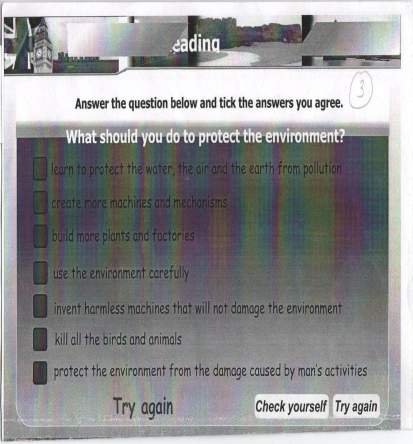
VIII. At home I'll give you a
creative tasks. Let's check
up(
идет проверка творческих заданий учащихся)
IX. Conclusion . Check yourself
XI. Giving the home-
task:
1. To write a short
composition about the nature of native land
2. To make a report about the
pollution of the environment in our region
3. Retell the
text
XI. Evaluation: All of you
have worked very hard, very actively . Lets counted your
scores.

 ЖИ көмекші


 Қауіпсіз төлем













 Бұл курс Қазақстан Республикасы Оқу-ағарту министрлігімен келісілген










