
 ЖИ көмекші

 Көп таңдалатын


 Ең тиімді
15 890₸ үнемдейсіз


жүктеу мүмкіндігіне ие боласыз
Бұл материал сайт қолданушысы жариялаған. Материалдың ішінде жазылған барлық ақпаратқа жауапкершілікті жариялаған қолданушы жауап береді. Ұстаз тілегі тек ақпаратты таратуға қолдау көрсетеді. Егер материал сіздің авторлық құқығыңызды бұзған болса немесе басқа да себептермен сайттан өшіру керек деп ойласаңыз осында жазыңыз
 21 Желтоқсан 2017
 1512
1512
Ашық сабақ "Social network profile "
|
|
Lesson 9 Communication and Technology Term 1 Unit 2 Social network profile |
School: 40 |
||||
|
|
Date: 17.10.2017 |
Teacher name: Zhanalieva Gulzhan |
||||
|
|
Grade: 7 |
Number present: |
absent: |
|||
|
|
Learning objectives that this lesson is contributing to |
7.C7 develop and sustain a consistent argument when speaking or writing 7.S5 keep interaction going in longer exchanges on a range of general and curricular topics 7.S3 give an opinion at sentence and discourse level on an increasing range of general and curricular topics 7.S7 use appropriate subject-specific vocabulary and syntax to talk about a limited range of general topics, and some curricular topics 7.R1 understand the main points in a growing range of short, simple texts on general and curricular topics 7.UE5Usequestions,whichinclude a varietyofdifferenttenseson a rangeoffamiliargeneralandcurriculartopics. 7.UE7 use simple perfect forms to express indefinite and unfinished past with for and since on a growing range of familiar general and curricular topics |
||||
|
|
Lesson objectives |
|
||||
|
|
All learners will be able to: -recognize the name of new technology. Read the topic and understand. Most learners will be able to: - Find true and false sentences from the text. Talk about positive and negative side of new technology. Some learners will be able to: - write own opinion about the text. Make up conclusion from the topic. |
|||||
|
|
Language objectives |
Practice indefinite and quantitative pronouns Present Simple |
||||
|
|
Cross curricular links |
Social Studies, ICT |
||||
|
|
ICT skills |
Acquisition of ICT specific vocabulary |
||||
|
|
Value links |
Respect, cooperation, functional literacy |
||||
|
|
Previous learning |
Writing blogs about technology |
||||
|
|
Intercultural awareness |
Students will be able to understand that every person, family and country has their own values. |
||||
|
|
Kazakh culture |
Investigation of using new technologies in Kazakhstan |
||||
|
|
Pastoral Care |
Students will be able to understand the importance of using some types of technology for communication |
||||
|
|
Health and Safety |
Everyday classroom precautions will ensure that safety measures are provided to prevent the exposure of electrical power cords |
||||
|
|
Plan |
|||||
|
|
Planned timings |
Planned activities |
Resources |
|
||
|
|
Start 3 min |
1.Leading-in stage (W) Teacher asks students to remind about the main aspects of the unit. Warm-up Teacher divided the class into 3 group with help of new words. |
Board |
|
||
|
|
2min (W) 5 min (I) 10 min (I) 10min (I)
|
Speaking
Support a talk with peers while agree, disagree and discuss about the positive and negative side of new technology Apply topic related vocabulary in speech appropriately arranging words and phrases into well-formed sentences;
The main part of the lesson Listening Listen to the dialogue. Find true and false sentences. Read the text. Choose the true and false sentences
Write 3 sentences about new technology Write the reasons in what way computers held you in your study. positive, negative
1_______________________________
Use of English Six thinking hat method. Talk about new technology:
|
FA CD 3 FA FA |
|
||
|
|
3 min (I) |
Plenary Teacher asks students to write a reflection of the lesson. Five fingers method |
|
|
||
|
|
End 7min (I)
|
Feedback: Teacher shows students’ basket what task was difficult to them and how they managed to cope with it |
Reflective journals |
|
||
|
|
Additional information |
|||||
|
|
Differentiation – how do you plan to give more support? How do you plan to challenge the more able learners? allow less confident learners to give different levels of response (differentiation by outcome); or let some learners ask and answer a fewer number of questions (differentiation by task). Monitor and take notes for future planning. |
Assessment – how are you planning to check learners’ learning? |
Health and safety check |
|
||
|
Teacher can provide different levels of questions: Who? Where? When? (lower –order thinking skill) What? Why (higher-order thinking skill). Use words from script. Grouping students should allow students of mixed ability to work together and support one another. . The teacher and co-teacher should circulate the room constantly offering support to weaker students and encouraging stronger students to write more complex, abstract thoughts. Higher students can be encouraged to use more difficult writing structures, vocabulary etc. Weaker students can be supported by the teacher when writing, and the complexity of the tasks could be reduced or adapted. |
Circulate about the room helping students with vocabulary and expressions. Monitor learners to check they can pick up main points from the text when answering the questions. Following each pair or individual activity, ask questions that check for comprehension and understanding. |
Lesson will delivered in accordance with health and safety standards. |
|
|||
|
|
Reflection Were the lesson objectives/learning objectives realistic? Did all learners achieve the LO? If not, why? Did my planned differentiation work well? Did I stick to timings? What changes did I make from my plan and why? |
|
||||
|
|
Summary evaluation What two things went really well (consider both teaching and learning)? 1: 2: What two things would have improved the lesson (consider both teaching and learning)? 1: 2: What have I learned from this lesson about the class orachievements/difficulties of individuals that will inform my next lesson? |
|||||

Unit: Communication and Technology
Speaking
Learning objective 7.S3 Give an opinion at discourse level on a growing range of
general and curricular topics
7.C4 Evaluate and respond constructively to feedback from others
Assessment criteria • Provide a point of view in conversations and discussions
• Analyze given feedback; Form opinion and give
constructive answers to feedback
Level of thinking skills Higher order thinking skills
Task
Work in groups. Divide 20 pictures into 3 or 4 categories. Name the categories and explain your decision giving arguments. Present your ideas to the class. Find 2 positive and 1 negative facts about the groups’ presentations.
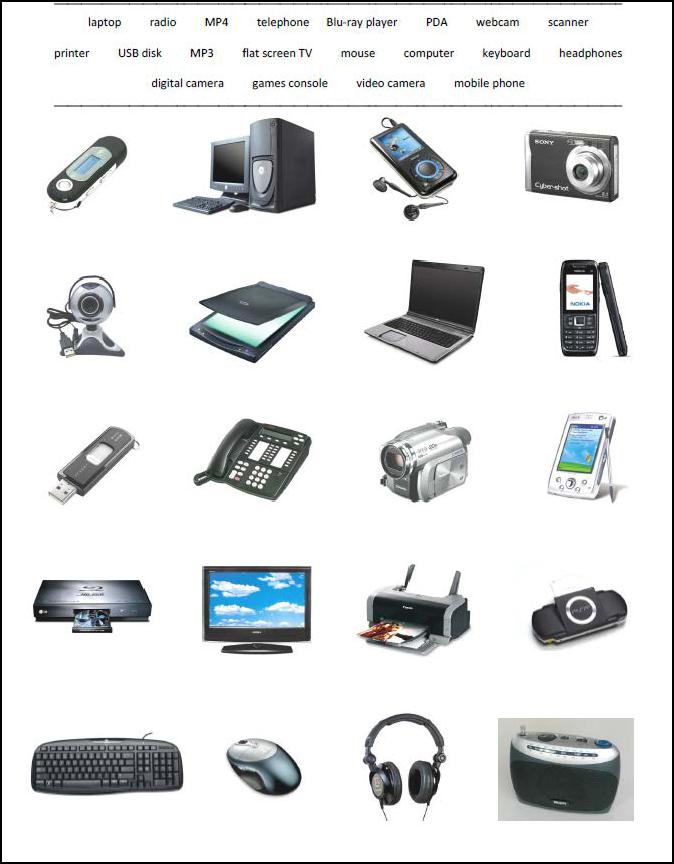
Descriptor A learner
explains and interprets the choice providing a point of view;
arranges own criteria for division;
evaluates and chooses positive and negative features in peers’ works.
Unit: Communication and technology
Listening
Learning objective 7.L1 Understand with little support the main points in extended
talk on a limited range of general and curricular topics
Assessment criteria Identify the main idea in extended talks with little
support
Level of thinking skills Knowledge and comprehension
Task
Listen to the story about mobile phones and choose the right option. You will listen twice. Go to this link to listen information: http://www.esl-lab.com/ramfiles/smartphone.wax
The young man says he needs a new phone because
his parents took his last one
someone stole his last one
his phone is an older model
his parents want it
How many phones does the young man already have?
two
three
four
five
According to the conversation, what are the young man's parents like?
friendly
generous
kind
smart
What do his parents want their son to do to get a phone?
take out money from his bank account
find a job and work to earn money
ask his brother if he can use an old phone
ask his sister if he can use an old one
What is the BEST word to describe the young man's personality?
talkative
mean
self-centered
selfish
Descriptor A learner
reads the questions and answers;
chooses appropriate answer to the question according to the talk.
Unit: Communication and technology
READING
Learning objective 7.R3 Understand the detail of an argument on a growing range of
familiar general and curricular topics, including some extended texts.
Assessment criteria Recognise the detail in a given argument relating to the
topic.
Level of thinking skills Knowledge and comprehension
Task
Read the text and complete the task.
Computers
A computer is a programmable machine designed to automatically carry out a sequence of arithmetic or logical operations. The first use of the word "computer" was recorded in 1613, referring to a person who carried out calculations, or computations, and the word continued with the same meaning until the middle of the 20th century. From the end of the 19th century the word began to take on its more familiar meaning, a machine that carries out computations
At the beginning, computers were as big as a large room. It is only later they have become smaller and smaller, accessible to anyone. This has given way to personal computers. Later developers created new applications to help users perform many things from word processing to image editing. A large scale of programs, some free and others costly, have opened new horizons in information technology.
Now computers have noticeable impact on social relations. They have enabled entirely new forms of social interaction, activities, and organision. With the Internet, working with computers has become a part of our daily lives thanks to its basic features such as widespread usability and access. In addition to face-to-face communication that characterized humans for centuries, a new form of virtual communication has become more predominant.
Choose True or False.
The word computer is a new term.
True
False
Computers were accessible to anyone at the beginning.
True
False
All computer applications are free.
True
False
Computers and the Internet have shaped new social relations.
True
False
Answer keys:
1. False; 2.False; 3. False; 4. True.
Descriptor A learner
chooses the appropriate answer
|
|
Unit: Communication and technology Writing |
|
|
Learning objective |
7.S5 Keep interaction with peers to negotiate, agree and organize |
|
|
|
priorities and plans for completing classroom tasks |
|
|
|
7. C8 Develop intercultural awareness through reading and |
|
|
|
discussion |
|
|
|
7. C10 Use talk or writing as a means of reflecting on and exploring |
|
|
|
a range of perspectives on the world |
|
|
Assessment criteria |
Demonstrate the ability to participate in a conversation |
|
|
|
Raise awareness about cultural diversity through reading |
|
|
|
and discussion |
|
|
|
Consider different perspectives on the world orally or in a |
|
|
|
written form |
|
|
Level of thinking skills |
Application |
|
|
Task |
Higher order thinking skills |
|
|
|
|
Work in groups of 3-4. Answer the question: “Are computers friends or troubles in teenagers’ study in modern world?” You have 5 minutes to brainstorm the ideas. Fill in the table with 3 positive and 3 negative reasons.
Computers and study


|
Write 3 positive reasons in what way |
Write 3 negative reasons in what way |
|
computers help you in your study |
computers distract you from study |
|
|
|
|
1. |
1. Addiction |
|
|
|
|
2. |
2. |
|
|
|
|
3. |
3. |
|
|
|
Descriptor A leaner
completes the table with positive and negative reasons;
summaries the information on a global issue;
gives evaluation to the problem
Unit: Communication and technology
Use of English
Learning objective 7.C6 Organise and present information clearly to others;
7.S3 Give an opinion at discourse level on a growing range of general and curricular topics
Assessment criteria Demonstrate an ability to organize and express ideas
clearly
Provide a point of view in conversations and discussions
Level of thinking skills Higher order thinking skills
Task
Answer the questions and speak before the other groups. You have 5 minutes to be ready and 5 minutes to present your ideas.
Learners work in the groups of 3-4. Teacher prepares three discussion tasks for learners. Teacher gives 5-8 minutes for them to brainstorm the ideas and present their findings to the class.
The six thinking hats methhod
1.
Tell about good sides of mobile phone and computers . White hat- facts . Yellow hat- positive
2.
Tell about bad sides of mobile phone and computers. Red hat- emotion , black hat – negative
3. make up conclusion. Green hat- creative. Blue hat – conclusion.
Descriptor A learner
selects useful information and plans the answer;
presents his/her information to the class.

I'm proud of you


well
done done
done

Think again


WOW!

you can do it


You could do it better











 Бұл курс Қазақстан Республикасы Оқу-ағарту министрлігімен келісілген










