
 ЖИ көмекші


 Қауіпсіз төлем

жүктеу мүмкіндігіне ие боласыз
Бұл материал сайт қолданушысы жариялаған. Материалдың ішінде жазылған барлық ақпаратқа жауапкершілікті жариялаған қолданушы жауап береді. Ұстаз тілегі тек ақпаратты таратуға қолдау көрсетеді. Егер материал сіздің авторлық құқығыңызды бұзған болса немесе басқа да себептермен сайттан өшіру керек деп ойласаңыз осында жазыңыз
 21 Желтоқсан 2017
 504

1 жыл бойы шексіз жүктеңіз
баяндама
Байжуманова Арайлым Шокановна
учитель английского языка
Казанская средняя школа
Северо-Казахстанской области
Teaching early literacy techniques: primary reading and writing skills
This article consist of theoretical and practical materials usage of technics. There given several examples of exercises for primary reading and writing skills in the first grade.
“The learning objectives in 1 grade are to form slowly reading skills, reading whole word, expressive retelling, learning words by heart, skills of literate reading, the development of the coherent speech.
The learning process must be built in principles of “from simple to complex, from easy to complicated ”. (Methodical letter, 2016)
In the first and second quarters we mostly paid attention to speaking and listening skills and primary use of language. In third and fourth quarters there added reading and writing skills.
Reading on the 1st grade is started by learning the English alphabet. Each teacher has their own technics in teaching learning by heart the English alphabet. Someone teach using songs, retelling, alphabet rainbow. Here we try to present pupils the alphabet and learn to memorize the letters by looking at them, pronouncing, finding definite letters in words, making the word using letters themselves.
When we teach a word or word combination we pronounce them, we read them. There are sounds and sound pictures. We teach writing, reading and speaking skills using sound chart. Another way it is called THASS. What does THASS cover? (picture 1)
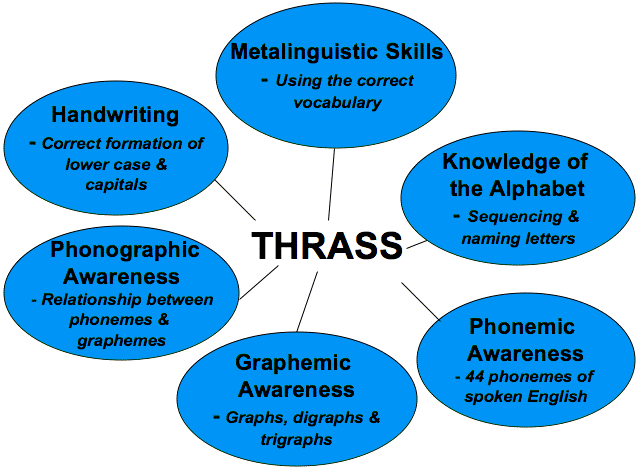 Pic.1
There are a lot of examples in youtube that help teachers in their work.
Teaching reading words can be done in different way (different technics)
They are: blending, segmenting, phoneme manipulating.
Let’s look at each of them.
Teaching the skills of segmentation in isolation or in combination with blending instruction helps with successful reading development.
When beginning readers sound out words, they slowly say each sound in a word (d-o-g), and then say the sounds quickly together to "read" the word (dog). In reading, teachers call this blending because sounds are being blended together.
Blending , in another word,combining sounds and segmenting , in another word, separating sounds are skills that are necessary for learning to read.
Developing a child's phonological awareness is an important part of developing a reader. Many research studies indicate that kids who have weak phonological awareness also have weak reading skills.
The figure below shows how the teaching of segmenting and blending should progress, starting at the sentence level, moving to syllable, and finally to individual phonemes. Be sure to provide lots of practice at the easier level before moving on. (picture 2)
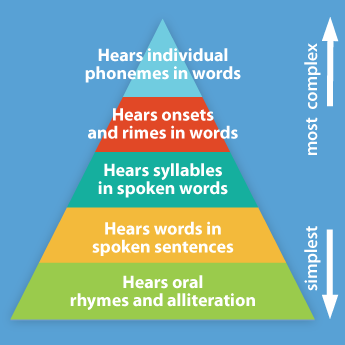 pic.2
Guess-the-word game
This activity is an example of how to teach students to blend and identify a word that is stretched out into its basic sound elements.
Objective: Students will be able to blend and identify a word that is stretched out into its component sounds.
Materials needed: Picture cards of objects that students are likely to recognize such as: sun, bell, fan, flag, snake, tree, book, cup, clock, plane
Activity: Place a small number of picture cards in front of children. Tell them you are going to say a word using "Snail Talk" a slow way of saying words (e.g., /tttrrrreeeeee/). They have to look at the pictures and guess the word you are saying. It is important to have the children guess the answer in their head so that everyone gets an opportunity to try it. Alternate between having one child identify the word and having all children say the word aloud in chorus to keep children engaged.
Robot talk
Talking in "Robot Talk," students hear segmented sounds and put them together (blend them) into word.
Blending slide
The
"Reading Genie" offers teachers a simple way to teach students
about blends. Teachers can use a picture or small replica of a
playground slide and have the sounds "slide" together to form a
word.
Oral blending activity
It
describes the importance of teaching blending
skills to young children. This link provides suggestions for oral
sound blending activities to help students practice and develop
smooth blending skills.
Sound blending using songs
Teacher often use sing songs in the lesson. Here is given an activity for blending using a song.
The following activity (see Yopp, M., 1992) is to the tune of "If You're Happy and You Know It, Clap Your Hands."
If
you think you know this word, shout it out!
If you think you know this word, shout it out!
If you think you know this word,
Then tell me what you've heard,
If you think you know this word, shout it
out!
After singing, the teacher says a segmented word such as /c/ /a/ /t/ and students provide the blended word "cat."
Segmenting
This activity is an example of how to teach students to segment, first with sentences, then words, and finally sounds.
-
Early in phonological awareness instruction, teach children to segment sentences into individual words. Identify familiar short poems such as "I scream you scream we all scream for ice cream!" Have children clap their hands with each word.
-
As children advance in their ability to manipulate oral language, teach them to segment words into syllables or onsets and rimes. For example, have children segment their names into syllables: e.g., Al-ma, Al-ex-an-der, and An-na.
-
When children have learned to remove the first phoneme (sound) of a word, teach them to segment short words into individual phonemes: e.g., d-o-g, b-a-t, s-t-o-p.
Segmenting cheer activity
This link provides teachers with information on
how to conduct the following segmentation cheer
activity.
Write the "Segmentation Cheer" on chart paper, and teach it to children. Each time you say the cheer, change the words in the third line. Have children segment the word sound by sound. Begin with words that have three phonemes, such as ten, rat, cat, dog, soap, read, and fish.
Segmentation Cheer
Listen to my cheer.
Then shout the sounds you hear.
Sun! Sun!
Sun!
Let's take apart the word sun.
Give me the beginning sound. (Children respond with
/s/.)
Give me the middle sound. (Children respond with
/u/.)
Give me the ending sound. (Children respond with
/n/.)
That's right!
/s/ /u/ /n/-Sun! Sun! Sun!
Differentiated instruction for second language learners, students of varying reading skill, and for younger learners
-
Use oral activities to help support students of lower level reading skills.
-
Use activities that include pictures to support ESL students and younger students.
-
Ask students to write the words that they form in the blending/segmenting activities.
Phoneme
manipulation is the most advanced form of
phonemic
awareness.
These activities require children to add or substitute phonemes in
words:
* Phoneme
addition. Say a word and
then say it again with a phoneme added at the
beginning
(an >
fan) or end
(an >
ant).
* Phoneme
deletion. Say a word and
then say it again without the initial
(farm >
arm)
or ending
(farm >
far)
sound.
* Phoneme
substitution. Substitute
initial sounds in lyrics of familiar songs
(Fe-Fi-
Fiddly-i-o > De-Di-Diddly-i-o)
Teaching early writing is goes with reading . When pupil is introduced with new words he do several actions at one moment. He sees the word (sight word), he pronounce it, manipulate with words, read them then try to write them himself. In teaching early writing goes with different technics, such as “sticks and tails”,
-
back writing
-
directional letter writing
-
letter sticks and tails
-
pattern within a word
-
word within a word
-
completing CVC words
-
labelling diagram
-
rhyming words
-
air writing
There are some advices given as Piaget ‘discovery’
-
get learners into the habit of ‘looking with intent’
-
point out that print is all around them
-
take an interest in words as you read/ come across them (sounds like/looks like but.../word families)
-
encourage learners to take mental photos of words/hold the image in their mind/break it down into ‘sound pictures’
-
get learners to write down words and see if it looks right
-
air write words
-
be multi-sensory: hear look say touch move sound write
We should remember that leaning in the 1 grade goes by active learning.Broad task dimensions of early reading and writing tasks are: integrated tasks, whole books, letter shapes, word patterns, picture dictionaries, read and do, write for display , read and predict, phonographix.









 Бұл курс Қазақстан Республикасы Оқу-ағарту министрлігімен келісілген










