
 ЖИ көмекші


 Қауіпсіз төлем

жүктеу мүмкіндігіне ие боласыз
Бұл материал сайт қолданушысы жариялаған. Материалдың ішінде жазылған барлық ақпаратқа жауапкершілікті жариялаған қолданушы жауап береді. Ұстаз тілегі тек ақпаратты таратуға қолдау көрсетеді. Егер материал сіздің авторлық құқығыңызды бұзған болса немесе басқа да себептермен сайттан өшіру керек деп ойласаңыз осында жазыңыз
 26 Қаңтар 2019
 665

1 жыл бойы шексіз жүктеңіз
Баяндама:The use of “critical thinking” strategies at the English lessons
Ministry of Education and science of the Republic of Kazakhstan
Tortkul general secondary school

The theme: The use of “critical thinking” strategies at the English lessons

Teacher of English: Akhanova M.Sh.
PLAN:
-
Introduction
-
Main chapter
-
The importance of using “critical thinking” strategies at the English lesson.
-
The creation of lessons with an element of “critical thinking” development.
-
Conclusion
Bibliography
Aims:
-to share both theoretical and practical ideas about critical thinking development within English language teaching;
-to answer three questions, namely, what critical thinking is, why to integrate and develop critical thinking in ELT, and how to create lessons including an element of critical thinking development;
-to educate a person who thinks critically, ask appropriate questions, gather relevant information, efficiently and creatively sort through this information, reason logically from this information, and come to reliable and trustworthy conclusions about the world that enable one to live and act successfully in it;
Objectives:
-to increase students’ interest in learning English language through using benefit methods of critical thinking, to create atmosphere where students are able to express their opinions;
-to find an appropriate approach to the heart of students through interesting and effective lessons;
-to develop individuals who are able to exchange their opinions, who are able to discuss and solve the problems, who are able to investigate and share with their opinions in group or before audience;
-to create relationship students’ pair work and group work, to learn them to respect each others opinions, to put students’ interest first, to create atmosphere where students can take active role, give them chance to participate in the evaluation of their learning;
I Introduction
President Nursultan Nazarbayev has called Kazakhstan citizens to learn three languages-Kazakh, Russian and English. “Knowledge of three languages should become a standard practice for us. We are teaching, these languages to our children starting from their first year at school,” he said.
Language lives only so long as there are people who speak it and use it as their native tongue and it greatness is only that given to it by these people. A language is important because the people who speak it are important-politically, economically, commercially, socially and culturally. The importance of English language is naturally very great.
Our purpose here is to explore the interactive methods of teaching English that have attracted attention of the teachers in recent years. Teacher has to organize different forms of activity at the foreign language. There are many methods of teaching languages. Teaching languages, we the English teachers, must find an appropriate approach to students. What is it? It is when we are able to bring up well educated students who have a personal way of thinking and learning.
Most teachers might be impressed to learn that critical thinking can be traced back many centuries ago. In fact, it has been practiced from times immemorial, notably, by Socrates and Plato. Defining critical thinking might seem difficult, especially because the term tends to be used repeatedly without actually reflecting on its true meaning. To begin with, we can state that critical thinking is a quality able to be developed throughout life. Critical thinking is self-guided, self-disciplined thinking which attempts to reason at the highest level of quality in a fair-minded way. People who think consistently attempt to live rationally, reasonably, empathically. It requires careful and intentional development of specific skills in processing information, considering beliefs, opinions, solving problems. Critical thinking is associated with quality thinking and, if sufficiently developed, provides learners with a more skillful way of communicating with other people, acquiring new knowledge, and dealing with ideas, beliefs, and attitudes. In all these areas language plays a crucial role.
Researchers of the American Foundation for Critical Thinking argue that critical thinking is not as a natural skill as speaking or running, it is a deliberately developed complex set of skills and features which takes years to acquire. Similarly, a foreign language acquisition needs years of persistent training. So practicing both simultaneously saves time and provides a synergy effect: developing the former we improve the latter and vice versa. Finally, critical thinking requires active and interactive learning. It does not tolerate passive learning, taking new things and opinions as ready-made words of wisdom. In our experience, students tend to learn better by actively communicating with each other in a particular academic content, especially if they are encouraged to apply critical thinking when comparing their views and ideas, when evaluating arguments, when probing into the intellectual standards of clarity and accuracy, breadth and width, relevance and fair-mindedness, etc. Engaged in the interactive activities while practicing both communicative skills and critical thinking, students have a better chance to improve their self consciousness, their understanding of their abilities and of their limits and thus paving the road to self-improvement as learners, as future professional, and as individuals.
II.Main chapter
The importance of using “critical thinking” strategies at the English lesson.
We have focused our attention on exploring some theoretical aspects of critical thinking, but as every English language teacher knows, it might be hard to find the way to apply and develop lesson plans that address critical thinking in viable and realistic ways. As usual, there are different contexts and student characteristics that may influence the degree to which critical thinking can be introduced and developed, but we firmly believe that the first steps are planning, experimenting and reflecting. Our own practice and students feedback will provide the teacher with the necessary information to start redesigning lessons so that they involve students in the development of critical thinking, i.e. to adapt content, language tasks, learning strategies in cognitive and affective domains. Undoubtedly, writing a lesson plan helps to organize our thoughts and have a framework that indicates how to take our students to certain “learning destinations”. In order to develop plans that include the development of critical thinking some essential elements or components are typical for any lesson plans, yet some other components need to be added and adapted in order to integrate a critical thinking element. After all, if we want to develop critical thinking in our foreign language class, we need to include some specific lesson components into the lesson plan, in addition to traditional components of the lesson description such as prerequisites, instructional objectives, supporting activities, and assessment.
Some strategies which can develop students’ critical thinking:
-
Brainstorming
-
K-W-L charts
-
Venn diagram
-
INSERT
-
Jigsaw reading I and II
-
Bloom’s Taxonomy
-
Six thinking hats of Edward de Bono
-
Author’s chair
-
Reflective writing
-
Cinquain method
-
Classroom discussion and Debates
-
Cluster and etc
Explanation of some strategies:
Classroom Discussion and Debates
Classroom discussion and debates can promote critical thinking. Various techniques are available. Bernstein developed a negotiation model in which students were confronted with credible but antagonistic arguments. Students were challenged to deal with the tension between the two arguments. This tension is believed to be one component driving critical thought. Controversial issues in psychology, such as animal rights and children rights, were presented and discussed. Students responded favorably and, as the class progressed over time, they reported being more comfortable arguing both sides of an issue. In athletic training education, a negotiation model could be employed to discuss certain topics, such as the use of heat versus ice or the use of ultrasound versus electric stimulation in the treatment of an injury. Students could be assigned to defend the use of a certain treatment. Another strategy to promote students to seek both sides of an issue is pro and con grids. Students create grids with the pros and cons or advantages or disadvantages of an issue or treatment. Debate was used to promote CT in second-year medical students. After debating, students reported improvements in literature searching, weighing risks and benefits of treatments, and making evidence-based decisions. Regardless of the teaching methods used, students should be exposed to analyzing the costs and benefits of issues, problems, and treatments to help prepare them for real-life decision making.
Jigsaw reading
Jigsaw is a strategy that emphasizes cooperative learning by providing students an opportunity to actively help each other build comprehension. Use this technique to assign students to reading groups composed of varying skill levels. Each group member is responsible for becoming an "expert" on one section of the assigned material and then "teaching" it to the other members of the team.
Benefits of jigsaw reading.
Jigsaw is a well-established method for encouraging group sharing and learning of specific content. This technique can be used as an instructional activity across several days and is best to use when there is a large amount of content to teach. Jigsaw helps students learn cooperation as group members share responsibility for each other's learning by using critical thinking and social skills to complete an assignment. Subsequently, this strategy helps to improve listening, communication, and problem-solving skills. Monitoring each student's participation within the groups provides teachers with information about how much the students already know about the topic. This allows teachers to tailor instruction accordingly.
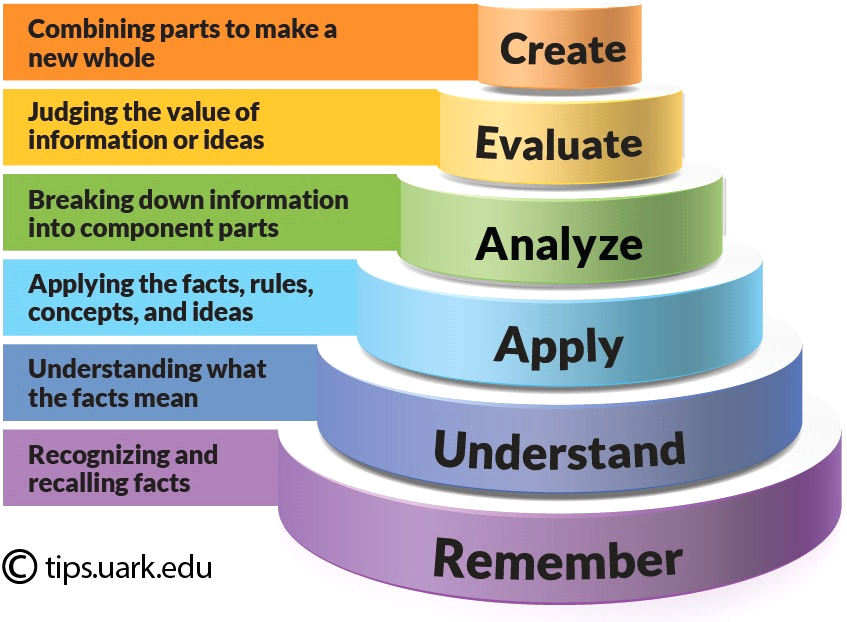
BLOOM’S TAXONOMY
What Is It? Bloom’s Taxonomy is a classification of educational objectives used for developing higher level thinking skills. It is a process-oriented model that allows teachers to present ideas and concepts at many different levels to meet the needs of a variety of learners. How Is It Used? When developing learning tasks and activities around Bloom’s Taxonomy, it is important to include at least one activity from each of the six levels of the taxonomy.
•Knowledge -requires learning information -consists of memorizing or identifying facts -provides the basis for greater understanding Questions that ask students to define, describe, label, locate, recite, select, memorize, recognize, name, state, identify, or repeat utilize the knowledge level of Bloom’s taxonomy.
•Comprehension -requires understanding information -focuses on the meaning and intent of the material Whenever students are asked to restate, paraphrase, rewrite, convert, give examples, illustrate, summarize, explain, locate, express they are employing comprehension level skills.
•Application -requires using information. -gives student practice in the transfer of their learning to other situations Some action verbs associated with the application level are apply, modify, dramatize, translate, demonstrate, and construct.
•Analysis -requires examining specific parts of information to “see” the underlying ideas -utilized before decisions are reached and problems are attacked Analyze, classify, distinguish, subdivide, separate, differentiate, examine, calculate, compare/contrast are verbs that could be used to express the analysis level of Bloom’s taxonomy.
•Synthesis -requires doing something new and different with information -involves the ability to put parts and elements together in a new form Students who combine, compose, design, organize, invent, develop, plan, or create are using synthesis level skills.
•Evaluation -requires judging information using some criteria or standard Asking students to evaluate, recommend, summarize, debate, criticize, or judge challenges them to incorporate the evaluation level in their thinking process. After the preparation of an activity is complete, teachers should look closely at the tasks assigned by reviewing the verbs (what the students are asked to do) to ensure that each level of Bloom’s Taxonomy has been addressed.
Author's Chair
This strategy provides a way for readers to share with each other the excitement of a particular moment in relation to a book or to their own writing. Author's Chair is the final step in the writing process. A special time and place is allotted to writers who wish to share their final products with an audience. Because the writing has already gone through revising and editing based on constructive criticism, Author's Chair is an opportunity for the writer to receive positive feedback from their classmates. The student in the author's chair reads aloud a selected piece of text or a piece of their own writing. Peers then have an opportunity to respond to what is read aloud.
What is its purpose?
-
to develop students' concept of authorship
-
to emphasize that students' ideas and experiences are worthy of preservation and sharing
-
to develop collaborative learning abilities and peer editing skills
-
provide an audience for hard work done well is a motivating force for children to write more in the future.
-
as an active-listening audience member, students develop listening and attention span skills.
-
analyze written work requires reflection and critical thinking abilities. Giving and receiving feedback is beneficial for both parties. Both the presenter and the audience member's own writing improves as a result of the critique.
How can I do it?
-
Facing the audience, an individual reads a personal draft or polished composition.
-
The author shares accompanying illustrations with the audience.
-
The audience is respectful and accepting of the author's efforts.
-
The author requests comments from audience members.
-
First responses are positive.
-
Comments focus upon favorite events and characters or particularly interesting and impressive uses of language.
-
The author or audience direct questions about the clarity and the effectiveness of passages, or about the language structures or specific vocabulary.
-
The audience offers suggestions.
-
Initially teachers model and guide audience responses.
How can I adapt it?
-
Beginning writers can share drawings with captions or limited text.
-
Students could share their writing with younger students.
-
An "author of the week" could be chosen regularly. The individual's work could be put on display and peers could post their comments about particular compositions. Items for display should be chosen by the author.
-
Allow children time to share their reasoning at the 'math author's chair,' a special chair for students to explain to their classmates their own solution to a problem.
-
This procedure should apply to writing efforts in all subject areas. Examples of narrative and expository writing should be shared.
Assessment & Evaluation Considerations
-
Students' interest and participation as authors and listeners is observed and recorded.
-
Note comments posed and questions asked about drafts which identify needs for instruction.
-
Sessions could be audio or video taped.

Brainstorming
The present study investigated the impact of brainstorming as a pre-reading strategy on reading comprehension ability as well as critical thinking (CT) ability of EFL learners. In so doing, the study used an experimental design with 29 participants in the control group and 25 participants in the experimental one. The results of the pre test confirmed the homogeneity of the participants in the two groups regarding their reading comprehension ability as well as critical thinking ability. Neither the control group nor experimental group had any previous experience in brainstorming strategies. The participants in the experimental group were instructed how to use brainstorming strategies before reading passages. A 45 multiple- choice reading items taken from Flash (2005) TOEFL Reading and the ‘Watson-Glaser Critical Thinking Appraisal’ (CTA) were employed to evaluate students’ reading comprehension ability, besides their CT ability; respectively. The post test results indicated that brainstorming strategies have a positive significant effect on both CT ability as well as reading comprehension ability of the participants. The conclusions and implications of the research have been further pointed out with reference to foreign language teaching context.
INSERT
Teachers can use this strategy when learning new information, new topic or texts. How to use this strategy?
-to give new topic or any type of the texts;
-to have students’ to read it in pair or in small groups;
-to explain them the action during the reading process:
1. Put a tick (v) in the margin if something you read contains what you knew or thought you knew;
2. Put a plus (+) in the margin if a piece of information you encounter is new for you;
3. Put a minus(-) if some information you reading contradicts or is different from what you already knew or thought you knew;
4. Put a question mark (?) in the margin if there is information that is confusing to you or there is something you would like to know more about.
K-W-L charts
K-W-L charts are graphic organizers that help students organize information before, during and after a unit or a lesson. They can be used to engage students in a new topic, activate prior knowledge, share units objectives, and monitor learning.
Procedure
Step1: Make K-W-L charts . ask students to create three columns on a sheet of paper: Column1: What do you know about the topic?
Column 2: What do you want to know?
Column3: What did you learn?
Or, you can distribute a blank of K-W-L chart that you have designed.
Step2: Complete column 1. Have students respond to the first prompt in column1. Students can do this individually or in small groups.
Step3: complete column 2. Have students respond to the first prompt in column2. Students can do this individually or in small groups.
Step4: Complete column 3 and review columns 1 and 2. throughout the unit, students can review their K-W-L charts by adding to column 3. Some teachers have students add to their charts at the end of the each lesson. While others have students add to their charts at the end of the week or at the end of the unit.
Venn diagram
Venn diagrams originate from a branch of mathematics called set theory. John Venn developed them in 1891 to show relationship between sets. They are now used across many other disciplines. Venn diagrams enable students to organize information visually so they are able to see the relationships between two or three sets of items. They can then identify similarities and differences.
The creation of lessons with an element of “critical thinking” development.
Lesson plan 1
Grade: 11 form
The theme of the lesson: The electoral system in Britain.
Aims of the lesson:
-
To introduce students with the electoral system in Britain, to show the peculiarities of the election in Kazakhstan and in Britain;
-
To organize students’ creative work on the given topic, exchange ideas and learn to predict, analyze;
-
To develop students’ self assessment, learn to compare electoral systems and interview, to learn to work in pair then in groups;
The type of the lesson: New lesson
The kind of the lesson: Integrated lesson
Methods of teaching: Use of critical thinking strategies
Relation between subjects: History, Law
Visual aids: book, charts of strategies, geometrical shapes.
The procedure of the lesson
I Organization moment
II Checking up the home task.
Strategy 1: Author’s chair
Students retell the topic sitting on the author’s chair which is given to the home work.
At the end of retelling other students can ask questions according to the topic.
III Warm up activity.
Strategy 2: Australian rain
Students should stand in circle around the teacher. The teacher makes with the help of hands the voice of the rain. Students should repeat the action appropriately to the teacher. This helps students’ fell good from the very beginning of the lesson.
IV Presentation of new material.
Strategy 3: Brainstorming
Teacher put questions to the students about election system general.
At what age do people vote in our country?
Have you ever voted in election?
What qualities should you look for when you vote for someone to represent you in the Parliament of Kazakhstan? Why?
After Brainstorming students are divided into two groups with the help of two shapes: a circle and a triangle.
Strategy 4: Jigsaw reading
Topic “Party system”. The parts of the topics are given to the groups. New words of the lesson are given on a sheet of paper.
The first part is for Group A.
For over 150 years Britain’s system of parliamentary democracy has been based on organized political parties competing to form governments. The system depends on the existence of at least two parties in the House of Commons, each of which is capable of forming a government. Any organization wishing to put up candidates at a relevant election must be registered a political party with the Electoral Commission. Voting is by secret ballot.
The second one is for Group B.
Most candidates in election and almost all winning candidates belong to one or other of main political parties. Candidates who are members of smaller political parties, or who do not belong to any party, may also stand. Science the Second World War the great majority of MP’s have belonged to either the Conservative or the Labour party.
The leader of the party that wins most seats at a general election is by convention invited by the Monarch to form a government. He or she becomes Prime Minister and chooses the ministers who will together form the Government.
After reading the topic one student from each group will make posters on the board and make presentation of the text. The rest of the group may help during the presentation.
Strategy 5: Venn diagram
Students will compare two countries’ electoral system, then present them in groups.
Kazakhstan Both Britain

V Conclusion
Strategy 5: Cluster
Students comprehension of the lesson will checked with the help of cluster.

VI Evaluation of Students
Students will evaluated with the numbers of smiles which they took during the lesson. Teacher should stick smiles who are participating active during the lesson. The teacher also must define the winner group through counting smiles which the have.
VII Giving home task
The home task will be to choose one topic given in exercise 16 at page-148 and write a short essay.
The End of the lesson.
Lesson Plan 2
Grade: 3 form
The theme of the lesson: How do you go to school?
Aims of the lesson:
-
To introduce students with the types of transports in Kazakhstan, to teach prepositions which are used before the names of transports, to learn phonics: ur, er and ir;
-
Organize students’ creative work on the given topic,
-
To develop students’ self assessment, to compare different types of transports and interview, to learn to work in pair then in groups;
The type of the lesson: New lesson
The kind of the lesson: Integrated lesson
Methods of teaching: Use of critical thinking strategies
Relation between subjects: Art, Geography.
Visual aids: book, charts of strategies, pictures of traffic lights, interactive board.
The procedure of the lesson
I Organization moment
II Warm up activity.
Strategy 1: Best wishes
Students should stand in circle around the teacher. Students should say one adjective to student who is standing opposite to him. The word must begin with the first letter of student’s name. The may say adjectives in their native language. This helps students’ fell good from the very beginning of the lesson.
III Checking up the home task.
Strategy 2: Author’s chair
Students will read the phonics then other students ask active vocabulary of the last lesson.
Strategy 3: Brainstorming
Students will divided into two groups with the help of pictures which are cut into several parts. The chart will given on the screen. Students should guess the words which begin with the letter A.
-
The first letter of the alphabet (A)
-
The name of the fruit (Apple)
-
The name of the river in the USA (Amazonka)
-
The famous Kazakh writer (A.Kunanbaev)
-
The name of the ocean (Atlantic Ocean)
IV Presentation of new material
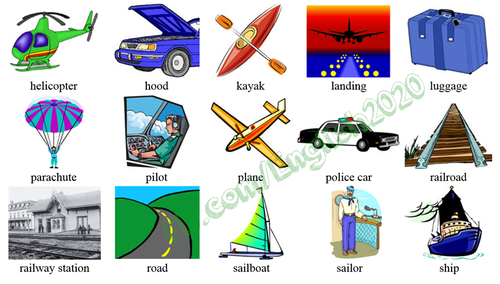
Present new words with the help of pictures on the screen
Exercise 1
A bus-автобус
A car-көлік
A trolleybus-тролейбус
A metro-метро
A taxi-такси
A bike-велосипед
A tram-трамвай
Listen and learn.
Strategy 4: Cluster
Exercise 2.
After listening the CD students make a cluster in two groups.

Exercise 3. Ask and answer.
Students ask questions within two groups.
Model:
The first group: How do you go to school?
The second group: I go to school by car.
Exercise 4. Learn to read. Present with the help of chart on the screen.
V Evaluation of students
Evaluate students with the help of Traffic light. Teacher names one student the rest show the colours of traffic light. Red-3, Yellow-4, Green-5.
VI Giving home task
Exercise 1 at page 52.
The End of the lesson.
Lesson Plan 3
Grade: 6 form
The theme of the lesson: Visiting big cities
Aims of the lesson:
-
To review the use and form of the Present Simple Tense, to learn adjectives describing cities, to introduce students with famous buildings and sightseeing of two cities (Astana and London);
-
To develop students critical thinking, comparing cities and to learn them to work in small groups;
-
To provide students cooperation, to develop their speaking skill and to learn them speak before the audience, to help them to overcome their hesitation when speaking;
The type of the lesson: New lesson
The kind of the lesson: Integrated lesson
Methods of teaching: Use of critical thinking strategies
Relation between subjects: Art, Geography
Visual aids: book, charts of strategies, pictures of Blob’s tree, interactive board, posters.
The procedure of the lesson
I Organization moment
II Warm up activity.
Strategy 1: Imitation
Students should stand in circle around the teacher. Students should imitate dancing through girls. The students will dance listening to music. This helps students’ fell good from the very beginning of the lesson.
III Checking up the home task.
Strategy 2: Author’s chair
Exercise 9, page-28. Write the description of these pictures.
Students will read the home task.
Strategy 3: Brainstorming
Students will be divided into two groups with the help of pictures which are cut into several parts.
Exercise 1. Look at the words in the box. Match a picture with a word.
The chart will be given on the screen.
-
factory
-
hills
-
bridge
-
field
-
woods
-
river
-
traffic lights
-
swimming pool
-
tram
-
cottage
-
statue
-
concert hall
IV Presentation of new material
Strategy 4: Venn diagrams
Exercise 2. Complete the chart.
TOWN BOTH COUNTRY
Strategy 5: Jigsaw reading
Exercise 7. New words are given.
Group A read the topic about Astana.
Group B read the topic about London.
Strategy 6: K-W-L chart
Exercise 11.
|
I knew |
I want to know |
I learned |
|
|
|
|
Exercise 12. Complete the sentences with the words from the texts. The exercise will be given on the screen. Students do it in their groups.
V Conclusion of the lesson
Strategy 7: Questioning
Exercise 8. Comprehension check
VI Evaluation of the students
Evaluate students with the help of Blob’s tree. Students will evaluate each other through analysing their participation in pair and in group work during the lesson.
VII Giving home task
Exercises 13, 5, at pages-30 and 31.
The End of the lesson.
III CONCLUSION
In the past decade, learning/teaching strategies have come into light for teachers to take into account in lesson plans. However, we need to be aware of specific critical thinking strategies if we declare our commitment to their developments when teaching anything, including foreign languages. Strategies related to critical thinking can be classified in two categories: cognitive strategies and affective strategies. By these we should understand the way we address issues in question. Critical thinking development can take place if students are given the task involving critical thinking strategies.
Critical thinking is knowingly hard and takes time to feel confident in it. If we think about consistent and continued development of critical thinking, we must understand it as a process. One lesson cannot be sufficient to achieve the complex purpose of developing critical thinking. Lessons, units, and a whole curriculum should include critical thinking objectives on a systematic basis, which creates continuity. Moving from traditional homework such as writing an exercise to more creative assignments like writing a paragraph which is focused on a critical thinking strategy can produce continuity in the teaching and learning of critical thinking.
In conclude, we state that transfer of knowledge typically from a teacher to a student may not require active learning. With a critical thinking objective in mind, this is not enough. By including a critical thinking objective, teachers are expected not only to plan a more inquisitive mode of learning new linguistic phenomena but also to engage their students’ in an interactive activity focused on various issues which can be of interest to a particular group of students like world events or problems of personal character. This can be done by relying on the students’ previous experience, by asking question for clarification in order to make the issue clearer, more accurate and precise, by comparing opinions, by identifying the underlying factors, etc. All this has an effect on the quality of arguments and thinking, thus becoming personal practice in using a foreign language and thinking critically at the same time.
Bibliography









 Бұл курс Қазақстан Республикасы Оқу-ағарту министрлігімен келісілген










