Lesson 12
|
|
Teacher’s
name:
|
D.K.Kalzhanova
M.K.Zhumadilova
K.B.Kalieva
G.K.Ormantaeva
K.B.Pusyrmanova
N.M.Kulbarakov
|
Date:
|
12.06.2026
|
Class:
|
Number
present:
|
Number
absent:
|
Theme of
the lesson
|
Camp Picnic
Day
|
Learning
objective (s)
|
understand
simple descriptions of people, actions, and objects with visual
support;
find specific information in different types of texts (postcards,
posters, flyers, messages, and notices: places, time, and
prices);
use
basic prepositions of time
|
Lesson
objectives
|
identify
means of transport practise
prepositions of time (in/on/at) introduce
the preposition by
|
Plan
|
Stages of
the lesson
|
Teacher’s
activities
|
Students’
activities
|
Assessment
|
Resources
|
Greeting
|
Greet
students; students respond to greeting and take their places.
Hello, boys and girls! How are you?
|
|
|
|
Warm-up
Presentation
Practice
Ending
the lesson
|
Discovery
activity.
Start
thinking. Answering questions.
|
Open
answers
|
Verbal
Assessment
|
https://games4esl.com/wp-content/uploads/Transportation-Flashcards.pdf
|
Activity1.Conveying
the meaning of new words
Have
Ss look at the pictures in the vocabulary section. Play the
recording a few times and have Ss point to the corresponding
pictures and repeat. Say
the words/phrase again in random order and have Ss point and
repeat
|
Key:
Means
of transport: plane, bus, train, ship
Phrase:
feed the animals
|
Oral
Assessment
|
Song
“What's This?”
|
Activity2.
Listen
and read. Then answer: What do you do every day in summer?
Ask
Ss if they have ever written and sent a postcard to somebody and
if they have ever sent a text message.
Read
the title and tell Ss a few things about Australia. Play the
recording, and ask Ss to point to the corresponding text as they
listen.
Detailed
reading. Answering questions.
Where
is Jim?
What
season is it?
What
does he do every day?
Where
does Tom want to go on Sunday? How
can they get there?
What
can you do at the zoo?
What
time does the zoo open?
Draw Ss'
attention to the question in the rubric
e.g. I
go to the beach and play with my friends every day in summer.
Grammar
Presentation: Prepositions
Draw
Ss’ attention to the prepositions: in
is used before the seasons of the year, on
is used before the days of the week and at
is used before time. Direct
Ss attention to the preposition by
and
guess
when is used. the preposition by is used to describe how we
travel.
Activity
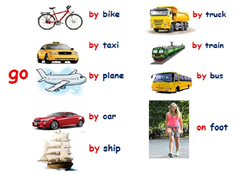
3. Look
at the picture and remember.
Я
еду на автобусе – I go by bus
Я
еду на поезде – I go by train
Я
лечу на самолете – I fly by plane
A
 ctivity
4. Listen
and tick (4) a or b.
Direct
Ss’ attention to the two posters and ask them to read through
them. Explain
to Ss that they are going to listen to a dialogue between a boy
and a girl about a new park in their town, and they have to tick
the poster which corresponds with what they hear. Play
the recording twice and have Ss do the activity.
Play
a guessing game.
S1
Choose one of the three zoos shown in the posters without
revealing it to his/ her partner. He/
She has to give SB information about the zoo, using the
information on the poster. SB has to try to guess which zoo his/
her partner has chosen. Then Ss swap roles.
Descriptor:
A
learner:
identifies
means of transport completes
sentences with right prepositions
of time (in/on/at)
gives
information by structure
|
Students
listen
and read, then answer
the questions:
What do you do
every
day in summer?.
KEY
1.In
Perth, Australia
2.
It’s summer.
3.
He goes to the beach.
4.
To the zoo.
5.
By train.
6.
Feed the animals and buy T-shirts with animals.
7.
At nine o’clock.
Students
guess and say.
Students
listen to a dialogue between a boy and a girl about a new park in
their town, and they have to tick
Answer:
a
Students
guess and say.
|
Self-Assessment
Peer
Assessment
Self-
Assessment
Peer
Assessment
Group
Assessment
|
Handouts
Worksheets
Textbook
Grammar
in Tables
Handouts
CD
Guessing
Game.
|
Feedback
|
K
 ey
Ideas:
|

|
|
|
Homework
|
WORKBOOK:
Activity 2 and 3
|
Additional
Information
|
Differentiation
- how do you plan to give more support? How do you plan to
challenge the more able learners?
|
Assessment
- how are you planning to check learners` learning?
|
Health
and safety check ICT links
|
More support
will be given to weaker learners by giving them a modified
worksheets in some tasks with greater support
|
-through
questioning and the redirecting of questioning in feedback
activities
-through
observation in group and end performance activities
-through
formative task
|
-White
board and video are used no more than 10 minutes
-Use
water-based pens
-Health
promoting techniques
-Breaks
and physical activities used.
-Points
from Safety rules used at this lesson.
|
REFLECTION
|
Answer the
most relevant questions to reflect on your lesson.
Were
the lesson objectives/learning objectives realistic?
What
did the learners learn? What did/didn’t you like? What was
difficult?
|

 ЖИ көмекші


 Қауіпсіз төлем













 Бұл курс Қазақстан Республикасы Оқу-ағарту министрлігімен келісілген










