
 ЖИ көмекші


 Қауіпсіз төлем

жүктеу мүмкіндігіне ие боласыз
Бұл материал сайт қолданушысы жариялаған. Материалдың ішінде жазылған барлық ақпаратқа жауапкершілікті жариялаған қолданушы жауап береді. Ұстаз тілегі тек ақпаратты таратуға қолдау көрсетеді. Егер материал сіздің авторлық құқығыңызды бұзған болса немесе басқа да себептермен сайттан өшіру керек деп ойласаңыз осында жазыңыз
 21 Қараша 2018
 409

1 жыл бойы шексіз жүктеңіз
Days of the week
|
Unit 3. Time |
School: 9 |
|||||
|
Date: 21.11.2018 |
Teacher name: Konysova Gulbakyt |
|||||
|
Grade: 3 |
Number present: |
absent: |
||||
|
Theme of the lesson: Days of the week 2 |
||||||
|
Learning objectives that this lesson is contributing to |
3.1.7.1 use contextual clues to predict content in short, supported talk on a limited range of general and some curricular topics; 3.2.2.1 ask questions to find out about present experiences on a limited range of general and some curricular topics; 3.2.6.1 take turns when speaking with others in a limited range of short, basic exchanges; 3.5.9.1 use common present simple forms [positive, negative, question] and contractions to talk about what you want and like, habits and facts, simple future timetabled events, use common past simple forms to describe actions and feelings
|
|||||
|
All learners will be able to: Learners will demonstrate usage of in and at with time phrases. Learners will answer personal questions related to time and when they do things. Learners will answer personal questions related their daily routine . |
||||||
|
Most learners will be able to: |
||||||
|
||||||
|
Assessment criteria |
Learners have met the learning objective (3.1.7.1 / 3.2. 2.1./3.2.6.1./3.5.9.1) if they can:
|
|||||
|
Value links |
Teamwork: Ls will work well together in their groups showing respect and being polite with each other. |
|||||
|
Cross - curricular links |
Math |
|||||
|
ICT skills |
Using SMART board, pictures and videos, |
|||||
|
Previous learning |
Days of the week 1 |
|||||
|
Plan |
||||||
|
Planned timings |
Planned activities |
Resources |
||||
|
Beginning 5 mins
|
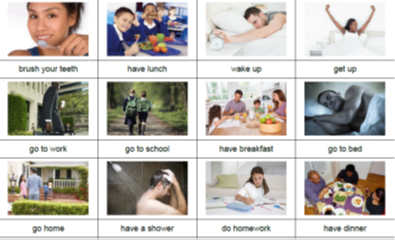
Greeting & Objectives Warm-up Project the first slide on the board and ask learners to guess the topic of the unit, describe what they see, name the activities.
The topic and Losare presented.
|
PPT
|
||||
|
Middle 30mins
|
Presentation Ls should highlight the words describing their daily routine. (P)Have Ls work in pairs and ask each other the words they do not know (dif: they may ask each other unfamiliar words.) Game “Find someone who”- 2 version In this version, students are allowed to ask one classmate one question (and follow-up questions-explanations) – and the answer, no matter ‘Yes’ or ‘No’, is written in the box. After a mutual interview exchange, students can move on to find another classmate to speak with. (WCF)
-Every day you wake up in the morning, so does Mr Bean. Let’swatch the video. Remember his activities. Have a general discussion with the whole class about the activities Mr Bean did that morning, encourage Ls to use the active vocabulary. (DIFFERENTIATION: more- able learners do more complex sentences and help less-able ones to choose the words and make sent-s) Pre-reading Ask Ls the question:What is your favorite time of the day? Why? While- reading Lsput the given words in the gaps individually, compare in pairs the results. (WCF)
Post- reading Discuss the criteria with Ls for completion of the tasks. Task 1 Match the words on the left with the meanings on the right. Task 2 Write ‘T’ (True) or ‘F’ (False) next to each statement.
Notes about daily routine: Write notes about your own daily routine, from the time you usually wake up in the morning until you fall asleep at night (or interview and make notes about a classmate).
|
DIDACTIC MATERIAL 1
|
||||
|
End 5 mins |
Reflection
|
|
||||
|
Additional information |
||||||
|
Differentiation – how do you plan to give more support? How do you plan to challenge the more able learners? |
Assessment – how are you planning to check learners’ learning? |
|||||
|
Less able students – greater support by means of prompts, visuals or writing difficult words on the board More able students – independent work on definite tasks with little/no support Allow for flexible groupings and cooperative learning, depending on the appropriateness to the task Allow for extra time for students needing it, when appropriate Give extra text or visual support to students needing extra English support Create small learning groups for students needing extra support or enrichment with the co-teacher, when appropriate |
through observation |
|||||
|
Reflection Were the lesson objectives/learning objectives realistic? What did the learners learn today? What was the learning atmosphere like? Did my planned differentiation work well? Did I stick to timings? What changes did I make from my plan and why? |
||||||
|
Summary evaluation What two things went really well (consider both teaching and learning)? 1: 2: What two things would have improved the lesson (consider both teaching and learning)? 1: 2: What have I learned from this lesson about the class or individuals that will inform my next lesson?
|
||||||









 Бұл курс Қазақстан Республикасы Оқу-ағарту министрлігімен келісілген










