Schools and Education:
Teachers and Learners
Around the Globe in the
Middle Ages
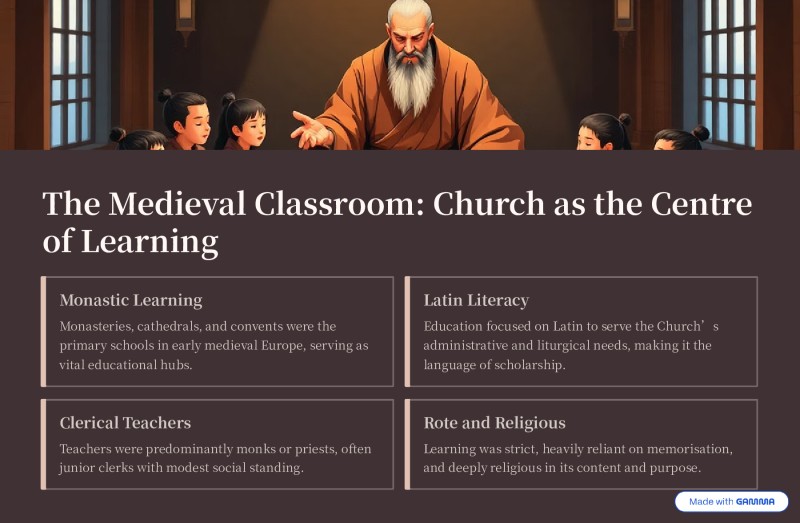
The Medieval Classroom: Church as the Centre
of Learning
Monastic Learning
Monasteries, cathedrals, and convents were the
primary schools in early medieval Europe, serving as
vital educational hubs.
Latin Literacy
Education focused on Latin to serve the Church9s
administrative and liturgical needs, making it the
language of scholarship.
Clerical Teachers
Teachers were predominantly monks or priests, often
junior clerks with modest social standing.
Rote and Religious
Learning was strict, heavily reliant on memorisation,
and deeply religious in its content and purpose.

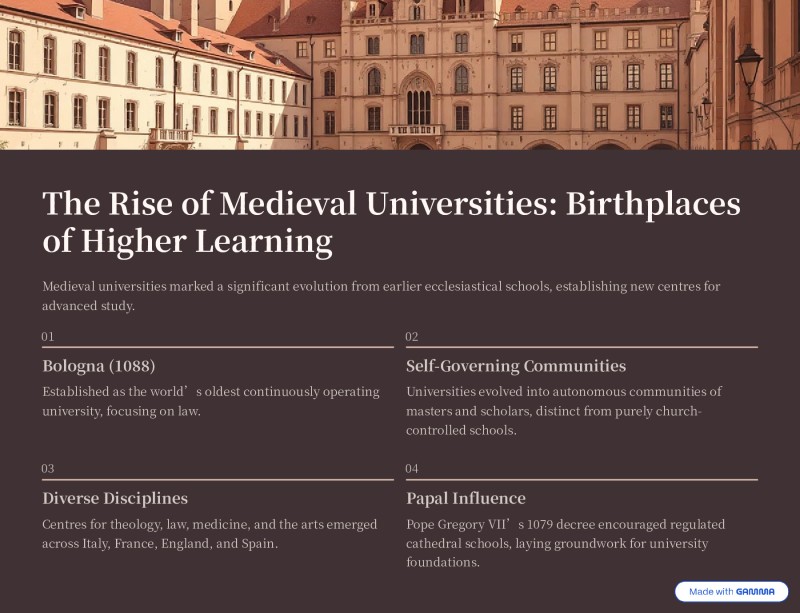
The Rise of Medieval Universities: Birthplaces
of Higher Learning
Medieval universities marked a significant evolution from earlier ecclesiastical schools, establishing new centres for
advanced study.
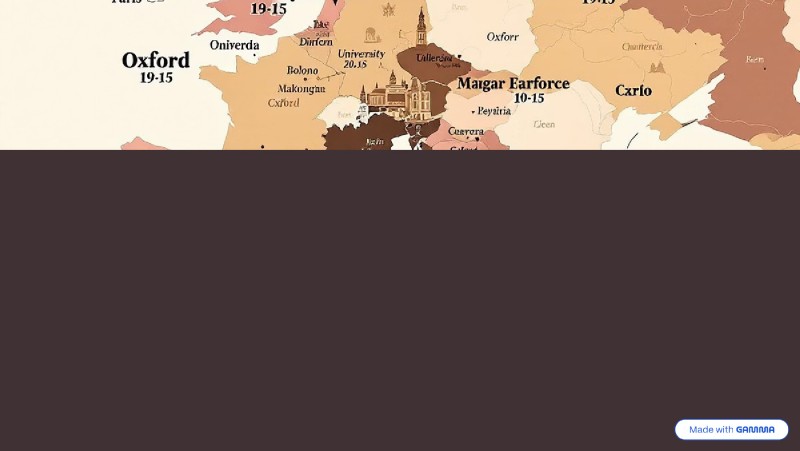
Bologna ( )
Established as the world9s oldest continuously operating
university, focusing on law.
Self-Governing Communities
Universities evolved into autonomous communities of
masters and scholars, distinct from purely church-
controlled schools.
Diverse Disciplines
Centres for theology, law, medicine, and the arts emerged
across Italy, France, England, and Spain.
Papal Influence
Pope Gregory VII9s decree encouraged regulated
cathedral schools, laying groundwork for university
foundations.
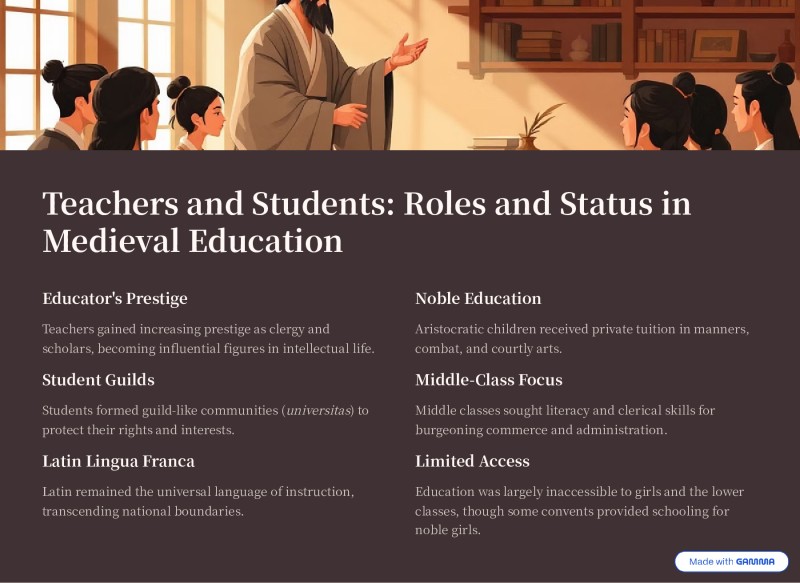
Teachers and Students: Roles and Status in
Medieval Education
Educator's Prestige
Teachers gained increasing prestige as clergy and
scholars, becoming influential figures in intellectual life.
Student Guilds
Students formed guild-like communities (universitas) to
protect their rights and interests.
Latin Lingua Franca
Latin remained the universal language of instruction,
transcending national boundaries.
Noble Education
Aristocratic children received private tuition in manners,
combat, and courtly arts.
Middle-Class Focus
Middle classes sought literacy and clerical skills for
burgeoning commerce and administration.
Limited Access
Education was largely inaccessible to girls and the lower
classes, though some convents provided schooling for
noble girls.
Curriculum and Pedagogy: From Rote
Learning to Early Reform
Oi
The Seven Liberal Arts
Curriculum centred on the trivium (grammar, rhetoric,
logic) and quadrivium (arithmetic, geometry, music,
astronomy).
Oj
Authoritarian Methods
Teaching was highly authoritarian, emphasising
memorisation over critical thinking, often detached
from practical application.
Ok
Comenius's Critique
Jan Amos Comenius (post-medieval) condemned old
schools as "slaughterhouses of the mind," advocating
child-centred and graded learning.
Ol
Foundation for Future
Despite limitations, medieval education laid critical
groundwork for later humanist and universal
education ideals.
Education Beyond Europe:
Islamic Madrasahs and
Cross-Cultural Influences
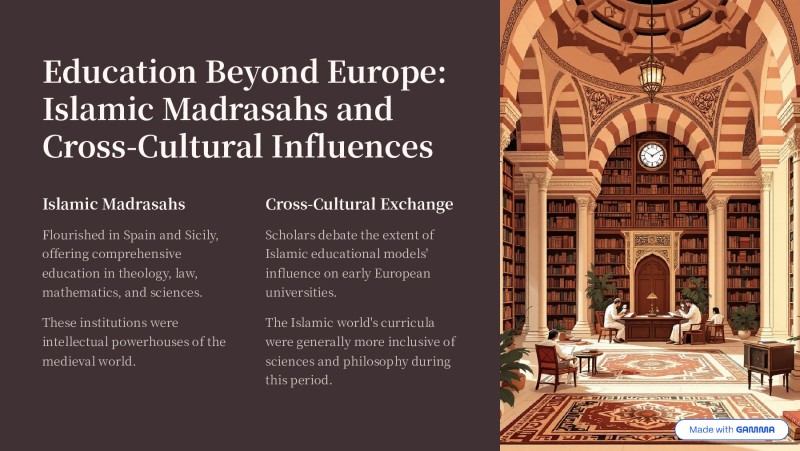
Islamic Madrasahs
Flourished in Spain and Sicily,
offering comprehensive
education in theology, law,
mathematics, and sciences.
These institutions were
intellectual powerhouses of the
medieval world.
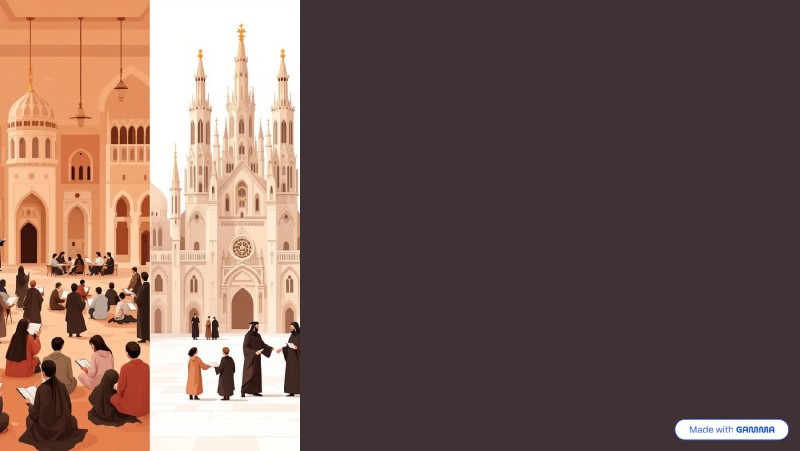
Cross-Cultural Exchange
Scholars debate the extent of
Islamic educational models'
influence on early European
universities.
The Islamic world's curricula
were generally more inclusive of
sciences and philosophy during
this period.
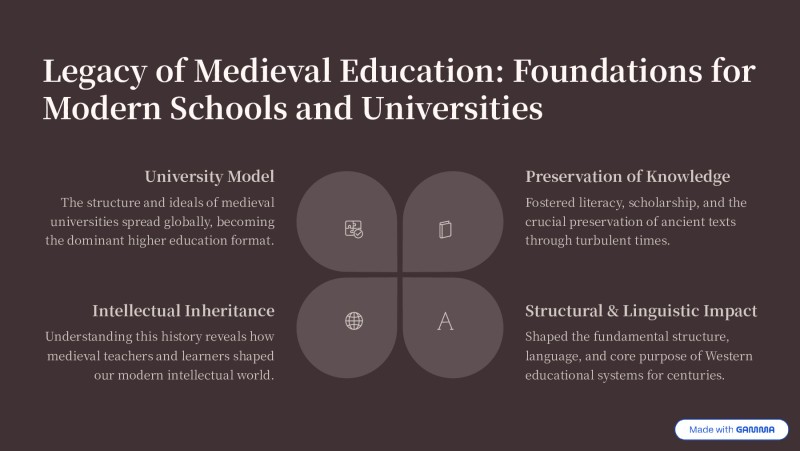
Legacy of Medieval Education: Foundations for
Modern Schools and Universities
University Model
The structure and ideals of medieval
universities spread globally, becoming
the dominant higher education format.
Preservation of Knowledge
Fostered literacy, scholarship, and the
crucial preservation of ancient texts
through turbulent times.
Structural & Linguistic Impact
Shaped the fundamental structure,
language, and core purpose of Western
educational systems for centuries.
Intellectual Inheritance
Understanding this history reveals how
medieval teachers and learners shaped
our modern intellectual world.

 ЖИ көмекші


 Қауіпсіз төлем













 Бұл курс Қазақстан Республикасы Оқу-ағарту министрлігімен келісілген










