
 ЖИ көмекші


 Қауіпсіз төлем

жүктеу мүмкіндігіне ие боласыз
Бұл материал сайт қолданушысы жариялаған. Материалдың ішінде жазылған барлық ақпаратқа жауапкершілікті жариялаған қолданушы жауап береді. Ұстаз тілегі тек ақпаратты таратуға қолдау көрсетеді. Егер материал сіздің авторлық құқығыңызды бұзған болса немесе басқа да себептермен сайттан өшіру керек деп ойласаңыз осында жазыңыз
 03 Мамыр 2020
 676

1 жыл бойы шексіз жүктеңіз
Электрондық конфиругатция/ Electron configuration
Қысқа мерзімді жоспар
Пән: химия Subject: chemistry |
Өткізілетін орын: ЖОМ №56 Location: shoole №56 |
Мұғалімі: Оралбекова К.Т. Тhecher: Oralbekova K.T. |
||||||
Сабақ № Lesson №20 |
Мерзімі: Date: |
Класс: 8 Class: 8 |
||||||
Оқушылар саны: Amount: |
Қатысқан: Present: |
Қатыспаған: Absent: |
||||||
Тарау 8.0 Chapter 8.0 |
PERIODIC TABLE OF CHEMICAL ELEMENTS |
|||||||
Сабақ тақырыбы: Lesson theme: |
ELECTRON CONFIGURATION |
|||||||
Сабақ мақсаты: The purpose of the lesson: |
write the electron configuration for elements; predict the properties of elements just by the use of PT; know which atoms are the most stable and group names; know shapes of s- and p-orbitals. |
|||||||
Тілдік мақсат: Language objectives:
Жаңа сөздер мен сөз тіркестер New words and phrases
|
Пәндік лексика және терминология: Subject vocabulary and terminology:
Диалог үшін пайдалы сөз тіркестер: Phrase for dialogue: The electron configuration…….. We know that the elements are ……. |
|||||||
Пәні бойынша күтілетін нәтижелер: Expected results on the subject: |
Why are 18 group elements called “Noble gases”? |
|||||||
Тілінде күтілетін нәтижелер: Expected results by language: |
Aғылшынша тақырыпқа байланысты терминдерді үйрену. Memories terminology in English. |
|||||||
Қажетті жабдық мен құрылғы: Necessary equipment and devices: |
|
|||||||
Қосымша ресурстар: Additional resources: |
Periodic Table |
|||||||
Сабақ барысы/ During the classes |
||||||||
Сабақ кезеңдері Lesson Stage Сәлемдесу Welcome
|
Тапсырмалар мен жаттығулар Tasks and Exercises Good afternoon dear children! I’m very glad to see you! How are you today? What date is it today? Who is duty today? Who is absent today? Write the date on the board, please. |
Ескер-тулер Notes |
||||||
Жаңа сөздер мен сөз тіркестер New words and phrases
Оқу стратегияcы: Reading strategies:
Тыңдау дағдыларын дамыту стратегиясы: Strategies for developing listening skills:
Сөйлеуді дамыту стратегиясы: Strategies for the development of oral speech:
Жазбаша тапсырмалар: Written assignments:
|
Оқушылардың алдыңғы білімдерін белсендіру: Activating previous knowledge of students: Алдыңғы сабақта не өттік? - What did we learn on the previous lesson? Let’s remember …(есімізге түсірейік) Structure of periodic table Негізгі мазмұнына жаңа материалды ұсыну Submission of new material on the subject content Today our topic is (Lesson topic is) …………. Let’s divide into groups (топқа бөлінейік)
I want you to open your copybooks and write down the date and lesson topic is “Electron configuration”. Today’s lesson is going to focus on 10 elements . We’ll start with look at the Periodic table , which describe elements, we’ll finish check your knowledge on electron configuration. 1. I want you to work together with your friend (Work in pairs). 2. I want you to read text and translation.
Electron configuration We know that the elements are arranged in the order of increasing atomic numbers. In a neutral atom atomic number is egual to a number of electrons. All electrons are distributed among the shells and subshells. The electron configuration repserents the way as they arranged. Their unigue electron configurations can explain the physical and chemical properties of elements. The valence electrons are the determining factor for the special properties of the element. The electron configuration simply is an order of orbitals which hold electrons. There are four orbitals: s-, p-, d-, f-orbitals. Each orbital can contain a different number of electrons. For example, s-orbital can hold 2 electrons, p-orbitals 6 electrons, d- orbitals 10 electrons and f-orbitals can hold 14 electrons. 1s2, 2s2, 2p6, 3s2, 3p6, 4s2, 3d10, 4p6, 5s2,4d10, 5p6, 6s2, 4f14, 5d10, 6p6, 7s2, 5f14, 6d10, 7p6 …. Біз периодтық кестеде элементтер атомдық нөмірлерінің өсуі бойынша орналасатынын білеміз. Бейтарап элементтің атомдық нөмірі, оның сыртындағы электрондар санына тең. Барлық электрондар атомның деңгейлері мен деңгейшелерінде орналасады. Электрондарды белгілі бір ретпен ережеге сәйкес орналастыру электрондық конфигурация деп аталады. Элементтердің физикалық және химиялық қасиеттерін олардың электрондық конфигурацияларымен түсіндіруге болады. Элементтердің кейбір қасиеттері валенттік электрондармен де түсіндіріледі. Электрондық конфигурация - электрондар орналасқан орбитальдардың қарапайым қатары. Электрондар орналасатын жалпы орбитальдар саны төртеу: s-,p-, d-, fорбитальдар. Әрбір орбитальда электрон саны даәр түрлі болады. Мысалы, s-орбитальда 2, p-орбитальдa 6, d-орбитальда 10, f-орбитальда 14 электроннан болады. 1s2, 2s2, 2p6, 3s2, 3p6, 4s2, 3d10, 4p6, 5s2, 4d10, 5p6, 6s2, 4f14, 5d10, 6p6, 7s2, 5f14, 6d10, 7p6 ….
The electron configurations for first 10 elements are shown in the table below. Here is the order of filling electrons in shells: s- orbital 2 e, p- orbital 6 e, d orbital 10 e, f orbital 14 e
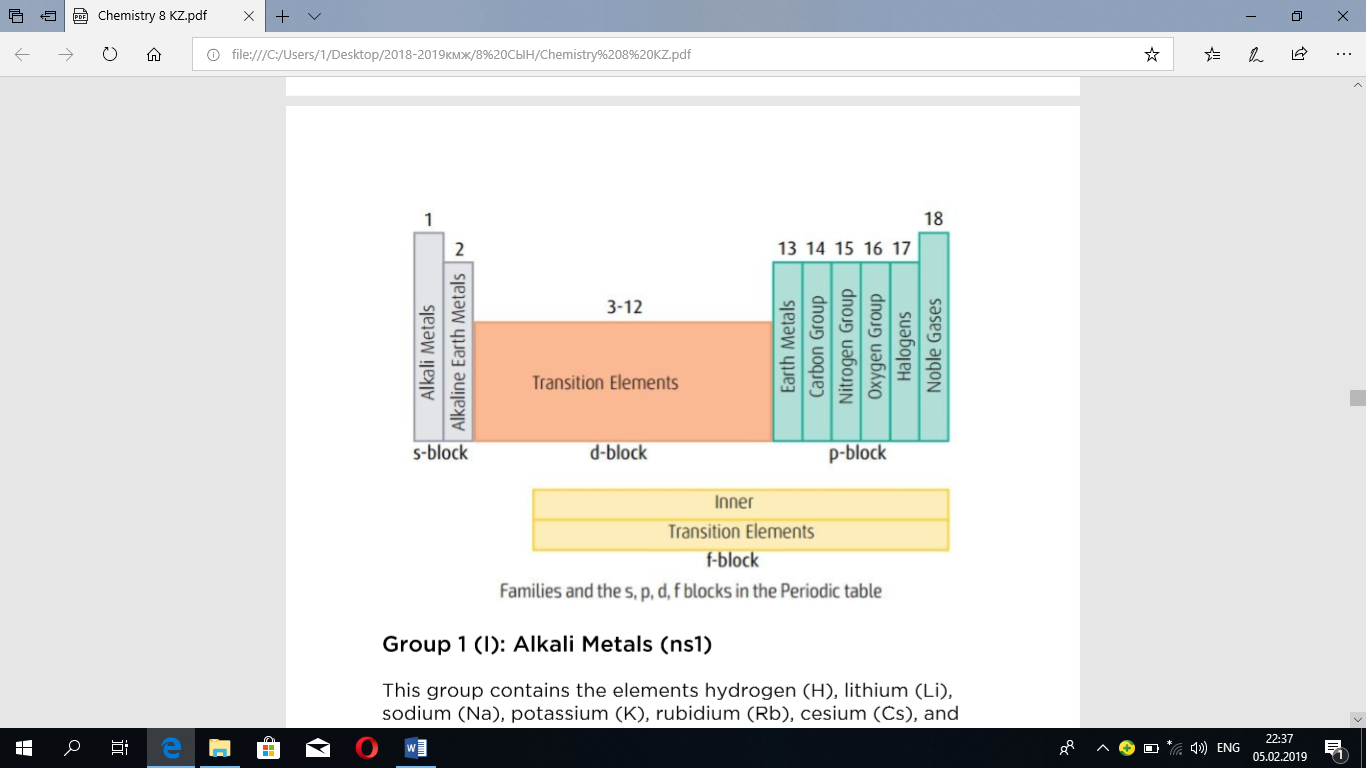
Group 1 (I): Alkali Metals (ns1) This group contains the elements hydrogen (H), lithium (Li), sodium (Na), potassium (K), rubidium (Rb), cesium (Cs), and francium (Fr). Although hydrogen is a nonmetal, it is placed in this group because of its Science in context Alkali metals and halogens are the most active metals and nonmetals respectively. That is why they are not found in elemental form in nature. Science in context Iodine and its compounds are primarily used in medicine, photography and dyes.
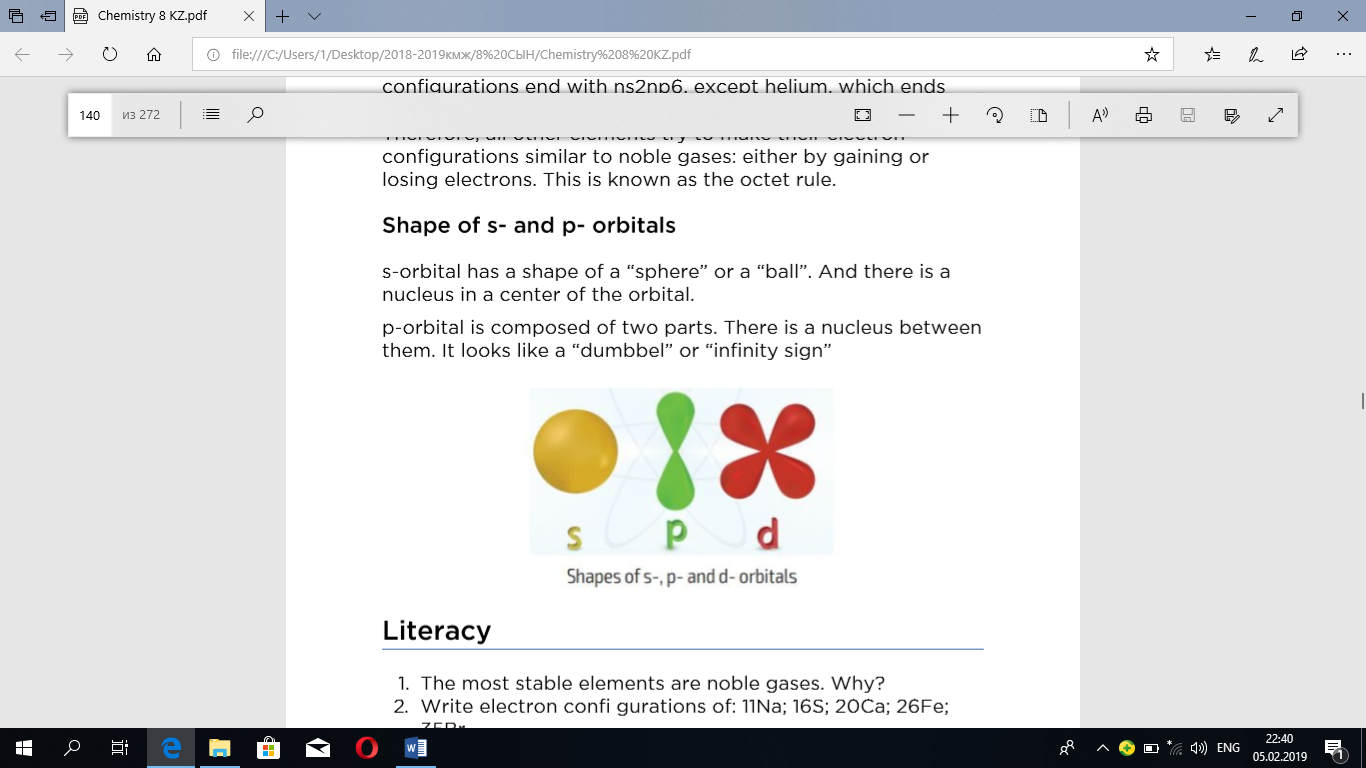
electron configuration, 1s1. Alkali metals are chemically the most active metals. Group 17 (VII): Halogens (ns2np5) This group contains the elements fl uorine (F), chlorine (Cl), bromine (Br), iodine (I) and astatine (At). These elements occur naturally in a diatomic structure (F2, Cl2, Br2, I2, At2). Fluorine and chlorine are gases, bromine is a liquid and iodine is a solid. Astatine is a radioactive and solid element. Halogens are the most active nonmetals. Group 18 (VIII): Noble Gases (ns2np6) Since they do not tend to react chemically, the elements of this group are called noble gases, or inert gases. All noble gases are colourless, odourless and water-insoluble. Their electron configurations end with s-orbital has a shape of a “sphere” or a “ball”. And there is a nucleus in a center of the orbital. p-orbital is composed of two parts. There is a nucleus between them. It looks like a “dumbbel” or th ns2np6, except helium, which ends with ns2. They are the most stable elements in nature. Therefore, all other elements try to make their electron configurations similar to noble gases: either by gaining or losing electrons. This is known as the octet rule. Shape of s- and p- orbitals “infinity sign”
Literacy 1. The most stable elements are noble gases. Why? 2. Write electron confi gurations of: 11Na; 16S; 20Ca; 26Fe; 35Br 3. Define the element with electron configurations: 1s22s22p63s23p64s23d104p5 1s22s22p63s23p64s23d7 1s22s22p63s23p64s23d104p65s1 Қорытынды жасайық - Let’s make conclusion … - Тақырып бойынша сұрақтарыңыз бар ма? - Have you got any questions on topic? Wride down homework: Periodic table Reflection /Рефлексия Reflection for the 2nd quarter The most difficult topic for me was ………………………… The easiest topic for me,was …………………………… Rate yourself on 10-points scale 1. I can help others ………. 2. I need more practice …………… 3. I need extra lessons ……………
|
|
||||||










 Бұл курс Қазақстан Республикасы Оқу-ағарту министрлігімен келісілген










