
 ЖИ көмекші


 Қауіпсіз төлем

жүктеу мүмкіндігіне ие боласыз
Бұл материал сайт қолданушысы жариялаған. Материалдың ішінде жазылған барлық ақпаратқа жауапкершілікті жариялаған қолданушы жауап береді. Ұстаз тілегі тек ақпаратты таратуға қолдау көрсетеді. Егер материал сіздің авторлық құқығыңызды бұзған болса немесе басқа да себептермен сайттан өшіру керек деп ойласаңыз осында жазыңыз
 08 Қырқүйек 2026
 51
51
1 жыл бойы шексіз жүктеңіз
English plus-7 grade (Have got)there’s and there are
Short term plan
Unit 1: Family and school lesson 6 |
School: |
||
Date: |
Teacher name: Nauryzbayeva Zhuldyz |
||
Grade: 7 |
Number present: |
absent: |
|
Lesson title |
Vocabulary band and language focus: have got, there is, there are. |
||
Learning objectives |
7.6.6.1 use have got and has got to talk about possessions on a growing range of familiar general and curricular topics; 7.6.6.1 use there is / there are to talk about places of objects on a growing range of familiar general and curricular topics.
|
||
Learning objectives (assessment criteria) |
Learners will be able to identify and use vocabulary related to school subjects, places and schoolwork; use combinations of nouns correctly (e.g. science laboratory, maths homework, English class); use “have got” in affirmative, negative and interrogative sentences to talk about schoolwork and school facilities; use “there is / there are” correctly in affirmative, negative and question forms; ask and answer questions about school and schoolwork using the target vocabulary and grammar; participate in short pair-work conversations about their school. |
||
Levels of thinking skills |
Knowledge and comprehension |
||
Stages/ Time |
Teachers actions |
Students actions |
Assessment |
Resources |
Beginning 5 min |
Greeting. (Whale class, Individually) Teacher greets the learners and creates a positive atmosphere. Warm-up: Near-far-catch up or “What subject is it?” Teacher shows the learners pictures connected with school subjects and schoolwork. Teacher asks:
Teacher writes several words on the board: science, maths, Russian, music, PE, ICT Teacher asks learners to guess the topic of the lesson. Setting the aim of the lesson. Teacher introduces the lesson objectives and explains that learners will learn vocabulary about school and practise have got, there is and there are.
|
Learners look at the pictures and answer the teacher’s questions. Learners name school subjects and school-related objects. Learners guess the topic of the lesson and share their ideas.
|
Teacher controles the process, gives feedback and asks additional questions if it’s nessasery. Teacher evaluate pupils with phrases like: “Good job! Well done!”
Formative Assessment
|
Sheets of peppers Pictures of to be
https://images.app.goo.gl/hpDAV6WVXwFDaRGo7
|
Middle 30 min |
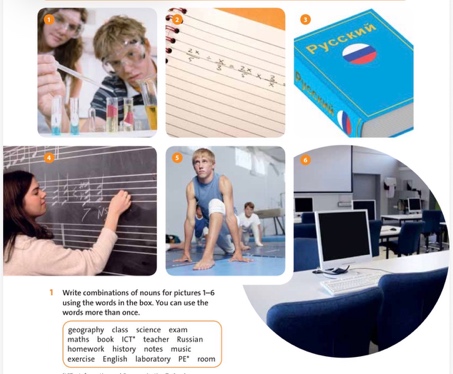
Task I – Vocabulary Ex. 1, p. 6 Teacher directs learners’ attention to pictures 1–6. Then, asks learners to identify what they can see in each picture.Teacher explains the task:“Write combinations of nouns for pictures 1–6 using the words in the box. You can use the words more than once.” Words in the box:
g Teacher checks the answers with the whole class.
|
Learners look at the pictures and make noun combinations. Possible answers:
Learners compare their answers with a partner.
|
T’s feedback Descriptor: identify the objects and subjects in the pictures; make correct noun combinations. |
Student’s book p.6, pictures and board.
|
|
Task. II Choose the correct words Ex. 2, p. 6Teachers actions Teacher asks learners to read the sentences and choose the correct word.
Teacher checks answers together with the class. |
Learners read the sentences and choose the correct words. Answers:
Learners compare their answers with a partner.
|
Pair -assessment
Descriptor: - read the sentences; choose the correct vocabulary. Total: 2 points
|
Worksheets PPP |
|
Task. III Talking about schoolworkEx. 3, p. 6 Teachers actions Teacher asks learners to study the key phrases. Key phrases – Talking about schoolwork:
Teacher models the dialogue:
A: Have
we got science homework today? Teacher asks learners to work in pairs and make their own short dialogues using the key phrases.
|
Learners read and repeat the key phrases. Learners work in pairs. They ask and answer questions about schoolwork. Example:
A: Have
we got maths homework today?
A: Who’s
your ICT teacher?
|
Self assessment Descriptor: - ask a question using the key phrase; answer appropriately; use school vocabulary correctly. Total: 2 points
|
|
|
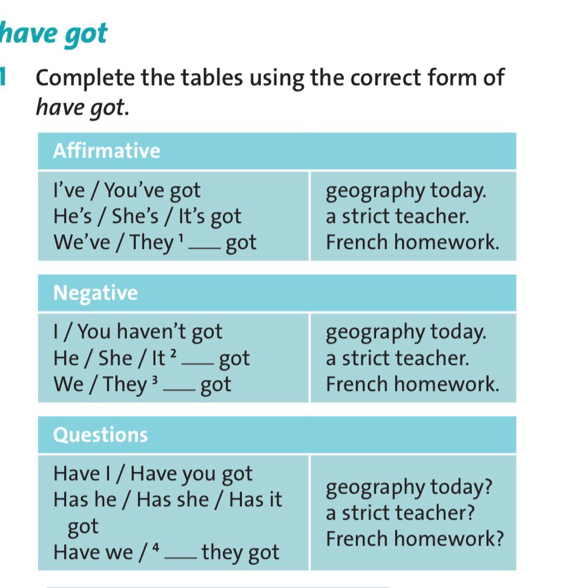
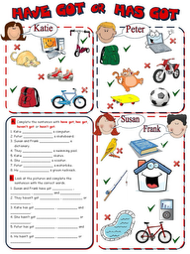
Task IV – Grammar: Have gotEx. 1–3, p. 7 Teachers actions: Teacher introduces the grammar topic have got. Teacher explains the affirmative, negative and question forms.
|
Learners complete the grammar table. Learners put the words in the correct order. Learners write questions using have got. Examples:
Learners ask and answer questions with a partner. |
|
|
|
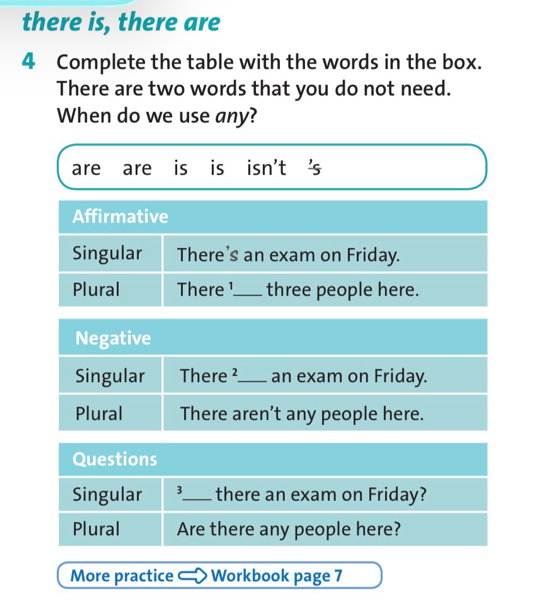
Task V – Grammar: There is / There areEx. 4–5, p. 7 Teacher explains the difference between:
There
is –
singular Teacher gives examples:
Teacher asks learners to complete Exercise 4.
T
|
Learners complete the table. Learners choose the correct forms of there is / there are. Learners complete the sentences. Possible answers: There is a teacher in the geography class. There aren’t any teachers.There are two new people in this class.There is some maths homework today.There is a science laboratory next to this room. |
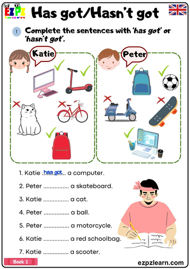
Descriptor: - use have got / has got correctly; form affirmative and negative sentences; form questions correctly Total: 2 point |
|
End 5 min |
The Ladder method was used as a reflection. T asks Ss to stick their stickers to the Success Ladder. Green- I understood Yellow-I have some questions Red-I need a help. Ex: Workbook:Unit 1, Vocabulary and Grammar band. Home task |
Ss use their stickers to show their knowledge according to the lesson
|
Poster Success Ladder |
|











 Бұл курс Қазақстан Республикасы Оқу-ағарту министрлігімен келісілген










