
 ЖИ көмекші


 Қауіпсіз төлем

жүктеу мүмкіндігіне ие боласыз
Бұл материал сайт қолданушысы жариялаған. Материалдың ішінде жазылған барлық ақпаратқа жауапкершілікті жариялаған қолданушы жауап береді. Ұстаз тілегі тек ақпаратты таратуға қолдау көрсетеді. Егер материал сіздің авторлық құқығыңызды бұзған болса немесе басқа да себептермен сайттан өшіру керек деп ойласаңыз осында жазыңыз
 05 Наурыз 2020
 647

1 жыл бойы шексіз жүктеңіз
Эссе Halloween
Тнркістан облысы, Қазығұрт ауданы, Шәмші Қалдаяқов атындағы жалпы орта білім беретін мектептің ағылшын тілі пәні мұғалімі Дауеева Жұлдызай.
Halloween
Halloween activities include trick-or-treating (or the related guising), attending Halloween costume parties, decorating, carving pumpkins into jack-o'-lanterns, lighting bonfires, apple bobbing and divination games, playing pranks, visitinghaunted attractions, telling scary stories and watching horror films. In many parts of the world, the Christian religious observances of All Hallows' Eve, including attending church services and lighting candles on the graves of the dead, remain popular,although elsewhere it is a more commercial and secular celebration. Some Christians historically abstained from meat on All Hallows' Eve, a tradition reflected in the eating of certain foods on this vigilday, including apples, colcannon, potato pancakes and soul cakes
Trick-or-treating and guising
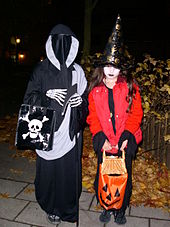
Trick-or-treaters in Sweden
Trick-or-treating is a customary celebration for children on Halloween. Children go in costume from house to house, asking for treats such as candy or sometimes money, with the question, "Trick or treat?" The word "trick" refers to "threat" to perform mischief on the homeowners or their property if no treat is given.The practice is said to have roots in the medieval practice of mumming, which is closely related to souling John Pymm writes that "many of the feast days associated with the presentation of mumming plays were celebrated by the Christian Church. These feast days included All Hallows' Eve, Christmas, Twelfth Night and Shrove Tuesday. Mumming, practiced in Germany, Scandinavia and other parts of Europe, involved masked persons in fancy dress who "paraded the streets and entered houses to dance or play dice in silence.
In England, from the medieval period, up until the 1930s, people practiced the Christian custom of souling on Halloween, which involved groups of soulers, both Protestant and Catholic, going from parish to parish, begging the rich for soul cakes, in exchange for praying for the souls of the givers and their friends. In Scotland and Ireland, guising – children disguised in costume going from door to door for food or coins – is a traditional Halloween custom, and is recorded in Scotland at Halloween in 1895 where masqueraders in disguise carrying lanterns made out of scooped out turnips, visit homes to be rewarded with cakes, fruit and money. The practice of guising at Halloween in North America is first recorded in 1911, where a newspaper in Kingston, Ontario reported children going "guising" around the neighborhood
Games and other activities
There are several games traditionally associated with Halloween parties. One common game is dunking or apple bobbing, which may be called "dooking" in Scotlandin which apples float in a tub or a large basin of water and the participants must use their teeth to remove an apple from the basin. The practice is thought by some to have derived from the Roman practices in celebration of Pomona.A variant of dunking involves kneeling on a chair, holding a fork between the teeth and trying to drive the fork into an apple. Another common game involves hanging up treacle or syrup-coated scones by strings; these must be eaten without using hands while they remain attached to the string, an activity that inevitably leads to a very sticky face.
Some games traditionally played at Halloween are forms of divination. In All Hallows' Eve celebrations during the Middle Ages, these activities historically occurred only in rural areas of medieval Europe and were only done by a "rare few" as these were considered to be "deadly serious" practices.A traditional Scottish form of divining one's future spouse is to carve an apple in one long strip, then toss the peel over one's shoulder. The peel is believed to land in the shape of the first letter of the future spouse's name.Unmarried women were told that if they sat in a darkened room and gazed into a mirror on Halloween night, the face of their future husband would appear in the mirror.However, if they were destined to die before marriage, a skull would appear. The custom was widespread enough to be commemorated on greeting cardsfrom the late 19th century and early 20th century.
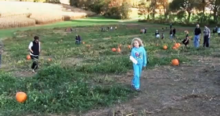
A common custom includes picking and purchasing pumpkins from patches
Another game/superstition that was enjoyed in the early 1900s involved walnut shells. People would write fortunes in milk on white paper. After drying, the paper was folded and placed in walnut shells. When the shell was warmed, milk would turn brown therefore the writing would appear on what looked like blank paper. Folks would also play fortune teller. In order to play this game, symbols were cut out of paper and placed on a platter. Someone would enter a dark room and was ordered to put her hand on a piece of ice then lay it on a platter. Her "fortune" would stick to the hand. Paper symbols included: dollar sign-wealth, button-bachelorhood, thimble-spinsterhood, clothespin- poverty, rice-wedding, umbrella- journey, caldron-trouble, 4-leaf clover- good luck, penny-fortune, ring-early marriage, and key-fame.
The telling of ghost stories and viewing of horror films are common fixtures of Halloween parties. Episodes of television series and Hallowe'en-themed specials (with the specials usually aimed at children) are commonly aired on or before Halloween, while new horror films are often released theatrically before Halloween to take advantage of the atmosphere.
Food
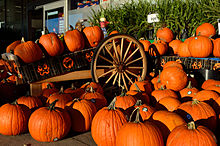
Pumpkins for sale during Halloween
On All Hallows' Eve, many Western Christian denominations encourage abstinence from meat, giving rise to a variety of vegetarian foods associated with this day.
Because in the Northern Hemisphere Halloween comes in the wake of the yearly apple harvest, candy apples (known as toffee apples outside North America), caramel or taffy apples are common Halloween treats made by rolling whole apples in a sticky sugar syrup, sometimes followed by rolling them in nuts.
At one time, candy apples were commonly given to trick-or-treating children, but the practice rapidly waned in the wake of widespread rumors that some individuals were embedding items like pins and razor blades in the apples in the United States. While there is evidence of such incidents relative to the degree of reporting of such cases, actual cases involving malicious acts are extremely rare and have never resulted in serious injury. Nonetheless, many parents assumed that such heinous practices were rampant because of the mass media. At the peak of the hysteria, some hospitals offered free X-rays of children's Halloween hauls in order to find evidence of tampering. Virtually all of the few known candy poisoning incidents involved parents who poisoned their own children's candy.
One custom that persists in modern-day Ireland is the baking (or more often nowadays, the purchase) of a barmbrack (Irish: báirín breac), which is a light fruitcake, into which a plain ring, a coin and other charms are placed before baking. It is said that those who get a ring will find their true love in the ensuing year. This is similar to the tradition of king cake at the festival of Epiphany.
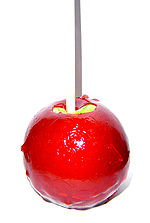
List of foods associated with Halloween:
Candy apples/toffee apples (Great Britain and Ireland)
Candy apples, Candy corn, candy pumpkins (North America)
Monkey nuts (peanuts in their shells) (Scotland and Ireland)
Novelty candy shaped like skulls, pumpkins, bats, worms, etc.
Pumpkin, pumpkinpie, pumpkinbread
Roasted pumpkinseeds
Roasted sweetcorn
Пайдаланылған әдебиеттер:
Diane C. Arkins, Halloween: Romantic Art and Customs of Yesteryear, Pelican Publishing Company (2000). 96 pages. ISBN 1-56554-712-8
Diane C. Arkins, Halloween Merrymaking: An Illustrated Celebration Of Fun, Food, And Frolics From Halloweens Past, Pelican Publishing Company (2004). 112 pages. ISBN 1-58980-113-X
Lesley Bannatyne, Halloween: An American Holiday, An American History, Facts on File (1990, Pelican Publishing Company, 1998). 180 pages. ISBN 1-56554-346-7
Lesley Bannatyne, A Halloween Reader. Stories, Poems and Plays from Halloweens Past, Pelican Publishing Company (2004). 272 pages. ISBN 1-58980-176-8
Phyllis Galembo, Dressed for Thrills: 100 Years of Halloween Costumes and Masquerade,Harry N. Abrams, Inc. (2002). 128 pages. ISBN 0-8109-3291-1
Editha Hörandner (ed.), Halloween in der Steiermark und anderswo, Volkskunde (Münster in Westfalen), LIT Verlag Münster (2005). 308 pages. ISBN 3-8258-8889-4
Lisa Morton, The Halloween Encyclopedia, McFarland & Company (2003). 240 pages. ISBN 0-7864-1524-X
Nicholas Rogers, Halloween: From Pagan Ritual to Party Night, Oxford University Press, USA (2002). ISBN 0-19-514691-3
Jack Santino (ed.), Halloween and Other Festivals of Death and Life, University of Tennessee Press (1994). 280 pages. ISBN 0-87049-813-4
David J. Skal, Death Makes a Holiday: A Cultural History of Halloween, Bloomsbury USA(2003). 224 pages. ISBN 1-58234-305-5
James Tipper, Gods of The Nowhere: A Novel of Halloween, Waxlight Press (2013). 294









 Бұл курс Қазақстан Республикасы Оқу-ағарту министрлігімен келісілген










