
 ЖИ көмекші


 Қауіпсіз төлем

жүктеу мүмкіндігіне ие боласыз
Бұл материал сайт қолданушысы жариялаған. Материалдың ішінде жазылған барлық ақпаратқа жауапкершілікті жариялаған қолданушы жауап береді. Ұстаз тілегі тек ақпаратты таратуға қолдау көрсетеді. Егер материал сіздің авторлық құқығыңызды бұзған болса немесе басқа да себептермен сайттан өшіру керек деп ойласаңыз осында жазыңыз
 02 Қырқүйек 2026
 93

1 жыл бойы шексіз жүктеңіз
Everyday English: Asking for and giving information
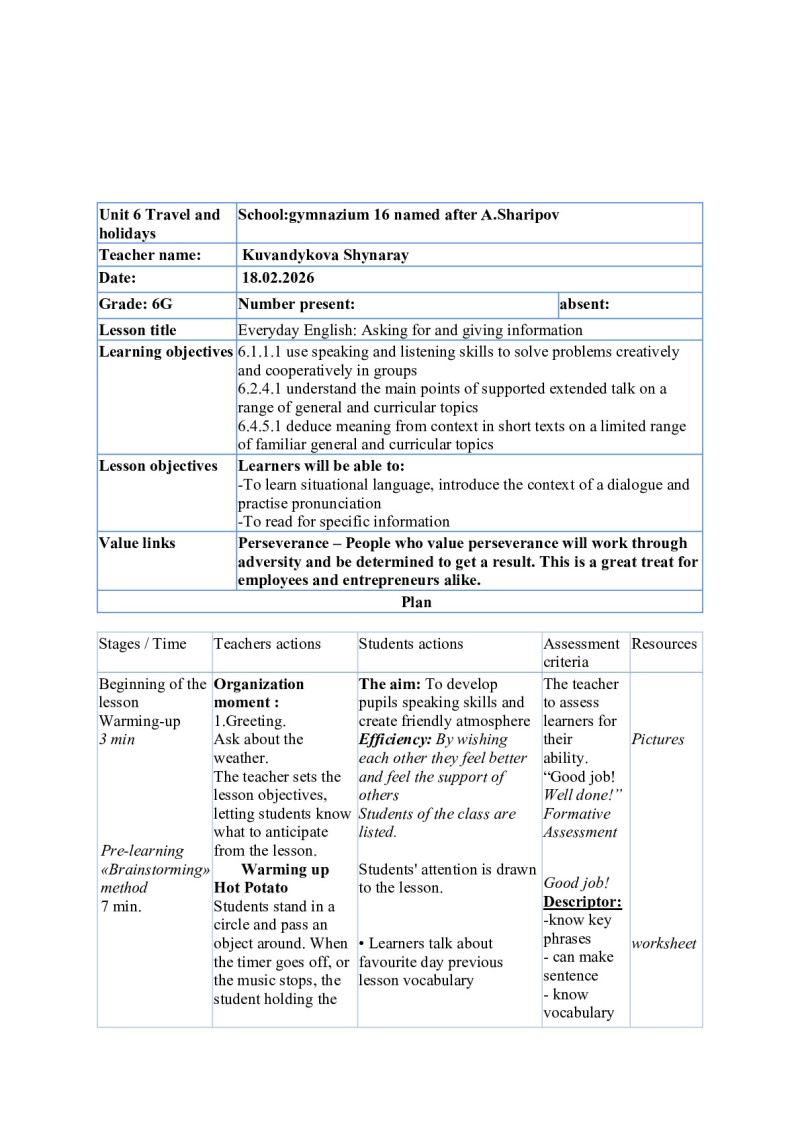
Unit 6 Travel and
holidays
School:gymnazium 16 named after A.Sharipov
Teacher name: Kuvandykova Shynaray
Date: 18.02.2026
Grade: 6G Number present: absent:
Lesson title Everyday English: Asking for and giving information
Learning objectives
6.1.1.1 use speaking and listening skills to solve problems creatively
and cooperatively in groups
6.2.4.1 understand the main points of supported extended talk on a
range of general and curricular topics
6.4.5.1 deduce meaning from context in short texts on a limited range
of familiar general and curricular topics
Lesson objectives Learners will be able to:
-To learn situational language, introduce the context of a dialogue and
practise pronunciation
-To read for specific information
Value links Perseverance – People who value perseverance will work through
adversity and be determined to get a result. This is a great treat for
employees and entrepreneurs alike.
Plan
Stages / Time Teachers actions Students actions Assessment
criteria
Resources
Beginning of the
lesson
Warming-up
3 min
Pre-learning
«Brainstorming»
method
7 min.
Organization
moment :
1.Greeting.
Ask about the
weather.
The teacher sets the
lesson objectives,
letting students know
what to anticipate
from the lesson.
Warming up
Hot Potato
Students stand in a
circle and pass an
object around. When
the timer goes off, or
the music stops, the
student holding the
The aim: To develop
pupils speaking skills and
create friendly atmosphere
Efficiency: By wishing
each other they feel better
and feel the support of
others
Students of the class are
listed.
Students' attention is drawn
to the lesson.
• Learners talk about
favourite day previous
lesson vocabulary
The teacher
to assess
learners for
their
ability.
“Good job!
Well done!”
Formative
Assessment
Good job!
Descriptor:
-know key
phrases
- can make
sentence
- know
vocabulary
Pictures
worksheet
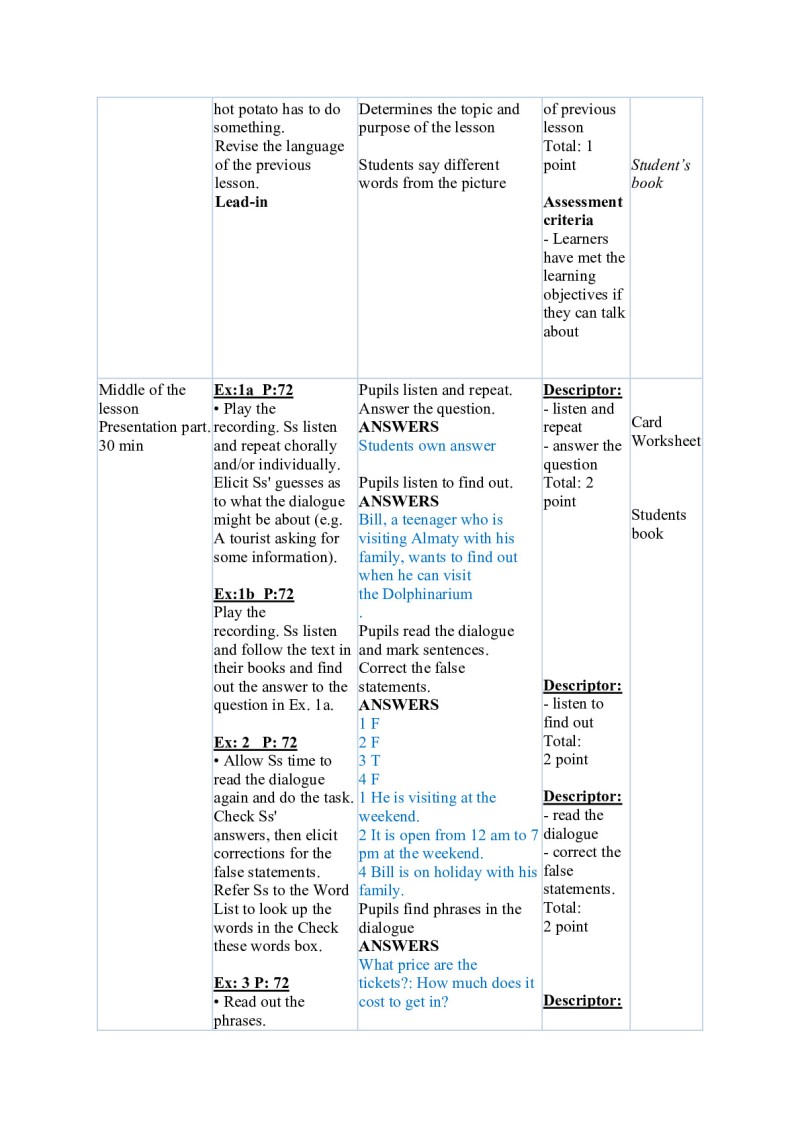
hot potato has to do
something.
Revise the language
of the previous
lesson.
Lead-in
Determines the topic and
purpose of the lesson
Students say different
words from the picture
of previous
lesson
Total: 1
point
Assessment
criteria
- Learners
have met the
learning
objectives if
they can talk
about
Student’s
book
Middle of the
lesson
Presentation part.
30 min
Ex:1a P:72
• Play the
recording. Ss listen
and repeat chorally
and/or individually.
Elicit Ss' guesses as
to what the dialogue
might be about (e.g.
A tourist asking for
some information).
Ex:1b P:72
Play the
recording. Ss listen
and follow the text in
their books and find
out the answer to the
question in Ex. 1a.
Ex: 2 P: 72
• Allow Ss time to
read the dialogue
again and do the task.
Check Ss'
answers, then elicit
corrections for the
false statements.
Refer Ss to the Word
List to look up the
words in the Check
these words box.
Ex: 3 P: 72
• Read out the
phrases.
Pupils listen and repeat.
Answer the question.
ANSWERS
Students own answer
Pupils listen to find out.
ANSWERS
Bill, a teenager who is
visiting Almaty with his
family, wants to find out
when he can visit
the Dolphinarium
.
Pupils read the dialogue
and mark sentences.
Correct the false
statements.
ANSWERS
1 F
2 F
3 T
4 F
1 He is visiting at the
weekend.
2 It is open from 12 am to 7
pm at the weekend.
4 Bill is on holiday with his
family.
Pupils find phrases in the
dialogue
ANSWERS
What price are the
tickets?: How much does it
cost to get in?
Descriptor:
- listen and
repeat
- answer the
question
Total: 2
point
Descriptor:
- listen to
find out
Total:
2 point
Descriptor:
- read the
dialogue
- correct the
false
statements.
Total:
2 point
Descriptor:
Card
Worksheet
Students
book
Refer Ss back to the
dialogue and elicit the
synonymous ones
from
various Ss around the
class.
Ex: 4 P: 72
• Play the recording
again.
Ask Ss to work in
pairs and take roles to
read out the dialogue.
Monitor the activity
around the class and
ask some pairs to
read out the dialogue
in front of the class
Ex: 5 P: 72
• Go through the
theory and explain
how the pitch goes up
at the end of a yes/no
question and down at
the end of a wh-
question.
Play the recording
with pauses for Ss to
listen and repeat
chorally and/or
individually. Pay
special attention to
Ss' pronunciation and
intonation and correct
as necessary.
Conclusion during
the lesson some tasks
differentiated by
outcomes of the
students and by their
abilities.
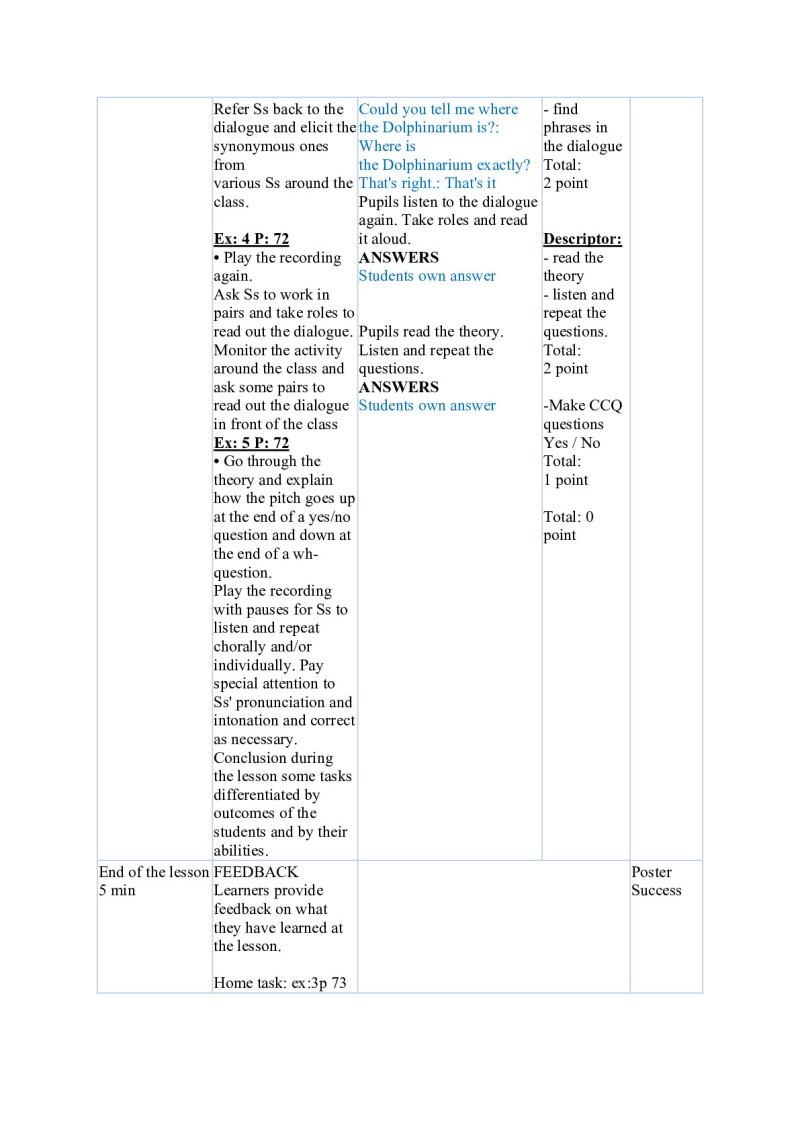
Could you tell me where
the Dolphinarium is?:
Where is
the Dolphinarium exactly?
That's right.: That's it
Pupils listen to the dialogue
again. Take roles and read
it aloud.
ANSWERS
Students own answer
Pupils read the theory.
Listen and repeat the
questions.
ANSWERS
Students own answer
- find
phrases in
the dialogue
Total:
2 point
Descriptor:
- read the
theory
- listen and
repeat the
questions.
Total:
2 point
-Make CCQ
questions
Yes / No
Total:
1 point
Total: 0
point
End of the lesson
5 min
FEEDBACK
Learners provide
feedback on what
they have learned at
the lesson.
Home task: ex:3p 73
Poster
Success









 Бұл курс Қазақстан Республикасы Оқу-ағарту министрлігімен келісілген










