ЖИ көмекші


жүктеу мүмкіндігіне ие боласыз
Бұл материал сайт қолданушысы жариялаған. Материалдың ішінде жазылған барлық ақпаратқа жауапкершілікті жариялаған қолданушы жауап береді. Ұстаз тілегі тек ақпаратты таратуға қолдау көрсетеді. Егер материал сіздің авторлық құқығыңызды бұзған болса немесе басқа да себептермен сайттан өшіру керек деп ойласаңыз осында жазыңыз
 13 Қараша 2018
 451
451
Fantasy World
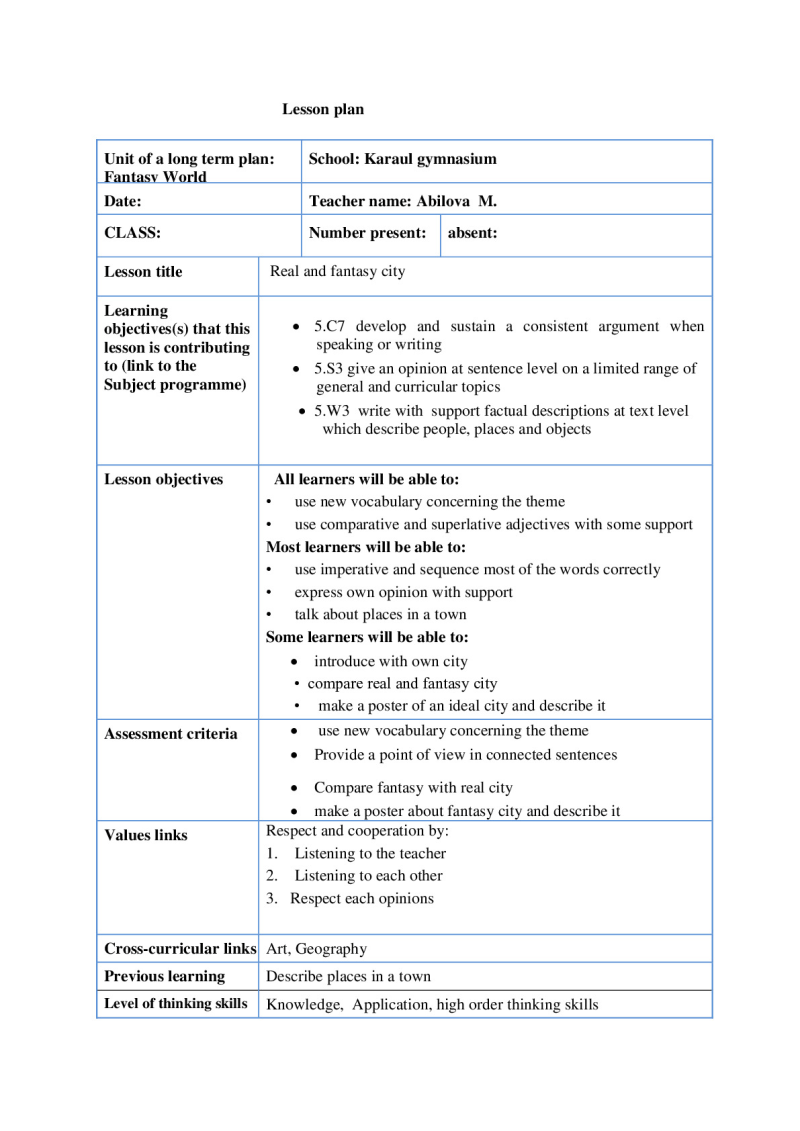
Lesson plan
Unit of a long term plan:
Fantasy World
School: Karaul gymnasium
Date: Teacher name: Abilova M.
CLASS: Number present: absent:
Lesson title Real and fantasy city
Learning
objectives(s) that this
lesson is contributing
to (link to the
Subject programme)
5.C7 develop and sustain a consistent argument when
speaking or writing
5.S3 give an opinion at sentence level on a limited range of
general and curricular topics
5.W3 write with support factual descriptions at text level
which describe people, places and objects
Lesson objectives All learners will be able to:
• use new vocabulary concerning the theme
• use comparative and superlative adjectives with some support
Most learners will be able to:
• use imperative and sequence most of the words correctly
• express own opinion with support
• talk about places in a town
Some learners will be able to:
introduce with own city
• compare real and fantasy city
• make a poster of an ideal city and describe it
Assessment criteria use new vocabulary concerning the theme
Provide a point of view in connected sentences
Compare fantasy with real city
make a poster about fantasy city and describe it
Values links
Respect and cooperation by:
1. Listening to the teacher
2. Listening to each other
3. Respect each opinions
Cross-curricular links Art, Geography
Previous learning Describe places in a town
Level of thinking skills Knowledge, Application, high order thinking skills
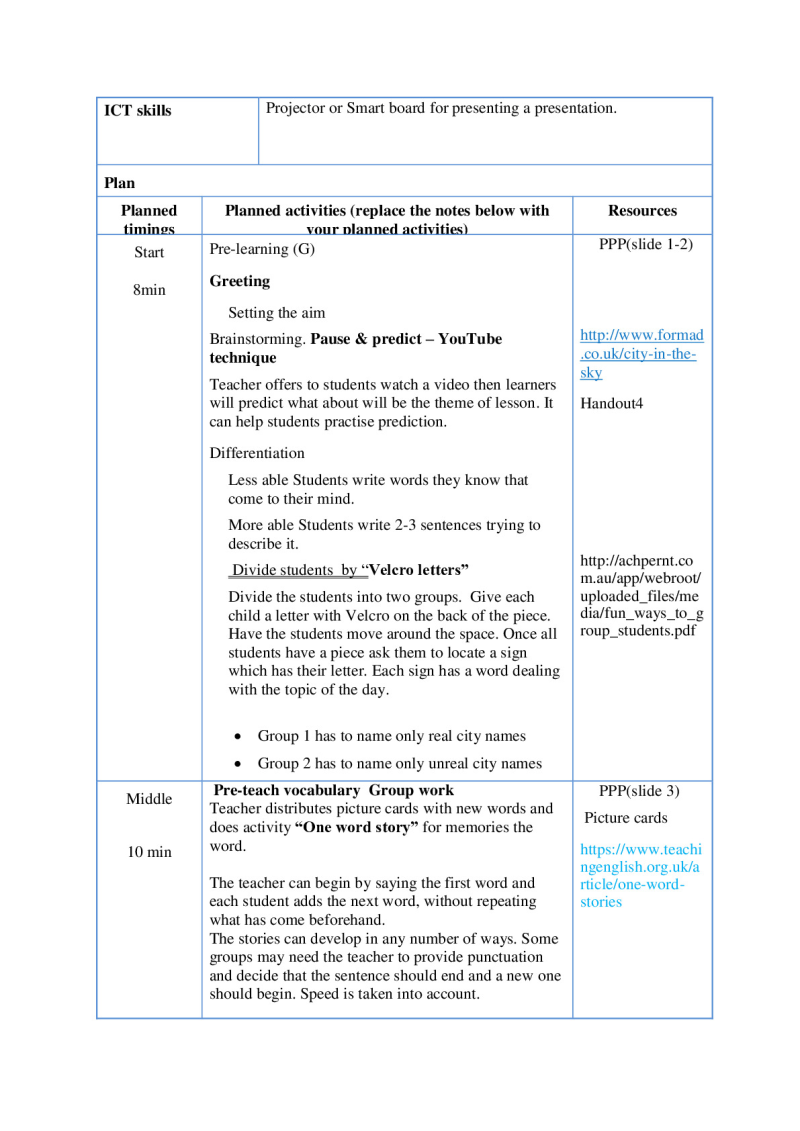
ICT skills Projector or Smart board for presenting a presentation.
Plan
Planned
timings
Planned activities (replace the notes below with
your planned activities)
Resources
Start
8min
Pre-learning (G)
Greeting
Setting the aim
Brainstorming. Pause & predict – YouTube
technique
Teacher offers to students watch a video then learners
will predict what about will be the theme of lesson. It
can help students practise prediction.
Differentiation
Less able Students write words they know that
come to their mind.
More able Students write 2-3 sentences trying to
describe it.
Divide students by “Velcro letters”
Divide the students into two groups. Give each
child a letter with Velcro on the back of the piece.
Have the students move around the space. Once all
students have a piece ask them to locate a sign
which has their letter. Each sign has a word dealing
with the topic of the day.
Group 1 has to name only real city names
Group 2 has to name only unreal city names
PPP(slide 1-2)
http://www.formad
.co.uk/city-in-the-
sky
Handout4
http://achpernt.co
m.au/app/webroot/
uploaded_files/me
dia/fun_ways_to_g
roup_students.pdf
Middle
10 min
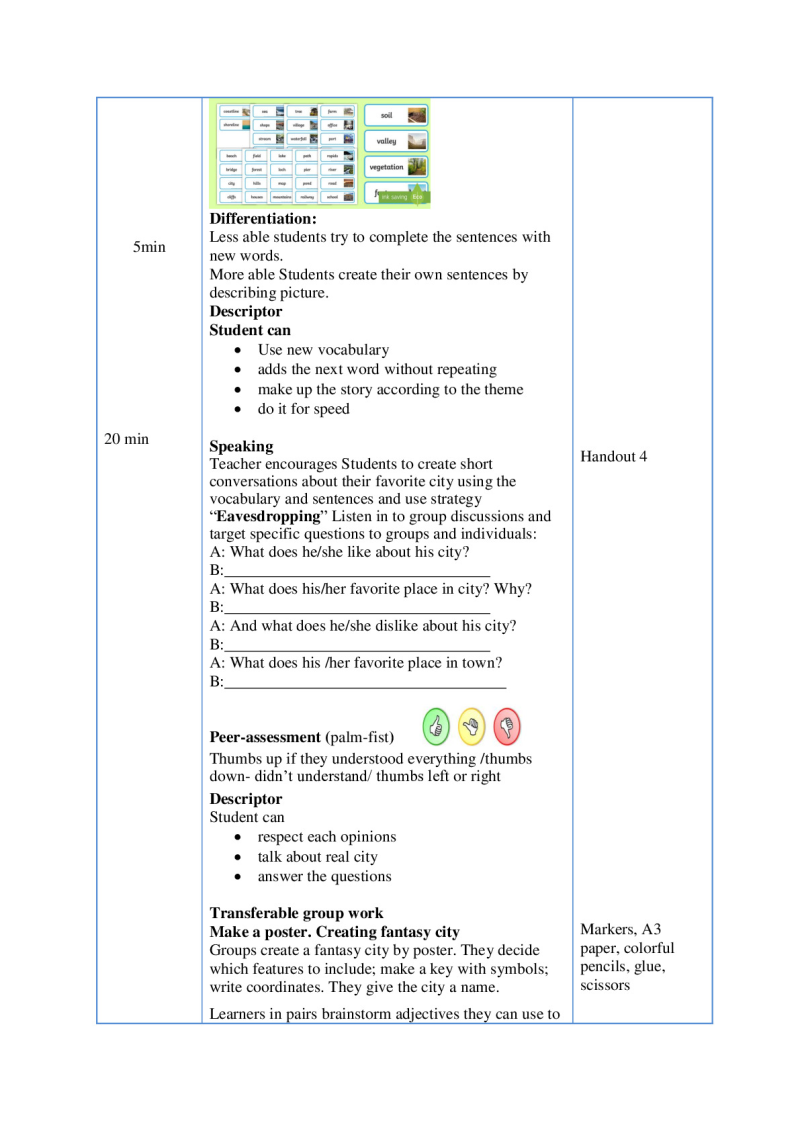
Pre-teach vocabulary Group work
Teacher distributes picture cards with new words and
does activity “One word story” for memories the
word.
The teacher can begin by saying the first word and
each student adds the next word, without repeating
what has come beforehand.
The stories can develop in any number of ways. Some
groups may need the teacher to provide punctuation
and decide that the sentence should end and a new one
should begin. Speed is taken into account.
PPP(slide 3)
Picture cards
https://www.teachi
ngenglish.org.uk/a
rticle/one-word-
stories
5min
20 min
Differentiation:
Less able students try to complete the sentences with
new words.
More able Students create their own sentences by
describing picture.
Descriptor
Student can
Use new vocabulary
adds the next word without repeating
make up the story according to the theme
do it for speed
Speaking
Teacher encourages Students to create short
conversations about their favorite city using the
vocabulary and sentences and use strategy
“Eavesdropping” Listen in to group discussions and
target specific questions to groups and individuals:
A: What does he/she like about his city?
B:_________________________________
A: What does his/her favorite place in city? Why?
B:_________________________________
A: And what does he/she dislike about his city?
B:_________________________________
A: What does his /her favorite place in town?
B:___________________________________
Peer-assessment (palm-fist)
Thumbs up if they understood everything /thumbs
down- didn’t understand/ thumbs left or right
Descriptor
Student can
respect each opinions
talk about real city
answer the questions
Transferable group work
Make a poster. Creating fantasy city
Groups create a fantasy city by poster. They decide
which features to include; make a key with symbols;
write coordinates. They give the city a name.
Learners in pairs brainstorm adjectives they can use to
Handout 4
Markers, A3
paper, colorful
pencils, glue,
scissors
persuade people to visit their city to describe their
fantasy city and its features e.g. Encourage learners to
practice comparative and superlative adjectives;
Explain what a persuasive text is. Below their poster
learners write a short, persuasive text to try to get
people to visit their city. (30-50 words). Try compare
with real city.
Assessment criteria
Student
Can use new words
Can present his/her ideal city creatively
can use comparative and superlative adjectives
can write 30-50 words
Plenary
Just a Minute
One student starts to speak about their poster.
They must express their opinion about the next
group`s work. At the first repetition, pause or
mistake another takes over - and so on until the
minute is up.
Transferable assessment
Two groups assess each other by expressing
their opinion and recommendation.
End
2 min
Feedback
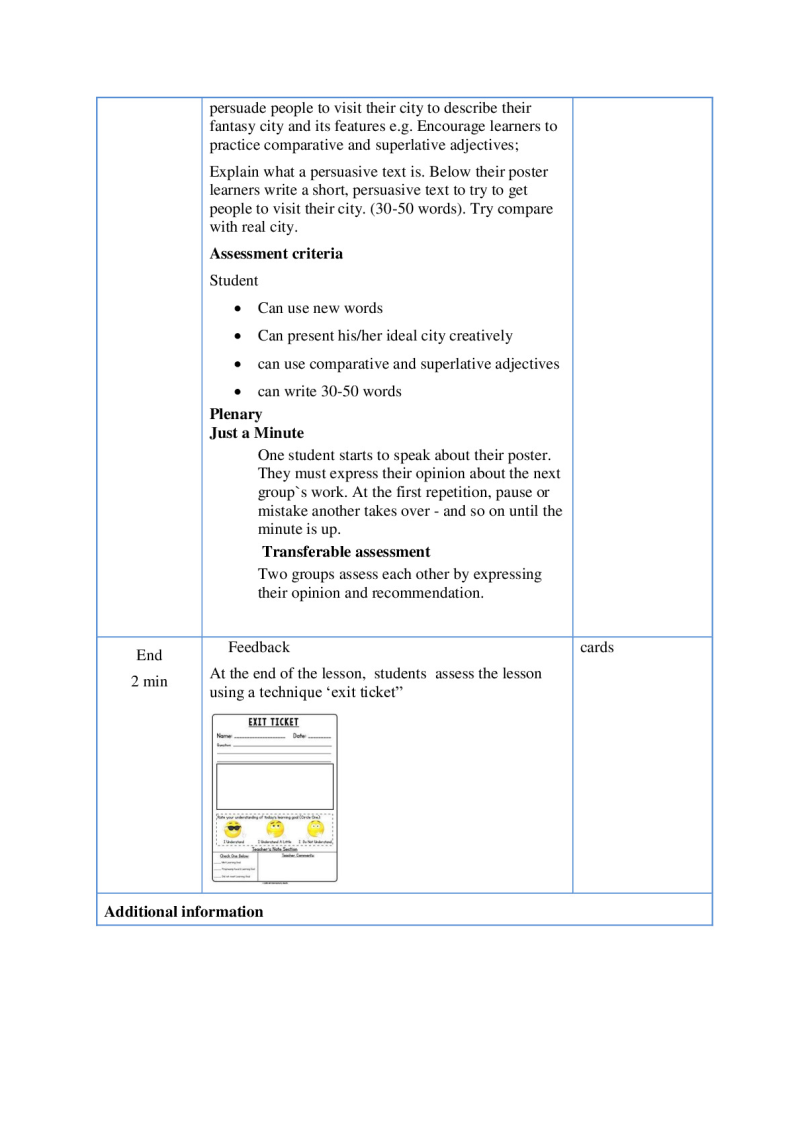
At the end of the lesson, students assess the lesson
using a technique ‘exit ticket”
cards
Additional information
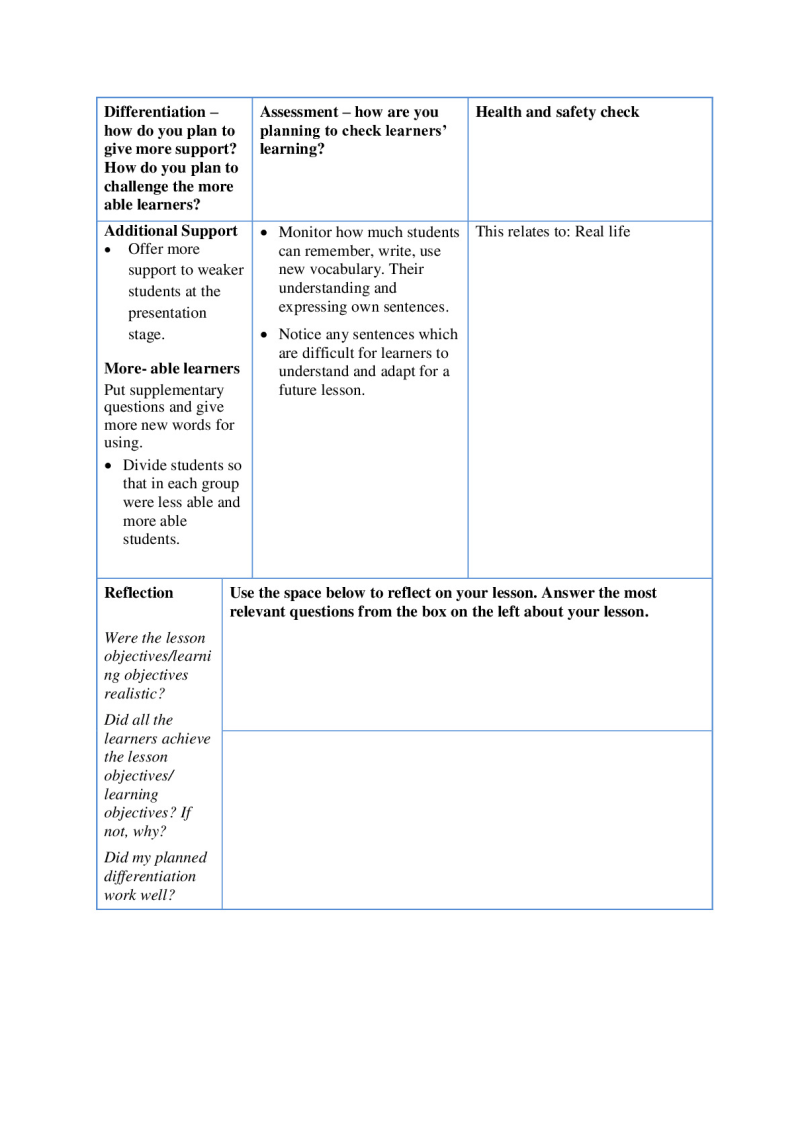
Differentiation –
how do you plan to
give more support?
How do you plan to
challenge the more
able learners?
Assessment – how are you
planning to check learners’
learning?
Health and safety check
Additional Support
Offer more
support to weaker
students at the
presentation
stage.
More- able learners
Put supplementary
questions and give
more new words for
using.
Divide students so
that in each group
were less able and
more able
students.
Monitor how much students
can remember, write, use
new vocabulary. Their
understanding and
expressing own sentences.
Notice any sentences which
are difficult for learners to
understand and adapt for a
future lesson.
This relates to: Real life
Reflection
Were the lesson
objectives/learni
ng objectives
realistic?
Did all the
learners achieve
the lesson
objectives/
learning
objectives? If
not, why?
Did my planned
differentiation
work well?
Did I stick to
timings?
What changes
did I make from
my plan and
why?
Use the space below to reflect on your lesson. Answer the most
relevant questions from the box on the left about your lesson.
Summary evaluation
What two things went really well (consider both teaching and learning)?
1:
2:
What two things would have improved the lesson (consider both teaching and learning)?
1:
2:
What have I learned from this lesson about the class or individuals that will inform my next
lesson?

 Жүктеу


 Жүктеу
шағым қалдыра аласыз

 Бұл курс Қазақстан Республикасы Оқу-ағарту министрлігімен келісілген