|
Unit: 6 |
|||||||
|
Teacher’s name: Bekzhigit Dinara |
|||||||
|
Date: |
|||||||
|
Grade: 9 |
Number present: |
absent: |
|||||
|
Theme of the lesson |
Present perfect and past simple. Present perfect simple and continuous |
||||||
|
Learning objectives |
9.3.6.1 link comments with flexibility to what others say at sentence and discourse level in pair, group and whole class exchanges 9.3.7.1 use appropriate subject-specific vocabutary and syntax to talk about an increased range of general and curricular topics 9.1.8.1 develop intercultural awareness through reading an discussion 9.5.3.1 write with grammatical accuracy on a range of familiar general and curricular topics |
||||||
|
Lesson objectives (assessment criteria) |
At the end of the lesson students will be able to: - use vocabulary in extended texts on a wide range of familiar general and curricular topics. - understand appropriate subject-specific vocabulary to talk about general topics. - give an opinion at sentence level on a limited range of general and curricular topics. |
||||||
|
Plan |
|||||||
|
Part of the lesson/Time |
Teacher’s activity |
Student’s activity |
Assessment |
Resources |
|||
|
Beginning of the lesson 5 min |
Organization moment: Greeting. Teacher checks student’s homework. Warm up. -Ask students: Are you excited and looking forward to the lesson? -Today's new theme is «Present perfect and past simple» |
Students greet the teacher and guess the theme of the lesson. Students understand the new theme explanation. |
Teacher evaluates pupils with phrases like:”Good job!” and “Wonderful” Formative assessment |
Board and markers |
|||
|
Middle of the lesson 30 min |
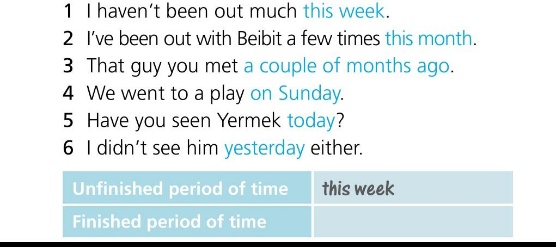
The present perfect is used when the time period has NOT finished. I have seen three movies this week. (This week has not finished yet.) The simple past is used when the time period HAS finished. I saw three movies last week. (Last week has finished.) The present perfect is often used when giving recent news. The simple past is used when giving older information. The present perfect is used when the time is not specific. The simple past is used when the time is clear. Ex: 1, p: 73. Study the sentences. Complete the table with the time expressions in blue. Do we use the present perfect with finished or unfinished time expressions?
|
Students understand the new grammar theme and listen to the teacher's explanation and examples. Students read the words and complete the table by using these words. Descriptor: -Completes the table. |
|
Book and board |
|||
|
|
Ex: 2, p: 73. Complete the text with the present perfect or the past simple form of the verbs in brackets. Lis»en and check. Then add the time expressions in blue to the table in exercise 1.
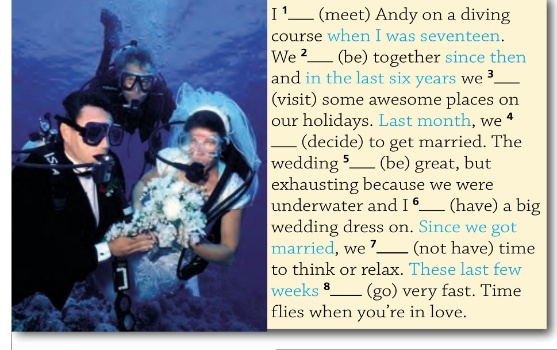
Task introduction -Draw students' attention to the sentences on the book. -Explain the task instructions clearly, ensuring students understand what they need to do. -If necessary, complete the first sentence together as a class example. |
Students complete the text Descriptor: |
Excellent -Completes the sentences correctly. Good - Completes most of the sentences correctly. |
Book |
|||
|
|
Ex: 4 , p: 73. Study sentences a–d and match them with descriptions 1–4. When do we use the present perfect simple and when do we use the continuous? A I’m exhausted. I’ve been running. B I’ve run three long-distance races. C I’ve been running for thirty minutes. D I’ve always liked running. 1 An action that is finished and complete. 2 A verb which describes a state. 3 An action that started in the pa»t and is still going on. 4 An action that has recently stopped and which explains the present situation. Task introduction -Explain the task instructions clearly, ensuring students understand what they need to do. -If necessary, complete the first sentence together as a class example. Individual Work: - Allow students time to work individually to complete the sentences. - Circulate to provide support and clarify doubts without giving direct answers. |
Students match the sentences. Descriptor: -Matches the sentences. |
Excellent -Matches the sentences correctly. Good - Matches most of the sentences correctly. |
Book Board |
|||
|
End of the lesson. 5 min |
Homework: Ex: 5, p: 73. Feedback. Students each will be given a feedback sticker, where they write how they feel about the lesson, write about the things that they've learned, and also ask questions if they have one. |
Students use their stickers to show their knowledge and impression of the lesson. |
|
|

|||
жүктеу мүмкіндігіне ие боласыз
Бұл материал сайт қолданушысы жариялаған. Материалдың ішінде жазылған барлық ақпаратқа жауапкершілікті жариялаған қолданушы жауап береді. Ұстаз тілегі тек ақпаратты таратуға қолдау көрсетеді. Егер материал сіздің авторлық құқығыңызды бұзған болса немесе басқа да себептермен сайттан өшіру керек деп ойласаңыз осында жазыңыз
Grade 9 КМЖ Present perfect and past simple
|
Unit: 6 |
|||||||
|
Teacher’s name: Bekzhigit Dinara |
|||||||
|
Date: |
|||||||
|
Grade: 9 |
Number present: |
absent: |
|||||
|
Theme of the lesson |
Present perfect and past simple. Present perfect simple and continuous |
||||||
|
Learning objectives |
9.3.6.1 link comments with flexibility to what others say at sentence and discourse level in pair, group and whole class exchanges 9.3.7.1 use appropriate subject-specific vocabutary and syntax to talk about an increased range of general and curricular topics 9.1.8.1 develop intercultural awareness through reading an discussion 9.5.3.1 write with grammatical accuracy on a range of familiar general and curricular topics |
||||||
|
Lesson objectives (assessment criteria) |
At the end of the lesson students will be able to: - use vocabulary in extended texts on a wide range of familiar general and curricular topics. - understand appropriate subject-specific vocabulary to talk about general topics. - give an opinion at sentence level on a limited range of general and curricular topics. |
||||||
|
Plan |
|||||||
|
Part of the lesson/Time |
Teacher’s activity |
Student’s activity |
Assessment |
Resources |
|||
|
Beginning of the lesson 5 min |
Organization moment: Greeting. Teacher checks student’s homework. Warm up. -Ask students: Are you excited and looking forward to the lesson? -Today's new theme is «Present perfect and past simple» |
Students greet the teacher and guess the theme of the lesson. Students understand the new theme explanation. |
Teacher evaluates pupils with phrases like:”Good job!” and “Wonderful” Formative assessment |
Board and markers |
|||
|
Middle of the lesson 30 min |
The present perfect is used when the time period has NOT finished. I have seen three movies this week. (This week has not finished yet.) The simple past is used when the time period HAS finished. I saw three movies last week. (Last week has finished.) The present perfect is often used when giving recent news. The simple past is used when giving older information. The present perfect is used when the time is not specific. The simple past is used when the time is clear. Ex: 1, p: 73. Study the sentences. Complete the table with the time expressions in blue. Do we use the present perfect with finished or unfinished time expressions?
|
Students understand the new grammar theme and listen to the teacher's explanation and examples. Students read the words and complete the table by using these words. Descriptor: -Completes the table. |
|
Book and board |
|||
|
|
Ex: 2, p: 73. Complete the text with the present perfect or the past simple form of the verbs in brackets. Lis»en and check. Then add the time expressions in blue to the table in exercise 1.
Task introduction -Draw students' attention to the sentences on the book. -Explain the task instructions clearly, ensuring students understand what they need to do. -If necessary, complete the first sentence together as a class example. |
Students complete the text Descriptor: |
Excellent -Completes the sentences correctly. Good - Completes most of the sentences correctly. |
Book |
|||
|
|
Ex: 4 , p: 73. Study sentences a–d and match them with descriptions 1–4. When do we use the present perfect simple and when do we use the continuous? A I’m exhausted. I’ve been running. B I’ve run three long-distance races. C I’ve been running for thirty minutes. D I’ve always liked running. 1 An action that is finished and complete. 2 A verb which describes a state. 3 An action that started in the pa»t and is still going on. 4 An action that has recently stopped and which explains the present situation. Task introduction -Explain the task instructions clearly, ensuring students understand what they need to do. -If necessary, complete the first sentence together as a class example. Individual Work: - Allow students time to work individually to complete the sentences. - Circulate to provide support and clarify doubts without giving direct answers. |
Students match the sentences. Descriptor: -Matches the sentences. |
Excellent -Matches the sentences correctly. Good - Matches most of the sentences correctly. |
Book Board |
|||
|
End of the lesson. 5 min |
Homework: Ex: 5, p: 73. Feedback. Students each will be given a feedback sticker, where they write how they feel about the lesson, write about the things that they've learned, and also ask questions if they have one. |
Students use their stickers to show their knowledge and impression of the lesson. |
|
|
|||
шағым қалдыра аласыз