|
Lesson Start (5
minutes)
|
Greeting.
Teacher and learners greet
each other.
- "Good
afternoon children!"
"Good
afternoon teacher!"
§ - "How are
you?"
§ - "I'm fine, thank you".
(I'm great, I'm super,I’m
tired)
Watch videos through a
holographic watch to discover new topics and answer
questions.
1.What did you see in the
video
2.
What do you think we will
learn today?
Aim: study and understand with some support short
simple fiction and non-fiction
texts
make use of adverbs of time and frequency:
sometimes, often, always, never to indicate when and how often
begin to use simple adverbs of manner e.g. well, badly, use common
–ly manner adverbs to describe actions e/g/ slowly,
quickly
|
Listen to the teacher and ask any questions about
the lesson's objectives.
The student watches a
video through a holographic watch and answers
questions.
|
The teacher to assess learners
for their ability.
“Good
job!
Well
done!”
Formative
Assessment

Good
job!
|


|
|
Lesson Middle (35
minutes)
|
Teacher
explains
adverbs of time and
frequency
and gives
examples
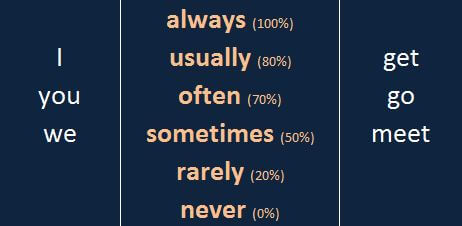
Example:
1.I often play the guital
well
2.I sometimes do my
homework
Task 1.Reading
Activity
Ride a short non-fiction
text
“Ways to Help the
Planet”
People can help the planet in many ways. We
should always turn off lights when we leave a room. We can
sometimes walk instead of using a car. It is important to recycle
plastic and paper. If we see trash in the park, we should pick it
up carefully.
Comprehension Questions:
1.What are some ways to help the
planet?
2.How often should we turn off the lights?
(Answer: always)
3.How should we pick up trash? (Answer:
carefully)
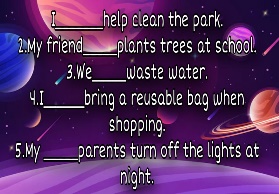
Task 2. Put the correct
answer
Instructions: Put the correct adverb for each
sentence.
1.I
(always / sometimes / never) help clean the
park.
2.My friend (often / never / usually) plants
trees at school.
3.We (always / never / sometimes) waste
water.
4.I
(often / always / sometimes) bring a reusable bag when
shopping.
5.My parents (never / usually / always) turn off
the lights at night.
Task 3 Fill in the
Blanks
Instructions: Fill in the blanks with well or
badly.
1.I
did my homework __ because I took my
time.
2.He
played football __ because he didn’t
practice.
3.She
sings very __. She has a beautiful
voice!
4.Tom
drives __ because he is not
careful.
5.The artist paints __. Her pictures are
amazing!
Task4. Use the adverb of time and frequency always,
sometimes, often, never in the sentence is well and
badly.
She always sings badly at the
concert.
2.He sometimes speaks well in
public.
3.They often play badly during
practice.
4.I never do my homework
badly.
5.She always performs well at
work.
6.He never behaves
well in class.
|
Students
give examples of
adverbs of time and frequency
Students read a
short non-fiction text and answer
questions
.
Students will put the correct
adverb for each sentence
Students fill in the blanks with well or
badly.
Answer
1.well
2.badly
3.well
4.badly
5.well
Students use adverbs of time
and frequency always, sometimes, often, never in the sentence bad
and good.
|
Descriptor1
:
A
learn
-read the text
- if they answer
questions.
Total:
3points
Descriptor
2:
-if you put the correct
adverb of the sentence
- if they pronounce the
sentences correctly
Total 2
points
Descriptor 3
:
-if the student fills
in the blanks
-understand the
sentences
Total:2points
Descriptor 4
:
-if the student uses
bad and good in sentences
-if he understands
sentences
-if he reads
correctly
Total:3points
|
Blooket
https://dashboard
Exercise
|

 ЖИ көмекші


 Қауіпсіз төлем

 19 Наурыз 2025
 153
153











 Бұл курс Қазақстан Республикасы Оқу-ағарту министрлігімен келісілген










