
 ЖИ көмекші


 Қауіпсіз төлем

жүктеу мүмкіндігіне ие боласыз
Бұл материал сайт қолданушысы жариялаған. Материалдың ішінде жазылған барлық ақпаратқа жауапкершілікті жариялаған қолданушы жауап береді. Ұстаз тілегі тек ақпаратты таратуға қолдау көрсетеді. Егер материал сіздің авторлық құқығыңызды бұзған болса немесе басқа да себептермен сайттан өшіру керек деп ойласаңыз осында жазыңыз
 09 Қазан 2026
 156

1 жыл бойы шексіз жүктеңіз
«HOW CARTOONS HELP CHILDREN LEARN ENGLISH?»
Қазақстан Республикасы Оқу-ағарту министрлігі
«Дарын» республикалық ғылыми-практикалық орталығы
2-8 сынып оқушыларына арналған «Зерде» республикалық зерттеу жобалары мен шығармашылық жұмыстарының конкурсы
Тіркеу коды (шифр) ____________________________
(«Дарын» РҒПО қызметкері толтырады)
Бағыт: Қоғамдық-гуманитарлық бағыт
Секцияның атауы: Шет тілдері және мәдениетаралық коммуникация
Жас санаты:
□ «Бастауыш буын» (2-4 сынып)
□ «Орта буын» (5-8 сынып)
Жобаның тақырыбы
«HOW CARTOONS HELP CHILDREN LEARN ENGLISH?»
Қатысушының Т.А.Ә.: Бекболатқызы Дилназ
Ғылыми жетекшінің Т.А.Ә.: Амишева Дильназ Съездбековна
2026-2027 оқу жылы
CONTENTS
1. Introduction .................................................. 4
2. Theoretical Part .............................................. 5
2.1. Young learners and English .................................. 5
2.2. Why cartoons can support learning ........................... 6
2.3. Learning through listening, context and repetition .......... 7
3. Practical Part ................................................ 8
3.1. Selecting suitable cartoons ................................. 8
3.2. The “Cartoon English” model ................................. 8
3.3. Sample classroom activities ................................. 9
4. Experimental Part ............................................. 10
4.1. Research design and methods ................................. 10
4.2. Pre-test and post-test ...................................... 10
4.3. Observation and learner questionnaire ....................... 11
4.4. Data analysis ............................................... 11
5. Results: how to record and interpret real data ................ 12
6. Conclusions and practical significance ........................ 13
7. References .................................................... 14
Appendices: research instruments ................................. 15
Аннотация
Бұл ғылыми жобада мультфильмдердің 3-сынып оқушыларына ағылшын тілін үйренуге әсері қарастырылады.
Зерттеудің мақсаты – мультфильмдер арқылы оқушылардың сөздік қорын дамыту жолдарын анықтап, «Cartoon English» атты оқу құралын әзірлеу.
Жобаның өзектілігі ағылшын тілін үйрену үдерісін қызықты, көрнекі және тиімді ұйымдастыру қажеттілігімен байланысты. Осыған орай, «Мультфильмдер оқушылардың ағылшын тіліндегі жаңа сөздерді меңгеруіне көмектесе ме?» деген зерттеу сұрағы қойылып, мультфильмдерді тақырыптық тапсырмалармен бірге қолдану сөздерді есте сақтауды жақсартады деген болжам жасалды.
Зерттеу барысында әдебиеттерді талдау, бақылау, тестілеу және нәтижелерді салыстыру әдістері қарастырылды.
Нәтижесінде тақырыптық бейнематериалдар, QR-кодтар, сөздік қор және практикалық тапсырмалар қамтылған «Cartoon English» оқу құралы әзірленді.
Қорытындылай келе, мультфильмдерді мақсатты әрі жүйелі пайдалану бастауыш сынып оқушыларының ағылшын тілін үйренуге қызығушылығын арттырып, жаңа сөздерді меңгеруіне ықпал ете алады.
1. INTRODUCTION
English is an important language for communication, education, travel, technology and access to information. For young learners, however, English can sometimes feel difficult because many words and sounds are unfamiliar. A third-grade child needs learning activities that are clear, interesting, short and connected with meaningful situations.
Cartoons are familiar to children. They combine pictures, movement, sound, facial expressions, actions and speech. This combination can give children more clues about meaning than words alone. A child may not know the word “jump”, but when a cartoon character jumps and says “Jump!”, the meaning becomes easier to understand. Repeated phrases can also help children notice and remember language.
The Council of Europe describes language learning through communication, action, interaction and learner participation. Its CEFR resources emphasise that classroom activities should help learners use language for meaningful purposes rather than only study isolated forms [1]. This idea is appropriate for young learners because a cartoon can create a small communicative situation in which children listen, identify, repeat, answer and speak.
The British Council also recommends short English-language videos for children and notes that younger children often benefit from short viewing periods of about five to ten minutes, followed by activities [2]. Therefore, the educational value of a cartoon does not come simply from watching it. The teacher needs to select an appropriate video and design tasks before, during and after viewing.
Research problem. Children may watch English cartoons for entertainment, but passive viewing does not automatically mean effective learning. The research problem is to identify how a cartoon can be transformed from entertainment into a purposeful English-learning resource for Grade 3.
Research question. How do cartoons help third-grade children learn English?
Aim. To investigate the educational value of short, age-appropriate cartoons and develop a practical method for using them to support English vocabulary, listening, pronunciation and motivation.
Hypothesis. If short cartoons are selected according to learners’ age and language level and are used with purposeful before-, during- and after-viewing tasks, then children will show better recognition and use of target vocabulary and greater engagement than during a lesson based only on isolated word practice.
Object of the research. The process of learning English by primary school learners.
Subject of the research. The use of short cartoons as a learning resource for English vocabulary, listening and speaking.
Tasks:
to study reliable sources about cartoons, animated videos and young language learners;
to identify the features that make a cartoon useful for Grade 3 English learning;
to design a three-stage “Cartoon English” learning model;
to prepare a small classroom experiment using a pre-test, learning activities and a post-test;
to collect and analyse real learner data rather than relying only on opinions;
to formulate practical recommendations for teachers and pupils.
Methods. Literature review, observation, questionnaire, pre-test and post-test, comparison of results, simple percentage calculations and graphical presentation.
Expected practical product. A “Cartoon English” mini-guide containing selection criteria, a lesson algorithm, sample tasks, an observation checklist, a learner questionnaire and a vocabulary test.
Research ethics and safety. The activity should be age-appropriate. Children should not be required to share personal information. Videos should be short, safe and suitable for school. Online platforms should be used with teacher or parent supervision. The experiment should be voluntary within normal classroom learning, and individual results should not be publicly shamed or ranked.
2. THEORETICAL PART
2.1. Young Learners and English
Young learners are not simply smaller versions of adult language learners. They usually need more concrete examples, movement, repetition, visual support and opportunities to interact. At the primary level, language learning is closely connected with attention, memory, imitation and emotion. For this reason, the learning material should be meaningful and manageable.
A cartoon can provide a rich context. Instead of seeing a vocabulary list such as “run, eat, sleep, happy, big”, a child can see characters running, eating, sleeping and showing emotions. The learner can connect the sound of a word with an action, object or facial expression. This reduces the need to translate every word.
The Kazakhstan education framework has emphasised foreign-language learning and communication as part of the Language and Literature area. Earlier state-standard documents explicitly described listening outcomes such as recognising familiar words and phrases, using contextual clues, and understanding the general meaning of short stories [3]. These outcomes support the idea that visual and contextual materials can be useful for young English learners.
The CEFR Companion Volume promotes an action-oriented view of language education. Learners are seen as people who use language to do things, interact and participate. Classroom tasks can therefore move from comprehension to action: a child watches, identifies, chooses, repeats, asks, answers, draws, acts or retells [1].
For a third-grade learner, the aim should not be to understand every single word in a cartoon. The realistic goal is to understand the main idea, recognise familiar words, notice a small number of new expressions and use them in simple communication.
2.2. What Makes a Cartoon Educational?
Feature |
How it can support learning |
Example |
Visual context |
Pictures help children guess meaning. |
A character opens a door and says “Open the door.” |
Repetition |
Repeated words and phrases become easier to notice. |
“Come here!” appears several times. |
Emotion |
Funny or surprising scenes can increase attention. |
A character is excited about a birthday. |
Action |
Movement connects language with meaning. |
“Run!”, “Jump!”, “Sit down!” |
Sound |
Children hear pronunciation and intonation. |
Short natural phrases are heard in context. |
Story |
A sequence helps memory. |
First the character loses a toy, then finds it. |
Dialogue |
Children hear language used between people. |
“What is this?” – “It is a ball.” |
Culture |
Stories can introduce everyday life and customs. |
Family, food, school or celebrations. |
A useful cartoon should therefore have a clear learning purpose. A teacher can choose one episode for colours, another for animals, another for daily routines, or another for classroom language. The same cartoon should not be overloaded with too many learning targets.
2.3. WHY CARTOONS CAN SUPPORT LEARNING
1. Visual support. When children hear a new word and see the related action or object at the same time, they receive two connected types of information. This can make the meaning easier to infer and remember. Animation is especially useful because the visual information changes together with the speech.
2. Context. A word is easier to understand when it appears in a situation. The expression “I am hungry” has more meaning when a character looks at food, holds their stomach and then eats. Context also helps learners predict what may happen next.
3. Repetition. Young learners need repeated exposure to new language. Cartoons naturally repeat names, routines and phrases. A teacher can increase useful repetition by pausing and asking children to repeat a target expression.
4. Listening. Cartoons give children opportunities to hear connected English rather than isolated textbook words. Research by Mukazhanova, Rybalkina and Gavrilova found that cartoons and animated films can be used as a meaningful alternative for developing listening skills among young learners [4].
5. Vocabulary learning. Recent research has reported positive results when animated videos are integrated into vocabulary teaching. Alameen’s 2024 experimental study found that learners taught vocabulary through context-based learning integrated with animated videos outperformed learners who received context-based learning without the animated-video component [5]. Setiawati and Septiana also reported an increase between pre-test and post-test vocabulary scores after using animated videos with young learners [6].
6. Motivation and participation. Children often perceive cartoons as enjoyable. Enjoyment can make them more willing to listen, repeat and answer. However, motivation should be treated as a support for learning, not as the final goal. A fun video becomes educational when it leads to language use.
7. Speaking and pronunciation. Children naturally imitate characters. This can be used for shadowing, repetition and short role-play. The British Council’s LearnEnglish Kids resources use animated songs and stories together with listen-and-record activities to encourage children to speak aloud and compare their pronunciation with a model [7].
8. Memory. A story creates a sequence. If a child remembers what happened to a character, the child can often remember the language connected with that event. For example, if a character is looking for a red ball, the words “red”, “ball”, “where”, “look” and “find” become part of one meaningful memory.
9. Learning autonomy. A child can rewatch a short episode, pause it, repeat a phrase or complete a simple task. This can help the learner become more independent, especially when adults provide clear limits and guidance.
The key principle
The project does not claim that cartoons are a replacement for a teacher, textbook or systematic language instruction. The main principle is: CARTOON + PURPOSEFUL TASKS + REPETITION + SPEAKING = MORE EDUCATIONAL VALUE.
2.4. EVIDENCE FROM RECENT RESEARCH
Recent studies provide useful evidence for investigating animated videos with young language learners. They also show why a small school project should combine several types of evidence rather than rely on a single test.
Study |
Participants / context |
Main finding relevant to this project |
Alameen (2024) [5] |
Young EFL learners; experimental comparison |
Contextualised animated-video instruction produced stronger vocabulary outcomes than context-based instruction alone. |
Muftah (2023) [8] |
60 Grade 4 EFL learners |
A pre/post quasi-experimental study found higher achievement for learners exposed to animated videos. |
Mukazhanova et al. (2022) [4] |
Young learners; listening-focused context |
Cartoons were reported as useful for listening, engagement and language exposure. |
Setiawati & Septiana (2022) [6] |
Young learners; vocabulary |
Average vocabulary score increased from pre-test to post-test after animated-video instruction. |
Riyanto et al. (2025) [9] |
22 Grade 4 learners in Thailand |
Animated videos, songs and games supported vocabulary learning, interaction and active participation. |
Bajec, Železnik & Pižorn (2025) [10] |
240 Grade 6 pupils in Slovenia |
The study investigated links between cartoon viewing and incidental vocabulary acquisition. |
These studies do not prove that every cartoon will improve every learner’s English. They suggest that animated material can be useful when it is appropriate to the learners, connected to a language goal and integrated into teaching. This distinction is important for the present research.
The research gap for this school project is small but practical: What happens when a third-grade learner uses a short cartoon with a simple, repeatable learning routine? The project therefore focuses on an age-appropriate classroom procedure that can be observed and measured.
Working model
Input |
Learning process |
Observable outcome |
Short cartoon with target words |
Watch + notice + repeat + act + answer |
Vocabulary recognition |
Dialogue and actions |
Listen + imitate + role-play |
Pronunciation / speaking |
Visual story |
Guess meaning + sequence events |
Listening comprehension |
Funny or interesting situation |
Attention + participation |
Motivation / engagement |
Repeated viewing with a purpose |
Retrieve and reuse words |
Retention / delayed recall |
The model is deliberately simple because it is designed for a third-grade learner and for a school research project. A strong project is not necessarily complicated; it is clear, measurable and connected to the research question.
2.5. The Cartoon English Website as a Digital Learning Environment
The practical product of this project includes a simple learning website called “Cartoon English”. It is designed as a child-friendly digital space where Grade 3 pupils can connect watching cartoons with purposeful English practice. The website is not intended to replace the teacher or the textbook. Instead, it provides an additional route from a short video to vocabulary recognition, listening, speaking and checking understanding.The practical product of this project includes a simple learning website called “Cartoon English”. It is designed as a child-friendly digital space where Grade 3 pupils can connect watching cartoons with purposeful English practice. The website is not intended to replace the teacher or the textbook. Instead, it provides an additional route from a short video to vocabulary recognition, listening, speaking and checking understanding.
The website is organised around short, manageable activities. A pupil can choose a cartoon or a topic, look at target words, listen to language, repeat useful expressions, play a short game and complete a quiz. The interface uses clear labels and visual cues so that a young learner can understand what to do next. Kazakh hints can support comprehension when a new English instruction is difficult, while the main learning target remains English.The website is organised around short, manageable activities. A pupil can choose a cartoon or a topic, look at target words, listen to language, repeat useful expressions, play a short game and complete a quiz. The interface uses clear labels and visual cues so that a young learner can understand what to do next. Kazakh hints can support comprehension when a new English instruction is difficult, while the main learning target remains English.
From a learning perspective, the website supports a three-stage routine: BEFORE WATCHING, WHILE WATCHING and AFTER WATCHING. Before watching, the learner previews a small set of words and predicts what may happen. While watching, the learner listens for familiar words or notices an action. After watching, the learner recalls words, repeats a phrase, answers a question or completes a quiz. This sequence makes viewing active rather than passive.From a learning perspective, the website supports a three-stage routine: BEFORE WATCHING, WHILE WATCHING and AFTER WATCHING. Before watching, the learner previews a small set of words and predicts what may happen. While watching, the learner listens for familiar words or notices an action. After watching, the learner recalls words, repeats a phrase, answers a question or completes a quiz. This sequence makes viewing active rather than passive.
The website also supports independent practice. A child may repeat a short activity and receive immediate feedback from a quiz or game. However, an adult should help choose safe videos, supervise online access and check that the material is appropriate for the child’s age and level. QR codes should lead only to the intended website or selected video pages; the links must be tested before the product is presented to the jury.The website also supports independent practice. A child may repeat a short activity and receive immediate feedback from a quiz or game. However, an adult should help choose safe videos, supervise online access and check that the material is appropriate for the child’s age and level. QR codes should lead only to the intended website or selected video pages; the links must be tested before the product is presented to the jury.
2.6. The Cassette-Shaped QR Notebook: Linking Paper and Digital Learning
The second part of the visual product is a small notebook designed in the shape of a retro audio cassette. Its working title is “Cartoon English: My Mini Video Notebook”. The cassette shape is a memorable design choice: it suggests listening and replaying, while the pages turn the idea into a practical learning tool for children.The second part of the visual product is a small notebook designed in the shape of a retro audio cassette. Its working title is “Cartoon English: My Mini Video Notebook”. The cassette shape is a memorable design choice: it suggests listening and replaying, while the pages turn the idea into a practical learning tool for children.
The cover introduces the project name and the simple message “Watch • Play • Learn”. A QR code on the back or inside cover opens the Cartoon English website. Inside pages are organised by familiar topics such as animals, colours and numbers, daily routines, food, and favourite cartoon moments. Each topic page contains a small visual, a few target English words, a simple task and one or more QR codes linked to a selected cartoon or short video.The cover introduces the project name and the simple message “Watch • Play • Learn”. A QR code on the back or inside cover opens the Cartoon English website. Inside pages are organised by familiar topics such as animals, colours and numbers, daily routines, food, and favourite cartoon moments. Each topic page contains a small visual, a few target English words, a simple task and one or more QR codes linked to a selected cartoon or short video.
The child’s learning path is straightforward: (1) open the notebook at a topic; (2) scan the QR code with a phone or tablet camera; (3) watch the selected short video with adult guidance where needed; (4) find or repeat the target words; and (5) complete the small task in the notebook. For example, on an “Animals” page, a pupil may scan a code, watch a short animal-themed clip, match “cat”, “dog” and “bird” to pictures, and say one sentence aloud.The child’s learning path is straightforward: (1) open the notebook at a topic; (2) scan the QR code with a phone or tablet camera; (3) watch the selected short video with adult guidance where needed; (4) find or repeat the target words; and (5) complete the small task in the notebook. For example, on an “Animals” page, a pupil may scan a code, watch a short animal-themed clip, match “cat”, “dog” and “bird” to pictures, and say one sentence aloud.
The notebook combines the advantages of a physical object and a digital resource. The paper page gives the child a clear goal and a place to draw, match, tick or write. The QR code reduces the time needed to find the video and helps connect the activity to a specific topic. The product can be used during a lesson, at home with a parent, or for short revision. Its value depends on the quality of the selected clips and tasks, not on the QR code itself.The notebook combines the advantages of a physical object and a digital resource. The paper page gives the child a clear goal and a place to draw, match, tick or write. The QR code reduces the time needed to find the video and helps connect the activity to a specific topic. The product can be used during a lesson, at home with a parent, or for short revision. Its value depends on the quality of the selected clips and tasks, not on the QR code itself.
For safe and reliable use, each QR code must be generated from a final, working link and tested on more than one device before printing. The code should be large enough to scan, printed with strong contrast, and surrounded by clear space. A short written title should appear beside every code so the child knows what it opens. The notebook should not include personal information about pupils. If a video is hosted on a public platform, the adult should check advertisements, comments, recommendations and age suitability.For safe and reliable use, each QR code must be generated from a final, working link and tested on more than one device before printing. The code should be large enough to scan, printed with strong contrast, and surrounded by clear space. A short written title should appear beside every code so the child knows what it opens. The notebook should not include personal information about pupils. If a video is hosted on a public platform, the adult should check advertisements, comments, recommendations and age suitability.
2.7. How the Two Products Work Together
The website and the cassette-shaped notebook are designed as one learning system. The website provides the interactive activities, while the notebook gives the child a tangible map of the learning journey. The notebook can be used offline for looking at pictures and completing paper tasks, but an internet connection is needed to open online videos and the website. The two formats therefore complement one another rather than duplicate each other.The website and the cassette-shaped notebook are designed as one learning system. The website provides the interactive activities, while the notebook gives the child a tangible map of the learning journey. The notebook can be used offline for looking at pictures and completing paper tasks, but an internet connection is needed to open online videos and the website. The two formats therefore complement one another rather than duplicate each other.
This combination also makes the project easier to demonstrate to the competition jury. The pupil can show the physical notebook, scan the main QR code, open the website, select a topic, watch a short clip and complete a related activity. A separate QR code on each topic page demonstrates that the product has been planned for a real learning purpose. The jury can see the connection between the research question, the learning method and the final product.This combination also makes the project easier to demonstrate to the competition jury. The pupil can show the physical notebook, scan the main QR code, open the website, select a topic, watch a short clip and complete a related activity. A separate QR code on each topic page demonstrates that the product has been planned for a real learning purpose. The jury can see the connection between the research question, the learning method and the final product.
The website and notebook should be evaluated through use, not appearance alone. Useful indicators include whether pupils can scan the codes without difficulty, identify the topic, recognise target words after viewing, participate in a speaking task and complete the page activity. These observations can be recorded alongside the project’s pre-test and post-test. The notebook is a teaching aid; it is not, by itself, proof that cartoons improve learning.The website and notebook should be evaluated through use, not appearance alone. Useful indicators include whether pupils can scan the codes without difficulty, identify the topic, recognise target words after viewing, participate in a speaking task and complete the page activity. These observations can be recorded alongside the project’s pre-test and post-test. The notebook is a teaching aid; it is not, by itself, proof that cartoons improve learning.
Design Concept for the Visual Product
The planned design uses a colourful cassette-shaped cover, rounded corners, a simple spiral or booklet binding, large readable labels and a limited number of QR codes per page. Suggested topic sections are: Animals; Colours and Numbers; Daily Routines; Food; and My Favourite Cartoons. The first QR code opens the main website, while the remaining codes open the selected topic videos. Before printing the final version, all codes and website links must be replaced with the actual final URLs and tested.The planned design uses a colourful cassette-shaped cover, rounded corners, a simple spiral or booklet binding, large readable labels and a limited number of QR codes per page. Suggested topic sections are: Animals; Colours and Numbers; Daily Routines; Food; and My Favourite Cartoons. The first QR code opens the main website, while the remaining codes open the selected topic videos. Before printing the final version, all codes and website links must be replaced with the actual final URLs and tested.
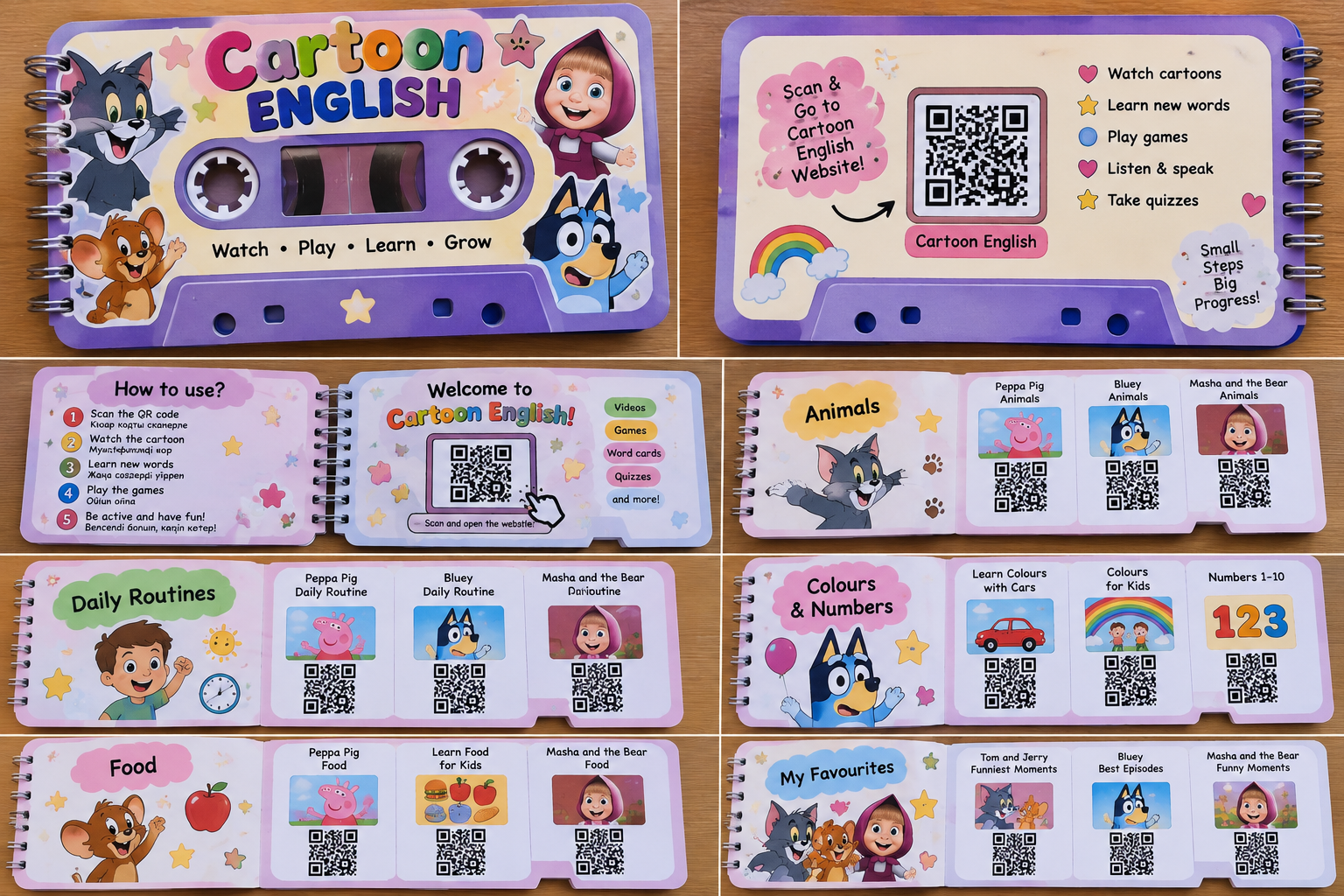
Figure 1. Visual concept of the cassette-shaped Cartoon English notebook and its QR-code pages.
3. PRACTICAL PART
3.1. SELECTING A SUITABLE CARTOON
Before using a cartoon, the teacher or pupil should check it against a simple selection filter. The video should be short, safe, understandable and connected with a clear learning target.
Criterion |
Yes / No |
Question |
Age suitability |
___ |
Is the content appropriate for Grade 3? |
Length |
___ |
Can the episode be used in about 5–10 minutes? |
Language level |
___ |
Are most words familiar or guessable from context? |
Target vocabulary |
___ |
Are 5–10 useful words clearly repeated? |
Visual clarity |
___ |
Can children understand important actions from the pictures? |
Audio quality |
___ |
Is the speech clear enough to hear? |
Learning purpose |
___ |
Can I write one clear learning objective? |
Safety |
___ |
Is the content free from inappropriate scenes or language? |
Follow-up task |
___ |
Can children speak, match, draw or answer after watching? |
3.2. THE “CARTOON ENGLISH” THREE-STAGE MODEL
Stage 1 – BEFORE WATCHING (2–3 minutes). Introduce five to eight target words using pictures, gestures or real objects. Ask one prediction question: “What do you think will happen?” Do not explain every word.
Stage 2 – WHILE WATCHING (3–7 minutes). Children watch for a specific purpose. They can circle a word, point to an object, count how many times they hear a phrase, put pictures in order, or show an action. Avoid stopping the video too often.
Stage 3 – AFTER WATCHING (5–10 minutes). Children use the language. They can answer simple questions, repeat a key phrase, act out a scene, draw a character, match words with pictures, or tell a partner what happened.
Example target: DAILY ROUTINES
Target words: wake up, wash, brush, eat, go to school, play, read, sleep. Before watching, the child matches pictures to words. During watching, the child ticks the routines they see. After watching, the child says: “I wake up. I wash my face. I eat breakfast. I go to school.”
The practical idea is to move from recognition to production. First the learner sees and hears the word; then the learner identifies it; finally the learner uses it.
3.3. SAMPLE CLASSROOM ACTIVITIES
1. Picture Prediction. Show three pictures from the cartoon. Ask: “Who is this? What is he/she doing? What will happen?” Learners use simple words and gestures.
2. Word Hunt. Give learners 6 target words. During the video, they tick a word when they hear it. This gives listening a clear purpose.
3. Freeze and Say. Pause on a clear action. Ask: “What is he doing?” Learners answer with one sentence, for example, “He is running.”
4. Match the Scene. Prepare six small pictures and six target words. After watching, learners match them and explain one match.
5. Echo the Character. Play one short sentence. Learners repeat it with the same rhythm and intonation. Keep the sentence short.
6. Act the Cartoon. Pairs choose a scene and act it out using two or three key phrases.
7. True or False. Read five simple statements about the cartoon. Learners show TRUE/FALSE cards and correct false statements.
8. Story Order. Learners put four pictures in the correct order and retell the story using “First… Then… Finally…”
9. My Favourite Character. Learners draw a character and complete: “This is ____. He/She is ____. He/She likes ____.”
10. One-Minute Retell. After repeated viewing, the learner tells a partner three things that happened. The goal is communication, not perfect grammar.
Mini lesson sequence
Time |
Teacher action |
Learner action |
0–3 min |
Introduce 6–8 target words |
Look, repeat, predict |
3–7 min |
Play short cartoon with task |
Listen, identify, tick |
7–10 min |
Pause / replay key scenes |
Answer and repeat |
10–15 min |
Pair activity |
Speak / act / match |
15–18 min |
Quick check |
Recall target words |
18–20 min |
Reflection |
Say one new word and one thing learned |
This sequence can be adapted to a real English lesson. It is short enough for a primary learner and gives the cartoon a clear pedagogical function.
4. EXPERIMENTAL PART
4.1. RESEARCH DESIGN AND METHODS
The most important part of this project is the pupil’s own evidence. To meet the research criteria, the final competition version should contain real data collected by the pupil with the support of a teacher. The numerical results in this document are intentionally not invented: the tables below are ready for recording the actual results.
Suggested participants. One Grade 3 class or a small volunteer group of approximately 10–20 pupils. If only one pupil is available, the same design can be used as a repeated personal learning experiment, but a group provides stronger comparison data.
Duration. Five short sessions over two weeks. Each session uses a different short cartoon or a different short section of a suitable animated story. The same target words are checked before and after the learning sequence.
Research design. A one-group pre-test/post-test classroom design is suitable for a small school project. The design does not prove that cartoons are the only cause of improvement, because other learning factors may contribute. It can, however, show whether scores changed after the cartoon-based learning sequence.
Experiment procedure
Day 1: explain the project and complete the pre-test without teaching the target words immediately before the test.
Days 2–4: use short cartoons with the “Cartoon English” model. Record observation data.
Day 5: complete the post-test using the same target vocabulary but a slightly different order of items.
After the post-test: ask learners three or four simple questions about their experience.
Calculate each learner’s pre-test and post-test percentage and the group average.
Compare the results and describe what changed, what did not change, and what limitations remain.
Variables
Type |
Variable |
How it is measured |
Independent variable |
Cartoon-based learning routine |
Use of short cartoons with structured tasks |
Dependent variable 1 |
Vocabulary recognition |
Score on pre/post test |
Dependent variable 2 |
Listening comprehension |
Simple listening items / picture choice |
Dependent variable 3 |
Engagement |
Observation checklist |
Dependent variable 4 |
Learner attitude |
Short questionnaire |
4.2. RESEARCH INSTRUMENTS
A. Vocabulary and Listening Pre-Test / Post-Test
Use 20 items. Give 1 point for each correct answer. Maximum = 20 points. The same target words should be taught during the intervention. For the post-test, change the order of the questions to reduce simple memorisation of the answer positions.
No. |
Item type |
Example |
Point |
1–5 |
Picture → word |
Choose: apple / cat / blue |
1 each |
6–10 |
Word → picture |
Circle the picture for “jump” |
1 each |
11–15 |
Listening → meaning |
Hear “sleep” and choose the correct picture |
1 each |
16–18 |
Phrase completion |
“I ____ breakfast.” |
1 each |
19–20 |
Short comprehension |
Choose the correct action after hearing a sentence |
1 each |
Score formula: Percentage = (number of correct answers ÷ 20) × 100.
B. Observation Checklist
Indicator |
0 = not observed |
1 = sometimes |
2 = often |
Pays attention to the cartoon |
☐ |
☐ |
☐ |
Recognises target words |
☐ |
☐ |
☐ |
Repeats a phrase willingly |
☐ |
☐ |
☐ |
Uses a word without prompting |
☐ |
☐ |
☐ |
Answers a simple question |
☐ |
☐ |
☐ |
Participates with a partner |
☐ |
☐ |
☐ |
Shows positive engagement |
☐ |
☐ |
☐ |
Maximum observation score = 14 per learner per session. The observer should focus on behaviour, not on whether the learner is “good” or “bad”.
C. Learner Questionnaire
I like learning English with cartoons. Yes / Sometimes / No
I can understand some words because I can see what is happening. Yes / Sometimes / No
I like repeating the characters’ words. Yes / Sometimes / No
Cartoons help me remember new words. Yes / Sometimes / No
My favourite activity is: watching / matching / speaking / acting / drawing.
4.3. DATA ANALYSIS AND RESULTS
The competition rubric requires independent data collection or processing and clear presentation of results. Therefore, the final version of this section must contain the actual scores obtained in the pupil’s experiment. The table below is a recording template.
Learner |
Pre-test /20 |
Pre % |
Post-test /20 |
Post % |
Change |
1 |
____ |
____ |
____ |
____ |
____ |
2 |
____ |
____ |
____ |
____ |
____ |
3 |
____ |
____ |
____ |
____ |
____ |
4 |
____ |
____ |
____ |
____ |
____ |
5 |
____ |
____ |
____ |
____ |
____ |
6 |
____ |
____ |
____ |
____ |
____ |
7 |
____ |
____ |
____ |
____ |
____ |
8 |
____ |
____ |
____ |
____ |
____ |
9 |
____ |
____ |
____ |
____ |
____ |
10 |
____ |
____ |
____ |
____ |
____ |
Group average |
____ |
____ |
____ |
____ |
____ |
Group average formula: add all learner percentages and divide by the number of learners. Improvement in percentage points = post-test group average – pre-test group average.
Illustrative calculation (NOT research data)
Example only: if a learner scores 11/20 on the pre-test, the score is 55%. If the same learner scores 17/20 on the post-test, the score is 85%. The improvement is 30 percentage points. This example demonstrates the calculation and must not be presented as the pupil’s actual result.
How to make the final diagram
Create a simple two-column bar chart: PRE-TEST GROUP AVERAGE and POST-TEST GROUP AVERAGE. Write the exact percentages above the bars. Under the chart, write two or three sentences explaining the change. If the score does not increase, report that honestly and explain possible reasons.
Example interpretation frame
“The pre-test group average was ____%. After the cartoon-based learning activities, the post-test group average was ____%. The difference was ____ percentage points. The observation checklist showed that learners were most engaged during __________. The questionnaire showed that ____ out of ____ learners chose ‘Yes’ for the statement __________. These results suggest __________, but the small sample and short intervention mean that the findings should be interpreted carefully.”
5. CONCLUSIONS, PRACTICAL SIGNIFICANCE AND LIMITATIONS
5.1. CONCLUSIONS
The theoretical review shows that cartoons can be useful English-learning resources for young learners when they provide clear visual context, understandable speech, repetition, meaningful situations and opportunities for interaction. Recent research has reported positive relationships between animated-video use and vocabulary, listening, engagement or participation [4–10].
The practical analysis shows that the educational value of a cartoon depends on what the learner does with it. Watching without a task can remain entertainment. Watching with a clear target, noticing words, answering questions, repeating phrases and speaking afterwards creates a learning sequence.
The proposed “Cartoon English” model is simple enough for Grade 3: BEFORE WATCHING → WHILE WATCHING → AFTER WATCHING. This structure can be applied to vocabulary, listening, pronunciation, grammar in context and speaking.
The experiment is designed to provide the project’s own evidence. A pre-test and post-test can show change in measurable learning outcomes, while observation and a questionnaire can show engagement and learner perception. Using several instruments is stronger than relying on one score.
5.2. PRACTICAL SIGNIFICANCE
Teachers can use short cartoons as an additional resource rather than as a replacement for systematic teaching.
Parents can support English exposure by choosing short, safe and age-appropriate videos and discussing them with children.
Pupils can use the three-stage model independently with a teacher-approved cartoon.
Schools can use the observation checklist and short tests for small classroom action-research projects.
The method can be adapted to topics such as animals, food, family, school, colours, routines, hobbies and weather.
5.3. LIMITATIONS
The sample may be small, so results cannot be generalised to all third-grade pupils.
A short experiment cannot measure long-term vocabulary retention unless a delayed test is added.
Learners differ in previous English exposure, attention and confidence.
The researcher may be influenced by expectations, so simple scoring rules and clear instruments are important.
Cartoons differ in language difficulty, speed and quality; therefore, the selection criteria matter.
5.4. REFLECTION
“What did I learn?” The project helps the pupil understand that research is not only searching for information. A researcher asks a question, chooses a method, collects evidence, compares results and explains limitations. The most important lesson is that a fun activity becomes research when it has a clear question and measurable evidence.
Final statement
Cartoons do not teach English automatically. They become powerful learning tools when a learner watches with a purpose, notices language, repeats it, uses it and reflects on the result.
6. REFERENCES
1. Council of Europe. (2020). Common European Framework of Reference for Languages: Learning, Teaching, Assessment – Companion Volume. Council of Europe. https://www.coe.int/en/web/common-european-framework-reference-languages
2. British Council. (2026). English language videos. LearnEnglish Kids. https://learnenglishkids.britishcouncil.org/parents/top-tips/english-language-videos
3. Ministry of Education and Science of the Republic of Kazakhstan. (2018). Order No. 604: On approval of state compulsory educational standards for all levels of education. Adilet legal information system. https://adilet.zan.kz/eng/docs/V1800017669
4. Mukazhanova, A., Rybalkina, Y., & Gavrilova, Y. (2022). Using Cartoons and Animated Films to Teach Listening Skills to Young Learners. European Proceedings of Social and Behavioural Sciences, 125, 1258–1263. https://doi.org/10.15405/epsbs.2022.03.149
5. Alameen, A. A. M. (2024). Enhancing Young EFL Learners’ Vocabulary Learning Through Contextualizing Animated Videos. Theory and Practice in Language Studies, 14(2), 578–586. https://doi.org/10.17507/tpls.1402.31
6. Setiawati, D. F., & Septiana, A. R. (2022). The Use of Animated Videos in Teaching Vocabulary for Young Learners. Wanastra: Jurnal Bahasa dan Sastra, 14(2). https://ejournal.bsi.ac.id/
7. British Council. (2026). LearnEnglish Kids: Playtime. LearnEnglish Kids. https://learnenglishkids.britishcouncil.org/en/apps/learnenglish-kids-playtime
8. Muftah, M. (2023). Implementing Animated Videos to Enhance Vocabulary Comprehension among Early Childhood EFL Learners. MEXTESOL Journal, 47(4), 1–13. https://doi.org/10.61871/mj.v47n4-9
9. Riyanto, R. F., Astutik, Y., Agustina, S., Mongboon, N., & Pribadi, I. (2025). Integrating Animated Videos, Songs, and Games to Enhance Young Learners’ Vocabulary Learning in EFL Classrooms. ELLITE: Journal of English Language, Literature, and Teaching, 10(2), 93–105. https://doi.org/10.32528/ellite.v10i2.3692
10. Bajec, M. L., Železnik, B., & Pižorn, K. (2025). Cartoons as a Tool for Incidental Vocabulary Acquisition in Year 6 EFL Pupils. European Journal of Educational Research, 14(3), 1015–1030. https://doi.org/10.12973/eu-jer.14.3.1015
7. APPENDIX: RESEARCH MATERIALS
The following materials should be printed or copied into the researcher’s notebook and used during the real classroom experiment.
Research diary prompts
Date: __________ Cartoon/topic: __________________________
What was my research goal today? __________________________
Which target words did I choose? ___________________________
What did learners do well? _________________________________
What was difficult? ________________________________________
What changed from the previous session? ____________________
What will I improve next time? ______________________________
APPENDIX A. READY-TO-USE TEST AND RUBRIC
Sample 20-item vocabulary/listening test
1. Choose the correct word for a picture: CAT / BUS / TREE.
2. Choose the correct word for a picture: RUN / SLEEP / EAT.
3. Choose the correct colour: RED / BIG / HAPPY.
4. Choose the correct word for a picture: SCHOOL / APPLE / BALL.
5. Choose the correct word for a picture: JUMP / READ / OPEN.
6. Match the word “dog” with the correct picture.
7. Match the word “blue” with the correct picture.
8. Match the word “eat” with the correct picture.
9. Match the word “sleep” with the correct picture.
10. Match the word “book” with the correct picture.
11. Listen and choose the picture for “run”.
12. Listen and choose the picture for “drink”.
13. Listen and choose the picture for “school”.
14. Listen and choose the picture for “happy”.
15. Listen and choose the picture for “open the door”.
16. Complete: “I ____ breakfast.” (eat / blue)
17. Complete: “I ____ to school.” (go / red)
18. Complete: “This is my ____.” (book / run)
19. Listen: “The boy is sleeping.” Choose the correct picture.
20. Listen: “The girl has a red ball.” Choose the correct picture.
Scoring rubric for the project evidence
Criterion |
Excellent evidence in the final version |
Research question |
Clear, specific and connected to a real Grade 3 learning need. |
Aim, tasks and logic |
Tasks directly answer the research question and lead to the experiment. |
Methods and ethics |
Age-appropriate method, clear procedure, safe materials and fair treatment. |
Data and analysis |
Real pupil-collected data, calculations, comparison, table and diagram. |
Sources and academic honesty |
Reliable sources, correctly listed; the pupil explains what was personally done. |
Conclusions and reflection |
Conclusions are based on data; limitations and “What did I learn?” are included. |
Presentation |
Short, clear, visual, age-appropriate and understandable scientific communication. |
Questions |
The pupil can explain the problem, method, results and personal contribution. |
IMPORTANT FOR THE FINAL SUBMISSION: Replace every blank in the data tables with the pupil’s real experiment results. Add one photo of the experiment or a screenshot of the pupil’s own worksheet only if the school permits it and no child’s private information is exposed. Add the final bar chart. This is essential for demonstrating independent data collection and processing under the Zerde criteria.









 Бұл курс Қазақстан Республикасы Оқу-ағарту министрлігімен келісілген










