|
Unit: 2
|
Physical education and
sports
|
|
Teachers’
name: Kadyrberliyeva
A.M.
|
Schools: school-gymnasium named after
K.Satbayev
|
|
Date:
07.10.2025.
|
|
|
Class:
9
|
Number
present:
|
Number
absent:
|
|
Theme of the
lesson
|
Language focus. May, might,
could, must, can’t. P.23
|
|
Learning objective
(s)
|
9. 5. 3. 1 write familiar
general and study topics with uniform grammatical
competence;
9.6.13.1 use a variety of
modal forms for different functions and a limited number of past
modal forms including should/ shouldn’t have to express regret and
criticism on range of familiar general and curricular
topics
|
|
Lesson
objectives
|
-
Identify and use modal verbs
(may, might, could, must, can’t) correctly in
context.
-
Distinguish between certainty
and possibility.
-
Use modal verbs to make
logical guesses and express opinions in spoken and written
form.
|
|
Values
|
|
|
Plan
|
|
Stages of the
lesson
|
Teacher’s
activities
|
Students’
activities
|
Assessment
|
Resources
|
|
Pre-learning (7 min)
|
Teacher starts lesson
with Warming-Up.
Ask
students:“What do you think these posters
mean?” Teacher gives motivations with these posters
to students.
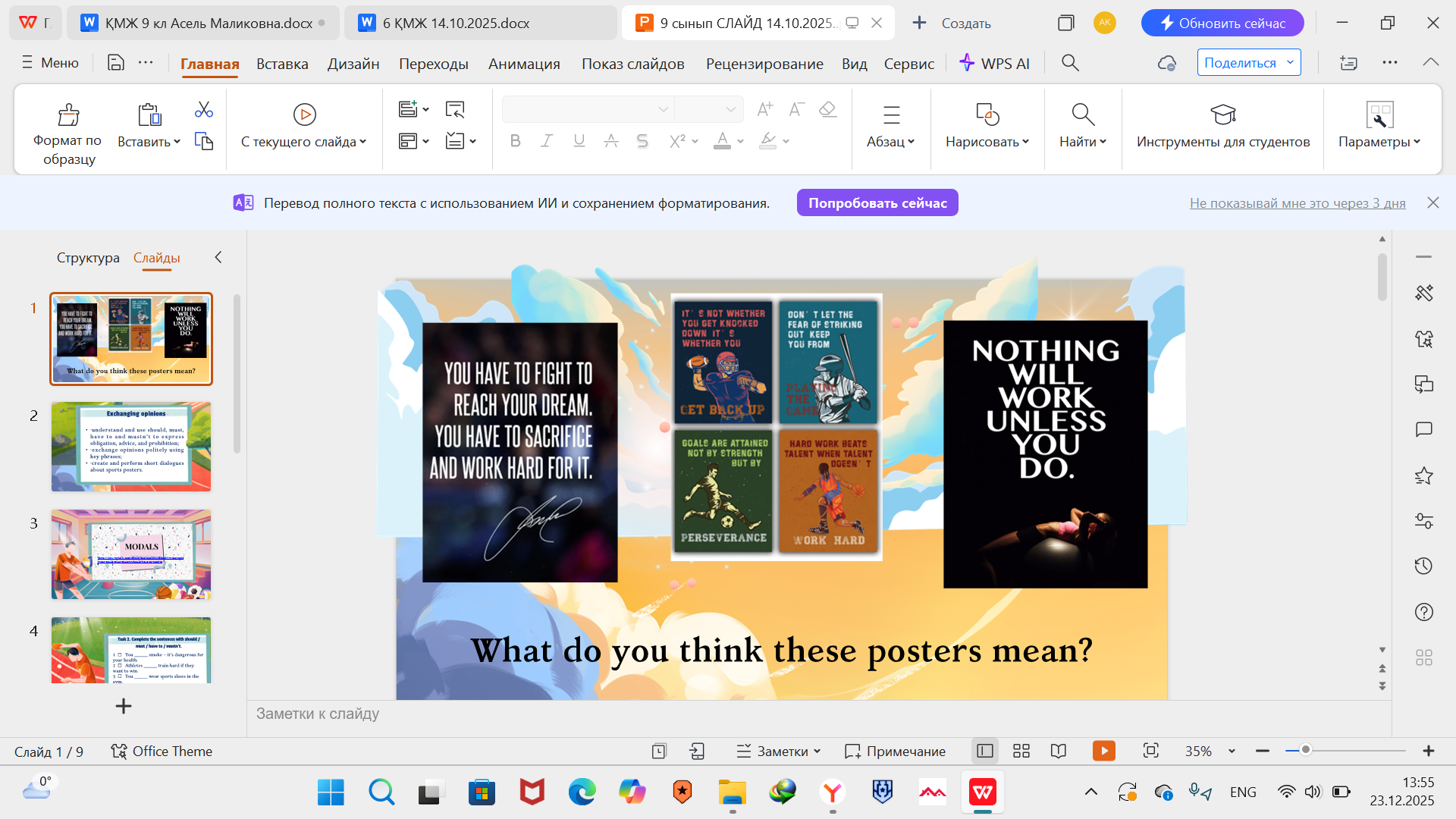 Introduce the
topic: Today we’ll learn how to use
modal verbs – may, might, could, must, can’t – to talk about
possibility and certainty. Introduce the
topic: Today we’ll learn how to use
modal verbs – may, might, could, must, can’t – to talk about
possibility and certainty.
|
Share their ideas about and
answer the teacher’s question.
Ss discuss posters with each
others.
|
Descriptor: Gives 1–2 examples of healthy
habits.
Point: 1
|
Board,
pictures,
PPT
|
|
While-learning (Grammar focus)
(10 min)
|
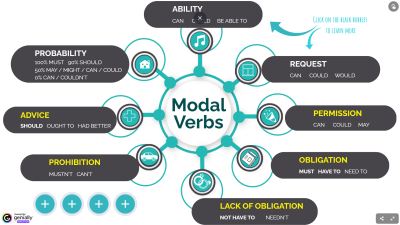
Ex.1: Present sentences 1–5
with modal verbs in blue. Explain the rules use
Genially:
✅
may / might /
could →
possibility
✅
must
→
certainty
✅
can’t → impossibility
Ask students to choose correct rules a–c.
|
Read the sentences and
identify correct rules about modal verbs.
|
Descriptor: Identifies the correct rule
for modal verbs.
Point: 1
|
SB
p.23 Ex.1
https://view.genially.com/65914ac095aaba001411fd52/presentation-modal-verbs
|
|
While-learning (Practice 1) (8
min)
|
Ex.2: Ask students to choose
the correct modal verb (may, might, must,
can’t) in each
sentence. Check answers together as a
class.
|
Complete the sentences with
the correct modal verb and compare answers in
pairs.
|
Descriptor: Uses correct modals in at
least 4–6 sentences.
Points: 2
|
SB
p.23 Ex.2
|
|
While-learning (Practice 2) (10
min)
|
Ex.3: Instruct students to
make sentences using the modal verbs and words in brackets.
Model one example: Sarah is crying. She may be in
pain.
Play game in
bamboozle

|
Write their own 6 sentences
using modal verbs and share answers with a
partner.
|
Descriptor: Writes 5–6 correct sentences
using modal verbs.
Points: 3
|
SB
p.23 Ex.3
https://www.baamboozle.com/classic/17584
|
|
Post-learning (Speaking task)
(8 min)
|
Ex.4: Organize pair work.
Students exchange opinions about the topics (1–6) using words in
the box (be fun, be effective, relax,
hurt, be boring).
Example: A: I think acupuncture might
be effective.
B: It must
hurt.
|
Discuss in pairs using modal
verbs and phrases from the box.
Students count their
scores.
|
Descriptor: Uses 3–4 modal verbs correctly
in conversation.
Points: 3
Total
points: 10
scores
|
SB
p.23 Ex.4
|
|
Reflection (2–3 min)
|
Ask:
“What new modal verbs did we
use today?” and
“What can you use
may/must/can’t for?” 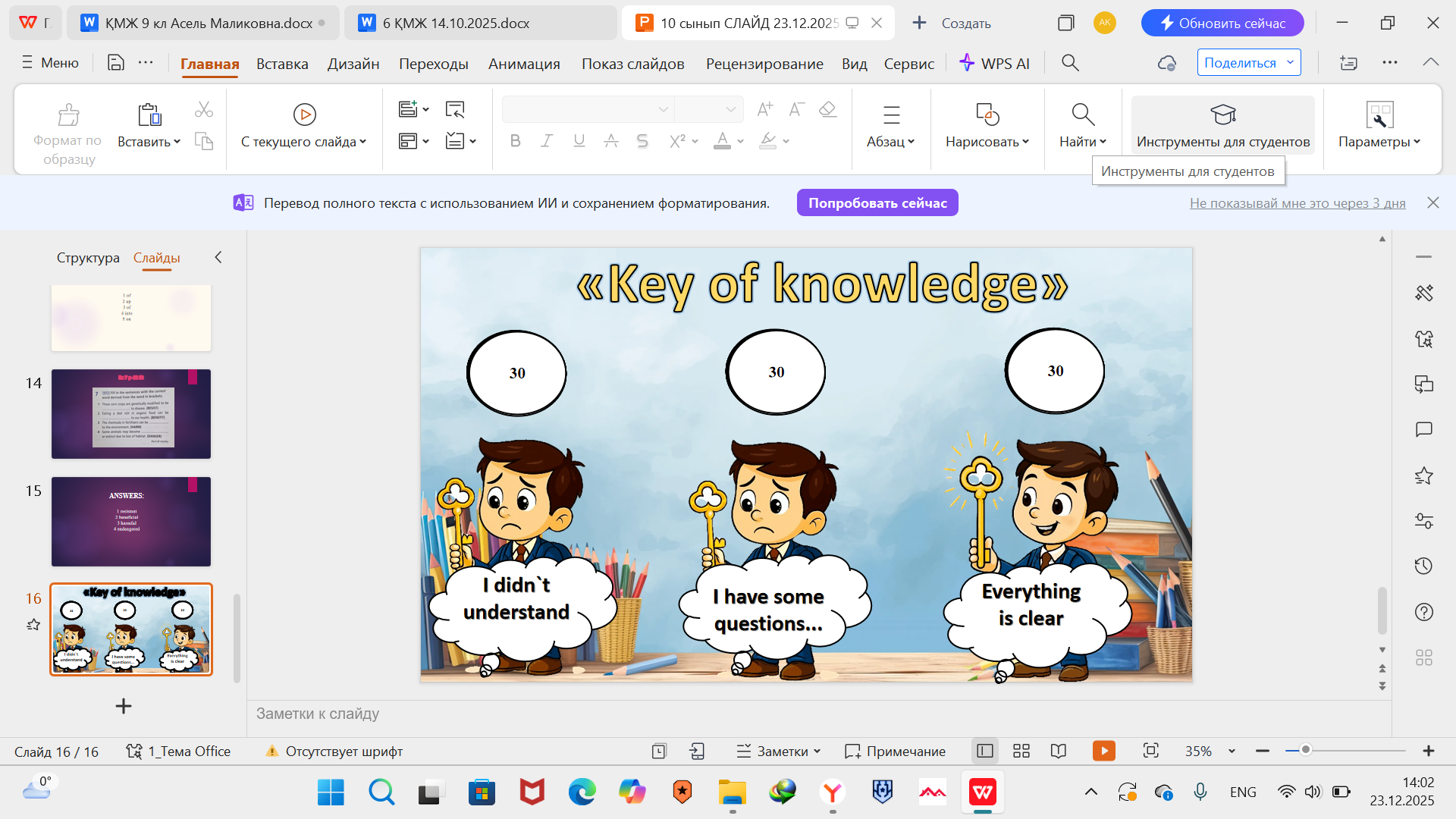
|
Share what they learned and
self-assess their understanding.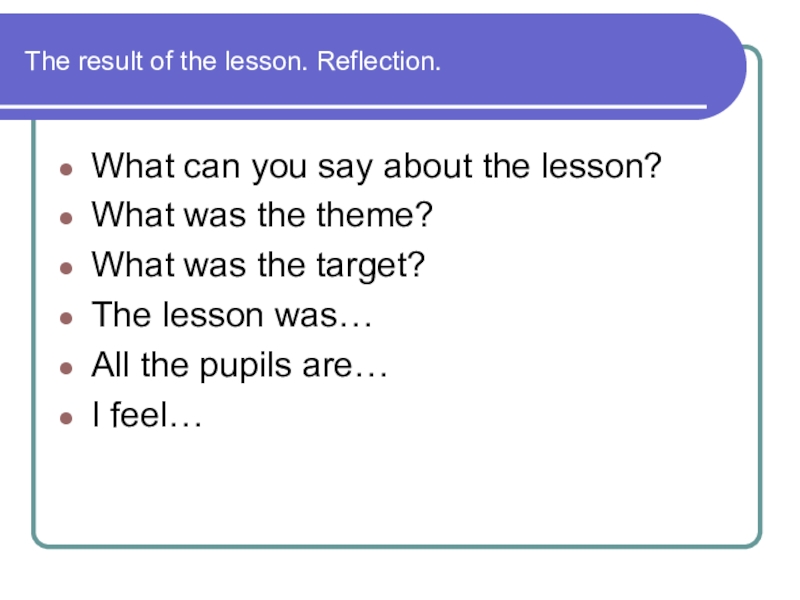
|
Participates in reflection and
names at least one new modal.
|
Stickers, board
|
|
Homework
|
Write 5 sentences
using may, might, could, must,
can’t about health and
sports.
|
Complete sentences at home.
|
—
|
Workbook
|

 ЖИ көмекші




 Жүктеу