Short term plan: term 4
|
Unit of a long term plan: Unit 9 Transport. |
School: 214 Secondary school |
||
|
Date: |
Teacher name: Maken Zhanbota |
||
|
Grade: 6 |
Number present: |
absent: |
|
|
Lesson title |
Language Focus. Past Simple of regular verbs |
||
|
Learning objectives |
6.2.1.1 understand a sequence of supported classroom instructions 6.6.9.1 use simple present and simple past regular and irregular forms to describe routines, habits and states on a limited range of familiar general and curricular topic 6.3.1.1 provide basic information about themselves and others at sentence level on an increasing range of general topics |
||
|
Lesson objectives |
Learners will be able to: • Learn the affirmative and negative past simple forms of regular verbs. • Write affirmative and negative sentences using the past simple. • Learn the use of different time expressionsto talk about time in the past. |
||
|
Plan |
|||
|
Stages / Time |
Teachers’ actions |
Students’ actions |
Assessment criteria |
Resources |
|
Beginning of the lesson 5 min |
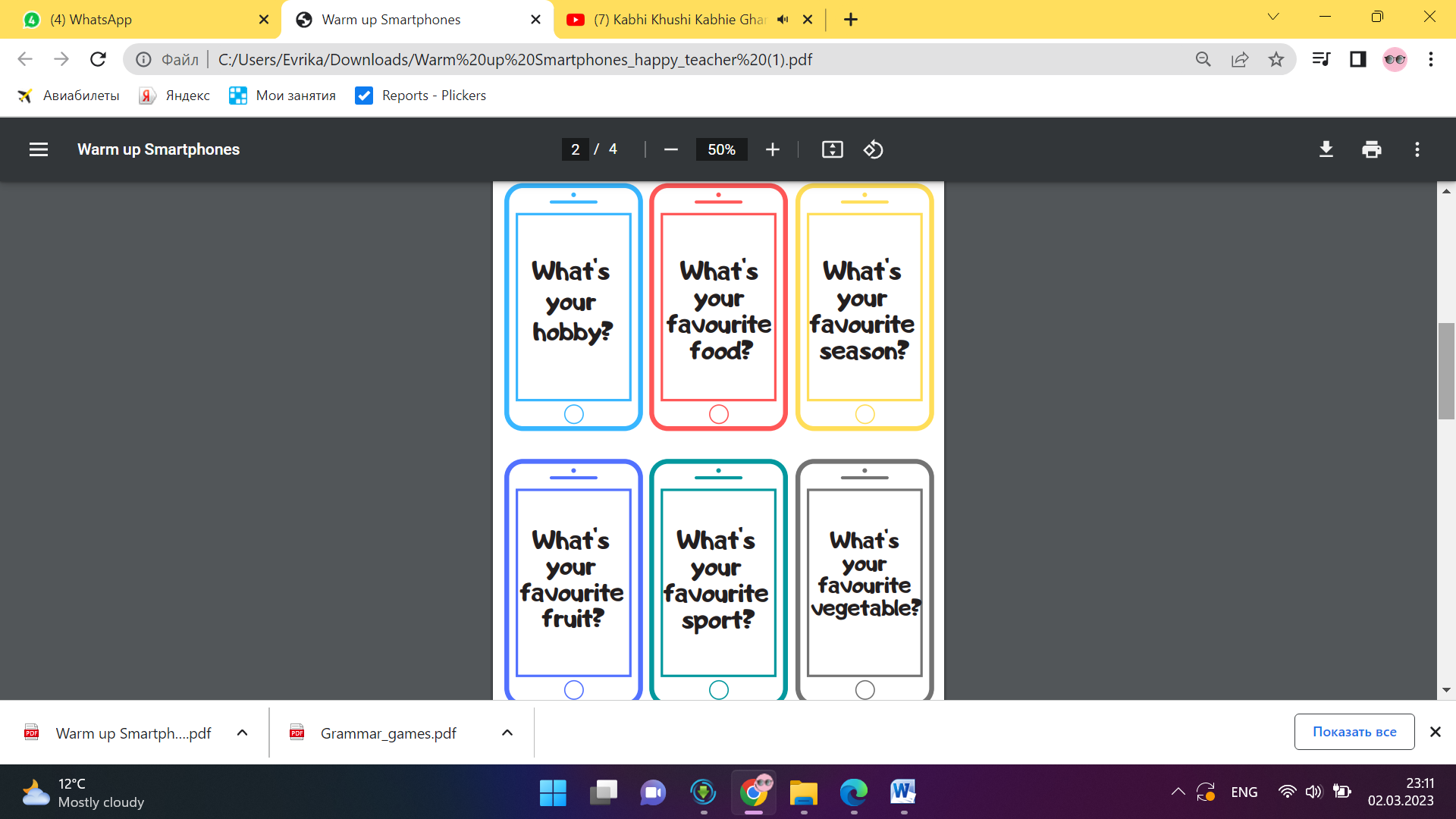
Organization moment 1.Greeting. Ask about the weather. The teacher sets the lesson objectives, letting students know what to anticipate from the lesson. Warm-up Method speaking phone was used to develop speaking skills.
Lead – In • Write on the board: Lions eat grass. • Elicit that the sentence is not true, and elicit the negative form: Lions don’t eat grass. • Write on the board: Columbus discovered Australia. • Elicit that the sentence is not true, and ask students how they would make this verb negative. • Elicit some ideas, but do not give students the answer. |
Students' attention is drawn to the lesson. Students discuss the pictures in pairs. Determines the topic and aim of the lesson Students say different words from the picture |
Formative Assessment
Good job! Assessment criteria -Identify detailed information in extended conversation with support |
Pictures Student’s book |
|
Middle of the lesson Presentation part. 35 min |
Ex: 1 P:109 • Students study the sentences. Elicit that the blue words are time expressions, and that they refer to the present or the past. Ex: 2 P:109 • Allow students time to complete the rules individually, then check answers with the class. In a weaker class, do it as a whole class activity. LANGUAGE NOTE In negative
sentences in the past simple we use the base form of the verb, not
the past tense form: He didn’t play football. NOT
Ex: 3 P:109 • Read the example with the class. Point out that some of the affirmative sentences will be factually incorrect, so they should write correct sentences for these ones. • Ask students to compare their answers in pairs. They may need to refer to other sources to find the answers to these. If possible, allow them time to do this in class Conclusion during the lesson some tasks differentiated by outcomes of the students and by their abilities. |
Students study the sentences and the words in blue. Which sentences refer to the present and which refer to the past? How do you know? Answers: 1 present 2 past 3 present 4 past ‘Now’ and ‘every Friday’ refer to the present. ‘In 2009’ and ‘last week’ refer to the past. Differentiation: «Verbal support» method is used to help Students use new words in the text. Students read and complete the rules. Answers: 1 Europeans explored Africa in the 18th century. False. Europeans explored Africa in the 19th century. 2 Tutankhamen lived in Egypt a long time ago. True. 3 The first astronauts visited space in 1981. False. The first astronauts visited space in 1961 4 Columbus arrived in South America about 500 years ago. False. Columbus arrived in Central America about 500 years ago. 5 People stopped using horses for transport in the 19th century. False. People stopped using horses for transport in the 20th century. Students write affirmative sentences using the past simple. Are they true or false? |
Descriptor: - refer to the present or the past. -identify the tenses Total: 1 point Descriptor: - complete the rules individually Total: 1 point Answers: |

Worksheets |

|
End of the lesson 5 min |
FEEDBACK Learners provide feedback on what they have learned at the lesson. |
|
Students evaluate each other and encourage classmate with phrases like: Well done! Brilliant! |
Poster
|
жүктеу мүмкіндігіне ие боласыз
Бұл материал сайт қолданушысы жариялаған. Материалдың ішінде жазылған барлық ақпаратқа жауапкершілікті жариялаған қолданушы жауап береді. Ұстаз тілегі тек ақпаратты таратуға қолдау көрсетеді. Егер материал сіздің авторлық құқығыңызды бұзған болса немесе басқа да себептермен сайттан өшіру керек деп ойласаңыз осында жазыңыз
Language Focus. Past Simple of regular verbs
Short term plan: term 4
|
Unit of a long term plan: Unit 9 Transport. |
School: 214 Secondary school |
||
|
Date: |
Teacher name: Maken Zhanbota |
||
|
Grade: 6 |
Number present: |
absent: |
|
|
Lesson title |
Language Focus. Past Simple of regular verbs |
||
|
Learning objectives |
6.2.1.1 understand a sequence of supported classroom instructions 6.6.9.1 use simple present and simple past regular and irregular forms to describe routines, habits and states on a limited range of familiar general and curricular topic 6.3.1.1 provide basic information about themselves and others at sentence level on an increasing range of general topics |
||
|
Lesson objectives |
Learners will be able to: • Learn the affirmative and negative past simple forms of regular verbs. • Write affirmative and negative sentences using the past simple. • Learn the use of different time expressionsto talk about time in the past. |
||
|
Plan |
|||
|
Stages / Time |
Teachers’ actions |
Students’ actions |
Assessment criteria |
Resources |
|
Beginning of the lesson 5 min |
Organization moment 1.Greeting. Ask about the weather. The teacher sets the lesson objectives, letting students know what to anticipate from the lesson. Warm-up Method speaking phone was used to develop speaking skills.
Lead – In • Write on the board: Lions eat grass. • Elicit that the sentence is not true, and elicit the negative form: Lions don’t eat grass. • Write on the board: Columbus discovered Australia. • Elicit that the sentence is not true, and ask students how they would make this verb negative. • Elicit some ideas, but do not give students the answer. |
Students' attention is drawn to the lesson. Students discuss the pictures in pairs. Determines the topic and aim of the lesson Students say different words from the picture |
Formative Assessment
Good job! Assessment criteria -Identify detailed information in extended conversation with support |
Pictures Student’s book |
|
Middle of the lesson Presentation part. 35 min |
Ex: 1 P:109 • Students study the sentences. Elicit that the blue words are time expressions, and that they refer to the present or the past. Ex: 2 P:109 • Allow students time to complete the rules individually, then check answers with the class. In a weaker class, do it as a whole class activity. LANGUAGE NOTE In negative
sentences in the past simple we use the base form of the verb, not
the past tense form: He didn’t play football. NOT
Ex: 3 P:109 • Read the example with the class. Point out that some of the affirmative sentences will be factually incorrect, so they should write correct sentences for these ones. • Ask students to compare their answers in pairs. They may need to refer to other sources to find the answers to these. If possible, allow them time to do this in class Conclusion during the lesson some tasks differentiated by outcomes of the students and by their abilities. |
Students study the sentences and the words in blue. Which sentences refer to the present and which refer to the past? How do you know? Answers: 1 present 2 past 3 present 4 past ‘Now’ and ‘every Friday’ refer to the present. ‘In 2009’ and ‘last week’ refer to the past. Differentiation: «Verbal support» method is used to help Students use new words in the text. Students read and complete the rules. Answers: 1 Europeans explored Africa in the 18th century. False. Europeans explored Africa in the 19th century. 2 Tutankhamen lived in Egypt a long time ago. True. 3 The first astronauts visited space in 1981. False. The first astronauts visited space in 1961 4 Columbus arrived in South America about 500 years ago. False. Columbus arrived in Central America about 500 years ago. 5 People stopped using horses for transport in the 19th century. False. People stopped using horses for transport in the 20th century. Students write affirmative sentences using the past simple. Are they true or false? |
Descriptor: - refer to the present or the past. -identify the tenses Total: 1 point Descriptor: - complete the rules individually Total: 1 point Answers: |
Worksheets |
|
End of the lesson 5 min |
FEEDBACK Learners provide feedback on what they have learned at the lesson. |
|
Students evaluate each other and encourage classmate with phrases like: Well done! Brilliant! |
Poster
|
шағым қалдыра аласыз