
 ЖИ көмекші


 Қауіпсіз төлем

жүктеу мүмкіндігіне ие боласыз
Бұл материал сайт қолданушысы жариялаған. Материалдың ішінде жазылған барлық ақпаратқа жауапкершілікті жариялаған қолданушы жауап береді. Ұстаз тілегі тек ақпаратты таратуға қолдау көрсетеді. Егер материал сіздің авторлық құқығыңызды бұзған болса немесе басқа да себептермен сайттан өшіру керек деп ойласаңыз осында жазыңыз
 05 Маусым 2019
 933

1 жыл бойы шексіз жүктеңіз
Language in Kazakhstan
LANGUAGE IN KAZAKHSTAN
The knowledge of English has become an objective social need because for millions of people the English language is now a tool of their Trade. Businessmen, tradesmen, engineers, scientists and scholars all over the world must know English because it is the international means of exchanging information and experience.
There are many reasons why we study English. Now, in a period when we are reconstructing our economy, when there are many joint ventures with foreign companies operating in our country, we need a number of specialists who know foreign languages. If you now English, you can communicate with others who use the language. If you wish to make a career in science, you must read scientific books and magazines in English. Knowing English you can read the works of foreign writers. A more general aim is to broaden our intellectual and cultural horizons through contacts with people of other countries. Knowledge of foreign languages helps people to develop mutual friendship and understanding.
As Kazakhstan a way of active integration to the world community a special value is given to English language, the language of the international cooperation. President of Rebublic of Kazakhstan pays a great attention to education and especially to vital importance for the acquisition of English language in his annual messages to the people of Kazakhstan. Teaching English in Kazakhstan requires high-quality instruction, culturally appropriate lessons, a creative imagination and an adventuresome and flexible spirit.
English is the international language all over the world. And there are several results of it.
The first is that English is the language of international air traffic control, and is currently developing its role in international maritime, policing, and emergency services. The second is that English is the chief language of international business and academic conferences, and the leading language of international tourism. And finally is that it is the main language of popular music, advertising, satellite broadcasting, home computers, and video games.
I think English plays an important role in our life not because that it helps to communicate with people from other countries but also because it helps to know more about other cultures, traditions and habits.
Kazakh and Russian are official languages for commercial purposes. Kazakh, spoken by 64.4 percent of the population, is the official “state” language, and Russian, spoken by 95 percent of the population, is designated as the “language of interethnic communication” and is used in everyday business. In 2006 President Nazarbayev proposed that Kazakhstan switch from the Cyrillic to the Latin alphabet.
The Russification program in Kazakhstan was successful. Many Kazakhs speak Russian better than Kazakh. Kazakh first became a state language in the late Soviet period, when few of the republic's Russians gave serious thought to the possibility that they might need Kazakh to retain their employment, to serve in the armed forces, or to have their children enter a Kazakhstani university. At that point, fewer than 5 percent of Russians could speak Kazakh, although the majority of Kazakhs could speak Russian. However, with the separation between Russia and Kazakhstan that followed independence, Russian nationalist sentiment and objections to alleged discrimination in official language policies have increased, especially in the north, as Russians have felt the threat of Kazakh becoming the sole legal state language. Meanwhile, Kazakhs have strongly defended the preeminence of their tongue, although mastery of the language is far from universal even among Kazakhs. According to some estimates, as much as 40 percent of the Kazakh population is not fluent in Kazakh.
English is not nearly as widely spoken as it is in Western Europe, and even Russia. More and more people, though, especially young people, are learning it. In the cities and tourist industry you will find some people that speak English. In the early 2000s, German outstripped English as the non-Kazakh-or-Russian language of choice in Kazakhstan. Many Kazakhs struggle to learn German as a means of getting ahead. Others were ethnic Germans living in Kazakhstan are people with some ethnic German blood. Most of the people studying German outside Germany are in eastern Europe and the former republics of the Soviet Union. At one time about half of the school children in Kazakhstan were studying in German.
Kazakhstan is a multiethnic state. Currently, apart from Kazakhs, making 65% of the total population, more than 120 nations and ethnic groups live in Kazakhstan. It is a bilingual country: the Kazakh language has the status of the “state” language, while Russian is declared the “official” language, and is used routinely in business.
Fist President Nursultan Nazarbayev has called Kazakhstan citizens to learn three languages – Kazakh, Russian and English. “Kazakhstan has to know its official language – the Kazakh language. The Russian language is the language of our big neighbor and one of the six UN languages. This language enabled us to access the great literature, the great culture. We need the English language to enter the global arena,” said the President.
More and more foreign companies operating in Kazakhstan need to communicate using local languages. Trade negotiations, business transactions, export and import deals, financial agreements, business contracts, and more, are all enabled thanks to the services of professional translators.
We at FORTE are not only providing a much-needed service in Kazakhstan, we are also keeping the beauty and diversity of languages alive.
Language
 Kazakh
is part of the Kipchak family of Turkic languages, its closest
linguistic relatives within that family including Karakalpak and
Nogay.
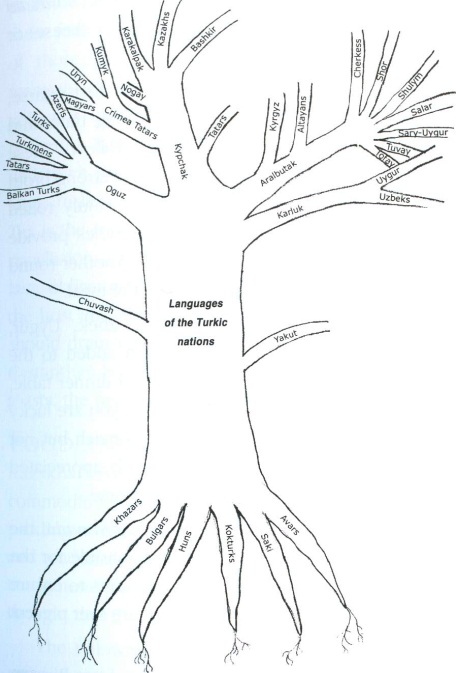
The first Kazakh linguist. Akhmet Baytursinuly, designed a language family tree almost 100 years ago, showing the origins and branching of the Turkic nations' tongues. Apart from the Turks, the Kyrgyz, Turkmen, Uzbek, Azeri, Tatar, Uygur, Bashkir and many other peoples belong to this group, and their various languages are strongly interrelated. A distinction of the Turkic languages that clearly sets them apart from the Indo-European language family is their grammar. All words are formed according to a specific system that consists of a mainly unchanging root to which large numbers of prefixes and suffixes are added.
It is hard to tell how many of the 10 million or so Kazakhs worldwide are masters of their mother tongue. Due to their Soviet past many Kazakhs, especially in the cities, speak Russian rather than Kazakh. Though Kazakh is the official state language, Russian is recognized as the lingua franca. Many Kazakh words have been borrowed from Russian, eg tramvay (tram) and svetofor (traffic light), and words from other languages have also been appropriated. Taxi, teatr, telefon, politika, kompas - many terms introduced in the 19th and 20th centuries have entered the Kazakh lexicon.
Kazakh was established in 1989 as the official language of Kazakhstan, a status confirmed under the 1993 Constitution. It has been written in several different alphabets. An Arabic script was traditionally used, although the Tsarist Russian authorities encouraged the use of a Cyrillic alphabet devised by the Kazakh educator Ibrai Altynsarin. This was not widely taken up, however. In the late 1920s the Soviet authorities switched to the use of a Latin-based alphabet, though this in turn was replaced in 1940 by a revised Cyrillic alphabet developed by Sarsen Amanzholov. A Latin script is however used to render Kazakh on some internet-based sources, and is also widely used informally by the Kazakh diaspora in Turkey and Western countries. The government of Kazakhstan did examine the case for moving officially from a Cyrillic- to Latin-based script, following the example of some other countries of the former Soviet Union, but President Nazarbayev decided that as it would cost US$300 million and take between ten and 12 years, it was not a priority.
Russian retains a formal status as the 'language of interethnic communication, and in many ways remains the lingua franca in Kazakhstan as it is spoken by 84% of Kazakhstanis. Kazakh is not widely spoken among the country's ethnic Russian and other Slavonic minorities, and the legacy of the Soviet Union, in which knowledge of the Russian language was an important requirement for career success, has meant that in urban areas in particular many ethnic Kazakhs who were educated in Russian-medium schools, do not have a good knowledge of Kazakh either. But the position of Kazakh is gradually strengthening. Hie in-migration of ethnic Kazakh oraltnans, many of whom do not speak Russian, and higher rates of out-migration of ethnic Russian and Slavonic groups, have altered the demographic picture since independence.
The government has introduced a number of measures to promote the Kazakh language, for example television and radio stations are required to provide at least 50% of their broadcasting in Kazakh; civil servants who are not ethnic Kazakhs receive a pay bonus if they are able to speak good Kazakh; and the Constitution provides that the president must be a fluent speaker of the language. There is a strong regional dimension to Kazakh- and Russian-language abilities. In the southern regions of South Kazakhstan and Kyzylorda in particular, the Kazakh language is clearly dominant, and you will hear little Russian spoken. In Petropavl in North Kazakhstan the reverse is true.
President Nazarbaev has urged citizens of Kazakhstan to master three languages: Kazakh, Russian and English. The emphasis placed by the government on encouragement of knowledge of English, as a global language, to bolster the economic competitiveness of Kazakhstan, is demonstrated by its focus on the teaching of English in schools and in the government-funded scholarships provided under its Bolashak programme for study at universities in the United States and United Kingdom. You will find some English spoken in hotels, restaurants and other establishments connected with tourism in the major cities, especially Almaty and Astana. You may however find it difficult to track down an English speaker in small towns or rural areas. Young Kazakhs are often keen to practise their English with foreign visitors.
The Kazakh tongue sounds strange to Western ears. Many consonants sound mute and guttural. This is due to the deep- throated pronunciation of consonants and a number of very short vowels. Most Western Europeans have trouble with pronunciation. However, you should practise a few expressions and have them ready as an icebreaker, since the joy and surprise of Kazakhs, whenever they hear their own language from the mouth of a foreign guest, is wonderful to see.









 Бұл курс Қазақстан Республикасы Оқу-ағарту министрлігімен келісілген










