
 ЖИ көмекші


 Қауіпсіз төлем

жүктеу мүмкіндігіне ие боласыз
Бұл материал сайт қолданушысы жариялаған. Материалдың ішінде жазылған барлық ақпаратқа жауапкершілікті жариялаған қолданушы жауап береді. Ұстаз тілегі тек ақпаратты таратуға қолдау көрсетеді. Егер материал сіздің авторлық құқығыңызды бұзған болса немесе басқа да себептермен сайттан өшіру керек деп ойласаңыз осында жазыңыз
 21 Мамыр 2018
 1853

1 жыл бойы шексіз жүктеңіз
МҰҚАҒАЛИ МАҚАТАЕВТЫҢ ӨЛЕҢДЕРІН ШЕТЕЛ ТІЛІНЕ (АҒЫЛШЫН ТІЛІ) АУДАРУ
The aim of work:
Mukagali Makatayev
"You devote Life to me!.": Chosen poetic works of Mukagali Makatayev in the translations Zhanat Baymukhametov. – Almaty: Publishing house …, 2011 – 130 pages.
Mukagali Makatayev (1931-1976), the outstanding Kazakh poet, whose poetic relation to the world it is based on aspiration to the life truth, to merge and harmony to the nature where the word and life meet together and broadcast about intimate sources of the Kazakh spiritual culture.
The literary translation into Russian of the chosen poetic works of M. Makatayev which entered this collection was performed by the Kazakhstan poet-translator Zhanat Baymukhametov famous for the translations of the Western European poetry. Trying to state in Russian almost the same that was told in original language, the translations of poetic creations of Makatayev it provided an opportunity to the Russian-speaking reader to feel the third rhyme of the Kazakh verse, a charming charm and depth of poetry of Makatayev. It is known that the essence of any literary translation consists in that having arisen, to be dissolved in imperious elements of the text of the original. Uniqueness of poetic works of Mukagali Makatayev consists that they, being made on fertile soil of Kazakh, are accumulators of those thin meanings and values which disclose essence not only the Kazakh poetry, but also poetry as such.
Having made an attempt of the translation of "spirit" and "letter" of poetry of Makatayev from Kazakh into Russian, from the very beginning of this complex, but fascinating entity, I decided to adhere to this strategy of the translation also exigeant, as well as promising from an approach line item to language of the original text. The literary translations of poetic creations of Makatayev I tried to give to the Russian-speaking reader an opportunity to feel the third rhyme of the Kazakh verse, taste of the text of Makatayev, to state in Russian almost the same that was told in original language.
Makatayev's poetry – the conceiving poetry. She thinks of such ideograms and philosophical concepts as "mountain" (тау ), "steppe" (дала ), "thunder-storm" (найзагай), "bird" (кұс), "ancestors" (ата – бабалар ), "honor" (aр), "dream" (арман ), "truth" (акикат), etc.
The main difficulty for me as for the translator of poetry Makatayev, was not only in adapting the Russian sillabo-tonic metrics for refined forms of the Kazakh versification with its features of alternation of syllables and rhymes, but also in keeping a live tonality of poetic expressions, considering at the same time their conceptual plan behind which experience of poetic self-judgment is hidden.
The poetic thinking of Makatayev is an expression of destiny of human life, and each his poetic statement urges the reader to think over that it remained not said author, calls it to with-mysliyu and to coauthorship.
Youth
What has youth given me what use in her?
She has given to obstinacy a lesson.
She has given fire life-giving,
She has given me a sword of enemies striking.
From poetry has connected me by the word,
To top has sent me to severe.
She has beaten off me, has tempered,
Has explained the truth to a wonderful life.
Not for nothing she has passed, is happy with her,
While in we wash to a garden she everything ripens.
Youth has given me mind, reason,
What to do with her, let doesn't leave at once.
The Last spring of war
As if painted in green
Those hills, those mountains
Is it painted in green
By the last year of war,
Nineteen forty-five spring?
As if clouds in blossom
Jumping ator the rocks,
Blue sky in peace
Like a pearl’s bliss.
As if that old forest
Woke and bloomed to glow
Merrily singing flowers
Jealously hide their prickles.
Thus You had come
Giftiing freedom and joy
The last spring of war
Folk had longed so for!
First stage
"About myself I here that I will tell: I am an age-mate of generation of the XXI century, or perhaps the relative still more distant generations".
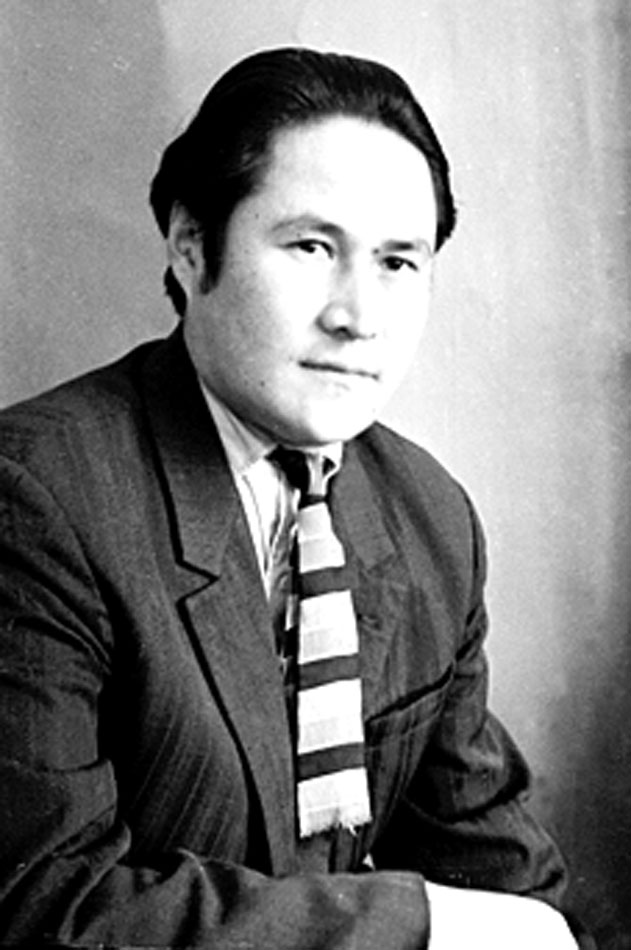
Mukagali Makatayev (On February 9, 1931, the village of Karasaz, Narynkolsky district, Almaty region — on March 27, 1976, Alma-Ata, the Kazakh SSR, the USSR) — the Kazakh Soviet poet and the writer, the translator.
The biography
Left secondary school. Worked as the secretary of an aulsovet, the manager of a red yurta, the employee of Komsomol bodies, the literary employee of the district newspaper.
In 1954-1962 worked as the announcer at the Kazakh radio, the teacher, in 1962-1972 — the head of department of the newspapers "Sotsialistyk Kazakhtan ", «Kazakh adebity» magazines "Madeniyet jane turmys", "Zhuldyz", in 1972-1973 — the literary consultant of the Writers' Union of Kazakhstan. [1]
Mukagali Makatayev was born in the village of Karasaz of the Almaty region, at the bottom of peak of Khan Tengri. Graduated from the Literary institute of Gorky. Author of books "Life Legend", "Life river", "Mozart's Requiem", "Favourites". The song on its verses of Sarzhaylyau became national. Translated on Kazakh the Russian classics, foreign literature, including Walt Uitmen, "The divine comedy" of Dante. His name is put near names of Abay, Auezov and other classics of the Kazakh literature. Winner of the State award of Kazakhstan.
Mukagali and his peers became the main labor power and replaced the adult men who left on the front. They grazed the cattle and plowed the earth, harvested and threshed. Together with women and old men they considered themselves responsible for life in the back and very much were proud of it.
"In twelve years all of us could: to stand at machines on the plant if it is necessary, to drive trains, to protect from the become impudent sheep-fold packs of wolves if it is necessary — reflecting on Mukagali Makatayev's destiny and children of wartime, the friend and the fellow writer Anuar Alimzhanov said it. —
«We at times so wanted to sleep, and so there was a wish to feel a cool touch to a body of a fresh, fresh print shirt.»
But there wasn't enough time for a dream, and the white chintz was replaced by the mutton skin manufactured and which is scraped out by hands of grandmothers …
War and hunger taught great wisdom of life — to be able to distinguish all edible: roots, leaves — to be able to find mountain onions and a sorrel, to be able to appreciate taste of yellow rhizomes of the snowdrops, similar to buttons, welded in boiled water and filled with milk … And still time taught us to patience, ability to wait …
We were able to rejoice to tears to any kind word, worked, feeling happy only because were necessary to people, are necessary to the aul, the kolkhoz. Kindness for us was the most sacred sign of humanity".
Pain for the early matured generation forever remained in heart of future poet and awakened in is mute feeling of compassion to all deserted children. On behalf of the peers, on behalf of all orphans of the earth Mukagali Makatayev addressed people in the poem "Mozart's Requiem" written to them shortly before death:
«We are orphans
One on light.
We — not adults and not children;
To us it isn't terrible
And to us it isn't painful.
Globe
As if soccerball.
Don't abuse us, feral,
Us, to any case suitable,
Us who were desperate, sad,
Us, disinterested persons hungry.
Overcome indifference,
Have our pain.»
You don't cause offense to us
Over us don't shed pathetic tears.
Capability to feel pity, empathize, create good, to be merciful became the main criterion of the poet in assessment of the person and a keynote of all creativity. For it it was vital that the lines "simple as life", the people understood and fell in love.
Mukagali Makatayev lived short, but bright creative life. He spent more than thirty years in native Karasaz. The last ten years of his life, excepting two years of study in Moscow, at Literary institute, passed in Almaty. Friends and contemporaries appreciated his optimism, cheerfulness, fixed search.
Monument to Mukagali Makatayev in Almaty. July, 2015
"He looked for words — Anuar Alimzhanov wrote — which more full expressed meaning of life, an essence of work and affairs of our generation. And he managed to find such words. Kindness filled its lines, with kindness and love to the person".
The first verses of seventeen-year-old Mukagali were issued in 1948 in the Sovetskaya Granitsa newspaper, he was from the Narynkol border-zone. Verses are always complete of references of these places, and, fatally sick, he asks to bring it to the native aul in hope that only the native earth can salvage it.
Readers learned and felt the poet according to publications in newspapers and magazines, according to the collective collection "Zhastar Fats" ("Songs of youth") issued in 1951. In 1962 the Sotsialistik Kazakhstan newspaper published the poem "Appassionata" which brought to Makatayev popularity, and his name joined ranks of the best Kazakh poets.
And here the first book of verses of M. Makatayev appeared when to him there were thirty three and there were only twelve years of life. He worked much, even then, when it was already seriously sick and realized that it is necessary to live not for long. In the diary he wrote down: "After any shocks, both moral, and material, it appeared in hospital. The hospital helped me. After long separation we met Poetry as lovers. To see, missed the friend without friend. Within two months … about four thousand poetic lines are written. Worked on conscience, without thinking whether somebody will undertake to publish them". And its really lifetime editions can be counted on fingers of one hand: "The swallow you flied", "Moor", "Dariga", "When sleep swans". The poet prepared one of the best books "Life — the Poem", but didn't see published. When in 1979 in Zhazushy publishing house there was a book "Life — the Lake", and in 1984 — Sholpan, became obvious:
M. Makatayev didn't publish during lifetime and half written to them. It was the tragedy for the poet realizing the creative force, the place in national poetry. Mukagali's heart began to glitch.
In the fortieth anniversary, in the poem "As early as Some Twenty Years" he asks from life such or at least ten years' delay for the creativity. The last period of life matches study time in Moscow on the High literary courses. It rises to tops of the poetry, but is to it difficult. M. Makatayev works much, and publish a little. In his works the tragic note of love to life, to all real amplifies. The poet died when to him was only 45, having left in inheritance to the future generations the numerous lines.
"When swans", "Hello, friends sleep!", "My dear swallow", "The singing soul", "The river of life", Sholpan, "With freight in heart", the two-volume edition of poems and poems "Heart beat" — all these books were published on native to the poet Kazakh. So it happened that the first book of verses of Mukagali Makatayev in Russian was published several years later after his death. In 1981 the collection "Call of Soul" was published.
The remarkable translations which deserved the appreciation of the literary public of Kazakhstan became a part of creative heritage of the poet. It is possible to refer its transfers of "Grass leaves" of U. Uitmen and "The divine comedy" of Dante, "Sonnets" of Shakespeare and the Russian poets A. Pushkin, N. Nekrasov, A. Blok to classical samples. Skillfully shifted onto Kazakh, they became property of native poetry. About the translation of "The divine comedy" by Dante Alighieri the colleague Makatayeva Orynbay Zhanaydarov wrote: "Mukagali, translating Dante, added two syllables and the well-known terza rimas to a line of "The divine comedy" rhymed, without dividing into a cross rhyme. At Mukagali in terza rimas tercets of which the poem consists all three lines are rhymed! As a result the stamping Kazakh verse turned out! A verse, amazing on the structure and a syllable" .
Mukagali Makatayev — the bright page of the Kazakh poetry of 60-70 years of the XX century. The poet rushed into literature like a fiery lightning, having blinded all. Once Rabindranath Tagore told: "The nation is obliged to make general property what it has". Fully shall carry these words to works of the poet.
He lived life rough, complete of deprivations, he was often not understood. The first collection of verses appeared only in thirteen years after a poetic debut, and into Russian of Mukagali didn't see the translations of the works. The poet never grumbled on life because creativity was the main thing for it.
The glory to Mukagali Makatayev came after death. The illustrated edition of "The divine comedy" of Dante in his translation became unique. Poetic collections were included into gold fund of the Kazakh poetry. And gentle poetic lines are set to music and sound songs. In the same years there were translations of verses of M. Makatayev into Russian made by O. Zhanaydarov and M. Kurgantsev, Yu. Alexandrov and L. Shashkova.
Of course, his big soul it was close in a transitory body. Perhaps therefore in it
creativity – unconscious aspiration to immortality, and once he directly wrote:
"About myself I here that I will tell: I am an age-mate of generation of the XXI century, or perhaps the relative still
more distant generations". Besides, Mukagali said that he "the soldier
the lit fire" – his father died at the front, and he has no right just like that
to go out and disappear. And a full name of the poet – Mukhametkali: it as if namesake
The prophet, but since the childhood him called Mukagali as a responsibility burden,
according to a belief, can complicate the child's life.
During war it and his peers replaced in the back of adult men. To it was
ten when the father left on the front, and all cares on economy laid down on shoulders
boys. The poet exclaimed, remembering that time:
I remember everything – both my earth, and my life,
Only I don't remember – whether laughed whether I cried.
Only I don't remember –
I had a childhood? Makatayev is recognized one of letters: "I love literature. Above it for me
there is nothing". As remembered mother of the poet, he seriously was fond of poetry already in
fourteen years. And it wasn't children's overindulgence, young Mukagali read Abay, Auezova, Seyfullin, Musrepov, so to speak, "voluntarily", these serious things didn't enter the school program. Besides, he independently learned Russian
language also very much loved the Russian classics, especially Pushkin, Yesenin, Blok's poetry.
At school re-read the translations into Heine, Goethe, Dumas, Hugo, Byron's Russian, Dreiser, Stendhal, Balzac, London and Shakespeare. It its easy
went to the universities: was a student of philological and legal faculties of KAZGU,
Institute of foreign languages, and in 1973 years entered the Literary institute
of M. Gorky in Moscow. However on family circumstances in the first year
left study: early married, right after school, spring of 1949. With the
future wife Lashyn Alimzhanova Mukagali got acquainted in the aul of Shibut where it in that time worked in office, then – the teacher of Russian at school,
correspondent of the district newspaper. It had a big family, having many children – Lyazzat, Maygul, Zhuldyz, Aybar, Almagul, Sholpan.
As many big poets, he had theomancy. Even the last it signed the book of verses "Life poem" which appeared at the beginning of March, 1976
to friends date – on March 27, day of the death. In the early seventies the poet wrote poem "Requiem. Mozart Zhanasasy" ("Requiem. Crying according to Mozart"). It is devoted to the last of the great Austrian composer – to well-known "Requiem". You remember, Mozart and waited for the mysterious customer and eventually decided that with it
the order his death came. By the way, this thing and remained not added, it
Mozart Suess Mayer's pupil finished.
Second stage:
Works of the poet
Mukagali Makatayev knew that his poetry will always find the reader. And it will be not only his contemporaries. In the diary entry made shortly before death there are such lines: "There will pass years, the new generation will come, and they will deliver each of us on the place. From time immemorial so was, so is, so will be! About myself I here that I will tell: I am an age-mate of generation of the XXI century or maybe the relative still of distant generations". To it 75 would be performed today. It isn't on light 30 years. These are those dates and terms which determined true greatness and poetic strength of his genius.
Mukagali... Today this name symbolizes the Kazakh poetry.
Mukagali... This name causes images of the Kazakh earth in soul: boundless steppe open spaces, majestic and unapproachable Khan Tengri and Ala Tau, mighty trees in which kroner the cool of the ringing summer day is covered. It bears in itself light and joy of understanding of infinity of the nature.
Mukagali... The great son of the great Kazakh earth and the Kazakh people who is generously presented with their love and presented with their bright talent.
Here one of the last diary entries of Makatayev: "Dear my companions! If you really intend to research my biography, my creativity, then don't forget to read everything that is written by me where I through the "I", without concealing, in verses kept the chronicle of the life". Let's obey a will of the poet and we will go with him in to pain a course of life short and complete of dramatic nature, as in a mirror reflected in its poetry.
"I grew up in a song raznotrav of Karasaz"
Karasaz — the small homeland of Makatayev helping him during the most difficult moments of life. It gave it wings and foreordained destiny of the poet: "Sing about me" — as if dark water asked, "Sing about me" — as if asked a dense cane".
Full name of the poet — Mukhametkali, but it since the childhood tenderly called Mukagali, considering that responsibility time (it is hard to bear a name of the Prophet) can complicate life of the small child. Suleymena and Nagiman, he was young parents' Makatayev' first of three children. The father of the poet, the modest and hard-working person, one year prior to war became the chairman of kolkhoz. Originally Makatayev's childhood was cloudless. In the poem "Native Earth", addressing Karasaz, he so remembers it: "I saddled the horse made of a twig, I caught fish, In the river and your woods froliced". Only the pranks and mischief connected with feelings of the childhood could leave a happy mark in soul of the person who already became to adults: "We were barefoot children when sent goats When threw stones in windows". Makatayev loved the world of the childhood and sincerely grieved for it: "About my childhood, I missed on you!" And childhood memories generated many images of its poetry: Look, crying and sobbing, the childhood costs
On break from which we jumped in water.
War changed everything in Mukagali's life. He was 10 years old when the father left on the front, and all burdens of life laid down on the teenager's shoulders. As all boys of military generation, he early became an adult, having realized that in the house where one women and children, remained for the man now. And as bitterly the poet exclaimed, remembering that time: "I remember everything — both my earth, and my life, Only I don't remember — whether laughed whether I cried. Only I don't remember — I Had a childhood?"
Makatayev's father died at the front. And since then Mukagali never on forgot that he — "the soldier the lit fire" — has no right just like that to go out and disappear. Perhaps, the unconscious understanding of immortality realized later in creativity came to this moment to it.
On memoirs of mother of the poet, at fourteen-year age Makatayev seriously was fond of poetry
Despite change of external circumstances, Makatayev in the main thing — selfless love to poetry was permanent. He writes verses all the time and is often published on pages of magazines and newspapers. Since 1962 when there was the first book, to the 1976th — the last year of life of Makatayev, eight poetic collections of the poet were issued. Among them — "I welcome you, friends!", "When swans sleep", "My light", "Grief of heart", "Life poem" and others. In twenty five years of work in literature Makatayev wrote more than 1 000 poems. He became the author of such poems as Ilyich, "Raimbek! Raimbek!", "A mountain eagle", "Fugitive", "Moor", and also stories and stories, the play "Farewell, Love", articles concerning modern Kazakh poetry. Translated the first part of "The divine comedy" of Dante. Was engaged in the translations from V. Shakespeare, U. Uitmen, east poets, the Russian poets contemporaries. His art talent was shown multilaterally.
From the first separate poems and poetic books the unique by Makataev voice was determined. Purity and clarity, simplicity in expression of the most deep human feelings and experiences strike the reader who touched a miracle of its poetry.
"I always sing my Matherland - Kazakhstan"
Makatayev sang of love and friendship, poetry and the nature. But a specific place in his creativity is held by the Homeland subject. In the poem "The Thoughts Which Are Given Rise by the Native Earth" Makatayev says that he opened doors to the big world through the world of the small Universe — a gold cradle of Karasaz. The poetry which is given rise here — the certificate of his huge love to the native earth which it, a baby bird, grew up and helped to find wings: The native earth when I look at your open spaces,
At me, at my song wings grow.
Makatayev never ceased to admire beauty of the native land. In diaries he quite often wrote about influence of the native nature on his soul: "Oh, my creator, thanks to you I has for the first time seen greatness and beauty of the nature! My first love — my native earth, pure, as a spring!".
Makatayev's poetry bears in itself a huge charge of patriotism which main components are love to the people and the native language. In the poem "My Homeland" the poet speaks: "I always sing my Matherland — Kazakhstan". On this sacred earth all people (Kazakhs, Russians, Uzbeks) are friends brothers. Wisdom of friendship and relationship has been bequeathed to Kazakhs by their great ancestors. Makatayev's poem written nearly forty years ago today, on a new round of historical development, sounds is very modern.
The poet considered that the person in a debt to the Matherland also is obliged to give it fire of the heart. And he has devoted heat of the poetry to the Homeland. Strikes that high patriotism is absolutely organic property of his verses. Makatayev learns as really it is necessary to protect the Homeland which has grown up his soul, became an inspiration source: "Having cherished me, you have grown up, the Great Homeland".
What is the Homeland across Makatayev? The answer can be found in the poem "My Homeland". The spirit and culture, language and history, the earth, amazing on beauty, and the talented people are the Homeland. The Kazakh earth is alive because on her guard there were always great Kazakh sons to whom the poet bows. He is happy and proud that was born on this earth. At the thought of this heart of the poet as the bird, is torn from a breast, and in soul of his songs the word "Homeland!" sounds. The homeland for Makatayev is and Kazakh people: "My people! I am in love with you!" The poet tenderly calls him "My people baby". With warmth speaks about him: "my good-natured people". The people — his protection and a support, his fortress: "My House — my People". The poet can't live without him: "My native people, In separation I miss". The people — his only friend. Makatayev carries on a continued conversation with him: "Destiny, you don't disturb me yet, Let's have a heart-to-heart talk with the people!" The people really understand and appreciate the poet. And communication between them is indissoluble: "Your voice, your songs, your Thoughts in me live in me".
Makatayev believes in the Kazakh people, in his future and tries to be necessary to him. In the diary he writes: "In my thoughts there is only one dream. It to be useful to the people. Only he wants to tell all truth. My people how to inform me you of the voice?". The poetry which is given rise in a subsoil of national tradition and national consciousness — the only thing that the poet can give to the people, and in it he sees a way of service to him.
Makatayev's happiness is in living in the Matherland with the people. But above it for him — happiness of the people and the native earth. How many in it nobility and the true patriotism! Inexhaustible love of the poet to the native earth, to the people deeply touch soul. Really — to us is to what to study at Makatayev!
-
"I was born the Person and I will remain him"
One of Makatayev's contemporaries has told about him so: "Heart of the great poet was childly pure". Kind and sincere, modest and impudent, naive and generous, open and simple, rectilinear and fair, the poet often spoke: "People are born to understand each other, to live in the world". He loved people and could find with everyone a common language. He always sought to come to the rescue.
How Makatayev's fate — the poet and the person was? The answer can be found in his diaries. The confession before by itself demanded sincerity, huge work of soul and, of course, courage. Therefore the revelations sounding in diaries allow to like destiny of the poet really. By the beginning of 1972 Makatayev as lives ten years in Almaty. At this time to him the glory comes, and at the same time heartrending experiences which have played not the last role in the early death of the poet fall to his lot. Tragic death of the oldest daughter: eleven-year-old Maygul was hit by the motorcycle. Feeling of disorder: the numerous family of Makatayev for many years wandered on rental apartments. Lack of work: "December 7, 1973. In new year year as I was left without work will be executed". Loss in November, 1969 of a briefcase with manuscripts. Persecution in literary circles ("on May 2, 1974. What it I have made by him?"), exception of the Writers' Union of Kazakhstan. And fight with, with the weaknesses, and a dreadful, incurable disease. "January 31, 1975. I can't remember at least in any way one day which would leave a joyful mark in my consciousness. Already the forty fourth year as I have appeared on this light has gone, and all life looks so offensively, is so disgusting that sometimes there is a wish to leave everything voluntarily. Frankly speaking, I didn't know earlier that such health what is a disease. It appears, my destiny hasn't deprived of me an opportunity and in this regard. Didn't know earlier, and now it was necessary to learn all illnesses".
Reading Makatayev's diaries, you understand that he not only the big poet with thin and vulnerable soul ("on May 25, 1974. You don't hold an open soul as it is bitter, it to good won't bring into our century"), but also the lonely, suffering person ("on June 10, 1974. As willy-nilly me people and as hardly who understands the person, even the closest to me understand the poet. So understand, I was born the Person and I will remain him, and the poet I became, understand, became...").
Record of March 20, 1973 contains reflections of the poet that friends companions spread about him many rumors, at times embellishing and modifying the facts. He treats this human weakness indulgently: "Let speak". Makatayev at heart was a person delicate therefore two things in life were given him with great difficulty. First, it was humiliating to expose the person in dishonourableness, secondly, to refuse, tell "no". And, maybe, it was the main cause of sufferings of the poet. "The Myagkoserdechnost — my weak point. Possibly, because of it I often also stumble".
At acquaintance to Makatayev's diaries as if you touch naked soul of the poet. Together with him you experience his sufferings. Covers despair when you read such recognition: "You be damned, my poetic destiny! You be three times damned, the Wednesday surrounding me! Wednesday to which I was given by soul and heart, has believed, hoped for the best. I while away the humiliated days, days which have brought nothing to me, except bitterness yes of sufferings. Now I have understood that there is no person on light more unfortunately me". The records concerning creativity have other character. The reader appears the witness of pleasures and Makatayev's opening, they carry in themselves light of his soul and happiness of creation.
Thoughts about the poet and poetry
-
"Poetry, beginning with love, has to come to an end with reflections".
-
"Poetry — science. If there is a force investigating human feelings comprehensively, then it — only poetry".
-
"I firmly believe in one that the poetry will die together with a nature, i.e. with the person and the nature. Let mankind soul will become hardened, all the same there will be one reasonable person. This is the poet. The last word behind it".
-
"Poems — first of all the most intense work, work laborious, nervous".
-
"Yes, everything passes through heart of the poet".
-
"A duty of the poet — not to depict, not to describe, and to reveal beauty secret that is hidden behind this beauty. As experienced diagnostics, the modern poet has to grope time pulse, has to be ill illness of an era, society".
-
"What does the poet have to have to be a poet?
-
The first — talent. Talent with education, with erudition (the diploma not necessarily).
-
The second — conscience to be ashamed most before itself, having read weak things.
-
The third — simplicity. Let not ingenious, as at Pushkin and Abay, but simplicity human to be clear another. Not to philosophize, not to argue, and to sing.
-
The fourth — an intuition. What isn't seen by others, to see and learn.
-
The fifth — work constantly to be improved.
-
The sixth — spirit. Always to behave spiritually rich"."What I am a person, frankly speaking, I don't know. Flabby, it is the truth. But soul my too kind, heart very soft".
-
"Days without verses — for me dead days. Praise to God who has given me this consolation in lives. The poet has the state, the society, the Universe. It much. Means, I for the sake of it live, for the sake of it I fight".
-
"Store the advantage! Protect a name of the poet because you are a true poet, be worthy it! Be simple as the nature, but also be unshakable as it. So be proud! Above head, brother!".
-
"Today, the poem under the name "Chile, My Light!" at one go, without interruption, without uniform blot, from 10 in the morning to 12 in the night is written on January 27, 1974. Try, to battle against me".
-
"I am not a researcher, and the poet. Bitterness and joy human I am interested more, than the person. Whether it is bad whether he is good, not to me to argue because itself I treat group of those. I am carried away by destinies human, the reality surrounding them, time in which they live, society which operates them".
-
"Understanding people, itself I want to be a witness. Here it is an essence of all my poetry. For me poetry — cry from the heart. It is more than nothing".
-
"I haven't got used to write verses with parts, it depends, anywhere. No! The poetry is a rush of soul. When the rush appears, it is necessary to sit, without being prevented from working. To whom as, and I won't get up, I won't dry up yet, I won't exploit inspiration. A disease a disease, but it was worked perfectly. Sometimes even it (creativity) cures me of all illnesses".
-
"What written by me 10 — 20 years ago, is read as new is surprising. In total on the place".
The last record is made on February 28, 1976 — exactly a month before Makatayev's death. The thin understanding of things, intuition peculiar to the poet have allowed it to define the most important quality not only the poetry, but also poetry in general is the present which basis is the Spirit.
-
"My poetry if I die - you live"
The latest lifetime book of verses of Makatayev "Life poem" appeared in the middle of March, 1976. Having at once begun to sign it to the closest people, the poet for some reason put date "on March 27, 1976". This day it didn't become.
That March day of the 76th Makatayev's friend — M. Zhomartbek, being in a business trip in the Aktyubinsk region, became the witness of a casual scene in the bus. The beautiful young Kazakh woman embraced the newspaper and bitterly cried. He has asked her what has occurred. In reply she has told: "The poet whose verses I very much love has died". It was the newspaper with the obituary about Makatayev's death. Those spring days together with this girl all who loved Mukagali cried.
Value of poetry of Makatayev in the XXI century most precisely is defined by words of one of his admirers: "The second life of the poet has begun. Mukagali today — a legend. Mukagali today — the truth. Mukagali today — the Koran". All poetry of Makatayev is a harmony of love and creative sense in which the identity of the poet creating immortality is reflected. And this poetry is always modern and eternally lives in the world which the poet loved and to which bequeathed in love to remember him
Sources
-
Kazakh SSR: short encyclopedia/Hl. edition R. N. Nurgaliyev. - Alma-Ata: Hl. edition of the Kazakh Soviet encyclopedia, 1991. - t. 4: E.g. Literature. Folklore. Architecture. 370. - 31 300 copies - Page.
-
Fire on December 15, 2000 No 1856 "About award of awards state the Republic of Kazakhstan 2000 2. the order of the Government of the Republic of Kazakhstan, in the field of literature, art and architecture" Alash of an Aynasa magazine Republican social and political daily newspaper, "Legend of people", on February 15 2011 NO3 3.
-
Kazakhstan: National entsklopediya / editor-in-chief and. Nysanbayev - Almaty "Pervozveri's subclass" head edition, 1998 Historic figures. Informative - the majority the edition. Designer: Toysbayev of B. Suzhikov A. - Almaty. "Publishing house Almatyk_tap", 2009
-
Kazakh literature. Encyclopedic reference book. - Almaty: "Arouna Ltd." Limited liability partnership, 2010.
13









 Бұл курс Қазақстан Республикасы Оқу-ағарту министрлігімен келісілген










