Approved by the Head of the department ______________________ _________
(name) (signature)
Short-Term Lesson Plan
Nazarbayev Intellectual School of Science and Mathematics in Nauryzbay district of Almaty”,
branch of Autonomous Educational Organization “Nazarbayev Intellectual Schools”
The school mission:
To contribute to the development of a highly moral, intellectual individual and the education of a
responsible, active citizen who contributes to making the world a better place in accordance with the
challenges of our time.
Duration: 40 minutes Date: Teacher:
Grade: 11 Number of students:
The aim of professional
development:
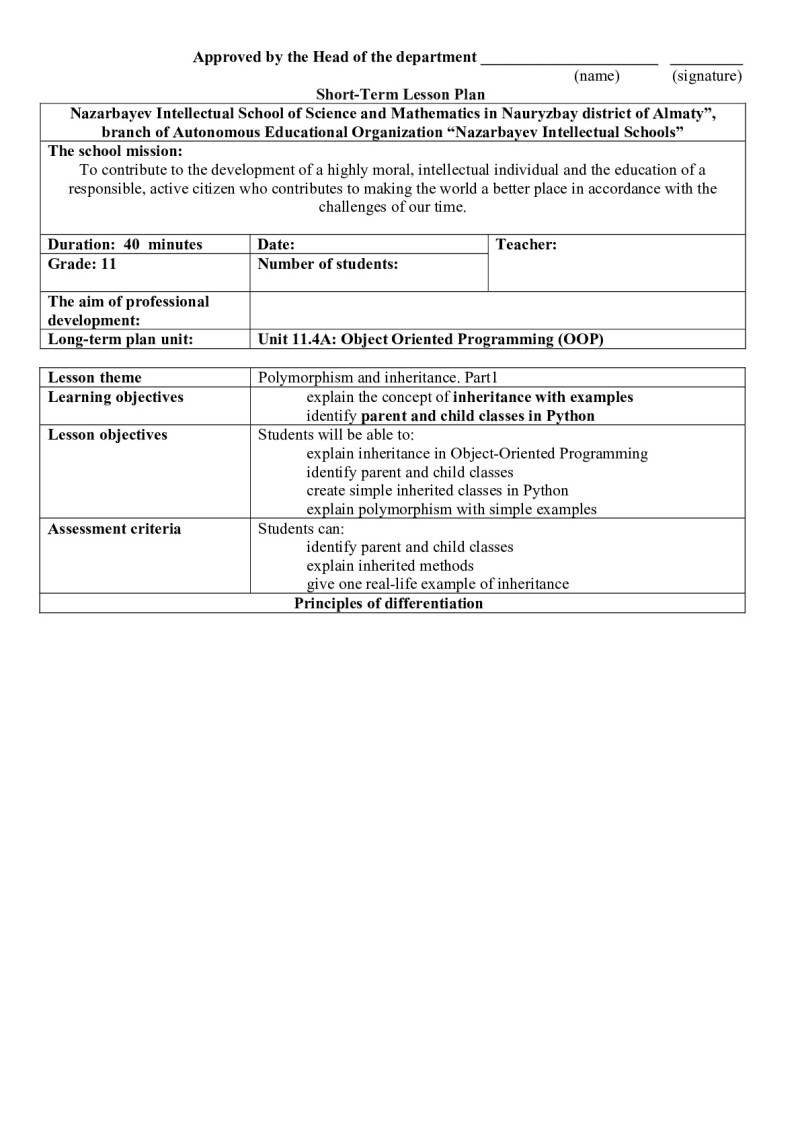
Long-term plan unit: Unit 11.4A: Object Oriented Programming (OOP)
Lesson theme Polymorphism and inheritance. Part1
Learning objectives • explain the concept of inheritance with examples
• identify parent and child classes in Python
Lesson objectives
Students will be able to:
• explain inheritance in Object-Oriented Programming
• identify parent and child classes
• create simple inherited classes in Python
• explain polymorphism with simple examples
Assessment criteria Students can:
• identify parent and child classes
• explain inherited methods
• give one real-life example of inheritance
Principles of differentiation
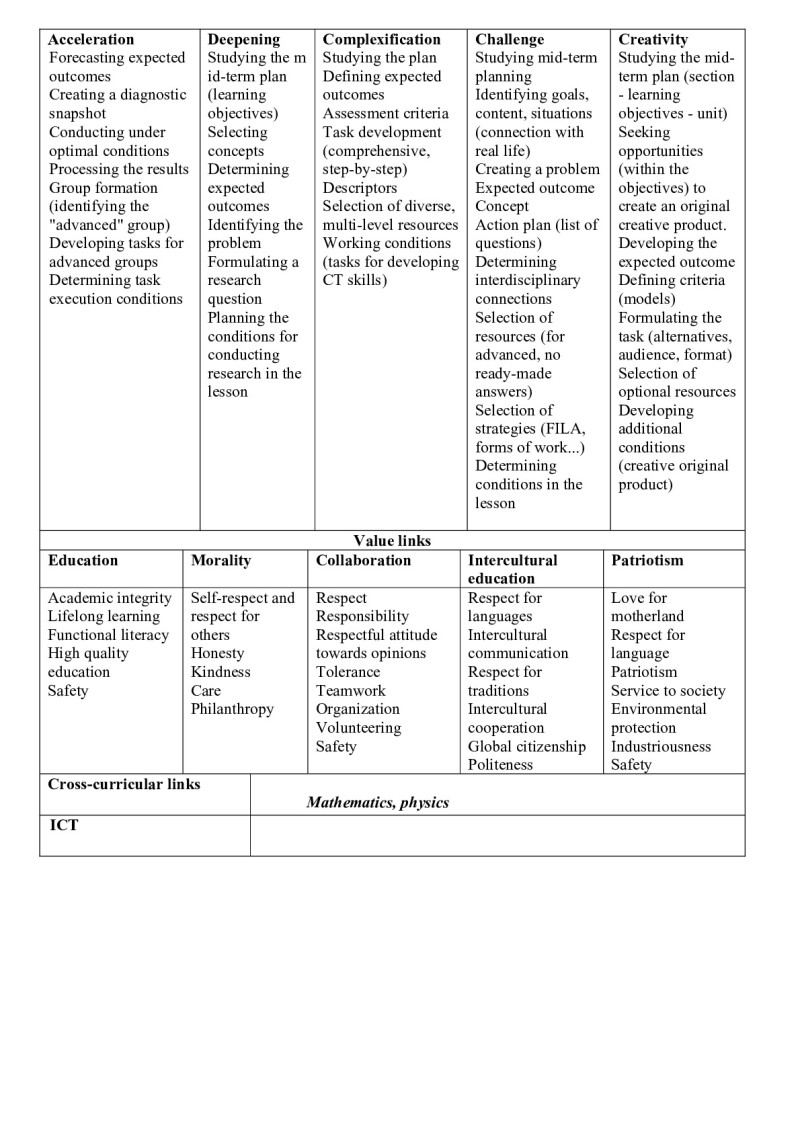
Acceleration
Forecasting expected
outcomes
Creating a diagnostic
snapshot
Conducting under
optimal conditions
Processing the results
Group formation
(identifying the
"advanced" group)
Developing tasks for
advanced groups
Determining task
execution conditions
Deepening
Studying the m
id-term plan
(learning
objectives)
Selecting
concepts
Determining
expected
outcomes
Identifying the
problem
Formulating a
research
question
Planning the
conditions for
conducting
research in the
lesson
Complexification
Studying the plan
Defining expected
outcomes
Assessment criteria
Task development
(comprehensive,
step-by-step)
Descriptors
Selection of diverse,
multi-level resources
Working conditions
(tasks for developing
CT skills)
Challenge
Studying mid-term
planning
Identifying goals,
content, situations
(connection with
real life)
Creating a problem
Expected outcome
Concept
Action plan (list of
questions)
Determining
interdisciplinary
connections
Selection of
resources (for
advanced, no
ready-made
answers)
Selection of
strategies (FILA,
forms of work...)
Determining
conditions in the
lesson
Creativity
Studying the mid-
term plan (section
- learning
objectives - unit)
Seeking
opportunities
(within the
objectives) to
create an original
creative product.
Developing the
expected outcome
Defining criteria
(models)
Formulating the
task (alternatives,
audience, format)
Selection of
optional resources
Developing
additional
conditions
(creative original
product)
Value links
Education Morality Collaboration Intercultural
education
Patriotism
Academic integrity
Lifelong learning
Functional literacy
High quality
education
Safety
Self-respect and
respect for
others
Honesty
Kindness
Care
Philanthropy
Respect
Responsibility
Respectful attitude
towards opinions
Tolerance
Teamwork
Organization
Volunteering
Safety
Respect for
languages
Intercultural
communication
Respect for
traditions
Intercultural
cooperation
Global citizenship
Politeness
Love for
motherland
Respect for
language
Patriotism
Service to society
Environmental
protection
Industriousness
Safety
Cross-curricular links
Mathematics, physics
ICT
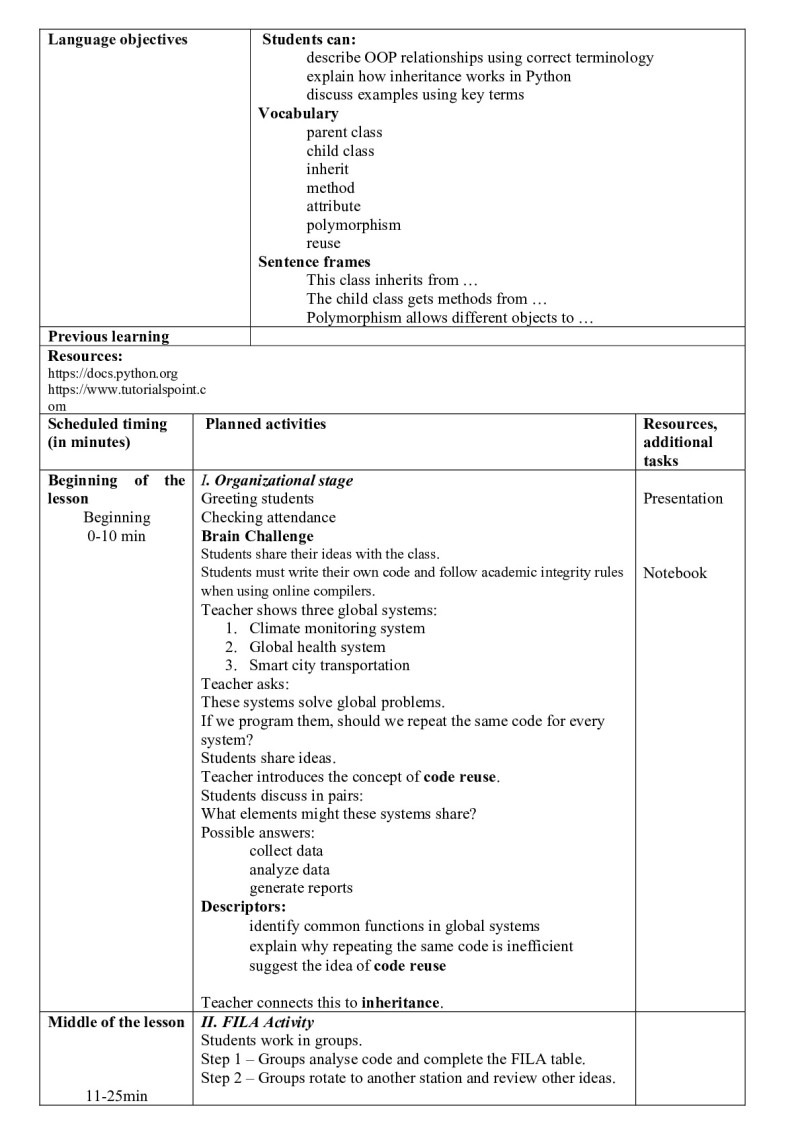
Language objectives
Students can:
• describe OOP relationships using correct terminology
• explain how inheritance works in Python
• discuss examples using key terms
Vocabulary
• parent class
• child class
• inherit
• method
• attribute
• polymorphism
• reuse
Sentence frames
• This class inherits from …
• The child class gets methods from …
• Polymorphism allows different objects to …
Previous learning
Resources:
https://docs.python.org
https://www.tutorialspoint.c
om
Scheduled timing
(in minutes)
Planned activities Resources,
additional
tasks
Beginning of the
lesson
Beginning
0-10 min
I. Organizational stage
Greeting students
Checking attendance
Brain Challenge
Students share their ideas with the class.
Students must write their own code and follow academic integrity rules
when using online compilers.
Teacher shows three global systems:
1. Climate monitoring system
2. Global health system
3. Smart city transportation
Teacher asks:
These systems solve global problems.
If we program them, should we repeat the same code for every
system?
Students share ideas.
Teacher introduces the concept of code reuse.
Students discuss in pairs:
What elements might these systems share?
Possible answers:
• collect data
• analyze data
• generate reports
Descriptors:
• identify common functions in global systems
• explain why repeating the same code is inefficient
• suggest the idea of code reuse
Teacher connects this to inheritance.
Presentation
Notebook
Middle of the lesson
11-25min
II. FILA Activity
Students work in groups.
Step 1 – Groups analyse code and complete the FILA table.
Step 2 – Groups rotate to another station and review other ideas.
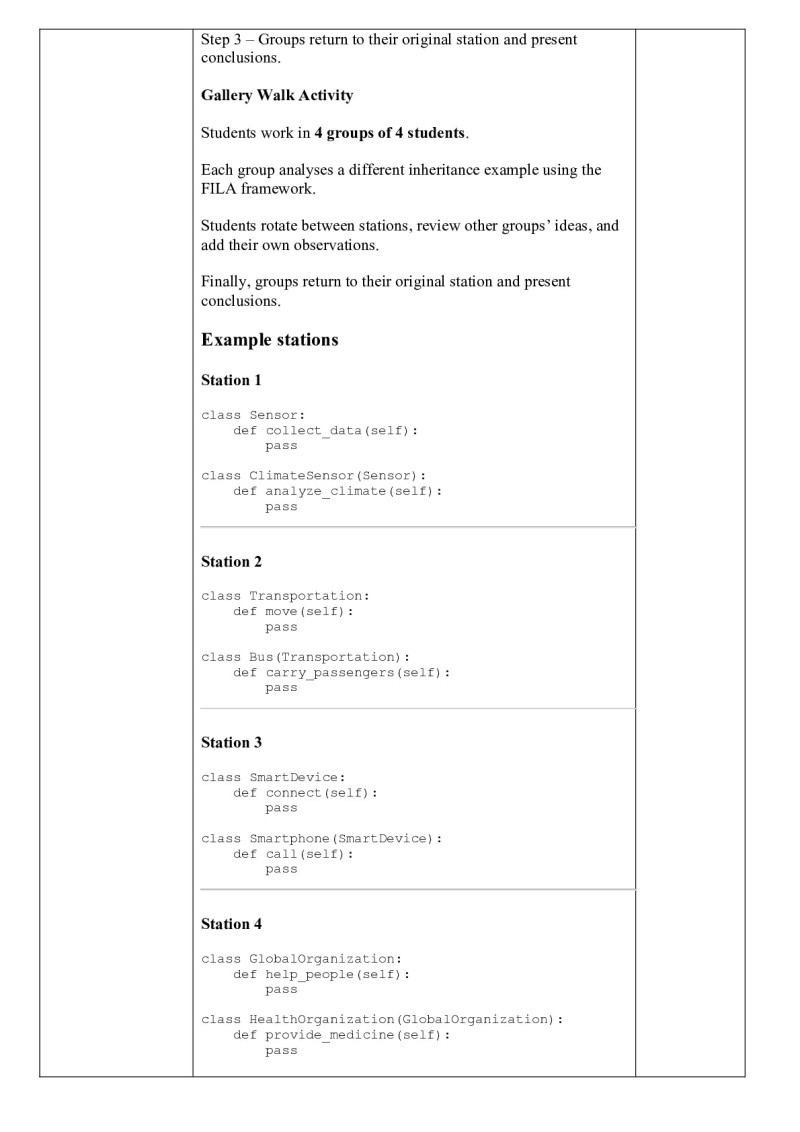
Step 3 – Groups return to their original station and present
conclusions.
Gallery Walk Activity
Students work in 4 groups of 4 students.
Each group analyses a different inheritance example using the
FILA framework.
Students rotate between stations, review other groups’ ideas, and
add their own observations.
Finally, groups return to their original station and present
conclusions.
Example stations
Station 1
class Sensor:
def collect_data(self):
pass
class ClimateSensor(Sensor):
def analyze_climate(self):
pass
Station 2
class Transportation:
def move(self):
pass
class Bus(Transportation):
def carry_passengers(self):
pass
Station 3
class SmartDevice:
def connect(self):
pass
class Smartphone(SmartDevice):
def call(self):
pass
Station 4
class GlobalOrganization:
def help_people(self):
pass
class HealthOrganization(GlobalOrganization):
def provide_medicine(self):
pass
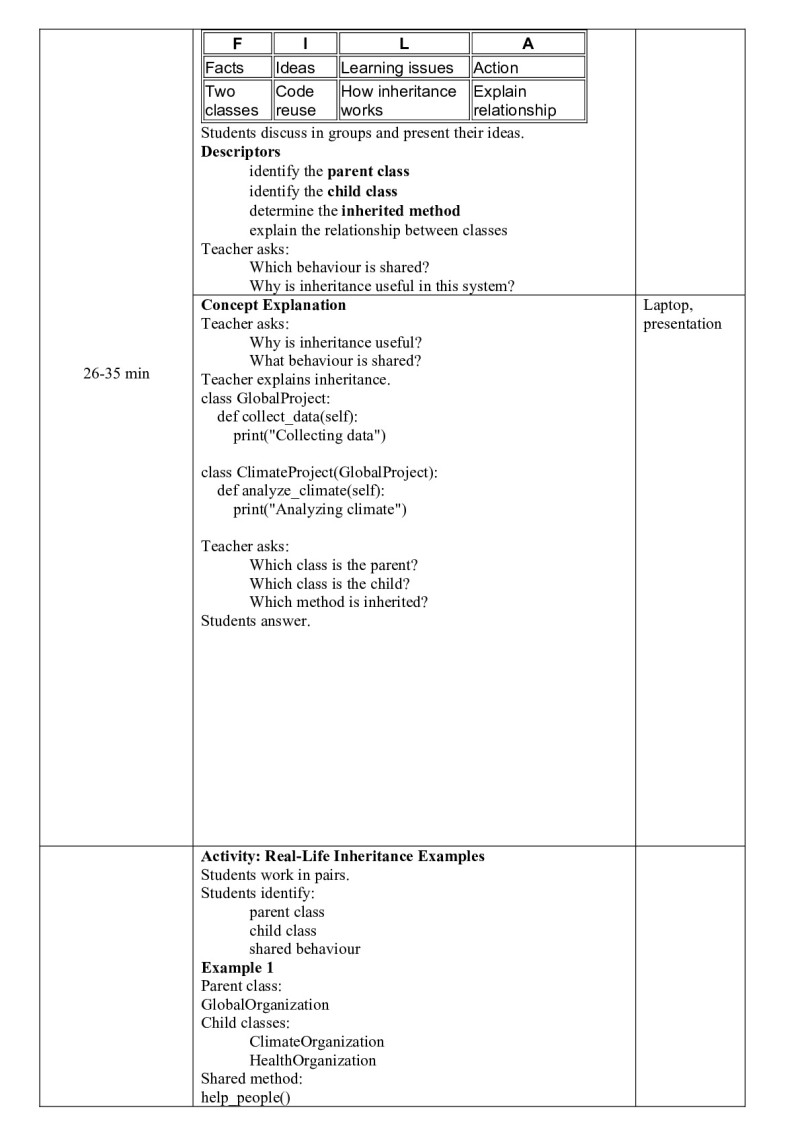
26-35 min
F I L A
Facts Ideas Learning issues Action
Two
classes
Code
reuse
How inheritance
works
Explain
relationship
Students discuss in groups and present their ideas.
Descriptors
• identify the parent class
• identify the child class
• determine the inherited method
• explain the relationship between classes
Teacher asks:
• Which behaviour is shared?
• Why is inheritance useful in this system?
Concept Explanation
Teacher asks:
• Why is inheritance useful?
• What behaviour is shared?
Teacher explains inheritance.
class GlobalProject:
def collect_data(self):
print("Collecting data")
class ClimateProject(GlobalProject):
def analyze_climate(self):
print("Analyzing climate")
Teacher asks:
• Which class is the parent?
• Which class is the child?
• Which method is inherited?
Students answer.
Laptop,
presentation
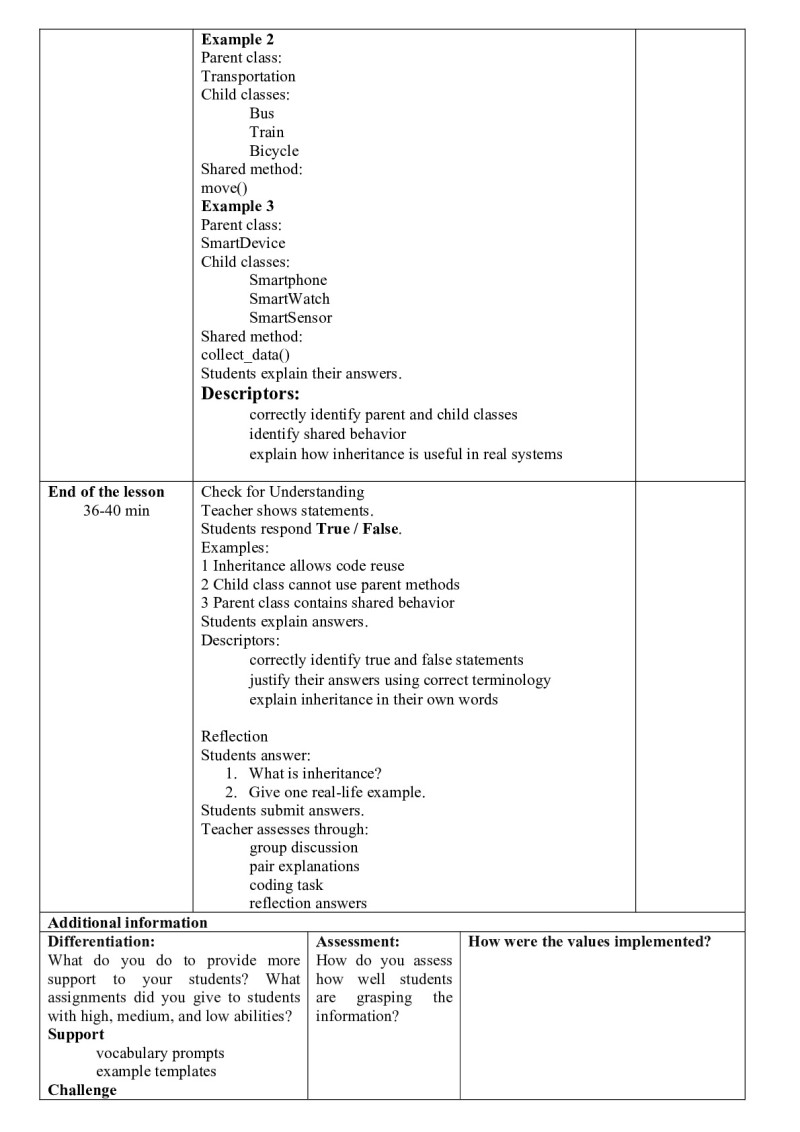
Activity: Real-Life Inheritance Examples
Students work in pairs.
Students identify:
• parent class
• child class
• shared behaviour
Example 1
Parent class:
GlobalOrganization
Child classes:
• ClimateOrganization
• HealthOrganization
Shared method:
help_people()
Example 2
Parent class:
Transportation
Child classes:
• Bus
• Train
• Bicycle
Shared method:
move()
Example 3
Parent class:
SmartDevice
Child classes:
• Smartphone
• SmartWatch
• SmartSensor
Shared method:
collect_data()
Students explain their answers.
Descriptors:
• correctly identify parent and child classes
• identify shared behavior
• explain how inheritance is useful in real systems
End of the lesson
36-40 min
Check for Understanding
Teacher shows statements.
Students respond True / False.
Examples:
1 Inheritance allows code reuse
2 Child class cannot use parent methods
3 Parent class contains shared behavior
Students explain answers.
Descriptors:
• correctly identify true and false statements
• justify their answers using correct terminology
• explain inheritance in their own words
Reflection
Students answer:
1. What is inheritance?
2. Give one real-life example.
Students submit answers.
Teacher assesses through:
• group discussion
• pair explanations
• coding task
• reflection answers
Additional information
Differentiation:
What do you do to provide more
support to your students? What
assignments did you give to students
with high, medium, and low abilities?
Support
• vocabulary prompts
• example templates
Challenge
Assessment:
How do you assess
how well students
are grasping the
information?
How were the values implemented?
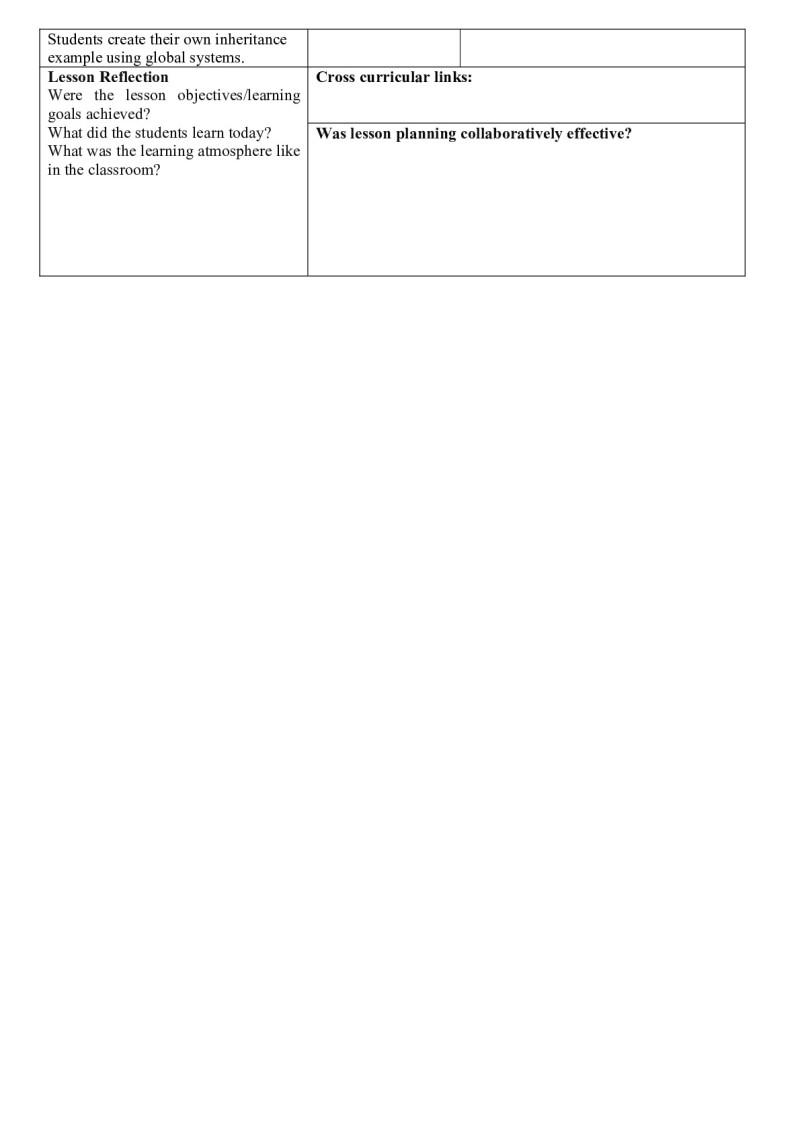
Students create their own inheritance
example using global systems.
Lesson Reflection
Were the lesson objectives/learning
goals achieved?
What did the students learn today?
What was the learning atmosphere like
in the classroom?
Cross curricular links:
Was lesson planning collaboratively effective?

 ЖИ көмекші


 Қауіпсіз төлем













 Бұл курс Қазақстан Республикасы Оқу-ағарту министрлігімен келісілген










