
 ЖИ көмекші


 Қауіпсіз төлем

жүктеу мүмкіндігіне ие боласыз
Бұл материал сайт қолданушысы жариялаған. Материалдың ішінде жазылған барлық ақпаратқа жауапкершілікті жариялаған қолданушы жауап береді. Ұстаз тілегі тек ақпаратты таратуға қолдау көрсетеді. Егер материал сіздің авторлық құқығыңызды бұзған болса немесе басқа да себептермен сайттан өшіру керек деп ойласаңыз осында жазыңыз
 21 Мамыр 2020
 490

1 жыл бойы шексіз жүктеңіз
Құттыбай Гүлдана Нұрмаханқызы
§2 An ideal Boltzmann monatomic gas of N particles
The simplest system of N particles that do not
interact with each other and is described by the Hamiltonian  ,
representing the sum over all particles of single-particle Hamiltonians, is usually called the ideal gas. If a particle in volume V has only kinetic energy, then the single-particle Hamiltonian, taking into account the presence of boundaries, can be represented as:

Potential boxes with infinite walls that simulate
the boundaries of the volume, allows you to strictly and uniquely
define the quantum state of a particle using a triple of numbers
 .
The wave function of this single-particle state is:

The state of all N particles of the system can be specified if you specify a set of triples of numbers for all particles:

In accordance with the Hamiltonian (1.1), the energy of this state is composed of the energies of individual particles of the system; therefore, from this point of view, each of them can be considered as a quasi-independent subsystem, and the partition function of the system turns into a product of single-particle stats. amounts.1

In accordance with the Hamiltonian (1.1), it is
composed of the individual particles of the system; It can be seen
that the system can be considered as a quasi-independent subsystem.
amounts
 .

The size of the partition function for one
coordinate depends on the ratio between the temperature T and the
energy of the ground state in the corresponding one-dimensional
potential box.
 .
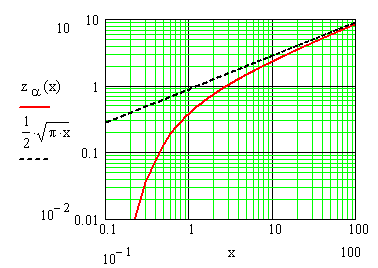

Addiction

on temperature
dimensionless on the energy of the main
state, with the ratio

visible from
pattern. Happening

can be realized only in thin films L~1000A,
since even for particles with electron mass
 .
In hetero structures, the distance between the
energy levels for electrons with characteristic sizes L ~ 100Ả in
one of the coordinates (for example, in x) may be greater than the
temperature: .
At the same time:
 :
only the state is populated
 .\,
-
this corresponds to the fact that the system will
become two-dimensional, when movement is possible only in the y-z
plane. Single particle partition in this case
 .
In the case of macroscopic dimensions of the
system in all coordinates for all reasonable temperatures

and the three-dimensional case is realized: .
Free energy

and, in accordance with the relation (1.5), we have:

Such a formula for free cannot be correct, since
it is not additive. This is a “payback” for not taking into
account the quantum principle of the identity of particles, which was
ignored when the quantum state was set for N particles. According to
(1.4), for each (i-th) numbered particle, three numbers were
indicated: ,
which set its state, but the particles are
indistinguishable, so the poet, setting the quantum state of the
whole system of N particles in this way, is the same from the point
of view of quantum mechanics
 time.
A “rough” consideration of the principle of identity, thus, it is
possible to ensure by dividing the expression in (1.5) into

(red text in formulas (1.5) and (1.8)). This leads
to the correct free energy formula for the Boltzmann ideal
gas:  ,
In it, the single-particle statistical sum
includes the possible contribution of the internal degrees of freedom
of an individual particle: ,
- for example, spin. In the absence of external magnetic fields, when
the energy of a particle does not depend on its spin projection
 -
the multiplicity of degeneracy on the spin projection. The presence of such a multiplier does not affect the heat capacity, which in this case is 3/2 per particle 2,
and for a two-dimensional system 1.
In conclusion of this section, we emphasize
once again that the division into only “roughly” takes into
account the principle of identity and is permissible only for the
case when the wave functions of gas particles overlap slightly.
Otherwise, the gas will need to become degenerate and will obey,
depending on the spin of the particles, on either Bose statistics or
Fermi. A pictorial illustration of this remark is shown in Fig.1.1,
which depicts a system of two particles (N=2) for the case when one
of the particles is in one of the states of a small phase volume
 ,
such that
 ,
and the other in the same volume
 .
From the point of view of the quantum principle of
the identity of particles, this state is no different from the state
in which the particle

replaced by
 ,
so when summing over all states

we do not have the right to take them into account
two-particle quantum system twice. For this reason, when the
particles are in different volumes and, accordingly, in different
states, the division by 2! required (left side of the picture). But,
if both particles are often in the same phase volume
 , then for Fermi particles such a situation is impossible at all (it
is assumed that the spin states of the particles are the same), since
the fermions do not “want” to be in the same state (the
right-hand part of the picture), and such states should be excluded
when summed. For fermions in these situations, division by

not enough. The bosons, on the contrary, “love”
is located in the same states and at high densities, as we shall see,
Bose occurs — condensation of particles of an ideal gas in one main
state. Therefore, when the average number of particles

in any quantum state of order 1( ),
quantum effects are essential, particles lose their individuality, and the wave functions of particles overlap strongly.
The ratio between the temperature and the density
of particles of an ideal gas, when quantum effects begin to be
significant, is easily established from the condition of overlapping
of the wave functions of individual particles. For a classical gas,
the average energy and momentum are dictated by the temperature T.
Thermal impulse

determines the order of the thermal wavelength of
a particle
 .
A particle can not be localized less than its
wavelength, so the wave functions begin to overlap if
 .
Whence it immediately follows that quantum effects
will become substantial, or, in other words, gas will become
degenerate when 
Under this condition, the formula (1.9) for the free energy of the Boltzmann ideal gas will be valid, in which a large number of
order
 ,
reflecting weak overlap of wave functions.









 Бұл курс Қазақстан Республикасы Оқу-ағарту министрлігімен келісілген










