
 ЖИ көмекші


 Қауіпсіз төлем

жүктеу мүмкіндігіне ие боласыз
Бұл материал сайт қолданушысы жариялаған. Материалдың ішінде жазылған барлық ақпаратқа жауапкершілікті жариялаған қолданушы жауап береді. Ұстаз тілегі тек ақпаратты таратуға қолдау көрсетеді. Егер материал сіздің авторлық құқығыңызды бұзған болса немесе басқа да себептермен сайттан өшіру керек деп ойласаңыз осында жазыңыз
 06 Сәуір 2025
 197
197
1 жыл бойы шексіз жүктеңіз
Рабочая тетрадь по физике: Физика на английском языке
Кайырбекова А.Е., Нуруллаева Г.А.
СБОРНИК
УПРАЖНЕНИЙ ПО ФИЗИКЕ
НА АНГЛИЙСКОМ ЯЗЫКЕ
к учебнику по физике на английском языке 9 класс
(авторы Ташев Н., Шокобалинов Н.,Дуйсеев Е. и др.)) «Physics»/ - 1 издание
УЧЕБНО – МЕТОДИЧЕСКИЙ КОМПЛЕКС
Кайырбекова А.Е., Нуруллаева Г.А.
Сборник упражнений
по физике на английском языке
9 класс
9 класс
Издание первое
Тараз
УДК 53(076.1)(075.3)(=811.111)
ББК 22.3я72
Авторы:
Кайырбекова А.Е., учитель физики МГ №41 им.А.Пушкина, г.Тараз
Нуруллаева Г.А., учитель английского языка МГ №41 им.А.Пушкина, г.Тараз
Рецензенты:
Бижигитов Т.Б., кандидат физико –математических наук, профессор, Таразский региональный университет им.Х.Дулати
Алтаева Г.А., кандидат филологических наук, доцент, Таразский региональный университет им.Х.Дулати
Сборник упражнений по физике на английском языке: 9 класс; к учебнику (авторы Ташев Н., Шокобалинов Н.,Дуйсеев Е. и др.)) «Physics»/ - 1 издание – Астана: Издательство
Данное пособие адаптировано государственному учебному стандарту.
Сборник упражнений является дополнительным пособием составляющей учебно –методического комплекса (авторы Ташев Н., Шокобалинов Н., Дуйсеев Е. и др.). Издание содержит материалы к каждому параграфу и разделу. В сборник упражнений включены дескрипторы по теме, словарь из основных терминов на казахском, русском и английском языках и упражнения по соответствующей теме.
Издание адресовано учителям физики, учащимся 9 класса, а также тем, кто готовится к итоговой аттестации 9 класса.
УДК 53(076.1)(075.3)(=811.111)
ББК 22.3я72
ISBN
CONTENT
Chapter 1 Basics of kinematics
|
|
|
Page |
|
Theme 1 |
Mechanical motion |
6 |
|
Theme 2 |
Vectors and operations (actions) on them |
7 |
|
Theme 3 |
Rectilinear (straight) equal motion. Acceleration |
9 |
|
Theme 4 |
Speed and displacement during the rectilinear uniformly accelerated motion |
10 |
|
Theme 5 |
Body free fall. Free fall gravity |
11 |
|
Theme 6 |
Curvilinear motion. Uniform circular body motion |
12 |
|
Theme 7 |
Linear and angular speeds. Centripetal acceleration |
14 |
|
Chapter 2 Basics of astronomy
|
||
|
Theme 8 |
The Stellar sky: stars and constellations |
15 |
|
Theme 9 |
Celestial sphere. Systems of celestial coordinates |
15 |
|
Theme 10 |
Visible motion of the celescial sphere at different geographical latitudes. Local, zone and worldwide time |
16 |
|
Theme 11 |
The motion law of planets of the solar system |
17 |
|
Theme 12 |
Distances determination in astronomy applying parallax |
18 |
|
Chapter 3 Basics of dynamics
|
||
|
Theme 13 |
Newton’s first law. Inertial systems of reference |
20 |
|
Theme 14 |
Forces in mechanics |
21 |
|
Theme 15 |
Newton’s second law. Mass |
23 |
|
Theme 16 |
Newton’s third law. |
24 |
|
Theme 17 |
The law of gravity |
26 |
|
Theme 18 |
Body weight, weightlessness |
27 |
|
Theme 19 |
Momentum and impulse. Impulse conservation Law |
28 |
|
Chapter 4 Conservation Laws
|
||
|
Theme 20 |
Mechanical work and energy. Conservation and conversion energy Law |
30 |
|
Chapter 5 Oscillations and waves
|
||
|
Theme 21 |
Oscillatory motion. Free and damped oscillations. Resonance. |
31 |
|
Theme 22
|
Transformation of energy under oscillations. Oscillations of a mathematical and pendulum springs. |
32 |
|
Chapter 6
Аtomic structure. Аtomic phenomena
|
||
|
Theme 23 |
Thermal radiation |
35 |
|
Theme 24 |
Light Quanta. Photoelectric effect |
35 |
Chapter 1 – Basics of kinematics
Theme 1: Mechanical motion
A learner
-
reads the new words
-
completes the sentences (Task 1) using words from Vocabulary
-
marks following pictures (Task 2) using words from Vocabulary
|
Kazakh |
Russian |
English |
|
Кинематика |
Кинематика |
Kinematics |
|
Динамика |
Динамика |
Dynamics |
|
Материя |
Материя |
Matter, substance, material |
|
Материалдық нүкте |
Материальная точка |
Material point |
|
Есептеу жүйесі |
Система отсчета |
Frame of reference |
|
Қозғалыс |
Движение |
Motion |
|
Механикалық қозғалыс |
Механическое движение |
Mechanical motion |
|
Қозғалыстың салыстырмалығы |
Относительность движения |
Relative motion |
|
Орны |
Местоположение |
Position |
|
Кеңістік |
Пространство |
Space |
|
Уақыт |
Время |
Time |
|
Дене |
Тело |
Body |
|
траектория |
Траектория |
Trajectory |
Task 1. Complete the sentences using words from the box
|
time, kinematics, trajectory, position, dynamics |
1) Motion is a change in ____________ in a certain amount of time.
2) ______________________ is the study of moti6on without regard to forces that cause it;
3) ____________ is the study of motions that result from forces
4) Units of ____________ is: year, month, week, day, hour, minute, second.
5) _______________ the curve that a body describes in space.
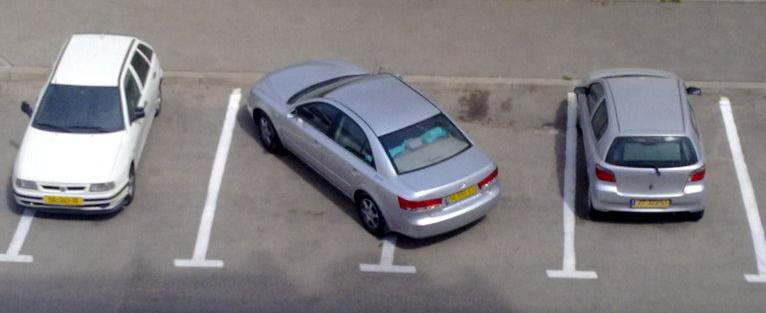
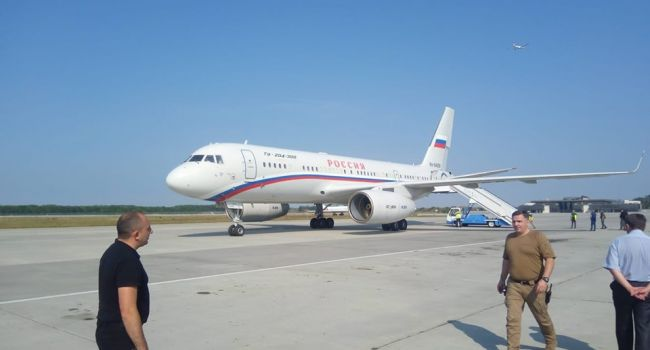
Task 2. Mark the picture showing an example of a material point.
• •
•
• •
•
Theme 2: Vectors and operations (actions) on them
A learner
-
reads the new words
-
distributes the quantities from the box into two columns (Task 1) using words from Vocabulary
-
adds two vectors (Task 2)
-
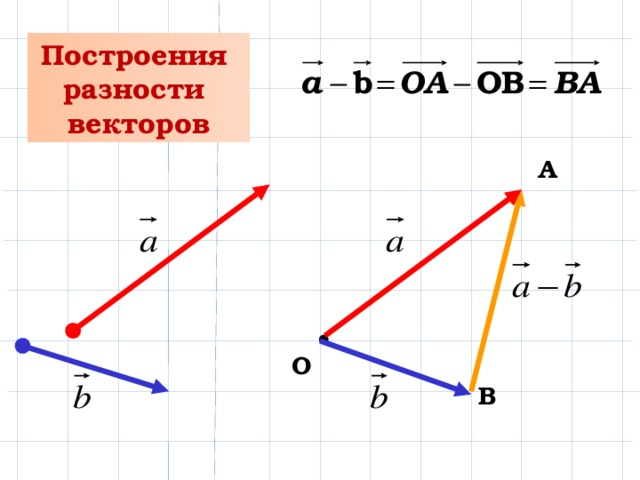
subtracts two vectors (Task 3)
|
Kazakh |
Russian |
English |
|
Вектор |
Вектор |
Vector |
|
Скаляр |
Скаляр |
Scalar |
|
Векторлық шамасы |
Векторная величина |
Vector quantity |
|
Скалярлық шамасы |
Скалярная величина |
Scalar quantity |
|
Вектор модулі |
Модуль вектора |
The module of the vector |
|
Векторларды қосу |
Сложение векторов |
Vector addition |
|
Векторларды азайту |
Вычитание векторов |
Vector subtraction |
|
Векторды скалярға көбейту |
Умножение вектора на скаляр |
Multiplying a vector to (by) a scalar |
|
Күш |
Сила |
Force |
|
Орын ауыстыру |
Перемещение |
Displacement |
|
Ереже |
Правило |
Rule |
|
Көлемі |
Объём |
Volume |
|
Параллелограмм |
Параллелограмм |
Parallelogram |
|
Үшбұрыш |
Треугольник |
Triangle |
|
Масса |
Масса |
Mass |
Task 1. Distribute the quantities from the box into two columns: vector and scalar quantities:
|
volume, velocity, time, mass, force, displacement |
|
Vector quantity |
Scalar quantity |
|
|
|
|
|
|
|
|
|
Task 2. Add two vectors using the triangle method:
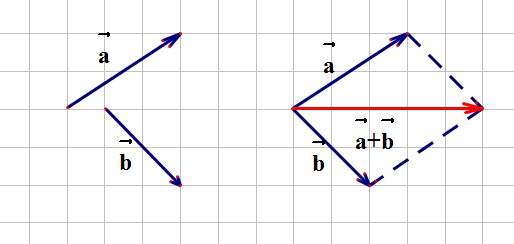
Task 3. Subtract two vectors using the parallelogram method
Theme 3: Rectilinear (straight) equal motion. Acceleration
A learner
-
reads the new words
-
writes the names and SI units of quantities (Task 1)
-
reads the definitions and chooses True or False (Task 2)
-
solves the problem using the equation of acceleration (Task 3)
|
Kazakh |
Russian |
English |
|
Тура (түзу сызықты)қозғалысы |
Прямолинейное движение |
(rectilinear) straight motion |
|
үдеу |
Ускорение |
Acceleration |
|
Бір қалыпты қозғалыс |
Равномерное движение |
Uniform motion |
|
Ауытқымалы қозғалыс |
Неравномерное движение |
Uneven motion |
|
Бастапқы |
Начальное |
Initial |
|
Соңғы |
Конечное |
Final |
|
Өзгеру |
Изменение |
Changing |
|
Бірқалыпты үдемелі қозғалыс |
Равноускоренное движение |
Uniformly accelerated motion |
|
Жылдамдық |
скорость |
Speed, velocity. |
Task 1. Write the SI units and names of quantities in the table:

|
Letter |
Quantity |
SI unit |
|
a |
|
|
|
t |
|
|
|
|
|
|
|
|
|
|
|
|
|
|


Task 2. Choose true or false for each of the following definitions:
-
If motion has normal acceleration, the motion is rectilinear T/F
-
If motion has constant speed, it’s uniform motion T/F
-
If motion has constant acceleration, the motion is T/F
uniformly accelerated motion
-
If body doesn’t move straight, his motion is rectilinear T/F
Task 3. Solve the problem:
1. The velocity of a car changes from 40km/h to 60km/h in 5 seconds. Find its acceleration in m/s2
Theme 4: Speed and displacement during the rectilinear uniformly accelerated motion
A learner
-
reads the new words
-
matches equation name with its general formula(Task 1)
-
solves the problem using the needed formula (Task 2)
-
determines the type of motion according to the equation of motion (Task 3)
-
finds the initial coordinate using the equation of coordinates of the material point (Task 3)
-
finds the acceleration using needed formula (Task 3)
|
Kazakh |
Russian |
English |
|
Ауысу, жылжу |
Перемещение |
Movement, displacement |
|
Жол. Бағыт |
Путь |
Way |
|
Жылдамдық |
Скорость |
Speeds |
|
Жылдамдық кестесі |
График скорости |
Speed graph |
|
Бастапқы, алғашқы жылдамдық |
Начальная скорость |
Initial velocity |
|
|
Мгновенная скорость |
Instant velocity |
|
Қозғалыс теңдеуі |
Уравнение движения |
Equation of motion |
|
Түзу |
Прямая |
Straight (forward) |
|
Координат өсі |
Ось координат |
Coordinate axis, axis of coordinates |
|
Қозғалыс заңы |
Закон движения |
Law of motion |
Task 1. Match an equation name with its general formula)
|
Name of equation (equation name) |
General formula |
|
A. Equation of average velocity |
1. |
|
B. Equation of instant velocity |
2. |
|
C. Equation of displacement |
3. |
|
D. Equation of coordinate |
4. |
|
E. Equation of acceleration |
5. |


 +
+


1 ___ 2 ___ 3 ___ 4 ___ 5 ___
Task 2. Solve the problem:
1) A bicycle starting from rest is accelerated 5m/s2 . How far will it travel after 10 seconds?
Task 3. The equation of coordinates of the material point has the form: ?=20+5?+6?2 (m)
a) What type of movement is it? _________________________________________
b) Find: the initial coordinate: ___________________________
the acceleration: _______________________________
Theme 5: Body free fall. Free fall gravity
A learner
-
reads the new words
-
answers the test questions(Task 1)
-
matches physical phenomena and its definitions (Task 2)
-
solves the problem using needed formula (Task 2)
|
Kazakh |
Russian |
English |
|
Еркін түсу |
Свободное падение тел |
Free fall of bodies |
|
Ауырлық үдеуі |
Ускорение свободного падения |
Gravity acceleration |
Task 1. Choose the right answer:
1. What is the value of the gravity acceleration on the Earth?
-
1.6
-
9.3
-
9.8
-
7.2
2. What is SI unit of gravity acceleration?
-
m/s
-
m/s2
-
N
-
m*s2
3. Where is gravity bigger?
-
On the Equator
-
On the Moon
-
On the Poles
-
Acceleration
Task 2. Find correct definitions of physical phenomena
|
Physical phenomena and quantities |
Definition |
|
A. Free fall |
1. the vertical upward or downward motion of an object when the only vertical force acting on it is gravity |
|
B. Free fall acceleration (gravity acceleration) |
2. in a vacuum, and only in a vacuum, all bodies fall with the same acceleration |
|
C. The law of falling bodies |
3. the acceleration of an object when gravity is the only force acting on it |
Task 3.Solve the problem:
1) Determine the acceleration of gravity on the Moon knowing that if you drop an object from a height of 5 m, it takes 2.47 s to reach the ground.
Theme 6: Curvilinear motion. Uniform circular body motion
A learner
-
reads the new words
-
chooses the curvilinear motion by the picture (Task 1)
-
writes the definitions, formulas and SI units of the frequency and period (Task 2)
|
Kazakh |
Russian |
English |
|
Қисық сызықты қозғалыс |
Криволинейное движение |
Curvilinear motion |
|
Шеңбер бойымен біркелкі қозғалыс |
Равномерное движение тела по окружности |
Uniform circular body motion |
|
Шеңбер бойымен қозғалыс |
Движение тела по окружности |
Uniform circular body motion |
|
Жиілік |
Период обращения |
Period |
|
Период |
Частота обращения |
Frequency |
Task 1. Choose the curvilinear motion example
A. 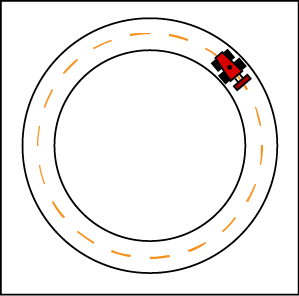 • B.
• B.  •
•
Task 2.What is difference between the period and frequency? Fill the table
|
|
Period |
Frequency |
|
Letter |
|
|
|
SI unit |
|
|
|
Formula |
|
|
|
Definition or explaining |
|
|
Theme 7: Linear and angular speeds. Centripetal acceleration
A learner
-
reads the new words
-
solves the problem and finds needed quantity (Task 1)
|
Kazakh |
Russian |
English |
|
Сызықтық жылдамдық |
Линейная скорость |
Linear speed |
|
Бұрыштық бұрылу |
Угол поворота |
Angular turn |
|
Радиан |
Радиан |
Radian |
|
Бұрыштық жылдамдық |
Угловая скорость |
Angular speed |
|
Қисық сызықты үдеу |
Ускорение при криволинейном движении. |
Curvilinear motionacceleration |
|
Центргетартқыш үдеу |
Центростремиртельное ускорение |
Centripetal acceleration |
Task 1.The London Eye is Europe's tallest cantilevered observation wheel. The structure is 135 metres.Tall and the wheel has a diameter of 120 metres. It makes one turnaround in 30 minutes. Find:
Period and Frequency _________________________________________________
Linear velocity (π=3,14) _______________________________________________
Angular velocity _____________________________________________________
Centripetal acceleration ________________________________________________
Chapter 2 Basics of astronomy
Theme 8: The Stellar sky: stars and constellations
A learner
-
reads the new words
-
reads the sentences and fills a necessary word (Task 1)
-
translates the names of the stars (Task 2)
|
Kazakh |
Russian |
English |
|
Жұлдызды аспан |
Звездное небо |
Stellar (star) sky |
|
Көрінетін жұлдызды шама |
Видимая звездная величина |
Apparent magnitude |
|
Абсолюттік жұлдызды шама |
Абсолютная звездная величина |
Absolute magnitude |
|
Жұлдызды аспан каталогы |
Каталог звездного неба |
The catalogue of the starry sky |
|
Жұлдыздар мен шоқжұлдыздардың атауы |
Названия звезд и созвездий |
The name of the stars and constellations |
Task 1. Fill a necessary word
Any of various groups of .......... to which definite names have been given, as Ursa Major, Ursa Minor, Boötes, Cancer, Orion.
Task 2. Translate the names of the stars and constellations from Task 1.
Theme 9: Celestial sphere. Systems of celestial coordinates
A learner
-
reads the new words
-
converts the measure of degree (Task 2)
-
converts the measure of hour (Task 2)
|
Kazakh |
Russian |
English |
|
Экваторлық координаттар жүйесі |
Экваториальная система координат |
Equatorial coordinate system |
|
Аспан саласы |
Небесная сфера |
Celestial sphere |
|
Аспан саласының элементтері |
Элементы небесной сферы |
Elements of the celestial sphere |
|
Эклиптика. Аспан экваторы |
Эклиптика небесный экватор |
The Ecliptic. Celestial equator |
|
Көлденең координаттар жүйесі |
Горизонтальная система координат |
Horizontal coordinate system |
Task 1. Convert the measure of degree: a) 6h 24m; b) 18h 43m.
Task 2. Convert the measure of hour: a) 90 30’; b) 105 43’.
Theme 10: Visible motion of the celescial sphere at different geographical latitudes. Local, zone and worldwide time
A learner
-
reads the new words
-
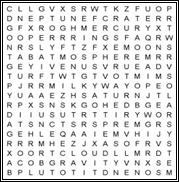
finds words on the theme “Cosmos” and translates it into Russian using translator (Task 1)
|
Kazakh |
Russian |
English |
|
Әртүрлі кеңдіктегі көктегі сфераның түрі |
Вид небесной сферы на различной широте |
View of the celestial sphere at different latitudes |
|
Жарықтың шарықтау шегі |
Кульминации светила |
Climax of the luminary |
|
Шынайы және орташа күн тәуліктері |
Истинные и средние солнечные сутки |
True and mean solar day |
|
Жергілікті, белдік және дүниежүзілік уақыты |
Местное, поясное и всемирное время |
Local, zone and worldwide time |
|
Жұлдызды уақыт |
Звездное время |
Sidereal time |
Task 1 Find words on the theme “Cosmos” and translateit into Russian
Theme 11:The motion law of planets of the solar system
-
reads the new words
-
solves the problem using needed formula (Task 1)
-
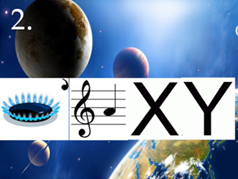
solves the rebus and translates the answers into Russian
|
Kazakh |
Russian |
English |
|
Кеплер заңы |
Закон Кеплера |
Law of Kepler Kepler’s law |
Task 1.Solve the problem
Mars is 1.5 times farther from the sun than Earth. What is the length of the year on Mars?
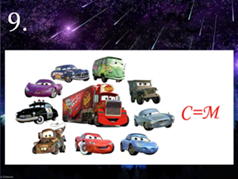
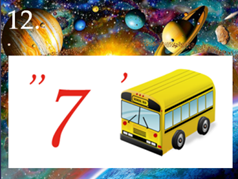
Task 2.Guess following rebuses and translate the answers into Russian
|
1.
|
|
|
|
2.
3. |
Theme 12: Distances determination in astronomy applying parallax
-
reads the new words
-
solves the problem using needed formula (Task 1)
|
Kazakh |
Russian |
English |
|
Тәуліктік параллакс |
Суточный параллакс |
Daily parallax |
|
Жылдық параллакс |
Годичный параллакс |
Annual parallax |
|
Ғасырлық параллакс |
Вековой параллакс |
The age-old parallax |
Task 1.Solve the problem
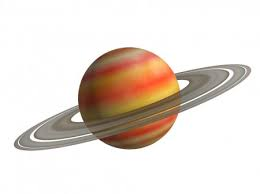
Saturn's rings are visible at an angle of 40 degrees at a distance of 1.3 * 109 kilometers. What is their linear diameter?
Chapter 3 Basics of dynamics
Theme 13: Newton’s first law. Inertial systems of reference
A learner
-
reads the new words
-
inserts missing words and formulates Newton’s first law(Task 1)
-
explains Newton's first law(Task 2)
-
answers the test questions (Task 3)
|
Kazakh |
Russian |
English |
|
Инерция |
Инерция |
Inertia |
|
инерттілік |
Инертность |
Inertness |
|
Инерциалды есептеу жүйесі |
Инерциальная система отсчета |
Inertial systems of reference |
|
Ньютонның 1 заңы |
Первый закон Ньютона |
The first law of Newton |
|
Массасы |
масса |
Mass |
|
килограмм |
килограмм |
kilogram |
|
Динамика |
динамика |
dynamics |
Task 1.Complete Newton’s first law:
An object at rest stays at r________ and an object in motion stays in m_________ with the same s___________ and in the same d______________ unless acted upon by an u_____________ f__________.
Task 2. Explain Newton’s first law on the example of this ball

Task 3 . Test
1. Who provided a basis for the study of dynamics?
-
Einstein
-
Kepler
-
Newton
2. Inertia is the tendency of an object to remain at constant
-
Velocity
-
Acceleration
-
Distance
3. What is the weight on earth of a 50 kg person?
-
9.8 N
-
490 N
-
120 N
Theme 14: Forces in mechanics
A learner
-
reads the new words
-
fills the table, writes the symbols and units of physical quantities (Task 1)
-
reads the text, inserts appropriate words and answers questions about the text (Task 2)
-
solves the problem and finds needed quantities (Task 3)
|
Kazakh |
Russian |
English |
|
Іргелі өзара іс-қимыл |
Фундаментальное взаимодействие |
Fundamental interaction |
|
Гравитациялық іс-қимыл |
Гравитационное взаимодействие |
Gravitational interaction |
|
Электромагниттық іс-қимыл |
Электромагнитное взаимодействие |
Electromagnetic interaction |
|
Ауырлық күші |
Сила тяжести |
Gravity, gravitation, force of gravity |
|
Серпімділік күші |
Сила упругости |
Elastic force |
|
Үйкеліс күші |
Сила трения |
Friction force |
|
Еркін түсу үдеуі |
Ускорение свободного падения |
Gravitational acceleration(free fall acceleration) |
|
Ұзындықты өзгерту |
Изменение длины |
Change in length |
|
Қаттылық коэффициенті |
Коэффицент жесткости |
Spring constant (Elastic constant) |
|
Метр |
Метр |
meter |
|
Үйкеліс коэффициенті |
Коэффициент трения |
Coefficient of friction |
|
Тірек реакция күшінің модулі |
Модуль силы реакции опоры |
A module support reaction force |
Task 1. Write down the symbols and units:
|
|
symbol |
unit |
|
Mass |
|
|
|
Acceleration |
|
|
|
Gravity acceleration |
|
|
|
spring constant (elastic constant) |
|
|
|
Coefficient of friction |
|
|
Task 2. Complete the sentences with words from the box:
|
resists, shape, stretched,elastic, elasticity,compress, spring back. |
Something that is elastic can return to its original s__________ (1) after being stretched or compressed. This property is called e____________ (2). As you stretch or c____________ (3) an elastic material like a bungee cord, it r__________(4) the change in shape. It exerts a counter force in the opposite direction. This force is called e___________(5) force. The farther the material is s____________ (6) or compressed, the greater the elastic force becomes. As soon as the stretching or compressing force is released, elastic force causes the material to s________ b_________ (7) to its original shape. Elastic force has many uses, from hair scrunches to bed springs.
Answer questions about the text:
1) What is elastic force?
2) In which cases does the elastic force appear?
3) Give examples of applying the elastic force.
Write out the words describing the elastic force from the text
___________________________________________________________________
___________________________________________________________________
Task 3. Solve the problem:
Mass of the car is 3ton. Find:
A) the force of gravity acting on the car on the Earth _________________________
B) the gravity acceleration on the Moon, if FgMoon =4.86 kN acting on this car.
C) friction force: a) on the roadwithfriction coefficient 0.8. ________________
b) on a snow covered roadwithfriction coefficient 0.05.
Theme 15: Newton’s second law. Mass
A learner
-
reads the new words
-
fills the table and finds force, mass or acceleration using Newton’s second law equation(Task 1)
-
completes the Newton’s second law using words from the vocabulary (Task 2)
|
Kazakh |
Russian |
English |
|
Жылдамдату |
Ускорение |
Acceleration |
|
Массасы |
Масса |
Mass |
|
Ньютонның 2 заңы |
Второй закон Ньютона |
The second law of Newton |
|
Тең әсер ететін күші |
Равнодействующая сила |
Resultant (net) force |
|
Түбір |
Корень квадратный |
Square root |
|
Квадрат |
Квадрат |
square |
Task 1.Fill the table:
|
№ |
Net force, N |
Mass, kg |
Acceleration, m/s2 |
|
1 |
|
3 |
2 |
|
2 |
|
7 |
5 |
|
3 |
39 |
|
1 |
|
4 |
13 |
4 |
|
|
5 |
117 |
|
2 |
|
6 |
189 |
63 |
|
Task 2. Complete the sentencesusing words from the vocabulary
Newton's s___________ law says that the a_____________ of an object is directly proportional to the net f___________ acting upon the object and inversely proportional to the m___________ of the object.
Newton's
second law equation: F = ___  a
a
m = 
Theme 16: Newton’s third law.
A learner
-
reads the new words
-
completesNewton’s third law using word from the vocabulary (Task 1)
-
reads the problem and chooses right answer using Newton’s third law(Task 2)
-
matches Newton’s law and their definitions and equations(Task 3)
|
Kazakh |
Russian |
English |
|
Әрекет |
Действие |
action |
|
Ньютонның 3 заңы |
Третий закон Ньютона |
The third law of Newton |
|
Қарсы әрекет |
Противодействие |
Opposite reaction |
Task 1. Complete Newton’s third law:
Newton's third law: For every action, there is an equal and opposite__________
Task 2. Read the text and choose right answer
In the top picture (below), Kent Budgett is pulling upon a rope that is attached to a wall. In the bottom picture, Kent is pulling upon a rope that is attached to an elephant. In each case, the force scale reads 500 Newton. Kent is pulling .
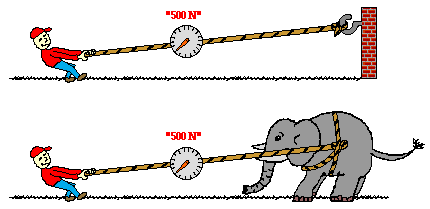
a. with more force when the rope is attached to the wall.
b. with more force when the rope is attached to the elephant.
c. the same force in each case.
Task 3. Match the numbers and letters
|
1 Mass vs. Weights |
|
|
2 Newton's 1st Law |
|
|
3 Newton's 2nd Law |
|
|
4 Newton's 2nd Law Equation |
|
|
5 Newton's 3rd Law |
|
Theme 17: The law of gravity
A learner
-
reads the new words
-
solves the problem using the law of gravity(Task 1)
-
reads the definitions and chooses True or False(Task 2)
|
Kazakh |
Russian |
English |
|
Гравитациялық күштер |
Гравитационные силы |
Gravitational forces |
|
Бүкіләлемдік тартылыс заңы |
Закон всемирного тяготения |
The law of gravity |
|
Гравитациялық тұрақты, үздіксіз |
Гравитационная постоянная |
Gravitational constant |
|
Денелер арасындағы қашықтық |
Расстояние между телами |
Distance between bodies |
|
Тура пропорционал |
Прямо пропорционально |
Directly proportional |
|
Кері пропорционал |
Обратно пропорционально |
Inversely proportional |
Task 1. Solve the problem:
Determine the force of gravitational attraction between the earth (m = 5.98 x 1024 kg) and a 70-kg physics student if the student is standing at sea level, a distance of 6.38 x 10⁶ m from earth's centre.
Task 2. Choose True (T) or False (F)
|
Newton’s idea was that gravity was a universal force acting between any two objects. |
T/F |
|
Gravitational force is inversely proportional to the masses of both objects. |
T/F |
|
Gravitational force is directly proportional to the distance between the objects. |
T/F |
|
G is a constant of proportionality. |
T/F |
|
G = 9.8Nm2/kg2 |
T/F |
Theme 18: Body weight, weightlessness
A learner
-
reads the new words
-
answers the questions using an information about body weight(Task 1)
-
writes the physical quantities names by given definition (Task 2)
|
Kazakh |
Russian |
English |
|
Дене салмағы |
Вестела |
Body weight |
|
Салмақсыздық |
Невесомость |
Weightlessness |
|
Шамадан тыс жүктеме |
Перегрузка |
overload |
|
Тірек реакциясының күші |
Сила реакции опоры |
Support reaction force |
|
Ілгіш, асқыш, аспа |
Подвес |
Suspension |
|
Тірек |
Опора |
Support, prop |
|
Аспа тартуы, созуы, керуі |
Натяжение подвеса |
Suspension tension |
|
Көлбеу жазықтық, көлбеген жазықтық |
Наклонная плоскость |
Inclined plane |
Task 1. Look at the picture and answer the questions:
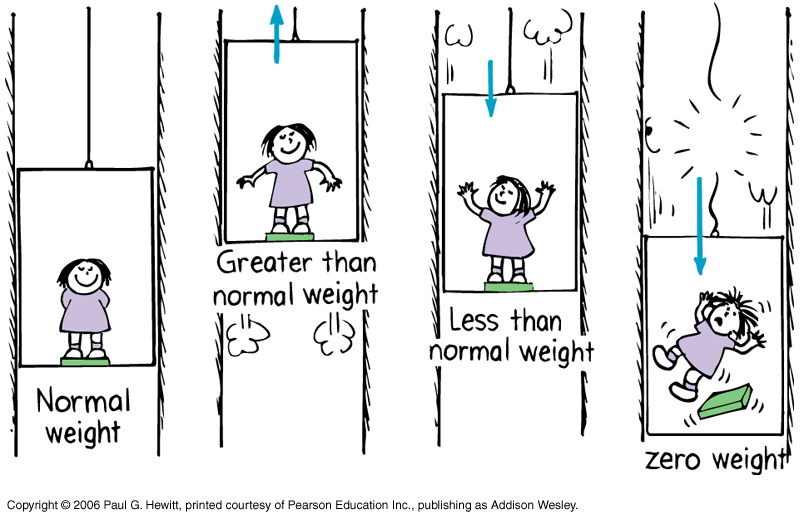
1) Is it true that your “apparent weight” depends on your acceleration?
2) Explain how does a vertical acceleration change the weight.
3) What is difference between “mass” and “weight”?
Task 2. There are two definitions. What is the physical quantity?
1) It shows how much you push on your surroundings.
2) It is absence of a support force.
Theme 19: Momentum and impulse. Impulse conservation Law
A learner
-
reads the new words
-
answers the text questions (Task 1)
-
solves the problems using momentum equation(Task2)
|
Kazakh |
Russian |
English |
|
Дене импульсі |
Импульс тела |
Momentum |
|
Күш импульсі |
Импульс силы |
Impulse |
|
Импульс сақталу заңы |
Закон сохранения импульса |
Impulse conservation Law |
|
Дене массасы |
Масса тела |
Body mass |
|
Жылдамдық векторы |
Вектор скорости |
Vector speed |
|
Ньютонның екінші заңы |
Второй закон Ньютона |
The second law of Newton |
|
Дене жуйесі |
Система тел |
Body system |
|
Ішкі күштер |
Внутренние силы |
Internal forces |
|
Сыртқы күштер |
Внешние силы |
External forces |
|
Тұыйықталған дене жүйесі |
Замкнутая система тел |
Body circuit system |
Task 1. Test. Choose one correct answer.
-
An object's momentum isdepend upon the object's ______&_____
-
size and shape
-
velocity and mass
-
mass and speed
-
mass and acceleration
-
What are the units of momentum?
-
m/s
-
kg
-
kg * m/s
-
kg * m/s2
-
The momentum equation is
-
p=mv
-
p=mg
-
p=mgh
-
p=ma
-
When the velocity of an object is doubled and its mass is cut in half, its momentum
-
decreases by a factor of 4 (x1/4)
-
doubles (x2)
-
quadruples (x4)
-
remains the same
-
How can a tennis ball and a bowling ball have the same momentum?
-
one is moving in the negative direction
-
they can't because they have different masses
-
have equal velocity
-
have unequal velocity
Task 2. Solve the problem
What is the average momentum of a 50-kg skateboarder who covers 400 m in 50 s?
Chapter 4. Conservation Laws
Theme 20: Mechanical work and energy.
Conservation and conversion energy Law
A learner
-
reads the new words
-
matches the physical quantities and its definitions (Task 1)
|
Kazakh |
Russian |
English |
|
Механикалық жұмыс және энергия |
Механическая работа и энергия |
Mechanical work and energy |
|
Күш модулі |
Модуль силы |
Force module |
|
Жылжыту |
Перемещение |
Displacement |
|
Энергия |
Энергия |
Energy |
|
Дененіңмеханикалықжағдайы |
Механическое состояние тела |
Body mechanical condition |
|
Тұыйықталған дене жүйесі |
Замкнутая система тел |
Body circuit system |
|
Кинетикалықжәнепотенциалды энергия |
Кинетическая и потенциальная энергии |
Kinetic and mechanical energies |
|
ЭнергиянысақтаужәнеайналдыруЗаңы |
Закон сохранения и превращения энергии |
Conservation and conversion energy Law |
Task 1. Match the numbers and letters
|
1. Mechanical work |
А. the sum of kinetic and potential energy in an object that is used to do work |
|
2. Mechanical energy |
B. the energy by virtue of an object's position relative to other objects. |
|
3. Potential energy |
C. the energy of movement |
|
4. Kinetic energy |
D. the amount of energy transferred by a force |
1 ____ 2 ___ 3 ___ 4 ___
Chapter 5. Oscillations and waves
Theme 21: Oscillatory motion. Free and damped oscillations. Resonance.
A learner
-
reads the new words
-
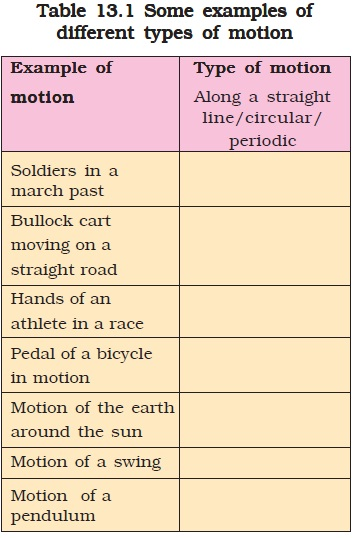
reads the examples of different types of motion and fills the table (Task 1)
|
Kazakh |
Russian |
English |
|
Тербемелі қозғалыс |
Колебательное движение |
Oscillatory motion |
|
Түзу сызықты қозғалыс |
Прямолинейное движение |
Stright line motion |
|
Айналмалы қозғалыс |
Вращательное движение |
Circular motion |
|
Периодтық тербеліс |
Периодичное движение |
Periodic motion |
|
Қозғалыс жиілігі |
Частота движения |
The frequency of the movement |
|
Тербеліс периоды |
Период колебания |
Oscillation period |
|
Ереже тепетеңдігі |
Положение равновесия |
Equilibrium position |
|
Тең әсерететін күш |
Равнодействующая сила |
Resultant force |
|
Ығысу |
Смещение |
displacement |
|
Гармоникалық тербелістер |
Гармонические колебания |
harmonic oscillations |
|
Еркін тербелістер |
Свободные колебания |
Freeoscillation |
|
Еріксіз тербелістер |
Вынужденные колебания |
Forced oscillations |
|
Өшетін тербеліс |
Затухающие колебания |
damped oscillation |
|
Резонанс |
Резонанс |
Resonance |
Task 1. Fill the table using needed types of motions
Theme 22: Transformation of energy under oscillations. Oscillations of a mathematical and pendulum springs.
A learner
-
reads the new words
-
determines needed quantity using the graph (Task 1)
-
solves the problems using needed formulas (Task 2)
|
Kazakh |
Russian |
English |
|
Тербеліс кезінде энергияның өзгеруі |
Превращение энергии при колебаниях |
Transformation of energy under oscillations |
|
Тербеліс қозғалысының теңдеуі |
Уравнение колебательного движения |
Equation of oscillatory motion |
|
Математикалық және серіппелі маятниктердің тербелістері |
Колебания математического и пружинного маятников |
Oscillations of a mathematical and pendulum springs |
|
Механикалық тербеліс |
Механические колебания |
Mechanical oscillation |
|
Жүйенің толық механикалық энергиясы |
Полная механическая энергия системы |
Total mechanical energy of the system |
|
Kinetic and potential energy |
Кинетическая и потенциальная энергии |
Кинетикалықжәнепотенциалдық энергия |
|
Тербеліскезеңі мен жиілігі |
Период и частота колебания |
The period and frequency of oscillation |
|
Айналым |
Цикл |
Cycle |
|
Тербеліс амплитудасы |
Амплитуда колебания |
Oscillation amplitude |
|
Тербеліс жүйелері |
Колебательные системы |
Oscillatory system |
|
Математикалық маятник |
Математеческий маятник |
Simple pendulum |
|
Математикалықмаятниктіңтербеліскезеңі |
Период колебаний математического маятника |
The oscillations period of the mathematical pendulum |
|
Серіппе маятник |
Пружинный маятник |
Spring pendulum |
|
Циклдік жиілік |
Циклическая частота |
Angular frequency |
|
Серіппелімаятниктіңтербелукезеңі |
Период колебаний пружинного маятника |
The oscillation period of the spring pendulum |
Task 1. Here is a graph of oscillatory motion.
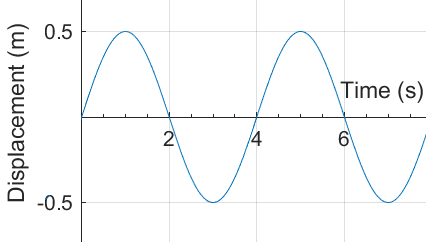
Using the graph determine
-
Amplitude _____________________________________________________
-
Period and frequency ____________________________________________
-
The angular frequency ___________________________________________
-
Equation of the oscillation motion __________________________________
Task 2. Solve the problems:
1) What is the period of spring-mass period is, if mass is 0.02 kg and k=0.5 N/m
2) What is the period of 0,9m long simple pendulum on the Earth?
Chapter 6. Аtomic structure. Аtomic phenomena
Theme 23: Thermal radiation
A learner
-
reads the new words
-
reads the definition of radiation and completes it (Task 1)
-
solves the problems using needed formulas (Task 2)
|
Kazakh |
Russian |
English |
|
Жылу сәулесі |
Тепловое излучение |
Thermal radiation |
|
Қызғандене |
Нагретое тело |
Heated body |
|
Сәулелену энергиясын сіңіру |
Поглощение энергии излучения |
The absorption of radiation energy |
Task 1.Fill a necessary word
Radiation – the process in which ….… is emitted as particles or waves (energy)
Task 2.Solve a problem
What energy luminosity does solidified lead have? The ratio of the energy luminosities of lead and a blackbody for a given temperature is k = 0.6.
Theme 24:Light Quanta. Photoelectric effect
A learner
-
reads the new words
-
solves the problem using needed formulas (Task 1)
-
matches the formulas and its names (Task 2)
|
Kazakh |
Russian |
English |
|
Қара дене |
Абсолютно черное тело |
Black body |
|
Кванттық энергия |
Квант энергия |
Quanta energy |
|
Планкгипотезасы |
Гипотеза Планка |
The Planck's hypothesis |
|
Тұрақты Планка |
Постоянная Планка |
Planck's constant |
|
Фотоэффект |
Фотоэффект |
Photoelectric effect |
|
Фотоэлемент |
Фотоэлемент |
Photoelectric element |
|
Күн батареялары |
Солнечные батареи |
The Sun batteries |
|
фоторезистор |
фоторезистор |
Photo resistor |
|
Einstein's equation for the photoelectric effect |
Уравнение Эйнштейна для фотоэффекта |
ФотоэффектүшінЭйнштейнтеңдеуі |
|
Фотоэффекттің қызыл шекарасы |
Красная граница для фотоэффекта |
Cut-off frequency |
|
Металлдан электрондардың шығу жұмысы |
Работа выхода электронов из металла |
The output of the electron work from the metal |
Task 1.Solve a problem
Determine the wavelength of radiation whose quantum energy is equal to the kinetic energy of an electron that has passed the potential difference of 5V.
Task 2.Matching following formulas
-
-
Ɛ = h v
Cut-off frequency
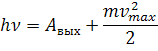
The Planck's hypothesis
λmax = ch
Aвых
Einstein's equation for the photoelectric effect
-
LITERATURE
-
PHYSICS, Gade 9: Билингвальный учебник/ Ташев Н., Шокобалинов Н, Дуйсеев Е, Карабатыров А., Бейшов А, Артыкбаев А., Ауелбаева К., Божкенова А.- Алматы: Астана-кітап, 2018.
-
Физика: учебник для 9 кл. общеобразоват.шк./Насоханова Ш., Казахбаева Д., Бекбасар Н.-Алматы: Мектеп (прект)
-
Физика: учебник для 9 кл. общеобразоват.шк./ Закирова Н., Аширов Р.-Нур-Султан: Издательство «Арман –ПВ», 2019
35








 Бұл курс Қазақстан Республикасы Оқу-ағарту министрлігімен келісілген










