|
Long term plan unit:
|
Secondary School named after
Nauaii, Sozak Region
|
|
Date:
|
Teacher name: Indira
Ushibayeva
|
|
Grade:
7
|
Number present:
|
Absent:
|
|
Theme of the
lesson: Space and
Earth
|
|
Learning objectives (s) that this lesson is
contributing to
|
7.C7 develop and sustain a consistent argument
when speaking or writing;
7.R1 understand the main points in texts on a
limited range of unfamiliar general and curricular
topics;
7.R7 recognise typical features at word, sentence
and text level in a range of written genres;
7.S3 give an opinion at discourse level on a
growing range of general and curricular topic;
|
|
Lesson objectives
|
All learners will be able
to: understand the main points
and give an opinion about space to develop and sustain a
consistent argument when speaking with lots of
support;
Most learners will be able
to: understand the main points
and give an opinion about space to develop and sustain a
consistent argument when speaking with some
support;
Some learners will be able
to:
understand the main points and
give an opinion about space to develop and sustain a
consistent argument when speaking independently;
|
|
Assessment criteria
|
- Develop and sustain a
consistent argument when speaking or
writing;
- Define the main points in
texts on a limited range of unfamiliar general and curricular
topics;
- Identify typical features at word, sentence and
text level in a range of written genres;
-
Give an opinion at discourse level on a growing range of general
and curricular topic;
|
|
Value links
|
“Mangilik Yel” Patriotic
Act:
4) Economic growth based on
industrialization and innovation
|
|
Cross curricular
links
|
World Sciences
|
|
ICT skills
|
digital references
|
|
Previous learning
|
words about solar
system
|
|
Plan
|
|
Time
|
Planned activities
|
Resources
|
|
7 min.
8 min.
5 min.
5 min.
8 min.
7 min.
|
Lead-in and pre-teaching
the vocabulary.
Look at the pictures of the solar
system.
-
Which ones do you already know?
-
What do you know?

Inner solar system or outer solar
system
Which four planets
comprise: the inner solar system
(closest to the Sun)? the outer solar
system.
Jigsaw
reading.
Learners will be divided into 2 groups. The
learners will read one part of the text. The members of the first
group will retell the information in the first paragraph to another
group.
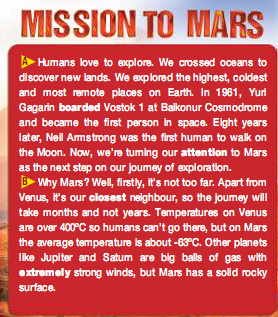
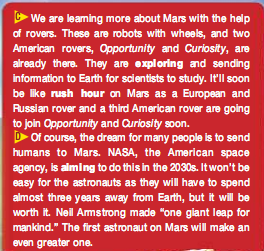
What do they relate?
How are these
names: Yuri Gagarin, Vostok 1,
Baikonur Cosmodrome, Neil Armstrong, Opportunity and Curiosity,
NASA related to space
exploration?
Scanning.
Read the text again by scanning and match the
halves of sentences:
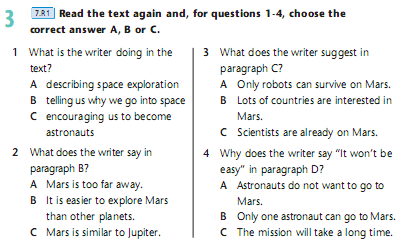
Explain the words in bold. You can use
your dictionaries or digital references.
|
solar system
worksheet
words
worksheet
dictionaries or digital
references
|
|
Additional
information
|
|
Differentiation – how do you plan to
give more support? How do you plan to challenge the more able
learners?
|
Assessment – how are you planning to check
learners’ learning?
|
Health and safety check
ICT links
|
|
Learners will be given support if they
need some help. In this case they will also use digital references
or dictionaries to look through the meaning of certain words. This
will be very useful for the last task.
|
I will use formative
assessment forms all the time. For Jigsaw reading task, I will give
group assessment sheets. Learners will assess each other, which is
the form of peer-assessment.
|
The teacher gives about the
solar system.
|
|
Reflection
Were the lesson objectives/learning objectives
realistic?
Did
the learners achieve the LO?
If
not, why?
Did
my planned differentiation work well?
Did
I stick to timings?
What changes did I make from my plan and
why?
|
|
|
Summary evaluation
What two things went really well (consider both
teaching and learning)?
1:
2:
What two things would have improved the lesson
(consider both teaching and learning)?
1:
2:
What have I learned from this lesson about the
class or achievements/ difficulties of individuals that will inform
my next lesson?
|

 ЖИ көмекші


 Қауіпсіз төлем













 Бұл курс Қазақстан Республикасы Оқу-ағарту министрлігімен келісілген










