
 ЖИ көмекші


 Қауіпсіз төлем

жүктеу мүмкіндігіне ие боласыз
Бұл материал сайт қолданушысы жариялаған. Материалдың ішінде жазылған барлық ақпаратқа жауапкершілікті жариялаған қолданушы жауап береді. Ұстаз тілегі тек ақпаратты таратуға қолдау көрсетеді. Егер материал сіздің авторлық құқығыңызды бұзған болса немесе басқа да себептермен сайттан өшіру керек деп ойласаңыз осында жазыңыз
 04 Наурыз 2019
 571

1 жыл бойы шексіз жүктеңіз
Secondary schools in the UK
Date:
08.12.2015
Subject:
English
Form:
7b
The
theme of the lesson:
«Secondary
schools in the UK»
The
aims:
a) to enrich the pupils’ knowledge with new facts concerning the theme;
b) to develop pupils' speaking, writing, reading skills and pronunciation abilities;
c)
to respect the traditions and customs of foreign countries.
The
type of the lesson:
mixed lesson.
The method: speaking, discussing.
Visual
aids:
an interactive board, tape recorder and papers.
The procedure of the lesson:
I.Organization moment:
- Good morning, everybody. Nice to meet you.
- How are you today? Are you fine?
- Today’s our lesson is an unusual because we have some guests. And I hope that you'll show your best knowledge during the lesson. And now I want you coming here and taking these stickers, by their colour you'll divide into three groups.
Table 1 «Schools».
Table 2 «Subjects».
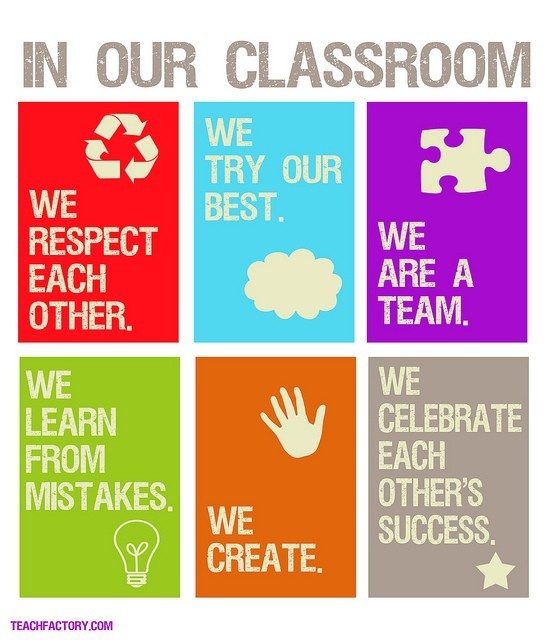
Table 3 «Grammar». I wish you good luck and always remember our golden rules!
- Then, let’s call the register. Who is on duty today?
- Who is absent? Is he/she ill?
- What was your home task for today?
- Our home task was to retell the text about «Primary schools in the UK». Then Ex 4c, at page 103
/Rysbek, Tomiris and Nurzhan/
-Well, who wants to retell the text? Are you ready today? /Tlek, Aruzhan, Kamilla, Eldar/
Text: «Primary schools in the UK».
In Great Britain school begins at the age of five. At the age of sixteen, the children usually leave school. So they spend eleven years there. There are primary and secondary schools in England. When children are five, they go to primary schools. First, they attend infant schools or infant classes. They spend two years there till they are seven. Their classes are usually informal: they learn to read, count and write through different games. They sing songs, dance, look at pictures in interesting books, draw, learn to get on with their classmates. So their lessons are easy, not difficult. At the age of seven they go to junior schools and stay there till they are eleven. Real school begins. The lessons are more formal. There are different subjects on the timetable. Children study English, Maths, History, Nature Study, Geography, Art, Music, Physical Education (PE), Handicraft and Religion. By the way, English children go to school five days a week. On Saturday and on Sunday they have their days off. Classes usually begin at nine and are over at 4 o'clock. Children have lunch at school. In many primary schools pupils don't wear uniforms. But some schools have special uniforms. School year starts in September and is over in summer, in July.
- Ok, thank you. Nice you are.
- Boys and girls! I have some questions for you.
1.
What type of school is our school?
Primary, secondary school.
2.
What age do our pupils start school?
At the of 6.
3.
What age do our pupils leave school?
At the age of 17.
4.
When does our school year begin?
Our school year begins on the 1st of September.
5.
When does our school year end?
Our school year ends on the 25th of May.
II. Presentation:
- Then everyone look at the screen. We'll continue our lesson after watching the video.
/5 minutes/
- What have you learnt from this video?
- How do you think about what kind of school shall we speak? And where?
-Yes you are right. So, write down today's date and the theme: «Secondary schools in the UK». Also we'll continue to work on the theme Passive Voice. /Past Simple/
a)
vocabulary work: There
are some new words for you to learn:
compulsory-
міндетті
core- негізгі
education- білім
free- тегін
further- жалғастырушы
infant- даярлық
junior- кіші
nursery- балабақша
physical education- дене тәрбиесі
primary- бастауыш
secondary- орта
stay- тоқтау, қалу
b)
to work on the text:
Secondary
schools in the UK.
Children in Britain start school when they are five and stay at school until they are sixteen or older. Many children in Britain attend nursery school from the age of about three, but these schools are not compulsory. Compulsory education begins at the age of five, when children go to primary school. Primary education lasts for six years. They attend the infant school from five to seven and then junior school until they are eleven. Then pupils go to secondary schools.
Children study 10 subjects: English, maths, science, geography, history, art, music, PE and a foreign language. Most secondary schools teach French and some schools offer Spanish, German, Italian and Russian. The first three are called «core» subjects. Pupils take examinations in the core subjects at the age of 7, 11 and 14.
After five years of secondary education, pupils take the General Certificate of Secondary Education (GCSE) examination. Most pupils take examinations in all subjects.
Compulsory education ends at sixteen. Some people choose to stay at secondary school for a further two years. Other people leave secondary school at sixteen and go to colleges of further education.
- You have just read the text. Now I want to give you some tasks. Work in a group.
Tasks
Task
for the 1st group:
To
answer these questions:
When does compulsory education start in England?
How long does primary education last?
How long does secondary education last?
Which subjects do British children study at school?
Which foreign languages are taught in British schools?
Is education in Britain free?
Task for the 2nd group:
To make up the poster on theme «Secondary schools».
Task for the third group:
To complete the chart
AGE TYPE OF SCHOOL
3-5 years ......................................
5 years .......................................
5-7 years .......................................
7-11 years .......................................
11-16 years .......................................
C) To work on grammar: Past Simple Passive
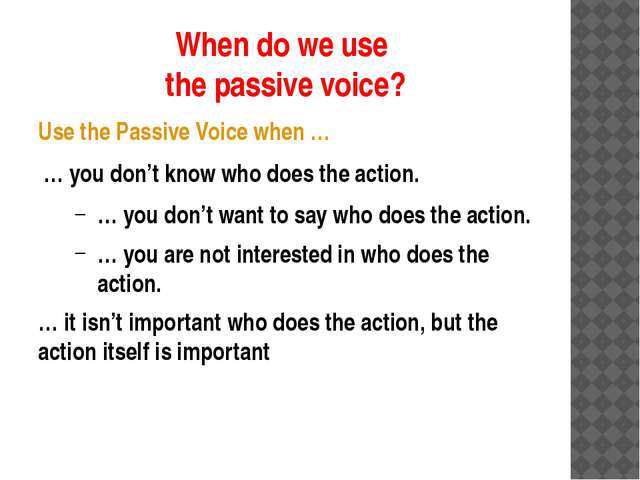
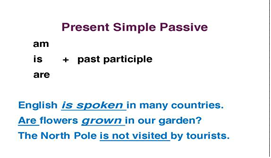
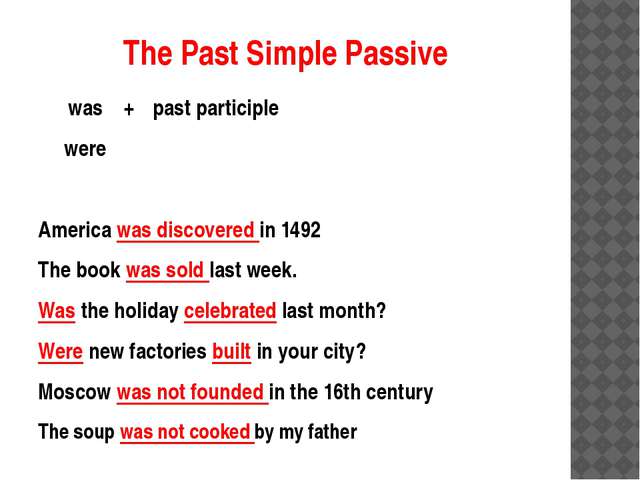
III. Practice: Doing exercises
Task for the 1st group:
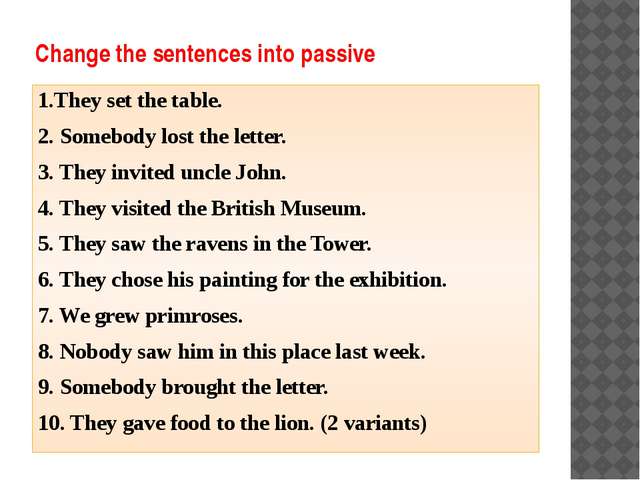
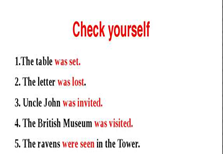
Task for the 2nd group:
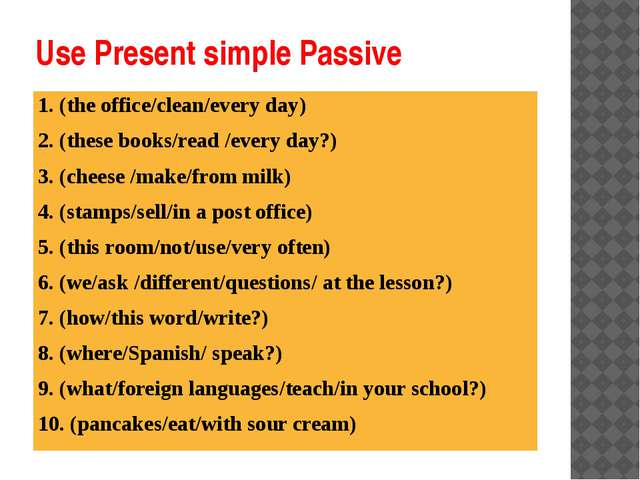
Task for the 3rd group:
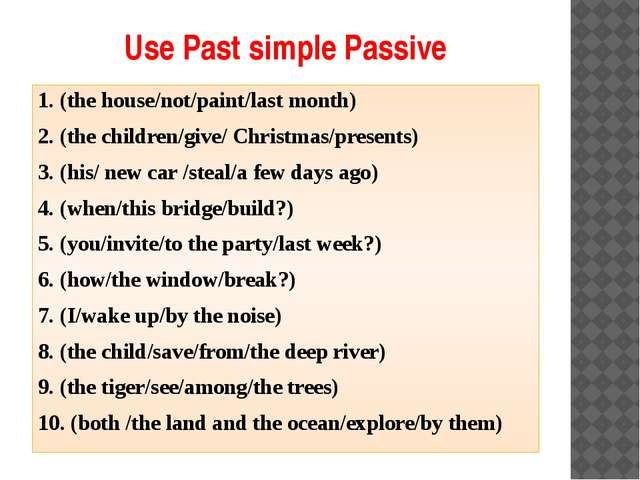
III. Practice: Doing exercises
Exercise
IY. Production:
Song «Back to school»
I'm going back. You're going back. We're going back, back to school.
My sisters going back, brothers going back, even my teacher’s going back to school.
Raina’s going back, Dan is going back, Maya’s going back, back to school.
It's the end of summer and for some that is a bummer but I just can't wait, wait, wait to get back to school.
Back to school. Back to school. I just can’t wait, wait, wait get back to school.
I ain't telling you no lies. I've got my school supplies. And I just can't wait, wait, wait to get back to school.
Fisher's going back, Duvan is going back, Brooks is going back, back to school.
Jasmine’s going back, Malik is going back, Julian is going back to school.
Juan is going back, Ella's going back, Sophie’s going back, back to school.
I've picked my first day outfit. I wanna tell you about it but I just can't wait, wait, wait to get back to school. (Chorus)
I've got new snazzy glasses. I wonder where my class is? I just can't wait, wait, wait to get back to school.
I’ve got a brand new lunch box. It’s gonna knock your socks off. I just can't wait, wait, wait to get back to school.
I’ve got pencils and a ruler. Won’t cut like Ferris Bueller. I just can't wait, wait, wait to get back to school.
Conclusion
-Thank you everybody, you were very active today.
Feedback: -I want to know your own opinion in each group about today's lesson. Did you like the lesson? Have you understood today's new theme?
Expected replies:
*We worked with text today.
*We got a lot of information about schools in the UK.
*We knew how to work with Passive voice in the Past Simple.
-Your marks are ...
-Your home task will be to retell the text and exercise 6c at page 105. To complete the sentences.









 Бұл курс Қазақстан Республикасы Оқу-ағарту министрлігімен келісілген










