
 ЖИ көмекші

 Көп таңдалатын


 Ең тиімді
15 890₸ үнемдейсіз


жүктеу мүмкіндігіне ие боласыз
Бұл материал сайт қолданушысы жариялаған. Материалдың ішінде жазылған барлық ақпаратқа жауапкершілікті жариялаған қолданушы жауап береді. Ұстаз тілегі тек ақпаратты таратуға қолдау көрсетеді. Егер материал сіздің авторлық құқығыңызды бұзған болса немесе басқа да себептермен сайттан өшіру керек деп ойласаңыз осында жазыңыз
 03 Сәуір 2019
 341
341
Сөз таптары. Сан есім.
A collection of tasks
for Formative Assessment
English
Grade 7
Dear teacher!
The group of teachers designed this collection of tasks as a teaching aid to assist teachers
within the framework of updating the content of education. Tasks wi th assessment criteria and
descriptors are samples for assisting teachers in providing constructive feedback to learners in terms
of achievement of learning objectives; in selecting and designing similar tasks, in planning lessons
and carrying out Formative Assessment.
T in tasks according to learners’ capacities and requirements.
An
forums and video instructions can be found on the official website of «Nazarbayev Intellectual
Schools» Autonomous Educational Organisation smk.edu.kz.
We wish you creative work and success!
This collection of tasks is designed for secondary school teachers, school administrations,
educational departments’ seniors, regional and school coordinators in criteria-based assessment and
others.
Freely available Internet resources such as pictures, cartoons, photos, texts, video and audio
materials, etc. have been used in designing this tasks collection. The collection of tasks was
designed for the uncommercial purposes.
2
Contents
TERM 1 .............................................................................................................................................................. 4
Unit: Hobbies and Leisure .................................................................................................................................. 4
Unit: Communication and technology .............................................................................................................. 26
TERM 2 ............................................................................................................................................................ 46
Unit: Holidays and Travel ................................................................................................................................ 46
Unit: Space and Earth ....................................................................................................................................... 68
TERM 3 ............................................................................................................................................................ 92
Unit: Reading for pleasure ................................................................................................................................ 92
Unit: Entertainment and media ....................................................................................................................... 107
Unit: Natural Disaster ..................................................................................................................................... 121
TERM 4 .......................................................................................................................................................... 132
Unit: Healthy Habits ....................................................................................................................................... 132
Unit: Clothes and Fashion .............................................................................................................................. 154
3
TERM 1
Unit: Hobbies and Leisure
Learning objective 7.L1 Understand with little support the main points in extended
talk on a limited range of general and curricular topics
Assessment criteria •Identify the main idea in extended talks with little support
Level of thinking skills Knowledge and comprehension
Task
Listen to the conversation of two friends and choose the correct answer A, B, or C.
Go to this link: http://www.esl- lab.com/nightlife/nightliferd1.htm
1. What is Stuart planning to do with his friends?
A) go for a drive and have a picnic
B) watch a football game
C) see a movie and have dinner
2. Why does Amy say she can't go with them?
A) She has to study for an exam. B) She doesn't have any spending money. C) She already has plans to attend a party.
3. What are they planning to do at the end of the evening?
A) watch a video B) have a party C) play some games
4. How is Amy getting to the activity?
A) She's driving her car. B) Stuart’s giving her a ride.
C) She's taking the bus.
5. What time does Amy want to be home?
A) at 10:30 p.m. B) at 11:30 p.m. C) at midnight
Answer keys:
1. C; 2. A; 3. B; 4. B; 5. A.
Descriptor A learner
•selects an appropriate answer;
•completes the task.
4
Unit: Hobbies and Leisure
Learning objective 7.L2 Understand with little support most specific information in
extended talk on a limited range of general and curricular topics
7.UE5 Use questions which include a variety of different tenses on a
range of familiar general and curricular topics
7.W3 Write with moderate grammatical accuracy on a limited range
of familiar general and curricular topics
Assessment criteria •Identify facts and details in extended talks with little support
•Demonstrate the ability to ask a variety of questions in
different tenses
•Demonstrate the ability to write grammatically correct
sentences on familiar topics
Level of thinking skills Knowledge and
comprehension
Application
Task
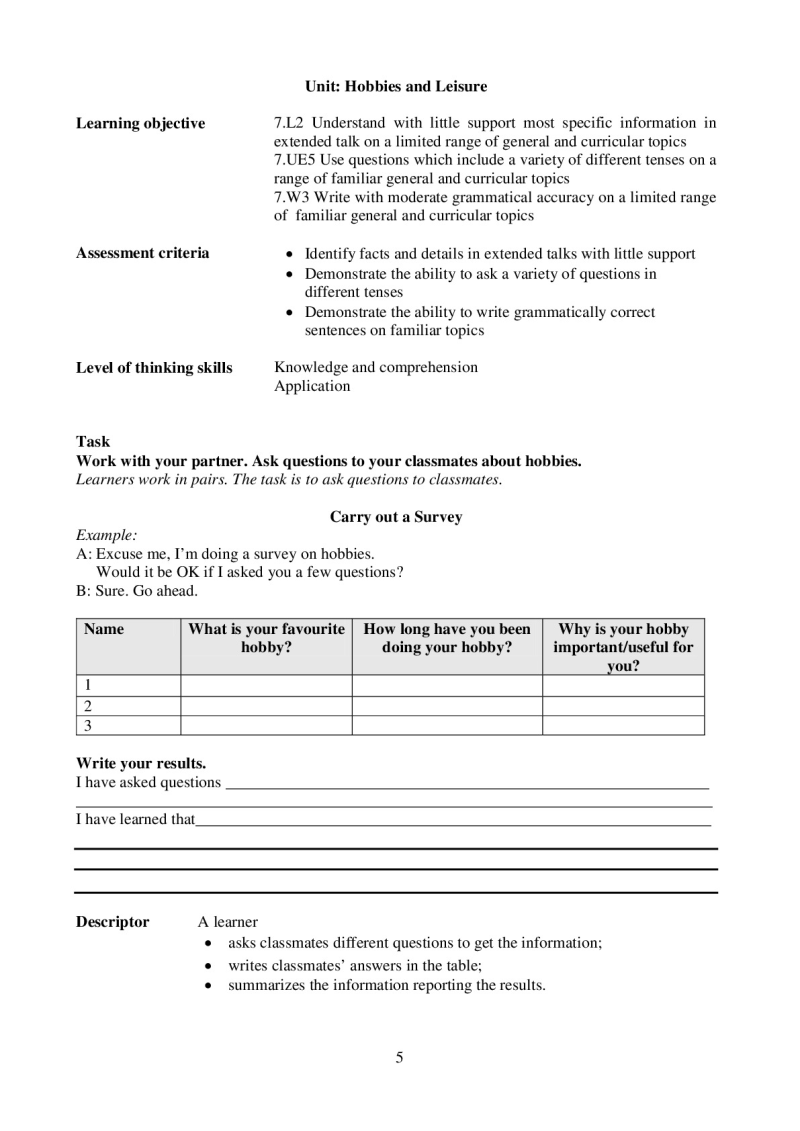
Work with your partner. Ask questions to your classmates about hobbies.
Learners work in pairs. The task is to ask questions to classmates.
Carry out a Survey
Example:
A: Excuse me, I’m doing a survey on hobbies.
Would it be OK if I asked you a few questions?
B: Sure. Go ahead.
Name What is your favourite
hobby?
How long have you been
doing your hobby?
Why is your hobby
important/useful for
you?
1
2
3
Write your results.
I have asked questions ____________________________________________________________ _______________________________________________________________________________ I have learned that________________________________________________________________
Descriptor A learner
•asks classmates different questions to get the information;
•writes classmates’ answers in the table;
•summarizes the information reporting the results.
5
Unit: Hobbies and Leisure
Learning objective 7.L4 Understand with little support some of the implied meaning
in extended talk on a limited range of general and curricular topics
7.S1 Use formal and informal registers in their talk on a limited
range of general and curricular topics
7.S2 Ask complex questions to get information about a limited
range of general topics and some curricular topics
7.C9 Use imagination to express thoughts, ideas, experiences and
feelings
Assessment criteria •Recognise the content of an extended conversation using
some supporting information
•Apply the difference between formal and informal speech
in a talk
•Make up complex interrogative sentences to get
information about the topic
•Convey opinions, notion, experiences and feelings
creatively
Level of thinking skills Knowledge and comprehension
Application
Higher order thinking skills
Task
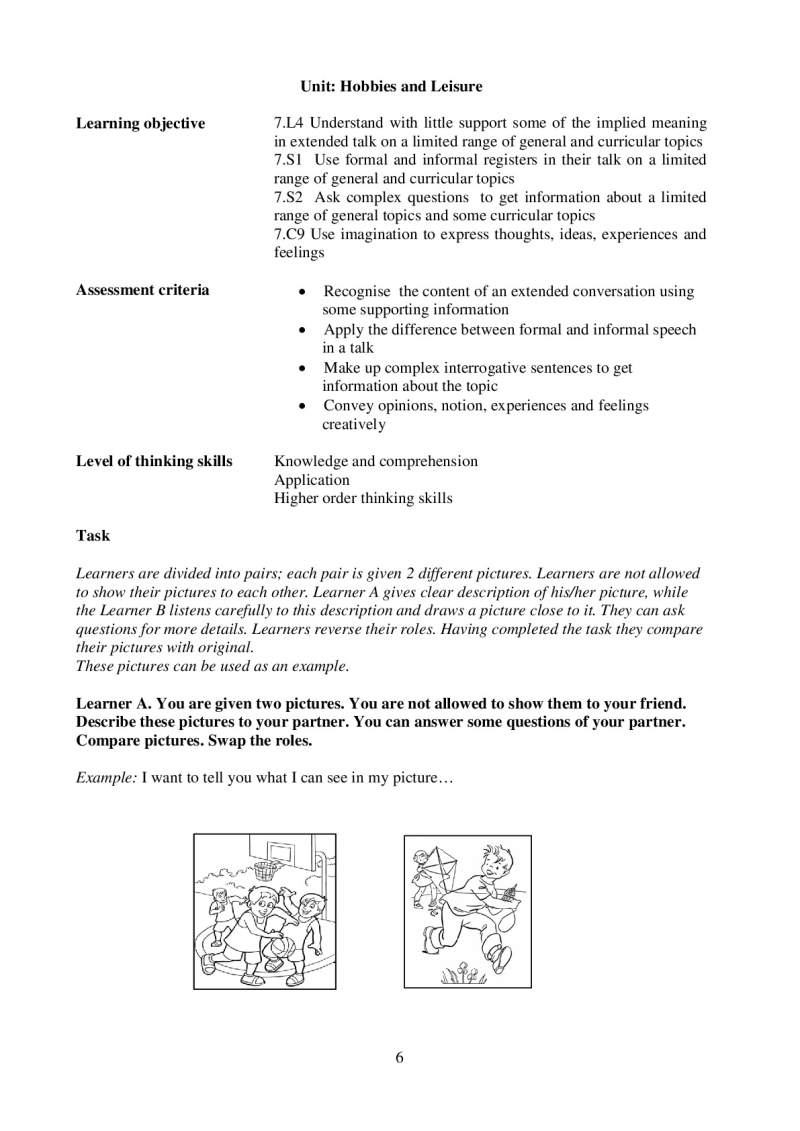
Learners are divided into pairs; each pair is given 2 different pictures. Learners are not allowed to show their pictures to each other. Learner A gives clear description of his/her picture, while the Learner B listens carefully to this description and draws a picture close to it. They can ask questions for more details. Learners reverse their roles. Having completed the task they compare their pictures with original.
These pictures can be used as an example.
Learner A. You are given two pictures. You are not allowed to show them to your friend.
Describe these pictures to your partner. You can answer some questions of your partner.
Compare pictures. Swap the roles.
Example: I want to tell you what I can see in my picture…
6
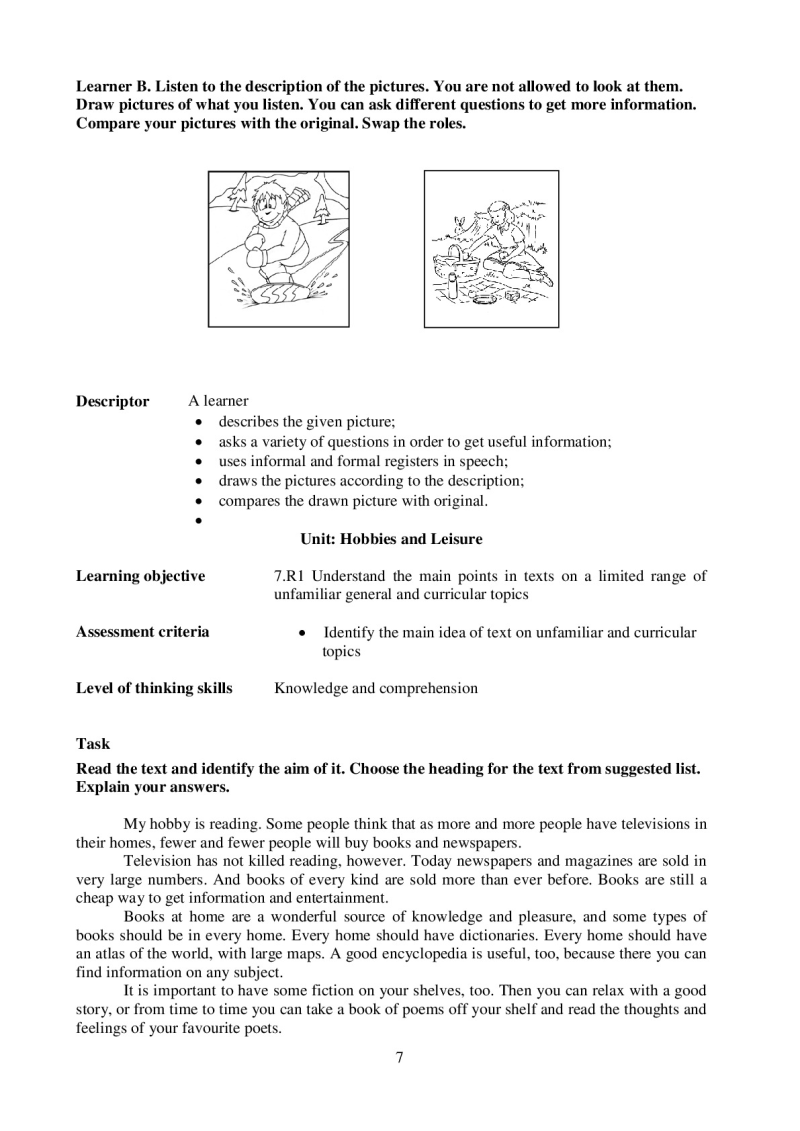
Learner B. Listen to the description of the pictures. You are not allowed to look at them.
Draw pictures of what you listen. You can ask different questions to get more information.
Compare your pictures with the original. Swap the roles.
Descriptor A learner
•describes the given picture;
•asks a variety of questions in order to get useful information;
•uses informal and formal registers in speech;
•draws the pictures according to the description;
•compares the drawn picture with original.
•
Unit: Hobbies and Leisure
Learning objective 7.R1 Understand the main points in texts on a limited range of
unfamiliar general and curricular topics
Assessment criteria •Identify the main idea of text on unfamiliar and curricular
topics
Level of thinking skills Knowledge and comprehension
Task
Read the text and identify the aim of it. Choose the heading for the text from suggested list.
Explain your answers.
My hobby is reading. Some people think that as more and more people have televisions in
their homes, fewer and fewer people will buy books and newspapers.
Television has not killed reading, however. Today newspapers and magazines are sold in
very large numbers. And books of every kind are sold more than ever before. Books are still a cheap way to get information and entertainment.
Books at home are a wonderful source of knowledge and pleasure, and some types of
books should be in every home. Every home should have dictionaries. Every home should have an atlas of the world, with large maps. A good encyclopedia is useful, too, because there you can
find information on any subject.
I story, or from time to time you can take a book of poems off your shelf and read the thoughts and
feelings of your favourite poets.
7
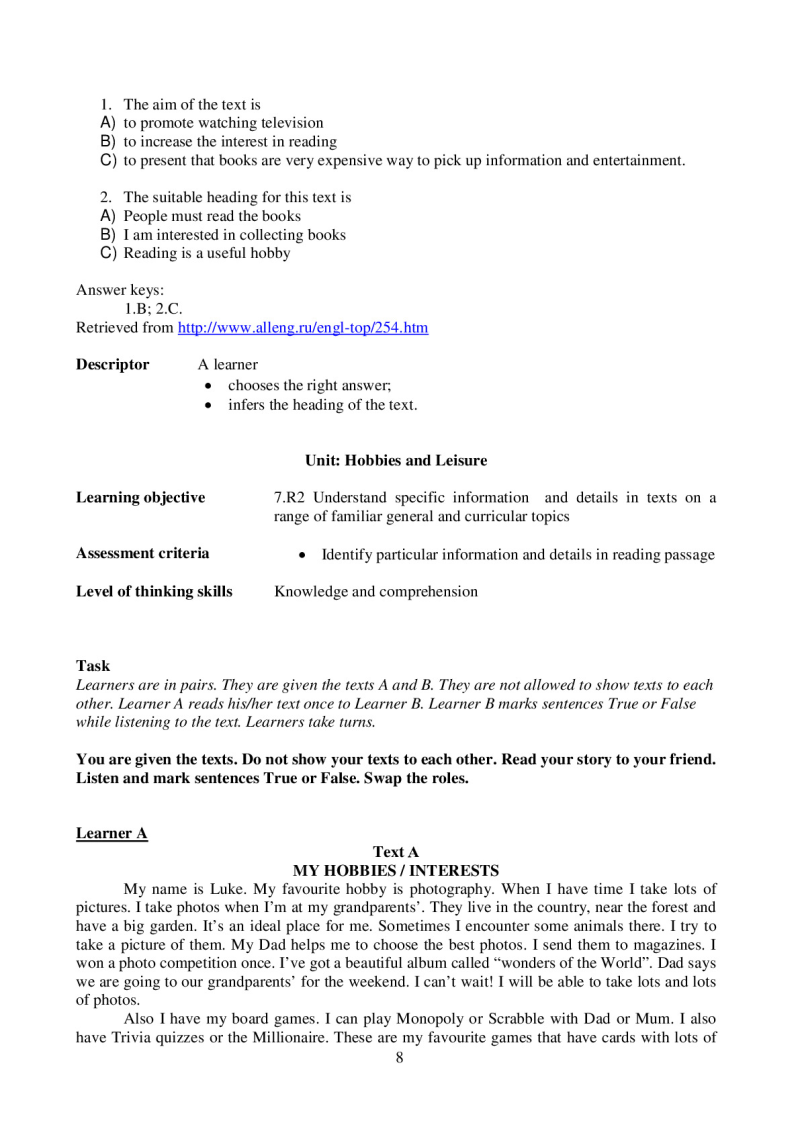
1.The aim of the text is
A)to promote watching television
B)to increase the interest in reading
C)to present that books are very expensive way to pick up information and entertainment.
2.The suitable heading for this text is
A)People must read the books
B)I am interested in collecting books
C)Reading is a useful hobby
Answer keys:
1.B; 2.C.
Retrieved from http://www.alleng.ru/engl-top/254.htm
Descriptor A learner
•chooses the right answer;
•infers the heading of the text.
Unit: Hobbies and Leisure
Learning objective 7.R2 Understand specific information and details in texts on a
range of familiar general and curricular topics
Assessment criteria •Identify particular information and details in reading passage
Level of thinking skills Knowledge and comprehension
Task
Learners are in pairs. They are given the texts A and B. They are not allowed to show texts to each
other. Learner A reads his/her text once to Learner B. Learner B marks sentences True or False
while listening to the text. Learners take turns.
You are given the texts. Do not show your texts to each other. Read your story to your friend.
Listen and mark sentences True or False. Swap the roles.
Learner A
Text А
MY HOBBIES / INTERESTS
My name is Luke. My favourite hobby is photography. When I have time I take lots of
pictures. I take photos when I’m at my grandparents’. They live in the country, near the forest and
have a big garden. It’s an ideal place for me. Sometimes I encounter some animals there. I try to
take a picture of them. My Dad helps me to choose the best photos. I send them to magazines. I
won a photo competition once. I’ve got a beautiful album called “wonders of the World”. Dad says we are going to our grandparents’ for the weekend. I can’t wait! I will be able to take lots and lots of photos.
Also I have my board games. I can play Monopoly or Scrabble with Dad or Mum. I also
have Trivia quizzes or the Millionaire. These are my favourite games that have cards with lots of
8
questions about sport, people and the world around us. They are great!
Find out if it is True or False from Text A
1. He doesn’t like board games. __________
2. They have two computers at home. __________
3. He likes playing hide and seek. __________
4. He enjoys being Aragon. __________
5. He likes playing football.__________
Learner B
Text B
MY HOBBIES / INTERESTS
I also like both computer games and board games. We have one computer at home but
sometimes Dad brings home his laptop and we can play a network game.
My favorite computer games are strategy, sport and adventure games. I got my first
computer two or three years ago and my first game was FIFA 2003. This is a game where you play
different football teams. It was great. My favorite adventure game is Broken Sword III. As for
strategy games, I like Command Conquer best.
When I’m outside with my friends we also play certain games. Not the silly games for little
children, like hide-and-seek or piggy-in-the middle, but more serious things. We play pirates, who
fight with each other to get the treasure or the Lord of Ring – I like to be Aragon best. And of
course there is nothing better than good game of football played with your friends!
Find out if
it is Tru False from Text B
1. His favorite hobby is playing games. __________ 2. His grandparents live in the village. __________ 3. He took part in a competition. __________
4. He is never bored with computer games. __________ 5. He plays board games with his parents. __________
Answer keys:
Text A: 1.False; 2.True; 3.True; 4.False; 5.True.
Text B:1.False; 2. False; 3.False; 4. True; 5.True.
Descriptor A learner
•marks sentences correctly.
9
Unit: Hobbies and Leisure
Learning objective 7.R3 Understand the detail of an argument on a growing range of
familiar general and curricular topics, including some extended
texts
7.R7 Recognise typical features at word, sentence and text level in a
range of written genres
Assessment criteria •Recognise the detail in a given argument relating to the
topic
•Identify the correct form of a word, appropriate sentence
structure and text layout
Level of thinking skills Knowledge and comprehension
Task1
Read the text and choose the best answer to the question.
Val's Garden
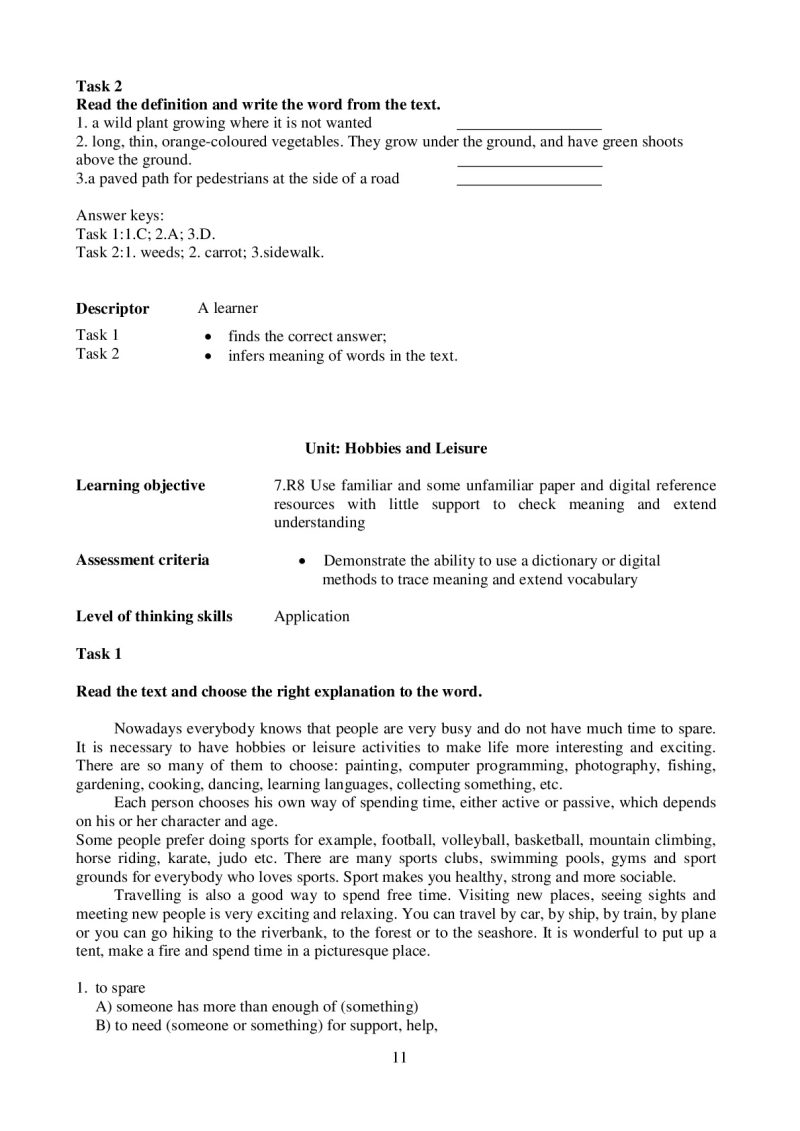
I am new to the city. I do not know anyone. But an old woman
lives next door. Her name is Val. She gives me a big box of vegetables.
She grows them in a garden by the sidewalk. There are carrots,
tomatoes, beans, and peas. They are the best vegetables I ever ate. Val
lives alone, too. But she seems happy in her garden. She loves plants.
Sometimes, I can hear her talking to them. Maybe that is why they
grow so big.
One day, I stop seeing Val in the garden. I see people take many
boxes from her home. Weeds grow in her garden. The dirt is dry. The plants look sad. Val must
have passed on.
So I pull the weeds. I water the garden. I even talk to the plants.
Then a family moves next door. They are new to the city. They do not know anyone. And I
give them a big box of vegetables from Val’s garden.
1.What kind of vegetable did Val not grow?
A)tomatoes
B)carrots
C)corn
D)beans and peas
2.Why was the new family lucky?
A)They moved into a good neighborhood.
B)They had lots of friends in town.
C)They were lucky because the writer of the story took care of Val's garden even after she died.
D)They had good jobs.
3.What is something that the writer of the story did not do after Val died?
A)pull the weeds
B)water the garden
C)talk to the plants
D)learn about Val's family
10
Task 2
Read the definition and write the word from the text.
1. a wild plant growing where it is not wanted__________________
2. long, thin, orange-coloured vegetables. They grow under the ground, and have green shoots
above the ground. __________________
3.a paved path for pedestrians at the side of a road __________________
Answer keys:
Task 1:1.C; 2.A; 3.D. Task 2:1. weeds; 2. carrot; 3.sidewalk.
Descriptor A learner
Task 1
Task 2
•finds the correct answer;
•infers meaning of words in the text.
Unit: Hobbies and Leisure
Learning objective 7.R8 Use familiar and some unfamiliar paper and digital reference
resources with little support to check meaning and extend
understanding
Assessment criteria •Demonstrate the ability to use a dictionary or digital
methods to trace meaning and extend vocabulary
Level of thinking skills Application
Task 1
Read the text and choose the right explanation to the word.
Nowadays everybody knows that people are very busy and do not have much time to spa re.
It is necessary to have hobbies or leisure activities to make life more interesting and exciting.
There are so many of them to choose: painting, computer programming, photography, fishing,
gardening, cooking, dancing, learning languages, collecting something, etc.
Each person chooses his own way of spending time, either active or passive, which depends
on his or her character and age.
Some people prefer doing sports for example, football, volleyball, basketball, mountain climbing, horse riding, karate
, judo etc. There are many sports clubs, swimming pools, gyms and sport
grounds for everybody who loves sports. Sport makes you healthy, strong and more sociable.
Travelling is also a good way to spend free time. Visiting new places, seeing sights and
meeting new people is very exciting and relaxing. You can travel by car, by ship, by train, by plane
or you can go hiking to the riverbank, to the forest or to the seashore. It is wonderful to put up a tent, make a fire and spend time in a picturesque place.
1.to spare
A) someone has more than enough of (something)
B) to need (someone or something) for support, help,
11
C)to like (someone or something) better than someone or something else
D) to allow (time) to pass in a particular place or while doing a particular activity
2.exciting
A)spending time resting or doing something enjoyable
B
)
causing feelings of interest and enthusiasm
C
)
very pretty or charming
D)liking to be with and talk to other people
3.depend on
A) someone has more than enough of (something)
B) to need (someone or something) for support, help,
C) to like (someone or something) better than someone or something else
D) to allow (time) to pass in a particular place or while doing a particular activity
4.sociable
A) spending time resting or doing something enjoyable
B) causing feelings of interest and enthusiasm
C) very pretty or charming
D) liking to be with and talk to other people
5.relaxing
A) spending time resting or doing something enjoyable B) causing feelings of interest and enthusiasm C) very pretty or charming
D) liking to be with and talk to other people
6. picturesque
A)spending time resting or doing something enjoyable
B)causing feelings of interest and enthusiasm
C)very pretty or charming
D)liking to be with and talk to other people
Task 2
Write your answers in the table and check the meaning of the words in an on- line dictionary.
1
2
3
4
5
6
Now go to the link and check your answer: http://www.merriam -webster.com/
Answer keys:
1.A; 2.B; 3.B; 4.D; 5.A; 6.C.
Descriptor A learner
Task 1
Task 2
•chooses the right answers;
•checks the meaning of the words in the dictionary and writes them in the
table.
12
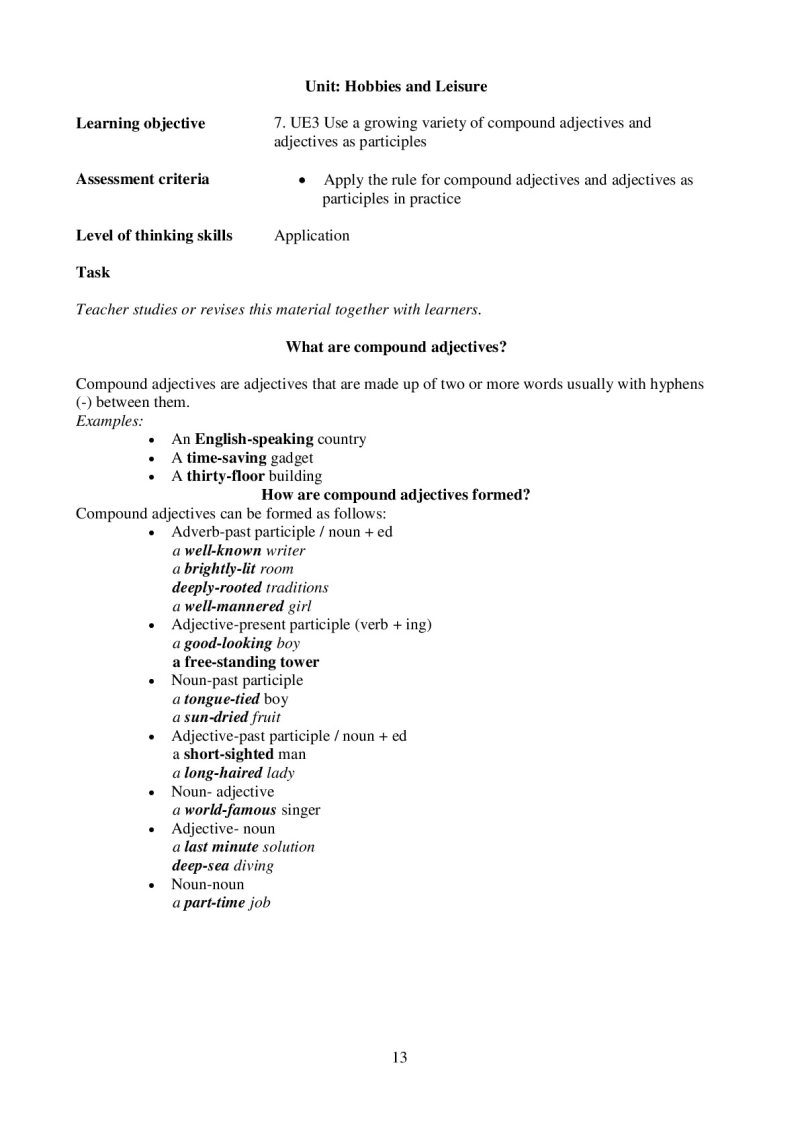
Unit: Hobbies and Leisure
Learning objective 7. UE3 Use a growing variety of compound adjectives and
adjectives as participles
Assessment criteria •Apply the rule for compound adjectives and adjectives as
participles in practice
Level of thinking skills Application
Task
Teacher studies or revises this material together with learners.
What are compound adjectives?
Compound adjectives are adjectives that are made up of two or more words usually with hyphens
(-) between them.
Examples:
•An English-speaking country
•A time-saving gadget
•A thirty-floor building
How are compound adjectives formed?
Compound adjectives can be formed as follows:
•Adverb-past participle / noun + ed
a well-known writer
a brightly-lit room
deeply-rooted traditions
a well-mannered girl
•Adjective-present participle (verb + ing)
a good-looking boy
a free-standing tower
•Noun-past participle
a tongue-tied boy
a sun-dried fruit
•Adjective-past participle / noun + ed
a short-sighted man
a long-haired lady
•Noun- adjective
a world-famous singer
•Adjective- noun
a last minute solution
deep-sea diving
•Noun-noun
a part-time job
13
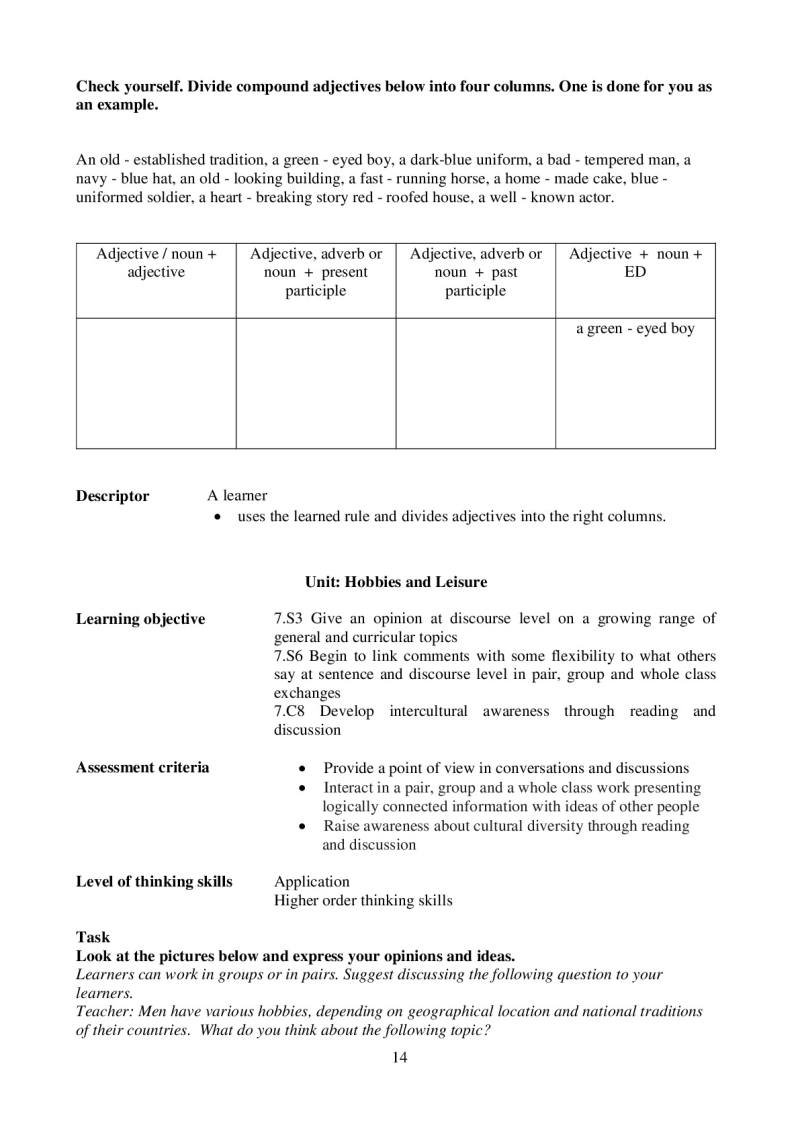
Check yourself. Divide compound adjectives below into four columns. One is done for you as
an example.
An old - established tradition, a green - eyed boy, a dark-blue uniform, a bad - tempered man, a
navy - blue hat, an old - looking building, a fast - running horse, a home - made cake, blue -
uniformed soldier, a heart - breaking story red - roofed house, a well - known actor.
Adjective / noun +
adjective
Adjective, adverb or
noun + present
participle
Adjective, adverb or
noun + past
participle
Adjective + noun +
ED
a green - eyed boy
Descriptor A learner
•uses the learned rule and divides adjectives into the right columns.
Unit: Hobbies and Leisure
Learning objective 7.S3 Give an opinion at discourse level on a growing range of
general and curricular topics
7.S6 Begin to link comments with some flexibility to what others
say at sentence and discourse level in pair, group and whole class
exchanges
7.C8 Develop intercultural awareness through reading and
discussion
Assessment criteria •Provide a point of view in conversations and discussions
•Interact in a pair, group and a whole class work presenting
logically connected information with ideas of other people
•Raise awareness about cultural diversity through reading
and discussion
Level of thinking skills Application
Higher order thinking skills
Task
Look at the pictures below and express your opinions and ideas.
Learners can work in groups or in pairs. Suggest discussing the following question to your
learners.
Teacher: Men have various hobbies, depending on geographical location and national traditions
of their countries. What do you think about the following topic?
14
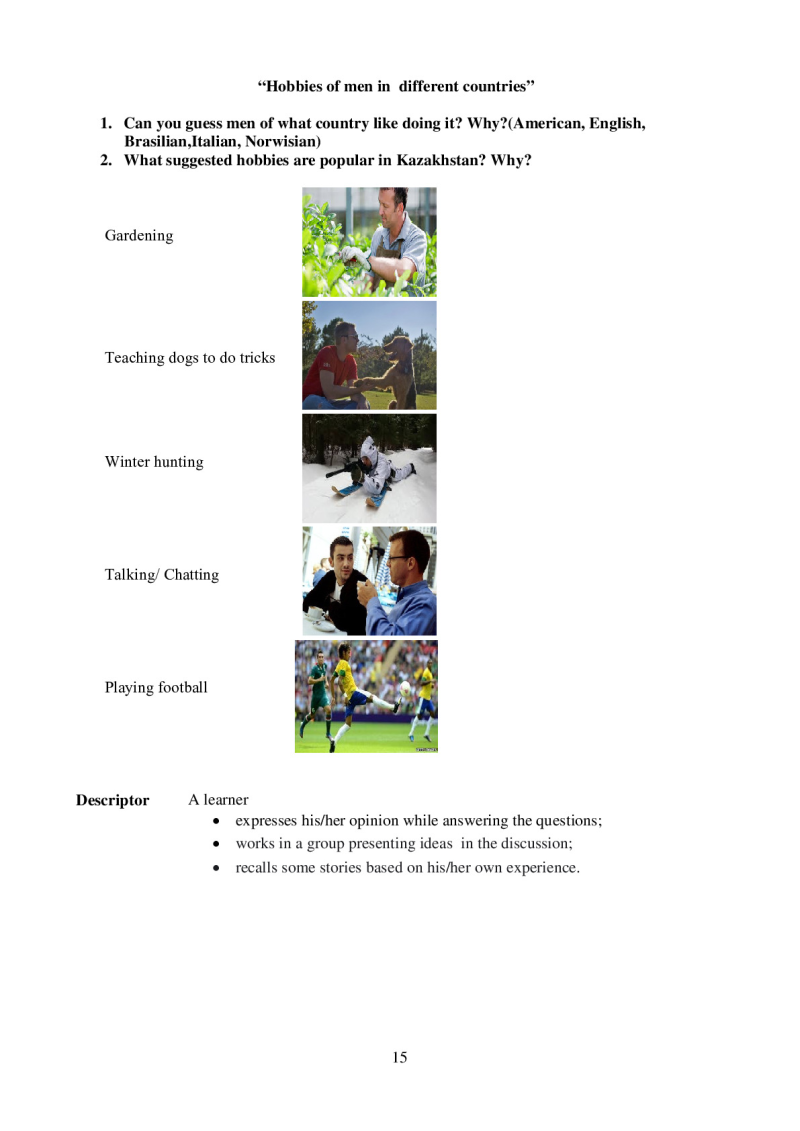
“Hobbies of men in different countries”
1. Can you guess men of what country like doing it? Why?(American, English,
Brasilian,Italian, Norwisian)
2. What suggested hobbies are popular in Kazakhstan? Why?
Gar
dening
Teaching dogs to do tricks
Winter hunting
Talk
ing/ Chatting
Playing football
Descriptor A learner
•expresses his/her opinion while answering the questions;
•works in a group presenting ideas in the discussion;
•recalls some stories based on his/her own experience.
15
Unit: Hobbies and Leisure
Learning objective 7.S7 Use appropriate subject-specific vocabulary and syntax to
talk about a growing range of general topics, and some curricular
topics
Assessment criteria •Apply topic related vocabulary in speech appropriately
arranging words and phrases into well-formed sentences
Level of thinking skills Application
Task
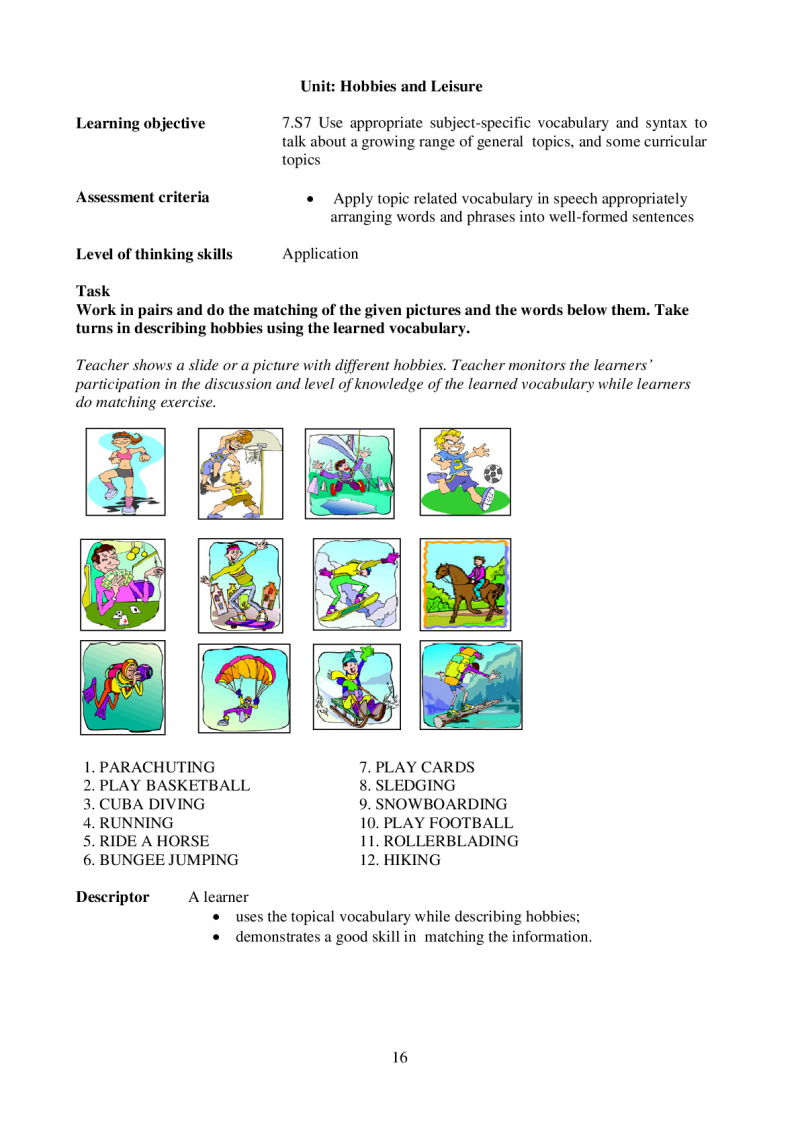
Work in pairs and do the matching of the given pictures and the words below them. Take turns in describing hobbies using the learned vocabulary.
Teacher shows a slide or a picture with different hobbies. Teacher monitors the learners’
participation in the discussion and level of knowledge of the learned vocabulary while learners do matching exercise.
1. PARACHUTING 2. PLAY BASKETBALL 3. CUBA DIVING 4. RUNNING 5. RIDE A HORSE 6. BUNGEE JUMPING 7. PLAY CARDS 8. SLEDGING 9. SNOWBOARDING 10. PLAY FOOTBALL 11. ROLLERBLADING 12. HIKING
Descriptor A learner
•uses the topical vocabulary while describing hobbies;
•demonstrates a good skill in matching the information.
16
Unit: Hobbies and Leisure
Learning objective 7.W6 Link with little or no support, sentences into coherent
paragraphs using a variety of basic connectors on a range of
familiar general topics and some curricular topics
7.UE17 Use if / unless in first conditional clauses; use defining
relative clauses with which , who, that, where on a wide range of
familiar general and curricular topics
Assessment criteria •Connect sentences into paragraphs with basic connectors
and linking words with some support
•Differentiate between if/unless in first conditional clauses;
between defining relative clauses with which who that and
where
Level of thinking skills Application
Task
Write three paragraphs essay about your dream hobby. Make up about 3 sentences using
if/unless as
first conditional, 3 sentences with defining relative clause with proper
connectors.
E
xample: If I choose my dream hobby, I will be a chef. I thi
people who like cooking are
very creative, b ecause they m ake different recipes.
Use the fol
s tructure:
Introduction: Why hobbies are important.
Main body: Describe your dre
am hobby.
Conclusion: Every person should have his own hobby.
Descriptor A learner
•illustrates the ability to link words into sentences and paragraphs;
•make up sentences with defining relative clauses;
•make up sentences with the first conditional;
•has introduction, main body and conclusion in written work.
17
Unit: Hobbies and Leisure
Learning objective 7.W1 Plan, write, edit and proofread work at text level with
some support on a range of general and curricular topics
7.UE12 Use comparative degree adverb structures with
regular and irregular adverbs on a range of familiar general
and curricular topics
Assessment criteria •Make a clear plan of writing; Write a text; Check the
written draft
•Apply regular and irregular adverbs and comparative
degree structures accurately
Level of thinking skills Application
Higher order thinking skills
Task
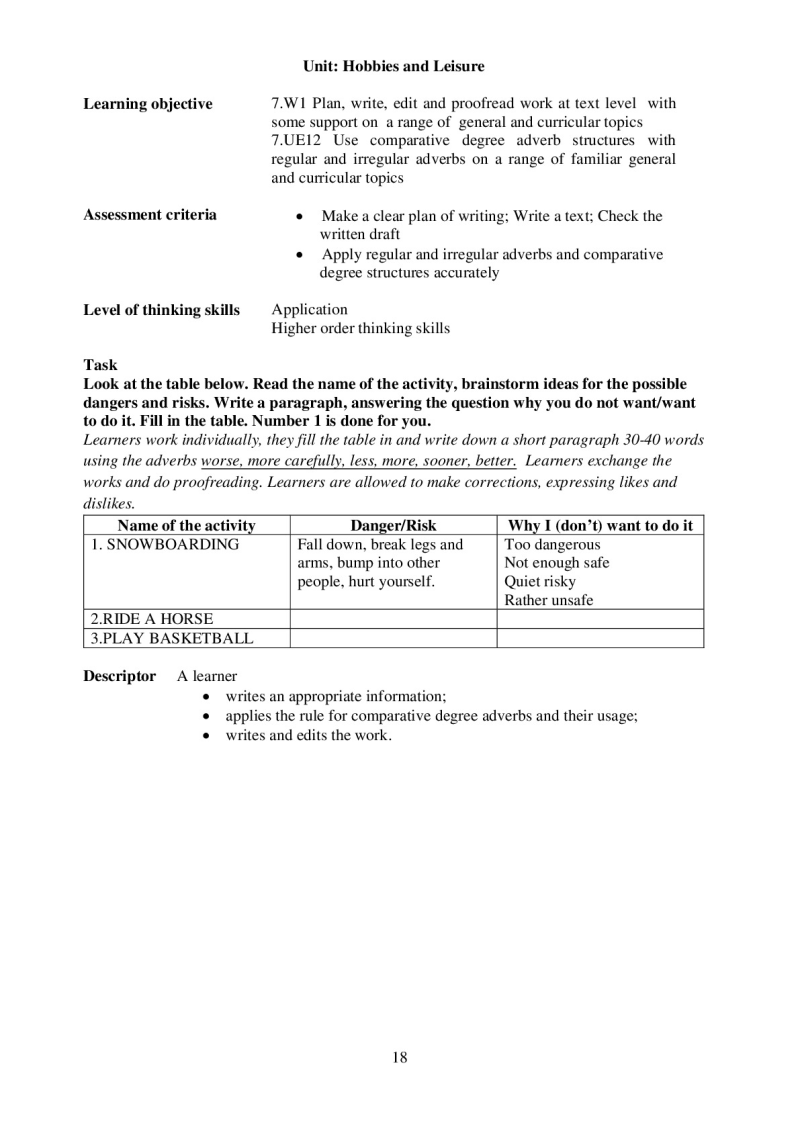
Look at the table below. Read the name
of the activity, brainstorm ideas for the possible
dangers and risks. Write a paragraph, answering the question why you do not want/want
t
o do it. Fill in the table. Number 1 is done for you.
Learners work individually, they fill the table in and write down a short paragraph 30-40 words
using the adverbs worse, more carefully, less, more, sooner, better. Learners exchange the
works and do proofreading. Learners are allowed to make corrections, expressing likes and
dislikes.
Name of the activity Danger/Risk Why I (don’t) want to do it
1.SNOWBOARDING Fall down, break legs and
arms, bump into other
people, hurt yourself.
Too dangerous
Not enough safe Quiet risky
Rather unsafe
2.RIDE A HORSE
3.PLAY BASKETBALL
Descriptor A learner
•writes an appropriate information;
•applies the rule for comparative degree adverbs and their usage;
•writes and edits the work.
18
Unit: Hobbies and Leisure
Learning objective 7.W8 Spell most high-frequency vocabulary accurately for a
growing range of familiar general and curricular topics
Assessment criteria •Write topic related words correctly
Level of thinking skills Application
Task
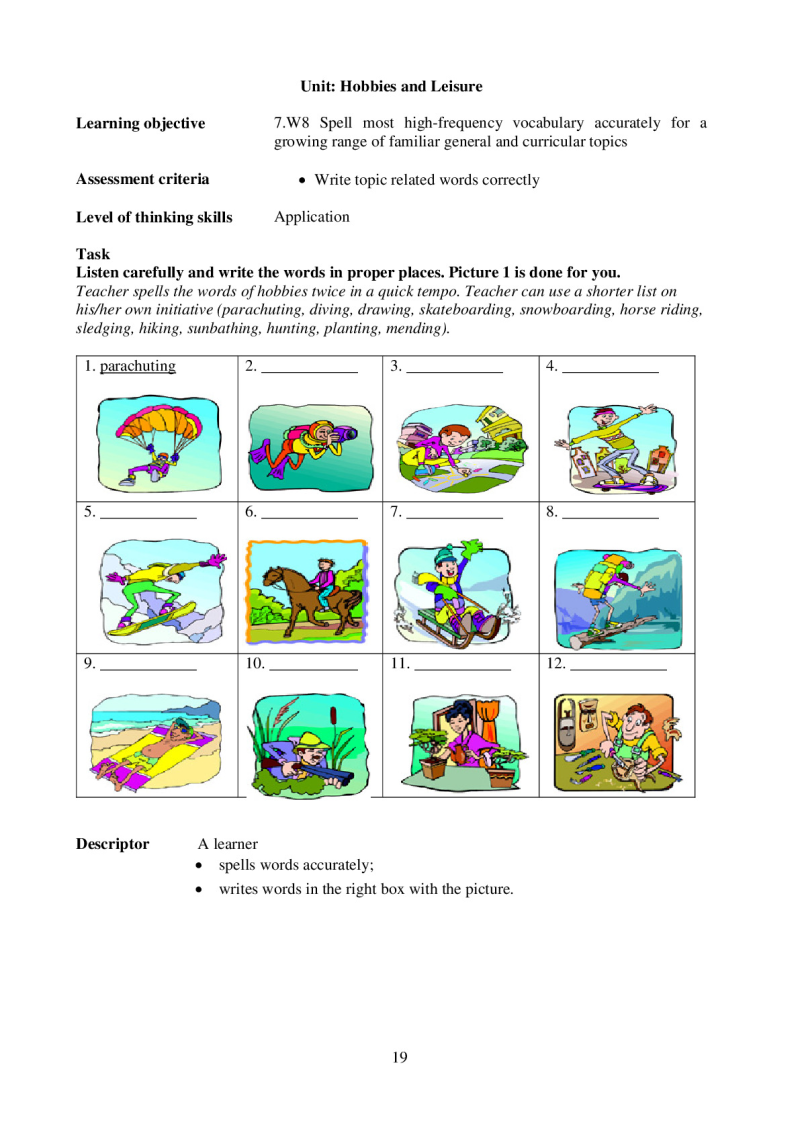
Listen carefully and write the words in proper places. Picture 1 is done for you.
Teacher spells the words of hobbies twice in a quick tempo. Teacher can use a shorter list on
his/her own initiative (parachuting, diving, drawing, skateboarding, snowboarding, horse riding,
sledging, hiking, sunbathing, hunting, planting, mending).
1.parachuting 2.____________3.____________ 4.____________
5.____________ 6.____________7.____________ 8.____________
9.____________ 10.___________11.____________ 12.____________
Descriptor A learner
•spells words accurately;
•writes words in the right box with the picture.
19
Unit: Hobbies and Leisure
Learning objective 7.W2 Write with minimal support about real and imaginary past
events, activities and experiences on a growing range of familiar
general topics and some curricular topics
7.C3 Respect different points of view 7.C4 Evaluate and respond constructively to feedback from others
Assessment criteria •Write sentences about real and imaginary past events
connecting them into paragraphs
•Demonstrate respect to people’s opinions using lexical units
of topic vocabulary
•Analyze given feedback; Form opinion and give
constructive answers to feedback
Level of thinking skills Application
Higher order thinking skills
Task
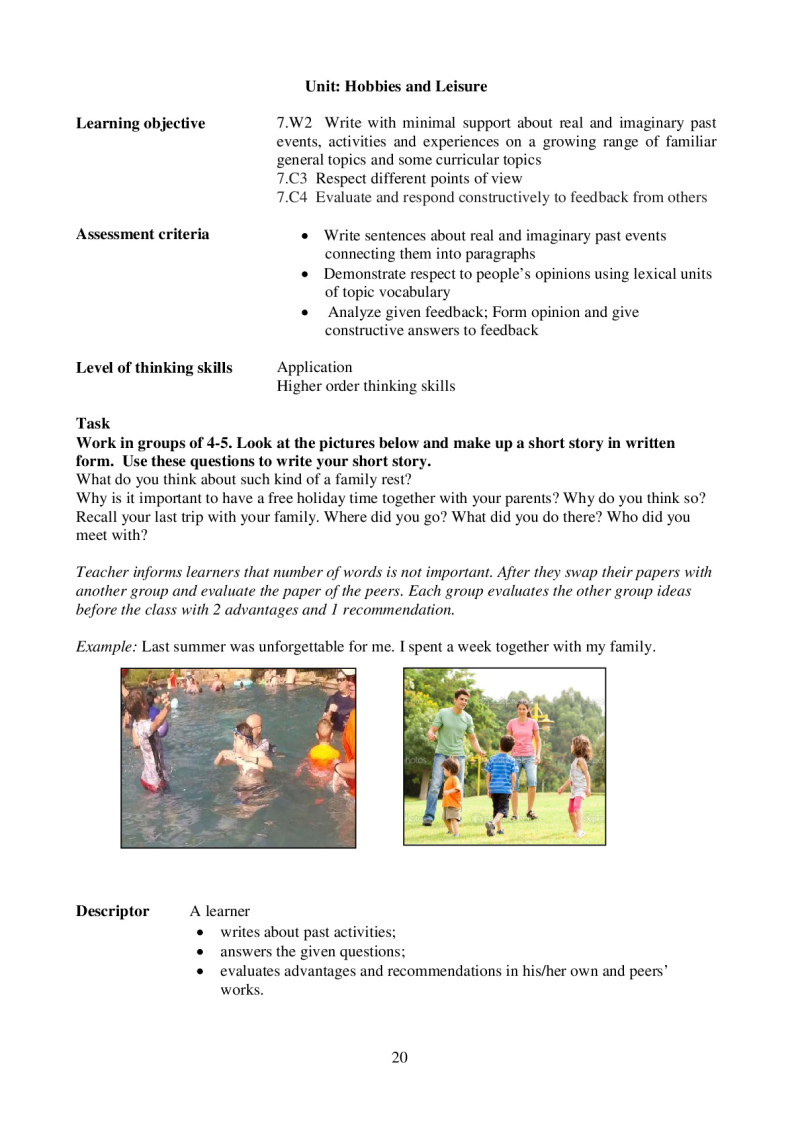
Work in groups of 4-5. Look at the pictures below and make up a short story in written
form. Use these questions to writ e your short story.
What do you think about such kind of a family rest? Why is it important to have a free holiday time together with your parents? Why do you think so?
Recall your last trip with your family. Where did you go? What did you do there? Who did you meet with?
Teacher informs learners that number of words is not important. After they swap their papers with
another group and evaluate the paper of the peers. Each group evaluates the other group ideas before the class with 2 advantages and 1 recommendation.
Example: Last summer was unforgettable for me. I spent a week together with my family.
Descriptor A learner
•writes about past activities;
•answers the given questions;
•evaluates advantages and recommendations in his/her own and peers’
works.
20
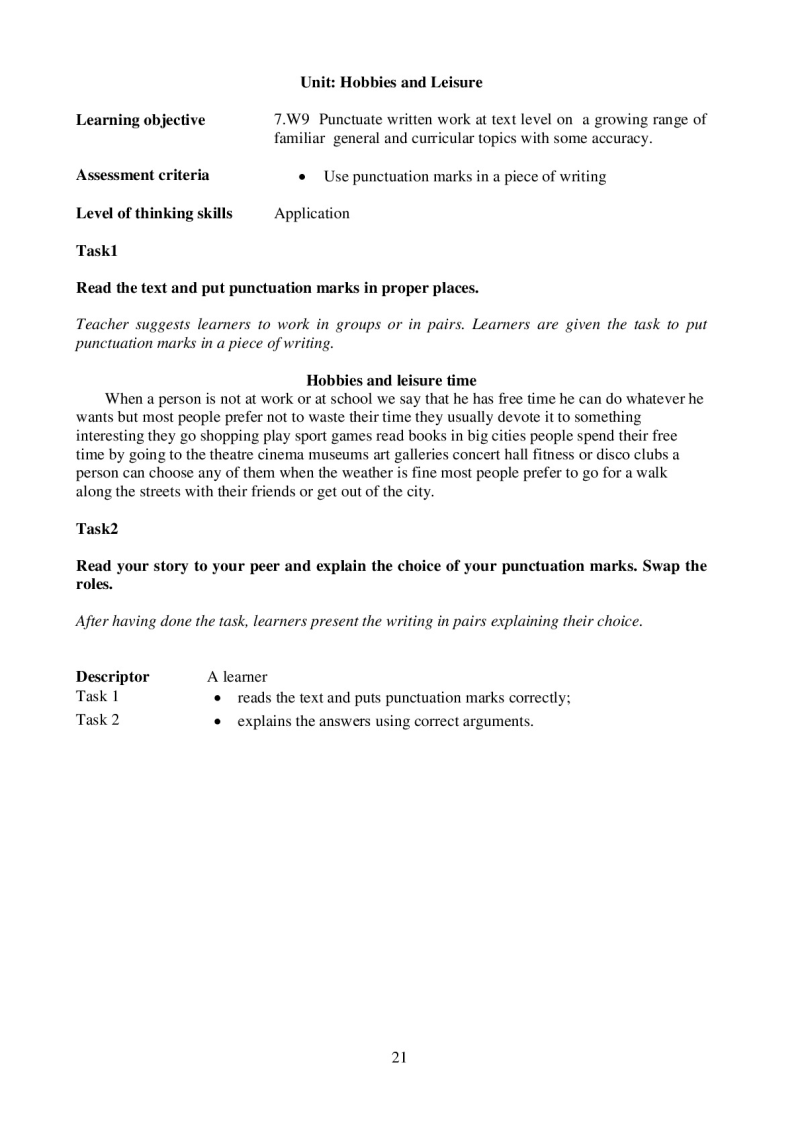
Unit: Hobbies and Leisure
Learning objective 7.W9 Punctuate written work at text level on a growing range of
familiar general and curricular topics with some accuracy.
Assessment criteria •Use punctuation marks in a piece of writing
Level of thinking skills Application
Task1
Read the text and put punctuation marks in proper places.
Teacher suggests learners to work in groups or in pairs. Learners are given the task to put
punctuation marks in a piece of writing.
Hobbies and leisure time
When a person is not at work or at school we say that he has free time he can do whatever he
wants but most people prefer not to waste their time they usually devote it to something
interesting they go shopping play sport games read books in big cities people spend their free
time by going to the theatre cinema museums art galleries concert hall fitness or disco clubs a
person can choose any of them when the weather is fine most people prefer to go for a walk
along the streets with their friends or get out of the city.
Task2
Read your story to your peer and explain the choice of your punctuation marks. Swap the
roles.
After having done the task, learners present the writing in pairs explaining their choice.
Descriptor A learner
Task 1
Task 2
•r
eads the text and puts punctuation marks correctly;
•explains the answers using correct arguments.
21
Unit: Hobbies and Leisure
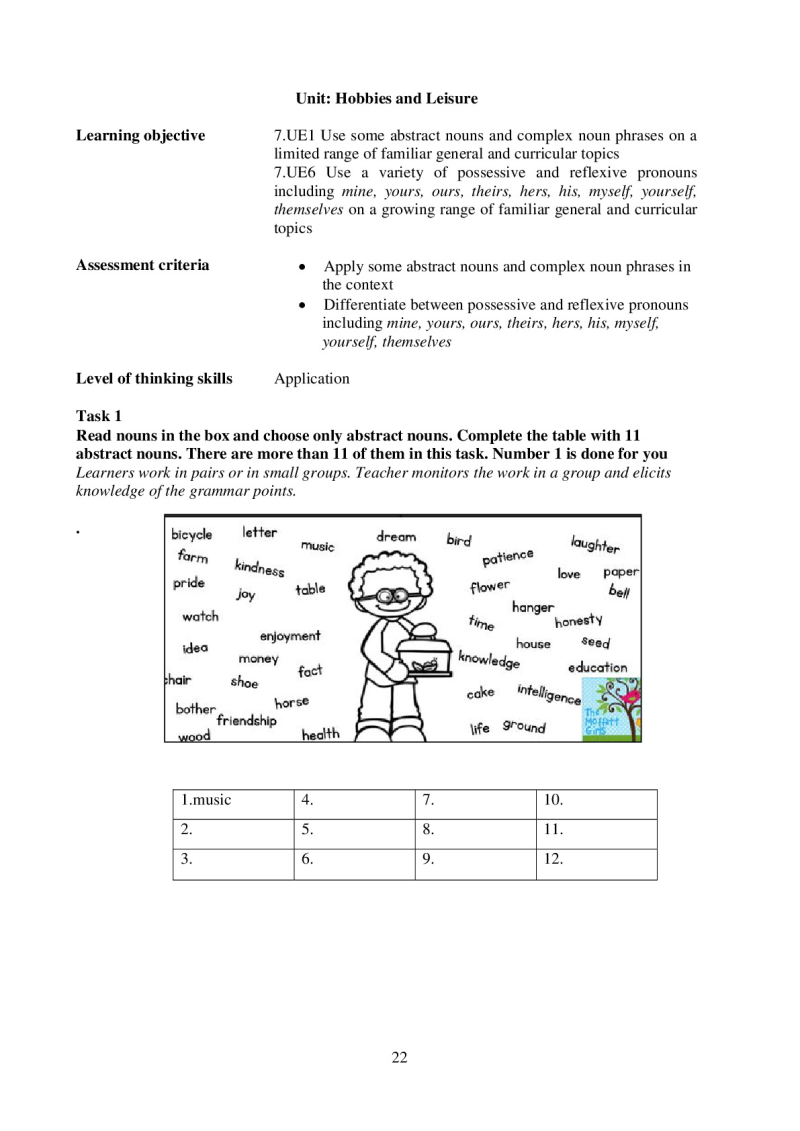
Learning objective 7.UE1 Use some abstract nouns and complex noun phrases on a
limited range of familiar general and curricular topics
7.UE6 Use a variety of possessive and reflexive pronouns
including mine, yours, ours, theirs, hers, his, myself, yourself,
themselves on a growing range of familiar general and curricular
topics
Assessment criteria •Apply some abstract nouns and complex noun phrases in
the context
•Differentiate between possessive and reflexive pronouns
including mine, yours, ours, theirs, hers, his, myself,
yourself, themselves
Level of thinking skills Application
Task 1
Read nouns in the box and choose only abstract nouns. Complete the table with 11
abstract nouns. There are more than 11 of them in this task. Number 1 is done for you
Learners work in pairs or in small groups. Teacher monitors the work in a group and elicits knowledge of the grammar points.
.
1.music 4. 7. 10.
2. 5. 8. 11.
3. 6. 9. 12.
22
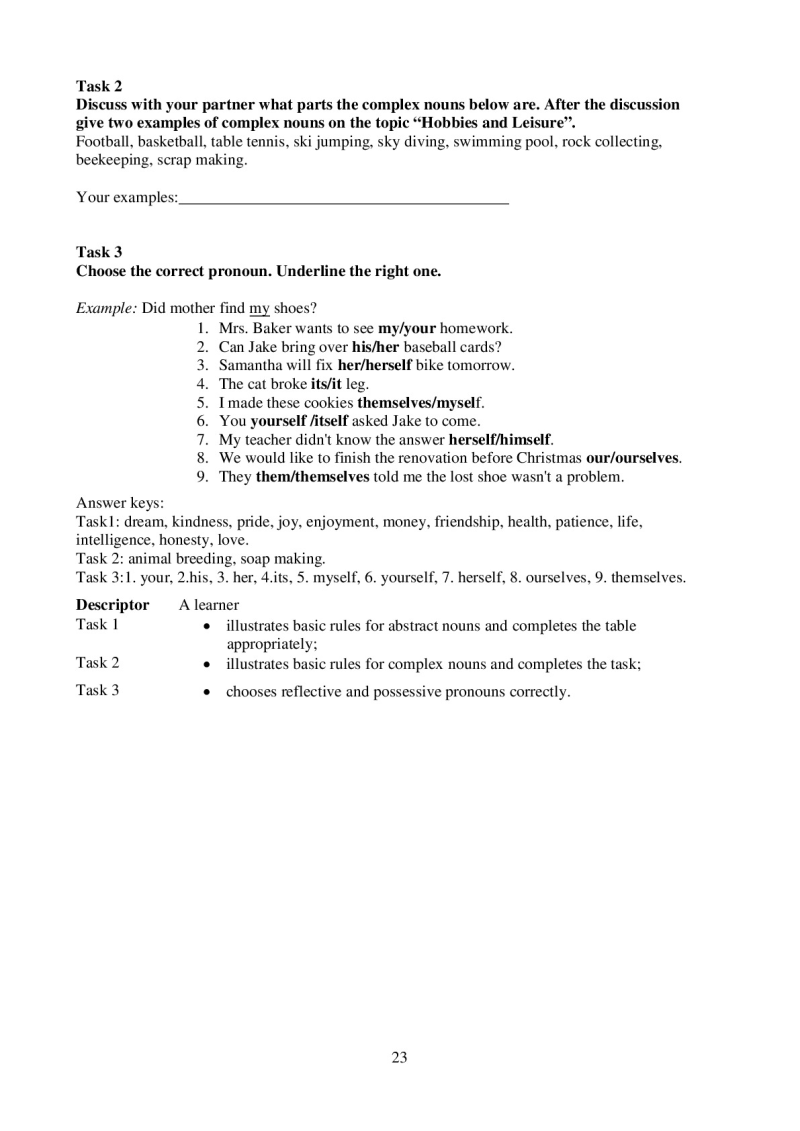
Task 2
Discuss w ith your par tner what parts the complex nou ns below are. After the discussion
give two examples of complex nouns on the topic “Hobbies and Leisure”.
Football, basketball, table tennis, ski jumping, sky diving, swimming pool,
rock collecting,
beekeeping, scrap making.
Your examples:_________________________________________
Task 3
Choose the correct pronoun. Underline the right one.
Example: Did mother find my shoes?
1.Mrs. Baker wants to see my/your homework.
2. Can Jake bring over his/her baseball cards?
3.Samantha will fix her/herself bike tomorrow.
4.The cat broke its/it leg.
5.I made these cookies themselves/mysel f.
6. You yourself /itself asked Jake to come.
7. My teacher didn't know the answer herself/himself .
8. We would like to finish the renovation before Christmas our/ourselves .
9.They them/themselves told me the lost shoe wasn't a problem.
Answer keys:
Task1: dream, kindness, pride, joy, enjoyment, money, friendship, health, patience, life,
intelligence, honesty, love.
Task 2: animal breeding, soap making.
Task 3:1. your, 2.his, 3. her, 4.its, 5. myself, 6. yourself, 7. herself, 8. ourselves, 9. themselves.
Descriptor A learner
Task 1 •illustrates basic rules for abstract nouns and completes the table
appropriately;
Task 2 •illustrates basic rules for complex nouns and completes the task;
Task 3 •chooses reflective and possessive pronouns correctly.
23
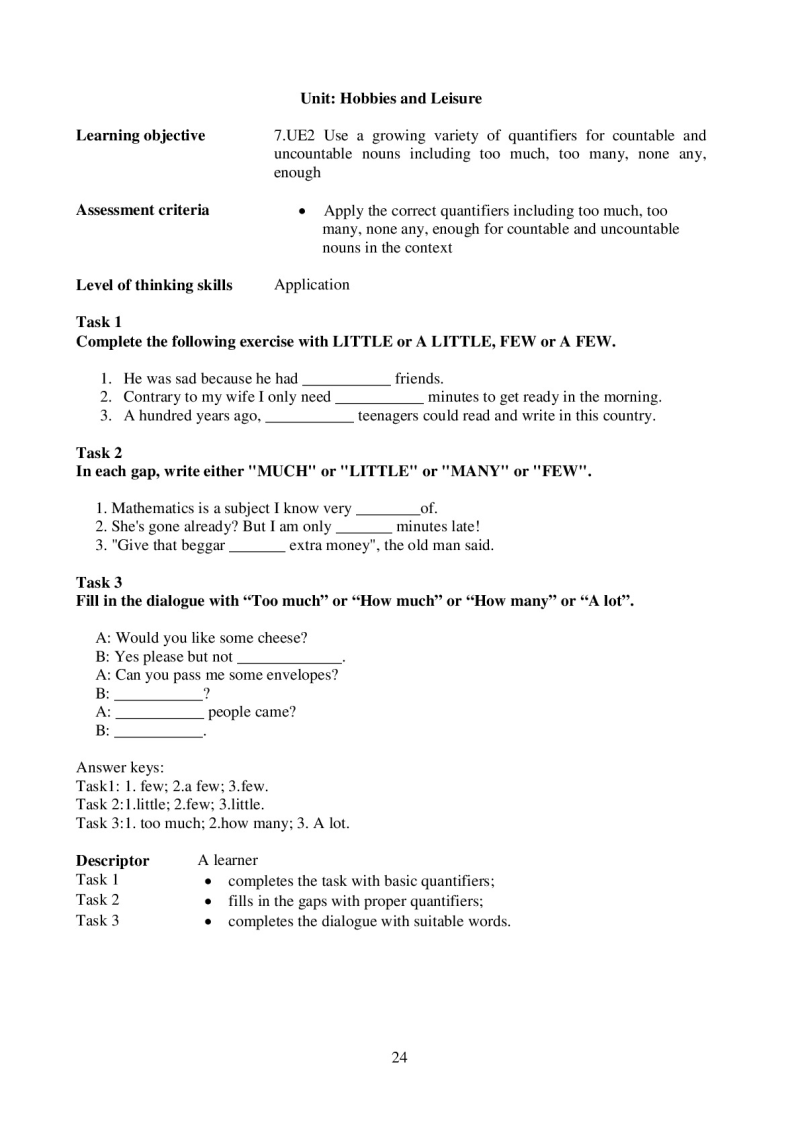
Unit: Hobbies and Leisure
Learning objective 7.UE2 Use a growing variety of quantifiers for countable and
uncountable nouns including too much, too many, none any,
enough
Assessment criteria •Apply the correct quantifiers including too much, too
many, none any, enough for countable and uncountable
nouns in the context
Level of thinking skills Application
Task 1
Complete t he following exercise w ith LITTLE or A LITTLE, F EW or A FEW.
1. He was sad because he had ___________ friends.
2. Contrary to my wife I only need ___________ minutes to get ready in the morning.
3. A hundred years ago, ___________ teenagers could read and write in this country.
Task 2
In each gap, write either "MUCH" or "LITTLE" or "MANY" or "FEW".
1. Mathematics is a subject I know very ________of.
2. She's gone already? But I am only _______ minutes late! 3. "Give that beggar _______ extra money", the old man said.
Task 3
Fill in the dialogue with “Too much” or “How much” or “How many” or “A lot”.
A: Would you like some cheese?
B: Yes please but not _____________. A: Can you pass me some envelopes?
B: ___________? A: ___________ people came? B: ___________.
Answer keys:
Task1: 1. few; 2.a few; 3.few. Task 2:1.little; 2.few; 3.little.
Task 3:1. too much; 2.how many; 3. A lot.
Descriptor A learner
Task 1 •completes the task with basic quantifiers;
Task 2 •fills in the gaps with proper quantifiers;
Task 3 •completes the dialogue with suitable words.
24
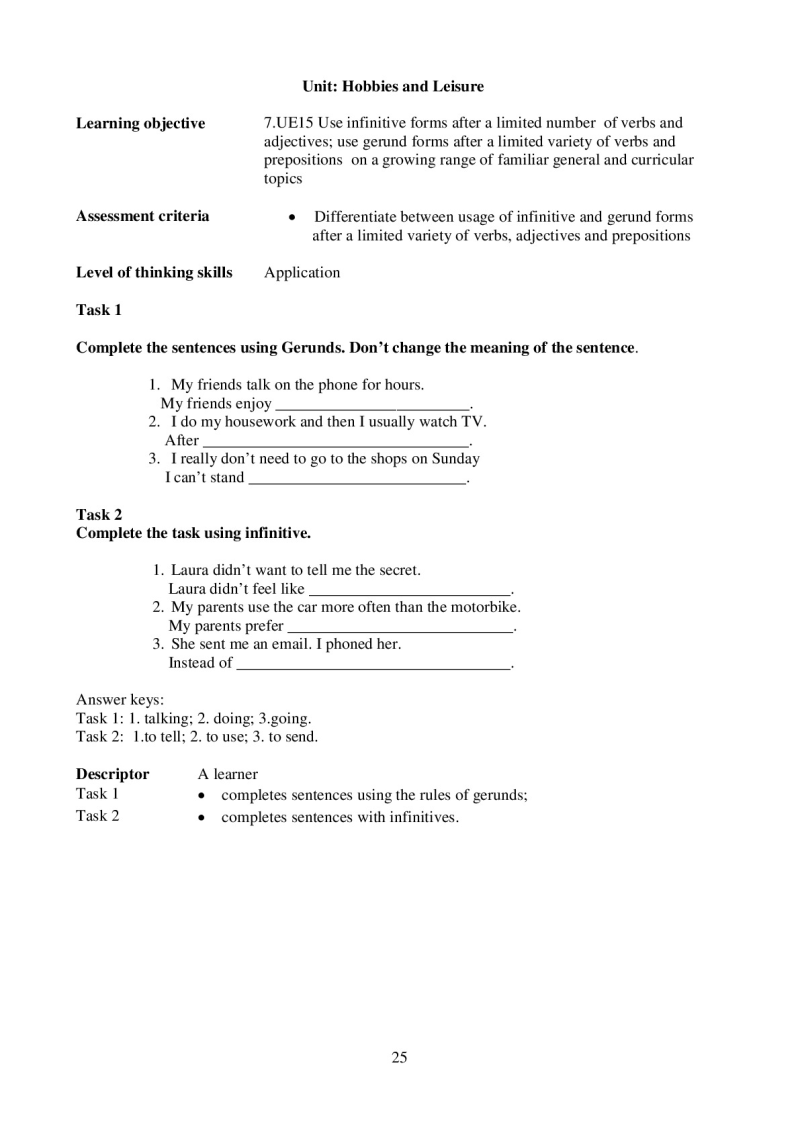
Unit: Hobbies and Leisure
Learning objective 7.UE15 Use infinitive forms after a limited number of verbs and
adjectives; use gerund forms after a limited variety of verbs and
prepositions on a growing range of familiar general and curricular
topics
Assessment criteria •Differentiate between usage of infinitive and gerund forms
after a limited variety of verbs, adjectives and prepositions
Level of thinking skills Application
Task 1
Complete the sentences using Gerunds. Don’t change the meaning of the sentence.
1. My friends talk on the phone for hours.
My friends enjoy ________________________.
2. I do my housework and then I usually watch TV.
After _________________________________.
3. I really don’t need to go to the shops on Sunday
I can’t stand ___________________________.
Task 2
Complete the task using infinitive.
1.Laura didn’t want to tell me the secret.
Laura didn’t feel like _________________________.
2. My parents use the car more often than the motorbike.
My parents prefer ____________________________.
3. She sent me an email. I phoned her.
Instead of __________________________________.
Answer keys:
Task 1: 1. talking; 2. doing; 3.going. Task 2: 1.to tell; 2. to use; 3. to send.
Descriptor A learner
Task 1 •completes sentences using the rules of gerunds;
Task 2 •completes sentences with infinitives.
25
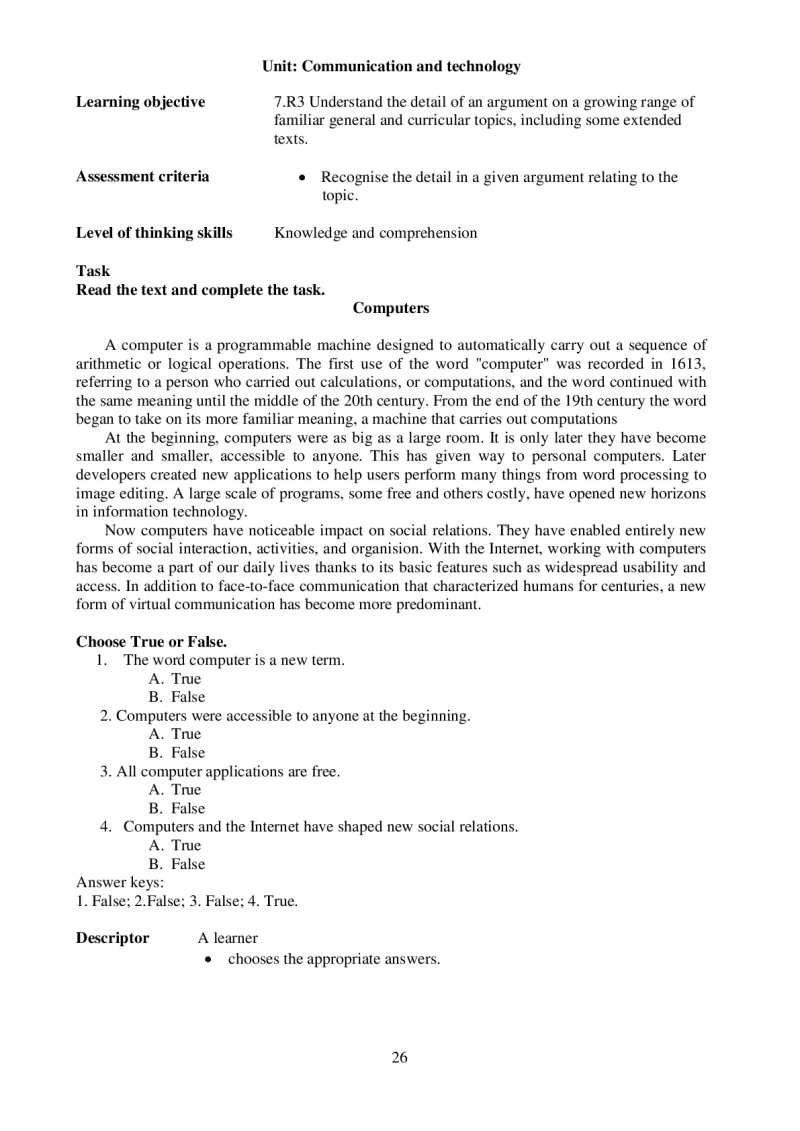
Unit: Communication and technology
Learning objective 7.R3 Understand the detail of an argument on a growing range of
familiar general and curricular topics, including some extended
texts.
Assessment criteria •Recognise the detail in a given argument relating to the
topic.
Level of thinking skills Knowledge and comprehension
Task
Read the text and complete the task.
Computers
A computer is a programmable machine designed to automatically carry out a sequence of
arithmetic or logical operations. The first use of the word "computer" was recorded in 1613, referring to a person who carried out calculations, or computations, and the word continued with the same meaning until the middle of the 20th century. From the end of the 19th century the word began to take on its more familiar meaning, a machine that carries out computations
At
the beginning, computers were as big as a large room. It is only later they have become
smaller and smaller, accessible to anyone. This has given way to personal computers. Later
developers created new applications to help users perform many things from word processing to image editing. A large scale of programs, some free and others costly, have opened new horizons in information technology.
Now computers have noticeable impact on social relations. They have enabled entirely new
forms of social interaction, activities, and organi sion. With the Internet, working with computers
has become a part of our daily lives thanks to its basic features such as widespread usability and
access. In addition to face-to-face communication that characterized humans for centuries, a new
form of virtual communication has become more predominant.
Choose True or False.
1. The word computer is a new term.
A.True
B.False
2.Computers were accessible to anyone at the beginning.
A.True
B.False
3. All computer applications are free.
A.True
B.False
4. Computers and the Internet have shaped new social relations.
A.True
B.False
Answer keys:
1. False; 2.False; 3. False; 4. True.
Descriptor A learner
•chooses the appropriate answers.
26
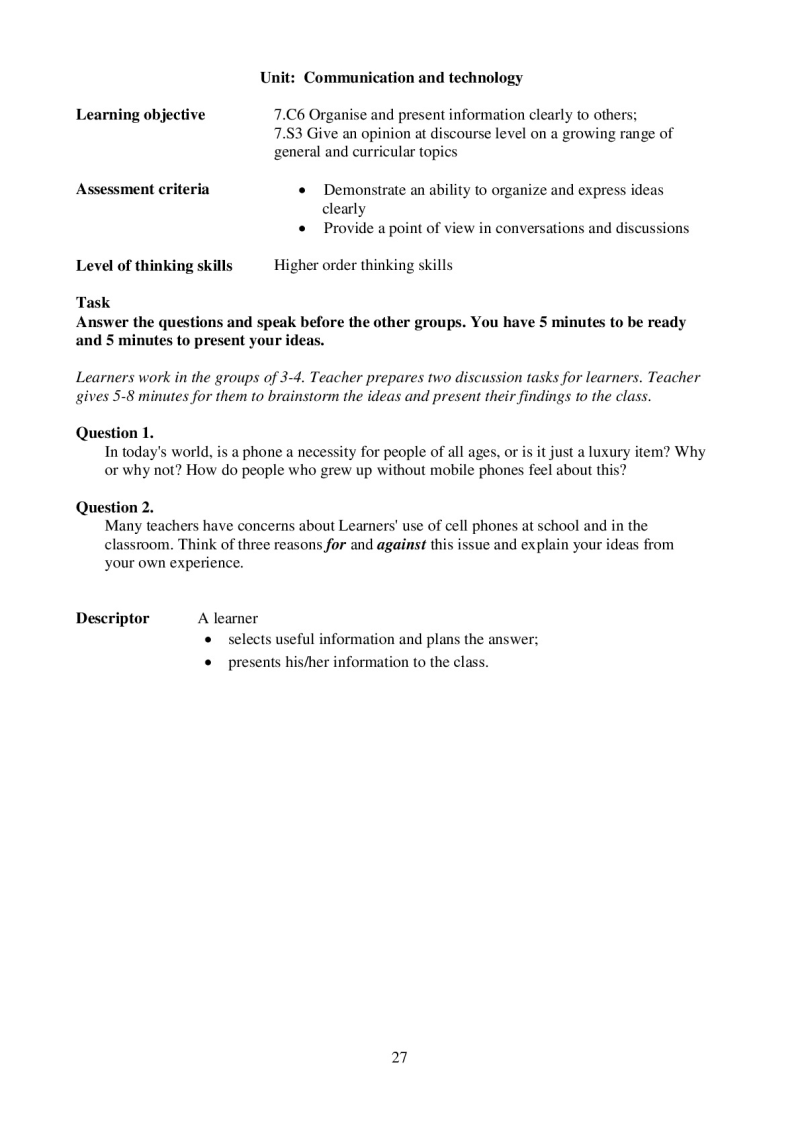
Unit: Communication and technology
Learning objective 7.C6 Organise and present information clearly to others;
7.S3 Give an opinion at discourse level on a growing range of
general and curricular topics
Assessment criteria •Demonstrate an ability to organize and express ideas
clearly
•Provide a point of view in conversations and discussions
Level of thinking skills Higher order thinking skills
Task
Answer the questions and speak before the other groups. You have 5 minutes to be ready
and 5 minutes to present your ideas.
Learners work in the groups of 3-4. Teacher prepares two discussion tasks for learners. Teacher
gives 5-8 minutes for them to brainstorm the ideas and present their findings to the class.
Question 1.
In today's world, is a phone a necessity for people of all ages, or is it just a luxury item? Why
or why not? How do people who grew up without mobile phones feel about this?
Question 2.
Many teachers have concerns about Learners' use of cell phones at school and in the
classroom. Think of three reasons for and against this issue and explain your ideas from
your own experience.
Descriptor A learner
•selects useful information and plans the answer;
•presents his/her information to the class.
27
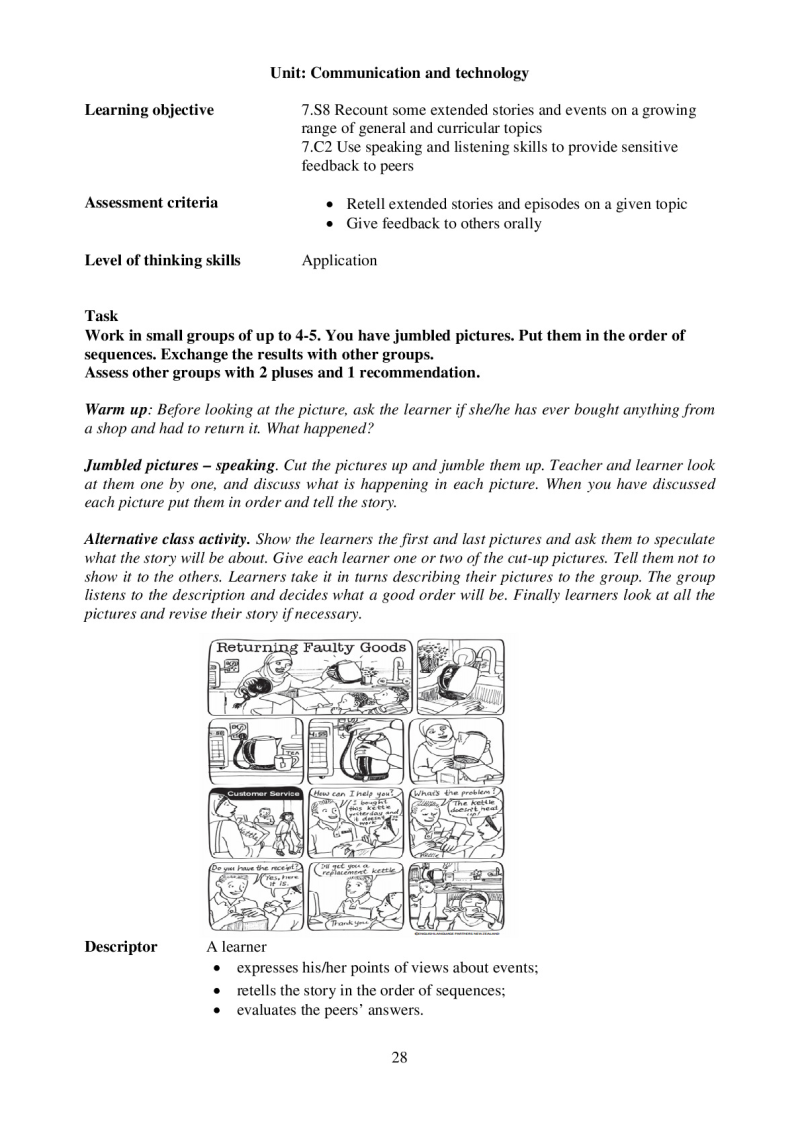
Unit: Communication and technology
Learning objective 7.S8 Recount some extended stories and events on a growing
range of general and curricular topics
7.C2 Use speaking and listening skills to provide sensitive
feedback to peers
Assessment criteria •Retell extended stories and episodes on a given topic
•Give feedback to others orally
Level of thinking skills Application
Task
Work in small groups of up to 4-5. You have jumbled pictures. Put them in the order of
sequences. Exchange the results with other groups.
Assess other groups with 2 pluses and 1 recommendation.
Warm up: Before looking at the picture, ask the learner if she/he has ever bought anything from
a shop and had to return it. What happened?
Jumbled pictures – speaking. Cut the pictures up and jumble them up. Teacher and learner look
at them one by one, and discuss what is happening in each picture. When you have discussed each picture put them in order and tell the story.
Alternative class activity. Show the learners the first and last pictures and ask them to speculate
what the story will be about. Give each learner one or two of the cut-up pictures. Tell them not to
show it to the others. Learners take it in turns describing their pictures to the group. The group listens to the description and decides what a good order will be. Finally learners look at all the pictures and revise their story if necessary.
Descriptor A learner
•expresses his/her points of views about events;
•retells the story in the order of sequences;
•evaluates the peers’ answers.
28
Learning objective 7.S5 Keep interaction with peers to negotiate, agree and organize
priorities and plans for completing classroom tasks
7. C8 Develop intercultural awareness through reading and
discussion 7. C10 Use talk or writing as a means of reflecting on and exploring a range of perspectives on the world
Assessment criteria •Demonstrate the ability to participate in a conversation
•Raise awareness about cultural diversity through reading
and discussion
•Consider different perspectives on the world orally or in a
written form
Level of thinking skills Application
Higher order thinking skills
Task
Work in groups of 3-4. Answer the question: “Are computers friends or troubles in
teenagers’ study in modern world?” You have 5 minutes to brainstorm the ideas. Fill in the
table with 3 positive and 3 negative reasons.
Computers and study
Write 3 positive reasons in what way
computers help you in your study
Write 3 negative reasons in what way
computers distract you from study
1. 1. Addiction
2. 2.
3. 3.
Learners swap the papers and read the information of the other groups. Make comparison where
it is possible. Learners discuss the results in any possible way.
Suggest learners to look at the map of 10 top countries with the highest number of Personal
Computers.
Task 2
Look at the map. Make some predictions what the map tells us about.
Together with your group give a summary including some
interesting i nformation.
Pr
esent the information in the following way:
It is interesting to us to
know that
______________________________________________________________________________
______________________________________________________________________________
We have learned t hat
___________________________________________________________________________
______________________________________________________________________________
______________________________________________________________________________
29
Unit: Communication and technology
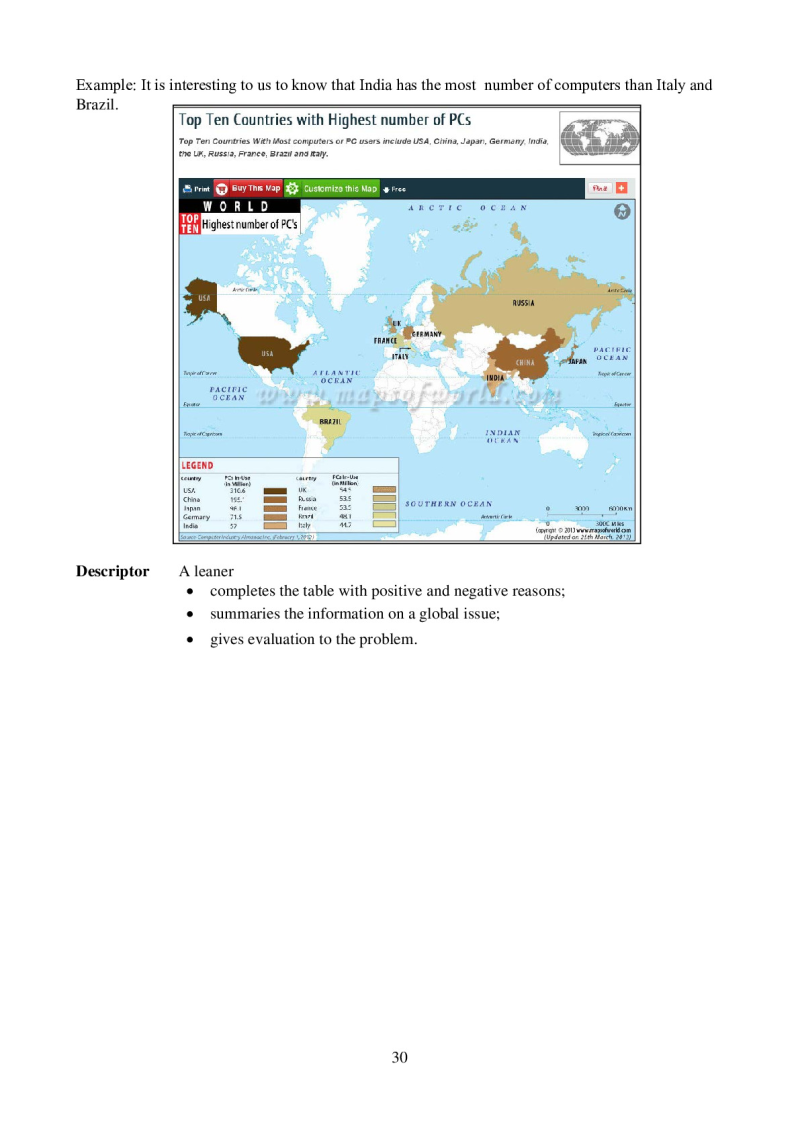
Ex
ample: It is interesting to us to know that India has the most number of computers than Italy and
B
razil.
Descriptor A leaner
•completes the table with positive and negative reasons;
•summaries the information on a global issue;
•gives evaluation to the problem.
30









 Бұл курс Қазақстан Республикасы Оқу-ағарту министрлігімен келісілген










