
 ЖИ көмекші


 Қауіпсіз төлем

жүктеу мүмкіндігіне ие боласыз
Бұл материал сайт қолданушысы жариялаған. Материалдың ішінде жазылған барлық ақпаратқа жауапкершілікті жариялаған қолданушы жауап береді. Ұстаз тілегі тек ақпаратты таратуға қолдау көрсетеді. Егер материал сіздің авторлық құқығыңызды бұзған болса немесе басқа да себептермен сайттан өшіру керек деп ойласаңыз осында жазыңыз
 24 Желтоқсан 2020
 370

1 жыл бойы шексіз жүктеңіз
Summative assessment
Summative assessment for the term 2
I. READING
Read the text and answer the questions below.
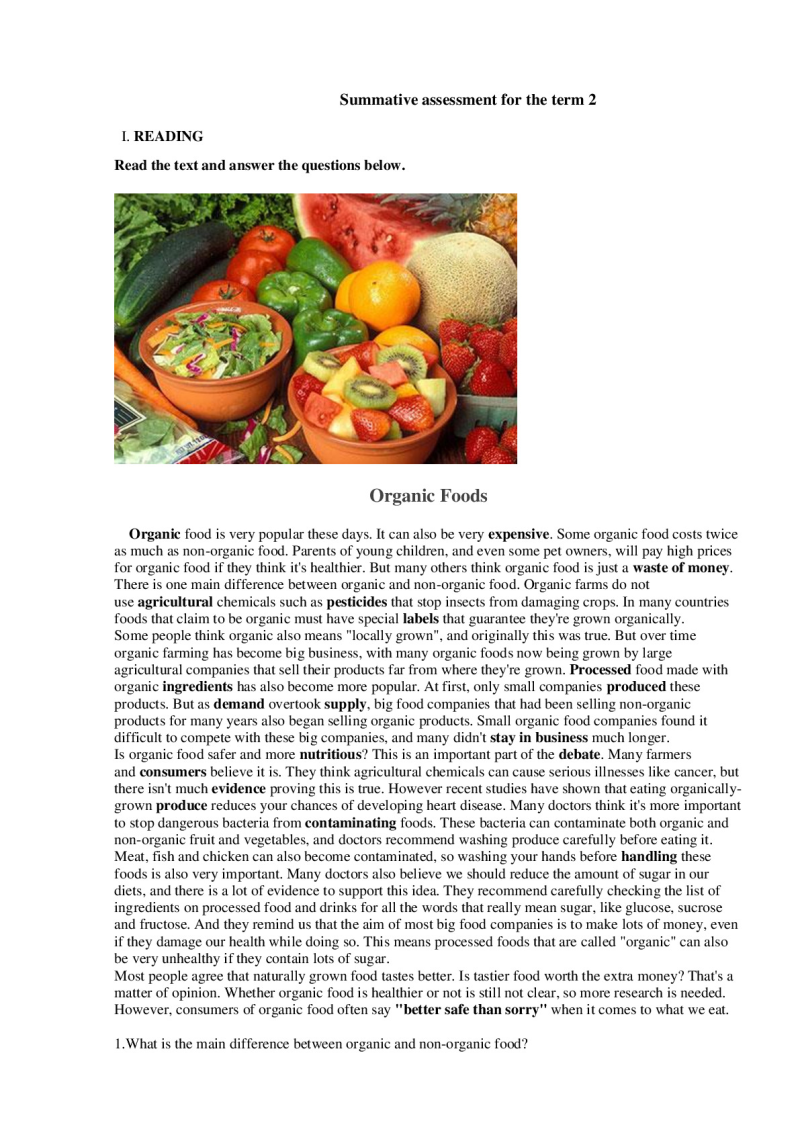
Organic Foods
Organic food is very popular these days. It can also be very expensive. Some organic food costs twice
as much as non-organic food. Parents of young children, and even some pet owners, will pay high prices
for organic food if they think it's healthier. But many others think organic food is just a waste of money.
There is one main difference between organic and non-organic food. Organic farms do not
use agricultural chemicals such as pesticides that stop insects from damaging crops. In many countries
foods that claim to be organic must have special labels that guarantee they're grown organically.
Some people think organic also means "locally grown", and originally this was true. But over time
organic farming has become big business, with many organic foods now being grown by large
agricultural companies that sell their products far from where they're grown. Processed food made with
organic ingredients has also become more popular. At first, only small companies produced these
products. But as demand overtook supply, big food companies that had been selling non-organic
products for many years also began selling organic products. Small organic food companies found it
difficult to compete with these big companies, and many didn't stay in business much longer.
Is organic food safer and more nutritious? This is an important part of the debate. Many farmers
and consumers believe it is. They think agricultural chemicals can cause serious illnesses like cancer, but
there isn't much evidence proving this is true. However recent studies have shown that eating organically-
grown produce reduces your chances of developing heart disease. Many doctors think it's more important
to stop dangerous bacteria from contaminating foods. These bacteria can contaminate both organic and
non-organic fruit and vegetables, and doctors recommend washing produce carefully before eating it.
Meat, fish and chicken can also become contaminated, so washing your hands before handling these
foods is also very important. Many doctors also believe we should reduce the amount of sugar in our
diets, and there is a lot of evidence to support this idea. They recommend carefully checking the list of
ingredients on processed food and drinks for all the words that really mean sugar, like glucose, sucrose
and fructose. And they remind us that the aim of most big food companies is to make lots of money, even
if they damage our health while doing so. This means processed foods that are called "organic" can also
be very unhealthy if they contain lots of sugar.
Most people agree that naturally grown food tastes better. Is tastier food worth the extra money? That's a
matter of opinion. Whether organic food is healthier or not is still not clear, so more research is needed.
However, consumers of organic food often say "better safe than sorry" when it comes to what we eat.
1.What is the main difference between organic and non-organic food?
A. use of pesticides
B. size of the company
C. location of the farm
2.Which is usually more expensive?
A. pet food
B. organic food
C. non-organic food
3.Recent studies show that eating organic produce can _______your chances of having heart disease.
A. develop
B. increase
C. reduce
4. Dangerous bacteria can contaminate
A. organic food only
B. non-organic food only
C. organic and non-organic food
5.All processed foods should a label listing the product’s
A. Ingredients
B. Pesticides
C. Organics
6.Many doctors now believe eating too much ________food is bad for our health.
A. Fresh
B. Sweet
C. Organic
7.Processed organic foods can also be unhealthy if they contain lots of
A. nutritious ingredients
B. organic produce
C. glucose
7 marks
II. Use of English.
1.Put the verbs in brackets in the future perfect or future perfect continuous.
1. I ________ a Londoner for five and a half years by next September. (be)
2. By Tuesday Jill ________ these novels by O’Henry. (finish)
3. They _________ the plans by then. (to finish)
4. Before his holiday Tom _______ all his money. (to spend)
5. The train _________ by the time the couple get to the station. (to leave)
6. I _______my chemistry homework before Jillian comes home. (finish)
6 marks
2.Fill in: compost, nutrients, solution, substances.
1.Organic fruit and vegetables contain lots of beneficial ___________ .
2.You don’t need soil if you grow your plants in a ___________ of nutrients and water.
3. Wash fruit and vegetables before you eat them to remove the synthetic_________ .
4. ________ is a great fertilizer and it’s made from food and plant waste.
4 marks
III.Writing
Answer the questions:
What do you think about 3D printing food? Would you try it?
_____________________________________________________________________________________
_____________________________________________________________________________________
_____________________________________________________________________________________
_____________________________________________________________________________________
_____________________________________________________________________________________
_____________________________________________________________________________________
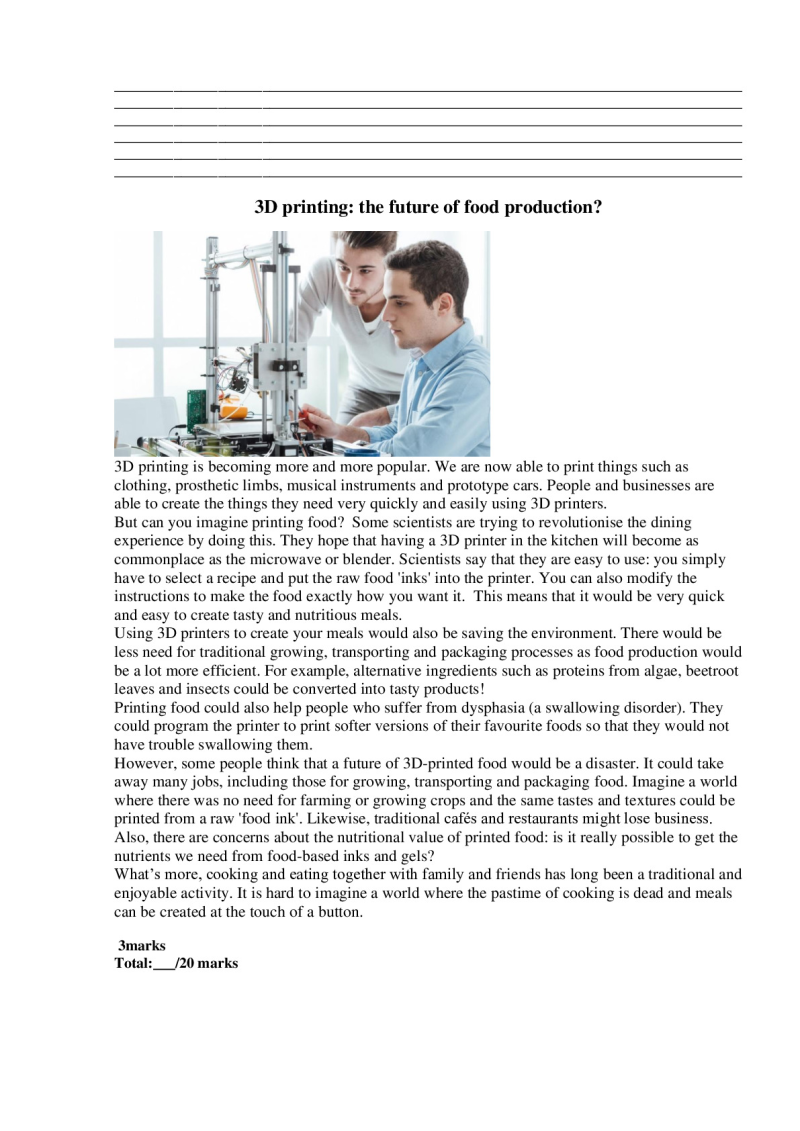
3D printing: the future of food production?
3D printing is becoming more and more popular. We are now able to print things such as
clothing, prosthetic limbs, musical instruments and prototype cars. People and businesses are
able to create the things they need very quickly and easily using 3D printers.
But can you imagine printing food? Some scientists are trying to revolutionise the dining
experience by doing this. They hope that having a 3D printer in the kitchen will become as
commonplace as the microwave or blender. Scientists say that they are easy to use: you simply
have to select a recipe and put the raw food 'inks' into the printer. You can also modify the
instructions to make the food exactly how you want it. This means that it would be very quick
and easy to create tasty and nutritious meals.
Using 3D printers to create your meals would also be saving the environment. There would be
less need for traditional growing, transporting and packaging processes as food production would
be a lot more efficient. For example, alternative ingredients such as proteins from algae, beetroot
leaves and insects could be converted into tasty products!
Printing food could also help people who suffer from dysphasia (a swallowing disorder). They
could program the printer to print softer versions of their favourite foods so that they would not
have trouble swallowing them.
However, some people think that a future of 3D-printed food would be a disaster. It could take
away many jobs, including those for growing, transporting and packaging food. Imagine a world
where there was no need for farming or growing crops and the same tastes and textures could be
printed from a raw 'food ink'. Likewise, traditional cafés and restaurants might lose business.
Also, there are concerns about the nutritional value of printed food: is it really possible to get the
nutrients we need from food-based inks and gels?
What’s more, cooking and eating together with family and friends has long been a traditional and
enjoyable activity. It is hard to imagine a world where the pastime of cooking is dead and meals
can be created at the touch of a button.
3marks
Total:___/20 marks
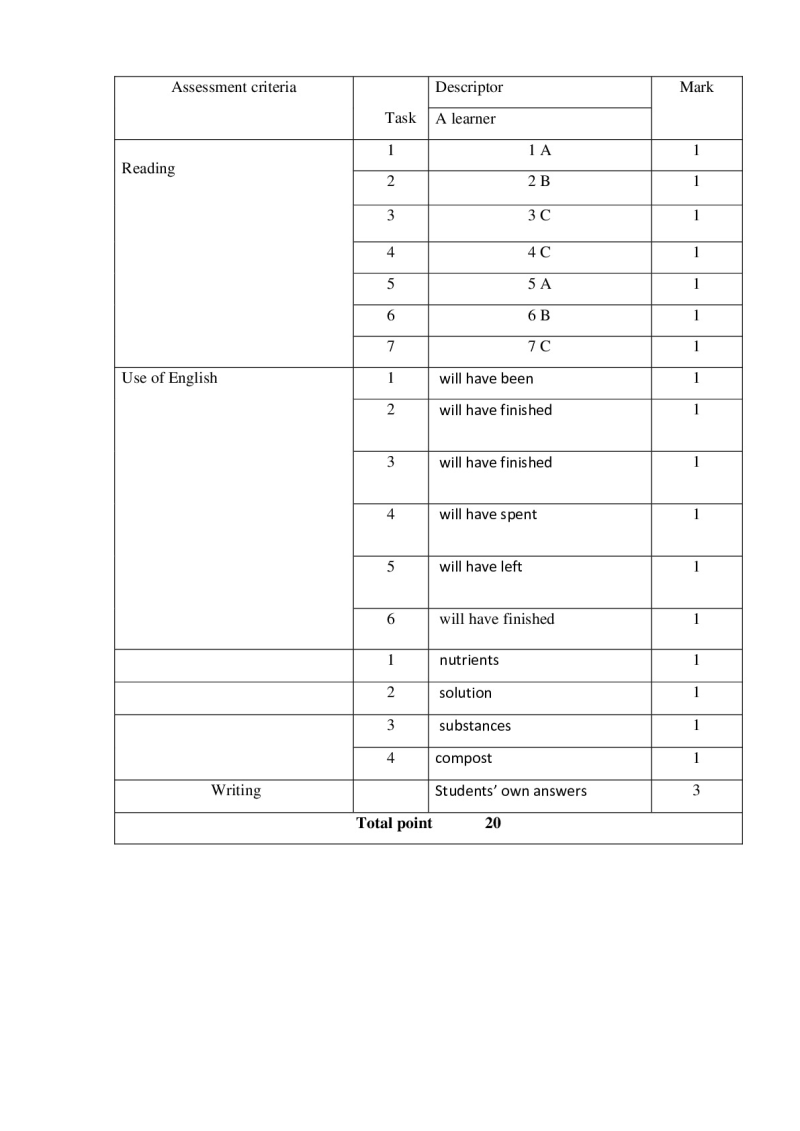
Assessment criteria
Task
Descriptor Mark
A learner
Reading
1 1 A 1
2 2 B 1
3 3 C 1
4 4 C 1
5 5 A 1
6 6 B 1
7 7 C 1
Use of English 1 will have been 1
2 will have finished
1
3 will have finished
1
4 will have spent
1
5 will have left
1
6 will have finished 1
1 nutrients 1
2 solution 1
3 substances 1
4 compost 1
Writing Students’ own answers 3
Total point 20









 Бұл курс Қазақстан Республикасы Оқу-ағарту министрлігімен келісілген










