
 ЖИ көмекші





borrowings


 Жүктеу
#1 слайд
BORROWINGS
1 слайд
BORROWINGS
#2 слайд
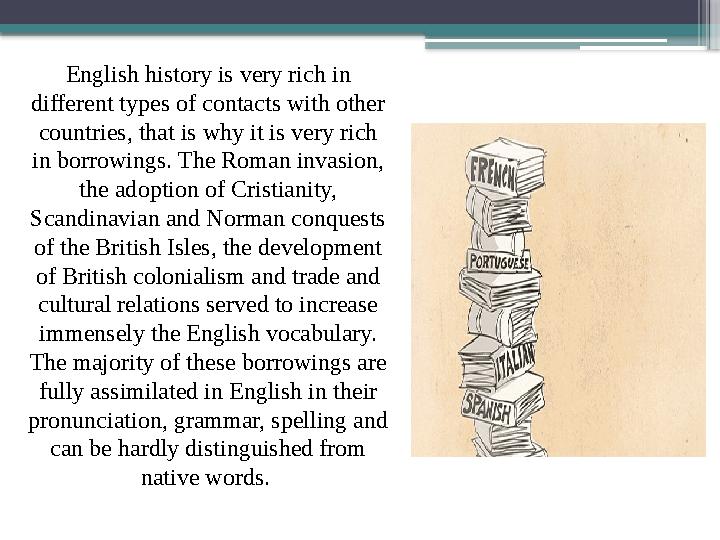
English history is very rich in
different types of contacts with other
countries, that is why it is very rich
in borrowings. The Roman invasion,
the adoption of Cristianity,
Scandinavian and Norman conquests
of the British Isles, the development
of British colonialism and trade and
cultural relations served to increase
immensely the English vocabulary.
The majority of these borrowings are
fully assimilated in English in their
pronunciation, grammar, spelling and
can be hardly distinguished from
native words.
2 слайд
English history is very rich in different types of contacts with other countries, that is why it is very rich in borrowings. The Roman invasion, the adoption of Cristianity, Scandinavian and Norman conquests of the British Isles, the development of British colonialism and trade and cultural relations served to increase immensely the English vocabulary. The majority of these borrowings are fully assimilated in English in their pronunciation, grammar, spelling and can be hardly distinguished from native words.
#3 слайд
Borrowings can be classified according
to different criteria:
a) according to the aspect which is borrowed,
b) according to the degree of assimilation,
c) according to the language from which the
word was borrowed.
3 слайд
Borrowings can be classified according to different criteria: a) according to the aspect which is borrowed, b) according to the degree of assimilation, c) according to the language from which the word was borrowed.
#4 слайд
Phonetic borrowings are most characteristic in all languages, they are
called loan words proper.Words are borrowed with their spelling,
pronunciation and meaning.Then they undergo assimilation, each sound
in the borrowed word is substituted by the corresponding sound of the
borrowing language.
Semantic borrowings are such units when a new meaning of
the unit existing in the language is borrowed. It can happen
when we have two relative languages which have common
words with different meanings: There are semantic
borrowings between Scandinavian and English, such as the
meaning «to live» for the word «to dwell» which in Old
English had the meaning «to wander».
Morphemic borrowings are borrowings of affixes which occur in the
language when many words with identical affixes are borrowed from
one language into another, so that the morphemic structure of borrowed
words becomes familiar to the people speaking the borrowing language.
4 слайд
Phonetic borrowings are most characteristic in all languages, they are called loan words proper.Words are borrowed with their spelling, pronunciation and meaning.Then they undergo assimilation, each sound in the borrowed word is substituted by the corresponding sound of the borrowing language. Semantic borrowings are such units when a new meaning of the unit existing in the language is borrowed. It can happen when we have two relative languages which have common words with different meanings: There are semantic borrowings between Scandinavian and English, such as the meaning «to live» for the word «to dwell» which in Old English had the meaning «to wander». Morphemic borrowings are borrowings of affixes which occur in the language when many words with identical affixes are borrowed from one language into another, so that the morphemic structure of borrowed words becomes familiar to the people speaking the borrowing language.
#5 слайд
Completely assimilated borrowings are
not felt as foreign words in the language,
as the French word «sport» and the native
word «start».Completely assimilated
verbs belong to regular verbs: correct -
corrected.Completely assimilated nouns
form their plural by means of s-inflexion:
gate- gates. In completely assimilated
French words the stress has been shifted
from the last syllable to the last but
one.Semantic assimilation of borrowed
words depends on the words existing in
the borrowing language, as a rule, a
borrowed word does not bring all its
meanings into the borrowing language, if
it is polysemantic: the Russian borrowing
«sputnik» is used in English only in one
of its meanings.
5 слайд
Completely assimilated borrowings are not felt as foreign words in the language, as the French word «sport» and the native word «start».Completely assimilated verbs belong to regular verbs: correct - corrected.Completely assimilated nouns form their plural by means of s-inflexion: gate- gates. In completely assimilated French words the stress has been shifted from the last syllable to the last but one.Semantic assimilation of borrowed words depends on the words existing in the borrowing language, as a rule, a borrowed word does not bring all its meanings into the borrowing language, if it is polysemantic: the Russian borrowing «sputnik» is used in English only in one of its meanings.
#6 слайд
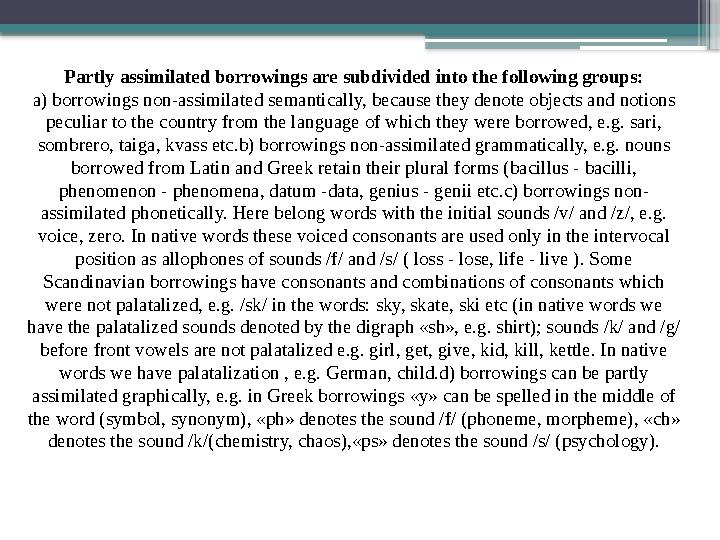
Partly assimilated borrowings are subdivided into the following groups:
a) borrowings non-assimilated semantically, because they denote objects and notions
peculiar to the country from the language of which they were borrowed, e.g. sari,
sombrero, taiga, kvass etc.b) borrowings non-assimilated grammatically, e.g. nouns
borrowed from Latin and Greek retain their plural forms (bacillus - bacilli,
phenomenon - phenomena, datum -data, genius - genii etc.c) borrowings non-
assimilated phonetically. Here belong words with the initial sounds /v/ and /z/, e.g.
voice, zero. In native words these voiced consonants are used only in the intervocal
position as allophones of sounds /f/ and /s/ ( loss - lose, life - live ). Some
Scandinavian borrowings have consonants and combinations of consonants which
were not palatalized, e.g. /sk/ in the words: sky, skate, ski etc (in native words we
have the palatalized sounds denoted by the digraph «sh», e.g. shirt); sounds /k/ and /g/
before front vowels are not palatalized e.g. girl, get, give, kid, kill, kettle. In native
words we have palatalization , e.g. German, child.d) borrowings can be partly
assimilated graphically, e.g. in Greek borrowings «y» can be spelled in the middle of
the word (symbol, synonym), «ph» denotes the sound /f/ (phoneme, morpheme), «ch»
denotes the sound /k/(chemistry, chaos),«ps» denotes the sound /s/ (psychology).
6 слайд
Partly assimilated borrowings are subdivided into the following groups: a) borrowings non-assimilated semantically, because they denote objects and notions peculiar to the country from the language of which they were borrowed, e.g. sari, sombrero, taiga, kvass etc.b) borrowings non-assimilated grammatically, e.g. nouns borrowed from Latin and Greek retain their plural forms (bacillus - bacilli, phenomenon - phenomena, datum -data, genius - genii etc.c) borrowings non- assimilated phonetically. Here belong words with the initial sounds /v/ and /z/, e.g. voice, zero. In native words these voiced consonants are used only in the intervocal position as allophones of sounds /f/ and /s/ ( loss - lose, life - live ). Some Scandinavian borrowings have consonants and combinations of consonants which were not palatalized, e.g. /sk/ in the words: sky, skate, ski etc (in native words we have the palatalized sounds denoted by the digraph «sh», e.g. shirt); sounds /k/ and /g/ before front vowels are not palatalized e.g. girl, get, give, kid, kill, kettle. In native words we have palatalization , e.g. German, child.d) borrowings can be partly assimilated graphically, e.g. in Greek borrowings «y» can be spelled in the middle of the word (symbol, synonym), «ph» denotes the sound /f/ (phoneme, morpheme), «ch» denotes the sound /k/(chemistry, chaos),«ps» denotes the sound /s/ (psychology).
#7 слайд
German borrowings
There are some 800 words borrowed from German into English. Some
of them have classical roots, e.g. in some geological terms, such as:
cobalt, bismuth, zink, quarts, gneiss, wolfram. There were also words
denoting objects used in everyday life which were borrowed from
German: iceberg, lobby, rucksack, Kindergarten etc.In the period of the
Second World War the following words were borrowed: Volkssturm,
Luftwaffe, SS-man, Bundeswehr, gestapo, gas chamber and many
others. After the Second World War the following words were
borrowed: Berufsverbot, Volkswagen etc.
7 слайд
German borrowings There are some 800 words borrowed from German into English. Some of them have classical roots, e.g. in some geological terms, such as: cobalt, bismuth, zink, quarts, gneiss, wolfram. There were also words denoting objects used in everyday life which were borrowed from German: iceberg, lobby, rucksack, Kindergarten etc.In the period of the Second World War the following words were borrowed: Volkssturm, Luftwaffe, SS-man, Bundeswehr, gestapo, gas chamber and many others. After the Second World War the following words were borrowed: Berufsverbot, Volkswagen etc.
#8 слайд
Russian borrowings
There were constant contacts between England and Russia and they borrowed
words from one language into the other. Among early Russian borrowings there
are mainly words connected with trade relations, such as: rouble, copeck, pood,
sterlet, vodka, sable, and also words relating to nature, such as: taiga, tundra,
steppe etc.There is also a large group of Russian borrowings which came into
English through Rushian literature of the 19-th century, such as : Narodnik,
moujik, duma, zemstvo. volost, ukase etc, and also words which were formed in
Russian with Latin roots, such as: nihilist, intelligenzia, Decembrist etc.After the
Great October Revolution many new words appeared in Russian connected with
the new political system, new culture, and many of them were borrowed into
English, such as: collectivization. udarnik, Komsomol etc and also translation
loans, such as: shock worker, collective farm, five-year plan etc.One more group
of Russian borrowings is connected with perestroika, such as: glasnost,
nomenklatura, apparatchik etc.
8 слайд
Russian borrowings There were constant contacts between England and Russia and they borrowed words from one language into the other. Among early Russian borrowings there are mainly words connected with trade relations, such as: rouble, copeck, pood, sterlet, vodka, sable, and also words relating to nature, such as: taiga, tundra, steppe etc.There is also a large group of Russian borrowings which came into English through Rushian literature of the 19-th century, such as : Narodnik, moujik, duma, zemstvo. volost, ukase etc, and also words which were formed in Russian with Latin roots, such as: nihilist, intelligenzia, Decembrist etc.After the Great October Revolution many new words appeared in Russian connected with the new political system, new culture, and many of them were borrowed into English, such as: collectivization. udarnik, Komsomol etc and also translation loans, such as: shock worker, collective farm, five-year plan etc.One more group of Russian borrowings is connected with perestroika, such as: glasnost, nomenklatura, apparatchik etc.
#9 слайд
Spanish borrowings
Spanish borrowings came into English mainly through its American variant.
There are the following semantic groups of them:a) trade terms: cargo,
embargo;b) names of dances and musical instruments: tango, rumba,
habanera, guitar;c) names of vegetables and fruit: tomato, potato, tobbaco,
cocoa, banana, ananas, apricot etc.
Italian borrowings
Cultural and trade relations between Italy and England brought many Italian words
into English. The earliest Italian borrowing came into English in the 14-th century, it
was the word «bank» /from the Italian «banko» - «bench»/. Italian money-lenders
and money-changers sat in the streets on benches. When they suffered losses they
turned over their benches, it was called «banco rotta» from which the English word
«bankrupt» originated. In the 17-th century some geological terms were borrowed :
volcano, granite, bronze, lava. At the same time some political terms were borrowed:
manifesto, bulletin.But mostly Italian is famous by its influence in music and in all
Indo-European languages musical terms were borrowed from Italian : alto, baritone,
basso, tenor, falsetto, solo, duet, trio, quartet, quintet, opera, operette, libretto, piano,
violin.Among the 20-th century Italian borrowings we can mention : gazette,
incognitto, autostrada, fiasco, fascist, diletante, grotesque, graffitto etc.
9 слайд
Spanish borrowings Spanish borrowings came into English mainly through its American variant. There are the following semantic groups of them:a) trade terms: cargo, embargo;b) names of dances and musical instruments: tango, rumba, habanera, guitar;c) names of vegetables and fruit: tomato, potato, tobbaco, cocoa, banana, ananas, apricot etc. Italian borrowings Cultural and trade relations between Italy and England brought many Italian words into English. The earliest Italian borrowing came into English in the 14-th century, it was the word «bank» /from the Italian «banko» - «bench»/. Italian money-lenders and money-changers sat in the streets on benches. When they suffered losses they turned over their benches, it was called «banco rotta» from which the English word «bankrupt» originated. In the 17-th century some geological terms were borrowed : volcano, granite, bronze, lava. At the same time some political terms were borrowed: manifesto, bulletin.But mostly Italian is famous by its influence in music and in all Indo-European languages musical terms were borrowed from Italian : alto, baritone, basso, tenor, falsetto, solo, duet, trio, quartet, quintet, opera, operette, libretto, piano, violin.Among the 20-th century Italian borrowings we can mention : gazette, incognitto, autostrada, fiasco, fascist, diletante, grotesque, graffitto etc.

#10 слайд
FOR YOUR
ATTENTION
10 слайд
FOR YOUR ATTENTION


 Жүктеу
шағым қалдыра аласыз

 Бұл курс Қазақстан Республикасы Оқу-ағарту министрлігімен келісілген










