ЖИ көмекші


 Көп таңдалатын





Language policy in Independent Kazakhstan

#1 слайд
Language policy in
Independent
Kazakhstan
1 слайд
Language policy in Independent Kazakhstan
#2 слайд
•
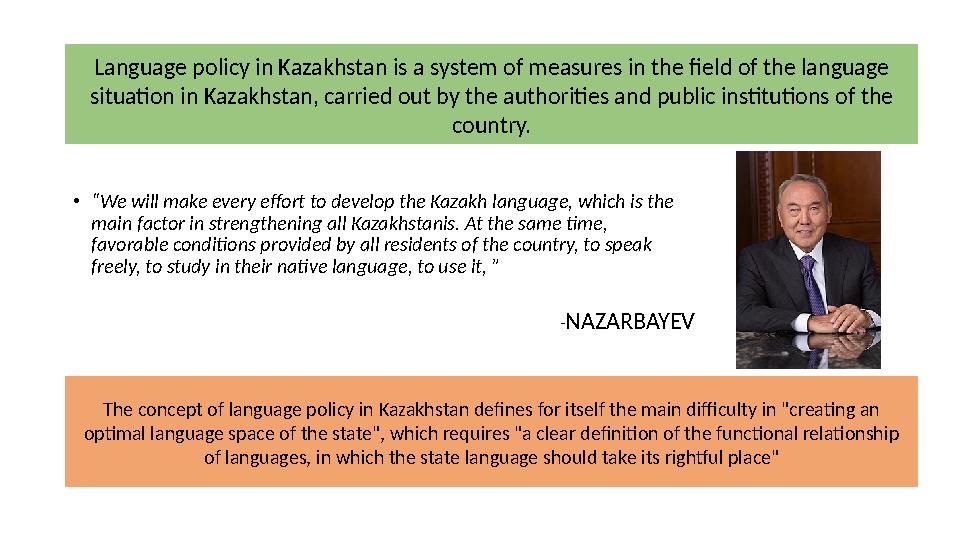
“ We will make every effort to develop the Kazakh language, which is the
main factor in strengthening all Kazakhstanis. At the same time,
favorable conditions provided by all residents of the country, to speak
freely, to study in their native language, to use it, ” Language policy in Kazakhstan is a system of measures in the field of the language
situation in Kazakhstan, carried out by the authorities and public institutions of the
country.
The concept of language policy in Kazakhstan defines for itself the main difficulty in "creating an
optimal language space of the state", which requires "a clear definition of the functional relationship
of languages, in which the state language should take its rightful place" - NAZARBAYEV
2 слайд
• “ We will make every effort to develop the Kazakh language, which is the main factor in strengthening all Kazakhstanis. At the same time, favorable conditions provided by all residents of the country, to speak freely, to study in their native language, to use it, ” Language policy in Kazakhstan is a system of measures in the field of the language situation in Kazakhstan, carried out by the authorities and public institutions of the country. The concept of language policy in Kazakhstan defines for itself the main difficulty in "creating an optimal language space of the state", which requires "a clear definition of the functional relationship of languages, in which the state language should take its rightful place" - NAZARBAYEV
#3 слайд
Legal framework
In 1989, the law "On languages in the Kazakh SSR" was adopted, which determined the status of the Kazakh
and Russian languages. It, in particular, said that "the state language of the Kazakh SSR is the Kazakh
language", and the Russian language is "the language of interethnic communication". According to the 1995
constitution of Kazakhstan, the only state language is Kazakh. However, despite this, the constitution also
protects the rights of specifically Russian-speakers.
In 2007, another resolution of the Constitutional Council clarified that "the Basic Law provides for the
supremacy of the status of the state language," while recognizing the right to appeal to state bodies in
Russian. In 2001, the State Program for the Functioning and Development of Languages
for 2001—2010 was approved,
clause 5.1.1. which stipulates that "State bodies need to carry out work on a phased transition until 2010 of
office work, keeping accounting, statistical, financial and technical documentation in the state language and,
subject to the provisions of paragraph 2 of Article 7 of the Constitution, to implement it."
3 слайд
Legal framework In 1989, the law "On languages in the Kazakh SSR" was adopted, which determined the status of the Kazakh and Russian languages. It, in particular, said that "the state language of the Kazakh SSR is the Kazakh language", and the Russian language is "the language of interethnic communication". According to the 1995 constitution of Kazakhstan, the only state language is Kazakh. However, despite this, the constitution also protects the rights of specifically Russian-speakers. In 2007, another resolution of the Constitutional Council clarified that "the Basic Law provides for the supremacy of the status of the state language," while recognizing the right to appeal to state bodies in Russian. In 2001, the State Program for the Functioning and Development of Languages for 2001—2010 was approved, clause 5.1.1. which stipulates that "State bodies need to carry out work on a phased transition until 2010 of office work, keeping accounting, statistical, financial and technical documentation in the state language and, subject to the provisions of paragraph 2 of Article 7 of the Constitution, to implement it."
#4 слайд
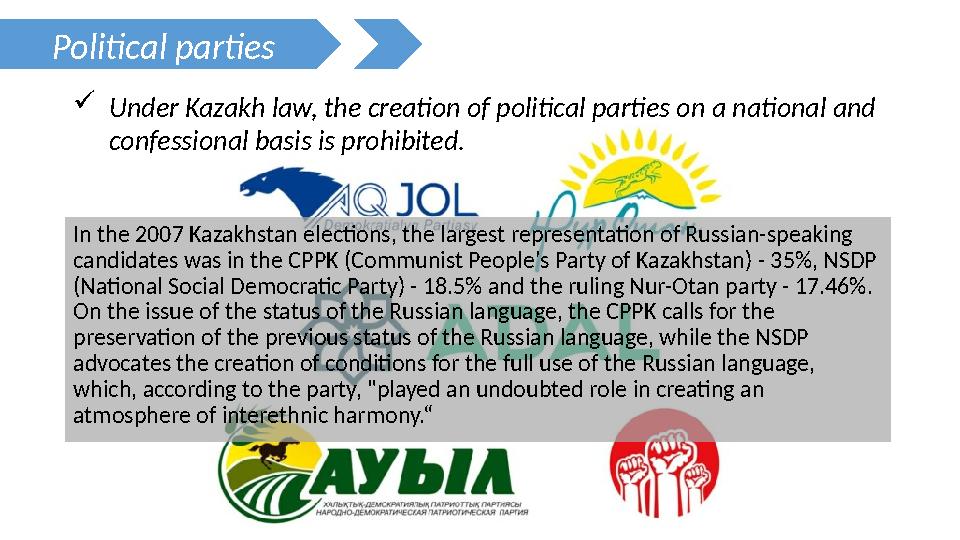
In the 2007 Kazakhstan elections, the largest representation of Russian-speaking
candidates was in the CPPK (Communist People's Party of Kazakhstan) - 35%, NSDP
(National Social Democratic Party) - 18.5% and the ruling Nur-Otan party - 17.46%.
On the issue of the status of the Russian language, the CPPK calls for the
preservation of the previous status of the Russian language, while the NSDP
advocates the creation of conditions for the full use of the Russian language,
which, according to the party, "played an undoubted role in creating an
atmosphere of interethnic harmony.“Political parties
Under Kazakh law, the creation of political parties on a national and
confessional basis is prohibited.
4 слайд
In the 2007 Kazakhstan elections, the largest representation of Russian-speaking candidates was in the CPPK (Communist People's Party of Kazakhstan) - 35%, NSDP (National Social Democratic Party) - 18.5% and the ruling Nur-Otan party - 17.46%. On the issue of the status of the Russian language, the CPPK calls for the preservation of the previous status of the Russian language, while the NSDP advocates the creation of conditions for the full use of the Russian language, which, according to the party, "played an undoubted role in creating an atmosphere of interethnic harmony.“Political parties Under Kazakh law, the creation of political parties on a national and confessional basis is prohibited.
#5 слайд
•
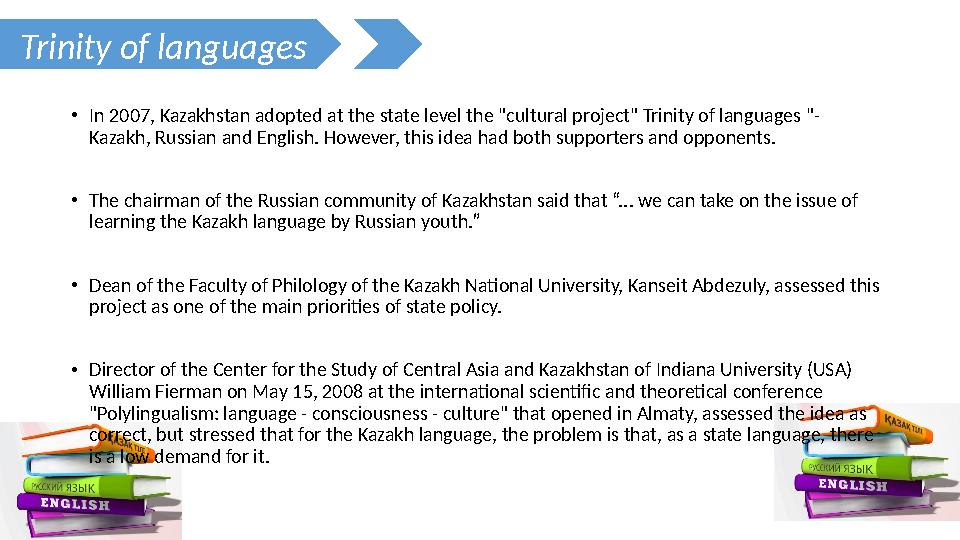
In 2007, Kazakhstan adopted at the state level the "cultural project" Trinity of languages "-
Kazakh, Russian and English. However, this idea had both supporters and opponents.
•
The chairman of the Russian community of Kazakhstan said that “... we can take on the issue of
learning the Kazakh language by Russian youth.”
•
Dean of the Faculty of Philology of the Kazakh National University, Kanseit Abdezuly, assessed this
project as one of the main priorities of state policy.
•
Director of the Center for the Study of Central Asia and Kazakhstan of Indiana University (USA)
William Fierman on May 15, 2008 at the international scientific and theoretical conference
"Polylingualism: language - consciousness - culture" that opened in Almaty, assessed the idea as
correct, but stressed that for the Kazakh language, the problem is that, as a state language, there
is a low demand for it.Trinity of languages
5 слайд
• In 2007, Kazakhstan adopted at the state level the "cultural project" Trinity of languages "- Kazakh, Russian and English. However, this idea had both supporters and opponents. • The chairman of the Russian community of Kazakhstan said that “... we can take on the issue of learning the Kazakh language by Russian youth.” • Dean of the Faculty of Philology of the Kazakh National University, Kanseit Abdezuly, assessed this project as one of the main priorities of state policy. • Director of the Center for the Study of Central Asia and Kazakhstan of Indiana University (USA) William Fierman on May 15, 2008 at the international scientific and theoretical conference "Polylingualism: language - consciousness - culture" that opened in Almaty, assessed the idea as correct, but stressed that for the Kazakh language, the problem is that, as a state language, there is a low demand for it.Trinity of languages
#6 слайд
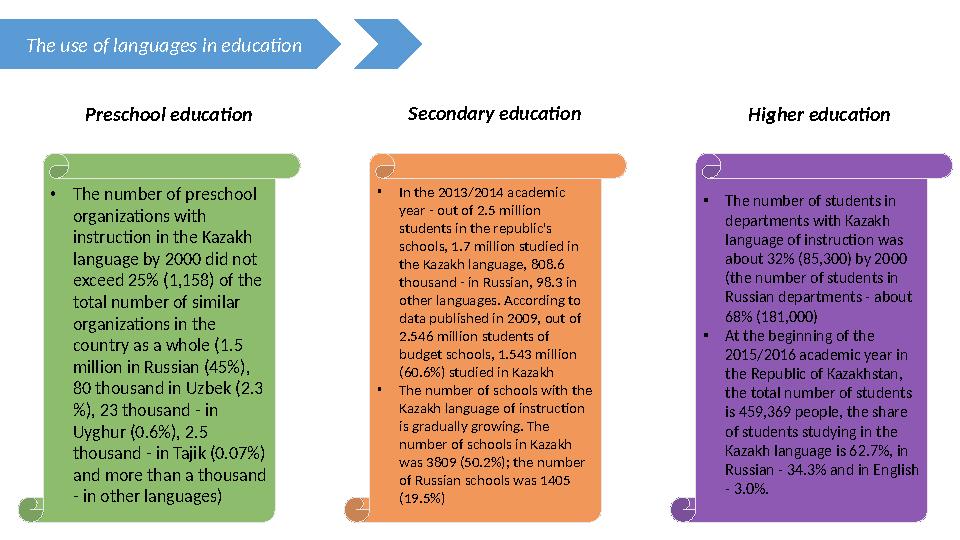
The use of languages in education
Preschool education
•
The number of preschool
organizations with
instruction in the Kazakh
language by 2000 did not
exceed 25% (1,158) of the
total number of similar
organizations in the
country as a whole (1.5
million in Russian (45%),
80 thousand in Uzbek (2.3
%), 23 thousand - in
Uyghur (0.6%), 2.5
thousand - in Tajik (0.07%)
and more than a thousand
- in other languages) •
The number of students in
departments with Kazakh
language of instruction was
about 32% (85,300) by 2000
(the number of students in
Russian departments - about
68% (181,000)
•
At the beginning of the
2015/2016 academic year in
the Republic of Kazakhstan,
the total number of students
is 459,369 people, the share
of students studying in the
Kazakh language is 62.7%, in
Russian - 34.3% and in English
- 3.0%.•
In the 2013/2014 academic
year - out of 2.5 million
students in the republic's
schools, 1.7 million studied in
the Kazakh language, 808.6
thousand - in Russian, 98.3 in
other languages. According to
data published in 2009, out of
2.546 million students of
budget schools, 1.543 million
(60.6%) studied in Kazakh
•
The number of schools with the
Kazakh language of instruction
is gradually growing. The
number of schools in Kazakh
was 3809 (50.2%); the number
of Russian schools was 1405
(19.5%) Secondary education
Higher education
6 слайд
The use of languages in education Preschool education • The number of preschool organizations with instruction in the Kazakh language by 2000 did not exceed 25% (1,158) of the total number of similar organizations in the country as a whole (1.5 million in Russian (45%), 80 thousand in Uzbek (2.3 %), 23 thousand - in Uyghur (0.6%), 2.5 thousand - in Tajik (0.07%) and more than a thousand - in other languages) • The number of students in departments with Kazakh language of instruction was about 32% (85,300) by 2000 (the number of students in Russian departments - about 68% (181,000) • At the beginning of the 2015/2016 academic year in the Republic of Kazakhstan, the total number of students is 459,369 people, the share of students studying in the Kazakh language is 62.7%, in Russian - 34.3% and in English - 3.0%.• In the 2013/2014 academic year - out of 2.5 million students in the republic's schools, 1.7 million studied in the Kazakh language, 808.6 thousand - in Russian, 98.3 in other languages. According to data published in 2009, out of 2.546 million students of budget schools, 1.543 million (60.6%) studied in Kazakh • The number of schools with the Kazakh language of instruction is gradually growing. The number of schools in Kazakh was 3809 (50.2%); the number of Russian schools was 1405 (19.5%) Secondary education Higher education









 Бұл курс Қазақстан Республикасы Оқу-ағарту министрлігімен келісілген