
 ЖИ көмекші


 Қауіпсіз төлем




1 жыл бойы шексіз жүктеңіз
Modal verbs

#1 слайд
Theme: Modals 2.
(possibility, probability,
certainty)
1 слайд
Theme: Modals 2. (possibility, probability, certainty)
#2 слайд
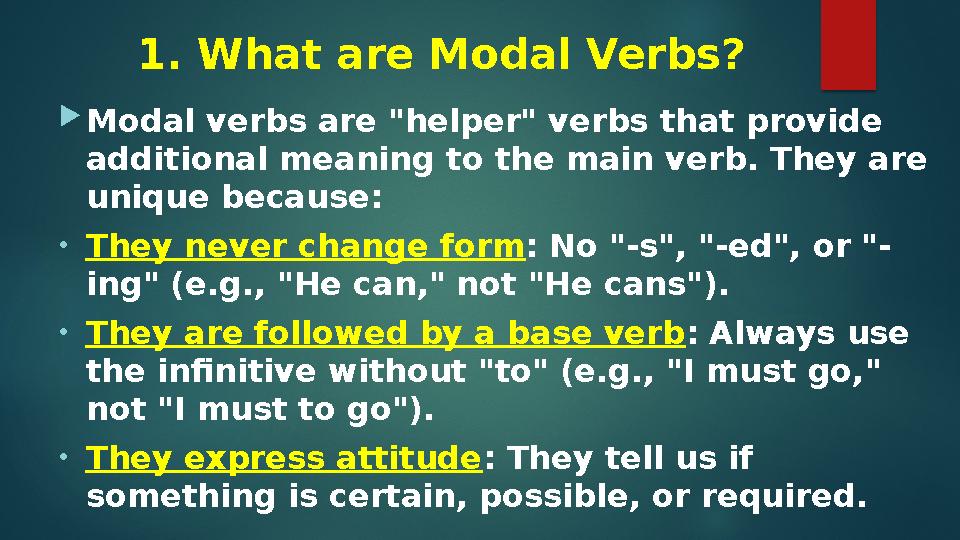
1. What are Modal Verbs?
Modal verbs are "helper" verbs that provide
additional meaning to the main verb. They are
unique because:
•They never change form : No "-s", "-ed", or "-
ing" (e.g., "He can," not "He cans").
•They are followed by a base verb : Always use
the infinitive without "to" (e.g., "I must go,"
not "I must to go").
•They express attitude: They tell us if
something is certain, possible, or required.
2 слайд
1. What are Modal Verbs? Modal verbs are "helper" verbs that provide additional meaning to the main verb. They are unique because: •They never change form : No "-s", "-ed", or "- ing" (e.g., "He can," not "He cans"). •They are followed by a base verb : Always use the infinitive without "to" (e.g., "I must go," not "I must to go"). •They express attitude: They tell us if something is certain, possible, or required.
#3 слайд
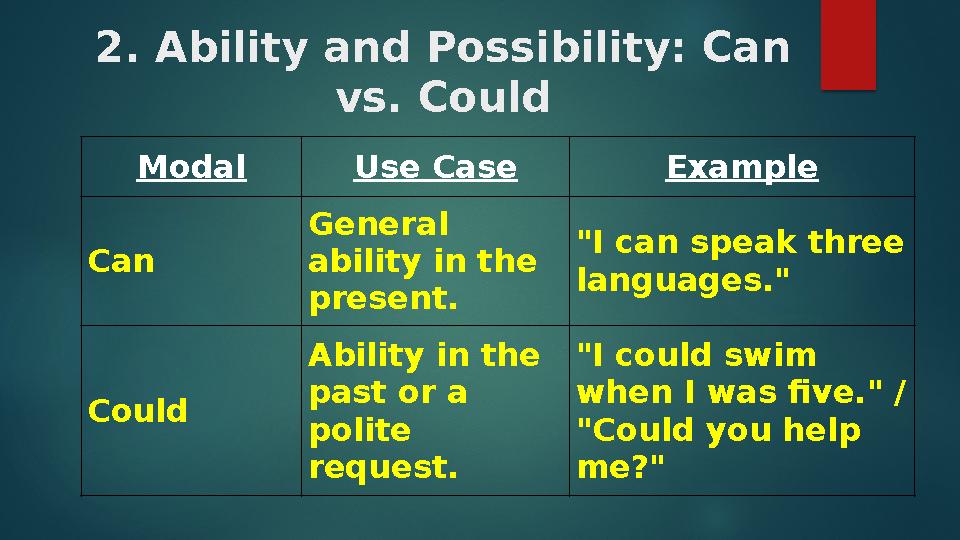
2. Ability and Possibility: Can
vs. Could
Modal Use Case Example
Can
General
ability in the
present.
"I can speak three
languages."
Could
Ability in the
past or a
polite
request.
"I could swim
when I was five." /
"Could you help
me?"
3 слайд
2. Ability and Possibility: Can vs. Could Modal Use Case Example Can General ability in the present. "I can speak three languages." Could Ability in the past or a polite request. "I could swim when I was five." / "Could you help me?"
#4 слайд
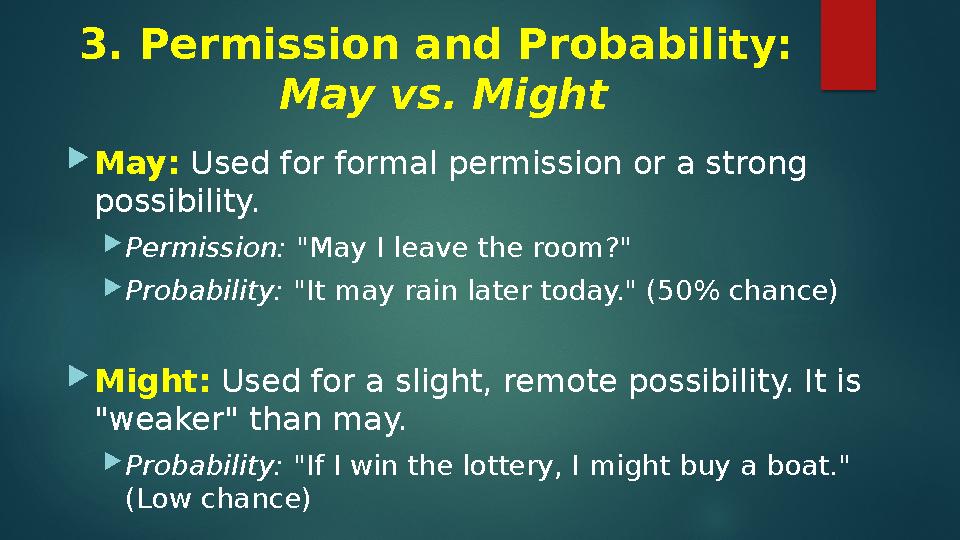
3. Permission and Probability:
May vs. Might
May: Used for formal permission or a strong
possibility.
Permission: "May I leave the room?"
Probability: "It may rain later today." (50% chance)
Might: Used for a slight, remote possibility. It is
"weaker" than may.
Probability: "If I win the lottery, I might buy a boat."
(Low chance)
4 слайд
3. Permission and Probability: May vs. Might May: Used for formal permission or a strong possibility. Permission: "May I leave the room?" Probability: "It may rain later today." (50% chance) Might: Used for a slight, remote possibility. It is "weaker" than may. Probability: "If I win the lottery, I might buy a boat." (Low chance)
#5 слайд
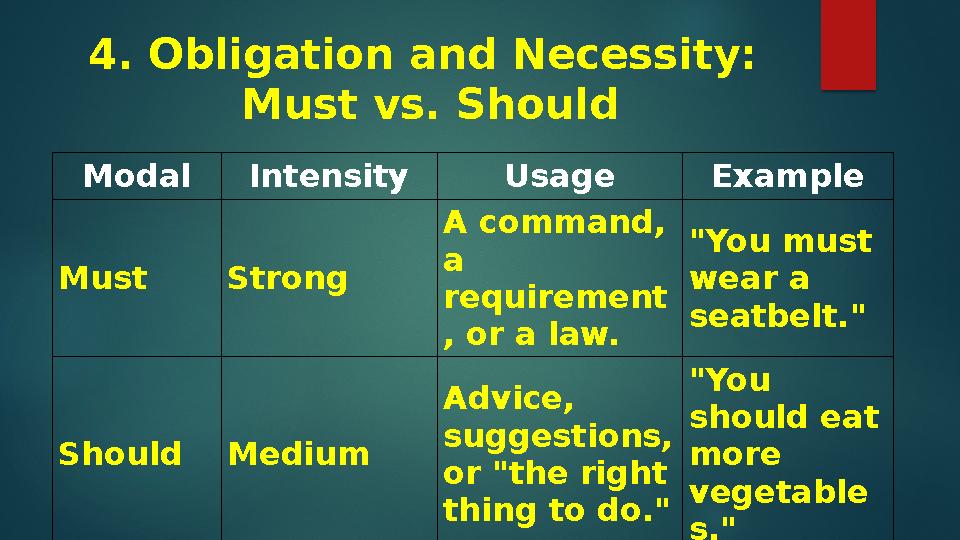
4. Obligation and Necessity:
Must vs. Should
Modal Intensity Usage Example
Must Strong
A command,
a
requirement
, or a law.
"You must
wear a
seatbelt."
Should Medium
Advice,
suggestions,
or "the right
thing to do."
"You
should eat
more
vegetable
s."
5 слайд
4. Obligation and Necessity: Must vs. Should Modal Intensity Usage Example Must Strong A command, a requirement , or a law. "You must wear a seatbelt." Should Medium Advice, suggestions, or "the right thing to do." "You should eat more vegetable s."
#6 слайд
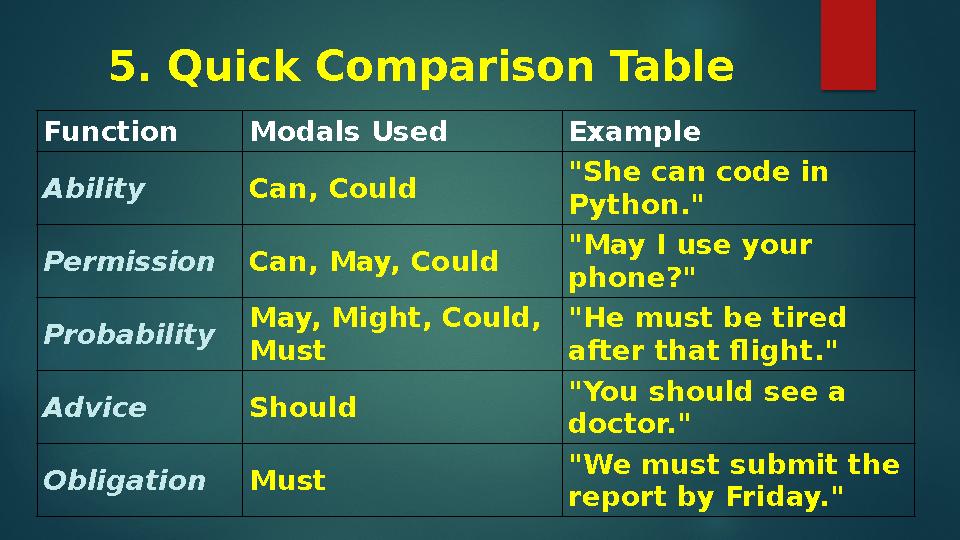
5. Quick Comparison Table
Function Modals Used Example
Ability Can, Could
"She can code in
Python."
Permission Can, May, Could
"May I use your
phone?"
Probability
May, Might, Could,
Must
"He must be tired
after that flight."
Advice Should
"You should see a
doctor."
Obligation Must
"We must submit the
report by Friday."
6 слайд
5. Quick Comparison Table Function Modals Used Example Ability Can, Could "She can code in Python." Permission Can, May, Could "May I use your phone?" Probability May, Might, Could, Must "He must be tired after that flight." Advice Should "You should see a doctor." Obligation Must "We must submit the report by Friday."
#7 слайд
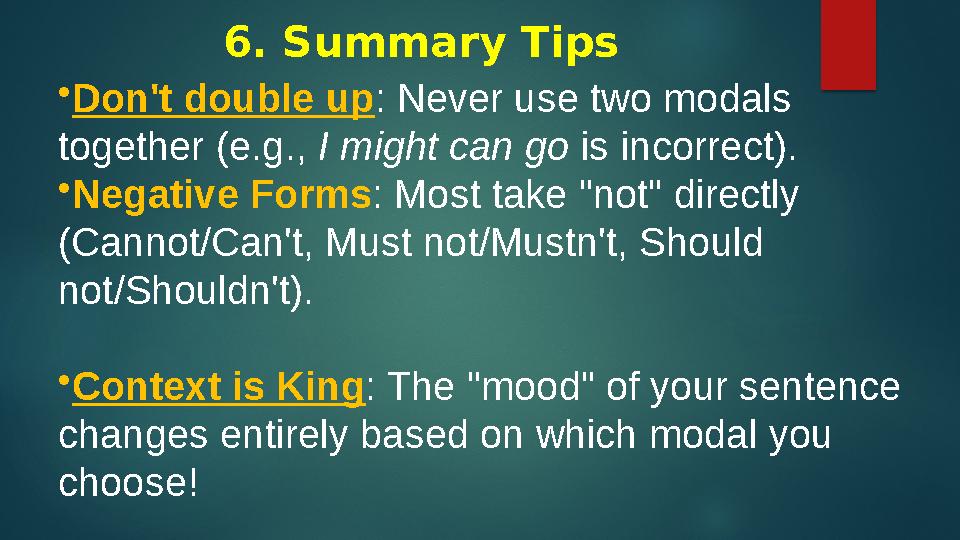
6. Summary Tips
•Don't double up: Never use two modals
together (e.g., I might can go is incorrect).
•Negative Forms: Most take "not" directly
(Cannot/Can't, Must not/Mustn't, Should
not/Shouldn't).
•Context is King: The "mood" of your sentence
changes entirely based on which modal you
choose!
7 слайд
6. Summary Tips •Don't double up: Never use two modals together (e.g., I might can go is incorrect). •Negative Forms: Most take "not" directly (Cannot/Can't, Must not/Mustn't, Should not/Shouldn't). •Context is King: The "mood" of your sentence changes entirely based on which modal you choose!









 Бұл курс Қазақстан Республикасы Оқу-ағарту министрлігімен келісілген










