
 ЖИ көмекші





Modern Methods of Teaching Foreign Languages

 Жүктеу
#1 слайд
Modern Methods of Teaching Foreign
Languages
prepared :Yeszhanova
Saya
Teacher of English
Language
1 слайд
Modern Methods of Teaching Foreign Languages prepared :Yeszhanova Saya Teacher of English Language
#2 слайд
Method
In the definitions of this term, Webster’s Third New
International Dictionary often uses expressions such as “a
procedure or process for attaining” a goal or “a systematic
procedure, technique” or “a set of rules” very often related to
a science or art
.
Hunkis claims that methods “have definite steps or stages
and sub-behaviours that are recurrent and applicable to
various subject matters”.
For our purposes we can consider the method to be a well
staged
procedure to teach new language.
2 слайд
Method In the definitions of this term, Webster’s Third New International Dictionary often uses expressions such as “a procedure or process for attaining” a goal or “a systematic procedure, technique” or “a set of rules” very often related to a science or art . Hunkis claims that methods “have definite steps or stages and sub-behaviours that are recurrent and applicable to various subject matters”. For our purposes we can consider the method to be a well staged procedure to teach new language.
#3 слайд
METHODOLOGY
According to Webster’s Third New International Dictionary,
methodology is “a body of methods, procedures, working
concepts, rules and postulates employed in the solution of a
problem or in doing something
we can say that
methodology, or teaching in this sense, is a set of methods based on
the same rules and having a common aim, e.g. to encourage
students to use the language, involve
the students in the lesson, or explain the language to students
who have
to listen attentively.
3 слайд
METHODOLOGY According to Webster’s Third New International Dictionary, methodology is “a body of methods, procedures, working concepts, rules and postulates employed in the solution of a problem or in doing something we can say that methodology, or teaching in this sense, is a set of methods based on the same rules and having a common aim, e.g. to encourage students to use the language, involve the students in the lesson, or explain the language to students who have to listen attentively.
#4 слайд
Dealing with communicative
approach, teacher should bear in
mind that it is not only dialogues
and monologues which make pupils
& students speak but also variety of
interactive methods, sometimes
even created and organized by the
teacher.
4 слайд
Dealing with communicative approach, teacher should bear in mind that it is not only dialogues and monologues which make pupils & students speak but also variety of interactive methods, sometimes even created and organized by the teacher.
#5 слайд
In the classroom #1
The most effective, tried – and – tested methods are:
Brainstorming
Debates
5 слайд
In the classroom #1 The most effective, tried – and – tested methods are: Brainstorming Debates
#6 слайд
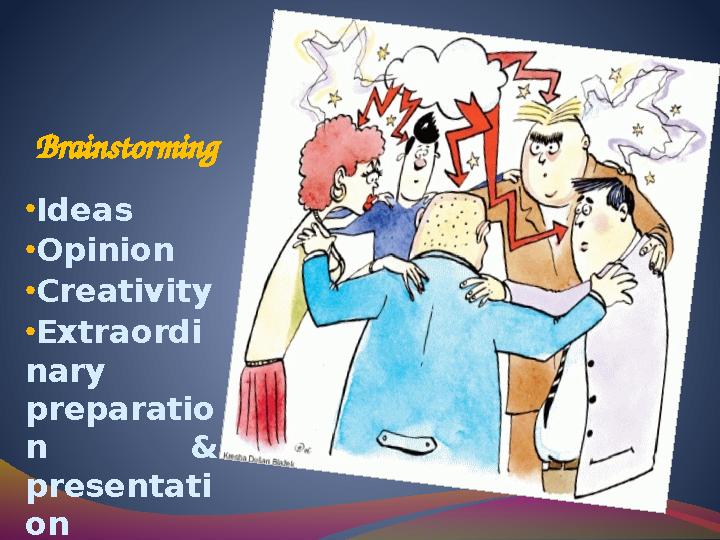
Brainstorming
•
Ideas
•
Opinion
•
Creativity
•
Extraordi
nary
preparatio
n &
presentati
on
6 слайд
Brainstorming • Ideas • Opinion • Creativity • Extraordi nary preparatio n & presentati on

#7 слайд
Debates
•
Get rid of
doubts
•
Erudition
•
Critical
opinion &
remarks
•
Personal
beliefs
•
Listen
7 слайд
Debates • Get rid of doubts • Erudition • Critical opinion & remarks • Personal beliefs • Listen
#8 слайд
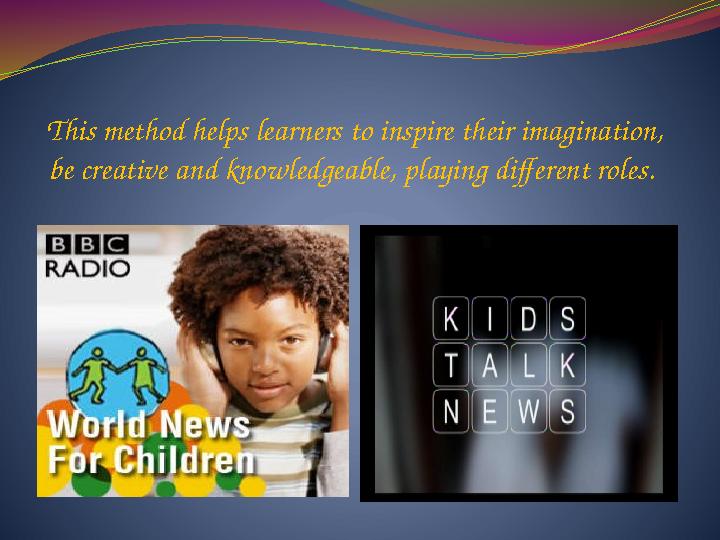
This method helps learners to inspire their imagination,
be creative and knowledgeable, playing different roles.
8 слайд
This method helps learners to inspire their imagination, be creative and knowledgeable, playing different roles.
#9 слайд
Being engaged in this method, pupils/students:
•
Think
•
Learn how express informed opinion
•
Talk for purpose and for fun
•
Listen
•
Train pronunciation
9 слайд
Being engaged in this method, pupils/students: • Think • Learn how express informed opinion • Talk for purpose and for fun • Listen • Train pronunciation
#10 слайд
Suggestopedia
-
Accelerated Language
Learning
10 слайд
Suggestopedia - Accelerated Language Learning
#11 слайд
Suggestopedia is a set of learning recommendations used to optimize
learning. In theory of language and learning, Suggestopedia is a teaching
and learning method by which a language is learned as "the material"
based on suggestion.
11 слайд
Suggestopedia is a set of learning recommendations used to optimize learning. In theory of language and learning, Suggestopedia is a teaching and learning method by which a language is learned as "the material" based on suggestion.

#12 слайд
The main objective of this foreign language
teaching method is to deliver advanced
conversational proficiency quickly.
12 слайд
The main objective of this foreign language teaching method is to deliver advanced conversational proficiency quickly.
#13 слайд
Suggestopedia Lesson
Lessons using Suggestopedia as a foreign
teaching method involves:
translating texts into the learner’s native
language;
explaining grammar structures explicitly;
practicing in an imitative way through
role plays.
13 слайд
Suggestopedia Lesson Lessons using Suggestopedia as a foreign teaching method involves: translating texts into the learner’s native language; explaining grammar structures explicitly; practicing in an imitative way through role plays.
#14 слайд
How To Structure a
Suggestopedia Course?
The course lasts 30 days and
consists of ten units of study. These
are presented in classes held 4 hours
a day, 6 days in a week.
Each unit is focused on a dialogue
consisting of cca. 1,200 words. The
dialogues are graded by lexis and
grammar.
14 слайд
How To Structure a Suggestopedia Course? The course lasts 30 days and consists of ten units of study. These are presented in classes held 4 hours a day, 6 days in a week. Each unit is focused on a dialogue consisting of cca. 1,200 words. The dialogues are graded by lexis and grammar.
#15 слайд
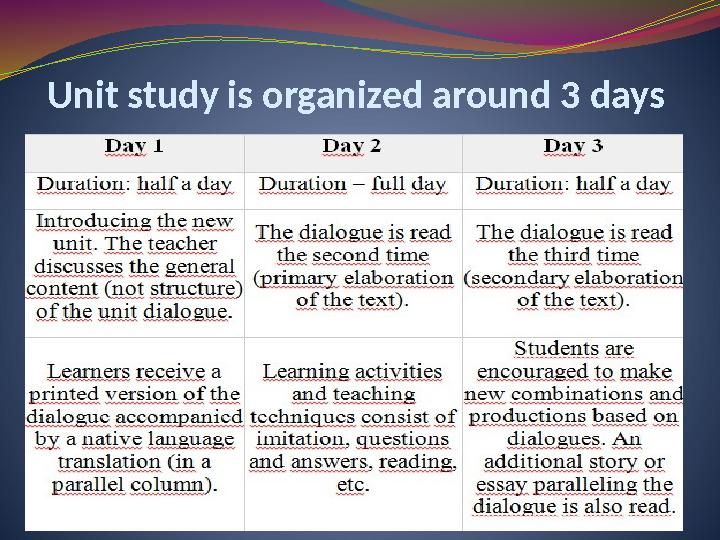
Unit study is organized around 3 days
15 слайд
Unit study is organized around 3 days
#16 слайд
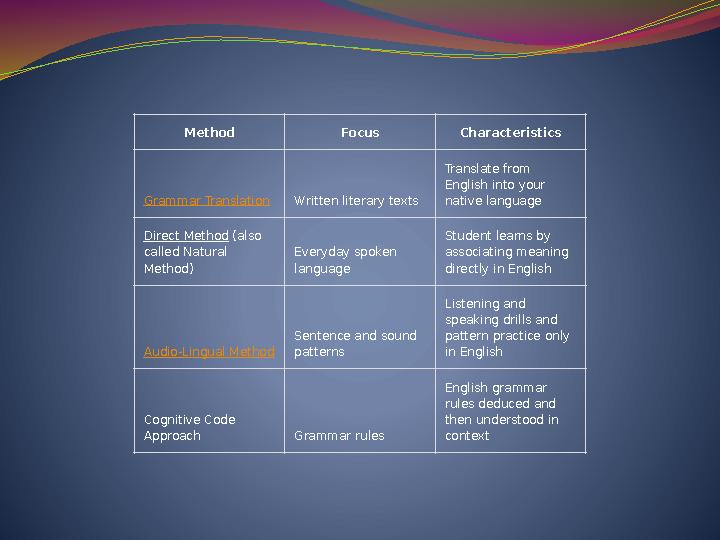
Method Focus Characteristics
Grammar Translation Written literary texts Translate from
English into your
native language
Direct Method (also
called Natural
Method) Everyday spoken
language Student learns by
associating meaning
directly in English
Audio-Lingual Method Sentence and sound
patterns Listening and
speaking drills and
pattern practice only
in English
Cognitive Code
Approach Grammar rules English grammar
rules deduced and
then understood in
context
16 слайд
Method Focus Characteristics Grammar Translation Written literary texts Translate from English into your native language Direct Method (also called Natural Method) Everyday spoken language Student learns by associating meaning directly in English Audio-Lingual Method Sentence and sound patterns Listening and speaking drills and pattern practice only in English Cognitive Code Approach Grammar rules English grammar rules deduced and then understood in context

#17 слайд
Humanistic Approaches – 4 popular examples:
- The Silent Way Student interaction rather than teacher Teacher is silent to allow student awareness of
how English works
- Suggestopedia Meaningful texts and vocabulary Relaxed atmosphere, with music; encourages
subliminal learning of English
- Community Language Learning Student interaction Understanding of English through active student
interaction
- Comprehension Approach (Natural Approach,
the Learnables, and Total Physical Response) Listening comprehension English speaking delayed until students are
ready; meaning clarified through actions and
visuals
Communicative Language Teaching Interaction, authentic communication and
negotiating meaning Understanding of English through active student
interaction; role play, games, information gaps
Content-based, Task-based, and Participatory
Approaches What is being communicated, not structure of
English Content based on relevance to students’ lives:
topics, tasks, problem-solving
Learning Strategy Training, Cooperative
Learning, and Multiple Intelligences How to learn Teach learning strategies, cooperation; activities
vary according to different intelligencesBased on Techniques and Principles in Language Teaching (Oxford University Press)
17 слайд
Humanistic Approaches – 4 popular examples: - The Silent Way Student interaction rather than teacher Teacher is silent to allow student awareness of how English works - Suggestopedia Meaningful texts and vocabulary Relaxed atmosphere, with music; encourages subliminal learning of English - Community Language Learning Student interaction Understanding of English through active student interaction - Comprehension Approach (Natural Approach, the Learnables, and Total Physical Response) Listening comprehension English speaking delayed until students are ready; meaning clarified through actions and visuals Communicative Language Teaching Interaction, authentic communication and negotiating meaning Understanding of English through active student interaction; role play, games, information gaps Content-based, Task-based, and Participatory Approaches What is being communicated, not structure of English Content based on relevance to students’ lives: topics, tasks, problem-solving Learning Strategy Training, Cooperative Learning, and Multiple Intelligences How to learn Teach learning strategies, cooperation; activities vary according to different intelligencesBased on Techniques and Principles in Language Teaching (Oxford University Press)
#18 слайд
•
Communicative Approach
The Communicative approach or the Communicative
Language Teaching (CLT) emphasises the
importance of language functions rather than focuses
on grammar and vocabulary. The main principle of
CLT is to train students to use language forms appropriately
a variety of contexts for a variety of
purposes (Harmer, 2001, 84). The top ten principles
of CLT are communicative interaction, meaningful
practice, active involvement, positive reinforcement
of suitable materials, changes of pace and
activity, making the teaching process enjoyable,
teaching English in English, realisation that mistakes
are natural and that even beginners can understand
when taught in the target language.
18 слайд
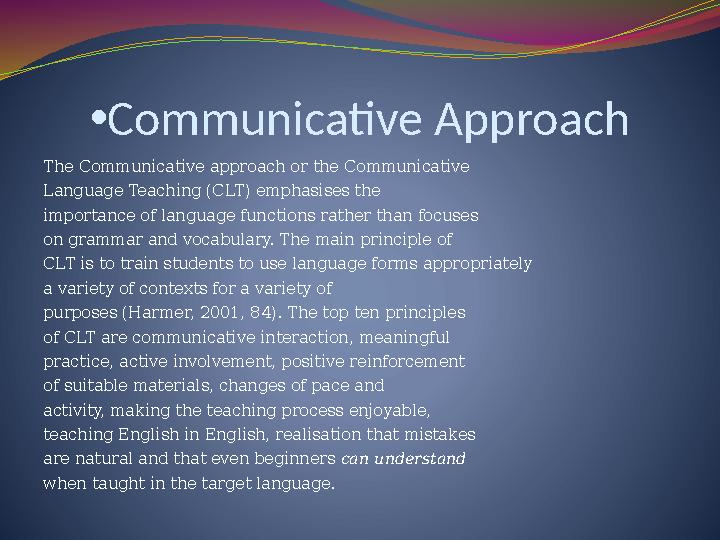
• Communicative Approach The Communicative approach or the Communicative Language Teaching (CLT) emphasises the importance of language functions rather than focuses on grammar and vocabulary. The main principle of CLT is to train students to use language forms appropriately a variety of contexts for a variety of purposes (Harmer, 2001, 84). The top ten principles of CLT are communicative interaction, meaningful practice, active involvement, positive reinforcement of suitable materials, changes of pace and activity, making the teaching process enjoyable, teaching English in English, realisation that mistakes are natural and that even beginners can understand when taught in the target language.
#19 слайд
•
ACTIVITIES
Activities in CLT involve students in real and
realistic communication, where the accuracy of the
language is less important than successful
achievement of the communicative purpose.
Therefore, such activities as role-play and
simulation are very popular in CLT.
All activities in CLT have to be
constructed in such a way that students should
have
a desire to communicate something.
19 слайд
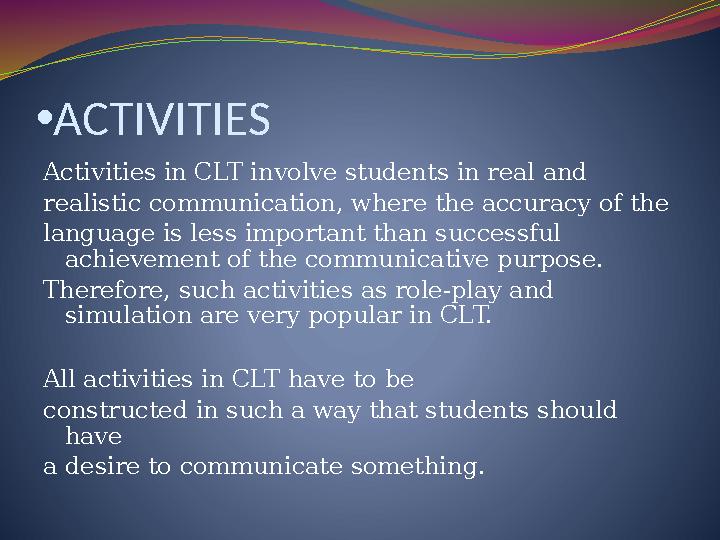
• ACTIVITIES Activities in CLT involve students in real and realistic communication, where the accuracy of the language is less important than successful achievement of the communicative purpose. Therefore, such activities as role-play and simulation are very popular in CLT. All activities in CLT have to be constructed in such a way that students should have a desire to communicate something.
#20 слайд
Key Principles of CLT
The key principles of effective CLT that
teachers
have to take into consideration are as follows:
be aware of students’ needs, develop learner
independence,
be a facilitator rather than a controller,
motivate your students by verbal
encouragement
(praising, good mark, awards, body
language), use
variety of activities, and encourage students’
active
involvement.
20 слайд
Key Principles of CLT The key principles of effective CLT that teachers have to take into consideration are as follows: be aware of students’ needs, develop learner independence, be a facilitator rather than a controller, motivate your students by verbal encouragement (praising, good mark, awards, body language), use variety of activities, and encourage students’ active involvement.
#21 слайд
Modes of Interaction
Active involvement can be achieved by a variety
of means such as varied modes of interaction,
changes of activity, changes of pace, changes of
intensity, changes of mood/atmosphere, changes of
beginnings and endings, balanced use of settlers and
stirrers, balancing the familiar and the unfamiliar,
presence and absence of correction, varying the
modes of correction, offering positive reinforcement
in varied ways, and employing principled use of
elicitation and nomination.
21 слайд
Modes of Interaction Active involvement can be achieved by a variety of means such as varied modes of interaction, changes of activity, changes of pace, changes of intensity, changes of mood/atmosphere, changes of beginnings and endings, balanced use of settlers and stirrers, balancing the familiar and the unfamiliar, presence and absence of correction, varying the modes of correction, offering positive reinforcement in varied ways, and employing principled use of elicitation and nomination.
#22 слайд
Content and Language Integrated
Learning
The term Content and Language Integrated
Learning (CLIL) was defined in 1994, and launched
in 1996 by UNICOM, the University of Jyväskylä
and the European Platform for Dutch Education, to
describe educational methods where “subjects are
taught through a foreign language with dual-focused
aims, namely the learning of content, and the simultaneous
learning of a foreign language.
CLIL can be interpreted as an “umbrella” term describing both
learning content subject such as physics or geography
through the medium of a foreign language and learning
a foreign language by studying a content-based
subject .
22 слайд
Content and Language Integrated Learning The term Content and Language Integrated Learning (CLIL) was defined in 1994, and launched in 1996 by UNICOM, the University of Jyväskylä and the European Platform for Dutch Education, to describe educational methods where “subjects are taught through a foreign language with dual-focused aims, namely the learning of content, and the simultaneous learning of a foreign language. CLIL can be interpreted as an “umbrella” term describing both learning content subject such as physics or geography through the medium of a foreign language and learning a foreign language by studying a content-based subject .
#23 слайд
CLIL
In CLIL content subjects are taught
and learnt in a language, which is not the
mother
tongue of the learners. Knowledge of the
language
becomes the means of learning content,
language
is integrated into the content-based subject
teaching,
and this increases motivation to study natural
contextualized language. Therefore, CLIL
provides
a practical approach to both content and
language
learning that improves intercultural
understanding
23 слайд
CLIL In CLIL content subjects are taught and learnt in a language, which is not the mother tongue of the learners. Knowledge of the language becomes the means of learning content, language is integrated into the content-based subject teaching, and this increases motivation to study natural contextualized language. Therefore, CLIL provides a practical approach to both content and language learning that improves intercultural understanding
#24 слайд
•
Advantages of CLIL
The important advantage of CLIL is its potential
for achieving bilingualism and improving intercultural
understanding.
Firstly, CLIL helps to broaden
intercultural knowledge and understanding and develops
intercultural communication skills.
Secondly, CLIL improves target language competence and raises awareness of
both mother tongue and target language.
Thirdly, CLIL provides opportunities to
study content and learn subject-specific terminology
and hence prepare students for future studies and/or
working life.
Finally, CLIL offers new learning
strategies while adding diversity and flexibility to
existing methods and forms of classroom practice
24 слайд
• Advantages of CLIL The important advantage of CLIL is its potential for achieving bilingualism and improving intercultural understanding. Firstly, CLIL helps to broaden intercultural knowledge and understanding and develops intercultural communication skills. Secondly, CLIL improves target language competence and raises awareness of both mother tongue and target language. Thirdly, CLIL provides opportunities to study content and learn subject-specific terminology and hence prepare students for future studies and/or working life. Finally, CLIL offers new learning strategies while adding diversity and flexibility to existing methods and forms of classroom practice
#25 слайд
•
IMPLEMENTATION OF CLIL
The implementation of CLIL is based on four
main principles. These are cognition, community,
communication, and culture. The four guiding principles
means that the learner works with an interface
in which cognition (the thinking skills and problem solving
approaches specific to that particular topic),
community (the development of the self-awareness of
the learner with respect to the content, him/herself as
a learner, and the purpose of learning in the wider environment
be it at school, university or the surrounding
society), communication (interaction with others
and the language domains specific to the topic), and
culture (how the learner engages with the language
and content and the discourse features required to
both learn and communicate), are all interlinked.
25 слайд
• IMPLEMENTATION OF CLIL The implementation of CLIL is based on four main principles. These are cognition, community, communication, and culture. The four guiding principles means that the learner works with an interface in which cognition (the thinking skills and problem solving approaches specific to that particular topic), community (the development of the self-awareness of the learner with respect to the content, him/herself as a learner, and the purpose of learning in the wider environment be it at school, university or the surrounding society), communication (interaction with others and the language domains specific to the topic), and culture (how the learner engages with the language and content and the discourse features required to both learn and communicate), are all interlinked.
#26 слайд
TASKS
five major tasks for successful CLIL
implementation:
Course design, methodology, tasks and
activities, competence development, and
teaching and learning environment.
26 слайд
TASKS five major tasks for successful CLIL implementation: Course design, methodology, tasks and activities, competence development, and teaching and learning environment.
#27 слайд
Task-Based Method
The idea of the Task-Based Learning (TBL) was
popularised by N Prabhu who, working in
schools of
South India, claimed that students were just as
likely
to learn language if they were thinking about a
nonlinguistic problem than if they were
concentrating
on particular language forms. Instead of a
language
structure, students are presented with a task
they have
to perform or a problem they have to solve.
27 слайд
Task-Based Method The idea of the Task-Based Learning (TBL) was popularised by N Prabhu who, working in schools of South India, claimed that students were just as likely to learn language if they were thinking about a nonlinguistic problem than if they were concentrating on particular language forms. Instead of a language structure, students are presented with a task they have to perform or a problem they have to solve.
#28 слайд
FOCUS
The focus is on language use for authentic, real-world
needs.
TBL
relies heavily on learners’ knowledge of the world,
on learners’ using skills of deduction and independent
language analysis to exploit the situation fully.
Motivation for communication becomes the primary
driving force. The emphasis is on communicative
fluency
rather than the accuracy. The target language is
used in a naturally occurring context. The materials
are selected and adopted from authentic sources.
28 слайд
FOCUS The focus is on language use for authentic, real-world needs. TBL relies heavily on learners’ knowledge of the world, on learners’ using skills of deduction and independent language analysis to exploit the situation fully. Motivation for communication becomes the primary driving force. The emphasis is on communicative fluency rather than the accuracy. The target language is used in a naturally occurring context. The materials are selected and adopted from authentic sources.
#29 слайд
CLT/TBL
Analysis of the key principles of the Task-Based
Learning demonstrates the apparent similarity
between the Task-Based Learning and the
Communicative Language Teaching.
A basic distinction
between TBL and CLT is that CLT is a
philosophy
or orientation whereas TBL represents a body
of
principles and procedures for making
communicative
language teaching work in the classroom.
29 слайд
CLT/TBL Analysis of the key principles of the Task-Based Learning demonstrates the apparent similarity between the Task-Based Learning and the Communicative Language Teaching. A basic distinction between TBL and CLT is that CLT is a philosophy or orientation whereas TBL represents a body of principles and procedures for making communicative language teaching work in the classroom.
#30 слайд
Fundamental Principles of TBT (4)
The four fundamental principles underlying the
Task-Based Teaching (TBT) are:
meaning is primary,
grammar and form are not ignored,
the task is a complete unit and there is a
systematic relationship between pedagogical
tasks and target/real-world tasks.
30 слайд
Fundamental Principles of TBT (4) The four fundamental principles underlying the Task-Based Teaching (TBT) are: meaning is primary, grammar and form are not ignored, the task is a complete unit and there is a systematic relationship between pedagogical tasks and target/real-world tasks.
#31 слайд
Disadvantagesof TBL
The major criticism of TBL concerns its applicability
to lower learning levels. However, there are
many tasks that are suitable for beginners or young
learners. Another point of criticism is about restricted
patterns of language that are usually used in the Task-
Based Learning. Language patterns that are used in
discussion, debate, or social interaction of other kind
fail to be included in the task-based interaction.
Nevertheless, tasks are widely used in language
teaching, either as the basis of language course or as
one of its components.
31 слайд
Disadvantagesof TBL The major criticism of TBL concerns its applicability to lower learning levels. However, there are many tasks that are suitable for beginners or young learners. Another point of criticism is about restricted patterns of language that are usually used in the Task- Based Learning. Language patterns that are used in discussion, debate, or social interaction of other kind fail to be included in the task-based interaction. Nevertheless, tasks are widely used in language teaching, either as the basis of language course or as one of its components.
#32 слайд
TOTAL PHYSICAL RESPONSE (TPR)
BACKGROUND :
TPR is a method developed by Dr. James J. Asher (1977), a
professor of psychology at San Jose State University of
California. Asher devloped TPR as a result of his experiences
observing young children learning their first language. He
noticed that interactions between parents and children often
took the form of speech from the parent followed by a physical
response from the child. Asher made three hypotheses based
on his observations: first, that language is learned primarily by
listening;
second, that language learning must engage the right
hemisphere of the brain;
third, that learning language should not involve any stress.
32 слайд
TOTAL PHYSICAL RESPONSE (TPR) BACKGROUND : TPR is a method developed by Dr. James J. Asher (1977), a professor of psychology at San Jose State University of California. Asher devloped TPR as a result of his experiences observing young children learning their first language. He noticed that interactions between parents and children often took the form of speech from the parent followed by a physical response from the child. Asher made three hypotheses based on his observations: first, that language is learned primarily by listening; second, that language learning must engage the right hemisphere of the brain; third, that learning language should not involve any stress.
#33 слайд
WHAT IS TPR? Total Physical
Response (TPR) is a language
teaching method built around the
coordination of speech and action; it
attempts to teach language through
physical (motor) activity. In TPR,
instructors give commands to
students in the target language, and
students respond with whole-body
actions. Total physical response is
often used alongside other methods
and techniques. It is popular with
beginners and with young learners,
although it can be used with students
of all levels and all age
33 слайд
WHAT IS TPR? Total Physical Response (TPR) is a language teaching method built around the coordination of speech and action; it attempts to teach language through physical (motor) activity. In TPR, instructors give commands to students in the target language, and students respond with whole-body actions. Total physical response is often used alongside other methods and techniques. It is popular with beginners and with young learners, although it can be used with students of all levels and all age
#34 слайд
THE CHARACTERISTICS OF TPR
THE CHARACTERISTICS OF TPR The coordination
of speech and action. Learners roles of listener and
performer. Listen. . . Learners monitor and evaluate
their own progress. Watch. . . Reading and writing
is taught after grammar and vocabulary. Imitate. . .
Grammar is taught inductively. Grammar and
vocabulary selected according to the situation.
Learning language by gesture (body movements).
The teacher and the students are the actors.
Students should be more active and talkative.
34 слайд
THE CHARACTERISTICS OF TPR THE CHARACTERISTICS OF TPR The coordination of speech and action. Learners roles of listener and performer. Listen. . . Learners monitor and evaluate their own progress. Watch. . . Reading and writing is taught after grammar and vocabulary. Imitate. . . Grammar is taught inductively. Grammar and vocabulary selected according to the situation. Learning language by gesture (body movements). The teacher and the students are the actors. Students should be more active and talkative.
#35 слайд
Applications of TPR
Reading : predicting skills and reading the text Writing :
making dialogue, picturing. Vocabulary : reality,
demonstration, conversation. Structure : reality,
demonstration. Learning keywords. . . Understanding
sentences. . . Listening to instructions. . . Imitating actions. . .
5. BASIC PRINCIPLES OF TPR Listening ability and
vocabulary must be developed first. There must not be any
stress in the class. Regular repetition. Action verbs are the
core of TPR. TPR is also technique of teaching vocabulary. No
forcing but exploit the student’s errors for exposing others
structure points. expose the natural use of language. Create an
artificial English community in the classroom. The more often
we trace memory and the more intensively we repeat, the
stonger the memory associations are and the more likely it will
be recalled.
35 слайд
Applications of TPR Reading : predicting skills and reading the text Writing : making dialogue, picturing. Vocabulary : reality, demonstration, conversation. Structure : reality, demonstration. Learning keywords. . . Understanding sentences. . . Listening to instructions. . . Imitating actions. . . 5. BASIC PRINCIPLES OF TPR Listening ability and vocabulary must be developed first. There must not be any stress in the class. Regular repetition. Action verbs are the core of TPR. TPR is also technique of teaching vocabulary. No forcing but exploit the student’s errors for exposing others structure points. expose the natural use of language. Create an artificial English community in the classroom. The more often we trace memory and the more intensively we repeat, the stonger the memory associations are and the more likely it will be recalled.
#36 слайд
THE ADVANTAGES OF TPR
It is fun, easy, and memorable It is a good tool
for building vocabulary. It can facilitate
students with the meaning in real context. It
does not require a great deal of preparation.
Help the students immediately understand
the target language. TPR is inclusive and
works well a class with mixed ability levels.
Helps learners achieve fluency faster in
learning language It benefits the Struggling
students. Creates positive thinking.
36 слайд
THE ADVANTAGES OF TPR It is fun, easy, and memorable It is a good tool for building vocabulary. It can facilitate students with the meaning in real context. It does not require a great deal of preparation. Help the students immediately understand the target language. TPR is inclusive and works well a class with mixed ability levels. Helps learners achieve fluency faster in learning language It benefits the Struggling students. Creates positive thinking.
#37 слайд
THE DISADVANTAGES OF TPR
Students are not generally given the
opportunity to express their own thoughts in
a creative way. It can be a challenge for shy
students. It is not a very creative method.
Overusing TPR causes someone easily bored.
Certain target languages may not be suited to
this method. It is limited, since everything
cannot be explained with this method.
37 слайд
THE DISADVANTAGES OF TPR Students are not generally given the opportunity to express their own thoughts in a creative way. It can be a challenge for shy students. It is not a very creative method. Overusing TPR causes someone easily bored. Certain target languages may not be suited to this method. It is limited, since everything cannot be explained with this method.
#38 слайд
CONCLUSION
Total Physical Response (TPR) is one of the
teaching methods that emphasize active
learning through actions. It means that
learners’ speaking skill through listening to
their teacher and before requiring them to
speak, and asking them to practice using
verbal communication accompany by physical
actions. Three basic steps that used in this
method are to listen, watch, and imitate
repeatedly.
38 слайд
CONCLUSION Total Physical Response (TPR) is one of the teaching methods that emphasize active learning through actions. It means that learners’ speaking skill through listening to their teacher and before requiring them to speak, and asking them to practice using verbal communication accompany by physical actions. Three basic steps that used in this method are to listen, watch, and imitate repeatedly.
#39 слайд
CLL –Community Language
Learning
CLL (Community Language Learning) is one of the so-
called ‘designer’ methods which arose in the flurry of
methodological experimentation in the 1970’s (along
with The Silent Way , Suggestopoedia , TPR etc.), which
form part of the Humanistic Approach to language
learning. The key features of all these innovative
methodologies are that they all in some way flouted
the current language teaching orthodoxy, that they all
had a guru who was regarded by devotees of the
method with something approaching religious awe,
and they all developed from outside language
teaching, they were all fairly rigidly-prescriptive, and
they all emphasised the learners’ responsibility for
their own learning.
39 слайд
CLL –Community Language Learning CLL (Community Language Learning) is one of the so- called ‘designer’ methods which arose in the flurry of methodological experimentation in the 1970’s (along with The Silent Way , Suggestopoedia , TPR etc.), which form part of the Humanistic Approach to language learning. The key features of all these innovative methodologies are that they all in some way flouted the current language teaching orthodoxy, that they all had a guru who was regarded by devotees of the method with something approaching religious awe, and they all developed from outside language teaching, they were all fairly rigidly-prescriptive, and they all emphasised the learners’ responsibility for their own learning.
#40 слайд
DESCIPTION OF CLL
In the case of CLL, the founder figure was Charles Curran, an American Jesuit
priest, whose work in Counselling Learning was then applied to language
learning.
One of the key ideas is that it is the students who determine what is to be
learned, so that the role of the teacher is that of a facilitator and support. In the
basic form of CLL, students (8 to 12 maximum) sit in a circle. There is a small
portable tape recorder inside the circle. The teacher (who is termed the
‘Knower’ ) stands outside the circle. When a student has decided on something
they want to say in the foreign language, they call the Knower over and
whisper what they want to say, in their mother tongue. The teacher, also in a
whisper, then offers the equivalent utterance in English (or the target
language). The student attempts to repeat the utterance, with encouragement
and shaping from the Knower, with the rest of the group eavesdropping. When
the Knower is satisfied, the utterance is recorded by the student. Another
student then repeats the process, till there is a kind of dialogue recorded. The
Knower then replays the recording, and transcribes it on the board. This is
followed by analysis, and questions from students. In a subsequent session, the
Knower may suggest activities springing from the dialogue. Gradually, the
students spin a web of language.
40 слайд
DESCIPTION OF CLL In the case of CLL, the founder figure was Charles Curran, an American Jesuit priest, whose work in Counselling Learning was then applied to language learning. One of the key ideas is that it is the students who determine what is to be learned, so that the role of the teacher is that of a facilitator and support. In the basic form of CLL, students (8 to 12 maximum) sit in a circle. There is a small portable tape recorder inside the circle. The teacher (who is termed the ‘Knower’ ) stands outside the circle. When a student has decided on something they want to say in the foreign language, they call the Knower over and whisper what they want to say, in their mother tongue. The teacher, also in a whisper, then offers the equivalent utterance in English (or the target language). The student attempts to repeat the utterance, with encouragement and shaping from the Knower, with the rest of the group eavesdropping. When the Knower is satisfied, the utterance is recorded by the student. Another student then repeats the process, till there is a kind of dialogue recorded. The Knower then replays the recording, and transcribes it on the board. This is followed by analysis, and questions from students. In a subsequent session, the Knower may suggest activities springing from the dialogue. Gradually, the students spin a web of language.
#41 слайд
STAGES OF CLL
The learner is supposed to move from a
stage of total dependence on the Knower at
the beginning to a stage of independent
autonomy at the end, passing through 5
developmental stages along the way. It is the
Knower’s job to provide the supportive and
secure environment for learners, and to
encourage a whole-person approach to the
learning.
41 слайд
STAGES OF CLL The learner is supposed to move from a stage of total dependence on the Knower at the beginning to a stage of independent autonomy at the end, passing through 5 developmental stages along the way. It is the Knower’s job to provide the supportive and secure environment for learners, and to encourage a whole-person approach to the learning.
#42 слайд
DISADVANTAGES OF CLL
There are clearly some major problems with
CLL. It can only be done with small numbers
of students. The students have to share a
single mother tongue. The teacher (Knower)
has to be highly proficient in the target
language and in the language of the students.
The teacher also has to have enormous
reserves of energy – both physical and
psychic. Arguably, too, it is unwise to
undertake CLL as a teacher without some
counselling training.
42 слайд
DISADVANTAGES OF CLL There are clearly some major problems with CLL. It can only be done with small numbers of students. The students have to share a single mother tongue. The teacher (Knower) has to be highly proficient in the target language and in the language of the students. The teacher also has to have enormous reserves of energy – both physical and psychic. Arguably, too, it is unwise to undertake CLL as a teacher without some counselling training.
#43 слайд
CONCLUSIONS
It has also been pointed out that this is a methodology
exclusively suitable for adult learners, not for
children. Also, that most descriptions of it in action
focus on the early stages of learning the new
language. What do teachers do after that? As for many
methods, it gets more difficult to distinguish between
one method and another the more advanced the
learner becomes.
Perhaps the enduring value of CLL has been its
emphasis on whole-person learning; the role of a
supportive, non-judgmental teacher; the passing of
responsibility for learning to the learners (where it
belongs); and the abolition of a pre-planned syllabus.
43 слайд
CONCLUSIONS It has also been pointed out that this is a methodology exclusively suitable for adult learners, not for children. Also, that most descriptions of it in action focus on the early stages of learning the new language. What do teachers do after that? As for many methods, it gets more difficult to distinguish between one method and another the more advanced the learner becomes. Perhaps the enduring value of CLL has been its emphasis on whole-person learning; the role of a supportive, non-judgmental teacher; the passing of responsibility for learning to the learners (where it belongs); and the abolition of a pre-planned syllabus.

#44 слайд
TEACHER’S and STUDENTS’ROLES
o Teacher is silent
o Teacher is controller
o Teacher is responsible
Student’s Roles:
• Students as center
• Keep attention
• Student should be independent .
44 слайд
TEACHER’S and STUDENTS’ROLES o Teacher is silent o Teacher is controller o Teacher is responsible Student’s Roles: • Students as center • Keep attention • Student should be independent .
#45 слайд
THE SILENT WAY OF TEACHING
The silent way is the name of method of language
teaching devised by Caleb Cattegno.
1. Focus on speaking, listening, reading and writing.
2. Use target language
3. Student Center
4. Study based on student skills and
knowledge
5. Learning facilitated by accompanying physical
object
6. Errors are important in learning
7. Involve me and I learn Principles
45 слайд
THE SILENT WAY OF TEACHING The silent way is the name of method of language teaching devised by Caleb Cattegno. 1. Focus on speaking, listening, reading and writing. 2. Use target language 3. Student Center 4. Study based on student skills and knowledge 5. Learning facilitated by accompanying physical object 6. Errors are important in learning 7. Involve me and I learn Principles
#46 слайд
ADVANTAGES OF SILENT WAY
• This method make students feel comfortable
• The students can be active in the class
• Students can improve their vocabulary from
their speaking
• Increase students confidence in their study
• Students become independent
46 слайд
ADVANTAGES OF SILENT WAY • This method make students feel comfortable • The students can be active in the class • Students can improve their vocabulary from their speaking • Increase students confidence in their study • Students become independent
#47 слайд
DISADVANTAGES OF SILENT WAY
• The students do not understand the
materials. because the teacher explains less.
• No repetition and no answer by the teacher,
it will be meaningless for students.
• The students can not easily catch the
materials given by the teacher.
47 слайд
DISADVANTAGES OF SILENT WAY • The students do not understand the materials. because the teacher explains less. • No repetition and no answer by the teacher, it will be meaningless for students. • The students can not easily catch the materials given by the teacher.
#48 слайд
CONCLUSION
In the Silent Way students are seen as bringing
a vast amount of knowledge with them in the
classroom, i.e. their first language. The
teacher capitalizes on this knowledge when
introducing new material, always building
from the known to unknown. The students
begin their study of the language by studying
its sound system. The sounds are associated
to different colours using a sound-colour
chart. These later to sound-colour
associations are later used to help students
with spelling, reading, writing and
pronunciation.
48 слайд
CONCLUSION In the Silent Way students are seen as bringing a vast amount of knowledge with them in the classroom, i.e. their first language. The teacher capitalizes on this knowledge when introducing new material, always building from the known to unknown. The students begin their study of the language by studying its sound system. The sounds are associated to different colours using a sound-colour chart. These later to sound-colour associations are later used to help students with spelling, reading, writing and pronunciation.
#49 слайд
Cognitive code-learning method
Appeared as a reaction to behaviorism, which was
based on the proposition that behavior can be
researched scientifically, the cognitive code
approach arose combining new thinking in
psychology, anthropology and linguistics fields.
Also, under this method, English teachers can be
more creative and more didactic with their
students and students can enjoy learning through
no rigorous processes. According to Quirke ,
language, under this English teaching method is
conceived not as a behavior, but as a mental
process.
49 слайд
Cognitive code-learning method Appeared as a reaction to behaviorism, which was based on the proposition that behavior can be researched scientifically, the cognitive code approach arose combining new thinking in psychology, anthropology and linguistics fields. Also, under this method, English teachers can be more creative and more didactic with their students and students can enjoy learning through no rigorous processes. According to Quirke , language, under this English teaching method is conceived not as a behavior, but as a mental process.

#50 слайд
FEATURES OF COGNITIVE
APPROACH
Teachers can use language not as a repetition drill but as something
that student can create on their own. One of the main features
that Cognitive code approach has is that teachers provide the
necessary tools to their students, so they can work on their own
with assignments. In this sense, learning depends upon
perception and insight formation. They feel that all learning is in
the nature of problem solving. The learner tries to solve new
problems on the basis learning. The learner analyses and tries to
identify the elements or components of the new situation.
However, teachers feel more comfortable about showing rules,
presenting grammar, and allowing students to work out rules. In
other words, the main purpose of this approach, in relation to the
learning process, is for the students to be capable to solve
problems individually. One important aspect to be mentioned is
that teaching should be subordinated to learning. This approach
makes emphasis on the development of vocabulary and grammar,
and the skills it develops are reading and writing.
50 слайд
FEATURES OF COGNITIVE APPROACH Teachers can use language not as a repetition drill but as something that student can create on their own. One of the main features that Cognitive code approach has is that teachers provide the necessary tools to their students, so they can work on their own with assignments. In this sense, learning depends upon perception and insight formation. They feel that all learning is in the nature of problem solving. The learner tries to solve new problems on the basis learning. The learner analyses and tries to identify the elements or components of the new situation. However, teachers feel more comfortable about showing rules, presenting grammar, and allowing students to work out rules. In other words, the main purpose of this approach, in relation to the learning process, is for the students to be capable to solve problems individually. One important aspect to be mentioned is that teaching should be subordinated to learning. This approach makes emphasis on the development of vocabulary and grammar, and the skills it develops are reading and writing.
#51 слайд
ERRORS AND GAMES
Errors are inevitable since they are
considered an important part in the learning
process.
Teachers have to treat errors as not only
natural, but as a positive indication that
learning is taking place. Teachers may put
into practice Cognitive Code- learning
method by using games such as: Crosswords,
Guessing among others. Cognitive code
approach is very meaningful and creative
when teachers want their student to enjoy
learning English in a practical way.
51 слайд
ERRORS AND GAMES Errors are inevitable since they are considered an important part in the learning process. Teachers have to treat errors as not only natural, but as a positive indication that learning is taking place. Teachers may put into practice Cognitive Code- learning method by using games such as: Crosswords, Guessing among others. Cognitive code approach is very meaningful and creative when teachers want their student to enjoy learning English in a practical way.
#52 слайд
Dogme Language Teaching
A teaching movement set up by a group of
English teachers who challenge what they
consider to be an over-reliance on materials
and technical wizardry in current language
teaching. The emphasis on the here-and-now
requires the teacher to focus on the actual
learners and the content that is relevant to
them.
52 слайд
Dogme Language Teaching A teaching movement set up by a group of English teachers who challenge what they consider to be an over-reliance on materials and technical wizardry in current language teaching. The emphasis on the here-and-now requires the teacher to focus on the actual learners and the content that is relevant to them.
#53 слайд
Dogme Philosophy
• Education is communication and dialogue. It is
not the transference of knowledge.
• The only question asked in a school should be by
the pupils. ’
• Success depends less on materials, techniques
and linguistic analyses, and more on what goes
on inside and between the people in the
classroom.
• A good teacher cannot be fixed in a routine….
During teaching, each moment requires a
sensitive mind that is constantly changing and
constantly adapting.
53 слайд
Dogme Philosophy • Education is communication and dialogue. It is not the transference of knowledge. • The only question asked in a school should be by the pupils. ’ • Success depends less on materials, techniques and linguistic analyses, and more on what goes on inside and between the people in the classroom. • A good teacher cannot be fixed in a routine…. During teaching, each moment requires a sensitive mind that is constantly changing and constantly adapting.
#54 слайд
Lessons conducted by using dogme-learning
method
Lessons should be learner-centred because learning is
the active construction of knowledge.
Lessons should have meaning and purpose for learners
now.
Learning takes place in social interaction. Reading,
writing, speaking and listening all develop together.
Lessons should support learners’ first languages and
cultures.
Faith in the learner expands learning potential.
‘ Students themselves are in a unique position to look for
relevant resource materials. They know what their own
needs and interests are.’ David R. Hall
54 слайд
Lessons conducted by using dogme-learning method Lessons should be learner-centred because learning is the active construction of knowledge. Lessons should have meaning and purpose for learners now. Learning takes place in social interaction. Reading, writing, speaking and listening all develop together. Lessons should support learners’ first languages and cultures. Faith in the learner expands learning potential. ‘ Students themselves are in a unique position to look for relevant resource materials. They know what their own needs and interests are.’ David R. Hall
#55 слайд
IMMERSION
Language immersion , or simply immersion , is
a method of teaching a second language in which
the learners’ second language (L2) is the medium
of classroom instruction. Through this method,
learners study school subjects, such as math,
science, and social studies, in their L2. The main
purpose of this method is to foster bilingualism ,
in other words, to develop learners'
communicative competence or
language proficiency in their L2 in addition to
their first or native language (L1). Additional
goals are the
cognitive advantages to bilingualism .
55 слайд
IMMERSION Language immersion , or simply immersion , is a method of teaching a second language in which the learners’ second language (L2) is the medium of classroom instruction. Through this method, learners study school subjects, such as math, science, and social studies, in their L2. The main purpose of this method is to foster bilingualism , in other words, to develop learners' communicative competence or language proficiency in their L2 in addition to their first or native language (L1). Additional goals are the cognitive advantages to bilingualism .
#56 слайд
BACKGROUND
The first modern language immersion
programs appeared in Canada in the 1960s.
Middle-income Anglophone (English-
speaking) parents there convinced educators
to establish an experimental
French immersion program enabling their
children 'to appreciate the traditions and
culture of French-speaking Canadians as well
as English-speaking Canadians'. [1]
56 слайд
BACKGROUND The first modern language immersion programs appeared in Canada in the 1960s. Middle-income Anglophone (English- speaking) parents there convinced educators to establish an experimental French immersion program enabling their children 'to appreciate the traditions and culture of French-speaking Canadians as well as English-speaking Canadians'. [1]

#57 слайд
AGE
Early immersion : Students begin the second
language from age 5 or 6.
Middle immersion : Students begin the second
language from age 9 or 10.
Late immersion : Students begin the second
language between ages 11 and 14.
Adult immersion : Students 17 or older.
57 слайд
AGE Early immersion : Students begin the second language from age 5 or 6. Middle immersion : Students begin the second language from age 9 or 10. Late immersion : Students begin the second language between ages 11 and 14. Adult immersion : Students 17 or older.
#58 слайд
COMPLETE/PARTIAL IMMERSION
In complete immersion , almost 100% of class time is spent in the foreign
language. Subject matter taught in foreign language and language
learning per se is incorporated as necessary throughout the curriculum.
The goals are to become functionally proficient in the foreign language, to
master subject content taught in the foreign languages, and to acquire an
understanding of and appreciation for other cultures. This type of program
is usually sequential, cumulative, continuous, proficiency-oriented, and
part of an integrated grade school sequence. Even after this type of
program, the language of the curriculum may revert to the first language
of the learners after several years.
In partial immersion , about half of the class time is spent learning subject
matter in the foreign language. The goals are to become functionally
proficient in the second language, to master subject content taught in the
foreign languages, and to acquire an understanding of and appreciation
for other cultures, but to a lesser extent than complete immersion .
58 слайд
COMPLETE/PARTIAL IMMERSION In complete immersion , almost 100% of class time is spent in the foreign language. Subject matter taught in foreign language and language learning per se is incorporated as necessary throughout the curriculum. The goals are to become functionally proficient in the foreign language, to master subject content taught in the foreign languages, and to acquire an understanding of and appreciation for other cultures. This type of program is usually sequential, cumulative, continuous, proficiency-oriented, and part of an integrated grade school sequence. Even after this type of program, the language of the curriculum may revert to the first language of the learners after several years. In partial immersion , about half of the class time is spent learning subject matter in the foreign language. The goals are to become functionally proficient in the second language, to master subject content taught in the foreign languages, and to acquire an understanding of and appreciation for other cultures, but to a lesser extent than complete immersion .
#59 слайд
Advantages of Immersion
Using abilities learners possess;
Easy understanding of context;
Facial expression and gestures are acquired the
same way as it was with native language;
No need to correct children while they are
talking;
It is recommended to repeat child’s phrases in
correct. paraphrased, simple way afterwards;
Contact should be intensive as a means of
communication and part of socialisation;
Communication should cover all possible aspects
of life.
59 слайд
Advantages of Immersion Using abilities learners possess; Easy understanding of context; Facial expression and gestures are acquired the same way as it was with native language; No need to correct children while they are talking; It is recommended to repeat child’s phrases in correct. paraphrased, simple way afterwards; Contact should be intensive as a means of communication and part of socialisation; Communication should cover all possible aspects of life.
#60 слайд
Callan Method
The Callan Method is a fast, fun and easy way of learning English
that focuses on improving students’ listening and speaking skills. It
was invented by a man named Robin Callan in England in the 1960s.
The first school to use this method opened in London 50 years ago
and it is now the largest private language school in Europe.
Today more than 300 schools use the Callan Method across Europe,
Asia and South America.
It is suitable for students of all nationalities, of all ages and for all
purposes of study. It is based on repetition and speed, the two things
that guarantee success in learning a language.
Students spend less time and less money on lessons by learning
English in a quarter of the time it takes to learn by other methods.
Students reach the level of the internationally-recognized Cambridge
Preliminary English Test (PET) in approximately 80 hours instead of
the usual 350 hours it takes when learning by other methods and the
level of the Cambridge First Certificate in English (FCE) in about 160
hours.
60 слайд
Callan Method The Callan Method is a fast, fun and easy way of learning English that focuses on improving students’ listening and speaking skills. It was invented by a man named Robin Callan in England in the 1960s. The first school to use this method opened in London 50 years ago and it is now the largest private language school in Europe. Today more than 300 schools use the Callan Method across Europe, Asia and South America. It is suitable for students of all nationalities, of all ages and for all purposes of study. It is based on repetition and speed, the two things that guarantee success in learning a language. Students spend less time and less money on lessons by learning English in a quarter of the time it takes to learn by other methods. Students reach the level of the internationally-recognized Cambridge Preliminary English Test (PET) in approximately 80 hours instead of the usual 350 hours it takes when learning by other methods and the level of the Cambridge First Certificate in English (FCE) in about 160 hours.
#61 слайд
Speed of Speech in Callan’s
Method
For a student to learn English quickly and to learn it well, they
must learn to understand and respond to English when it is
spoken at normal speed.
One of the ways the Callan Method achieves maximum
speaking time and maximum concentration from its students is
by ensuring that, from the very first lesson, the teacher speaks
to their students in English at the rate of 200 to 240 words a
minute.
The Callan teacher’s extra speed prevents boredom, makes the
student concentrate, stops them translating in their head (by
not giving them time), allows them to hear more words
repeated more times. This makes it easier for them to
understand English outside the classroom, and, of course,
makes them learn faster.
61 слайд
Speed of Speech in Callan’s Method For a student to learn English quickly and to learn it well, they must learn to understand and respond to English when it is spoken at normal speed. One of the ways the Callan Method achieves maximum speaking time and maximum concentration from its students is by ensuring that, from the very first lesson, the teacher speaks to their students in English at the rate of 200 to 240 words a minute. The Callan teacher’s extra speed prevents boredom, makes the student concentrate, stops them translating in their head (by not giving them time), allows them to hear more words repeated more times. This makes it easier for them to understand English outside the classroom, and, of course, makes them learn faster.

#62 слайд
Success of the Method
Callan Method has become a huge success and
today it is taught in 425 schools in 35
countries with more than a million former
pupils, including Nobel Prize winning writer
Gabriel Garcia.
Callan School in Oxford Street in London is
said to be the biggest single language school
in the world attracting about 2.000 pupils
every day.
62 слайд
Success of the Method Callan Method has become a huge success and today it is taught in 425 schools in 35 countries with more than a million former pupils, including Nobel Prize winning writer Gabriel Garcia. Callan School in Oxford Street in London is said to be the biggest single language school in the world attracting about 2.000 pupils every day.
#63 слайд
How Callan Method Works
C.M. improves speaking and listening abilities and makes a
learner a confident communicator.
It is carefully designed so the most important words and
grammar are practised first.
Each question the teacher asks practices a key word or
grammar point.
Emphasis is put on revision.
The teacher corrects every mistake you make as soon as you
make it.
There are on average, 8 students per class.
The classes are lively and full of action - so you won’t be bored.
You will enjoy every hour you study and make a steady
progress.
63 слайд
How Callan Method Works C.M. improves speaking and listening abilities and makes a learner a confident communicator. It is carefully designed so the most important words and grammar are practised first. Each question the teacher asks practices a key word or grammar point. Emphasis is put on revision. The teacher corrects every mistake you make as soon as you make it. There are on average, 8 students per class. The classes are lively and full of action - so you won’t be bored. You will enjoy every hour you study and make a steady progress.
#64 слайд
Borrowing Ideas
Teachers may take every good idea and leave the
door open for all further developments . They
can also reject nothing except useless , and
harmful forms of work .
The multiple line of opportunity to choose
judiciously and without prejudice all that is
likely to help teachers in their work . Thus ,
eclecticists try then to absorb the best
techniques of all well – known language –
learning methods into their classroom
procedures using them for the purpose for
which they are appropriate. a
64 слайд
Borrowing Ideas Teachers may take every good idea and leave the door open for all further developments . They can also reject nothing except useless , and harmful forms of work . The multiple line of opportunity to choose judiciously and without prejudice all that is likely to help teachers in their work . Thus , eclecticists try then to absorb the best techniques of all well – known language – learning methods into their classroom procedures using them for the purpose for which they are appropriate. a
#65 слайд
Principled Eclecticism
Eclectic method is used as one of the main methods in language
learning inside the classroom.
Not all pupils respond to a dealing situation in the same way , so
,
teachers may try other techniques from other approaches .
Eclecticism is defined as a type of methodology that makes use
of the different language learning approaches instead of sticking
to
one standard approach ( AL Hamash, 1985 : 22) .
It should be pointed out that making use of the positive
aspects of different approaches helps the teacher to achieve his
aim
with his pupils in different learning situations when presenting
his
material.
65 слайд
Principled Eclecticism Eclectic method is used as one of the main methods in language learning inside the classroom. Not all pupils respond to a dealing situation in the same way , so , teachers may try other techniques from other approaches . Eclecticism is defined as a type of methodology that makes use of the different language learning approaches instead of sticking to one standard approach ( AL Hamash, 1985 : 22) . It should be pointed out that making use of the positive aspects of different approaches helps the teacher to achieve his aim with his pupils in different learning situations when presenting his material.
#66 слайд
Requirements for Eclectic Teachers
Eclecticists seek the balanced development of all four skills
at
all stages , while retaining an emphasis on the early
development of oral skills.
These techniques are appropriate to the type of pupils who
pass
through their classes they gradually involve a method
which suits their personality . To be successful , an eclectic
teacher needs to be :
imaginative , energetic , and willing to experiment for the
purpose of
keeping lessons varied and interesting.
66 слайд
Requirements for Eclectic Teachers Eclecticists seek the balanced development of all four skills at all stages , while retaining an emphasis on the early development of oral skills. These techniques are appropriate to the type of pupils who pass through their classes they gradually involve a method which suits their personality . To be successful , an eclectic teacher needs to be : imaginative , energetic , and willing to experiment for the purpose of keeping lessons varied and interesting.
#67 слайд
Principles of Eclectic Method
Eclectic method
contains the following principles : -
1- Giving teachers a chance to choose different kinds of teaching
techniques in each class period to reach the aims of the lesson.
2- Flexibility in choosing any aspect or method that teachers think
suitable for teaching inside the classroom.
3- Giving a chance to pupils to see different kinds of teaching
techniques that break monotony and dull ,on one hand, and
ensure better understanding for the material, on the other hand.
4- Solving difficulties concerning presenting the language
material in the pupil's textbook.
5- Using different kinds of teaching aids which leads to better
understanding , and
6- Saving a lot of time and effort in presenting language activities.
67 слайд
Principles of Eclectic Method Eclectic method contains the following principles : - 1- Giving teachers a chance to choose different kinds of teaching techniques in each class period to reach the aims of the lesson. 2- Flexibility in choosing any aspect or method that teachers think suitable for teaching inside the classroom. 3- Giving a chance to pupils to see different kinds of teaching techniques that break monotony and dull ,on one hand, and ensure better understanding for the material, on the other hand. 4- Solving difficulties concerning presenting the language material in the pupil's textbook. 5- Using different kinds of teaching aids which leads to better understanding , and 6- Saving a lot of time and effort in presenting language activities.
#68 слайд
WEAKNESSES OF ECLECTICISM
Brown .D (1994:74) gives some of the weak points of
eclecticism as follows:
1- Teaching English by eclecticism urged that practical
eclecticism does not meet the criterion of efficiency.
2- Theoretical eclecticism is suspicious on logical and theoretical
grounds.
3- The fault of eclecticism in language teaching lies in that
attempts to make a kind of all-purpose language teaching out of
existing methods and to persuade that eclecticism is the only
right idea in foreign language teaching methodology.
4- Without principles eclecticism is likely to fall into a state of
arbitrariness.
68 слайд
WEAKNESSES OF ECLECTICISM Brown .D (1994:74) gives some of the weak points of eclecticism as follows: 1- Teaching English by eclecticism urged that practical eclecticism does not meet the criterion of efficiency. 2- Theoretical eclecticism is suspicious on logical and theoretical grounds. 3- The fault of eclecticism in language teaching lies in that attempts to make a kind of all-purpose language teaching out of existing methods and to persuade that eclecticism is the only right idea in foreign language teaching methodology. 4- Without principles eclecticism is likely to fall into a state of arbitrariness.
#69 слайд
Conclusions
There is no ideal approach in language learning .
Each one has its merits and demerits . There is
no loyalty to certain methods .
Teachers should know that they have the right to
choose the best methods and techniques in any
method according to pupils needs and learning
situation . Teachers can adopt a flexible method
and technique so as to achieve their goals . they
may choose whatever works best at a particular
time in a particular situation.
69 слайд
Conclusions There is no ideal approach in language learning . Each one has its merits and demerits . There is no loyalty to certain methods . Teachers should know that they have the right to choose the best methods and techniques in any method according to pupils needs and learning situation . Teachers can adopt a flexible method and technique so as to achieve their goals . they may choose whatever works best at a particular time in a particular situation.
#70 слайд
CONCLUSIONS
Among the modern methodology principles, we can highlight the
student-centered interaction which is connected to the involvement of
the students in everything going on during the lesson. This shifts the
teacher’s role to not causing the learning, but helping learning to
happen.
The teacher’s task is
to choose activities suitable for their learner
to guide them in the lessons and to encourage them to experiment
with the language.
The modern methodology comprises a rich variety of methods which
should have some common features: activities involving students and
close to the real-life situations
. To be effective, the methods follow after each other in a suitable order,
and there should be a balance of teaching focused on different
aspects of the language.
70 слайд
CONCLUSIONS Among the modern methodology principles, we can highlight the student-centered interaction which is connected to the involvement of the students in everything going on during the lesson. This shifts the teacher’s role to not causing the learning, but helping learning to happen. The teacher’s task is to choose activities suitable for their learner to guide them in the lessons and to encourage them to experiment with the language. The modern methodology comprises a rich variety of methods which should have some common features: activities involving students and close to the real-life situations . To be effective, the methods follow after each other in a suitable order, and there should be a balance of teaching focused on different aspects of the language.
#71 слайд
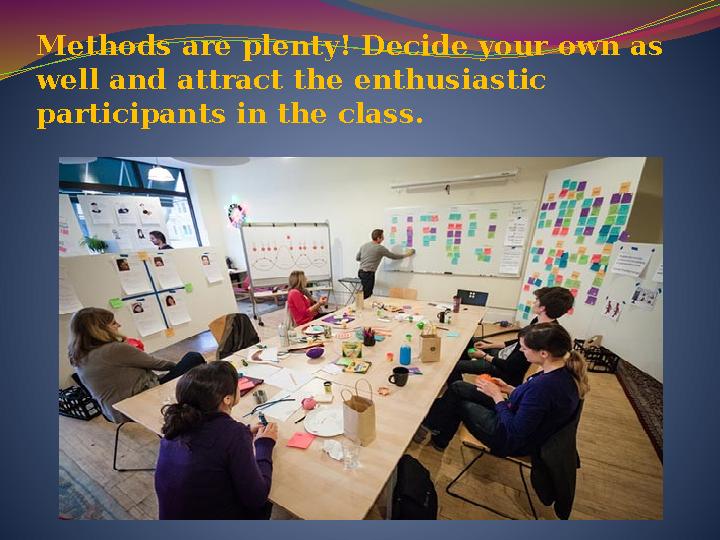
Methods are plenty! Decide your own as
well and attract the enthusiastic
participants in the class.
71 слайд
Methods are plenty! Decide your own as well and attract the enthusiastic participants in the class.

#72 слайд
Thank you for your
attention!
72 слайд
Thank you for your attention!


 Жүктеу
шағым қалдыра аласыз

 Бұл курс Қазақстан Республикасы Оқу-ағарту министрлігімен келісілген










