
 ЖИ көмекші





Презентация The future of transport.


 Жүктеу
#1 слайд
Hello My
Dear
students
1 слайд
Hello My Dear students

#2 слайд
Plickers
https:// www.plickers.com/
2 слайд
Plickers https:// www.plickers.com/
#3 слайд
The future of
transport
3 слайд
The future of transport
#4 слайд
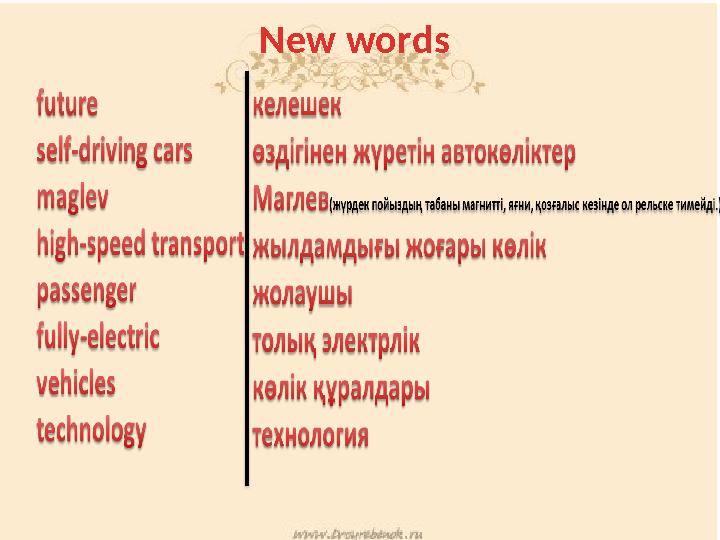
New words
4 слайд
New words
#5 слайд
There is no doubt, that transport plays a significant role in our everyday life.
Self-driving cars are expected to be on the roads more quickly than was
anticipated just a few years ago, and in greater numbers.
However, looking to 2025 and beyond, driverless cars will become increasingly
integrated in a system that might have a passenger using her smartphone to hail an
autonomous, fully-electric taxi that communicates with other vehicles to ensure
safety and with infrastructure managers in order to manage traffic flows.
Magnetic levitation, or maglev, technology has been around for decades,
but is in commercial use in only a few locations.
The technology, powering trains, is mainly a curiosity or tourist attraction, as is the
case with the Shanghai Maglev which began operations in 2004 and connects
Shanghai Pudong International Airport with a station on the outskirts of the city
proper. The first line of substantial length, the Chuo Shinkansen, is planned to come
into service in the mid-2020s and will cut the travel time between Tokyo and
Nagoya, 350km apart, by half to just 40 minutes. At least ten other countries are
now considering the development of maglev lines of their own over the next 20
years, including the UK, Germany, the US, China, India, and Malaysia.
The future of high-speed transport may not be so far off but its arrival may
be delayed because of economic constraints, much to the frustration of
entrepreneurs and the rest of us.
5 слайд
There is no doubt, that transport plays a significant role in our everyday life. Self-driving cars are expected to be on the roads more quickly than was anticipated just a few years ago, and in greater numbers. However, looking to 2025 and beyond, driverless cars will become increasingly integrated in a system that might have a passenger using her smartphone to hail an autonomous, fully-electric taxi that communicates with other vehicles to ensure safety and with infrastructure managers in order to manage traffic flows. Magnetic levitation, or maglev, technology has been around for decades, but is in commercial use in only a few locations. The technology, powering trains, is mainly a curiosity or tourist attraction, as is the case with the Shanghai Maglev which began operations in 2004 and connects Shanghai Pudong International Airport with a station on the outskirts of the city proper. The first line of substantial length, the Chuo Shinkansen, is planned to come into service in the mid-2020s and will cut the travel time between Tokyo and Nagoya, 350km apart, by half to just 40 minutes. At least ten other countries are now considering the development of maglev lines of their own over the next 20 years, including the UK, Germany, the US, China, India, and Malaysia. The future of high-speed transport may not be so far off but its arrival may be delayed because of economic constraints, much to the frustration of entrepreneurs and the rest of us.
#6 слайд
What will future transportation be like?
Make a poster
https://youtu.be/d68yRIE9OvQ
6 слайд
What will future transportation be like? Make a poster https://youtu.be/d68yRIE9OvQ

#7 слайд
In what ways were filmmakers
right in their prediction?
How were they wrong?
How have things changed?
7 слайд
In what ways were filmmakers right in their prediction? How were they wrong? How have things changed?

#8 слайд
Home task. WB p.56 Ex.2,3
8 слайд
Home task. WB p.56 Ex.2,3

#9 слайд
9 слайд


 Жүктеу
шағым қалдыра аласыз

 Бұл курс Қазақстан Республикасы Оқу-ағарту министрлігімен келісілген










