ЖИ көмекші


 Қауіпсіз төлем

жүктеу мүмкіндігіне ие боласыз
Бұл материал сайт қолданушысы жариялаған. Материалдың ішінде жазылған барлық ақпаратқа жауапкершілікті жариялаған қолданушы жауап береді. Ұстаз тілегі тек ақпаратты таратуға қолдау көрсетеді. Егер материал сіздің авторлық құқығыңызды бұзған болса немесе басқа да себептермен сайттан өшіру керек деп ойласаңыз осында жазыңыз
 28 Мамыр 2026
 90
90
1 жыл бойы шексіз жүктеңіз
8 сынып ҚМЖ 1 тоқсан
Бұйрық No194 (30.07.2024) – «Біртұтас тәрбие» бағдарламасы.
Бұйрық No123 (26.05.2025) – «Адал азамат» жобасы арқылы адалдық пен әділдікке тәрбиелеу.
Short term plan
Unit 1: Our world |
lesson 1 |
||
Name of school: |
|
||
Teacher name: |
|
||
Date: |
|
||
Grade: 8 |
Number present: |
absent: |
|
Lesson title |
Everyday objects |
||
Learning objectives |
8. 2. 1. 1 understanding of general and main ideas of study topics with long conversations without practical support; 8. 3. 1. 1 the use of formal and informal registers when talking within general and educational topics; |
||
Lesson objectives (assessment criteria) |
Learners will be able to: - Learn vocabulary of household goods. - Learn how to say numbers. - Do a quiz about human consumers. |
||
Instilling values of the program “Birtutas tarbiye” |
Honesty and fairness Unity and solidarity Diligence and professional competence – respect Justice and Responsibility Independence and Patriotism Perseverance and hard work |
||
Stages/ Time |
Teachers actions |
Students actions |
Assessment |
Resources |
Beginning 5 min |
Greeting. T tells the class to make groups of 2. Warm up: - Show pictures of items (water bottles, smartphones, paper stacks, shopping bags). - Ask: Do you use these things a lot or a little? (brief pair discussion). Presentation -On the board, draw two columns: Countable / Uncountable nouns. -Elicit examples from students and add your own. -Teach/review quantity expressions: much, many, a few, a little, a lot of, not much, not many. -Model pronunciation and sentence examples. |
Learners read the given sentences on the board and guess the topic and share with their ideas.
|
Teacher controles the process, gives feedback and asks additional questions if it’s nessasery. Teacher evaluate pupils with phrases like: “Good job! Well done!”
|
|
Middle 10 min |
Ex: 1 P:8 Task Setup -Give students the matching task: match words with corresponding photos. -In a weaker class, encourage students to work in pairs for support. Answer Checking -Check answers together as a class. -Ask volunteers to share their matches and explain their choices. Pronunciation Drilling -Identify any new or challenging words from the matched set. -Model correct pronunciation clearly for the whole class. -Drill pronunciation chorally (all together) and individually. Differentiation: - Allow students to work in pairs to encourage peer support during the matching activity. Values of the program “Birtutas tarbiye”
– Law
& Order: |
Students match the words in the boxes with photos. Then listen and check your answers. ANSWERS : 1 a can of fizzy drink 2 a bottle of shampoo 3 a roll of toilet paper 4 a box of washing powder 5 a packet of crisps 6 a bag of apples 7 a bar of chocolate 8 a jar of coffee 9 a tube of toothpaste 10 a carton of juice Descriptor: - match words to corresponding photos - checks answers with the class and models correct pronunciation |
Excellent (2) - Accuracy of matching words to the correct photos. Good (1) - Observe students’ matches during pair work and class checking.
|
Student’s book |
7 min |
Ex: 2 P:8 Whole-Class Discussion -Ask students to share their ideas about containers and contents. -Write their examples on the board as they contribute. Pair Work -Organize students to work in pairs. -Ask pairs to think of more examples of containers and what they might contain. Sharing and Expanding -After pairs have discussed, invite some pairs to share their new examples with the class. -Encourage students to explain why a container is suitable for the content.
Differentiation: - Allow students to prepare their ideas in pairs or small groups before sharing with the class.
Values of the program “Birtutas tarbiye” – Diligence & Professional Competence: Thinking carefully about the most suitable container for an item mirrors problem-solving and attention to detail in real-life tasks. |
Learners work in pairs. Think of more containers and contents. ANSWERS: Students of answer Descriptor: - work in pairs - discuss about of more containers and contents.
|
Excellent (3) - Quality of pair interaction, sharing ideas, and explaining reasons. Good (2) - Listen to pairs during discussion and observe interactions.
|
Worksheets Stickers |
8 min |
Ex: 3 P:9 Introduce Key Phrases -Read through the key phrases aloud with the class. -Ensure students understand each phrase. Guided Practice (Weaker Class) -Do the first item together on the board as an example. -Then let students work in pairs to complete the rest of the activity. Class Participation (Stronger Class) -Invite volunteers to write their answers (numbers) on the board. -Encourage the rest of the class to listen carefully and correct any mistakes collaboratively.
Differentiation: - Allow students to work in pairs to complete the rest of the activity, providing peer support.
Values of the program “Birtutas tarbiye” – Independence & Patriotism: Encouraging students to produce their own examples helps them express themselves confidently, fostering independent thinking. |
Learners study the key phrases and write the numbers. Listen and say the numbers. ANSWERS Descriptor: - practice key phrases with numbers by listening - repeat and complete a quiz activity
|
Excellent (2) - Correctly matches numbers to key phrases during activity. Good (1) - Ability to pronounce key phrases and numbers clearly during repetition.
|
|
10 min |
Ex: 4 P:9 Pair Comparison -Ask students to compare their answers with their partner. -If their answers differ, encourage them to explain their reasons without judging who is correct. First Listening for Check -Play the CD/audio once. -Students listen carefully to see if their answers are confirmed or challenged. Second Listening for Confirmation -Play the recording a second time to allow students to check answers more confidently. Class Discussion (Optional) -After listening, invite pairs to share insights or tricky parts of the task without focusing on “right” or “wrong” answers.
Differentiation: - Provide a table of quantity words with example sentences; allow more time for speaking tasks.
Values of the program “Birtutas tarbiye” – Law & Order: Respectful turn-taking and non-judgmental discussion promote a disciplined, supportive learning environment. |
Learners compare your answers to the quiz with a partner. Then listen and check. ANSWERS 1 628; 1,700 2 4.8; 9.8 3 198; 656 4 4.5, 21; 1,201 5 10,354; 854 6 120,000; 8 7 24,000; 720,000 8 276; 4,239 9 74,802; 49,717; 38,320 Descriptor: - compare answers with a partner and discussing their reasoning - confirm or revise their answers through focused listening |
Excellent (3) - Accuracy in confirming or revising answers after listening. Good (2) - Monitor changes in answers after the first and second listening.
9-10 points – “5” 7-8 points – “4” 5-6 points – “3”
|
|
End 5 min |
REFLECTION. “3-3-1” 3 sentences to reflect on the lesson 3 adjectives to describe the lesson 1 word about the lesson Saying goodbye |
Ss show their knowledge according to the lesson Ss evaluate each other and encourage classmate with phrases like: Well done! Brilliant! Good job! I like it! |
Poster |
|
Бұйрық No194 (30.07.2024) – «Біртұтас тәрбие» бағдарламасы.
Бұйрық No123 (26.05.2025) – «Адал азамат» жобасы арқылы адалдық пен әділдікке тәрбиелеу.
Short term plan
Unit 1: Our world |
lesson 2 |
||
Name of school |
|
||
Teacher name: |
|
||
Date: |
|
||
Grade: 8 |
Number present: |
absent: |
|
Lesson title |
Much, many, a lot of, some, any |
||
Learning objectives |
8.5.2.1 write with minimal support about real and imaginary past events, activities and experiences on a range of familiar general topics and some curricular topics; 8.6.2.1 use a growing variety of quantifiers for countable and uncountable nouns including several, plenty, a large/small number/amount on a range of familiar general and curricular topics |
||
Lesson objectives (assessment criteria) |
Learners will be able to: - Do a quiz about human consumers. - Learn expressions of quantity and practise using them. |
||
Instilling values of the program “Birtutas tarbiye” |
Honesty and fairness Unity and solidarity Diligence and professional competence – respect Justice and Responsibility Independence and Patriotism Perseverance and hard work |
||
Stages/ Time |
Teachers actions |
Students actions |
Assessment |
Resources |
Beginning 5 min |
Greeting. T tells the class to make groups of 2. Warm up: With books closed, write the words carbon footprint on the board and ask students what they understand by it. Ask if students think they have a big or small carbon footprint and why. Ask what makes a person’s carbon footprint bigger, and elicit some ideas such as travelling by car, using energy in the home and buying lots of goods T: What do you think about today’s theme? Setting the aim of the lesson. |
Learners read the given sentences on the board and guess the topic and share with their ideas.
|
Teacher controles the process, gives feedback and asks additional questions if it’s nessasery.
Teacher evaluate pupils with phrases like: “Good job! Well done!”
|
|
Middle 13 min |
Ex: 5 P: 9 Introduction of Key Terms -Explain the terms countable and uncountable clearly. In a weaker class: -Give simple examples aloud: “Apples — can you count them?” (Yes) “Water — can you count it?” (No) -In a stronger class: Ask students to give their own examples of countable and uncountable nouns. Pair Work: Classification Task -Organize students into pairs. -Give them a list of blue phrases (nouns/phrases) from the sentences. -Ask pairs to decide if each noun is countable or uncountable. -Students complete a two-column table: Left column: Countable nouns Right column: Uncountable nouns Class Review -Check answers together as a class. -Discuss any tricky examples or common mistakes.
Differentiation: - Model the first example as a class and ask guided questions: Can you count it? Is there an “s” at the end?
Values of the program “Birtutas tarbiye” – Diligence & Professional Competence: Careful sorting of words trains attention to detail and accuracy, key skills for academic and professional success.
|
Learners read the sentences. Complete the table with the words in blue. ANSWERS : 1 uncountable 2 countable 3 countable 4 uncountable 5 uncountable 6 uncountable, countable, uncountable 7countable, uncountable 8countable, uncountable Uncountable nouns: 2 much 3 a lot of 4 some Countable nouns: 1 not many 5 not any Descriptor: - identify and classify nouns as countable or uncountable - apply their understanding by analyzing sentences and organizing example phrases
|
Excellent (4) - Correct placement of nouns in countable or uncountable columns. Good (3) - Observe student responses during examples and pair work.
|
Student’s book |
10 min |
Ex: 6 P: 9 Task Explanation -Explain to students that they will choose the correct word to complete each sentence or question individually. -Emphasize accuracy and understanding of meaning. Individual Work -Students work quietly on selecting the correct words. -Monitor and support as needed. Answer Checking -Check answers together as a class. -Clarify any misunderstandings or tricky vocabulary.
Differentiation: - Pre-teach or review key vocabulary or grammar before starting the activity. Values of the program “Birtutas tarbiye” – Independence and Patriotism: Developing confidence to make individual choices without copying fosters self-reliance, which supports active and responsible citizenship. |
Students choose the correct words ANSWERS : 1 much 2 many 3 some 4 much 5 any 6 any Descriptor: - demonstrate their understanding of vocabulary or grammar by selecting the correct words
|
Excellent (3) - Correct selection of words to complete sentences/questions. Good (2) - Monitor individual work; review answers during class check.
|
Worksheets
|
12 min |
Ex: 7 P: 9 Task Introduction -Read through the task instructions aloud with the class. -Confirm students understand what they need to do. Recap Key Phrases -Review the phrases from exercise 5. -Remind students to refer to the completed phrases in their notebooks for help. Modeling the Activity -Go through example questions together. -Select one or two confident students to answer the first few questions aloud. -Demonstrate a short Q&A to show the expected format and flow. Pair Work -Students work in pairs to ask and answer the questions. -Circulate, monitor, and provide support as needed. Class Reporting -Ask several students to report back to the class what they learned about their partner. -Encourage complete sentences and use of key phrases.
Differentiation: - Model the first 1–2 questions with confident students before pair work begins.
Values of the program “Birtutas tarbiye” – Diligence and professional competence: Careful use of key phrases shows precision and attention to detail, skills important for future professional success. |
Learners work in pairs. Ask and answer with your own ideas. Use the phrases in the table in ex.5 and numbers. ANSWERS: 1 Do you eat much pasta each week? How much? 2 Do you walk many kilometres every month? How many? 3 Are there many books in the school library? How many? 4 Do you use a lot of toothpaste each year? How much? 5 Do you drink much milk every week? How much? 6 Do you say many words Descriptor: - practice speaking and listening skills by asking and answering - use target phrases from a previous exercise
|
Excellent (3) - Students grasp what is required in asking and answering questions. Good (2) - Monitor during modeling and pair work.
9-10 points – “5” 7-8 points – “4” 5-6 points – “3”
|
Pictures
|
End 5 min |
REFLECTION. “3-3-1” 3 sentences to reflect on the lesson 3 adjectives to describe the lesson 1 word about the lesson Saying goodbye |
Ss use their stickers to show their knowledge according to the lesson
|
Poster |
|
Бұйрық No194 (30.07.2024) – «Біртұтас тәрбие» бағдарламасы.
Бұйрық No123 (26.05.2025) – «Адал азамат» жобасы арқылы адалдық пен әділдікке тәрбиелеу.
Short term plan
Unit 1: Our world |
Lesson 3 |
||
Name of school |
|
||
Teacher name: |
|
||
Date: |
|
||
Grade: 8 |
Number present: |
absent: |
|
Lesson title |
The "no impact" family |
||
Learning objectives |
8. 4. 4. 1 read long texts in various fiction and non-fiction literature within the framework of familiar and some unfamiliar general and educational topics; 8.5.3.1 write with moderate grammatical accuracy on a growing range of familiar general and curricular topics; |
||
Lesson objectives (assessment criteria) |
Learners will be able to: - Learn how to predict before you read. - Read about a family that wants to reduce its impact on the environment. - Learn about compound nouns |
||
Instilling values of the program “Birtutas tarbiye” |
Honesty and fairness Unity and solidarity Diligence and professional competence – respect Justice and Responsibility Independence and Patriotism Perseverance and hard work |
||
Stages/ Time |
Teachers actions |
Students actions |
Assessment |
Resources |
Beginning 5 min |
Greeting. T tells the class to make groups of 2. Warm up: - Show a few pictures of different lifestyles (city life, countryside, digital nomad, off-grid living). -Ask: "What do you think these people’s lives are like?" / "Which lifestyle is most different from yours?" Purpose: Activate prior knowledge and interest in the topic. Pre-reading Vocabulary Preparation: -Teach 6–8 key words from the text (e.g., self-sufficient, sustainable, nomadic, minimalism, renewable energy). -Use pictures, synonyms, and short example sentences. -Quick "guess the meaning" or "match the word to the picture" game. |
Learners read the given sentences on the board and guess the topic and share with their ideas. Remember and recognize the main vocabulary. |
Teacher evaluate pupils with phrases like: “Good job! Well done!” Formative Assessment
|
Printed text about an alternative lifestyle (e.g., minimalism, van life, eco-village living), projector or board, vocabulary flashcards, worksheets.
|
Middle 8 min |
Ex: 1 P: 10 Lead-in -Ask students to look at the pictures and title of the text. -Elicit quick ideas about what the text might be about (no right or wrong answers at this stage). -Explain: "Guessing before reading helps you understand better." True/False Prediction -Give students the list of sentences. -Ask them to decide individually which they think are true or false based on their prediction. -Students compare their answers in pairs, explaining their reasons. Skim Reading -Tell students to read the text quickly to check their predictions. -Emphasize: "Do not focus on the gaps or unknown words now. Just check your ideas." -Remind them they are reading for general meaning, not details.
Differentiation: - Provide sentence frames for pair discussion (e.g., I think this is true because…)
Values of the program “Birtutas tarbiye” – Diligence and professional competence: Practising skimming and predicting builds efficiency in processing information—an important academic and workplace skill. |
Learners look at the photos and the title of the text. Predict which of the sentences are true or false. Then read the text and check your answers. ANSWERS : 1 True. 2 False. 3 True. 4 True. 5 False. 6 True. Descriptor: - Uses pictures and title to make a logical guess about the text’s topic. - read the text for general understanding to confirm or revise their ideas.
|
Excellent (3) - Prediction is accurate, relevant, and clearly linked to clues. Good (2) - Prediction is partly relevant or only loosely linked to clues.
|
Student’s book |
7 min |
Ex: 2 P: 10 Focus on the Task -Draw students’ attention to the sentences/options provided. -Explain: "These sentences complete the gaps in the text." Careful Reading -Instruct students to read each paragraph carefully. When they reach a gap: Pause and think about what information is missing. -Read through all the given options. -Choose the one that is correct and fits the meaning of the paragraph. Individual Work -Students complete the task on their own first. -Remind them to use meaning and grammar clues to decide. Pair Check -Students compare answers in pairs, explaining why they chose each option.
Differentiation: - Allow students to work in pairs after attempting one or two gaps individually.
Values of the program “Birtutas tarbiye” – Diligence and professional competence: Students practise analytical reading skills, choosing answers that fit in context both logically and grammatically. |
Learners complete the text with sentences. There is one sentence that you don’t need. Then listen and check your answer. ANSWERS: 1 b 2 e 3 c 4 a Descriptor: - complete gaps in a text - choose the most relevant and coherent fit.
|
Excellent (2) - Fully understands and follows instructions accurately. Good (1) - Understands the task but occasionally misapplies it. |
Worksheets
|
10 min |
Ex: 3 P: 10 Introduction -Read through the information and examples about compound nouns with the class. -Check understanding by asking: "What is a compound noun? Can you give me one example?" Text Search -Tell students: "Read the text silently and look for compound nouns." -When a student finds one, they should raise their hand. -Write each correct example on the board as they say it. Target Number -Stop after four examples (or continue if you want more practice). -Briefly discuss why each is a compound noun. Extension for Stronger Classes -Ask: "Can you think of any more compound nouns, not in the text?" -Encourage students to create examples from everyday life, their school, or the topic of the lesson.
Differentiation: - Read through the information and examples together, clarifying the meaning of “compound noun” with simple definitions and visuals if needed (e.g., toothbrush = tooth + brush).
Values of the program “Birtutas tarbiye” – Independence & Patriotism: Creating original examples encourages independent thinking and expression, important for active and confident citizens. |
Learners read the information and complete the examples. Then find four more compound nouns in the text. ANSWERS : 1 shopping 2 bed 3 washes More compound nouns in the text: toilet paper, dishwasher, light bulb, bathroom, shampoo bottles, toothpaste, second hand things, plastic bags, takeaway food, plastic cup, plastic pots, lifestyle Descriptor: - identify compound nouns in a text - form new meanings and build awareness of word formation patterns.
|
Excellent (3) - Clearly defines and provides a correct example. Good (2) - Gives partial definition or example with small error. |
Pictures
Worksheet |
10 min |
Ex: 4 P: 10 Task Introduction -Tell students: "We are going to practise some more compound nouns." -Explain that they will complete sentences using the correct compound noun. Demonstration -For a weaker class, do the first sentence together on the board. -Highlight how the two words combine to make one idea. Individual Work -Students complete the rest of the sentences individually. -Remind them to check spelling and that the compound noun makes sense in context.
Differentiation: - Allow students to complete the task individually with the option to ask for help, then compare answers in pairs for support.
Values of the program “Birtutas tarbiye” – Law & Order: Raising hands and waiting their turn to share models respectful and orderly classroom behavior. |
Learners complete the sentences with the words in the box. ANSWERS : 1 strawberry 4 washing 2 Christmas 5 kitchen 3 shopping 6 chicken Descriptor: - reinforce their understanding of compound nouns by completing sentences
|
Excellent (2) - Fully understands and applies instructions correctly. Good (1) - Understands partially but makes some task-related errors.
9-10 points – “5” 7-8 points – “4” 5-6 points – “3”
|
Pictures |
End 5 min |
Reflection - Students write one sentence starting with "Today I learned that..." - Quick class feedback: thumbs up/middle/down on how interesting they found the topic. Saying goodbye |
Ss use their stickers to show their knowledge according to the lesson
|
Poster |
|

Бұйрық No194 (30.07.2024) – «Біртұтас тәрбие» бағдарламасы.
Бұйрық No123 (26.05.2025) – «Адал азамат» жобасы арқылы адалдық пен әділдікке тәрбиелеу.
Short term plan
Unit 1: Our world |
lesson 4 |
||
Name of school |
|
||
Teacher name:
|
|
||
Date:
|
Teacher name: S. Murataliyeva
|
||
Grade: 8 |
Number present: |
absent: |
|
Lesson title |
Language Focus. Relative pronouns |
||
Learning objectives |
8. 5. 3. 1 write a variety of familiar general and academic topics with uniform grammatical competence; 8.6.17.1 use if / unless/ if only in second conditional clauses and wish [that] clauses [present reference] use a growing variety of relative clauses including why clauses on a range of familiar general and curricular topics |
||
Lesson objectives (assessment criteria) |
Learners will be able to: -Learn about relative pronouns. -Practise using relative pronouns. |
||
Instilling values of the program “Birtutas tarbiye” |
Honesty and fairness Unity and solidarity Diligence and professional competence – respect Justice and Responsibility Independence and Patriotism Perseverance and hard work |
||
Stages/ Time |
Teachers actions |
Students actions |
Assessment |
Resources |
Beginning 5 min |
Greeting. T tells the class to make groups of 2. Warm up: - Show 4 pictures: a famous person, a well-known place, a common object, and a situation that shows a reason (e.g., a rainy day = reason for using an umbrella). - Ask: Who is this? Where is this? What is this? Why is this happening? - Write students’ answers on the board. Presentation -Write these sentences on the board: She’s the woman who lives next door. That’s the place where I was born. Do you know the reason why he’s late? This is the book which/that I told you about. Underline the relative pronouns and explain their use: who → people where → places why → reasons which/that → things |
Learners read the given sentences on the board and guess the topic and share with their ideas. Remember and recognize the main vocabulary. |
Teacher evaluate pupils with phrases like: “Good job! Well done!” Formative Assessment
|
Board, markers, projector or flashcards, worksheet with gap-fill & matching activities, pictures of famous people/places/objects.
|
Middle 7 min |
Ex: 1 P: 11 Pair Work -Tell students: "Work in pairs to complete the sentences and the rules." -Remind them to look back at the text or examples if they’re unsure. Class Check -Check answers together as a class. Invite pairs to share their answers aloud. -Confirm correct responses and write them clearly on the board. Board Completion -If the examples/rules on the board are still gapped, ask students to complete them aloud. -Elicit answers from different students so several voices are heard. Quick Recap -Read the completed rules together as a class. -Highlight any important points or common mistakes.
Differentiation: - Allow pairs to discuss and complete the remaining sentences and rules with teacher support if needed.
Values of the program “Birtutas tarbiye” – Independence and Patriotism: Encouraging students to express their own ideas supports confidence and active participation in community learning. |
Learners complete the sentences from the text. Then complete the rules with places, people, reasons and things ANSWERS : 1 who 2 where 3 which Rules ANSWERS 1 people 2 places 3 things Descriptor: - develop their grammar awareness by completing example sentences - promotes collaborative learning and inductive grammar thinking
|
Excellent (2) - Fully understands and applies the task accurately. Good (1) - Mostly understands but makes occasional errors in approach.
|
Student’s book |
8 min |
Ex: 2 P: 11 Title Discussion -Read the title of the text with the class. -Weaker class: Translate the title into L1 and briefly explain. Discuss students’ opinions about buying locally in their L1 if needed for clarity. -Stronger class: Elicit an explanation of the title in English. Ask: "Is buying locally something you think about when shopping?" Encourage short opinions. Text Completion -Students read the text and complete it with the correct relative pronouns (e.g., who, which, that, whose, where). -Remind them to read the whole sentence for meaning before choosing. Pair Check -Students compare their answers with a partner. -Encourage them to explain why they chose each pronoun. Class Feedback -Check answers together as a class. -Clarify any tricky sentences by highlighting the grammatical clue that leads to the correct pronoun.
Differentiation: - Read the title aloud and provide a translation in L1 if needed to ensure understanding.
Values of the program “Birtutas tarbiye” – Law & Order: Respectful pair work and class feedback sessions promote a disciplined and cooperative learning environment. |
Learners complete the text with who, why, where and which ANSWERS : 1 which 2 where 3 which 4 where 5 which 6 who Descriptor: - develop reading comprehension and grammar skills by engaging with a text - complete it using correct relative pronouns
|
Excellent (2) - Consistently chooses correct pronouns without prompting. Good (1) - Chooses mostly correct pronouns but sometimes confuses usage.
|
Worksheets
|
10 min |
Ex: 3 P: 11 Individual Writing -Ask students to write their sentences individually based on the given prompt, rule, or example. -Remind them to check spelling, grammar, and punctuation as they write. Pair Comparison -Students exchange their sentences with a partner. -Encourage them to look for and correct any mistakes (grammar, vocabulary, or word order) in their partner’s work. Class Sharing -Invite a few students to read out one or two of their sentences to the class. -As they read, note any errors on the board (without naming the student). -Correct the sentences together as a class.
Differentiation: -Provide sentence starters or model examples to guide their writing.
Values of the program “Birtutas tarbiye” – Independence and Patriotism: Individual writing builds confidence in expressing personal ideas, important for active citizenship and self-expression. |
Students complete the sentences with your own ideas. Use who, where or which. Compare with a partner. ANSWERS: 1 where … 2 which … 3 who … 4 which … 5 who … 6 which Descriptor: - develop their editing and speaking skills through peer comparison and error correction - use who, where or which
|
Excellent (2) - All or almost all sentences are correct with no major errors. Good (1) - Most sentences are correct, with occasional errors that don’t affect meaning.
|
Pictures
Worksheet |
10 min |
Ex: 4 P: 11 Task Introduction -Read through the task instructions with the class. -Ask two students to read out the example sentence aloud. -Check understanding by asking: "How do we use this table? What information do we need?" Modelling -Ask a confident student to think of another sentence, or provide one yourself. -Invite another student to guess the person, place, or thing. -If the guess is wrong, encourage more students to try until someone gets it right. Activity Stage -Students continue the activity in pairs or small groups. -Allow them time to write their sentences before playing, if needed. -Walk around, helping with vocabulary or sentence structure. Support for Weaker Classes -Before guessing starts, check students’ sentences for accuracy. -Correct errors so the activity runs smoothly without confusion. Challenge for Stronger Classes -Skip the long planning stage and encourage spontaneous sentence creation. -Keep the pace quick to maintain energy.
Differentiation: - Provide sentence frames (e.g., It’s a person who… / It’s a place where…) and monitor sentence accuracy during writing.
Values of the program “Birtutas tarbiye” – Diligence and professional competence: Accuracy checks and thoughtful sentence building develop language skills and careful work habits. |
Learners write six sentences with who, where, why and which. ANSWERS: Students own answer Descriptor: - use descriptive sentences to give clues about a person, place, or thing - develops speaking, listening, and deductive reasoning skills
|
Excellent (2) - Fully participates, both giving and guessing sentences. Good (1) - Participates in one stage more than the other.
9-10 points – “5” 7-8 points – “4” 5-6 points – “3”
|
|
End 5 min |
Reflection - Ask 2–3 students to share their favorite sentence from the speaking activity. - Students write one example for each relative pronoun in their notebook. Saying goodbye |
Ss use their stickers to show their knowledge according to the lesson
|
Poster |
|
Бұйрық No194 (30.07.2024) – «Біртұтас тәрбие» бағдарламасы.
Бұйрық No123 (26.05.2025) – «Адал азамат» жобасы арқылы адалдық пен әділдікке тәрбиелеу.
Short term plan
Unit 1: Our world |
lesson 5 |
||
Name of school |
|
||
Teacher name: |
|
||
Date: |
|
||
Grade: 8 |
Number present: |
absent: |
|
Lesson title |
Pollution and the environment |
||
Learning objectives |
8. 2. 3. 1 understand most of the argument without practical support in a long conversation on general and academic topics; 8.3.7.1 use appropriate subject-specific vocabulary and syntax to talk about a range of general topics, and some curricular topics |
||
Lesson objectives (assessment criteria) |
Learners will be able to: - Learn vocabulary relating to the environment. - Listen to an account of someone who decided to make a difference to the environment. - Listen for general meaning and specific details. |
||
Instilling values of the program “Birtutas tarbiye” |
Honesty and fairness Unity and solidarity Diligence and professional competence – respect Justice and Responsibility Independence and Patriotism Perseverance and hard work |
||
Stages/ Time |
Teachers actions |
Students actions |
Assessment |
Resources |
Beginning 5 min |
Greeting. T tells the class to make groups of 2. Warm up: - Show 3–4 pictures related to different environmental problems. - Ask: "What problems can you see?" / "Which do you think is the most serious?" - Elicit a few ideas and write them on the board. Pre-listening Prediction task: Show the title of the programme and a few key words from the audio. Ask: "What do you think the programme will be about?" Weaker class: Translate or explain difficult words in L1. Stronger class: Ask students to explain the title in English and share quick ideas. |
Learners read the given sentences on the board and guess the topic and share with their ideas. Remember and recognize the main vocabulary. |
Teacher evaluate pupils with phrases like: “Good job! Well done!” Formative Assessment
|
Audio or video clip (3–5 minutes) about an environmental issue (e.g., plastic pollution, deforestation, climate change) Worksheet with before-, while-, and after-listening tasks Pictures or keywords related to the topic Board and markers |
Middle 7 min |
Ex: 1 P: 12 Dictionary Work -Tell students: "Use your dictionaries to check the meaning of these words." -Remind them to look for the meaning that best fits the text’s topic. Word Choice in Text -Students choose the correct words to fill the gaps in the text. -Encourage them to use both meaning and grammar clues. Listening Confirmation -Play the complete text audio. -Students follow along in their books, checking if their chosen words are correct. -Pause briefly if needed to give them time to self-correct. Self-Correction -Encourage students to change any incorrect answers based on the listening. -Emphasize: "It’s fine to make changes — that’s how we improve."
Differentiation: - Allow students to work in pairs for support while choosing the correct words.
Values of the program “Birtutas tarbiye” –Independence and Patriotism: Encouraging self-correction fosters self-reliance and a growth mindset—key traits of responsible citizens. |
Learners check the meaning of the words in blue. Choose the correct words. Then listen and check ANSWERS : 1 throw away 2 reuse 3 recycle 4 destroy 5 burn 6 poisons 7 bury Descriptor: - build vocabulary and reading comprehension skills by using dictionaries - Choose the correct words
|
Excellent (2) - Correctly confirms or changes answers after listening, with minimal errors. Good (1) - Makes some correct adjustments but misses other necessary changes.
|
Student’s book |
10 min |
Ex: 2 P: 12 Individual Preparation -Tell students: "Read through all the questions by yourself first." -Encourage them to think of possible answers in their head. -For weaker classes, quickly check meaning of any tricky words. Pair Work Q&A -Students work in pairs, taking turns asking and answering the questions. -Remind them to give full sentences and explain their answers where possible. -Circulate to monitor, support vocabulary, and note common errors. Class Sharing -Elicit a few answers from different students for variety. -Praise interesting or thoughtful responses. -Briefly correct common mistakes you heard during pair work.
Differentiation: - Provide sentence starters (e.g., I think that… / In my opinion… / I agree because…) to support speaking.
Values of the program “Birtutas tarbiye” – Independence and Patriotism: Encouraging personal ideas and sharing in class builds confidence and active citizenship
|
Learners work in pairs. Ask and answer the question ANSWERS : Students’ own answers Descriptor: - discuss questions in pairs - ask and answer
|
Excellent (3) - Answers are accurate and clear, with minimal errors. Good (2) - Some errors occur but meaning remains clear.
|
Student’s book |
8 min |
Ex: 3 P: 12 Picture Focus -Show students the pictures. -Ask: "Which problem do you think Rebecca Hosking was concerned about?" -Accept all reasonable answers and briefly discuss possible issues. Sentence Preview & Vocabulary Check -Explain: "These sentences summarize different parts of the text, but they are not in the right order." -Students read the sentences silently. -Check and clarify any difficult vocabulary together. Prediction & Sequencing -Encourage students to underline key words in each sentence. -Students work individually (or in pairs for weaker classes) to guess the correct sequence based on meaning and logic. Listening for Confirmation -Students listen to the recording. -While listening, they check if their predicted sequence matches the text. -Encourage them to adjust their answers if needed. Class Feedback -Ask: "Who got the order exactly right?" -Go through the correct sequence as a class, writing it on the board. -Praise correct guesses and discuss why the order makes sense.
Differentiation: - Highlight key words in each sentence and model how to use them to guess the order Values of the program “Birtutas tarbiye” – Unity and Solidarity : Pair work and class discussion promote collaborative learning and respectful sharing of ideas. |
Learners read the information about Rebecca Hosking Order sentences then listen and check. ANSWERS: b, d, a, c Descriptor: - predict the main issue addressed in the text - order and check unfamiliar vocabulary
|
Excellent (2) - Fully understands new words and applies them effectively. Good (1) - Understands most key words but occasionally misinterprets them.
|
Pictures
Worksheet |
10 min |
Ex: 4 P: 12 Question Preview -Allow students time to read through all the statements individually. -Remind them: "In a True/False task, read the statements carefully — sometimes you will hear the opposite in the recording." Vocabulary Focus -Ask students to underline or highlight key words in each statement. -Discuss any unfamiliar vocabulary as a class to ensure everyone understands the meaning before listening. Prediction (Optional for stronger classes) -For stronger groups, ask: "Can you guess if any of these are True or False before listening?" -Encourage them to give a short reason for their guess. Listening -Play the audio again, pausing briefly after each statement if needed. -Students confirm or change their answers. Class Check -Go through each statement as a class. -Ask volunteers to explain why they chose True or False, referring to specific words or phrases they heard.
Differentiation: - Allow extra reading time and highlight key vocabulary in the statements . Values of the program “Birtutas tarbiye” – Diligence and professional competence: Careful listening and analysis improve attention to detail and critical thinking skills |
Learners listen again and write true or false. Correct the false sentences. ANSWERS: 1 False. The speaker is the presenter of SOS Environment. 2 True. 3 False. She was shocked when she saw how many creatures were dying because of all the plastic in the sea. 4 True. 5 False. None of the shops give plastic bags. 6 True. Descriptor: - read the True/False statements carefully before listening - predict answers based on their previous listening
|
Excellent (3) - Provides logical guesses with clear reasoning. Good (2) - Makes guesses but reasoning is weak or incomplete.
9-10 points – “5” 7-8 points – “4” 5-6 points – “3”
|
|
End 5 min |
Reflection - Students write one sentence starting with "I learned that..." or "I think we should..." - Invite a few students to share. Saying goodbye |
Ss use their stickers to show their knowledge according to the lesson
|
Poster |
|
Бұйрық No194 (30.07.2024) – «Біртұтас тәрбие» бағдарламасы.
Бұйрық No123 (26.05.2025) – «Адал азамат» жобасы арқылы адалдық пен әділдікке тәрбиелеу.
Short term plan
Unit 1: Our world |
lesson 6 |
||
Name of school |
|
||
Teacher name: |
|
||
Date: |
|
||
Grade: 8 |
Number present: |
absent: |
|
Lesson title |
Language Focus. Too, too much, too many, enough, not enough |
||
Learning objectives |
8. 2. 3. 1 understand most of the argument without practical support in a long conversation on general and academic topics; 8. 3. 7. 1 use subject-specific vocabulary and syntax within the framework of general and a number of educational topics |
||
Lesson objectives (assessment criteria) |
Learners will be able to: - Learn too, too much, too many, enough and not enough. - Practise using too, too much, too many, enough and not enough. |
||
Instilling values of the program “Birtutas tarbiye” |
Honesty and fairness Unity and solidarity Diligence and professional competence – respect Justice and Responsibility Independence and Patriotism Perseverance and hard work |
||
Stages/ Time |
Teachers actions |
Students actions |
Assessment |
Resources |
Beginning 5 min |
Greeting. T tells the class to make groups of 2. Warm up: - Show pictures of various meals or snacks. - Ask simple questions: “What do you like to eat?” “What do you usually have for breakfast/lunch/dinner?” - Write key vocabulary on the board as students answer. Vocabulary Presentation -Introduce vocabulary related to eating habits (e.g., vegetables, junk food, healthy, snack, breakfast, dinner, often, rarely). -Use pictures and example sentences. Drill pronunciation. Quick matching activity: match words to pictures. |
Learners read the given sentences on the board and guess the topic and share with their ideas. Remember and recognize the main vocabulary. |
Teacher evaluate pupils with phrases like: “Good job! Well done!” Formative Assessment
|
Pictures or flashcards showing different foods and eating situations Worksheets with vocabulary and speaking prompts Audio clip or dialogue about eating habits (optional) Board and markers |
Middle 10 min |
Ex: 1 P: 13 Preparation & Focus -Write the example sentences clearly on the board or show them on the screen. -Tell students: “We will look at these examples carefully to find the rules.” Example Study -Read the examples aloud as a class. -Highlight or underline the key parts that show the grammar or vocabulary pattern. -Briefly explain any unknown words. Individual Rule Completion -Ask students to copy the rules into their notebooks. -Leave gaps for them to fill in based on the examples. -Remind them to check the examples if they feel unsure. Pair Comparison -Students compare their completed rules in pairs. -Encourage them to explain why they chose each answer. -Circulate to check for understanding and help with corrections.
Differentiation: - Allow students to refer back to the examples while completing the rules.
Values of the program “Birtutas tarbiye” – Independence and Patriotism: Encouraging students to formulate rules promotes autonomous learning and confidence, vital for active citizenship. |
Learners study these sentences from the listening. Then complete the rules with adjectives, countable nouns and uncountable nouns ANSWERS: 1uncountable nouns 2 countable nouns 3 adjective Descriptor: - copy and complete grammar rules to reinforce understanding - discuss and compare their ideas
|
Excellent (3) - Fills all gaps correctly without assistance. Good (2) - Fills most gaps correctly, with minor errors.
|
Student’s book |
8 min |
Ex: 2 P: 13 Task Introduction -Tell students: “You will complete the sentences on your own first. Then you’ll check with a partner.” -Remind them to think about grammar, vocabulary, and sentence meaning. Individual Work -Students complete all sentences individually in their notebooks. -Circulate quietly to check progress and give hints without giving full answers. Pair Comparison -Students compare answers in pairs. Encourage them to spot and correct mistakes together. -Remind them to explain why they think a correction is needed. Class Feedback -Check answers together as a class. Invite different pairs to share their answers. -Confirm correct responses and write them on the board. -Correct common mistakes and briefly explain the reason.
Differentiation: - Provide sentence stems, word banks, or examples to guide completion.
Values of the program “Birtutas tarbiye” – Unity and Solidarity: Peer checking fosters respectful communication and mutual support. |
Learners complete the sentences with too, too much or too many. ANSWERS : 1 too 2 too much 3 too many 4 too much 5 too many 6 too 7 too many, too much Descriptor: - complete a set of sentences individually to apply a target language - correct mistakes collaboratively
|
Excellent (3) - Spots and accurately corrects most mistakes. Good (2) - Corrects some mistakes but misses others or makes incorrect corrections.
|
Worksheets
|
7 min |
Ex: 3 P: 13 Introduction & Context -Tell students: “We are going to look at how to use the word ‘enough’ in sentences.” -Write enough on the board and ask: “What does it mean?” Elicit meaning and, if necessary, translate into L1 for weaker classes. Example Analysis -Ask students to read the example sentences in their books or on the board. -Elicit the target word “enough” from the examples. -Highlight the bold words and explain that the part of speech is shown in brackets (e.g., adjective, noun, verb). Demonstration -Show how “enough” is placed before nouns (enough time) and after adjectives/adverbs (warm enough, quickly enough). -Give one extra example for each pattern.
Differentiation: - Provide scaffolding, such as sentence frames or partially completed rules.
Values of the program “Birtutas tarbiye” – Unity and Solidarity: Discussing examples together fosters a respectful learning environment where everyone’s input matters. |
Learners study these sentences from the listening. Then complete the rules with before or after ANSWERS: 1 after 2 after 3 before Descriptor: - identify and elicit the target word - discuss the rules in pairs before checking
|
Excellent (3) - Accurately explains the meaning and usage. Good (2) - Understands basic meaning but with some confusion.
|
Student’s book |
10 min |
Ex: 4 P: 13 Introduction & Task Setup -Tell students: “We are going to put these questions in the correct order before listening to the recording.” -Remind them to read each question carefully and think about the logical sequence. Individual Work – Ordering Questions -Students work individually to put the questions in order. -Circulate to check progress and help where needed. Listening – Answering Questions -Play the CD and ask students to write down the answers while listening. -Encourage them to focus on key words in the questions to catch relevant information. Pair Work – Answer Comparison -Students compare their written answers with a partner. -Tell them to correct or add details if they missed something.
Differentiation: - Provide visual or contextual clues (e.g., photos or short summaries) to help them order the questions.
Values of the program “Birtutas tarbiye” – Diligence and professional competence: Careful ordering and attentive listening develop strong comprehension and analytical skills. |
Learners order the words to make questions. Then listen to a conversation and answer the questions ANSWERS: 1 Is this pizza big enough? Yes, it’s big enough. 2 Are there enough apples? There are too many apples. 3 Have we got enough drinks? No, we haven’t got enough drinks. 4 Is this soup hot enough? No, it’s cold. 5 Have we got enough sandwiches? Yes, we’ve got a lot. 6 Is this coffee strong enough? Yes, the coffee’s really strong Descriptor: - work individually to put a set of questions into a logical - listen to a conversation and answer the questions
|
Excellent (3) - Effectively improves answers after comparison. Good (2) - Makes some corrections but misses others.
9-10 points – “5” 7-8 points – “4” 5-6 points – “3”
|
Student’s book |
End 5 min |
Reflection - Ask a few students to share something interesting they learned about a classmate’s eating habits. - Students write one sentence about their own eating habit (e.g., I usually eat fruit for breakfast.). Saying goodbye |
Ss use their stickers to show their knowledge according to the lesson
|
Poster |
|
Бұйрық No194 (30.07.2024) – «Біртұтас тәрбие» бағдарламасы.
Бұйрық No123 (26.05.2025) – «Адал азамат» жобасы арқылы адалдық пен әділдікке тәрбиелеу.
Short term plan
Unit 1: Our world |
lesson 7 |
||
Name of school |
|
||
Teacher name: |
|
||
Date: |
|
||
Grade: 8 |
Number present: |
absent: |
|
Lesson title |
Offering and asking for help |
||
Learning objectives |
8. 2. 3. 1 understand most of the argument without practical support in a long conversation on general and academic topics; 8. 3. 7. 1 use subject-specific vocabulary and syntax within the framework of general and a number of educational topics |
||
Lesson objectives (assessment criteria) |
Learners will be able to: - Listen to a dialogue in which people offer and ask for help. - Learn key phrases for offering and asking for help. - Practise offering and asking for help. |
||
Instilling values of the program “Birtutas tarbiye” |
Honesty and fairness Unity and solidarity Diligence and professional competence – respect Justice and Responsibility Independence and Patriotism Perseverance and hard work |
||
Stages/ Time |
Teachers actions |
Students actions |
Assessment |
Resources |
Beginning 5 min |
Greeting. T tells the class to make groups of 2. Warm up: - Ask students: “Have you ever needed help? When? How did you ask?” - Write a few student responses on the board. Presentation -Introduce key expressions: -Offering help: “Can I help you?”, “Do you need any help?”, “Let me help you.” -Asking for help: “Can you help me?”, “Could you please help me?”, “I need some help.” -Write examples on the board and model pronunciation. -Drill choral and individual repetition. |
Learners read the given sentences on the board and guess the topic and share with their ideas. Remember and recognize the main vocabulary. |
Teacher evaluate pupils with phrases like: “Good job! Well done!”
Formative Assessment |
Flashcards or slides with common phrases for offering and asking for help Role-play scenario cards Board and markers |
Middle 10 min |
Ex: 1 P: 14 Introduction & Engagement -Show the photo to the class. -Tell students: “We’re going to look carefully at this photo and guess what is happening.” Clue Spotting -Ask students to focus on specific details: What food can you see? Where do you think this is? (e.g., park, beach, garden) What time of day might it be? (based on lighting) Guided Elicitation -Elicit ideas from different students. -Encourage them to explain why they think so, using the clues. Vocabulary Support -If new or difficult words come up (e.g., “picnic,” “barbecue,” “blanket”), write them on the board. -Model and drill pronunciation briefly. Prediction Task -Ask: “What do you think is happening or will happen in this photo?” -Accept multiple possible answers and note them.
Differentiation: - Allow pair or small group discussion before sharing ideas with the class.
Values of the program “Birtutas tarbiye” – Independence and Patriotism: Encouraging students to form and share their own ideas promotes confident, responsible participation in discussions. |
Learners look at the photo. What are Lucy and Adam preparing? ANSWERS : Lucy and Adam are preparing a barbecue. Descriptor: - examine a photo and share their ideas about what is happening or being shown. - answer the question
|
Excellent (3) - Correctly uses new words and pronunciation after modelling. Good (2) - Understands vocabulary but pronunciation or use is inconsistent.
|
Student’s book |
8 min |
Ex: 2 P: 14 Pre-listening Preparation -Read the task aloud with the class. -Clarify instructions: “When you listen the first time, don’t try to understand every word. Your only goal is to find out what Adam needs.” -Check understanding by asking: “Do we need to write full sentences?” (Answer: No, just identify the thing Adam needs.) Vocabulary Preview (Optional for Weaker Classes) -Pre-teach or quickly review 2–3 key words that might help (without giving away the answer). Listening – Main Idea -Play the audio. -Students listen silently and write down what Adam needs. Pair Check -Students compare answers with a partner to confirm or adjust their ideas.
Differentiation: -Pre-teach key vocabulary or provide a word bank to support listening.
Values of the program “Birtutas tarbiye” – Unity and Solidarity: Pair work supports respectful exchange of ideas and collaborative problem-solving. |
Learners listen to the dialogue. What does Adam need? ANSWERS : Adam needs some more drinks, a bag of ice and some bags for the rubbish. Learners answers Descriptor: - listen to an audio recording for the first time - identify what Adam needs
|
Excellent (2) - Accurately identifies the item or need on first listening. Good (1) - Mostly identifies the correct need but with minor confusion.
|
Student’s book |
10 min |
Ex: 3 P: 14 Preparation -Explain to students: “We’re going to practise polite ways of offering to do something or asking someone to help.” -Point out: “If we cover the dialogue, it will help us focus on the form of the key phrases, not just reading the words.” Support for Weaker Classes -If students can’t remember the exact phrase, guide them by asking: “What kind of word is missing here?” (Elicit: “a verb.”) -Give an example of the sentence structure without the verb to prompt recall. First Listening -Play the audio. -Students listen and try to remember/complete the missing words in the phrases. Pair Check -Students compare answers with a partner, discussing any differences. Teacher Feedback -Elicit correct answers and write them clearly on the board. -Model pronunciation and intonation of the polite phrases, asking the class to repeat. Short Practice -Have students practise the phrases in pairs in short mini-dialogues.
Differentiation: - Provide sentence frames with gaps to narrow down the possible answers.
Values of the program “Birtutas tarbiye” – Diligence and professional competence: Practising polite communication builds professionalism and social skills. |
Learners cover the dialogue and complete the key phrases. Listen and check. Then practise the dialogue with a partner. ANSWERS: 1 help you with anything? (offering help) 2 get a few cartons of juice or something? (offering help) 3 get a bag of ice, too. (offering help) 4 get some? (asking for help) 5 see what they’ve got. (offering help) Descriptor: - cover the dialogue to focus on the structure - listen to the audio to check or complete their answers
|
Excellent (3) - Effectively discusses and justifies answers with partner. Good (2) - Participates but discussion lacks depth or confidence.
|
|
8 min |
Ex: 4 P: 14 Introduction -Tell students: “In natural English, words often join together in speech. This is called linking.” -Explain: “When a word ends with a consonant sound and the next word starts with a vowel sound, we link them together smoothly.” Model the Example -Write on the board: A bag of ice Read it out slowly, then naturally: Slow: A / bag / of / ice Natural: A bagovice (show the sound blending). -Emphasize the linking between g and o in bag of. Listening Focus -Play or say the sentence normally. Ask students: “Did you hear a pause between the words?” Highlight that in fluent speech there is no gap. Guided Practice -Give students 3–4 more examples (e.g., cup of tea, piece of apple, end of it). -First, they say each word separately, then practise linking. Pair Practice -Students work in pairs to read short phrases from a list, focusing on linking consonant-to-vowel. -Partners listen for smooth linking and correct each other.
Differentiation: - Provide visual aids (e.g., arrows or color coding) to show how sounds connect.
Values of the program “Birtutas tarbiye” – Unity and Solidarity: Pair work encourages active listening and respectful peer feedback. |
Learners listen and repeat the sentences practise linking the words. ANSWERS: 1 clean it 2 help you 3 come with you 4 be quiet 5 buy some more 6 call him Descriptor: - Read out the first sentence - practise linking the words
|
Excellent (2) - Correctly identifies linked sounds in examples. Good (1) - Sometimes identifies linking but not consistently.
9-10 points – “5” 7-8 points – “4” 5-6 points – “3”
|
|
End 5 min |
Reflection -What has been learned today? -What remained unclear? -What is necessary to work on? Saying goodbye |
Ss use their stickers to show their knowledge according to the lesson
|
Poster |
|
Бұйрық No194 (30.07.2024) – «Біртұтас тәрбие» бағдарламасы.
Бұйрық No123 (26.05.2025) – «Адал азамат» жобасы арқылы адалдық пен әділдікке тәрбиелеу.
Short term plan
Unit 1: Our world |
lesson 8 |
||
Name of school |
|
||
Teacher name: |
|
||
Date: |
|
||
Grade: 8 |
Number present: |
absent: |
|
Lesson title |
An environmental problem |
||
Learning objectives |
8. 4. 1. 1 understand the main idea of texts on a variety of unfamiliar general and academic topics, including some longer texts; 8. 5. 4. 1 using appropriate style and form of language in written genre on general and educational topics; |
||
Lesson objectives (assessment criteria) |
Learners will be able to: - Study an email about an environmental problem. - Learn key phrases for writing about a problem. - Learn about so and because. - Write an email about an environmental problem. |
||
Instilling values of the program “Birtutas tarbiye” |
Honesty and fairness Unity and solidarity Diligence and professional competence – respect Justice and Responsibility Independence and Patriotism Perseverance and hard work |
||
Stages/ Time |
Teachers actions |
Students actions |
Assessment |
Resources |
Beginning 5 min |
Greeting. T tells the class to make groups of 2. Warm up: - Show images of environmental problems. - Ask: “What problems do you see?” - Brief class discussion on causes and effects. Vocabulary Introduction -Introduce key vocabulary: pollution, recycle, climate change, waste, protect, solution, cause, effect, etc. -Use visuals and simple definitions. Drill pronunciation.
|
Learners read the given sentences on the board and guess the topic and share with their ideas.
Remember and recognize the main vocabulary. |
Teacher controles the process, gives feedback and asks additional questions if it’s nessasery.
Teacher evaluate pupils with phrases like: “Good job! Well done!”
Formative Assessment
|
Pictures or short texts about environmental problems (e.g., pollution, deforestation, plastic waste) Vocabulary list related to environment and problem-solving
|
Middle 10 min |
Ex: 1 P: 15 Pre-Reading Discussion -Display the photo for the class. Ask: “What do you think this text might be about?” -Elicit ideas from several students (e.g., pollution, tourism, cleaning beaches). -Discuss these briefly as a class. Title Prediction -Read the title aloud with the class: Dirty Beaches. -Ask: “Does this confirm your ideas or is it different?” Encourage short reactions. Reading the Model Text -Students read the text individually, focusing on understanding the main points. -Clarify any new or difficult vocabulary as needed. Comprehension Questions -Students answer the provided questions about the text. -Remind them to look back at the text for evidence. Pair Check -Students compare their answers with a partner. -Encourage them to correct each other and explain their reasoning.
Differentiation: -Use guided questions during the photo discussion (e.g., What do you see? What might this be about?).
Values of the program “Birtutas tarbiye” – Independence and Patriotism: Engaging with environmental topics like pollution nurtures awareness and care for one’s community and country. |
Learners read the model text and choose the correct answers ANSWERS : 1 b 2 b 3 b 4 c Descriptor: -read the model text and answer comprehension questions individually - choose the correct answers
|
Excellent (2) - Makes relevant and logical predictions about the text. Good (1) - Predictions are somewhat related but may lack depth.
|
Student’s book |
12 min |
Ex: 2 P: 15 Key Phrase Review -Read through the list of key phrases aloud with the class. -Ask students to repeat each phrase after you to check pronunciation. Paragraph Starter Identification -Ask: “Which of these phrases are used in the text to start paragraphs?” Students scan the model text to locate them. -Check answers together and underline or highlight these in the text. Personal Completion Task -Students complete each phrase with their own ideas (e.g., One reason is… pollution from ships). -Encourage variety and originality in their completions. Finding in the Model Text -Ask students to go back to the model text and physically point out or highlight the key phrases where they occur. -Discuss how they help organize the text.
Differentiation: - Read and explain each key phrase with examples from the model text.
Values of the program “Birtutas tarbiye” – Unity and Solidarity: Sharing ideas encourages respectful listening and collaboration. |
Learners study the key phrases. Complete the key phrases with your own ideas ANSWERS : I’m writing because … I think there are possibly (two) reasons for this. We must do something about … Students’ own answers. Descriptor: - read through the key phrases - identify and underline these phrases in the text
|
Excellent (2) - Correctly identifies paragraph starter phrases in the text. Good (1) - Identifies most starters but misses some.
|
Worksheets Student’s book |
13 min |
Ex: 3 P: 15 Reading the Examples -Read the given examples aloud with the class: I’m writing because I was at the beach … There aren’t enough bins … , so I think we need more. Eliciting Continuations -Ask students to look in the text and tell you how each sentence continues. -Write the full sentences on the board as students share them. Explaining the Difference -Point out that: because gives the reason. so gives the result. Transform the second example to use because: We need more bins because there aren’t enough bins. -Compare the two structures side-by-side on the board. Translation Task -Ask students to translate both sentences into their own language. -Check as a class to ensure the meaning of so and because is clear. Matching and Linking -Give students mixed halves of sentences. -Students work individually or in pairs to match and link them correctly using so or because.
Differentiation: - Allow pair work to support sentence linking and translation into their own language.
Values of the program “Birtutas tarbiye” – Diligence & Professional Competence: Learning clear cause-effect language supports logical thinking and competent communication. |
Learners complete the examples from the text. Then match with a-e. Use so or because ANSWERS: 1 d; because 2 a; so 3 e; so 4 c; because 5 b; because Descriptor: - translate the sentences into their own language to deepen understanding - match and correctly link sentence halves using the appropriate connector
|
Excellent (2) - Listens carefully and reads examples clearly aloud. Good (1) - Reads examples but with minor hesitations or errors.
9-10 points – “5” 7-8 points – “4” 5-6 points – “3”
|
|
End 5 min |
Feedback Traffic light. Pupils will take the stickers and put on the suitable colour (traffic lights). Saying goodbye |
Ss use their stickers to show their knowledge according to the lesson
|
Poster |
|
Бұйрық No194 (30.07.2024) – «Біртұтас тәрбие» бағдарламасы.
Бұйрық No123 (26.05.2025) – «Адал азамат» жобасы арқылы адалдық пен әділдікке тәрбиелеу.
Short term plan
Unit 1: Our world |
lesson 9 |
||
Name of school |
|
||
Teacher name: |
|
||
Date: |
|
||
Grade: 8 |
Number present: |
absent: |
|
Lesson title |
My country: Our world |
||
Learning objectives |
8. 4. 2. 1 understand specific information in texts on a variety of familiar general and reading topics, including some longer texts; 8.5.2.1 write with minimal support about real and imaginary past events, activities and experiences on a range of familiar general topics and some curricular topics; |
||
Lesson objectives (assessment criteria) |
Learners will be able to: - Study a text about an environmental problem in Kazakhstan. - Review phrases to talk about quantity with countable and uncountable nouns. - Learn verbs connected with the environment. - Participate in a discussion about local environmental problems. |
||
Instilling values of the program “Birtutas tarbiye” |
Honesty and fairness Unity and solidarity Diligence and professional competence – respect Justice and Responsibility Independence and Patriotism Perseverance and hard work |
||
Stages/ Time |
Teachers actions |
Students actions |
Assessment |
Resources |
Beginning 5 min |
Greeting. T tells the class to make groups of 2. Warm up: Start with a brief discussion: “What environmental problems do we have in our country?” Write students’ ideas on the board. Vocabulary Preview -Introduce and explain key words from the text (e.g., pollution, deforestation, waste, recycling). -Use visuals or examples to clarify meaning. -Drill pronunciation. |
Learners read the given sentences on the board and guess the topic and share with their ideas. Learners discuss about Aral Sea. |
Teacher evaluate pupils with phrases like: “Good job! Well done!” Formative Assessment |
Worksheet with comprehension questions (multiple choice, true/false, or short answers) Board and markers |
Middle 8 min |
Ex: 1 P: 16 Dictionary Work -Ask students to use a bilingual or - English-English dictionary to check the meanings of the words in the box. -Monitor to ensure they are writing accurate, clear meanings. Meaning Check -Go through each word as a class. -Give the meaning in translation (for weaker groups) or as an English definition (for stronger groups). -Ask students for synonyms or similar phrases, e.g.: litter → rubbish, trash irrigate → move water to dry land Prediction Before Reading -Tell students there are 8 verbs in the box but only 6 will be used. -Ask them to think which verbs are most likely to appear in the text, based on its topic. Reading for Completion -Students read the text silently and try to complete the gaps using the correct form of the verbs. -Remind them to think about grammar (tense, subject agreement).
Differentiation: - Pre-teach or highlight key verbs with pictures, realia, or simplified definitions.
Values of the program “Birtutas tarbiye” – Unity and Solidarity: Group discussions on synonyms foster collaborative learning and respect for others’ ideas.
|
Learners check the meaning of these verbs in a dictionary. Complete the text with six of the verbs. Then listen and check your answers ANSWERS : 1 irrigate 2 shrink 3 split 4 restore 5 flow 6 increase Descriptor: - check the meanings of verbs provided in a word box - read the text and complete the gaps with appropriate verbs from the list
|
Excellent (2) - Accurately finds and records clear, appropriate meanings of all words. Good (1) - Finds meanings for most words with minor errors or gaps.
|
Student’s book |
10 min |
Ex: 2 P: 16 Pre-Listening Preparation -Give students the true/false statements before listening. -Ask them to read each one carefully and underline key words. -Remind them that they may hear opposite information in the recording. First Listening -Play the CD once. -Students mark each statement T (True) or F (False). -Stronger class: ask them to correct any False sentences while listening. Second Listening (optional for weaker classes) -Play the CD again for weaker students so they can focus on correcting the False statements. -Allow short pauses if needed for note-taking. Pair Check -Students compare answers with a partner and explain their reasoning.
Differentiation: - Allow pair or group discussion between listening to compare answers and correct false statements.
Values of the program “Birtutas tarbiye” – Diligence & Professional Competence: Encourages careful listening and focused attention to details. |
Learners read and listen to the text. Write true or false. Correct the false sentences ANSWERS : 1 F - It was one of the largest lakes in the world. 2 F – It’s in Kazakhstan. 3 T 4 F – A small number of freshwater fish species have returned. 5 T Descriptor: - listen to an audio recording to complete a True/False task based on specific statements - identify which statements are false
|
Excellent (2) - Correctly marks true/false for all statements on first listening. Good (1) - Marks most statements correctly, with few errors.
|
Worksheets Student’s book |
10 min |
Ex: 3 P: 16 Lead-in -Direct students’ attention to the text and ask: “What do all the words in blue have in common?” -Elicit that they all relate to quantity (e.g., amount, number, plenty, few, many). Rule Discovery -Ask students to read the examples in the text and use them to complete the rules and definitions in their books/notebooks. -Encourage them to work individually first to promote independent thinking. Example Generation -Ask students to think of their own examples for each phrase. -Provide prompts if necessary: “a small amount of…” (sugar, energy, water) “plenty of…” (milk, people, information) “a few…” / “a little…”
Differentiation: -Provide a word bank or matching activity to support rule completion.
Values of the program “Birtutas tarbiye” – Diligence and professional competence: Highlight that being diligent in how we talk about amounts and quantities can help us plan carefully (for example, when shopping or cooking), which shows responsibility and care. |
Learners study the words in blue in the text. Then choose the correct words to complete the rules and definitions ANSWERS: 1 uncountable 2 two 3 two 4 countable 5 100 percent 6 more than enough Descriptor: - complete grammar rules or definitions related to quantifiers - choose the correct words
|
Excellent (2) - Independently completes the rules accurately based on examples. Good (1) - Completes most of the rules with some errors or guidance.
|
|
7 min |
Ex: 4 P: 16 Task Introduction -Tell students: “Now you will use the rules we learned to choose the correct words for these sentences.” -Remind them to look at the rules and examples they wrote earlier as a guide. Independent Work -Give students a few minutes to complete the sentences individually. -Encourage them to underline or highlight clues in the sentence (countable/uncountable nouns, singular/plural forms, positive/negative meaning). Monitoring -Move around the classroom, observing students’ answers. Offer help where needed, especially if you notice common mistakes with quantity phrases or countable/uncountable usage. Whole-Class Feedback -Go through each sentence together. Elicit answers from different students and discuss why the correct answer fits according to the rules. -Address any tricky cases by showing the rule in context again.
Differentiation: - Provide a shortened version of the task with fewer or simpler sentences.
Values of the program “Birtutas tarbiye” – Diligence and professional competence: Relate this to being responsible not only in language but in everyday life tasks, showing care and accuracy. |
Learners choose the correct words ANSWERS: 1 amount 2 plenty 3 both 4 several 5 al Descriptor: - choose the correct words in a set of sentences - work individually for a few minutes to complete the task
|
Excellent (2) - Accurately chooses correct words using quantity rules and sentence clues. Good (1) - Chooses mostly correct words but makes some errors.
9-10 points – “5” 7-8 points – “4” 5-6 points – “3”
|
|
End 5 min |
REFLECTION What have I learnt? What new words have I learnt? What are my problems? Saying goodbye |
Ss use their stickers to show their knowledge according to the lesson
|
Poster |
|
Бұйрық No194 (30.07.2024) – «Біртұтас тәрбие» бағдарламасы.
Бұйрық No123 (26.05.2025) – «Адал азамат» жобасы арқылы адалдық пен әділдікке тәрбиелеу.
Short term plan
Unit 1: Our world |
lesson 10 |
||
Name of school |
|
||
Teacher name: |
|
||
Date: |
Teacher name:
|
||
Grade: 8 |
Number present: |
absent: |
|
Lesson title |
CLIL Geography: Sustainable development |
||
Learning objectives |
8.4.1.1 understand the main points in texts on a growing range of unfamiliar general and curricular topics, including some extended texts 8.5.3.1 write with moderate grammatical accuracy on a growing range of familiar general and curricular topics; |
||
Lesson objectives (assessment criteria) |
Learners will be able to: - Learn vocabulary to do with sustainable development. - Read a text about sustainable development. - Talk about environmental problems and solutions. - Write a letter about an environmental problem |
||
Instilling values of the program “Birtutas tarbiye” |
Honesty and fairness Unity and solidarity Diligence and professional competence – respect Justice and Responsibility Independence and Patriotism Perseverance and hard work
|
||
Stages/ Time |
Teachers actions |
Students actions |
Assessment |
Resources |
Beginning 5 min |
Greeting. T tells the class to make groups of 2. Warm up: - Show images/videos of environmental problems. - Ask: “What environmental problems do you know about?” - Write ideas on the board. Vocabulary Introduction -Present key words and phrases related to the topic. -Use visuals, simple definitions, and pronunciation drills.
|
Learners read the given sentences on the board and guess the topic and share with their ideas.
|
Teacher controles the process, gives feedback and asks additional questions if it’s nessasery. Teacher evaluate pupils with phrases like: “Good job! Well done!” |
Pictures or videos related to environmental issues Vocabulary list (pollution, recycling, waste, climate change, deforestation, solution, cause, effect) Board and markers |
Middle 8 min |
Ex: 1 P: 17 Preparation -Tell students: “You will first check the meaning of the words in your dictionaries. After that, you’ll use them to complete the text.” -Remind them to also look for part of speech (verb, noun, adjective) and example sentences in the dictionary. Individual Work – Vocabulary Check -Students work individually to find the meanings of the given words. -Encourage them to write a short definition or a translation, plus a sample sentence if possible. Applying Vocabulary – Gap Fill -Students use their newly learned meanings to complete the text. -Remind them to check grammar (e.g., verb form, singular/plural) when inserting the word.
Differentiation: - Pre-teach a few key words with visuals or simple definitions before the activity.
Values of the program “Birtutas tarbiye” – Unity and Solidarity: Encourage students to value and respect tools like dictionaries as resources that aid learning—this nurtures an attitude of respect for knowledge and continual education. |
Learners check the meaning of the words in the box. Then complete the text. ANSWERS : Students’ own answer Descriptor: - understand the meanings of a set of target words. - use the words to complete a gap-fill text
|
Excellent (2) - Accurately chooses correct words using quantity rules and sentence clues. Good (1) - Chooses mostly correct words but makes some errors.
|
Student’s book |
10 min |
Ex: 2 P: 17 Quick Review
-After
students finish Exercise
1
and have checked their answers (either from the board, a peer, or
listening/reading), say: Class Poll -Ask students to raise their hands if they got all answers correct. Then ask: “Who got one wrong? Two wrong?” to get a quick sense of the overall performance. Error Awareness -Without singling out individuals, note the most common mistakes on the board. -Discuss why they happened and provide correct examples. Reinforcement -If many students struggled with a specific item, give one or two more similar examples for extra practice.
Differentiation: - Allow students to compare answers in pairs before discussing as a class to build confidence.
Values of the program “Birtutas tarbiye” Diligence and professional competence- “When we check our work carefully, we improve our competence — this is part of being diligent and responsible learners.” |
Learners read and listen to the text. Check yours answers ANSWERS : 1 environment 2 solutions 3 recycles 4 community 5 facilities 6 save Descriptor: - check the answers to a previous exercise - find out how many students answered correctly
|
Excellent (2) - Accurately chooses correct words using quantity rules and sentence clues. Good (1) - Chooses mostly correct words but makes some errors.
|
Worksheets Student’s book |
10 min |
Ex: 3 P: 17 Task Introduction -Say: “Now we’ll read the text again, but more carefully this time. Your job is not just to say if a sentence is true or false — if it’s false, you must correct it.” Reading for Detail -Students read the text silently, focusing on details that prove or disprove each sentence. -Encourage underlining or highlighting the parts of the text that give the answer. True / False Decision -Students mark each statement T (True) or F (False) individually. Correction Step -For each F, they rewrite the sentence so it is correct, using information from the text. Example: ❌ Rebecca Hosking was concerned about dirty rivers. ✅ Rebecca Hosking was concerned about dirty beaches. Pair Check -Students compare answers with a partner, explaining why they chose T or F. Class Feedback -Elicit answers from different students. Write the correct versions of false sentences on the board.
Values of the program “Birtutas tarbiye” law and order -“Being accurate and correcting mistakes is like following rules — it helps keep information clear and reliable.” |
Learners read the text again and write true or false. Correct the false sentences ANSWERS: 1 False. The leaders of more than 100 countries met at the Earth Summit. 2 True. 3 True. 4 False. It is easy for individuals to do something small every day to contribute to Local Agenda 21. 5 True. 6 False. People need their local councils to provide good facilities, such as recycling and public transport Descriptor: - re-read a given text carefully to evaluate a series of statements as true or false - provide corrections for any false sentences
|
Excellent (2) - Accurately chooses correct words using quantity rules and sentence clues. Good (1) - Chooses mostly correct words but makes some errors.
|
|
7 min |
Ex: 4 P: 17 Set the Context -Say: “We’re going to think about everyday problems and how we can solve them in a sustainable way — that means solutions that help people and protect our planet.” -Write “Problem” and “Sustainable -Solution” on the board as two columns. Pair Brainstorming -Students work in pairs to list problems. Encourage them to think about: Use of lights and heating Paper waste Food packaging (lunches & canteen) Water waste Transport to school -In weaker classes, let them discuss ideas in L1 first, then translate key words into English. In stronger classes, encourage full English discussion and note new vocabulary on the board. Prompt if Needed -If students get stuck, give question prompts: “What happens when lights are left on all day?” “How can we reduce paper use in school?” Recording Ideas -Students write problems in one column and their sustainable solution in the other. Example: -Problem: Too much paper used in class Solution: Use both sides of the paper / share worksheets digitally Values of the program “Birtutas tarbiye” Diligence & Professional Competence: finding effective, responsible solutions. |
Learners think about things at your school which have a negative impact on the environment. Make a list of problems and solutions ANSWERS: Students’ own answer Descriptor: - work in pairs to brainstorm everyday environmental problems - make a list of problems and solutions
|
Excellent (2) - Accurately chooses correct words using quantity rules and sentence clues. Good (1) - Chooses mostly correct words but makes some errors.
9-10 points – “5” 7-8 points – “4” 5-6 points – “3” |
|
End 5 min |
REFLECTION What have I learnt? What new words have I learnt? What are my problems? Saying goodbye |
Ss use their stickers to show their knowledge according to the lesson
|
Poster |
|
Бұйрық No194 (30.07.2024) – «Біртұтас тәрбие» бағдарламасы.
Бұйрық No123 (26.05.2025) – «Адал азамат» жобасы арқылы адалдық пен әділдікке тәрбиелеу.
Short term plan
Unit 1 Our world |
lesson 11 |
||
Name of school |
|
||
Teacher name: |
|
||
Date: |
|
||
Grade: 8 |
Number present: |
absent: |
|
Lesson title |
Review Unit 1 Summative Assessment “Our World” |
||
Learning objectives |
8.4.1.1 understand the main points in texts on a growing range of unfamiliar general and curricular topics, including some extended texts; 8. 5. 2. 1 write past experiences or real events, activities on familiar general and educational topics with little support; |
||
Lesson objectives (assessment criteria) |
Learners will be able to: - Practise vocabulary of household goods - Use vocabulary relating to the environment. |
||
Instilling values of the program “Birtutas tarbiye” |
Honesty and fairness Unity and solidarity Diligence and professional competence – respect Justice and Responsibility Independence and Patriotism Perseverance and hard work |
||
Stages/ Time |
Teachers actions |
Students actions |
Assessment |
Resources |
Beginning 5 min |
Greeting. T tells the class to make groups of 2. Warm up: With books closed, write the phrase sustainable development on the board. Elicit or explain the meaning, and ask students to give examples of development that is sustainable. Encourage students to contribute ideas, but do not confirm or reject any at this stage. Setting the aim of the lesson.
|
Learners read the given sentences on the board and guess the topic and share with their ideas. Remember and recognize the main vocabulary. |
Teacher evaluate pupils with phrases like: “Good job! Well done!” Formative Assessment
|
|
Middle 5 min |
Ex: 1 P: 18 Task Setup -Give students the matching activity: match vocabulary words with corresponding photos. -In a weaker class, encourage pair work for support and discussion. Answer Checking -Review answers together as a whole class. -Invite volunteers to share which words they matched with which photos and explain their reasoning. Pronunciation Drilling -Identify any new or challenging words from the matched set. -Model correct pronunciation clearly for the class. -Conduct choral drilling (all students repeat together) and individual drilling (students repeat one by one). Reinforcement -Encourage students to use the new vocabulary in sentences or describe the photos briefly to reinforce meaning.
Values of the program “Birtutas tarbiye” Diligence and Competence: Practicing pronunciation carefully helps students develop clear communication skills, building their competence and confidence. |
Learners complete the phrases with the words in the box ANSWERS : 1 a bottle 2 a roll 3 a tube 4 a bar 5 a tin / a can 6 a jar 7 a packet 8 a can Descriptor: - complete the phrases - use the words in the box
|
Excellent (4) - All words correctly matched to photos. Good (3) - Most words correctly matched (1–2 mistakes).
|
Student’s book |
5 min |
Ex: 2 P: 18 Dictionary Work -Instruct students to use their dictionaries to find the meanings of the target words. -Encourage them to note the part of speech and example sentences if available, to help choose the correct word later. Text Completion -Students read the text and select the appropriate words to fill the gaps based on meaning and grammar. Listening for Confirmation -Play the complete audio/text recording. -Students listen carefully to check if their word choices are correct. -Encourage them to mark any mistakes and make corrections. Answer Checking and Pronunciation Practice -Review the answers together as a class. -Highlight any common errors and clarify meaning. -Model the pronunciation of all target words clearly. -Drill pronunciation chorally and individually, ensuring students articulate sounds correctly. Values of the program “Birtutas tarbiye” Unity and Solidarity: Listening carefully and following class pronunciation drills show respect for the learning process and classmates. |
Students complete the sentences with the verbs in the box ANSWERS : 1 throw away, recycle 2 save 3 pollute 4 poisons 5 burn 6 bury 7 waste Descriptor: - complete the sentences - model and drill pronunciation.
|
Excellent (3) - Finds accurate meanings, part of speech, and at least one relevant example for all target words. Good (2) - Finds correct meanings for most words (1–2 minor errors).
|
Student’s book |
5 min |
Ex: 3 P: 18 Individual Work -Students complete the sentences on their own to focus on personal understanding and responsibility. Pair Comparison -Students work in pairs to compare their answers. -Encourage them to discuss and correct any mistakes together, promoting peer learning and cooperative skills. Class Feedback -Review the answers as a class. -Invite pairs to share corrections or explanations. -Provide clarifications and highlight common errors.
Values of the program “Birtutas tarbiye” Diligence and Professional Competence: Completing work individually helps develop focus and accountability. |
Learners choose the correct words ANSWERS: 1 many 2 too many 3 many 4 a lot of 5 any 6 enough 7 many 8 too many 9 fast enough Descriptor: - complete the sentences - choose the correct words Total: 2 point
|
Excellent (3) - Actively discusses answers, justifies choices, and helps correct partner’s mistakes. Good (2) - Participates in discussion but limited explanations or corrections.
9-10 points – “5” 7-8 points – “4” 5-6 points – “3”
|
|
20 min |
Summative Assessment for the unit 1 Speaking Task 1. Choose one card. Discuss statements with your partner saying whether you agree or disagree with him/her. Provide explanation to your answer. Answer the questions while speaking. You should speak at least 2 minutes.
Listening Task 2. Listen to the speakers twice and choose the best answer A, B, C or D. CD2. Tapescript 1. And transcript for listening task can be found after the rubrics. |
Students choose one card. Discuss statements with your partner saying whether you agree or disagree with him/her ANSWERS: Students’ own answer
Students listen to the speakers twice and choose the best answer
|
Descriptor: - choose the correct words
|
|
End 5 min |
Feedback what they learned - what remained unclear for them - what they need to continue working on Saying goodbye |
Ss use their stickers to show their knowledge according to the lesson
|
Poster |
|
Бұйрық No194 (30.07.2024) – «Біртұтас тәрбие» бағдарламасы.
Бұйрық No123 (26.05.2025) – «Адал азамат» жобасы арқылы адалдық пен әділдікке тәрбиелеу.
Short term plan
Unit 1 Our world |
lesson 12 |
||
Name of school |
|
||
Teacher name: |
|
||
Date: |
|
||
Grade: 8 |
Number present: |
absent: |
|
Lesson title |
Unit review |
||
Learning objectives |
8. 2. 3. 1 understand most of the argument without practical support in a long conversation on general and academic topics; 8. 4. 2. 1 understand specific information in texts on a variety of familiar general and reading topics, including some longer texts; 8. 5. 3. 1 write various familiar general and academic topics with uniform grammatical competence; |
||
Lesson objectives (assessment criteria) |
Learners will be able to: - Practise vocabulary of household goods - Use vocabulary relating to the environment. |
||
Instilling values of the program “Birtutas tarbiye” |
Honesty and fairness Unity and solidarity Diligence and professional competence – respect Justice and Responsibility Independence and Patriotism Perseverance and hard work |
||
Stages/ Time |
Teachers actions |
Students actions |
Assessment |
Resources |
Beginning 5 min |
Greeting. T tells the class to make groups of 2. Warm up: With books closed, write the phrase sustainable development on the board. Elicit or explain the meaning, and ask students to give examples of development that is sustainable. Encourage students to contribute ideas, but do not confirm or reject any at this stage. Setting the aim of the lesson.
|
Learners read the given sentences on the board and guess the topic and share with their ideas.
|
Teacher controles the process, gives feedback and asks additional questions if it’s nessasery. Teacher evaluate pupils with phrases like: “Good job! Well done!” Formative Assessment |
|
Middle 10 min |
Ex: 4 P: 18 Individual Writing -Students write their sentences individually to focus on their own understanding and expression. Pair Comparison and Peer Correction -Students exchange sentences with a partner. -Encourage them to carefully read each other’s sentences and suggest corrections for any mistakes (grammar, vocabulary, punctuation). -This promotes critical thinking and respectful communication. Class Sharing and Teacher Feedback -Invite a few students to read their sentences aloud to the class. -Provide gentle, constructive correction of any errors noticed. -Highlight correct usage and encourage all students to learn from examples. Values of the program “Birtutas tarbiye” Unity and Solidarity: Peer correction develops mutual respect and willingness to help others improve. |
Learners match the two parts of the sentences. Then complete the sentences with who, which, why and where. ANSWERS : 1 who e 2 which c 3 where a 4 where f 5 who d 6 which b Descriptor: - match the two parts - complete the sentences
|
Excellent (3) - Writes clear, well-structured sentences with correct grammar, vocabulary, and punctuation. Good (2) - Writes mostly correct sentences with minor mistakes that do not affect understanding.
|
Student’s book |
10 min |
Ex: 5 P: 18 Preparation and Explanation -Tell students: “We will cover the dialogue to help you focus on the form of the key polite phrases.” -Explain that these phrases are useful for offering help or asking politely. Guided Support for Weaker Students
-If
students struggle to remember exact phrases, ask them: -Clarify that the missing words are verbs completing polite offers or requests. Listening Activity -Play the recording or read the dialogue aloud. -Students listen and try to fill in the missing verbs in the polite phrases. Pair or Group Check -Students compare their completed answers in pairs or small groups, discussing any differences.
Values of the program “Birtutas tarbiye” Justice and Responsibility : Students take ownership of their learning by self-correcting and helping peers. |
Learners complete the dialogue with the phrases in the box ANSWERS : 1 How much 2 a lot 3 If you wan 4 that’s fine 5 some Descriptor: - complete the dialogue - use phrases in the box
|
Excellent (3) - Correctly identifies and uses all polite phrases with appropriate verbs. Good (2) - Identifies most polite phrases correctly; minor errors do not affect understanding.
|
Student’s book |
15 min |
Ex: 6 P: 18 Task Explanation -Give students time to read all the True/False statements carefully. -Explain: “In this task, you may hear the opposite of some statements, so listen carefully.” -Encourage students to underline or think about key vocabulary words in each statement before listening. Pre-Listening Discussion (Stronger Classes) -Ask: “Can anyone guess which statements might be True or False before we listen?” -Invite brief explanations to activate prior knowledge and prediction skills. Listening -Play the recording once. -Students mark each statement as True or False based on what they hear. Post-Listening -Discuss answers as a class. -Ask volunteers to explain why a statement is true or false, referring to specific words in the audio. Values of the program “Birtutas tarbiye” Justice and Responsibility : Encourages careful listening and attention to detail, promoting responsibility in learning. |
Learners listen to a conversation about a ‘no impact’ lifestyle. Write true or false. ANSWERS: 1 False. She is interviewing Joe, who read Colin Beavan’s book. 2 True. 3 False. He buys bananas. 4 False. He buys fruit and vegetables from farmers’ markets. He still gets some things from the supermarket. 5 True. 6 False. He walks and travels by bus Descriptor: - listen to a conversation - write true or false.
|
Excellent (3) - Correctly identifies all or almost all statements as True or False with no guessing. Good (2) - Correctly identifies most statements; a few errors do not affect overall comprehension.
9-10 points – “5” 7-8 points – “4” 5-6 points – “3”
|
|
End 5 min |
Feedback what they learned - what remained unclear for them - what they need to continue working on Saying goodbye |
Ss use their stickers to show their knowledge according to the lesson
|
Poster |
|
Бұйрық No194 (30.07.2024) – «Біртұтас тәрбие» бағдарламасы.
Бұйрық No123 (26.05.2025) – «Адал азамат» жобасы арқылы адалдық пен әділдікке тәрбиелеу.
Short term plan
Unit 2 Daily life and shopping |
lesson 13 |
||
Name of school |
|
||
Teacher name: |
|
||
Date: |
|
||
Grade: 8 |
Number present: |
absent: |
|
Lesson title |
The internet |
||
Learning objectives |
8. 2. 3. 1 understand most of the argument without practical support in a long conversation on general and academic topics; 8. 3. 7. 1 use subject-specific vocabulary and syntax within the framework of general and a number of educational topics |
||
Lesson objectives (assessment criteria) |
Learners will be able to: - Learn nouns and verbs to do with the internet. - Do a questionnaire about internet usage. - Learn the affirmative and negative forms of the present perfect. |
||
Instilling values of the program “Birtutas tarbiye” |
Honesty and fairness Unity and solidarity Diligence and professional competence – respect Justice and Responsibility Independence and Patriotism Perseverance and hard work |
||
Stages/ Time |
Teachers actions |
Students actions |
Assessment |
Resources |
Beginning 5 min |
Greeting. T tells the class to make groups of 2. Warm up: - Show students a few screenshots of real or mock social media posts about daily life (Instagram stories, TikTok captions, blog excerpts). - Ask: “What kind of daily activities do people post about online?” “Do you share your daily life online? Why or why not?” - Elicit examples (e.g., breakfast, going to school, hobbies). Vocabulary Focus
-Present
key vocabulary for daily routines + time expressions: -Use pictures or short videos to illustrate. -Quick matching activity: Match vocabulary to images. -Pronunciation drill (choral + individual). |
Learners read the given sentences on the board and guess the topic and share with their ideas. Remember and recognize the main vocabulary. |
Teacher controles the process, gives feedback and asks additional questions if it’s nessasery. Teacher evaluate pupils with phrases like: “Good job! Well done!” Formative Assessment
|
|
Middle 7 min |
Ex: 1 P: 20 Task Introduction -Explain the task: “You will complete a table of words and their forms.” -Emphasize that understanding word formation helps improve vocabulary and writing skills. Independent / Pair Work -Stronger class: Encourage students to try completing the table before checking the text, fostering independent thinking. -Weaker class: Allow students to work in pairs, supporting each other and discussing answers collaboratively. Dictionary Work -Students use dictionaries to check meanings of unfamiliar words. -Clarify new vocabulary as a class, highlighting nuances or multiple meanings. Word Formation Awareness -Draw attention to how many verbs are formed from nouns in modern English. -Provide examples and discuss patterns (e.g., decision → decide, preparation → prepare). Class Feedback -Review the completed table together. -Highlight correct word forms and usage in sentences. Differentiation: - Allow students to work in pairs or small groups to complete the table collaboratively. Values of the program “Birtutas tarbiye” Diligence & Professional Competence: Encourages careful work with vocabulary and language structures. |
Learners complete the table with words or phrases from the Are you well-connected questionnaire. Then listen and check ANSWERS : 1 download 2 share 3 message 4 blog 5 create 6 chat 7 play 8 search 9 use 10 attachment Descriptor: - complete a table categorizing vocabulary items - model and drill the pronunciation of any words
|
Excellent (2) - Uses dictionary effectively to find accurate meanings, parts of speech, and pronunciation. Good (1) - Uses dictionary but occasionally misses nuances or exact forms.
|
Student’s book |
10 min |
Ex: 2 P: 21 Task Introduction -Explain: “You will complete this questionnaire individually first, then check your answers against the answer key.” -Clarify that the goal is both understanding and self-assessment. Individual Work -Students complete the questionnaire quietly on their own. -Encourage them to think carefully and attempt all questions before checking the key. Checking with the Key -Students compare their answers with the provided key. -Highlight that finding differences is normal and part of learning. Pair Discussion -Students work in pairs to discuss any discrepancies or words they find difficult. -Encourage them to infer meanings from context and justify their choices. Class Feedback -Ask students to share their scores and whether they agreed with the key. -Discuss tricky items collectively, clarifying vocabulary or concepts. Differentiation: - Offer sentence starters to help students express agreement or disagreement (e.g., “I think this is true because…”, “I don’t agree because…”). Values of the program “Birtutas tarbiye” Justice and Responsibility: Comparing answers, analyzing discrepancies, and justifying choices. |
Learners do the questionnaire. Answer yes or no. ANSWERS : Students’ own answers Descriptor: - complete a questionnaire individually - check their answers using an answer key
|
Excellent (3) - Accurately identifies own mistakes and understands why they occurred. Good (2) - Recognizes most errors but needs some teacher help to explain them.
|
Student’s book |
10 min |
Ex: 3 P: 21 Task Introduction -Show the example sentence or dialogue to the class. -Explain how to correctly use the verbs and nouns from the table. -Check understanding by asking a few concept questions: “Which verb fits here?” / “Which noun matches this verb?” Individual/Pair Preparation -Weaker class: Give students a few minutes to prepare questions individually using the verbs and nouns. -Stronger class: Encourage spontaneous question creation without preparation. Pair Work -Students work in pairs to ask and answer their questions. -Encourage them to incorporate as many verbs and nouns from the table as possible. -Circulate around the room to monitor, support vocabulary usage, and prompt full sentences. Differentiation: - Allow extra time for question preparation before speaking.
Values of the program “Birtutas tarbiye” Unity and Solidarity: Working in pairs encourages listening and valuing each other’s ideas. |
Learners work in pairs. Ask and answer questions using the nouns and verbsю ANSWERS: Students’ own answers Descriptor: - use the verbs and nouns correctly - ask and answer their questions in pairs
|
Excellent (3) - Uses target verbs and nouns from the table accurately in questions and answers. Good (2) - Uses most verbs/nouns correctly; occasional mistakes.
|
|
8 min |
Ex: 4 P: 21 Task Reference -Ask students to look back at the statements in the internet questionnaire on page 28. -Draw attention to the verbs in the statements. Observation & Prediction -Ask: “Do you know what tense these verbs are in?” -Accept suggestions from the class, but do not confirm or reject answers yet. -Encourage students to notice patterns in the endings or forms of the verbs. Time Reference Discussion -Ask: “Do these statements refer to a time in the past or the present?” -Guide them to conclude that the verbs refer to the past, but not a specific time (i.e., simple past without time markers). Rule Completion -Ask students to complete the rules for the past simple tense using the correct words. -Encourage them to refer to the examples for guidance. -Check answers together as a class, clarifying common errors.
Differentiation: - Provide a timeline diagram to show the contrast between past simple and present perfect.
Values of the program “Birtutas tarbiye” Diligence and Professional Competence: Completing the rules and examples correctly develops competence in using English accurately. |
Learners write sentences using the present perfect affirmative and negative. ANSWERS: 1 We’ve created a webpage for our school. 2 I haven’t posted any messages this week. 3 She hasn’t looked at my blog. 4 My friend has changed his email address. 5 I haven’t chatted a lot today. 6 We haven’t downloaded that programme. 7 The internet has changed the way we communicate. 8 I’ve visited a lot of music websites Descriptor: - deduce the tense and its use—specifically - describe actions in the past without a specific time
|
Excellent (2) - Correctly identifies the past simple tense in all examples. Good (1) - Identifies most verbs correctly; minor errors.
9-10 points – “5” 7-8 points – “4” 5-6 points – “3”
|
|
End 5 min |
Feedback -Ask: “What new words did you learn today?” “How can you describe your life more clearly online?” Homework: Write a short blog entry or create a short video describing your daily life. Saying good-bye |
Ss use their stickers to show their knowledge according to the lesson
|
Poster |
|
Бұйрық No194 (30.07.2024) – «Біртұтас тәрбие» бағдарламасы.
Бұйрық No123 (26.05.2025) – «Адал азамат» жобасы арқылы адалдық пен әділдікке тәрбиелеу.
Short term plan
Unit 2 Daily life and shopping |
lesson 14 |
||
Name of school |
|
||
Teacher name: |
|
||
Date: |
|
||
Grade: 8 |
Number present: |
absent: |
|
Lesson title |
Internet addiction |
||
Learning objectives |
8. 4. 2. 1 understand specific information in texts on a variety of familiar general and reading topics, including some longer texts; 8. 5. 6. 1 to logically connect a sentence to a paragraph on its own, using the main connectives of common topics; |
||
Lesson objectives (assessment criteria) |
Learners will be able to: - Read about a virtual world and online computer games. - Read for general meaning and specific information. - Learn about verb and noun collocations. |
||
Instilling values of the program “Birtutas tarbiye” |
Honesty and fairness Unity and solidarity Diligence and professional competence – respect Justice and Responsibility Independence and Patriotism Perseverance and hard work |
||
Stages/ Time |
Teachers actions |
Students actions |
Assessment |
Resources |
Beginning 5 min |
Greeting. T tells the class to make groups of 2. Warm up: - Write “Internet Addiction” on the board. - Ask students: “What do you think it means?” “Do you know anyone who spends too much time online?” “How can too much internet use affect someone’s life?” - Optional: Show a short image/meme related to internet overuse to spark discussion. Pre-Reading Vocabulary -Pre-teach key vocabulary from the text (e.g., compulsive, withdrawal symptoms, screen time, neglect, distraction, productivity). -Activity: Matching exercise – -Students match words to definitions or pictures. -Drill pronunciation and check understanding with quick example sentences. |
Learners read the given sentences on the board and guess the topic and share with their ideas. Remember and recognize the main vocabulary. |
Teacher controles the process, gives feedback and asks additional questions if it’s nessasery.
Teacher evaluate pupils with phrases like: “Good job! Well done!”
Formative Assessment
|
|
Middle 10 min |
Ex: 1 P: 22 Title Focus -Display the article title to the class. Ask: “What do you think this article will be about?” -Encourage all students to share their ideas. Open-Ended Discussion -Accept any reasonable answers, without confirming or denying them at this stage. -Encourage students to explain the reasoning behind their suggestions.
Differentiation: - Provide sentence starters such as: “I think this article is about…” or “Maybe it will talk about…”
Values of the program “Birtutas tarbiye” Independence and Patriotism: Students form their own opinions rather than relying on the teacher. |
Learners read the title of the article. What do you think it means to be trapped in the net? ANSWERS: Students’ own answers. Descriptor: - read the title of the article - answer the question
|
Excellent (3) - Suggestions are relevant and show creative thinking. Good (2) - Suggestions mostly relevant; limited creativity.
|
Student’s book |
10 min |
Ex: 2 P: 22 Task Setup -Display the list of headings or ideas for the class. -Explain: “You will scan the text to find information that matches four of these headings.” -Emphasize that scanning is about looking for key words or phrases, not reading every word. Individual or Pair Work Weaker class: -Students read the list and underline key words. -Ask them to share the words they underlined with the teacher or partner before matching, ensuring comprehension. Stronger class: -Students scan and match headings independently, then complete both parts of the exercise before checking answers. Class Feedback -Check answers together. -Invite students to explain why they matched certain text sections with each heading. Differentiation: - Guide students to underline or highlight keywords in the headings before reading.
Values of the program “Birtutas tarbiye” Diligence and Competence: Encourages careful reading and attention to detail. |
Learners read the text and underline words and ideas that go with headings. Then match the headings with paragraphs. There is one heading that you don’t need. ANSWERS : 1 d 2 a 3 e 4 b Descriptor: - read through a list of topic headings or idea - scan the text to locate information that corresponds to four of those headings
|
Excellent (3) - All headings correctly matched with appropriate text sections. Good (2) - 1–2 headings mismatched; majority correct.
|
Student’s book |
8min |
Ex: 3 P: 22 Task Introduction -Explain: “You will complete the summary of the text using your own words or words from the text.” -Emphasize that the goal is to capture the main ideas clearly and accurately. Individual or Pair Work Weaker class: -Students work in pairs to support each other. -Encourage discussion about which words or ideas best summarize the text. Stronger class: -Students complete the summary individually. -Remind them to check the text to ensure all key points are included. Checking and Feedback -Invite volunteers to read their summaries aloud. -Discuss as a class which sentences best reflect the main ideas. -Highlight any errors or omissions and model corrections.
Differentiation: - Allow students to work in pairs or small groups for peer support.
Values of the program “Birtutas tarbiye” Unity and Solidarity: Pair work promotes teamwork and mutual support. |
Learners complete the summary of the text with six of the words in the box. ANSWERS: 1 internet 2 virtual 3 plays games 4 chat rooms 5 real 6 psychologists Descriptor: - read a summary paragraph and complete it with words or phrases
|
Excellent (2) - Effectively paraphrases using own words and appropriate vocabulary. Good (1) - Uses some own words; occasional reliance on text phrasing.
|
|
7 min |
Ex: 4 P: 22 Task Introduction -Explain to students: “You will look for verb + noun combinations (collocations) in the text. Your goal is to find which verbs commonly go with which nouns.” -Give one example from the text to clarify (e.g., make a decision). Individual or Pair Work Weaker class: -Students work in pairs to locate collocations. -Encourage discussion: “Why do you think this verb goes with this noun?” Stronger class: -Students work individually and underline the collocations in their text. -Encourage them to think of additional examples they know outside the text. Checking and Feedback -Ask volunteers to share the collocations they found. -Write correct answers on the board and clarify any tricky or unexpected combinations. -Model pronunciation and ask students to repeat. Differentiation: - Provide a list of verbs and nouns taken directly from the text to limit the search. Values of the program “Birtutas tarbiye” Diligence and Professional Competence: Careful reading and attention to word patterns. |
Learners find the nouns in the text that go with this verbs ANSWERS: fight – battles recognize – a problem make – a sandwich feel – tired / depressed / isolated play – games spend – time Descriptor: - identify and match verb–noun collocations by scanning the text
|
Excellent (2) - Finds all or almost all correct verb + noun combinations in the text. Good (1) - Finds most correct combinations; minor omissions.
9-10 points – “5” 7-8 points – “4” 5-6 points – “3”
|
|
End 5 min |
Feedback The results of the lesson can be summed up on the "Tree of Success". After the lesson, the children attach a fruit, a flower or a leaf to the tree Saying good-bye |
Ss use their stickers to show their knowledge according to the lesson
|
Poster |
|
Бұйрық No194 (30.07.2024) – «Біртұтас тәрбие» бағдарламасы.
Бұйрық No123 (26.05.2025) – «Адал азамат» жобасы арқылы адалдық пен әділдікке тәрбиелеу.
Short term plan
Unit 2 Daily life and shopping |
lesson 15 |
||
Name of school |
|
||
Teacher name: |
|
||
Date: |
|
||
Grade: 8 |
Number present: |
absent: |
|
Lesson title |
Language Focus. Present Perfect: regular and irregular verbs |
||
Learning objectives |
8. 2. 3. 1 understand most of the argument without practical support in a long conversation on general and academic topics; 8. 3. 7. 1 use subject-specific vocabulary and syntax within the framework of general and a number of educational topics 8. 5. 2. 1 write past experiences or real events, activities on familiar general and educational topics with little support |
||
Lesson objectives (assessment criteria) |
Learners will be able to: - Learn regular and irregular past participles. - Identify use of the present perfect in a conversation. - Practise using the present perfect in a discussion. |
||
Instilling values of the program “Birtutas tarbiye” |
Honesty and fairness Unity and solidarity Diligence and professional competence – respect Justice and Responsibility Independence and Patriotism Perseverance and hard work |
||
Stages/ Time |
Teachers actions |
Students actions |
Assessment |
Resources |
Beginning 5 min |
Greeting. T tells the class to make groups of 2. Warm up: - Activity: Quick class poll. Ask: “How many hours a day do you spend online?” “What’s the first thing you do online in the morning?” - Record answers on the board to generate interest and show variety of habits. Vocabulary Introduction Target Vocabulary: browse, stream, download, upload, social media, online shopping, internet addiction, cyber safety, screen time. Method: -Show flashcards/pictures or write words on the board. -Ask students to match each word to its definition or an example. -Drill pronunciation. |
Learners read the given sentences on the board and guess the topic and share with their ideas.
Remember and recognize the main vocabulary. |
Teacher evaluate pupils with phrases like: “Good job! Well done!” Formative Assessment
|
|
Middle 7 min |
Ex: 1 P: 23 Task Introduction -Tell students: “You will complete the table by identifying whether each verb is regular or irregular and writing its past form.” -Give one example from the text to clarify (e.g., play → played [regular], go → went [irregular]). Individual Work -Students complete the table on their own first. -Encourage careful attention to spelling and verb forms. Pair Check -Students compare their answers with a partner. -Encourage discussion: “Why is this verb regular or irregular?” -Prompt them to check in their Irregular Verb List or a dictionary if unsure. Class Feedback -Ask individual students to read out their answers. -Correct any mistakes and explain tricky verbs. -Model pronunciation and ask students to repeat past forms.
Differentiation: - Allow students to complete the table with the help of a word bank or partially filled-in table.
Values of the program “Birtutas tarbiye” Diligence and Professional Competence: Students carefully check verb forms and spelling. |
Learners complete the table with the past participle form of the verbs in the box. ANSWERS : Regular: join – joined, ruin – ruined Irregular: buy – bought, sleep – slept, eat – eaten, be – been, spend – spent Descriptor: - complete a table with regular and irregular verbs - check and confirm their answers
|
Excellent (2) - Correctly classifies all verbs as regular or irregular. Good (1) - Correctly classifies most verbs (1–2 errors).
|
Student’s book |
8 min |
Ex: 2 P: 23 Task Introduction -Tell students: “You will now add the past participle forms of the verbs from Exercise 1 to your table.” -Give an example: write → written, play → played. Remind students to refer to their Irregular Verb list or a dictionary if unsure. Support for Weaker Classes -Write the irregular verbs in alphabetical order on the board to help students locate the correct past participles. -Encourage students to work in pairs to discuss and confirm the forms before writing them. Individual / Pair Work -Students complete the table individually, then check their answers with a partner. -Ask them to discuss why a verb is irregular and how the past participle is formed. Class Feedback -Invite volunteers to read some past participles aloud. -Correct common mistakes and highlight patterns in irregular verb forms. -Drill pronunciation and stress in irregular forms. Differentiation -Provide a list of irregular verbs on the board in alphabetical order for easier reference. Values of the program “Birtutas tarbiye” Unity and Solidarity: Pair discussion encourages mutual support. |
Learners add the verbs in the box to the table ANSWERS : Regular: stay – stayed, design – designed, play – played, visit – visited Irregular: have – had, find – found, sell – sold, write – written, speak – spoken, put – put, go – been / gone, make – made Descriptor: - add the verbs to the table - use an Irregular Verb list or a dictionary to check unfamiliar forms
|
Excellent (2) - Consistently and effectively uses Irregular Verb List or dictionary to check uncertain forms. Good (1) - Occasionally uses references when prompted.
|
Student’s book |
10 min |
Ex: 3 P: 23 Task Introduction -Tell students: “You are going to listen to a conversation about three people’s internet usage. Your task is to complete a table with the information you hear.” -Emphasize: “Listen carefully the first time to get the general idea. Don’t worry if you don’t understand everything.” First Listening – General Understanding -Play the CD once. -Students listen silently and try to understand the main points, e.g., who uses the internet, what they use it for, and how often. 3. Second Listening – Detailed Information -Play the CD a second time. -Students complete the table with details from the conversation. -Encourage them to focus on key words and phrases to find the answers. Pair or Group Check (Optional) -Students compare their answers with a partner. -Encourage discussion if there are differences. Class Feedback -Copy the table on the board. -Invite students to come up and fill in the rows with correct information. -Check answers as a class and discuss any tricky points. Differentiation: - Pre-teach key vocabulary (e.g., “surf the net,” “download,” “social media”). Values of the program “Birtutas tarbiye” Justice and Responsibility: Checking own answers and correcting mistakes. |
Learners listen to a conversation. Tick things that the speakers have done and put a cross for things they haven’t done ANSWERS :
Descriptor: - listen to a conversation about three people’s internet habits - tick things that the speakers have done
|
Excellent (3) - Completes the table with all details correct (names, activities, frequency). Good (2) - Completes most details correctly; 1–2 minor errors or missing points.
|
|
10 min |
Ex: 4 P: 23 Task Introduction -Explain to students: “We are going to use the examples to write our own sentences. You can refer to the table for ideas about vocabulary and structure.” -Emphasize accuracy and clarity in writing. Pair Work – Sentence Writing -Students work in pairs to write sentences based on the examples. -Encourage discussion about word choice and grammar within each pair. -Weaker pairs can focus on simpler sentences; stronger pairs can try more complex structures. Class Feedback – Peer Checking -Invite pairs to share some of their sentences with the class. -Ask the class: “Is this sentence correct? If not, how can we correct it?” -Discuss corrections together, highlighting common mistakes and good examples. Listening Confirmation -Play the CD again. -Students listen and check if their sentences match the spoken examples or convey the same meaning. Encourage pairs to adjust or improve their sentences if needed. Differentiation: - Allow extra time for sentence writing and provide vocabulary support. Values of the program “Birtutas tarbiye” Diligence and Professional Competence: Carefully creating sentences and checking them. |
Students work in pairs and write sentences about Mark, Mary and Paul using verbs from ex. 1 and 2. Then listen again and check ANSWERS: Students’ own answers. Descriptor: - write sentences about Mark, Mary and Paul - use verbs from ex. 1 and 2 Total: 2 point |
Excellent (3) - Uses vocabulary and sentence structures from the table/examples correctly and creatively. Good2) - Mostly uses correct vocabulary/structure; some repetition or minor misuse.
9-10 points – “5” 7-8 points – “4” 5-6 points – “3” |
|
End 5 min |
REFLECTION Learners reflect on their learning:
Saying good-bye |
Ss use their stickers to show their knowledge according to the lesson
|
Poster |
|
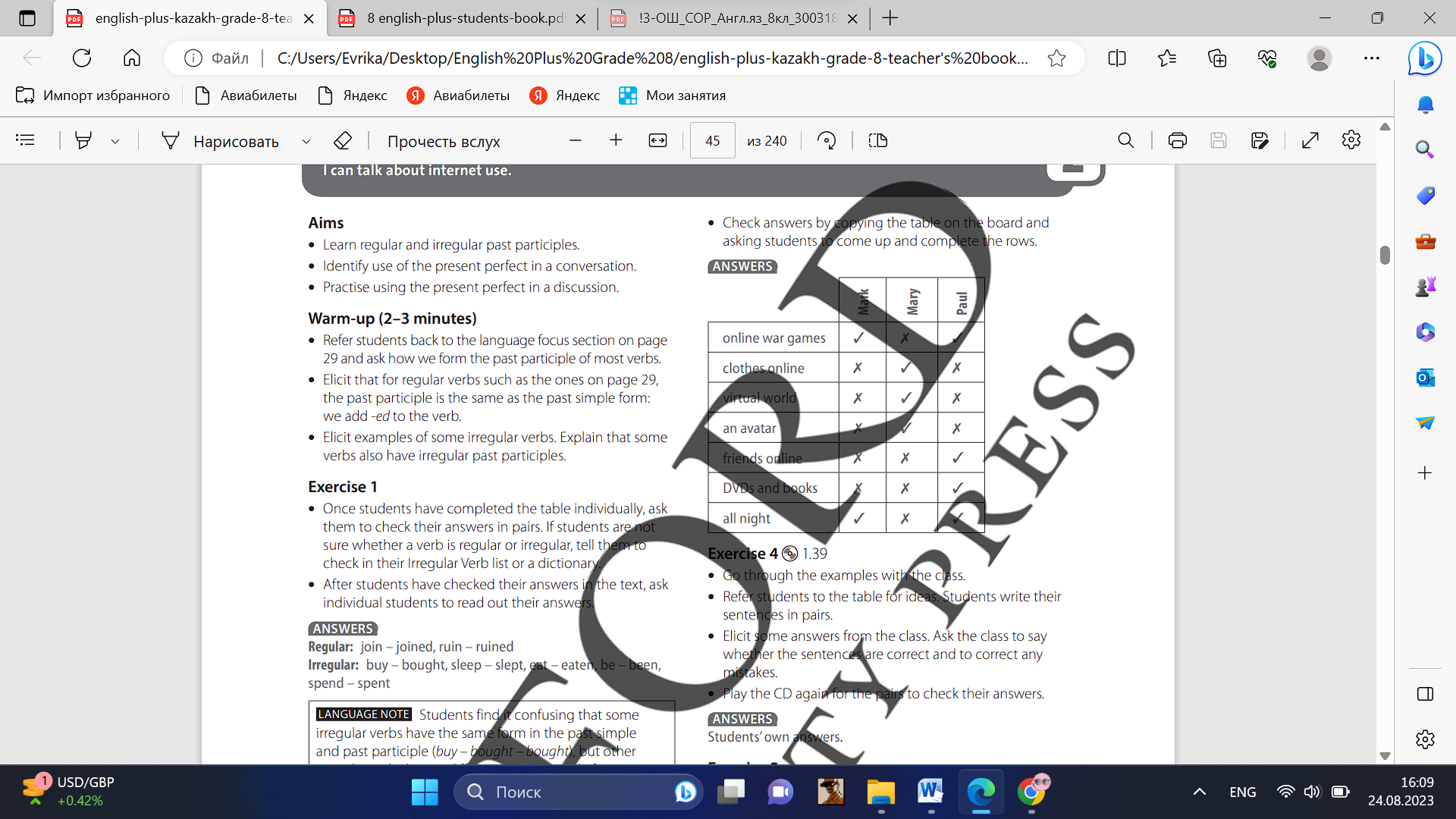
Бұйрық No194 (30.07.2024) – «Біртұтас тәрбие» бағдарламасы.
Бұйрық No123 (26.05.2025) – «Адал азамат» жобасы арқылы адалдық пен әділдікке тәрбиелеу.
Short term plan
Unit 2 Daily life and shopping |
lesson 16 |
||
Name of school |
|
||
Teacher name: |
|
||
Date: |
|
||
Grade: 8 |
Number present: |
absent: |
|
Lesson title |
Cybercrime |
||
Learning objectives |
8. 2. 2. 1 understand some specific information on a wide range of general and academic topics in an extended conversation with little support from the teacher or independently; 8. 3. 5. 1 communicate with classmates to plan and create priorities, partner, discuss, and agree on educational tasks; |
||
Lesson objectives (assessment criteria) |
Learners will be able to: - Learn vocabulary relating to cybercrime. - Listen to a radio programme about cybercrime. - Discuss problems with internet use. |
||
Instilling values of the program “Birtutas tarbiye” |
Honesty and fairness Unity and solidarity Diligence and professional competence – respect Justice and Responsibility Independence and Patriotism Perseverance and hard work |
||
Stages/ Time |
Teachers actions |
Students actions |
Assessment |
Resources |
Beginning 5 min |
Greeting. T tells the class to make groups of 2. Warm up: -Write the word CYBERCRIME in the centre of the board. -Ask: “What comes to your mind when you hear this word?” -Students brainstorm in pairs, then share ideas with the class. -Teacher writes down key words (e.g., hacking, phishing, identity theft, malware). Vocabulary Focus -Pre-teach or elicit key cybercrime terms: hacking, phishing, identity theft, online fraud, cyberbullying, malware, password cracking, scam -Show short definitions and example sentences. -Matching activity: Students match cybercrime types to definitions/examples. -Quick pronunciation drilling of difficult words. |
Learners read the given sentences on the board and guess the topic and share with their ideas.
|
Teacher controles the process, gives feedback and asks additional questions if it’s nessasery.
Teacher evaluate pupils with phrases like: “Good job! Well done!”
|
Board & markers Handout with vocabulary definitions & matching activity Short reading text Information gap case cards
|
Middle 8 min |
Ex: 1 P: 24 Dictionary Work -Tell students: “Use your dictionaries to check the meanings of the words in the box.” -Encourage them to write a short definition or translation for each word. -Monitor the class to ensure accurate understanding. Vocabulary Checking -Go through each word with the class. -Clarify meanings and check comprehension, asking students for synonyms or examples. Pronunciation Practice -Model the correct pronunciation of new or challenging words. -Drill pronunciation chorally (all together) and individually. -Highlight stress, intonation, or tricky sounds if needed. Extension for Stronger Classes -Ask students to create sentences using the new words. -Invite a few students to share their sentences with the class for feedback. Differentiation: - Model the pronunciation several times and drill as a class and individually. Values of the program “Birtutas tarbiye” Unity and Solidarity: Listening to peers’ sentences and giving constructive feedback. |
Learners check the meaning of the words in the box. Then complete the dialogue with six of the words ANSWERS : 1 inbox 2 spam filter 3 virus 4 firewall 5 phishing 6 password Descriptor: - develop their vocabulary skills by using dictionaries to find the meanings of new words - model and drill the pronunciation of any words
|
Excellent (2) - All definitions/ translations are correct and precise. Good (1) - Most definitions/translations are correct (1–2 minor errors).
|
Student’s book |
10 min |
Ex: 2 P: 24 Pre-Listening Preparation -Read the two or more introduction texts aloud with the class. -Explain: “One of these texts is the correct introduction to the radio programme you are about to hear.” -Ask students to pay attention to clues like tone, information, and style that match a radio introduction. Prediction and Focus -Encourage students to make a guess about which text is correct before listening. -Discuss briefly what makes an effective radio introduction (clear, engaging, and informative). Listening Activity -Play the complete radio programme once. -Students listen carefully to confirm which text matches the actual introduction. -Emphasize attentive listening rather than understanding every single word. Post-Listening Check -Ask students to select the correct introduction. -Invite volunteers to explain why they think it is correct, referring to specific words or style features they heard. Discussion and Feedback -Compare answers as a class. -Discuss the differences between the correct and incorrect options. -Highlight useful phrases and expressions from the correct introduction. Differentiation: - Allow discussion in pairs or small groups before making a decision. Values of the program “Birtutas tarbiye” Diligence and professional competence: Listening attentively and carefully analyzing the options. |
Learners read presentation texts. Listen to the radio programme and choose the correct text. ANSWERS : 3 Descriptor: - develop their listening skills by reading and comparing two introductory texts - identify key details that support accurate matching.
|
Excellent (3) - Identifies correct introduction with strong evidence from tone, style, or key details. Good2) - Identifies correct introduction with some evidence.
|
Student’s book |
10 min |
Ex: 3 P: 24 Pre-Task Preparation -Display the options and related pictures clearly to the class. -Explain: “Look carefully at the pictures and the options. They will help you remember what you heard in the programme.” Memory Activation / Prediction -Ask students to think back to the first listening. -Encourage them to predict or guess answers based on what they recall. -In a stronger class, allow students to discuss predictions in pairs. -In a weaker class, give hints by pointing to specific pictures or key words in the options. Individual or Pair Work -Students attempt to complete as many answers as they can before listening again. -Encourage them to use both the visuals and keywords in the options to guide their choices. Second Listening -Play the audio again. -Students listen carefully and check or correct their predictions. -Remind them to focus on key words that confirm the correct answers. Post-Listening Check and Discussion -Ask students to compare their answers in pairs first. -Go through the correct answers as a class. -Invite volunteers to explain how the pictures or keywords helped them. Differentiation: - Provide sentence starters or visual aids to support understanding. Values of the program “Birtutas tarbiye” Unity and Solidarity: Discussing ideas with partners respectfully to improve understanding. |
Learners listen again and choose the correct answers ANSWERS: 1 a 2 c 3 b 4 a 5 a 6 c Descriptor: - prepare for a detailed listening activity by reading the multiple-choice options - recall what they understood from the first listening
|
Excellent (3) - Effectively uses pictures and keywords to make accurate predictions before listening again. Good2) - Uses visuals and keywords somewhat effectively to make predictions.
|
|
7 min |
Ex: 4 P: 24 Individual Preparation -Ask students to read the questions carefully. -Instruct them to prepare their answers individually, writing notes or keywords to help remember important points. -For weaker classes, explicitly encourage students to make short notes as support for later discussion. Partner Comparison -Organize students into pairs. -Students share their answers with their partner, explaining their reasoning. -Encourage them to listen carefully, ask questions, and clarify any differences in understanding. Whole-Class Feedback (Optional) -Invite a few pairs to share interesting points or well-reasoned answers. -Highlight good examples of clarity, accuracy, and collaboration. Values of the program “Birtutas tarbiye” Justice and Responsibility: Being accountable for one’s own answers and participation. |
Learners ask and answer the questions ANSWERS: Students’ own answers. Descriptor: - prepare their answers individually, encouraging independent thinking - compare their responses with a partner to develop speaking
|
Excellent (2) - Provides accurate, complete answers and explains reasoning clearly. Good1) - Provides mostly accurate answers, but some points are unclear or incomplete.
9-10 points – “5” 7-8 points – “4” 5-6 points – “3” |
|
End 5 min |
REFLECTION - Ask: “What’s the most important advice you would give to avoid cybercrime?” - Optional homework: Write a short article “How to Stay Safe from Cybercrime” (100–120 words). Saying good-bye |
Ss use their stickers to show their knowledge according to the lesson
|
Poster |
|
Бұйрық No194 (30.07.2024) – «Біртұтас тәрбие» бағдарламасы.
Бұйрық No123 (26.05.2025) – «Адал азамат» жобасы арқылы адалдық пен әділдікке тәрбиелеу.
Short term plan
Unit 2 Daily life and shopping |
lesson 17
|
||
Name of school |
|
||
Teacher’s name |
|
||
Date: |
|
||
Grade: 8 |
Number present: |
absent: |
|
Lesson title |
Language Focus. Present perfect questions |
||
Learning objectives |
8. 5. 3. 1 write various familiar general and academic topics with uniform grammatical competence; 8.6.7.1 use a variety of simple perfect forms to express recent, indefinite and unfinished past on a range of familiar general and curricular topics |
||
Lesson objectives (assessment criteria) |
Learners will be able to: - Learn the question form of the present perfect. - Learn how to talk about experiences. - Practise asking and answering questions about experiences using the present perfect. |
||
Instilling values of the program “Birtutas tarbiye” |
Honesty and fairness Unity and solidarity Diligence and professional competence – respect Justice and Responsibility Independence and Patriotism Perseverance and hard work |
||
Stages/ Time |
Teachers actions |
Students actions |
Assessment |
Resources |
Beginning 5 min |
Greeting. T tells the class to make groups of 2. Warm up: - Show a few pictures or scenarios of experiences (e.g., a person at a concert, traveling, playing a sport). - Ask students: “Have you ever…?” or “What is the most exciting thing you have done?” - Encourage students to answer briefly to activate prior knowledge and vocabulary. Presentation -Introduce common question forms for experiences: Have you ever…? When did you…? What was the most…? -Model asking and answering with one or two students. -Highlight past tense usage and question structure. |
Learners read the given sentences on the board and guess the topic and share with their ideas. Remember and recognize the main vocabulary. |
Teacher evaluate pupils with phrases like: “Good job! Well done!” Formative Assessment
|
Whiteboard/markers or projector Handouts with question prompts or sentence starters Pictures or short scenarios to stimulate conversation |
Middle 7 min |
Ex: 1 P: 25 Context Reminder Remind students of the radio programme they listened to in the previous lesson. Explain: “You do not need to remember every word; focus on the main ideas to complete the sentences.” Vocabulary Focus Ask students how they say ever in their language. Elicit the opposite: never, and check understanding with a few quick examples. Highlight that knowing opposites helps complete gapped sentences logically. Question Reading Read out the gapped sentences/questions clearly. Ask students to give short oral answers to check comprehension. For weaker classes, allow students to discuss in pairs before answering. Individual Completion Students complete the gapped sentences individually. Encourage them to think about context, opposites (ever/never), and meaning. Pair or Class Check Students compare answers with a partner, explaining why they chose each word. Discuss answers as a class, highlighting correct usage and reasoning.
Differentiation: - Provide sentence starters or word banks for gap-fill support. Values of the program “Birtutas tarbiye” Diligence and professional competence: Listening carefully and focusing on main ideas from the programme. |
Learners complete the sentences from the listening with the words in the box. ANSWERS : 1 attacked 2 Has 3 have 4 ’s Descriptor: - recall context from a previously heard radio programme to activate prior knowledge - work on completing gapped sentences taken from the audio
|
Excellent (2) - Completes sentences using correct tense, word order, and sentence structure. Good1) - Some minor grammatical or word order errors; meaning still mostly clear. |
Student’s book |
8 min |
Ex: 2 P: 25 Individual Work – Ordering Words Tell students: “You will first put the words in the correct order to make a meaningful sentence.” Students work individually, focusing on grammar, meaning, and word forms. Pair Comparison Students compare their sentences with a partner. Encourage discussion about why a certain order is correct. Ask them to correct any mistakes collaboratively. Class Feedback Invite a few pairs to share their sentences with the class. Highlight correct sentences and explain common mistakes. Differentiation: - Give extra time and encourage peer correction with sentence frames like: I think this goes first because… Values of the program “Birtutas tarbiye” Unity and Solidarity: Listening to a partner’s reasoning and helping each other improve. |
Learners order the words to make questions. Then write answers for the questions ANSWERS : 1 What websites have you visited recently? 2 Have your friends downloaded any music recently? 3 Why have you put that photo on the internet? 4 Have you ever lost a computer file? 5 Has she ever visited a chat room? 6 What have they written on the message board? Descriptor: - develop their understanding of sentence structure by ordering jumbled words to form correct sentences - work individually to complete the task
|
Excellent (3) - orrect word order, tense, and sentence structure in all sentences. Good (2) - Some errors in word order or grammar, but meaning is mostly clear. |
Student’s book |
10 min |
Ex: 3 P: 25 Task Introduction & Modeling Weaker class: Do the first question together as a class. Model both the question and the short answer. Stronger class: Ask a volunteer to answer the first question. Invite the class to comment on whether the answer is correct. Individual Writing Students write their questions (and possible short answers) individually. Answer Checking Check answers quickly before students begin asking each other. Correct any obvious errors to avoid confusion. Pair Practice – Asking and Answering Students work in pairs to ask and answer the questions. Circulate around the class to: Check accuracy of short answers (Yes/No + extra information) Encourage students to expand answers if appropriate.
Differentiation: - Teacher models the first question and answer with the class. Values of the program “Birtutas tarbiye” Diligence & Professional Competence: Paying attention to accuracy when forming questions and answers. |
Learners complete the questions using the present perfect. Then ask and answer with a partner. ANSWERS: 1 Have you read 2 Has a virus attacked 3 Has your friend made 4 Have your grandparents used 5 Have you emailed 6 Has your teacher used Descriptor: - complete the questions - use the present perfect
|
Excellent (2) - Gives accurate, complete short answers appropriate to the questions. Good1) - Short answers mostly correct; occasional errors in tense or word choice.
|
|
10 min |
Ex: 4 P: 25 Task Introduction Read the task aloud with the class. Emphasize that there is one gap per missing word, so students should focus on context when choosing the correct verb or phrase. Guidance for Weaker Classes Remind students to read the responses first to help them decide which verb or phrase fits. Encourage them to think about the meaning of the dialogue and the order of the conversation. Individual Work Students complete the dialogue individually. Monitor and support as needed, prompting them to think about grammar, tense, and meaning. Pair Check Students compare their answers with a partner. Encourage them to discuss differences and correct mistakes together, promoting peer learning.
Differentiation: - Provide examples or model one item as a class. Values of the program “Birtutas tarbiye” Unity and Solidarity: Working with a partner to correct mistakes politely. |
Learners complete the dialogue with questions in the present perfect ANSWERS: 1 Have you made 2 have you won 3 Have you created 4 have visited 5 Have you met 6 Have you stolen Descriptor: - complete a dialogue by filling in the missing questions - correct any mistakes Total: 2 point
|
Excellent (3) - All missing verbs/phrases are correct and contextually appropriate. Good(2) - Most verbs/phrases are correct; minor errors that do not change meaning.
9-10 points – “5” 7-8 points – “4” 5-6 points – “3”
|
|
End 5 min |
REFLECTION Learners reflect on their learning:
Saying good-bye |
Ss use their stickers to show their knowledge according to the lesson
|
Poster |
|
Бұйрық No194 (30.07.2024) – «Біртұтас тәрбие» бағдарламасы.
Бұйрық No123 (26.05.2025) – «Адал азамат» жобасы арқылы адалдық пен әділдікке тәрбиелеу.
Short term plan
Unit 2 Daily life and shopping |
lesson 18 |
||
Name of school |
|
||
Teacher name: |
|
||
Date: |
|
||
Grade: 8 |
Number present: |
absent: |
|
Lesson title |
Online shopping |
||
Learning objectives |
8. 2. 1. 1 understanding of general and main ideas of study topics with long conversations without practical support; 8.3.5.1 interact with peers to negotiate, agree and organise priorities and plans for completing classroom tasks; |
||
Lesson objectives |
Learners will be able to: - Learn vocabulary relating to online shopping - Listen for general meaning and specific details. - Discuss problems with internet use. |
||
Instilling values of the program “Birtutas tarbiye” |
Honesty and fairness Unity and solidarity Diligence and professional competence – respect Justice and Responsibility Independence and Patriotism Perseverance and hard work |
||
Stages/ Time |
Teachers actions |
Students actions |
Assessment |
Resources |
Beginning 5 min |
Greeting. T tells the class to make groups of 2. Warm up: - Show students images of online shopping (websites, delivery boxes, carts, mobile apps). - Ask: “Who shops online?” “What items do people usually buy online?” “Do you prefer online or in-store shopping? Why?” - Encourage a few students to share short answers. Vocabulary Introduction Present key vocabulary and phrases: to add to cart, checkout, delivery, return policy, discount, secure payment, customer review Dictionary Work: Students check meanings in bilingual or English-English dictionaries. Pronunciation Practice: Model correct pronunciation and drill chorally and individually. |
Learners read the given sentences on the board and guess the topic and share with their ideas. Remember and recognize the main vocabulary. |
Teacher evaluate pupils with phrases like: “Good job! Well done!” Formative Assessment
|
|
Middle 8 min |
Ex: 1 P: 26 Vocabulary Introduction Ask students: “How do you say ever in your language?” Elicit answers from several students. Introduce the opposite word: never, and check understanding with examples. Reinforce by giving a simple sentence: Have you ever been to the beach? → No, I have never been to the beach. Photo Observation Show students the photo. Ask: “What is happening in this picture?” Encourage them to focus on details in the photo (objects, people, actions, setting). Question Reading and Short Answers Read the questions aloud. Ask students to answer with short answers first: yes/no or one word/phrase. For stronger students, encourage them to expand their answers: Yes, he is eating ice cream on the beach.
Differentiation: - Provide sentence starters (e.g., "I have never...", "Have you ever...?"). Values of the program “Birtutas tarbiye” Unity and Solidarity: Listening to classmates’ answers and valuing different responses. |
Learners look at the photo and answer the question ANSWERS : Lucy says she hasn't been on the computer for a long time Descriptor: - ask students how they say “ever” in their own language. - answer the question
|
Excellent (3) - Uses “ever/never” accurately in context; demonstrates understanding of opposites; attempts extra related words Good(2) - Uses “ever/never” correctly most of the time; minor errors do not affect meaning
|
Student’s book |
7 min |
Ex: 2 P: 26 Task Introduction Tell students: “We are going to listen to a dialogue. Your task is to find out what Lucy wants to buy.” Clarify that they should focus on understanding the main idea, not every single word. First Listening Play the dialogue once. Students listen carefully and try to identify Lucy’s intention. Encourage them to note key words (items, numbers, actions). Individual Work Students complete the dialogue individually, filling in the missing questions. Remind them to check that each question makes sense in the context of the dialogue. Pair Comparison Students compare their answers with a partner. Encourage them to discuss any differences and correct mistakes together. Prompt discussion with questions like: “Does this question match Lucy’s answer?” Class Feedback Invite a few students to read their completed dialogue aloud. Correct mistakes on the board without naming students, explaining why the corrected form is better.
Differentiation: - Provide a word bank or sentence stems to support students in forming the correct questions. Values of the program “Birtutas tarbiye” Justice and Responsibility: Completing work individually first before seeking help. |
Learners listen to the dialogue what does Lucy want to buy. ANSWERS : Lucy want to buy an e-reader Descriptor: - listen to the dialogue - complete the dialogue
|
Excellent (3) - Accurately identifies Lucy’s intentions and key details; understands all questions and answers Good(2) - Mostly accurate; minor details missed but main idea clear
|
Student’s book |
10 min |
Ex: 3 P: 26 Task Introduction Tell students: “We are going to listen to a dialogue. Your task is to complete the key phrases in the questions from the dialogue.” Remind them: “There is one gap per missing word, so pay attention to the order of the responses when checking your answers.” First Listening Play the dialogue once. Students listen carefully to pick up the missing words for each question. Emphasize that understanding the context is more important than catching every single word. Individual Work Students complete the dialogue individually, filling in the missing words in the questions. Encourage them to think about grammar, vocabulary, and meaning. Pair Check Students compare answers with a partner. Encourage discussion: “Do these words fit the context?” Students correct mistakes together before you check as a class.
Differentiation: - Provide a gap-fill template with the first few words of the missing questions. Values of the program “Birtutas tarbiye Diligence and professional competence: Listening carefully and paying attention to key phrases. |
Learners complete the key phrases from the dialogue ANSWERS: 1) blowing 2) bargain 3) sold 4) reviews 5) include 6) payment Descriptor: - Listen to the task together with the students. - complete the key phrases from the dialogue
|
Excellent (3) - Correctly identifies all missing words; understands context fully Good(2) - Correctly identifies most missing words; minor misunderstandings
|
|
10 min |
Ex: 4 P: 26 Task Introduction Read the instructions aloud with the class. Point out: “You will use the rule and the examples to find three more examples in the dialogue.” Explain the purpose: “This helps you notice patterns in language and use them correctly.” Individual Work Students listen or read the dialogue and identify the three examples that follow the rule. Students then complete the dialogue questions individually, filling in any missing words. Encourage careful attention to grammar, vocabulary, and meaning. Pair Check Students compare answers with a partner. Discuss differences and correct mistakes together, explaining why a phrase is correct.
Differentiation: - Read the task aloud with the students to ensure understanding. Values of the program “Birtutas Tarbiye” Unity and Solidarity: Discussing and correcting answers with a partner. |
Learners read the rule and the examples to find three more examples in the dialogue ANSWERS: Could you ask me next time? (request) May I order it? (request) Can you order it today? (permission) Descriptor: - identify grammar patterns in context - apply them through completing a dialogue with appropriate questions.
|
Excellent (3) - Correctly identifies all three examples and applies the rule accurately Good(2) - Identifies most examples correctly; minor errors in applying the rule
9-10 points – “5” 7-8 points – “4” 5-6 points – “3”
|
|
End 5 min |
Reflection - Invite volunteers to share sentences or paragraphs with the class. - Correct common mistakes and highlight good use of vocabulary. - Summarize the lesson: “Today we learned to talk about online shopping, shared our experiences, and practiced useful vocabulary and phrases.”
|
Ss use their stickers to show their knowledge according to the lesson
|
Poster |
|
Бұйрық No194 (30.07.2024) – «Біртұтас тәрбие» бағдарламасы.
Бұйрық No123 (26.05.2025) – «Адал азамат» жобасы арқылы адалдық пен әділдікке тәрбиелеу.
Short term plan
Unit 2 Daily life and shopping |
lesson 19 |
||
Name of school |
|
||
Teacher name: |
|
||
Date: |
|
||
Grade: 8 |
Number present: |
absent: |
|
Lesson title |
A comment on a website 1 |
||
Learning objectives |
8. 4. 6. 1 identify the author's opinion or point of view in short texts on a variety of unfamiliar general and academic topics, including long texts 8. 5. 1. 1 planning, writing, revising and checking text-level work on general and academic topics with minor support; |
||
Lesson objectives (assessment criteria) |
Learners will be able to: - Study a model comment on an internet forum. - Learn key phrases for expressing opinions on an internet forum. - Write a comment for an internet forum. |
||
Instilling values of the program “Birtutas tarbiye” |
Honesty and fairness Unity and solidarity Diligence and professional competence – respect Justice and Responsibility Independence and Patriotism Perseverance and hard work |
||
Stages/ Time |
Teachers actions |
Students actions |
Assessment |
Resources |
Beginning 5 min |
Greeting. T tells the class to make groups of 2. Warm up: - Show a screenshot of a website comment section or a blog post. - Ask: “Have you ever left a comment online? What do people usually write?” - Elicit ideas about opinions, agreeing/disagreeing, and giving reasons. Vocabulary & Key Phrases Introduce phrases for expressing opinions: I think… / I believe… / In my opinion… / I agree / I disagree Introduce phrases for reasons: because… / due to… / the reason is… Practice pronunciation and drilling. Optional: quick matching activity with phrases and their meanings. |
Learners read the given sentences on the board and guess the topic and share with their ideas.
|
Teacher controles the process, gives feedback and asks additional questions if it’s nessasery.
Teacher evaluate pupils with phrases like: “Good job! Well done!” Formative Assessment |
|
Middle 7 min |
Ex: 1 P: 27 Task Introduction Show the model text to the class. Ask: “Where do you think this text comes from?” (Elicit: a website). Read the introductory question aloud and check that students understand it. Explain that the rest of the text is someone’s opinion in response to the question. Guided Reading Students scan the text individually or in pairs (weaker class) to find answers to the introductory question. Encourage students to underline or highlight the part of the text that provides the answers. Pair Work (for weaker classes) Students work together to compare their ideas and confirm understanding. Teacher circulates to monitor comprehension and provide support. Answer Checking Ask volunteers to point to the specific part of the text that gives each answer. Confirm correct responses and clarify any misunderstandings.
Differentiation; - Break the text into sections and assign specific parts to pairs. Values of the program “Birtutas Tarbiye” Justice and Responsibility: Identifying answers from the text itself, not guessing randomly. |
Learners read the model text and answer the question ANSWERS : 1 The writer is a 15-year-old boy called Sean. 2 The readers are other young people who use the internet. 3 The writer goes online every day. 4 Some of his friends are internet addicts. 5 The real problem is with the person, not with the activity they are addicted to. Descriptor: - show and read the model text with the whole class. - read the introductory question aloud and check understanding by asking
|
Excellent (3) - Correctly identifies the text as a website comment independently and confidently. Good(2) - Correctly identifies the text as a website comment with minor prompting.
|
Student’s book |
10 min |
Ex: 2 P: 27 Task Introduction Explain to students that they will complete the key phrases individually. Emphasize the importance of paying attention to context and meaning. Individual Work Students complete each key phrase on their own. Encourage careful thinking and reference to the rules or examples they have already studied. Text Checking Ask students to check their answers in the model text to confirm accuracy. Remind them to notice how the phrases are used in context. Key Phrase Identification & Translation Students find the completed key phrases in the text. Ask them to translate each phrase into their own language to ensure full understanding. .
Differentiation; - Provide a word bank or partial phrases as scaffolding. Values of the program “Birtutas Tarbiye” Justice and Responsibility: Using the text for guidance rather than guessing. |
Learners complete the key phrases. Then read the model text again and check ANSWERS : 1 my 2 seen 3 problem 4 reason Descriptor: - complete the key phrases from memory or prior input individually - check their answers by locating the phrases in the model text
|
Excellent (2) - All phrases are completed correctly and match the context in the text. Good(1) - Most phrases are correct; minor errors in a few.
|
Student’s book |
10 min |
Ex: 3 P: 27 Task Introduction Draw students’ attention to the blue words in the text. Explain that these words either add ideas (e.g., and, also, moreover) or contrast ideas (e.g., but, however, although). Individual/Pair Work Students complete the table by classifying each blue word as adding or contrasting. Weaker class: Allow translation of words into L1 to support understanding. Stronger class: Encourage students to create their own sentences using each word to demonstrate understanding. Class Check Review the completed table together. Ask volunteers to share sentences using the words, and discuss any tricky examples.
Differentiation; - Provide example sentences and use visual aids (e.g., arrows for contrast vs. addition). Values of the program “Birtutas Tarbiye” Diligence: Carefully analyzing words to classify them correctly. |
Learners study the words in blue in the model text. Then put these words into two groups ANSWERS: Adding ideas: also, too Contrast: but, Although, However Descriptor: - attention to the blue words in the text - complete a table, categorizing each word or phrase
|
Excellent (3) - All blue words are correctly classified as adding or contrasting. Good(2) - Most words are correctly classified; minor errors in one or two.
|
|
8 min |
Ex: 4 P: 27 Task Introduction Remind students to read each sentence carefully before choosing a word. Explain that the goal is to see how the two ideas are connected (addition, contrast, cause-effect, etc.). Individual Work Students complete the sentences on their own, thinking about the meaning and relationship between the ideas. Encourage them to underline key words or phrases that hint at the correct connector. Pair Check Students compare answers with a partner and explain their choices. Discuss any differences and correct misunderstandings collaboratively. Class Feedback Go through the sentences as a class, confirming correct answers and highlighting tricky cases. Ask students to give examples of other sentences using the same connectors.
Differentiation; - Provide a short list of linking words with definitions or examples. Values of the program “Birtutas Tarbiye”: Diligence: Working carefully to select the correct words. |
Learners complete the sentences with the words ANSWERS: 1 but 2 too 3 also 4 However 5 Although 6 but Descriptor: - remind them to read each sentence carefully - complete the sentences using appropriate linking words or phrases |
Excellent (2) - Chooses the correct connector for all sentences; relationships between ideas are accurately expressed. Good(1) - Chooses correct connectors for most sentences; minor errors do not affect overall meaning.
9-10 points – “5” 7-8 points – “4” 5-6 points – “3”
|
|
End 5 min |
REFLECTION What have I learnt? What new words have I learnt? What are my problems? Home task: learn the new vocabulary Saying goodbye |
Ss use their stickers to show their knowledge according to the lesson
|
Poster |
|
Бұйрық No194 (30.07.2024) – «Біртұтас тәрбие» бағдарламасы.
Бұйрық No123 (26.05.2025) – «Адал азамат» жобасы арқылы адалдық пен әділдікке тәрбиелеу.
Short term plan
Unit 2 Daily life and shopping |
lesson 20 |
||
Name of school |
|
||
Teacher name: |
|
||
Date: |
|
||
Grade: 8 |
Number present: |
absent: |
|
Lesson title |
My country: Daily life and shopping Summative Assessment “Daily life and shopping” |
||
Learning objectives |
8. 4. 6. 1 identify the author's opinion or point of view in short texts on a variety of unfamiliar general and academic topics, including long texts 8. 5. 1. 1 planning, writing, revising and checking text-level work on general and academic topics with minor support; |
||
Lesson objectives (assessment criteria) |
Learners will be able to: - Study a text about different types of shops. - Review how to use indefinite pronouns. |
||
Instilling values of the program “Birtutas tarbiye” |
Honesty and fairness Unity and solidarity Diligence and professional competence – respect Justice and Responsibility Independence and Patriotism Perseverance and hard work |
||
Stages/ Time |
Teachers actions |
Students actions |
Assessment |
Resources |
Beginning 5 min |
Greeting. T tells the class to make groups of 2. Warm up: Give students one minute to think of as many types of shop as they can and make a list. Go through the students’ ideas as a class and write their suggestions on the board. You could do this as a competition – the winner is the student with the longest list.
|
Learners read the given sentences on the board and guess the topic and share with their ideas.
Remember and recognize the main vocabulary. |
Teacher controles the process, gives feedback and asks additional questions if it’s nessasery. Teacher evaluate pupils with phrases like: “Good job! Well done!” Formative Assessment
|
Sheets of peppers Pictures of to be
https://images.app.goo.gl/Br4MFpnX5nsnL5cJ6
|
Middle 5 min |
Ex: 1 P: 28 Task Introduction Explain to students: “We are going to organize vocabulary into categories using a word diagram (word spider).” Show an example of a word diagram and explain that each branch represents a category (e.g., People, Places, Things). Dictionary Work Ask students to use a dictionary to check the meanings of the words in the box. Encourage them to write a short definition or translation for each word. Categorization Draw attention to the word diagram on the board. Model placing one word (e.g., shop assistant) in the correct category (People). Allow students enough time to place all the words into the correct categories in their own diagrams. Monitoring & Support Walk around the class to check students’ diagrams. Offer guidance or ask prompting questions for any mistakes. Sharing & Discussion (Optional) Ask a few students to show their diagrams and explain their choices. Discuss any differences as a class to ensure understanding.
Differentiation: - Provide a partially completed word diagram as scaffolding. Values of the program “Birtutas Tarbiye” Diligence: Using dictionaries carefully to check word meanings. |
Learners match questions with answers. Then choose the correct answers in rules. ANSWERS: 1 e 2 d 3 c 4 a 5 b Rules 1 do / does 2 don’t add 3 beginning Descriptor: - use a dictionary (print or digital) to check the meanings of the words in the box. - choose the correct answers
|
Excellent (3) - Correctly understands all vocabulary; definitions are accurate. Good(2) - Understands most words; minor inaccuracies in definitions. |
Student’s book |
5 min |
Ex: 2 P: 28 Task Introduction Tell students: “We are going to listen to this text and focus only on the advantages of shopping.” Clarify: “You don’t need to understand every word, just listen for the advantages mentioned.” First Listening Play the CD once. Ask students to follow along in the text silently. Encourage them to underline or note down any advantages they hear. Individual/Pair Reflection Students compare their notes with a partner to confirm what they heard. Encourage them to discuss any differences politely. Class Feedback Go through the answers together as a class. Ask volunteers to share the advantages they identified. Write the correct answers on the board.
Differentiation - Allow students to underline or highlight the parts of the text as they listen. Values of the program “Birtutas Tarbiye” Respect & Collaboration: Comparing ideas with a partner without judgment. |
Learners write question and short answers. Then ask and answer with a partner. ANSWERS : 1 Do your parents play tennis? 2 Does your mother speak French? 3 Do you watch TV every evening? 4 Does this book teach vocabulary? 5 Does your father work in a factory? 6 Do you and your friends go to school on Saturdays? 7 Do you and your family live in a modern building? 8 Does your friend come to your home after school? Descriptor: - write question and short answers - ask and answer with a partner.
|
Excellent (4) - Accurately identifies all advantages mentioned in the text. Good(3) - Identifies most advantages; misses 1–2 minor points.
|
Student’s book |
5 min
20 min
|
Ex: 3 P: 28 Task Introduction Draw attention to the highlighted words in the text. Explain: “We are going to use these words to complete the table and understand when to use some and any.” Individual / Pair Work Weaker class: Students discuss the table in pairs, explaining their ideas to each other. Stronger class: Students complete the table individually, applying the rules they have learned. Monitoring and Support Walk around the classroom to check understanding. Offer guidance for tricky examples or common mistakes. Class Check Go through the completed table as a class. Ask volunteers to share their answers and reasoning. Clarify any misunderstandings about some vs. any.
Differentiation: - Provide sentence frames or examples in the table as a guide. Values of the program “Birtutas Tarbiye” Cooperation & Respect: Working in pairs and listening to a partner’s reasoning.
Summative Assessment “Daily life and shopping”
|
Learners complete the questions. Then match questions with answers ANSWERS 1 do you and your family go; h 2 does your best friend live; g 3 do you do; f 4 do you travel; a 5 do your friends like; b 6 do you watch; c 7 do you do; e Descriptor: - complete the table by categorizing how these words are used - discuss their ideas about the usage of some and any in pairs
|
Excellent (3) - Completes the table fully and accurately. Good(2) - Completes most of the table correctly.
9-10 points – “5” 7-8 points – “4” 5-6 points – “3
|
|
End 5 min |
REFLECTION What have I learnt? What new words have I learnt? What are my problems? Home task: learn the new vocabulary Saying goodbye |
Ss use their stickers to show their knowledge according to the lesson
|
Poster \ |
|

Бұйрық No194 (30.07.2024) – «Біртұтас тәрбие» бағдарламасы.
Бұйрық No123 (26.05.2025) – «Адал азамат» жобасы арқылы адалдық пен әділдікке тәрбиелеу.
Short term plan
Unit 2 Daily life and shopping |
lesson 21 |
||
Name of school |
|
||
Teacher name: |
|
||
Date: |
|
||
Grade: 8 |
Number present: |
absent: |
|
Lesson title |
CLIL Technology: The internet - wikis |
||
Learning objectives |
8. 4. 4. 1 read long texts in various fiction and non-fiction literature within the framework of familiar and some unfamiliar general and educational topics; 8.5.2.1 write with minimal support about real and imaginary past events, activities and experiences on a range of familiar general topics and some curricular topics; |
||
Lesson objectives (assessment criteria) |
Learners will be able to: - Learn vocabulary to do with newspapers. - Read a text about different types of newspaper. - Discuss different types of newspaper in your country. |
||
Instilling values of the program “Birtutas tarbiye” |
Honesty and fairness Unity and solidarity Diligence and professional competence – respect Justice and Responsibility Independence and Patriotism Perseverance and hard work |
||
Stages/ Time |
Teachers actions |
Students actions |
Assessment |
Resources |
Beginning 5 min |
Greeting. T tells the class to make groups of 2. Warm up: - Ask: “What is a wiki? Where can we find them?” - Show a sample wiki page and discuss its features: title, introduction, sections, hyperlinks, images. - Highlight the importance of neutrality, clarity, and factual information. Vocabulary & Phrases Introduce key phrases for writing wikis: “It is believed that…” “This article explains…” “In addition…” / “However…” / “For example…” Quick choral drilling of phrases to check pronunciation. |
Learners read the given sentences on the board and guess the topic and share with their ideas.
|
Teacher controles the process, gives feedback and asks additional questions if it’s nessasery.
Teacher evaluate pupils with phrases like: “Good job! Well done!” Formative Assessment |
Example wiki page(s) Computers/tablets with access to a wiki platform (or Google Docs for practice) Checklist for editing (spelling, grammar, clarity, neutrality) |
Middle 7min |
Task. I Ex: 1 P: 29 Vocabulary Check Students use dictionaries or prior knowledge to check the meanings of the words. Ensure they understand each word before moving to the matching task. Photo Focus & Prediction Show the newspaper photos to the class. Ask: “What do you think is in each newspaper?” Elicit a few ideas from students to activate prior knowledge. Pair Work – Matching Task Students work in pairs to match the words to the photos. Encourage discussion: “Why do you think this word goes with this photo?” Do not check answers at this stage; the focus is on discussion and reasoning. Monitoring Walk around the classroom, listening to pairs. Offer support for tricky vocabulary or conceptual misunderstandings.
Differentiation: - Provide a word bank with brief definitions or visual clues. Values of the program “Birtutas Tarbiye” Curiosity & Critical Thinking: Predicting content based on visual clues and word meanings. |
Learners check the meaning words in the box. Then complete the text below ANSWERS : Students’ own answer Descriptor: - check the meanings of the new vocabulary words - match the vocabulary words to the appropriate photos
|
Excellent (2) - Accurately explains all words and can provide Good(1) - Understands most words and gives mostly correct examples. |
Student’s book |
10 min |
Ex: 2 P: 29 Review & Read Students read the text/dialogue silently or aloud. Ask them to focus on comprehension: Who is speaking? What is the main idea? Listening for Confirmation Play the audio recording once. Students listen carefully to check or correct their answers from exercise 1. Emphasize listening for key words, phrases, and sentence structures. Completing the Dialogue Students fill in any missing parts of the dialogue individually. Encourage them to refer to vocabulary or grammar clues from the reading and listening. Pair Check Students compare their completed dialogues in pairs. Encourage discussion: “Why did you choose this word/phrase here?” Pairs help each other correct mistakes. Values of the program “Birtutas Tarbiye” Cooperation: Sharing ideas with a partner and correcting each other respectfully. |
Learners complete the dialogue, then listen ANSWERS : 1 c 2 d 3 b 4 a Descriptor: - identifies all key words and phrases - correctly to complete dialogue.
|
Excellent (2) - Applies vocabulary and grammar knowledge correctly to complete dialogue. 1) - Uses some clues correctly; occasional errors in vocabulary or grammar. |
Student’s book |
8 min |
Ex: 3 P: 29 Pre-Reading Focus Students skim the text to refresh understanding of the topic. Remind them to read each statement carefully before deciding. Individual Decision Students decide if each sentence is True (T), False (F), or Not Mentioned (?). Emphasize: “If the text does not give information about a point, write a question mark.” Pair Comparison Students compare their answers with a partner. Encourage discussion: “Why do you think this is True, False, or Not Mentioned?” Monitor pairs and guide reasoning, especially if a point seems ambiguous. Class Feedback Check answers together as a class. Ask students to justify their choices, referring directly to sentences in the text. Highlight tricky sentences and explain reasoning for each choice.
Differentiation: - Pre-teach or review key vocabulary from the text before the task. Values of the program “Birtutas Tarbiye” Critical Thinking: Analyzing the text carefully to distinguish fact from opinion or missing information. |
Learners read the text again and answer the questions ANSWERS: 1 False. A lot of people still prefer to get the news in a more traditional way, by reading a newspaper. 2 Don’t know. 3 True. 4 False. Quality newspapers use a formal style of language with longer sentences and technical vocabulary. Sensationalist newspapers use shorter words and sentences, with colloquial words and expressions. 5 True. 6 False. Both types of newspaper contain articles about sport. Descriptor: - read the text again carefully - compare their answers in pairs, discussing any differences.
|
Excellent (3) - Fully understands all statements; accurately identifies T, F, or ?. Good(2) - Understands most statements; minor errors in identification. |
|
10min |
Ex: 4 P: 29 Individual Preparation Give students time to think about and write down their answers individually. Encourage them to use full sentences and check vocabulary or grammar if needed. Pair Work Students work in pairs, taking turns to ask and answer their prepared questions. Remind them to listen carefully to their partner and respond politely. Monitor the class, offering help with vocabulary, sentence structure, or pronunciation. Class Sharing Ask one or two students to read one of their answers aloud. Encourage the class to listen and give positive feedback, and gently correct errors if needed.
Differentiation: - Allow extra preparation time and practice in pairs before whole-class sharing. Values of the program “Birtutas Tarbiye” Diligence: Preparing answers carefully and trying to express ideas clearly. |
Learners follow the instructions and create your own wiki ANSWERS: Students’ own answers. Descriptor: - time to prepare their answers individually - ask and answer the questions with each other
|
Excellent (3) - Forms questions accurately using correct grammar and word order. Good(2) - Forms mostly correct questions; minor grammar errors.
9-10 points – “5” 7-8 points – “4” 5-6 points – “3
|
|
End 5 min |
REFLECTION What have I learnt? What new words have I learnt? What are my problems? Home task: learn the new vocabulary Saying goodbye |
Ss use their stickers to show their knowledge according to the lesson
|
Poster |
|
Бұйрық No194 (30.07.2024) – «Біртұтас тәрбие» бағдарламасы.
Бұйрық No123 (26.05.2025) – «Адал азамат» жобасы арқылы адалдық пен әділдікке тәрбиелеу.
Short term plan
Unit 2 Daily life and shopping |
lesson 22 |
||
Name of school |
|
||
Teacher name: |
|
||
Date: |
|
||
Grade: 8 |
Number present: |
absent: |
|
Lesson title |
Review unit 2 |
||
Learning objectives |
8.4.2.1 understand specific information and detail in texts on a growing range of familiar general and curricular topics, including some extended texts; 8. 5. 2. 1 write past experiences or real events, activities on familiar general and educational topics with little support; |
||
Lesson objectives (assessment criteria) |
Learners will be able to: - Use nouns and verbs to do with the internet. - Use the word about a virtual world and online computer games. |
||
Instilling values of the program “Birtutas tarbiye” |
Honesty and fairness Unity and solidarity Diligence and professional competence – respect Justice and Responsibility Independence and Patriotism Perseverance and hard work |
||
Stages/ Time |
Teachers actions |
Students actions |
Assessment |
Resources |
Beginning 5 min |
Greeting. T tells the class to make groups of 2. Warm up: With books closed, ask students if they read any newspapers. If so, elicit the names of the newspapers. If not, elicit the names of different newspapers they have heard of. Ask students what the differences are between the newspapers they have mentioned. Ask what types of information you would find in each. Elicit some ideas, but do not accept or reject any at this stage. T: What do you think about today’s theme? |
Learners read the given sentences on the board and guess the topic and share with their ideas.
|
Teacher controles the process, gives feedback and asks additional questions if it’s nessasery.
Teacher evaluate pupils with phrases like: “Good job! Well done!” Formative Assessment
|
Sheets of peppers Pictures of to be
|
Middle 10 min |
Ex: 1 P: 30 Class Setup Explain the purpose of the table: to match verbs with their meanings and notice patterns of word formation. Emphasize that many English verbs are formed from nouns, helping students see connections between words. Stronger Class Approach Challenge students to complete the table individually before referring to the text. Encourage them to think critically about meaning and word formation patterns. Weaker Class Approach Allow students to work in pairs, discussing ideas and using the text to help complete the table. Provide support by pointing to the text or key examples if they struggle. Dictionary Work Ask all students to use dictionaries to check the meanings of words. Encourage them to write clear meanings and, if possible, create example sentences. Vocabulary Understanding & Pronunciation Go through each new word, checking students’ understanding either through translation or explanation. Values of the program “Birtutas Tarbiye” Diligence: Encouraging careful dictionary use and checking meanings. |
Learners complete the sentences with the words in the box ANSWERS : 1 email 2 download 3 message 4 blog 5 online games 6 posted 7 engines 8 website Descriptor: - complete the sentences - use words in the box
|
Excellent (3) - All verbs correctly matched with meanings. Good(2) - Most verbs correctly matched; 1–2 minor errors. |
Student’s book |
8 min |
Ex: 2 P: 30 Task Introduction Explain that students will complete the summary by choosing the correct words from a given list. Emphasize that the goal is to capture the main ideas of the text, not to copy whole sentences. Stronger Class Approach Students work individually to complete the summary. Encourage them to read the text carefully and think about meaning before choosing words. Weaker Class Approach Students work in pairs to complete the summary. Encourage discussion about which words make sense and why. Provide guidance or examples if they are unsure. Values of the program “Birtutas Tarbiye” Cooperation: Working in pairs supports classmates and encourages sharing ideas. |
Learners choose the correct words ANSWERS : 1 hacker 2 anti-virus software 3 spam 4 password 5 virus 6 a firewall Descriptor: - complete the summary - choose the correct words
|
Excellent (2) - All words correctly selected and placed; meaning matches the text. Good(1) - Most words correct; 1–2 minor mistakes. |
Student’s book |
10 min |
Ex: 3 P: 30 Task Introduction Explain that students will add verbs to the table from exercise 1, paying attention to regular and irregular forms. Remind students to use their Irregular Verb list or a dictionary if needed. Stronger Class Approach Students work individually to fill in the table. Encourage them to check the spelling of past participles and compare with the verbs in the text or dictionary. Weaker Class Approach Write irregular verbs in alphabetical order on the board. Allow students to work in pairs, finding the correct past participles from the list. Provide support and clarify any tricky forms. Checking Understanding After completion, ask individual students to read out their answers. Correct mistakes together and discuss any common difficulties. Values of the program “Birtutas Tarbiye” Diligence: Careful checking of irregular forms promotes attention to detail. |
Learners write affirmative or negative sentences using the present perfect ANSWERS: 1 My mum has created a blog. 2 My friend has sent me a lot of emails. 3 We haven’t downloaded videos. 4 I’ve played an online game once. 5 My grandparents haven’t used the internet. 6 My friends have made money on the internet a few time Descriptor: - write affirmative or negative sentences
|
Excellent (3) - All verbs correctly identified as regular or irregular. Good(2) - Most verbs correctly identified; 1–2 minor mistakes. |
|
7 min |
Ex: 5 P: 30 Task Introduction Explain that students will read the sentences carefully and identify any words or phrases they are unsure of. Emphasize that careful reading helps them know what information to listen for or look for in the text. Individual Work Students work individually to check each sentence. Encourage them to underline or highlight uncertain words and try to clarify meaning using context or a dictionary. Pair Comparison Students compare their answers with a partner, discussing any differences. Encourage them to explain why they think a sentence is true or false.
Values of the program “Birtutas Tarbiye” Responsibility: Students take responsibility for checking and correcting their own work. |
Learners match sentences with responses. ANSWERS : 1 f 2 g 3 c 4 d 5 h 6 e 7 b 8 a Descriptor: - match sentences - compare answers in pairs
|
Excellent (2) - Correctly identifies meaning of all sentences; understands context fully. Good(1) - Correctly identifies most sentences; minor misunderstandings.
9-10 points – “5” 7-8 points – “4” 5-6 points – “3 |
|
End 5 min |
REFLECTION What have I learnt? What new words have I learnt? What are my problems? Home task: learn the new vocabulary Saying goodbye |
Ss use their stickers to show their knowledge according to the lesson
|
Poster |
|
Бұйрық No194 (30.07.2024) – «Біртұтас тәрбие» бағдарламасы.
Бұйрық No123 (26.05.2025) – «Адал азамат» жобасы арқылы адалдық пен әділдікке тәрбиелеу.
Short term plan
Unit 2 Daily life and shopping |
lesson 23 |
||
Name of school |
|
||
Teacher name: |
|
||
Date: |
|
||
Grade: 8 |
Number present: |
absent: |
|
Lesson title |
Summative control work for the 1st term |
||
Learning objectives |
8.2.3.1 (8.L3)Understand with littleor no support most ofthe detail of anargument in extendedtalk on a wide range ofgeneral and curriculartopics 8. 4. 3. 1 understand evidence within familiar general and reading topics, including some longer texts; 8.5.3.1 (8.W3) Write with moderate grammatical accuracy on a growing range of familiar general and curricular topics. 8.3.3.1 (8.S3) Give an opinion at discourse level on a wide range of general and curricular topics. |
||
Lesson objectives (assessment criteria) |
Learners will be able to: - Use nouns and verbs to do with the internet. - Use the word about a virtual world and online computer games. |
||
Values and its purpose: |
Honesty and fairness Unity and solidarity Diligence and professional competence – respect Justice and Responsibility Independence and Patriotism Perseverance and hard work |
||
Бұйрық No194 (30.07.2024) – «Біртұтас тәрбие» бағдарламасы.
Бұйрық No123 (26.05.2025) – «Адал азамат» жобасы арқылы адалдық пен әділдікке тәрбиелеу.
Short term plan
Unit 2 Daily life and shopping |
lesson 24 |
||
Name of school |
|
||
Teacher name: |
|
||
Date: |
|
||
Grade: 8 |
Number present: |
absent: |
|
Lesson title |
Skills round-up 2. |
||
Learning objectives |
8. 2. 3. 1 understand most of the argument without practical support in a long conversation on general and academic topics; 8.3.6.1 link comments with some flexibility to what others say at sentence and discourse level in pair, group and whole class exchanges; |
||
Lesson objectives (assessment criteria) |
Learners will be able to: - Use nouns and verbs to do with the internet. - Use the word about a virtual world and online computer games. |
||
Instilling values of the program “Birtutas tarbiye” |
Honesty and fairness Unity and solidarity Diligence and professional competence – respect Justice and Responsibility Independence and Patriotism Perseverance and hard work |
||
Stages/ Time |
Teachers actions |
Students actions |
Assessment |
Resources |
Beginning 5 min |
Greeting. T tells the class to make groups of 2. Warm up: With books closed, ask students if they read any newspapers. If so, elicit the names of the newspapers. If not, elicit the names of different newspapers they have heard of. Ask students what the differences are between the newspapers they have mentioned. Ask what types of information you would find in each. Elicit some ideas, but do not accept or reject any at this stage. T: What do you think about today’s theme?
|
Learners read the given sentences on the board and guess the topic and share with their ideas.
Remember and recognize the main vocabulary. |
Teacher controles the process, gives feedback and asks additional questions if it’s nessasery.
Teacher evaluate pupils with phrases like: “Good job! Well done!” Formative Assessment
|
|
Middle 10 min |
Ex: 1 P: 31 Introduction Show students the photo related to the text. Ask them to observe silently for 20–30 seconds and notice details. Guided Questioning Read the discussion question aloud (e.g., “What do you think is happening in the picture?”). Elicit answers from students without correcting at this stage — encourage different viewpoints. Pair Discussion Students discuss their ideas in pairs, using the vocabulary they know. Encourage them to link the picture to what they remember from the text. Class Sharing Ask volunteers to share their ideas. Accept all reasonable suggestions — the goal is idea generation, not accuracy yet. Values of the program “Birtutas Tarbiye” Cooperation: Working together to connect the picture with the text. |
Learners look at the photo and answer the question ANSWERS : A music festival Descriptor: - look at the photos - answer the question
|
Excellent (3) - Speaks clearly, uses full sentences, and organizes ideas logically. Good(2) - Speaks mostly clearly; occasional hesitation or incomplete sentences. |
Student’s book |
12 min |
Ex: 2 P: 31 Set the Context Briefly introduce the situation of the conversation (e.g., “You will hear two friends talking about their weekend plans.”). Ask students to predict what they might hear — encourage just general ideas, not exact details. First Listening – Overall Understanding Play the audio all the way through without pausing. Task: Students choose the main idea or topic from 3–4 options, or answer a very general question (e.g., “Are they talking about work, school, or a holiday?”). Pair Check Students compare their answers in pairs and explain why they chose them. Values of the program “Birtutas Tarbiye” Collaboration: Discussing answers and reasoning with a partner. |
Learners listen to a conversation. ANSWERS : Dilnaz went to the FourE festival last year Descriptor: - listen to a conversation - complete the sentences
|
Excellent (4) - Correctly identifies the main topic and key points with no errors. Good(2) - Identifies main topic with minor errors or omissions. |
Student’s book |
13 min |
Ex: 3 P: 31 Preparation Read through the incomplete sentences with the class. Clarify any difficult vocabulary so that students focus on listening, not guessing word meanings. In a weaker class, highlight key words in each sentence that will help them listen for the exact information. First Listening – General Idea Play the audio once without pausing. Students try to get the overall sense of the conversation to understand the context of each sentence. Second Listening – Detailed Focus Play the audio again, pausing slightly after the parts that contain the answers. Students write down the missing words or phrases. Remind them to use the exact words they hear (unless told to paraphrase). Pair Check Students compare their answers with a partner and discuss any differences. Values of the program “Birtutas Tarbiye” Diligence: Listening carefully for small details and completing the task accurately. |
Learners listen again and complete the sentences ANSWERS: 1) Almaty 2) art 3) online 4) tent 5) expensive 6) bread 7) bus 8) white Descriptor: - listen again - complete the sentences
|
Excellent (3) - Correctly identifies the key ideas needed to complete all sentences. Good(2) - Identifies most key ideas; minor mistakes.
9-10 points – “5” 7-8 points – “4” 5-6 points – “3 |
|
End 5 min |
REFLECTION What have I learnt? What new words have I learnt? What are my problems? Home task: learn the new vocabulary Saying goodbye |
Ss use their stickers to show their knowledge according to the lesson
|
Poster |
|
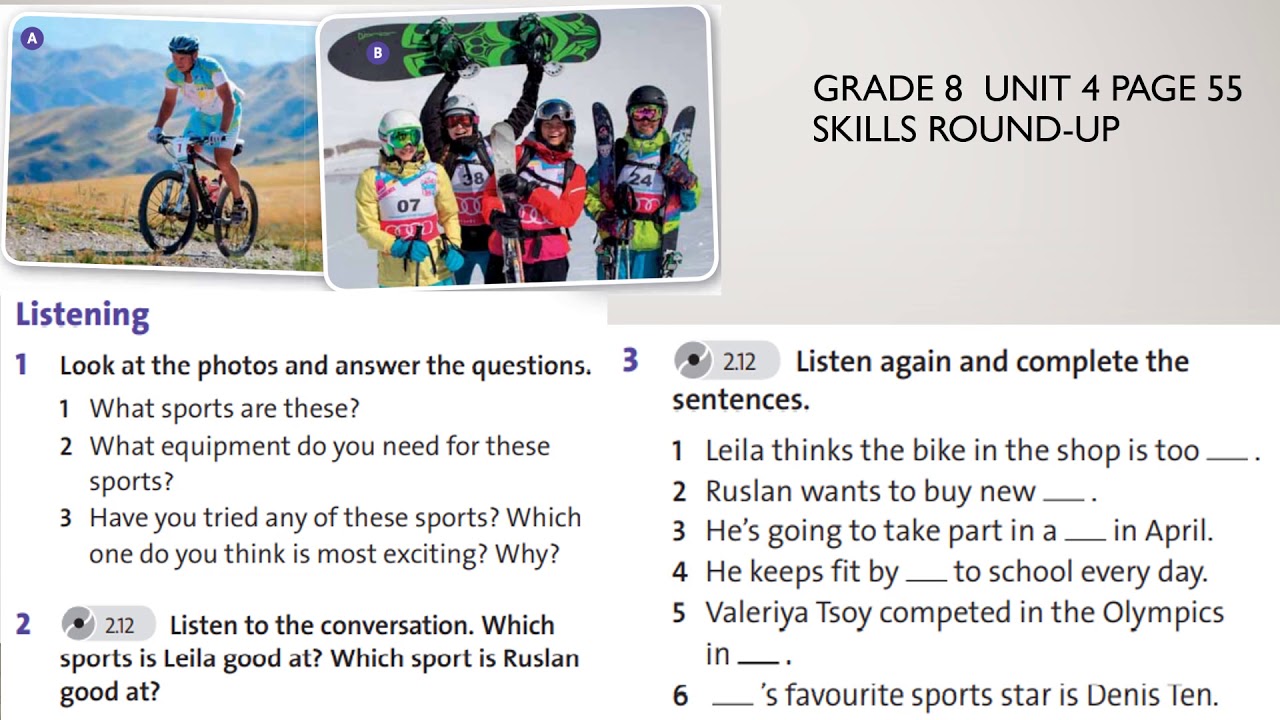









 Бұл курс Қазақстан Республикасы Оқу-ағарту министрлігімен келісілген