ЖИ көмекші


 Қауіпсіз төлем

жүктеу мүмкіндігіне ие боласыз
Бұл материал сайт қолданушысы жариялаған. Материалдың ішінде жазылған барлық ақпаратқа жауапкершілікті жариялаған қолданушы жауап береді. Ұстаз тілегі тек ақпаратты таратуға қолдау көрсетеді. Егер материал сіздің авторлық құқығыңызды бұзған болса немесе басқа да себептермен сайттан өшіру керек деп ойласаңыз осында жазыңыз
 17 Ақпан 2026
 28
28
1 жыл бойы шексіз жүктеңіз
A scientific video review (physics, biology, economics)
Бекітемін:
Директордың оқу жұмысы
жөніндегі орынбасары:
_________Қадырова А.С.
Short term plan
|
Unit 2: A scientific video review (physics, biology, economics) |
Lesson 32 |
|
|
Teacher name: Kabdulova Venera |
|
|
|
Date: |
||
|
Group: |
Number present: |
absent: |
|
Lesson title |
Energy X |
|
|
Learning objectives |
10.2.1.1 - understand the main points in unsupported extended talk on a wide range of general and curricular topics, including talk on a limited range of unfamiliar topics; 10.3.5.1 - interact with peers to make hypotheses about a wide range of general and curricular topics ; 10.5.3.1 - write with grammatical accuracy on a range of familiar general and curricular topics; |
|
|
Lesson objectives (assessment criteria) |
Learners will be able to: - Understand and use vocabulary related to natural disasters. - Identify main ideas and specific details from the text. - Discuss causes and effects of natural disasters. |
|
|
Instilling values of the program “Birtutas tarbiye” |
Independence and Patriotism Unity and Solidarity Justice and Responsibility |
|
|
Stages/ Time |
Teachers actions |
Students actions |
Assessment |
Resources |
|
Beginning 5 min |
Greeting. T tells the class to make groups of 2. Warm up: - Show a photo/video of an earthquake. - Ask: What do you see? What natural disaster is this? -
Brainstorm: What other natural disasters do you know? (volcano,
flood, tsunami, tornado, etc.) Pre-Reading Teach key vocabulary (e.g., tremor, magnitude, fault line, destruction, survivor). Quick matching activity: Students match words to definitions. |
Learners read the given sentences on the board and guess the topic and share with their ideas. Remember and recognize the main vocabulary. |
Teacher evaluate pupils with phrases like: “Good job! Well done!” Formative Assessment
|
Short text about mythical monsters (e.g., Loch Ness Monster, Bigfoot). Progress check worksheet with: Vocabulary task (matching or gap-fill) Grammar task (past simple, modals of speculation, passive voice) |
|
Middle 10 min |
Ex: 1 P:21 Pre-Listening Preparation Play the recording once for general understanding. Highlight any difficult words or phrases and model their pronunciation. Choral Repetition Play the recording in small segments and pause after each segment. Ask students to repeat chorally. Monitor students and correct common pronunciation errors immediately. Individual Practice Play the segment again and ask individual students to repeat it. Give feedback on intonation, stress, and pronunciation. Peer Check (Optional) Ask students to practice in pairs, listening to each other and giving gentle corrections. Value Link: Reinforce cooperation, respect, and open-mindedness—listening to peers and explaining reasoning politely promotes ethical communication. |
Students listen and say Answers: Student’s own answer
Descriptor: - words pronounced correctly - speaks smoothly with natural rhythm |
Excellent (3) - Actively participates in choral and individual practice Good (2) - Participates occasionally; limited practice |
Student’s book |
|
7 min |
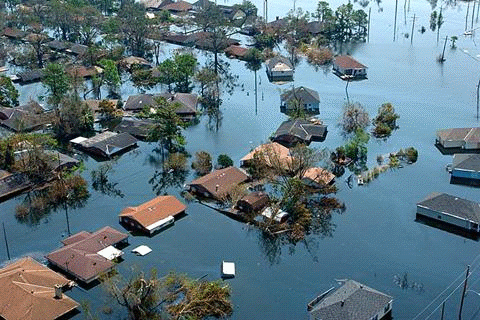
Ex: 2 a P:21 Task Introduction Tell students: “We are going to look at pictures of natural disasters and complete sentences describing them. Then we will match the sentences to the correct disaster.” Explain that this activity will help them connect vocabulary with images and context. Pre-Task Preparation Display the pictures of natural disasters and check that students know the key vocabulary. Go through one example sentence together as a model. Pair Work Ask students to work in pairs. Give them time to: Look at each picture. Complete the sentences based on what they see. Match each completed sentence to the correct disaster. Whole-Class Feedback Ask pairs to share their answers with the class. Confirm correct matches and correct any misunderstandings. Value Link: Celebrate honesty and encouragement—acknowledging effort teaches students that trying their best and supporting classmates is important. |
Students look at the natural disasters in the pictures and complete the sentences then match the disasters Answers: 1 burnt 2 rescued 3 caused 4 erupted 5 hit Descriptor: - sentences completed correctly with appropriate vocabulary - sentences correctly matched to the corresponding disasters - correct and precise use of natural disaster vocabulary |
Excellent (2) - All sentences completed correctly with appropriate vocabulary Good (1) - Most sentences completed correctly; minor errors |
Worksheets |
|
10 min |
Ex: 2 b P:21 Introduction Briefly remind students of the natural disasters from the pictures/text. Write two guiding questions on the board: What do you know about this disaster? How did it make you feel / how do you think the people involved felt? Pair Work Ask students to work in pairs. Instruct them to take turns describing: What they know about the disaster (facts, examples, personal knowledge). Their own feelings and empathy toward people involved. Encourage them to use descriptive words for feelings (e.g., scared, shocked, worried, sad, hopeful). Monitoring (throughout pair work) Move around the classroom, listening to pairs. Prompt quieter students with simple questions if necessary. Note good vocabulary or expressions for feedback later. Reporting Back Select a few pairs to share their discussion with the whole class. Ask follow-up questions to encourage deeper thinking (e.g., What can people do to stay safe during such disasters?). Value Link: Highlight diligence and perseverance—trying the task independently shows self-discipline and courage to face challenges. |
Students discuss with your partner. Answer the questions Answers: I heard about the earthquake and tsunami in 2011. I felt very sad for the people who died and the survivors who lost their loved ones and their homes. I think the people in Japan also felt very sad. In this year in Turkey was the earthquake. Many of people and children died. They lost their family and homes. Descriptor: - Provides accurate information about the disaster - Uses a wide range of topic-related words - Speaks clearly and smoothly, with little hesitation. |
Excellent (3) - Provides accurate information about the disaster and gives detailed ideas about feelings and experiences. Good (2) - Provides some information and mentions feelings but lacks detail. |
Student’s book |
|
8 min |
Ex: 3 P:21 Pre-Listening Preparation Direct students’ attention to the pictures. Briefly elicit what they see in each picture to activate vocabulary and context. Teach or review any key words that might appear in the recording. First Listening (Global Understanding) Play the recording once without pausing. Ask students just to listen carefully and get a general idea. Second Listening (Focused Task) Play the recording again. Students listen carefully and try to match each extract with two appropriate pictures. Encourage them to take short notes (keywords, feelings, actions, etc.). Pair Check After listening, ask students to compare their answers in pairs or small groups. Encourage them to explain why they chose certain pictures. Value Link: Reinforce cooperation and respect—students learn to communicate politely, listen to each other, and value their partner’s ideas. |
Students listen to extract from two news reports. Answer: Extract 1 – D Extract 2 – B Descriptor: - matches extracts to the appropriate pictures. - uses key words/details from the recording to justify answers |
Excellent (2) - Correctly matches all extracts to the appropriate pictures. Good (1) - Matches most extracts correctly with minor errors. |
|
|
End 5 min |
Reflection: - What new words or phrases about interests did I learn today? - How well did I understand the text? - Which part of the reading was easiest for me? - Which part was most difficult? - How can I improve my reading skills when understanding texts about interests? |
Ss use their stickers to show their knowledge according to the lesson |
Poster |
|







 Бұл курс Қазақстан Республикасы Оқу-ағарту министрлігімен келісілген