
 ЖИ көмекші


жүктеу мүмкіндігіне ие боласыз
Бұл материал сайт қолданушысы жариялаған. Материалдың ішінде жазылған барлық ақпаратқа жауапкершілікті жариялаған қолданушы жауап береді. Ұстаз тілегі тек ақпаратты таратуға қолдау көрсетеді. Егер материал сіздің авторлық құқығыңызды бұзған болса немесе басқа да себептермен сайттан өшіру керек деп ойласаңыз осында жазыңыз
 17 Қазан 2020
 551
551
Affirmative and negative
Unit 2 Helping and heroes
Affirmative and negative School: Atameken
Date:
Teacher's name: Duisenbaeva Yrysgul
CLASS: 6 Number present: absent:
Lesson title
Language Focus.
Present Simple: affirmative and negative.
Learning objectives(s)
6.L1 understand a sequence of supported classroom instructions
6.S1 provide basic information about themselves and others at
sentence level on an increasing range of general topics ( p.23
Mind map)
6.W3 write with support factual descriptions at text level which
describe people, places and objects ( Facts and routine) p.23
6.L6 deduce meaning from context in short, supported talk on
an increasing range of general and curricular topics ( Ex.4 p.23)
6.C1 use speaking and listening skills to solve problems
creatively and cooperatively in groups ( Ex.3,5 p.23)
6.UE9 use simple present and simple past regular and irregular
forms to describe routines ,habits and states on a limited range of
familiar general and curricular topics
Lesson objectives
All learners will be able to:
Identify the theme, give the examples of Present Simple,
use active vocabulary speaking about lifestyle.
Transfer information from the book about grammar into a
graphic organizer.
Offer constructive peer-feedback using rubric.
Most learners will be able to:
Select, compile, and synthesize information from the
reading passage for an oral presentation.
Some learners will be able to:
Respond to and discuss the reading rules and texts using
interpretive, evaluative and creative thinking skills.
Level of thinking
Higher order thinking skills (according to the revised Bloom's
taxonomy).
Assessment criteria
Read the given rules and identify the general information.
Demonstrate skills of organizing and expressing ideas
accurately.
Illustrate a viewpoint in a discussion.
Target language routine, to happen ,carry, come from, cooking, food, comics.
Values links Appreciating people's healthy way of life
Cross-curricular links Art, Sport, Social Science
Previous learning Vocabulary related to people's lifestyle
Plan
Planned
timings
Planned activities (replace the notes below with
your planned activities)
Resources
Start
5min
The lesson greeting.
Slide (objectives)
The teacher sets the lesson objectives, letting students
know what to anticipate from the lesson.
Warm up.
Then to create a positive learning environment the
teachers asks students to start the lesson giving each
other compliments about appearance, job performance,
talent, etc. and also practice accepting compliments.
(E.g. - Hello, my friend, you speak English very well!
-That's very nice of you to say so.)
Slide (useful
phrases)
Main Activity
Brainstorming
Pre-learning
* Teacher suggests listening to a song as a warm-up
for the lesson.Learners sing Almaty Song and give
translation from Russian into English.
https://www.youtube.com/watch?v=ZuEZfr5_tTQ
* Learners are informed about the theme.
Hot Seat Game
One learner sits in front of the class. Teacher hands a
strip of a paper with the names of people Artur and
Sung from the previous lesson. The classmates should
say what they remember about Almaty by asking some
questions:
Whose grandparents come from Russia?
Whose parents come from Korea?
Do Artur or Sung like stories about family?
Who doesn't know his mother tongue?
Teacher elicits the knowledge of making question rule
and helps learners to remember the rules for making
questions. and affirmative sentences in the Present
Simple Tense.
To introduce Present Simple Tense related to
people's life.
Ex1. p.23( Complete from the text).
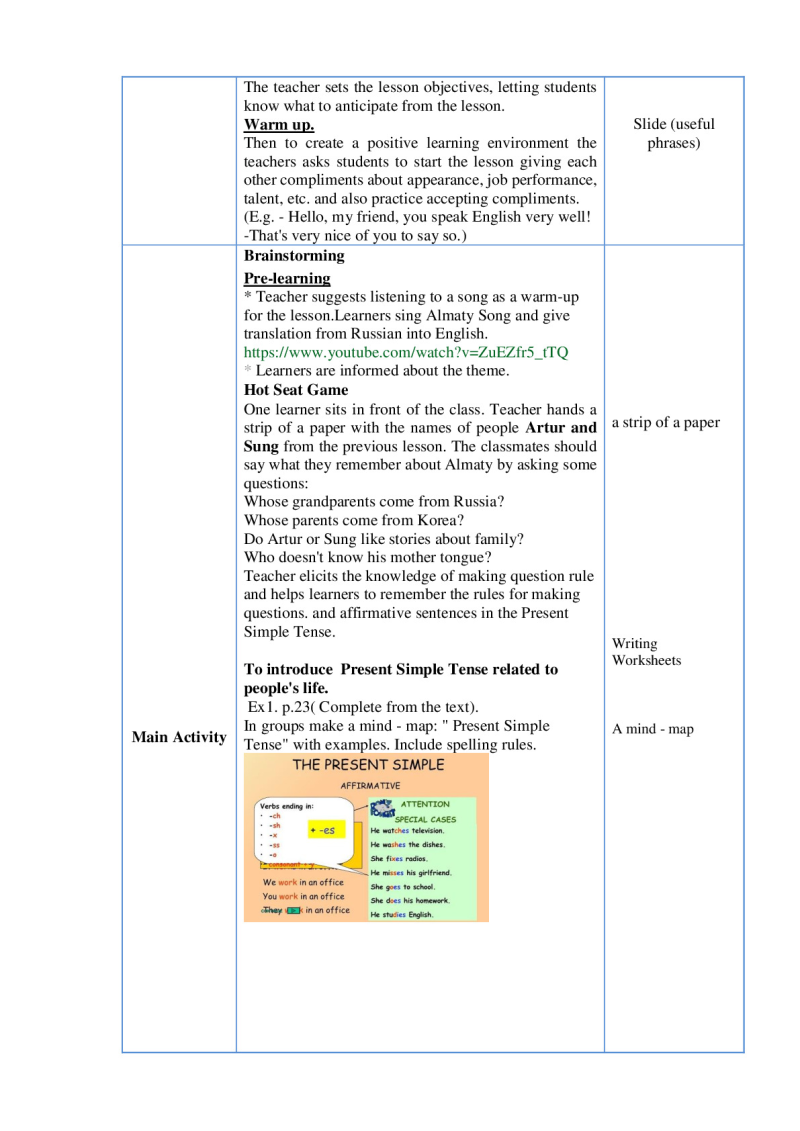
In groups make a mind - map: " Present Simple
Tense" with examples. Include spelling rules.
a strip of a paper
Writing
Worksheets
A mind - map
Middle part
Students give presentations of their mind - maps,
explain how we form Present Simple affirmative and
negative.
Ex. 2 - 4 p.23
To consolidate information from a text Ex.4 and
speak about your family:
I live in Almaty, but my family comes from......
Speak about your likes and dislikes and fill in a table:
Affirmative sentences Negative sentences
I like playing chess. I don't go in for sport
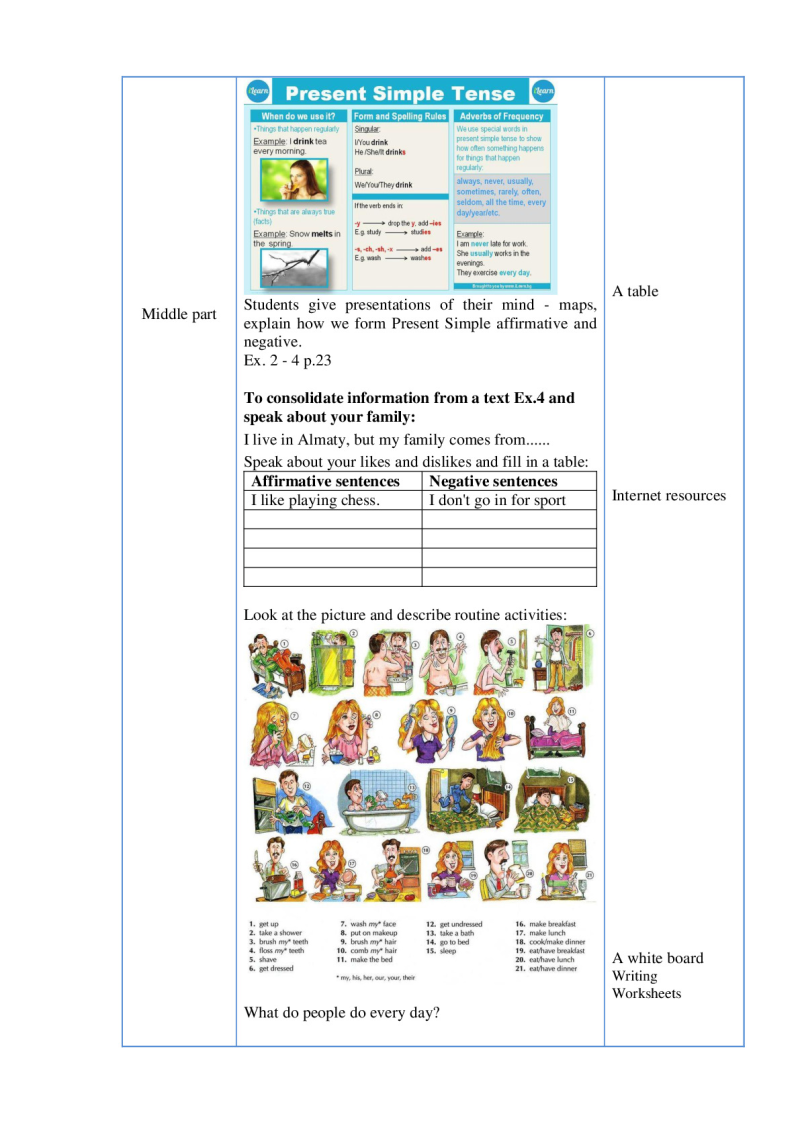
Look at the picture and describe routine activities:
What do people do every day?
A table
Internet resources
A white board
Writing
Worksheets
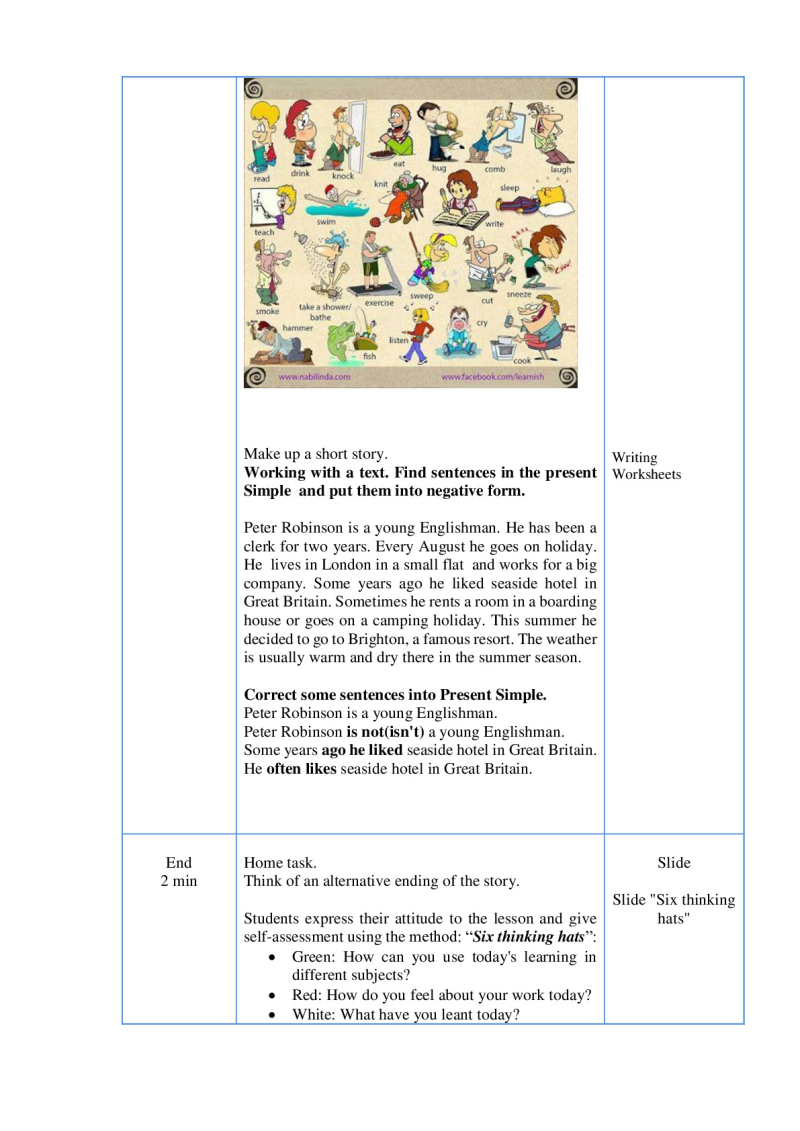
Make up a short story.
Working with a text. Find sentences in the present
Simple and put them into negative form.
Peter Robinson is a young Englishman. He has been a
clerk for two years. Every August he goes on holiday.
He lives in London in a small flat and works for a big
company. Some years ago he liked seaside hotel in
Great Britain. Sometimes he rents a room in a boarding
house or goes on a camping holiday. This summer he
decided to go to Brighton, a famous resort. The weather
is usually warm and dry there in the summer season.
Correct some sentences into Present Simple.
Peter Robinson is a young Englishman.
Peter Robinson is not(isn't) a young Englishman.
Some years ago he liked seaside hotel in Great Britain.
He often likes seaside hotel in Great Britain.
P
Writing
Worksheets
End
2 min
Home task.
Think of an alternative ending of the story.
Students express their attitude to the lesson and give
self-assessment using the method: “Six thinking hats”:
Green: How can you use today's learning in
different subjects?
Red: How do you feel about your work today?
White: What have you leant today?
Slide
Slide "Six thinking
hats"
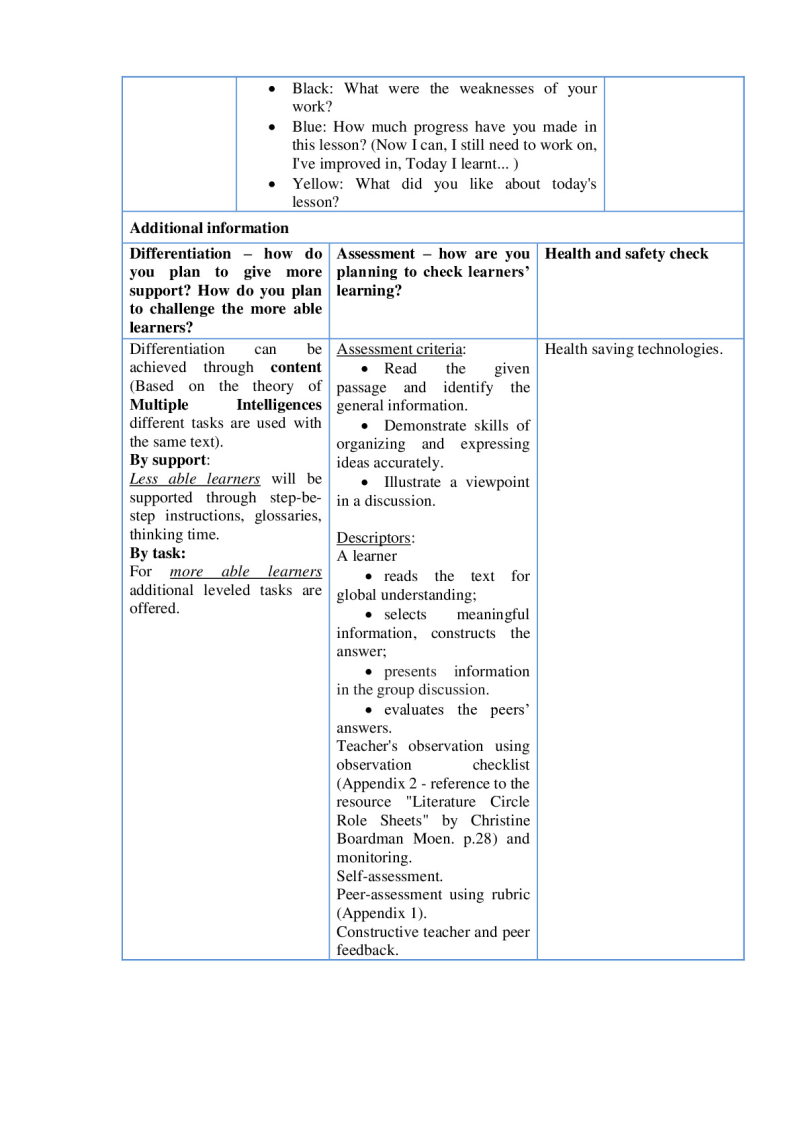
Black: What were the weaknesses of your
work?
Blue: How much progress have you made in
this lesson? (Now I can, I still need to work on,
I've improved in, Today I learnt... )
Yellow: What did you like about today's
lesson?
Additional information
Differentiation – how do
you plan to give more
support? How do you plan
to challenge the more able
learners?
Assessment – how are you
planning to check learners’
learning?
Health and safety check
Differentiation can be
achieved through content
(Based on the theory of
Multiple Intelligences
different tasks are used with
the same text).
By support:
Less able learners will be
supported through step-be-
step instructions, glossaries,
thinking time.
By task:
For more able learners
additional leveled tasks are
offered.
Assessment criteria:
Read the given
passage and identify the
general information.
Demonstrate skills of
organizing and expressing
ideas accurately.
Illustrate a viewpoint
in a discussion.
Descriptors:
A learner
reads the text for
global understanding;
selects meaningful
information, constructs the
answer;
presents information
in the group discussion.
evaluates the peers’
answers.
Teacher's observation using
observation checklist
(Appendix 2 - reference to the
resource "Literature Circle
Role Sheets" by Christine
Boardman Moen. p.28) and
monitoring.
Self-assessment.
Peer-assessment using rubric
(Appendix 1).
Constructive teacher and peer
feedback.
Health saving technologies.


 Жүктеу


 Жүктеу
шағым қалдыра аласыз

 Бұл курс Қазақстан Республикасы Оқу-ағарту министрлігімен келісілген










