
 ЖИ көмекші


жүктеу мүмкіндігіне ие боласыз
Бұл материал сайт қолданушысы жариялаған. Материалдың ішінде жазылған барлық ақпаратқа жауапкершілікті жариялаған қолданушы жауап береді. Ұстаз тілегі тек ақпаратты таратуға қолдау көрсетеді. Егер материал сіздің авторлық құқығыңызды бұзған болса немесе басқа да себептермен сайттан өшіру керек деп ойласаңыз осында жазыңыз
 20 Қазан 2020
 820
820
Asking for a giving opinions

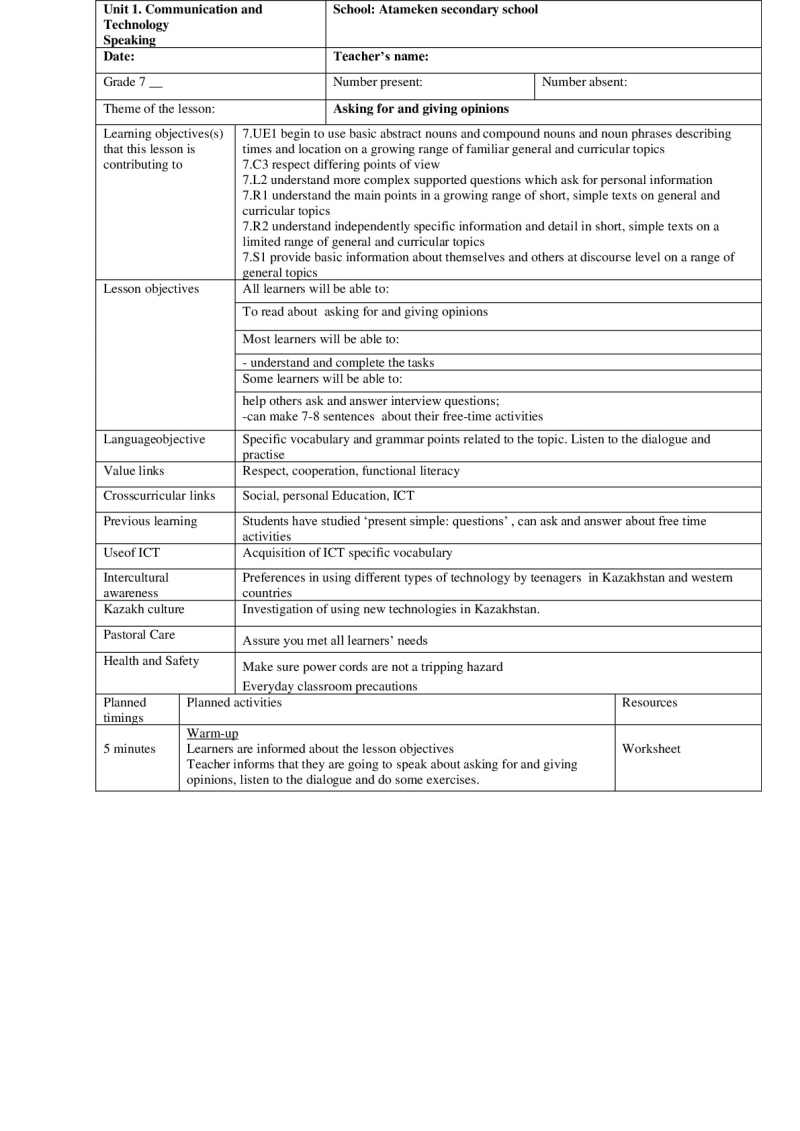
Unit 1. Communication and
Technology
Speaking
School: Atameken secondary school
Date: Teacher’s name:
Grade 7 __ Number present: Number absent:
Theme of the lesson: Asking for and giving opinions
Learning objectives(s)
that this lesson is
contributing to
7.UE1 begin to use basic abstract nouns and compound nouns and noun phrases describing
times and location on a growing range of familiar general and curricular topics
7.C3 respect differing points of view
7.L2 understand more complex supported questions which ask for personal information
7.R1 understand the main points in a growing range of short, simple texts on general and
curricular topics
7.R2 understand independently specific information and detail in short, simple texts on a
limited range of general and curricular topics
7.S1 provide basic information about themselves and others at discourse level on a range of
general topics
Lesson objectives All learners will be able to:
To read about asking for and giving opinions
Most learners will be able to:
- understand and complete the tasks
Some learners will be able to:
help others ask and answer interview questions;
-can make 7-8 sentences about their free-time activities
Languageobjective Specific vocabulary and grammar points related to the topic. Listen to the dialogue and
practise
Value links Respect, cooperation, functional literacy
Crosscurricular links Social, personal Education, ICT
Previous learning Students have studied ‘present simple: questions’ , can ask and answer about free time
activities
Useof ICT Acquisition of ICT specific vocabulary
Intercultural
awareness
Preferences in using different types of technology by teenagers in Kazakhstan and western
countries
Kazakh culture Investigation of using new technologies in Kazakhstan.
Pastoral Care
Assure you met all learners’ needs
Health and Safety
Make sure power cords are not a tripping hazard
Everyday classroom precautions
Planned
timings
Planned activities Resources
5 minutes
Warm-up
Learners are informed about the lesson objectives
Teacher informs that they are going to speak about asking for and giving
opinions, listen to the dialogue and do some exercises.
Worksheet
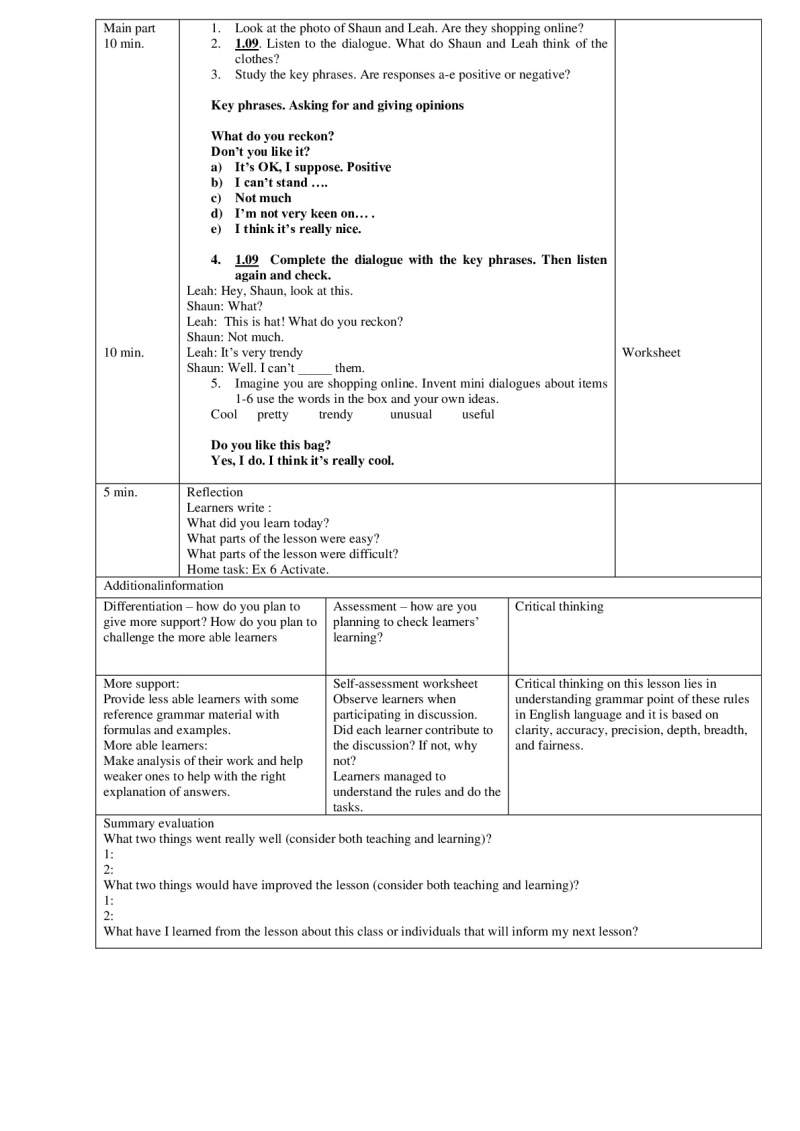
Main part
10 min.
10 min.
1. Look at the photo of Shaun and Leah. Are they shopping online?
2. 1.09. Listen to the dialogue. What do Shaun and Leah think of the
clothes?
3. Study the key phrases. Are responses a-e positive or negative?
Key phrases. Asking for and giving opinions
What do you reckon?
Don’t you like it?
a) It’s OK, I suppose. Positive
b) I can’t stand ….
c) Not much
d) I’m not very keen on… .
e) I think it’s really nice.
4. 1.09 Complete the dialogue with the key phrases. Then listen
again and check.
Leah: Hey, Shaun, look at this.
Shaun: What?
Leah: This is hat! What do you reckon?
Shaun: Not much.
Leah: It’s very trendy
Shaun: Well. I can’t _____ them.
5. Imagine you are shopping online. Invent mini dialogues about items
1-6 use the words in the box and your own ideas.
Cool pretty trendy unusual useful
Do you like this bag?
Yes, I do. I think it’s really cool.
Worksheet
5 min. Reflection
Learners write :
What did you learn today?
What parts of the lesson were easy?
What parts of the lesson were difficult?
Home task: Ex 6 Activate.
Additionalinformation
Differentiation – how do you plan to
give more support? How do you plan to
challenge the more able learners
Assessment – how are you
planning to check learners’
learning?
Critical thinking
More support:
Provide less able learners with some
reference grammar material with
formulas and examples.
More able learners:
Make analysis of their work and help
weaker ones to help with the right
explanation of answers.
Self-assessment worksheet
Observe learners when
participating in discussion.
Did each learner contribute to
the discussion? If not, why
not?
Learners managed to
understand the rules and do the
tasks.
Critical thinking on this lesson lies in
understanding grammar point of these rules
in English language and it is based on
clarity, accuracy, precision, depth, breadth,
and fairness.
Summary evaluation
What two things went really well (consider both teaching and learning)?
1:
2:
What two things would have improved the lesson (consider both teaching and learning)?
1:
2:
What have I learned from the lesson about this class or individuals that will inform my next lesson?


 Жүктеу


 Жүктеу
шағым қалдыра аласыз
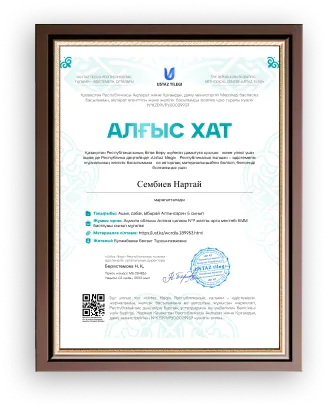

 Бұл курс Қазақстан Республикасы Оқу-ағарту министрлігімен келісілген










